Strottner-Drechsler 56 (StDr56) Goblet of Fire nebula
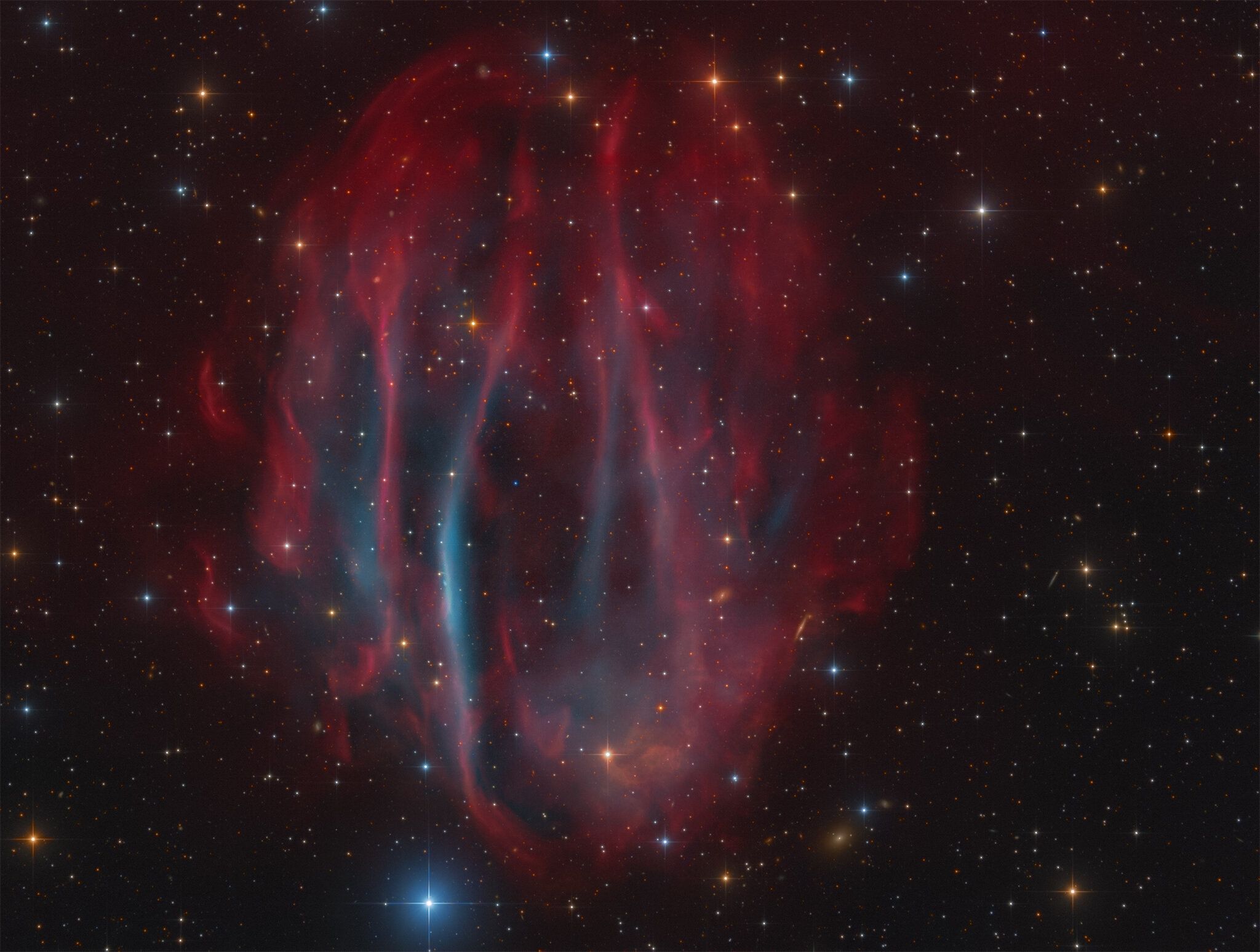
Image Description and Details :
StDr 56 / Goblet of Fire nebula (c) Robert Pölzl & Marcel Drechsler & Xavier Srottner
This probable new planetary nebula was discovered by my colleague Xavier Strottner and me in January 2020.
If the candidate is confirmed as a true planetary nebula, it will be the first planetary nebula ever discovered in the constellation Triangulum (Triangle).
Photo: StDr56 was photographed by the Austrian Robert Pölzl with a total exposure of 59 hours.
Image processing: Marcel Drechsler
At the center of the PN candidate is a potential white dwarf with a surface temperature of 35542 Kelvin and a distance of about 1130 light years to Earth. With an extension of 44 x 36 arc minutes, StDr56 is not only the largest probable PN in the region, but in the night sky it covers more than half of the area of the famous Triangulum Galaxy M33, which is located only a few degrees from Strottner-Drechsler 56.
Robert Pölzl collected 90 hours of exposure time in 21 nights from July to November 2020.
Out of these 90 hours, 30 hours had to be sorted out because of minimal cirrus and dew - leaving 59 hours at the end.
Coordinates: 02:07:17.41 +30:05:11.90 (J2000)
Name: Strottner-Drechsler 56, StDr56, PN-G: 141.8-29.9
Data:
58 x 30 min. H-alpha
41 x 30 min [OIII].
28 x 10 min. RGB each
Date: 31.7.2020 - 18.11.2020
Location: Observatory Hirschegg-Österreich
Optics: Lacerta Newton 10" f/4
Camera: Moravian G2 8300 at -30° - Baader filter
Copyright Information: Robert Pölzl & Marcel Drechsler & Xavier Srottner
Share & Credit This AAPOD2 Feature
When you share this image on AstroBin, social media, forums, or your own website, please include a credit to AAPOD2 so viewers can discover where this feature came from.
Support AAPOD2 for free! Use Our AGENA ASTRO Affliate Link
AAPOD2 Title: Strottner-Drechsler 56 (StDr56) Goblet of Fire nebula
AAPOD2 Page Link: https://www.aapod2.com/blog/6mg8iis30k4notb5j8nbbm46odn56a
Submit Your Photo!