0
Skip to Content
AAPOD2.COM
Home
Image Archives
All 2026 Images
All 2025 Images
All 2024 Images
All 2023 Images
All 2022 Images
All 2021 Images
All 2020 Images
All archived images
Image Submission
Blog
Donate
Support
AAPOD2.COM
Home
Image Archives
All 2026 Images
All 2025 Images
All 2024 Images
All 2023 Images
All 2022 Images
All 2021 Images
All 2020 Images
All archived images
Image Submission
Blog
Donate
Support
Home
Folder: Image Archives
Back
Image Archives
All 2026 Images
All 2025 Images
All 2024 Images
All 2023 Images
All 2022 Images
All 2021 Images
All 2020 Images
All archived images
Image Submission
Blog
Donate
Support


Featured
Two unique planetary nebulae in Cygnus,MWP1 Alves1
September 11, 2026
Two unique planetary nebulae in Cygnus,MWP1 Alves1
September 11, 2026

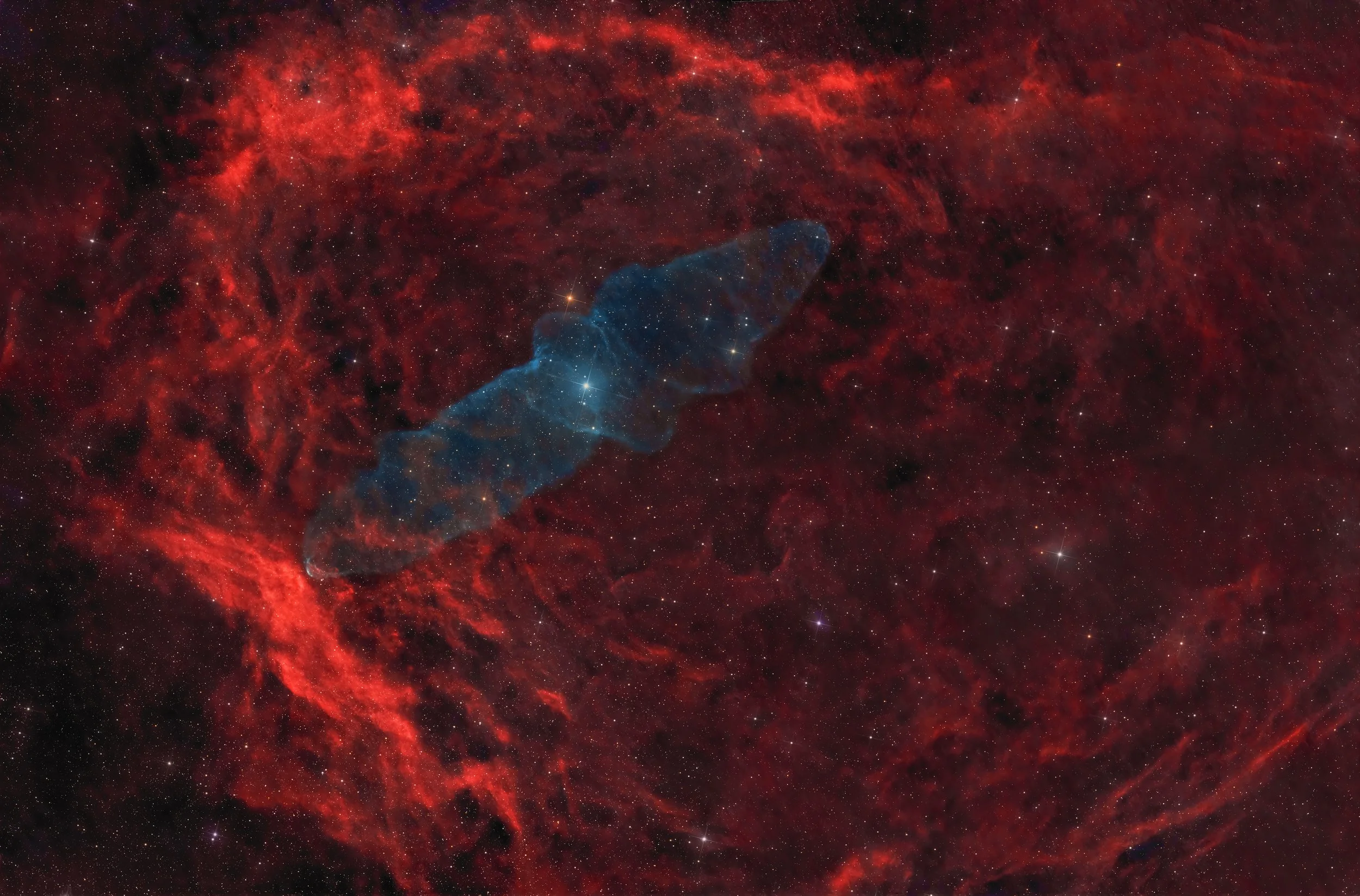
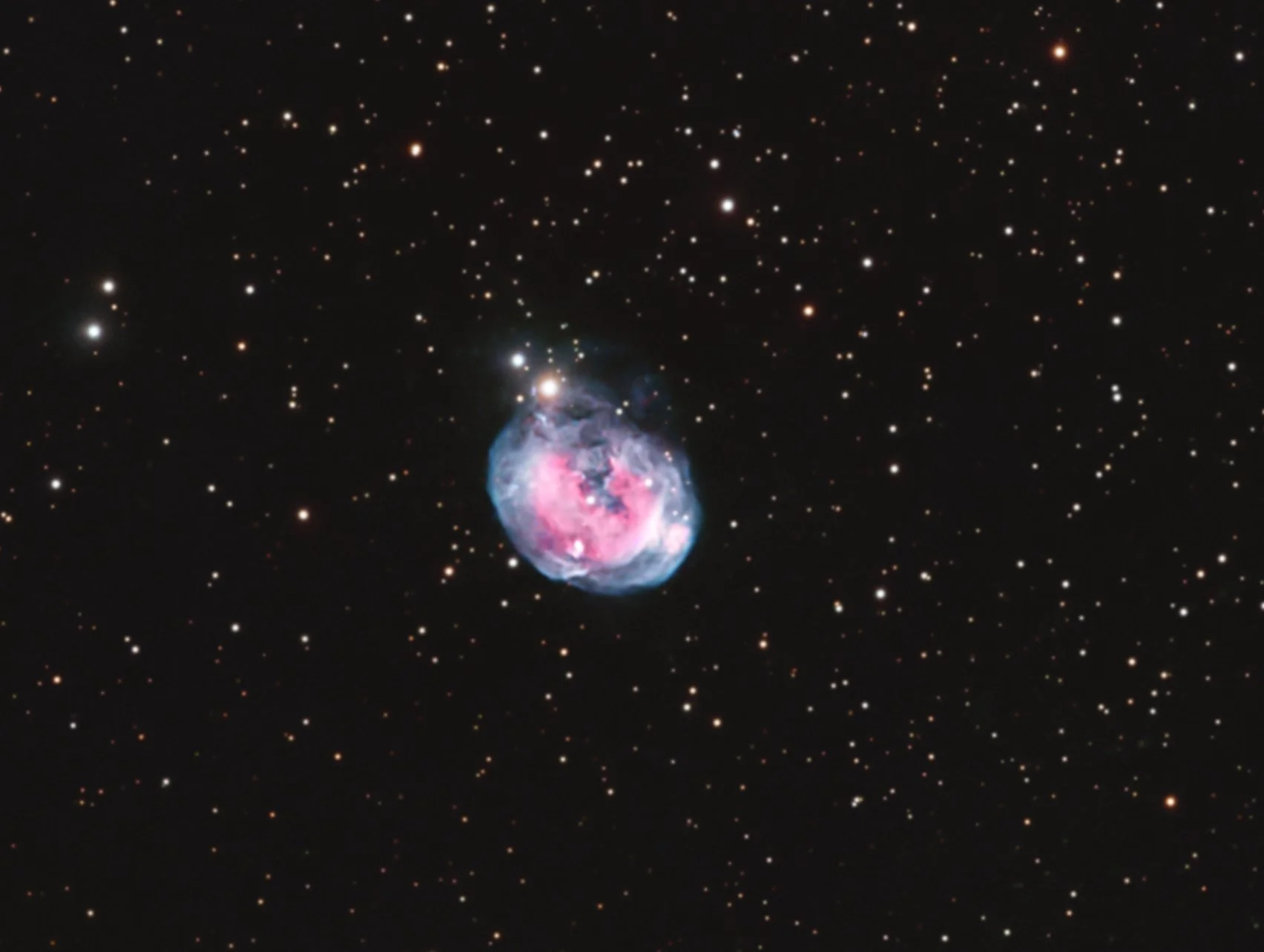
MWP1, the most famous and oldest, discovered only in 1993, is a faint bipolar planetary nebula also known as "Methuselah." At the bottom right, discovered almost by accident only in 2009 while photographing MWP1, is Alves1, a classic small planetary nebula with a rounded shape. HOO palette

Read more →
September 11, 2026
NGC 6164/6165 — The Dragon’s Egg Nebula
September 10, 2026
Daniel Stern
NGC 6164/6165 — The Dragon’s Egg Nebula
September 10, 2026
Daniel Stern

NGC 6164, often referred to as the Dragon's Egg Nebula, is a striking bipolar emission nebula located approximately 4,200 light-years away in the southern constellation Norma. Spanning roughly 4 light-years across, this cosmic structure is characterized by its intricate, reverse-S shaped glowing lobes created by high-speed stellar winds streaming outward at speeds up to 8 million kilometers per hour. Expanding beyond its bright central core is a faint, majestic outer halo of gas, thrown into interstellar space by explosive outbursts thousands of years ago.

Read more →
September 10, 2026
Daniel Stern
The Glowing Beauty of Andromeda
September 9, 2026
Gianmaria Veronese
The Glowing Beauty of Andromeda
September 9, 2026
Gianmaria Veronese
Read more →
September 9, 2026
Gianmaria Veronese
Mineral Moon
September 8, 2026
Mineral Moon
September 8, 2026

A Mineral Moon photo is a color-enhanced astrophotograph of the lunar surface that reveals variations in the Moon's geological composition.

While the Moon appears monochromatic grey to the naked eye, its surface material (regolith) reflects light at slightly different wavelengths based on its chemical elements. Standard color cameras capture these subtle color differences, but human eyes cannot perceive them due to their low intensity. By stacking multiple frames to reduce visual noise and gradually boosting color saturation during post-processing, astrophotographers bring out these underlying hues.

Read more →
September 8, 2026
Tarantula Nebula — Threads of Fire in the Large Magellanic Cloud
September 7, 2026
Fernando Marana de Alencar
Tarantula Nebula — Threads of Fire in the Large Magellanic Cloud
September 7, 2026
Fernando Marana de Alencar

Glowing across a complex web of luminous filaments and dark cosmic dust, the energetic Tarantula Nebula (30 Doradus) shines brightly within the Large Magellanic Cloud. Located roughly 160,000 light-years away, this giant stellar nursery is powered by intense radiation and stellar winds from the massive young star cluster R136 at its core, carving vast cavities and glowing clouds into the interstellar medium of our neighboring galaxy.

Read more →
September 7, 2026
Fernando Marana de Alencar
Kepheus - Dark Shark & Wolf' Cave
September 6, 2026
Dr. Arndt Wolkenhauer
Kepheus - Dark Shark & Wolf' Cave
September 6, 2026
Dr. Arndt Wolkenhauer

Drifting through the northern constellation Cepheus, a vast cosmic landscape reveals two striking dark nebulae: LDN 1235 (the "Dark Shark Nebula") and the surrounding Wolf's Cave region (LDN 1217 and Barnard 175). Dense, opaque clouds of interstellar dust block out the light of background stars, while embedded reflection nebulae scatter faint blue light from nearby stellar neighbors, highlighting the intricate dust lanes threading through interstellar space.

Read more →
September 6, 2026
Dr. Arndt Wolkenhauer
NGC 281 Pacman nebula
September 5, 2026
Claudio Antinoro
NGC 281 Pacman nebula
September 5, 2026
Claudio Antinoro

Glowing with bright ionized oxygen and cosmic dust, the iconic Pacman Nebula (NGC 281) shines in the northern constellation Cassiopeia. Situated roughly 9,500 light-years away, this active H II region and stellar nursery features dense Bok globules and intricate gas structures sculpted by intense radiation from newborn stars at its core.

Read more →
September 5, 2026
Claudio Antinoro
The Dusty Heart of Scorpius
September 4, 2026
Piotr Czerski
The Dusty Heart of Scorpius
September 4, 2026
Piotr Czerski

A vibrant mosaic of interstellar dust and glowing starfields, the dusty heart of Scorpius centers on the majestic supergiant Antares. Golden reflection nebulae cast a warm glow across intricate cosmic dust lanes, anchored nearby by the ancient stellar swarm of the Messier 4 (M4) globular cluster. Surrounding blue and red emission clouds frame this active cosmic nursery, illustrating one of the most colorful regions in the night sky.

Read more →
September 4, 2026
Piotr Czerski
M27
September 3, 2026
PRO’ GIACOMO
M27
September 3, 2026
PRO’ GIACOMO

At the heart of the constellation of Volpetta, about 1,200 light-years from Earth, lies M27, the Manubrio Nebula, one of the most famous and spectacular planetary nebulae in the summer sky. Discovered by Charles Messier in 1764, it is the result of the last evolutionary phase of a star similar to our own.

Read more →
September 3, 2026
PRO’ GIACOMO
IC 5068
September 2, 2026
Chris Gaudy
IC 5068
September 2, 2026
Chris Gaudy

IC 5068 is an emission nebula located in the constellation Cygnus near the North America and Pelican nebulae, characterized by sweeping, vibrant gas formations interwoven with dark, light-blocking dust lanes. Captured using a traditional SHO (Sulfur II, Hydrogen-alpha, Oxygen III) narrowband processing technique by astrophotographer Chris Gaudy on August 5, 2026.

Read more →
September 2, 2026
Chris Gaudy
NGC 7048 - Not your typical ring nebula
September 1, 2026
Nicola Valentini
NGC 7048 - Not your typical ring nebula
September 1, 2026
Nicola Valentini

NGC 7048 is a planetary nebula situated approximately 6,000 light-years away in the constellation Cygnus. Glowing with an apparent magnitude of around 12.1 and spanning roughly 60 to 62 arcseconds in diameter, it exhibits a distinct asymmetrical shell created by gas expanding outward from a central white dwarf remnant. Its complex physical structure features a prominent, bright hydrogen outer envelope wrapped around delicate, highly ionized oxygen filaments, standing apart from typical circular ring nebulae and making it a captivating object for deep-sky astronomical observation.

Read more →
September 1, 2026
Nicola Valentini
Seahorse Nebula
August 31, 2026
Jordi Compt
Seahorse Nebula
August 31, 2026
Jordi Compt

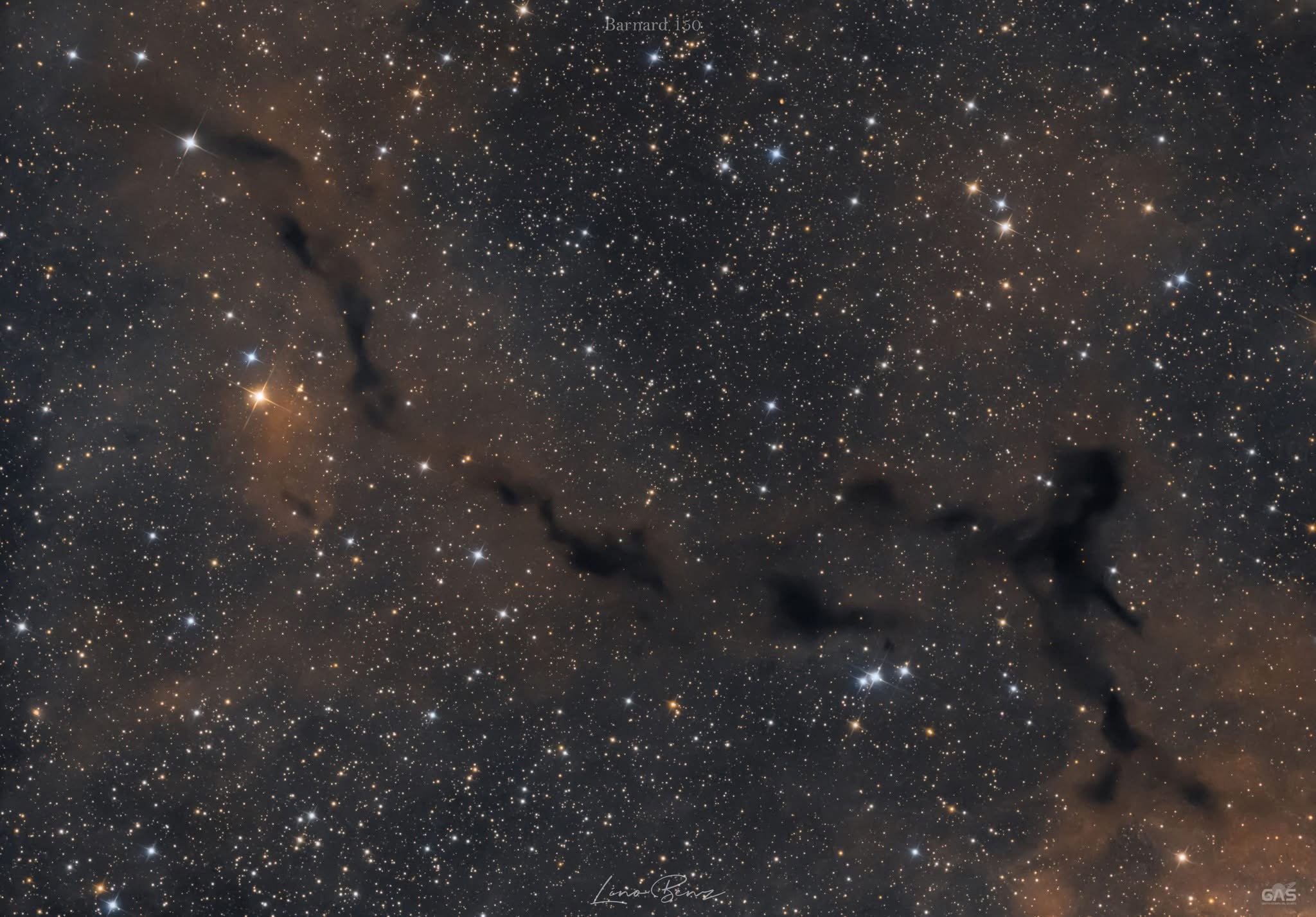
The Seahorse Nebula (Barnard 150) region, captured under Bortle 5 skies in Tona, Spain. Barnard 150 is a striking dark molecular cloud located in the constellation Cepheus, weaving its dark dust lanes across a rich background of faint reddish Hydrogen-alpha emission and background stars. The image was taken using a Sky-Watcher Esprit 80 f/5 refractor mounted with a ZWO ASI2600 monochrome camera and Baader filters. Total integration time combines 11 hours 35 minutes of H-alpha data (May 27 and June 7), 13 hours 7 minutes of Luminance data (July 8, 11, and 12), and 8 hours 44 minutes of RGB data (July 26–28).

Read more →
August 31, 2026
Jordi Compt
M83, The Southern Pinwheel Galaxy
August 30, 2026
Aldo Zanett
M83, The Southern Pinwheel Galaxy
August 30, 2026
Aldo Zanett

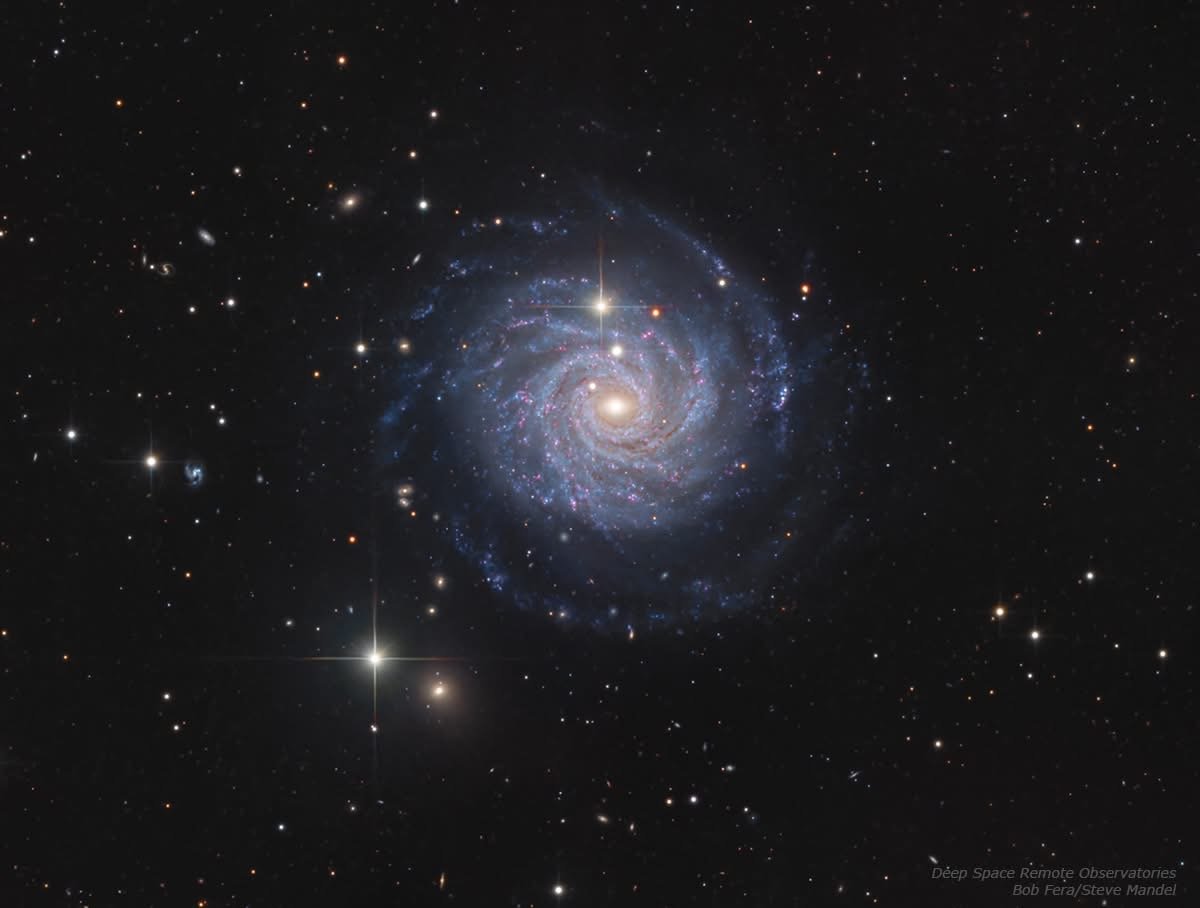
The spiral galaxy Messier 83 is located in the southern constellation Hydra and is also known as NGC 5236 and as the Southern Pinwheel galaxy. Its distance is about 15 million light-years. Being about twice as small as the Milky Way, its size on the sky is 11x10 arcmin. It was discovered by French astronomer Nicholas Louis de Lacaille in 1752.
The image was taken with the 1 meter telescope at Chilescope, with a FLI Proline 16803 CCD and processed by Pixinsight.

Read more →
August 30, 2026
Aldo Zanett
The Double Cluster
August 29, 2026
Colm O'Dwyer
The Double Cluster
August 29, 2026
Colm O'Dwyer

This is the Double Cluster (NGC 869 and NGC 884), one of the most beautiful star clusters to view with your eyes, but it also sparkles when imaged. One of the most appealing aspects aside from the two clusters, is the characteristics difference in star colors, ranging from white/blue hot stars, the B0 cream-colored stars, huge red giants and orange suns. In this field of view, the swath of background emission from ionized hydrogen alpha shows how rich this area of sky really is.

Read more →
August 29, 2026
Colm O'Dwyer
LDN 1251 – The Rotting Fish Dark Nebula
August 28, 2026
Colm O'Dwyer
LDN 1251 – The Rotting Fish Dark Nebula
August 28, 2026
Colm O'Dwyer

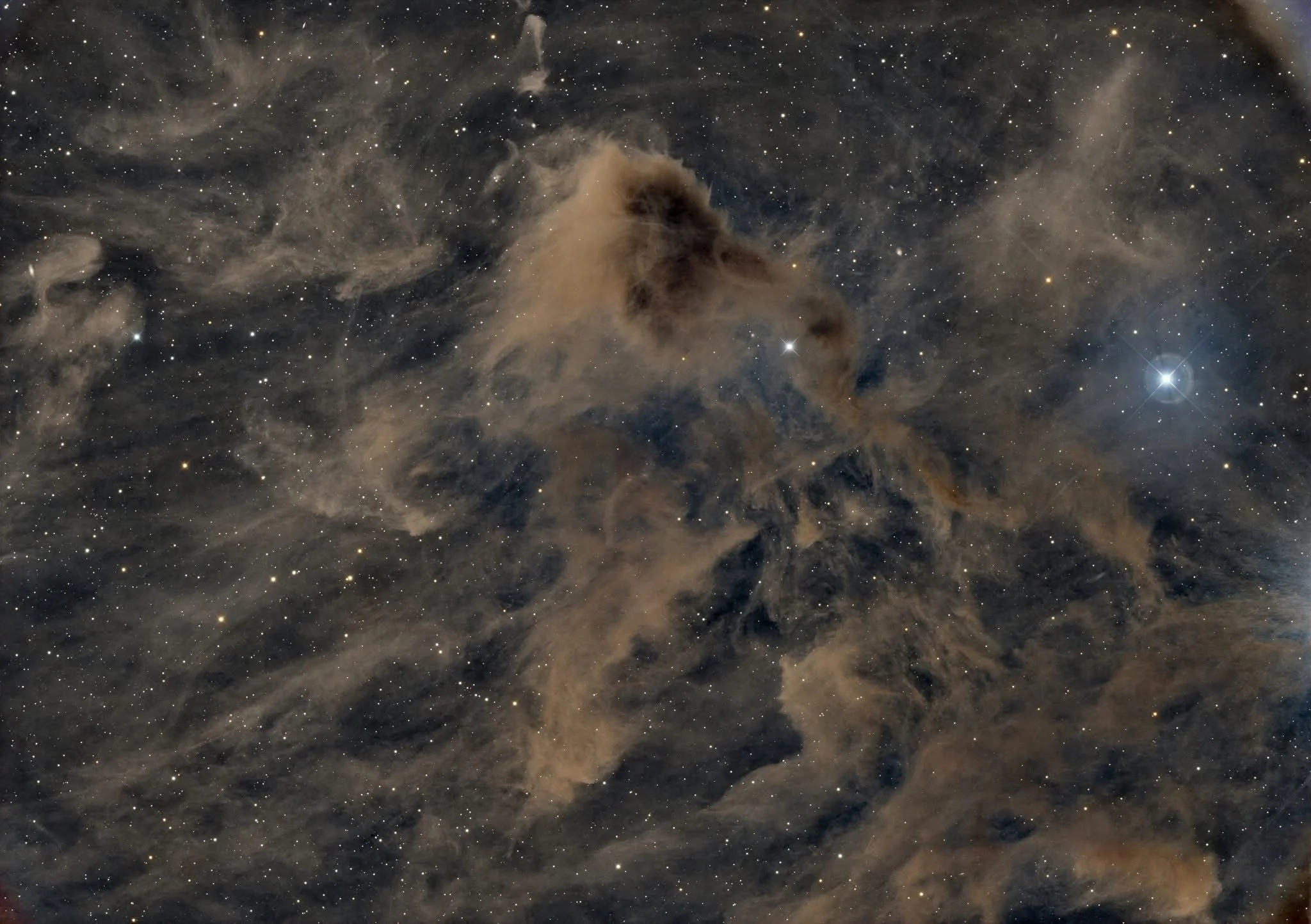
A striking portrait-orientation capture of LDN 1251, the Rotting Fish Dark Nebula, located roughly 1,000 light-years away in the constellation Cepheus. Imaged under Bortle 7 suburban skies in Cork, Ireland, this fast f/2.8 deep-sky integration reveals the intricate structures of dense interstellar dust, active star-forming molecular clouds, and surrounding background field stars.

Read more →
August 28, 2026
Colm O'Dwyer
The Cocoon Nebula (IC 5146) in Widefield
August 27, 2026
The Cocoon Nebula (IC 5146) in Widefield
August 27, 2026

Glowing amidst a dense field of Milky Way stars in the constellation Cygnus, the Cocoon Nebula (IC 5146) showcases a striking interplay of stellar formation and cosmic dust. Located approximately 2,500 light-years away, this target combines an emission nebula ionized by a young, hot central B-type star with vibrant surrounding reflection nebulosity.

By blending Hydrogen-alpha (Ha) narrowband data into standard RGB exposures, the deep pink and red emission filaments within the core are brought out in rich detail without sacrificing the natural color of the surrounding field stars. Extending outward from the bright core is Barnard 168, a massive, light-blocking dark nebula that carves a dramatic silhouette through the crowded star field, tracing the rich lane of interstellar dust from which new stars continue to emerge.

Read more →
August 27, 2026
MWP1 and ALV1: Ancient Planetary Nebulae in Cygnus
August 26, 2026
Alexandros Filothodoros
MWP1 and ALV1: Ancient Planetary Nebulae in Cygnus
August 26, 2026
Alexandros Filothodoros

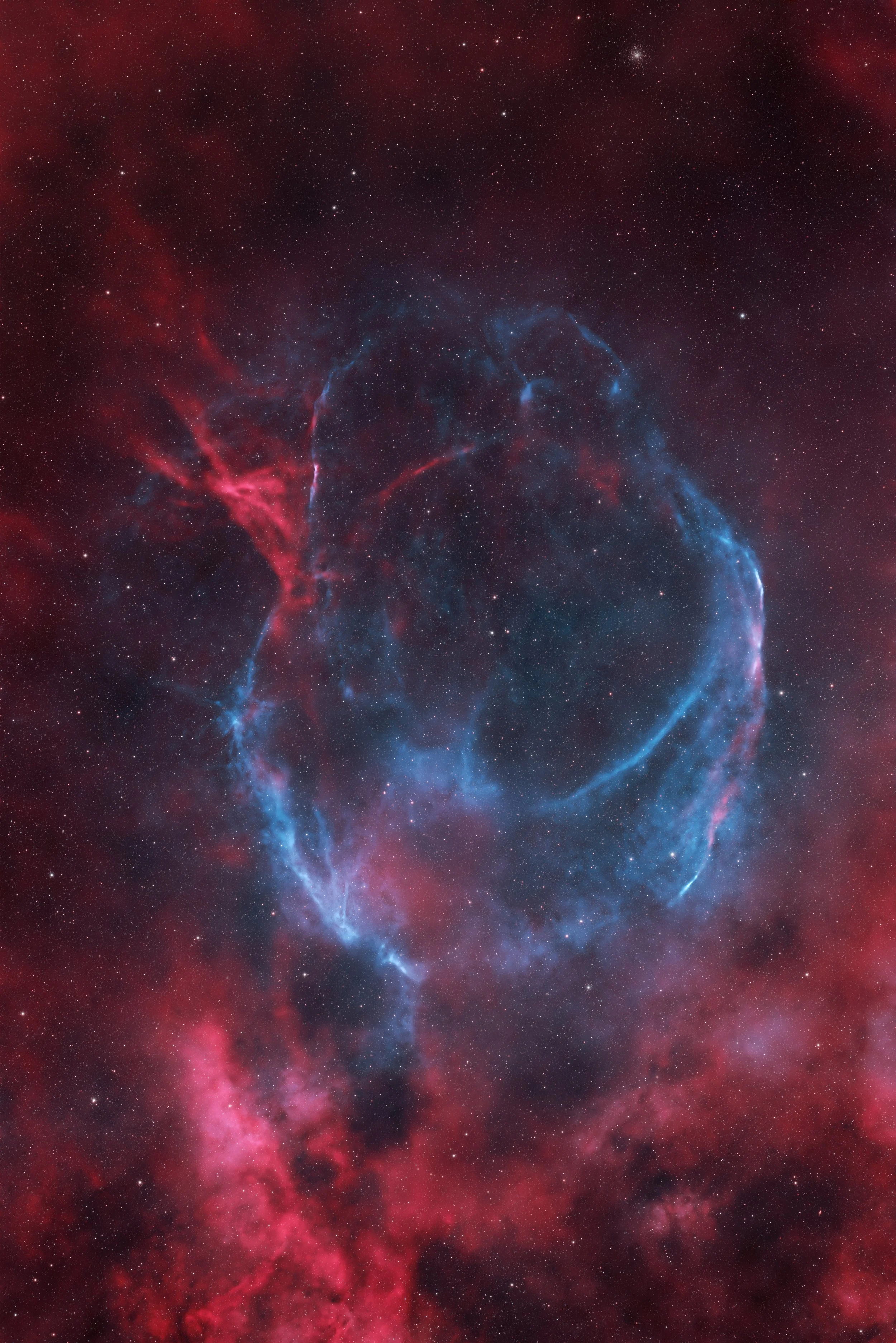
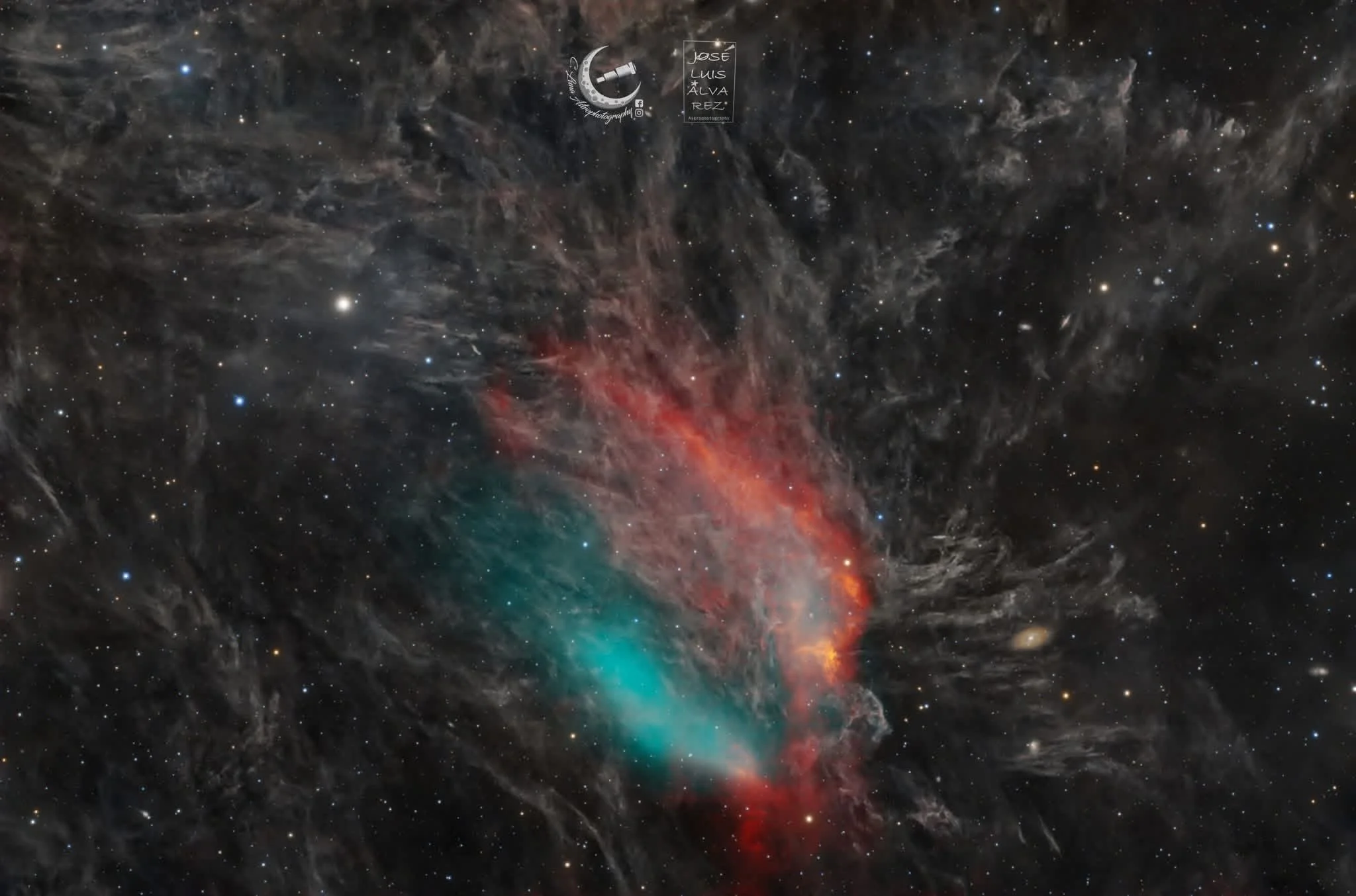
This narrowband deep-field image highlights two faint planetary nebulae situated against a rich background of ionized gas clouds in the constellation Cygnus. Near the lower-center of the field sits MWP1, an extraordinarily large and ancient bipolar planetary nebula (~150,000 years old) glowing with prominent bluish-cyan Oxygen-III shell emissions. Just to its lower-left lies ALV1, a fainter, asymmetric planetary nebula shaped by surrounding stellar winds. The surrounding field is swept with intricate red Hydrogen-alpha filaments and faint cosmic dust, creating a striking dual-color contrast across the star-studded field.

Read more →
August 26, 2026
Alexandros Filothodoros
The Deer Lick Group (NGC 7331) & Stephan’s Quintet (HCG 92) in a Sea of IFN
August 25, 2026
Michele Bayliss
The Deer Lick Group (NGC 7331) & Stephan’s Quintet (HCG 92) in a Sea of IFN
August 25, 2026
Michele Bayliss

This deep-field astrophotography image captures a rich section of the night sky featuring the prominent spiral galaxy NGC 7331 (the anchor of the Deer Lick Group), visible near the right-center with its bright core, pronounced dust lanes, and elongated disk. Accompanied by smaller background companion galaxies, the region is set against a faint, intricate web of Integrated Flux Nebula (IFN)—dust clouds residing high above the Milky Way's galactic plane that reflect the combined starlight of our galaxy. Nearby within the same field sits Stephan’s Quintet (HCG 92), a famous compact group of interacting galaxies showing tidal tails and gravitational distortion. The dark backdrop of deep space is filled with a dense field of distant background galaxies and pinpoint field stars.

Read more →
August 25, 2026
Michele Bayliss
Saturn: Enceladus in transit and a cross-checked white spot
August 24, 2026
makrem larnaout, Hafedh Driss
Saturn: Enceladus in transit and a cross-checked white spot
August 24, 2026
makrem larnaout, Hafedh Driss

Captured on July 31, 2026, from Tunis, Tunisia, this detailed planetary observation of Saturn reveals a transient atmospheric white spot in the northern hemisphere, independently cross-checked and confirmed across two distinct optical setups. Simultaneous imaging via a 14-inch Celestron EdgeHD and a 16-inch Sky-Watcher Dobsonian utilizing four distinct filter configurations detected the feature at identical planetary coordinates; its persistence across deeper infrared wavelengths and higher-altitude Rayleigh-scattering bands indicates a vertically extended convective storm cell tied to seasonal northern atmospheric dynamics rather than a localized surface albedo artifact. The high-resolution composite additionally resolves fine internal ring dynamics—notably faint radial spokes in the B ring and a crisp Cassini Division separating it from the A ring—while capturing Enceladus in mid-transit alongside Tethys and Mimas positioned to the east. The overall data integration of 6 minutes and 40 seconds was processed using WinJUPOS, AutoStakkert!, and PixInsight to maximize cloud-deck contrast and optical alignment.

Read more →
August 24, 2026
makrem larnaout, Hafedh Driss
The Dragon Has Returned to the Universe
August 23, 2026
Mark Anderson
The Dragon Has Returned to the Universe
August 23, 2026
Mark Anderson

Captured from Georgetown, New South Wales, Australia, between July 14 and July 22, 2026, this high-resolution narrowband image details NGC 6188, an active star-forming emission nebula located approximately 4,000 light-years away in the constellation Ara. Rendered in the Hubble Palette (SHO) with broad-band RGB star data for natural color accuracy, the false-color composite highlights distinct ionization fronts driven by the massive, young stars of the embedded open cluster NGC 6193. Strong stellar winds and intense ultraviolet radiation carve dark, dense dust structures while exciting surrounding atomic gases, mapped here as sulfur II (red), hydrogen-alpha (green/gold), and oxygen III (blue). Acquired using a fast RASA 1100 V2 telescope paired with a full-frame ZWO ASI6200MM-Pro camera on an EQ6R-Pro mount, the image integrates 29.5 hours of total exposure (1,761 individual sub-frames) processed in PixInsight to resolve intricate shock fronts, dark globule boundaries, and subtle elemental boundaries across the region.

Read more →
August 23, 2026
Mark Anderson
Full Moon
August 22, 2026
Raffaele Calcagno, Francesco Nesc
Full Moon
August 22, 2026
Raffaele Calcagno, Francesco Nesc

Captured from Faggiano, Italy, on July 29, 2026, this high-resolution lunar mosaic details the near side of Earth's Moon during the full phase. Acquired using an SVBONY MK127 telescope at its native 1,500 mm focal length paired with a ZWO ASI224 camera, the final image is a mosaic assembled from 30 individual video panels. To mitigate atmospheric distortion while target was positioned roughly 25 degrees above the horizon, 4,000 frames were recorded per panel at a 3.0 ms exposure time, from which the sharpest 1,500 frames were selected and stacked. The resulting composite showcases key geological structures with exceptional contrast and resolution, including dark, volcanic basalt plains (maria), heavily cratered highlands, and bright, extensive impact ejecta rays emanating from geologically young craters.

Read more →
August 22, 2026
Raffaele Calcagno, Francesco Nesc
Seahorse nebula - Barnard 150
August 21, 2026
Azathoth Pics
Seahorse nebula - Barnard 150
August 21, 2026
Azathoth Pics

Captured under the dark Bortle 3 skies of Lanuéjols, France during the Nuits du Causse Noir 2026 event, Maxime Senes (Azathoth Pics) presents a striking view of the Seahorse Nebula (Barnard 150). Imaging with a personal telescope setup, Senes collected 59 unfiltered sub-exposures of 300 seconds each to reveal the intricate, dark dust lanes winding through this iconic cosmic silhouette.

Read more →
August 21, 2026
Azathoth Pics
GigaVeil: 1 billion pixels, 300 hours, 35 panels, and 5 contributors on the Veil Nebula
August 20, 2026
GB Astronomy, Brian Nietfeld, Hunter Outten, Kaleb Jordan, Stan Williams
GigaVeil: 1 billion pixels, 300 hours, 35 panels, and 5 contributors on the Veil Nebula
August 20, 2026
GB Astronomy, Brian Nietfeld, Hunter Outten, Kaleb Jordan, Stan Williams

The Veil Nebula is a massive, expanding supernova remnant—the expanding shell of ionized gas left behind when a star roughly 20 times the mass of the Sun exploded around 10,000 to 20,000 years ago—where high-velocity shockwaves collide with surrounding interstellar clouds to excite atoms of doubly ionized oxygen ($\text{OIII}$, glowing in vivid cyan) and hydrogen-alpha ($\text{H}\alpha$, glowing in deep red). Capturing this vast structure in uniform high resolution required a collaborative imaging project bringing together five astrophotographers across Delaware and Texas: Gavin Bent, Brian Nietfeld, Hunter Outten, Kaleb Jordan, and Stan Williams. Over more than 318 total hours of exposure time using a variety of focal lengths, filters, and optics, the team stitched together a 35-panel, 1-gigapixel mosaic that reveals intricate filamentary shock fronts, surrounding ambient hydrogen clouds, and faint nearby targets such as the rarely imaged planetary nebula PA28.

Read more →
August 20, 2026
GB Astronomy, Brian Nietfeld, Hunter Outten, Kaleb Jordan, Stan Williams
Collinder 399 - The Coathanger Cluste
August 19, 2026
Jan Lindemann
Collinder 399 - The Coathanger Cluste
August 19, 2026
Jan Lindemann

A striking capture of Collinder 399—the Coathanger Cluster—standing out against the rich background of the Milky Way, showcasing vivid star colors taken from Buttwil, Switzerland. Though long thought to be an open cluster, modern astrometry reveals it is an chance alignment—an asterism—of ten main stars ranging from 230 to 1,300 light-years away. Its distinctive coat-hanger shape remains one of the northern sky's most delightful binocular targets.

Read more →
August 19, 2026
Jan Lindemann
“Little Cocoon” and its dark nebulae
August 18, 2026
Andrea Arbizzi
“Little Cocoon” and its dark nebulae
August 18, 2026
Andrea Arbizzi

The "Little Cocoon" nebula, cataloged as SH2-82, is an active star-forming emission nebula embedded in a reflective region of dust and gas, set against the rich star clouds of the constellation Sagitta in the inner Milky Way. Glowing primarily via ionizing radiation from adjacent stellar activity, the nebula's vibrant core is framed by surrounding reflection dust and complex lanes of dark nebulae that obscure background starlight. Astrophotographic data captured across LRGB and narrow-band OIII wavelengths reveals intricate structural layers within these molecular clouds, highlighting the delicate interplay between hydrogen excitation, light scattering, and dense interstellar dust absorbing light across the region.

Read more →
August 18, 2026
Andrea Arbizzi
Beyond Totality: The Sun’s Chromosphere and Corona
August 17, 2026
Alessandro Ravagnin & Nicola Bizzotto
Beyond Totality: The Sun’s Chromosphere and Corona
August 17, 2026
Alessandro Ravagnin & Nicola Bizzotto

A composite view of the eclipsed Sun combining two normally very different perspectives of our star: the H-alpha chromosphere and prominences, reconstructed through spectroheliography, and the faint outer corona, photographed during totality.

The chromospheric data were acquired from Menorca, Balearic Islands, with the Sun only 12° above the western horizon, while the coronal images were obtained by Nicola Bizzotto from Madrid with the Sun 7° above the horizon.

Read more →
August 17, 2026
Alessandro Ravagnin & Nicola Bizzotto
ECLIPSE LANDSCAPE
August 16, 2026
ECLIPSE LANDSCAPE
August 16, 2026

A unique composite captures the progression of the August 12, 2026 partial solar eclipse set against the countryside of Butser Hill in the South Downs, UK.

To properly balance the extreme brightness difference between the solar disk and the scenic foreground, this image was built using multiple exposures taken at various exposure lengths and ISO settings. Short, filtered exposures taken every 30 seconds across the 2.5-hour event captured the precise phases of the Sun, which were then composited onto a dedicated landscape exposure. This multi-exposure approach ensures both the fine detail of the Sun's path and the rich tones of the surrounding terrain remain perfectly exposed.

Read more →
August 16, 2026
TOTAL SOLAR ECLIPSE 2026
August 15, 2026
TOTAL SOLAR ECLIPSE 2026
August 15, 2026

During totality of the August 12, 2026 solar eclipse over Guadalajara, Spain, the moon completely covered the solar disk, revealing the majestic structure of the Sun's outer atmosphere.

To capture the vast dynamic range—from the intense brilliance of the solar prominences hugging the lunar limb to the delicate, faint streamers stretching far into the solar corona—this image was crafted using a composite of multiple exposures taken at varying exposure times and ISO settings. Blending these exposures allows the intricate details of the magnetic field lines frozen within the corona to shine through alongside the fiery, crimson prominences at the edge of the disk.

Read more →
August 15, 2026
Sunset Eclipse
August 14, 2026
Michel Kroll
Sunset Eclipse
August 14, 2026
Michel Kroll

On August 12, 2026, a magnificent partial solar eclipse unfolded across Western Europe, reaching an impressive 87% maximum solar obscuration as viewed from Lüdinghausen, Germany. Captured by photographer Michel Kroll using a Sony RX10 IV with sequential exposures taken every three minutes, this composite image illustrates the lunar limb progressively occulting the solar photosphere as the Sun descended toward the horizon. Even without achieving full totality, an 87% reduction in solar irradiance drastically alters ambient light, while atmospheric extinction and Rayleigh scattering near the horizon shift the Sun's spectral output toward deep amber hues, casting an eerie, twilight-like illumination over the terrestrial landscape.

Read more →
August 14, 2026
Michel Kroll
The Sun two weeks (July 27, 2026) before the total eclipse
August 13, 2026
Alessando Ravagnin
The Sun two weeks (July 27, 2026) before the total eclipse
August 13, 2026
Alessando Ravagnin

Captured just two weeks ahead of the August 12 total solar eclipse, this striking full-disk H-alpha portrait highlights the Sun’s dynamic chromosphere in exceptional detail. A dense network of dark filaments spans across the solar disk, surrounded by brilliant active regions and prominent solar filaments extending from the limb.

Reconstructed from roughly 3,600 monochromatic frames, the image beautifully preserves the delicate fibrillar structures and complex magnetic pathways of our nearest star—promising a spectacular show for eclipse observers.

Read more →
August 13, 2026
Alessando Ravagnin

contact us | Terms and conditions

About Donate Advertise Supporters Contact Us Search Newsletter