
AAPOD2 Image Archives

The Great Spiral in Triangulum- M33
Image Description and Details : The great spiral galaxy M33 in Triangulum, a favorite among imagers, imaged from my home observatory under suburban Bortle 5 skies, during the month of Oct, early Nov 2019. Stellarvue SVX152T @f8, 1200mm FL on a Paramount MyT. QSI 683 camera using Luminance, Red, Green, Blue, and 5nm Ha filters. 360min Luminance bin 1x1, 300min Red, 290min Green, 280min Blue and 660min Ha bin 2x2. Total of 31.5hrs of exposure time. PixInsight used for processing. Please visit the full size link on the web page above to see individual stars resolved within the galaxy.
Copyright: Jon Talbot
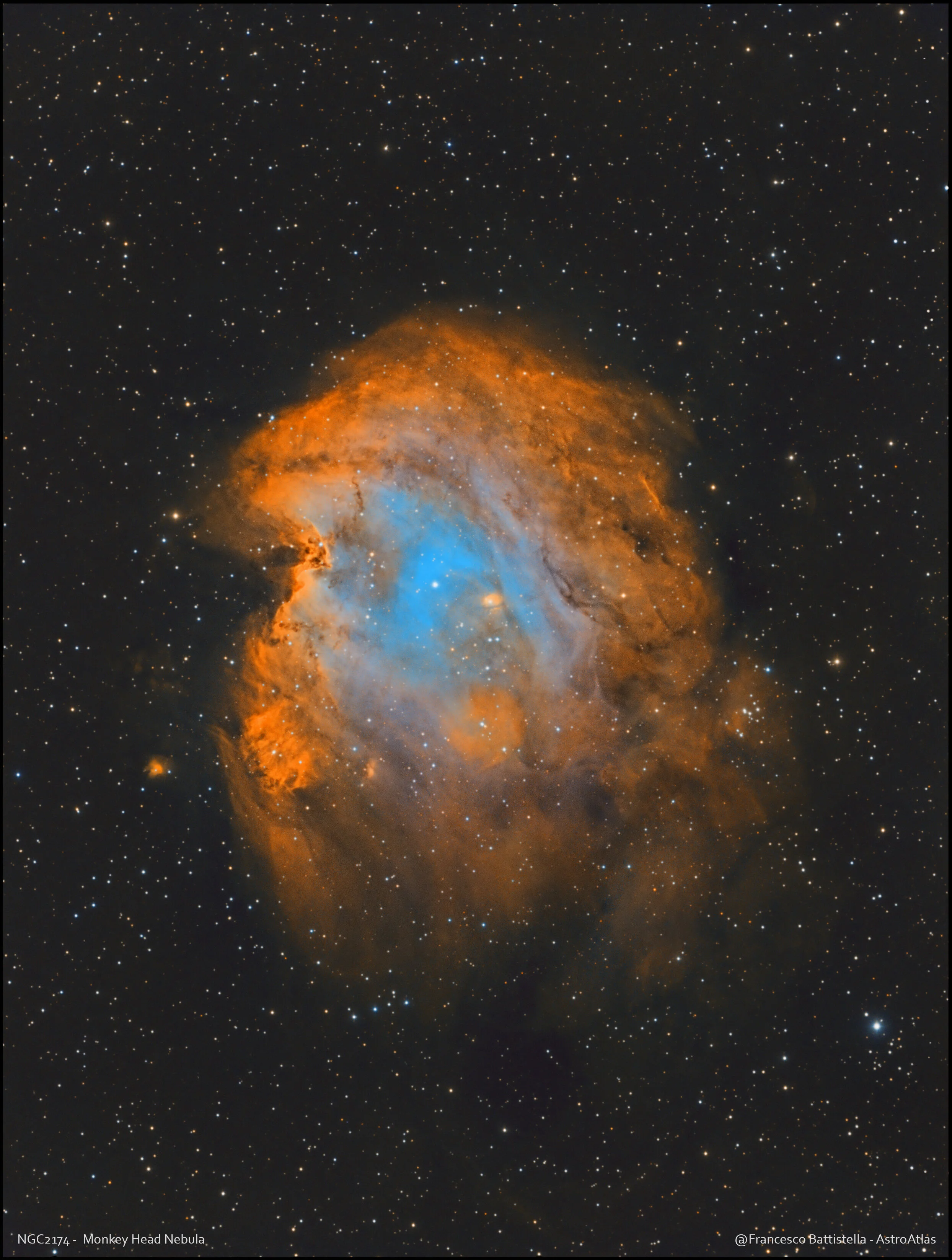
The Monkey Head Nebula - NGC2174
The monkey head nebula - ngc2174 is an emission nebula located in the Orion Constellation. It is associated with the stellar cluster ngc2175. It was given this name as you can see well from the photo, the face of a monkey.
I decided to process this photo with the Hubble Palette technique, and therefore, with fake colors to highlight better the emission areas of the various chemical elements that compose the nebula.
Optolong Astronomy Filter
Qhyccd
Technical Information:
Telescope: AIRY APO 130T
Mount: Paramount MyT - Software Bisque
Room: qhy9
Filter: Optolong H-A 7 NM, oiii 6.5 NM, be 6.5 NM
Frames: H-a: 32 x900s -- oiii: 32 x900s -- SII:32x900s
Total Integration: 24 Hours
Software: SGP – TheSkyX – PHD2 – DSS -PixInsight – CS6
Location: Noventa di Piave (Venice) 4 meter above sea level – ITALY
Environment Temperature: About 2°C
Relative Humidity: 88%
Date: 29.12.19 - 30.12.19 - 31.12.19 - 01.01.20
Copyright: Francesco Battistella
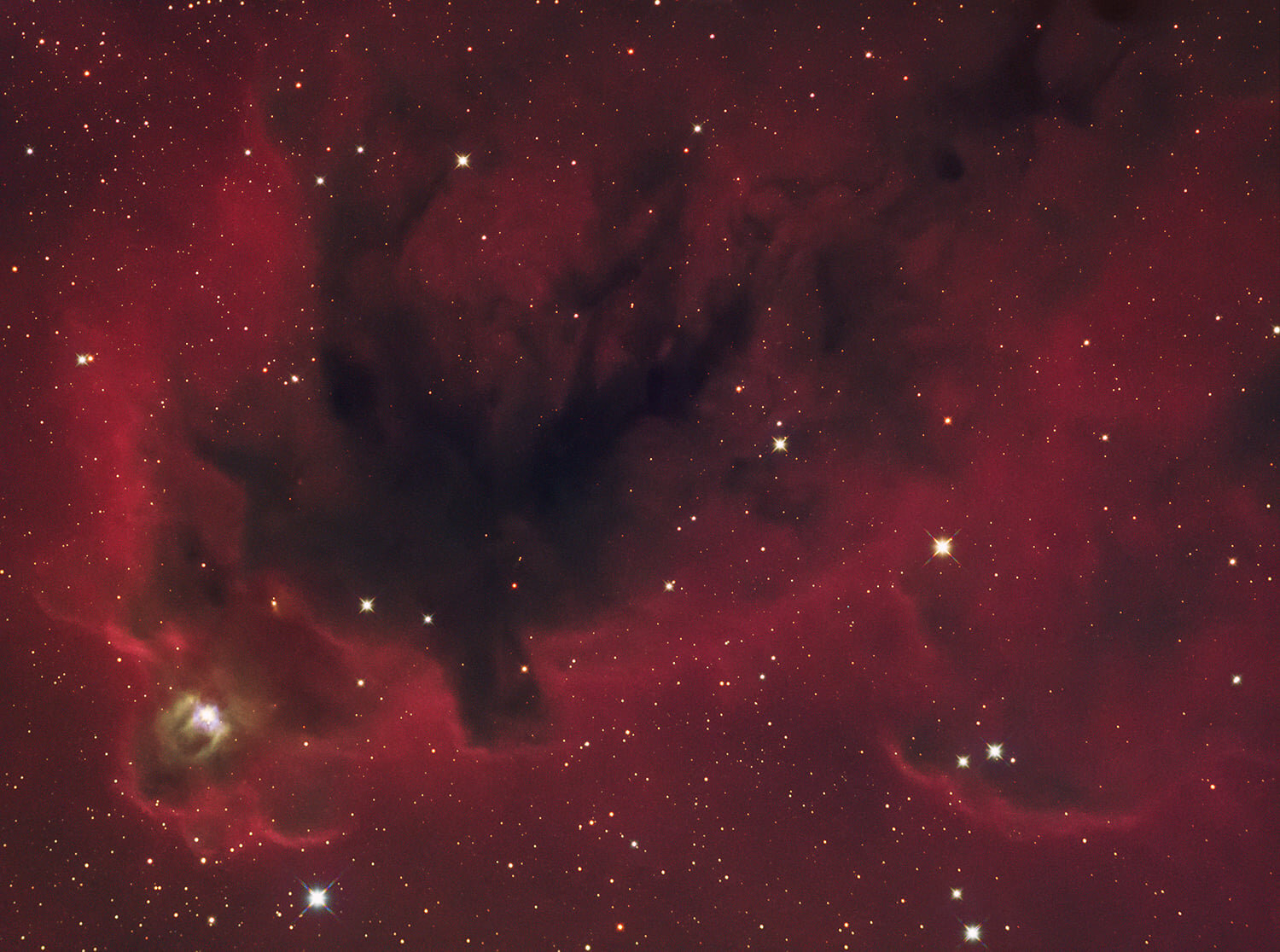
The Boogie Man Nebula
LDN 1622 "Boogie Man Nebula" in the constellation Orion
Equipment SBIG STT-8300 CCD Camera Takahashi CCA-250, 1,250 mm f/5 Astro-Physics 1200 GTO mount LRHa-RHaGB image, total exposure 1,180 mins (19hr 40 min) From TJ Observatory, Banmi, Lopburi, Thailand
Copyright: Tragoolchitr Jittasaiyapan

M63- Sunflower Galaxy
Astrnomik CLS-CCD: 90x300" -10C bin 1x1 ATIK 460ex_neq6pro_newton 200/1000
Astronomik RGB: 45x150" bin 1x1
Integration 9.4 Hours
Copyright: Rémi MERE
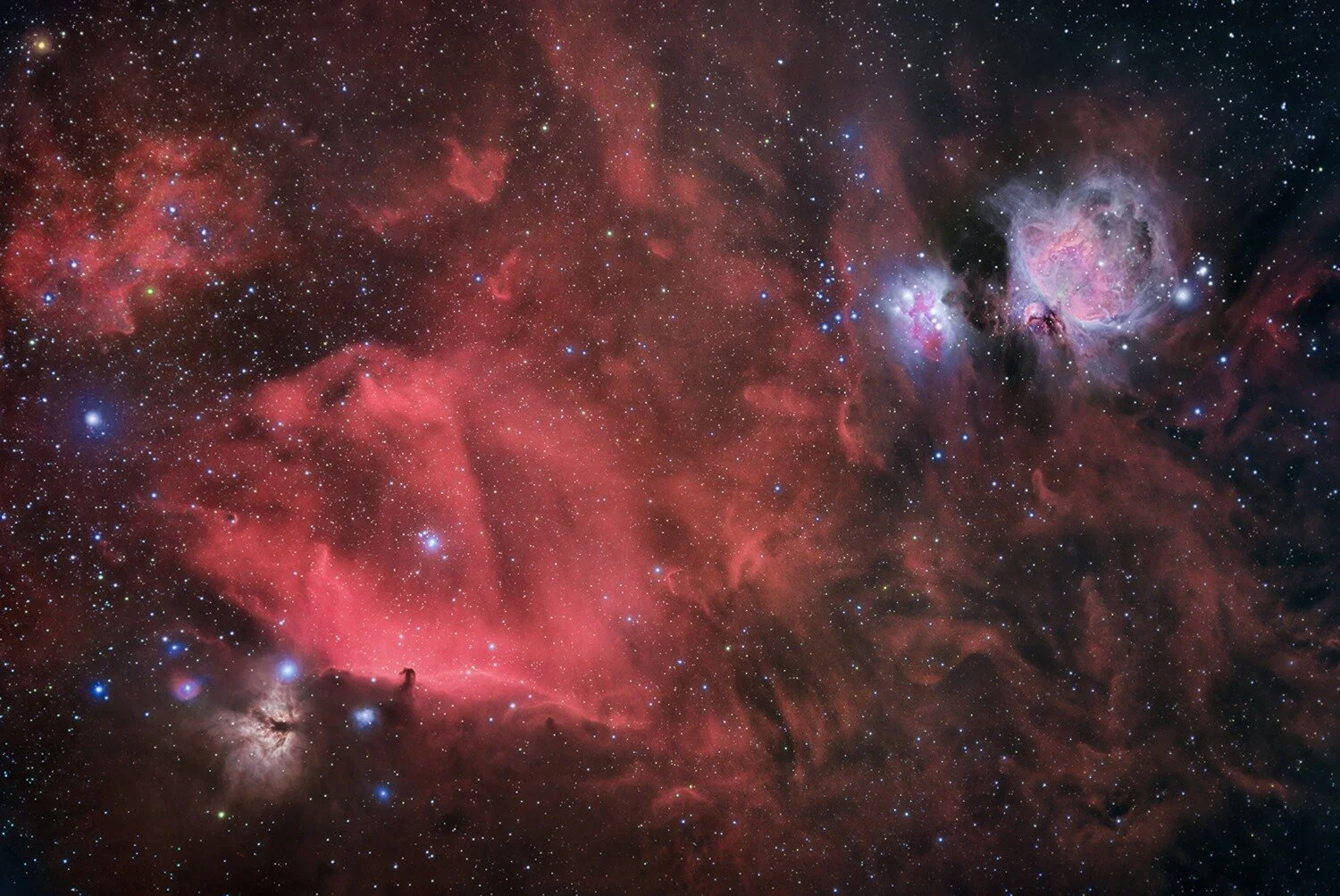
Orion CoNstellation
Date image was taken: 1/5/2020
Image Title: Orion Costellation
Image Description and Details : Orion Costellation
Sharpstar Optics 76EDPH Artesky
Qhyccd 600 Mono
Filter Optolong Astronomy Filter Narrowband improved version
44 light 600 sec HA
44 Light 300 sec Red
33 Light 300 sec Green
22 Light 300 sec Blu
Software APT - Astro Photography ToolPixinsight Photoshop
Copyright: Andrea Maggi
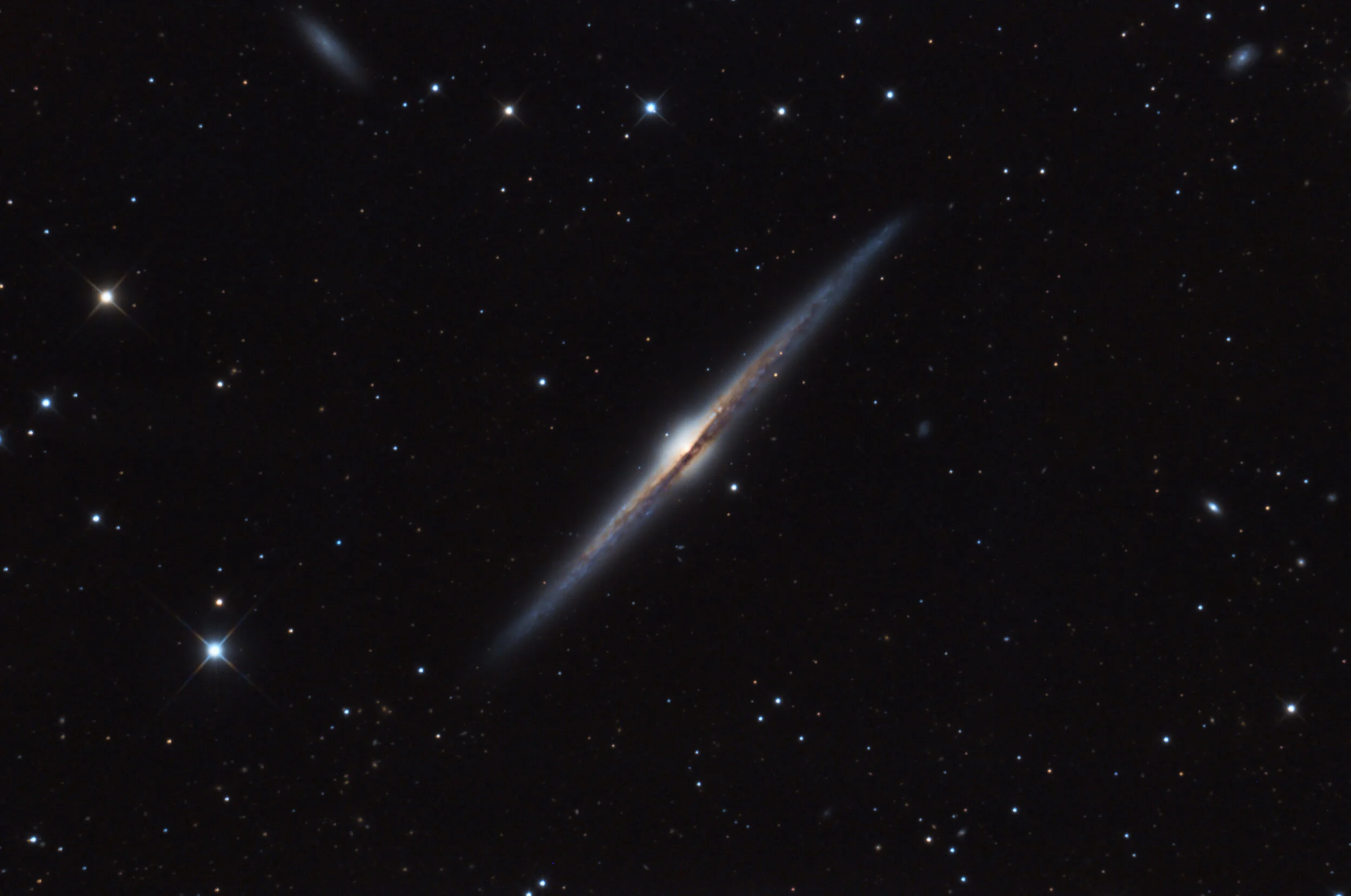
NGC 4565 Galaxy
Imaging telescope or lens:GSO RC12 truss
Imaging camera:ZWO ASI071MC Pro
Mount:SkyWatcher EQ8 Pro
Guiding telescope or lens:GSO RC12 truss
Dates:March 3, 2019
Frames: 20x450"
Integration: 2.5 hours
Avg. Moon phase: 8.75%
Locations: Calar Alto, Almeria, Spain
Copyright: Jose Luis Bedmar
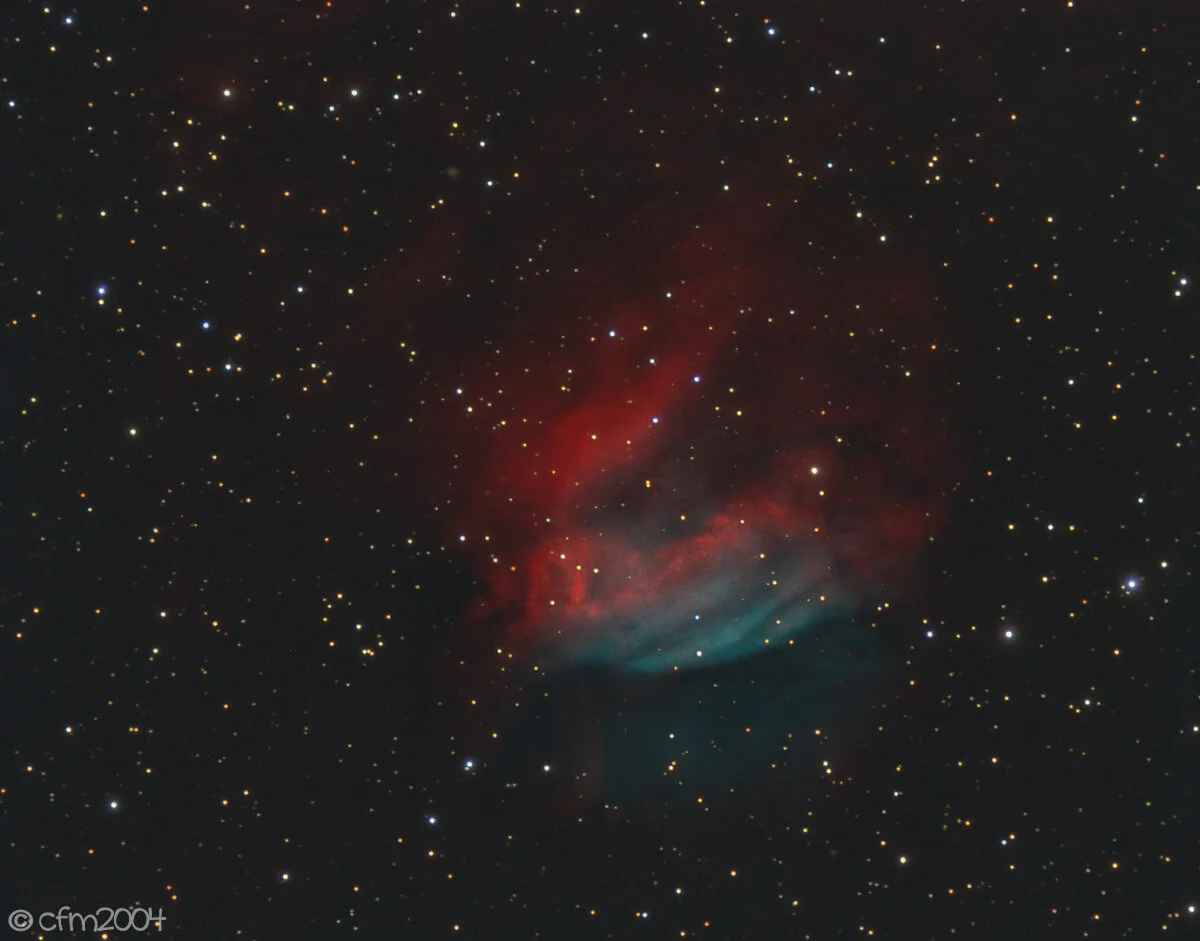
SH2-174 - Valentine Rose
Sh2- 174 Planetary Nebula in the cepheo, also known as "Valentine's rose". filming started in April 2018 and finished in October 2019.
Location: San Romualdo - Ravenna
Tecnosky There 130/900
Asa Ddm60pro - Non-guided poses
CCD CCD 520 WSI Cooled-15
RGB the I-SERIES AND NARROWBAND 5 NM
HA-OIII-RGB: H-alpha 43 x10min, OIII 29 x10min, R 26 x5min, G 27 x5min, B 30 x5min
Acquisition: Maximdl5 - calibrated with dark, bias and flat.
Processing: Maximdl5, Astroart6, Paint Shop Pro2020, Plugin Topaz and starspikepro3.
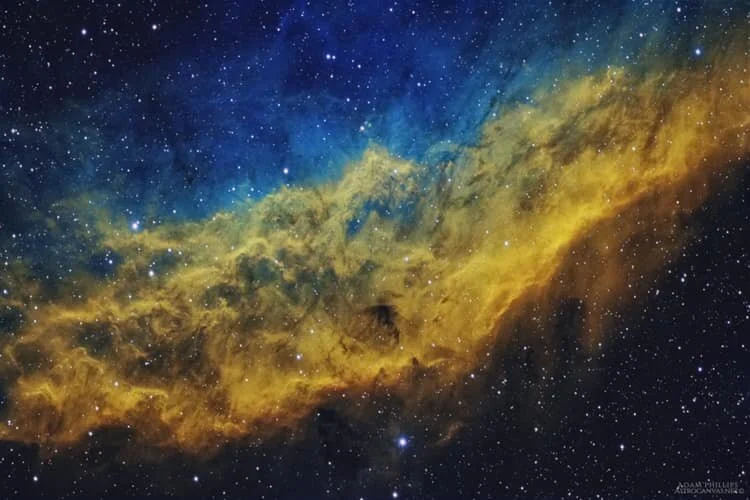
California Nebula - NGC 1499
California nebula.
QSI6120
Stellarvue 80mm APO, With reducer to f/4.8
Astrodome 3nm filters Ha OIII SII.
24 hours total exposure.
All 900 second subs
Copyright: Adam Phillips

MBM 28 and MBM 29 Molecular Nebula
● Object: NGC2633, IFN, MBM28.
● Exposure: 22 x 300s (L) + 10 x 300s (R) + 10x 300s (G) + 10 x 300s (B).
● Processing: PixInsight Core 1.8.
● Telescope: Takahashi FSQ-106EDX3 on EM-200Temma2M. Seletek Armadillo / Focusmax.
● Camera: Andor Apogee U16M / AFW-50-7S ( - 20ºC ). Astrodon E-Series genII filters.
● Guiding: FS-60CSV, QHY-5, PHDguiding.
● Date: 27th of December 2019.
Copyright: Iñaki Lizaso Ibarguren

LBN 576 - Abell 85 and CTB 1
Telescope Tecnosky 100Q F 5.8
CCD Moravian G3 16200
Ioptron CEM120EC
H-alfa 13X1800S Bin 1X1
OIII 10X1800S Bin 2X2
11 Dark 11 Flat 11 Bias
Processing Pixinsight
Gualdo Tadino (PG) Italy
SQM: 19.50/19.90
Copyright: Ciavaglia Francesco
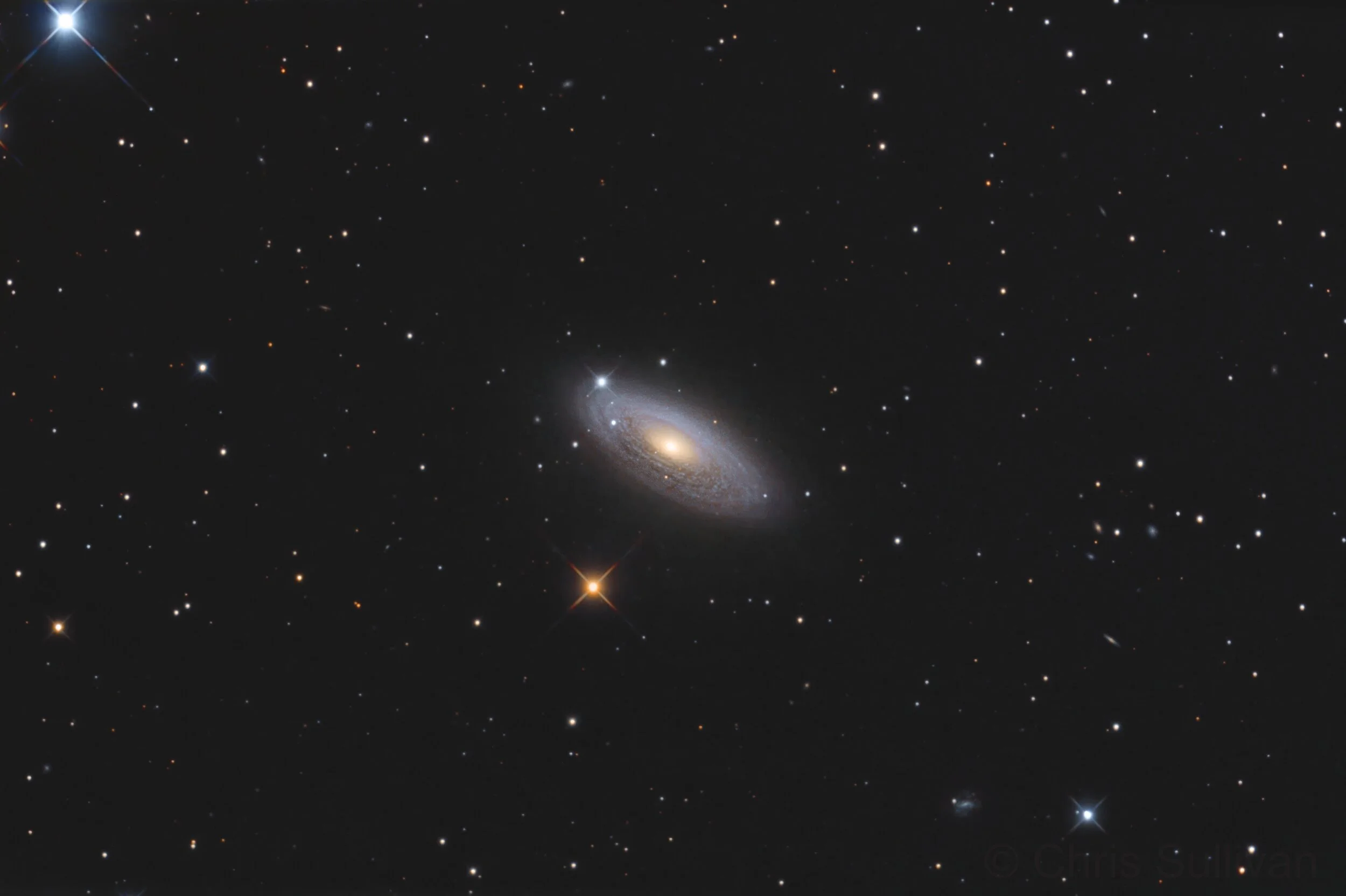
NGC 2841 - Tiger's Eye Galaxy
31 hours
8" GSO Ritchey-Chretien
Skywatcher EQ6-R
QHY183
Astrophysics CCDT67 reducer
Chroma LoGlow for luminance, Optolong RGB
Copyright: Christopher Sullivan
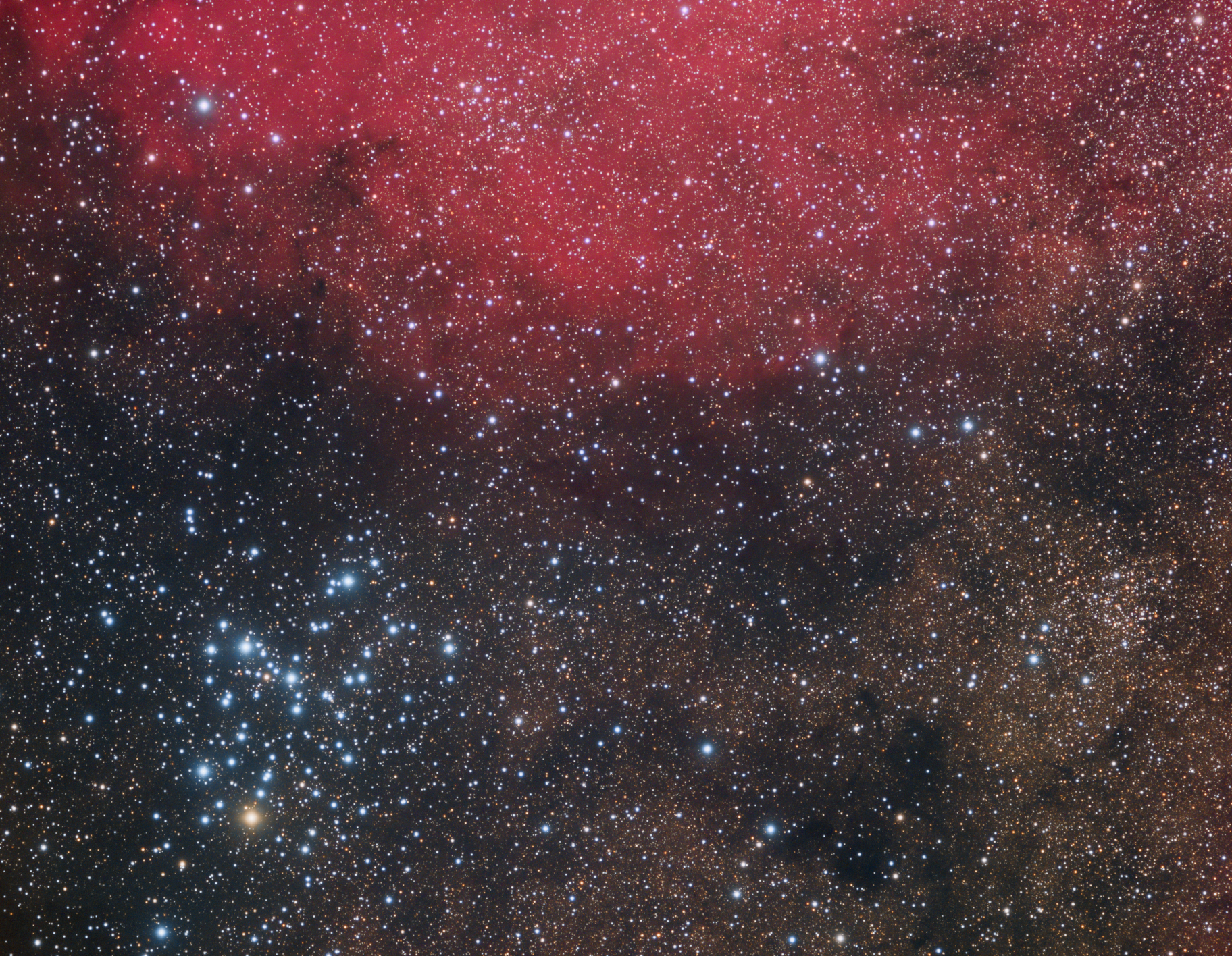
Messier 6 & Surrounding Area
HALPHA: 100 x 180 seconds
LUMINANCE: 40 x 180 seconds
RGB: 20 x 180 (each channel)
Total: 10 hours
Robert Burnham, Jr. describes this beautiful object as follows:
“Charming group whose arrangement suggests the outline of a butterfly with open wings.” Nothing better than a little "poetry" to describe such a prominent object.
In 1654 Italian astronomer Giovanni Battista Hodierna was the first man to record this beautiful star cluster in the scorpion constellation.
In 1764 the French Charles Messier includes in his catalog as Messier 6. Under good conditions, it can be seen with the naked eye, in contrast to the dark regions surrounding the star cluster. It has an apparent magnitude of 4.2 and an estimated age of 100 million years, at a distance of approximately 1600 light years from planet Earth.
The brightest star in the cluster is BM SCORPII. It is cataloged as a yellow / orange supergiant, and is considered a semi-regular variable, as it is of the spectral class K0-K3, its magnitude varies from 5.5 to 7, in periods of 30 to 1100 days. The hot blue stars of the cluster belong to the spectral class B4 and B5.
The cluster to the right of this image is NGC 6404.
The most intense part of the image, which I had the idea from the outset to highlight, is part of an extensive emission nebula called: Sharpless 12.
The information about this object is very scarce, but I will try to put as much information as I can about this object. All ionization occurs due to the O-Star (O7V + O7V) HD 159176 binary star, which is located in cluster NGC 6383 and does not appear in my image.
A fact that caught my attention and that when we talk about astronomy we always go back to the past, most catalogs are hundreds of years old, but Sharpless is not even a century old. Stewart Lane Sharpless (born March 29, 1926 in Milwaukee, January 19, 2013) was an American astronomer who studied the structure of the Milky Way, professor emeritus of the Department of Physics and Astronomy at the University of Rochester. The first edition of its catalog is from the year 1953 (SH1) contained 142 objects. The final version, published in 1959 (SH2), contains 312 objects.
Copyright: Maicon Germiniani
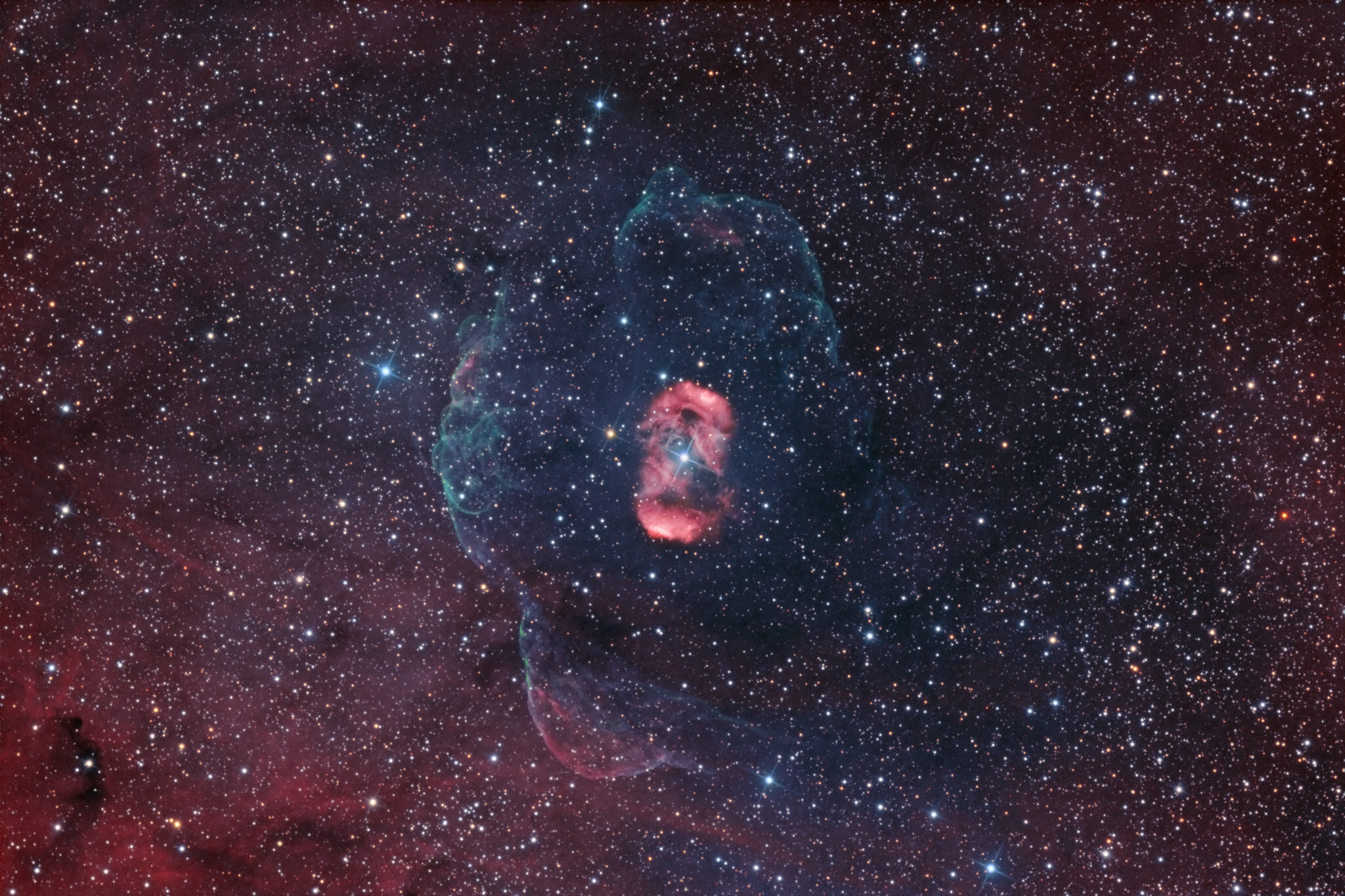
NGC 6164
NGC 6164 has an appearance similar to what you would see in a planetary nebula. It has a gaseous shroud that surrounds the central star. These typically have shock-waves, and often highlight where they brighten showing where they are interacting with the interstellar medium.
The extensive outer halo would have to be my favorite part of this image. The outer halo is very dim and certainly proved to be a challenge to reveal it with all the tiny filaments with blue and teal highlights and a bit of red where Ha is present. There is a feature that I initially believed to be a light leak. On the left side of the image, there is what looks like a straight line. After looking through many images, it’s definitely real, and not a light leak.
NGC 6164 is 4,200 light-years away in the constellation of Ara. It is about 21 X 13 arc mins, at magnitude 11. It contains a very bright O-type star about 40 times as massive as our sun. The nebula in the center spans around 4 light-years and has an interesting bipolar symmetry, this is all framed nicely in the larger outer-shell, all set within a beautiful star-field.
Equipment Details: 10 Inch RCOS fl 9.1
Astro Physics AP-900 Mount
SBIG STL 11000m
FLI Filter Wheel
Astrodon Lum, Red, Green, Blue Filters
Baader Planetarium H-alpha 7nm Narrowband-Filter
Baader Planetarium OIII 8.5nm Narrowband-Filter
Baader Planetarium SII 8.0nm Narrowband-Filter
Exposures Details:
Lum 45X900 Bin 1
Red 15X900 Bin 1
Green 14X900 Bin 1
Blue 12X900 Bin 1
Ha 61X1800
OIII 113X1800
Total Time: 108.75 hours

IC348 & LBN749
Imaged in the constellation of Perseus. IC348 and LBN749.
ASA10 '' telescope
Canon 6D Astrodon
Guiding by SW evostar 72ED and ASI120mini
147x300s at 400ISO
Total exposure = 12hrs
Automatic acquisition via Maxpilote (TheSkyX pro, Focusmax).
PixInsight for pre-processing and PixInsight + Photoshop for processing.
Lorraine - FRANCE
DECEMBER, 2019
Copyright: Thomas Lelu
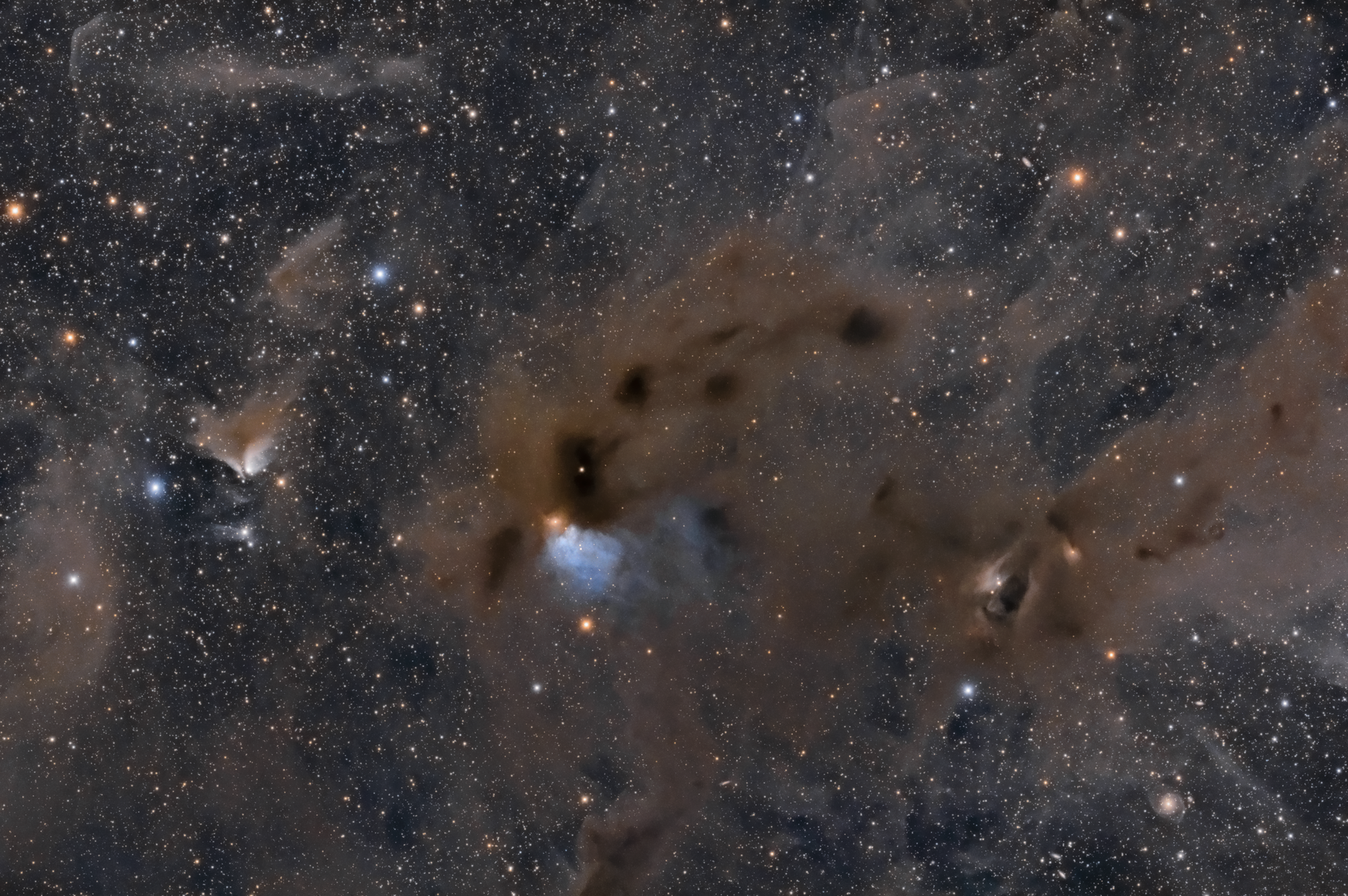
Banard 7 & more
Imaging telescope: Celestron 11" Rowe-Ackermann Schmidt Astrograph
Imaging camera: QHYCCD QHY367C
Mount: Orion Atlas Pro AZ/EQ-G
Guiding:Astromania 60mm Guide Scope & QHYCCD QHY5III178M
Filter:Astronomik L2 UV/IR Cut
Dates:Nov. 29, 2019, Dec. 15, 2019
Frames: 410x60"
Integration: 6.8 hours
Bortle Dark-Sky Scale: 5.00
Mean SQM: 19.68
This is a very interesting area in the Taurus Molecular Cloud featuring many dark and reflection nebulae. The main subject in the center is Barnard 7 (the dark nebula) and LBN 782 (the blue reflection nebula). To the left side is vdB 27, illuminated by RY Tauri, a young variable star. To the right is another reflection nebula illuminated by variable star CW Tauri. Peeking through the dust 186 million light years away is the galaxy IC 359, in the bottom right. All in all, a lot of different things to see here!
Copyright Jarrett Trezzo

Rosebud Nebula - NGC 7129
The young open star cluster NGC 7129 is embedded in the bluish reflection nebula vdB 146. Due to it's shape the reflection nebula is called "Rosebud Nebula" and is located in the constellation Cepheus. The young stars have blown a large, oddly shaped bubble in the molecular cloud that once surrounded them at their birth. The rosy pink color comes from glowing dust grains on the surface of the bubble being heated by the intense light from the young stars within. Also some Herbig-Haro objects can be identified in the reflection nebula. Their shape and pinkish red color is characteristic of glowing hydrogen gas shocked by jets streaming away from newborn stars.
NGC 7142 is an open cluster about 6,200 light-years away. With an estimated age of 4.5 billion years, he is one of the oldest known open clusters.
The fine Halpha filaments on the left side of the image are part of the supernova remnant SNR 110.3 + 11.3.
Scope: ASA 10" Astrograph
Mount: ASA DDM60
Camera: Moravian G3-16200 with Astrodon LRGB and Halpha filters
Total exposure time: ~81h
Copyright: Thomas Henne

Elephant's Trunk Nebula - IC1396
INFO
IC 1396 spans hundreds of light years at distance of about 3000 light years in constellation Cepheus. The famous formation of glowing gases, the "Elephant's Trunk Nebula" can be seen at four o'clock position. This is an active star formation region and it has several massive young stars inside it, coursing the ionization of elements of this emission nebula.
Technical details Processing workflow Image acquisition, MaxiDL v5.07. Stacked and calibrated in CCDStack2. Deconvolution with a CCDStack2 Positive Constraint, 33 iterations, added at 50% weight Color combine in PS CS3 Levels and curves in PS CS3. Imaging optics Tokina AT-x f2.8 camera lens Mount 10-micron 1000 Cameras and filters Imaging camera Apogee Alta U16 and Apogee seven slot filter wheel Guider camera, Lodestar x 2 and an old spotting scope of Meade LX200
Astrodon filters,
5nm H-alpha 3nm S-II and 3nm O-III Total exposure time for all of the four panels
H-alpha, 12 x 600 s, binned 1x1 = 2 h
O-III, 6x 600 s, binned 4x4 = 1 h.
S-II, 3 x 600 s. binned 4x4 = 0,5 h
Copyright: J-P Mets̈avainio

IC1795 - The Fishhead Nebula
IC 1795 - The Fish Head nebula
IC 1795 is an area of gas and dust and also a star forming region in the northern constellation Cassiopeia.
IC 1795 is an extension of the larger Heart nebula or IC 1805.
The brightest part of the nebula has the designation NGC 896 in the New General Catalogue. It is classified separately because it was the first part of IC 1805 to be discovered.
Equipment used:
Eq6 hypertune gen2 by DarkFrame Ltd
AstroTech 106LE with upgraded Moonlite focuser
TSFlat 2" field flattener
Qhyccd QHY183M Coldmos, cooled at - 20°C
7x1.25" Starlight Xpress USB filterwheel
Baader 1.25" filters, 7nm Ha, 8.5nm Oiii and 8nm Sii
Qhyccd QHY5L-IIM guide camera
TS09OAG off axis guider
Qhyccd Polemaster
Software used:
Eqmod, SGP - Sequence Generator Pro, PHD2, Stellarium with stellariumScope, SharpCap for polar alignment
Date: 14.09 to 11.12.2019
Location: Bushey, bortle 6
Total integration time 19 hours
Stacked in AstroPixel Processor and processed in Pixinsight and Photoshop CC 2019
Copyright: Emil Andronic

Sun comparison in Cak and Hydrogen Alpha
Sun in CaK and HA
TS 80ED f/7, Lunt modulo CaK B1200, Lunt LS60THa/B1200, Grasshopper3 GS3-U3-28S4M.
A comparison between FD Cak and H-Alpha taken 1/9/2020. I used a Lunt LS60THa/B1200 and a TS 80ED f/7 with a Grasshopper3 GS3-U3-28S4M.
Copyright: Salvo Lauricella

The Wizard Nebula - NGC 7380
Image data:
Date: 25/10/2019 and 26/10/2019
Site: Albox - Almería - Spain
Image Details: H-Alpha: 24x600" / OIII: 15x600" / SII: 24x600"
Telescope: Teleskop-Service Imaging Star 130mm f/5 - 6-elements Flatfield APO
CCD: ASI1600MMC
CCD Guiding: QHY5L-II
Capture and guiding software: MaxIm DL
Mount: Celestron CGEM
Processing: PixInsight
Bias, Darks and Flats applied
https://www.astrobin.com/m784zo
Copyright: José Francisco del Aguila del Aguila