
APPOD2 2025 images
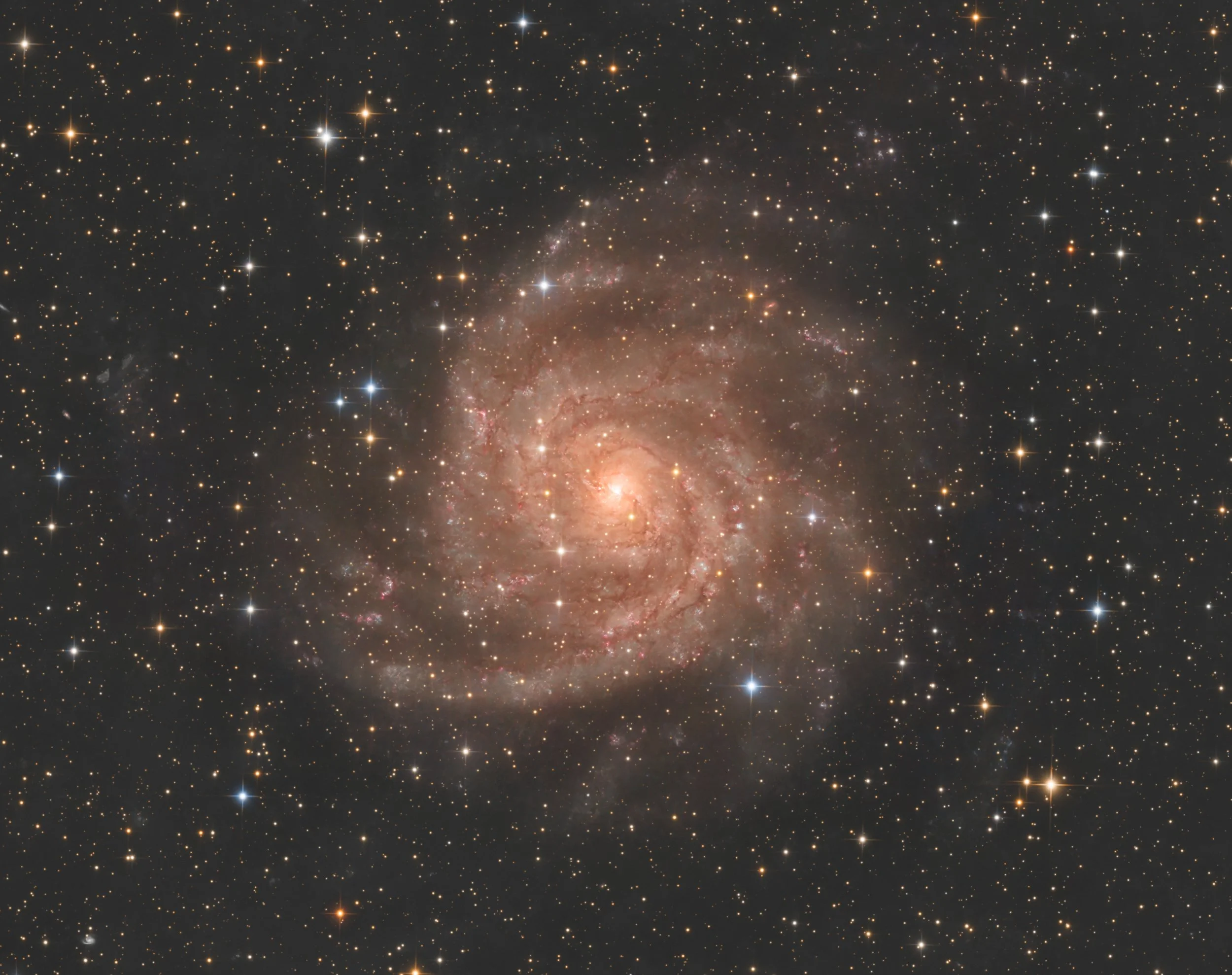
IC 342 is a face-on spiral galaxy located just beyond the plane of the Milky Way, where dense foreground stars and interstellar dust obscure and redden its light. Often called the Hidden Galaxy, it lies roughly 11 million light-years away in the constellation Camelopardalis and is one of the nearest large spiral galaxies to our own. Despite its proximity, extinction from the Milky Way makes accurate distance measurements challenging and softens the contrast of its spiral structure when viewed from Earth.
In this deep image, delicate spiral arms wind outward from a luminous core, threaded with faint pink regions that trace active star formation within IC 342’s disk. The galaxy’s mottled appearance reflects a mix of young blue star clusters, older yellow stellar populations, and scattered H II regions embedded in dust lanes. Captured from Wëntger, Luxembourg using a personal telescope setup, this view reveals the subtle beauty of a major spiral galaxy that often goes unnoticed behind the veil of our own galaxy.
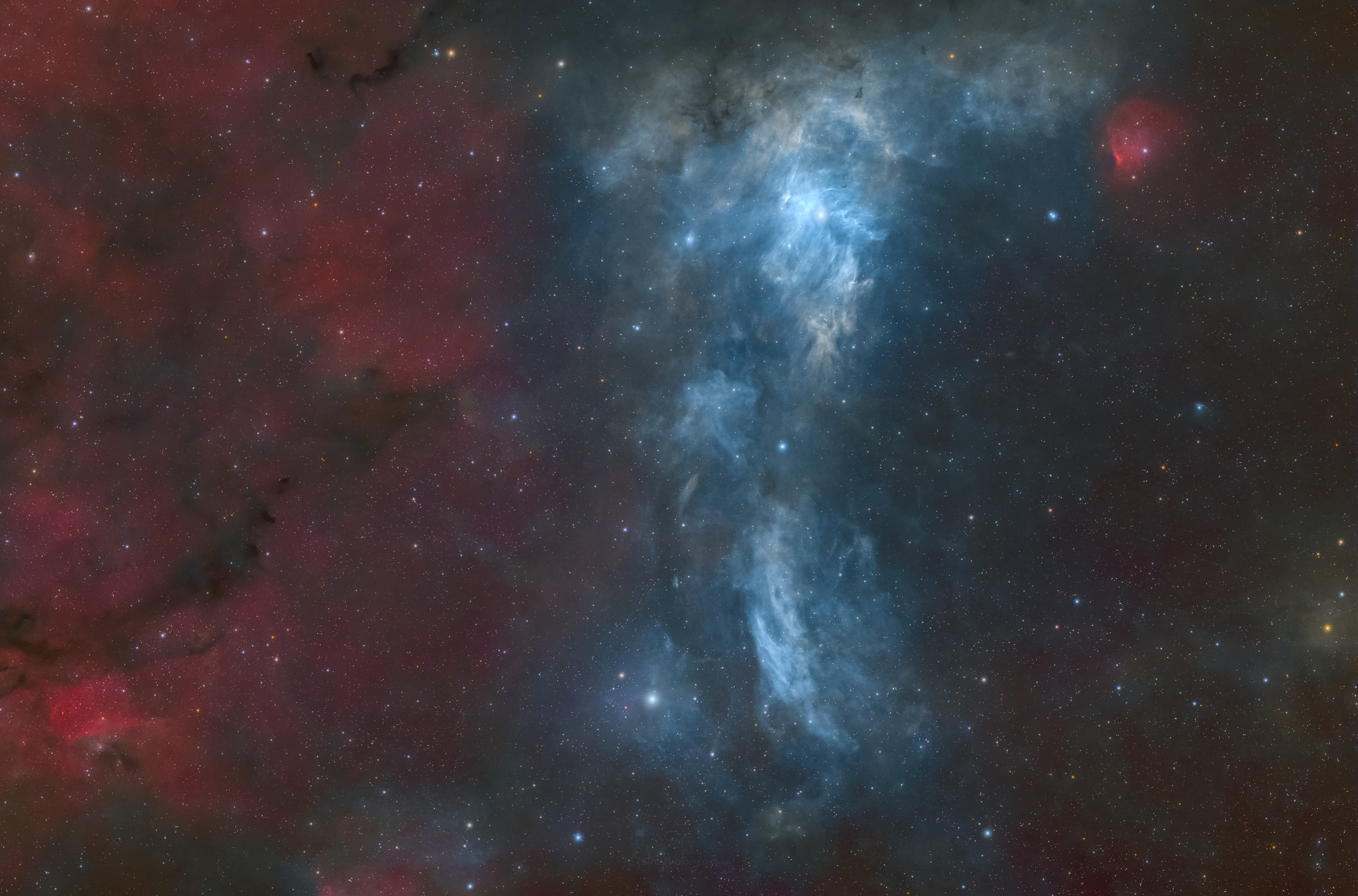
vdB 14 and vdB 15 are faint reflection nebulae embedded in the Perseus molecular cloud complex, illuminated by nearby hot stars whose blue light is scattered by surrounding interstellar dust. Unlike emission nebulae, their glow is not produced by ionized gas but by dust grains reflecting starlight, giving rise to the delicate blue filaments that dominate the central structure. The surrounding red hydrogen emission traces more distant ionized regions of the Perseus arm, revealing multiple layers of gas and dust along the line of sight.
Captured in HaRGB from Perros-Guirec in Brittany, France, this wide-field composition highlights the contrast between cool reflection nebulosity and warmer hydrogen clouds. Dark dust lanes cut through the field, absorbing background starlight and shaping the nebulae into elongated, wispy forms. Together, vdB 14 and vdB 15 offer a subtle but striking example of how starlight, dust, and ionized gas interact within an active star-forming region of the Milky Way.
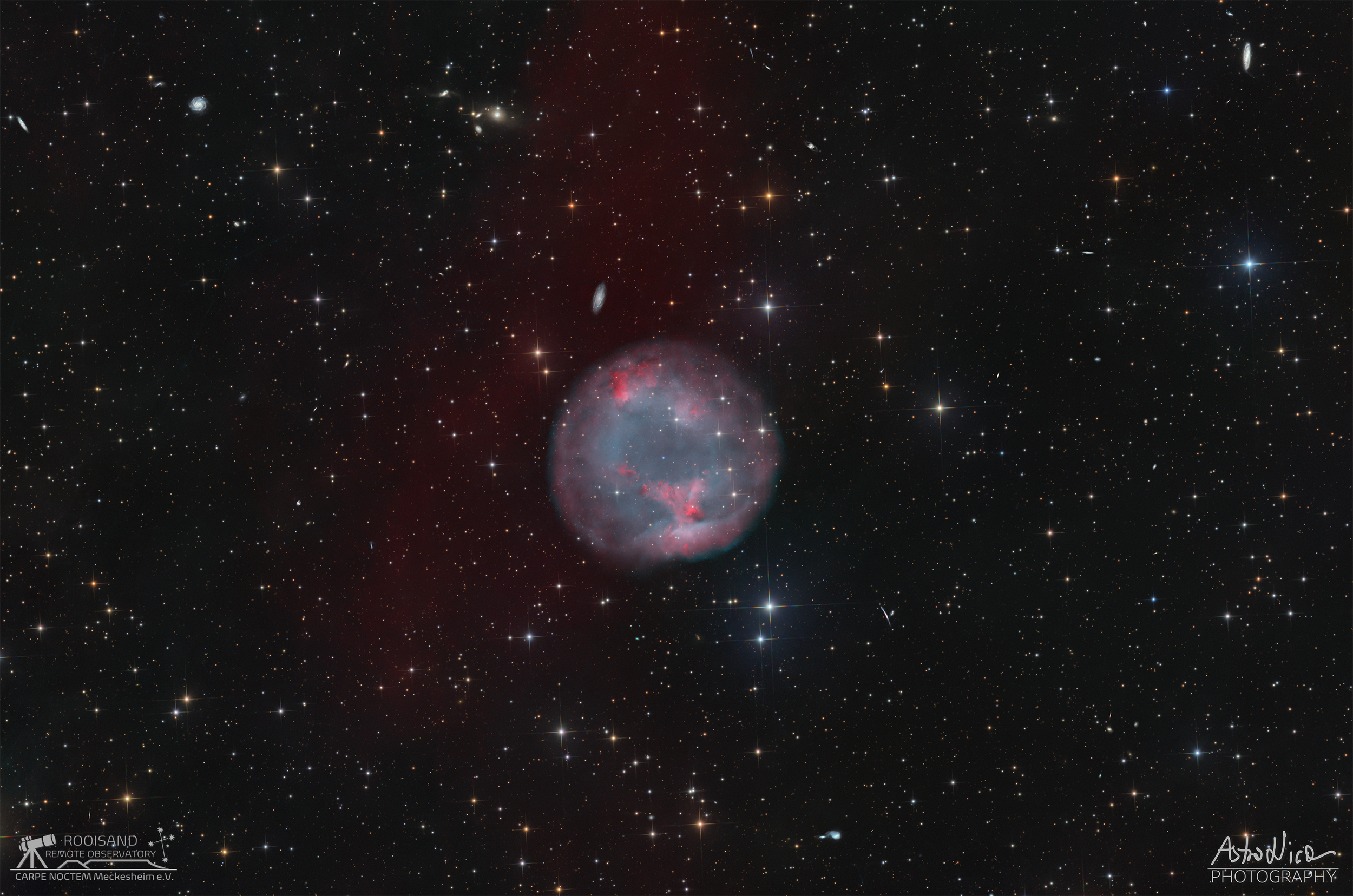
Abell 7 is a large, faint planetary nebula formed from the outer layers of a Sun-like star shed near the end of its life. Spanning several light-years, its diffuse spherical shell is the remnant of a slow stellar outflow that has been expanding and thinning for over 20,000 years. The soft blue glow traces doubly ionized oxygen, while patches of red reveal hydrogen emission where denser knots of gas persist within the aging structure.
Captured from Rooisand, Namibia, this wide-field view emphasizes Abell 7’s isolation against a deep background of Milky Way stars and distant galaxies. The nebula’s low surface brightness makes it a challenging target, but its subtle colors and near-perfect symmetry offer a quiet portrait of stellar evolution, showing how enriched material is returned to interstellar space to seed future generations of stars.
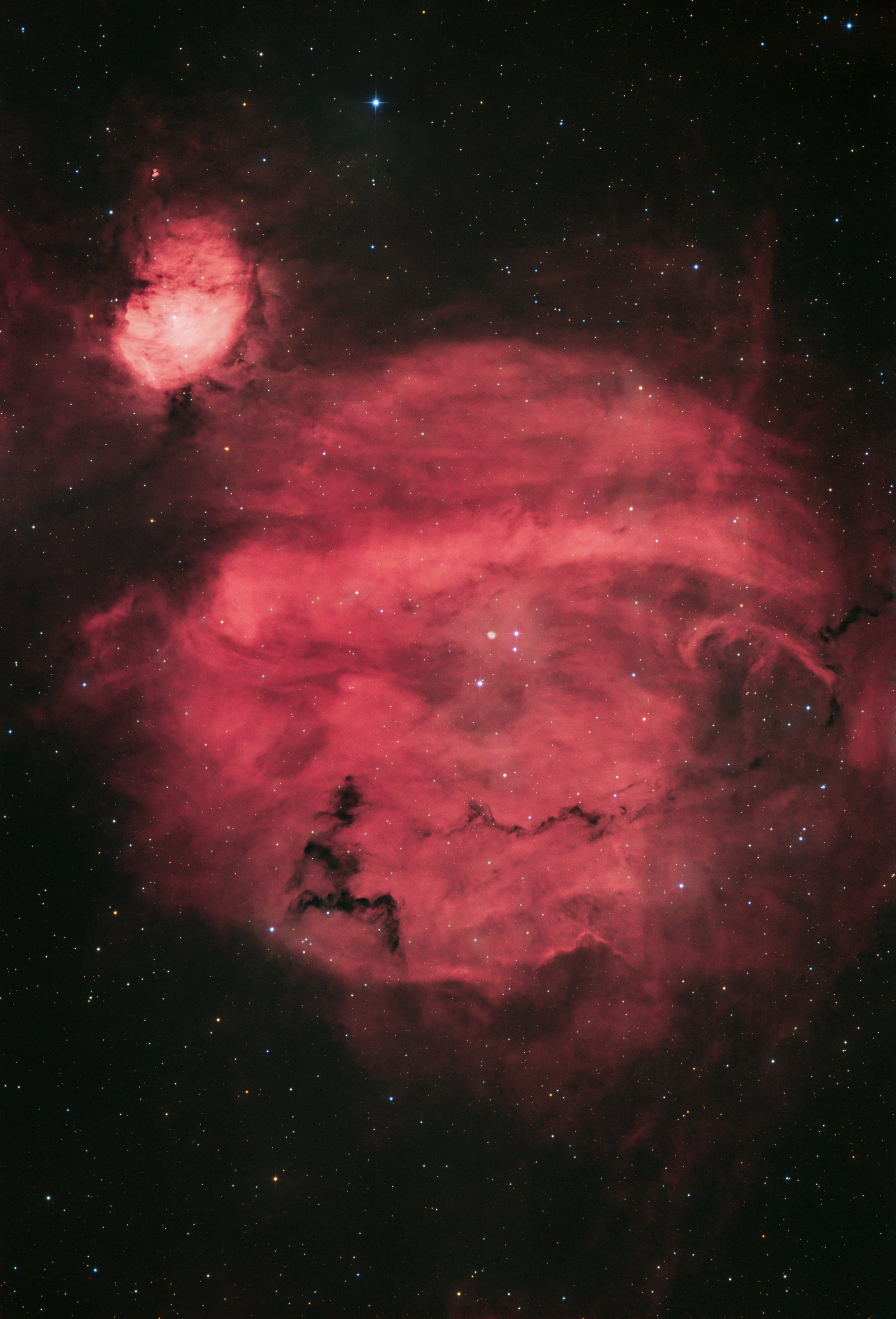
Sh2-231 through Sh2-235 form an extended complex of ionized hydrogen clouds in the Perseus Arm of the Milky Way, one of the Galaxy’s major spiral arms beyond the Sun’s orbit. These Sharpless regions are emission nebulae where ultraviolet radiation from young, massive stars strips electrons from hydrogen atoms, causing the gas to glow strongly in Hα light. The brighter knots mark active and recent star formation, while the softer, more diffuse structures trace gas shaped by stellar winds and radiation over millions of years.
This deep view reveals the layered texture of the complex, with dark dust lanes cutting across luminous red emission and creating a sense of depth against the background star field. Captured from Cork City, Ireland, the image highlights both the scientific richness and visual elegance of this outer-galaxy region, showing how large-scale star-forming environments connect individual nebulae into a coherent galactic structure.
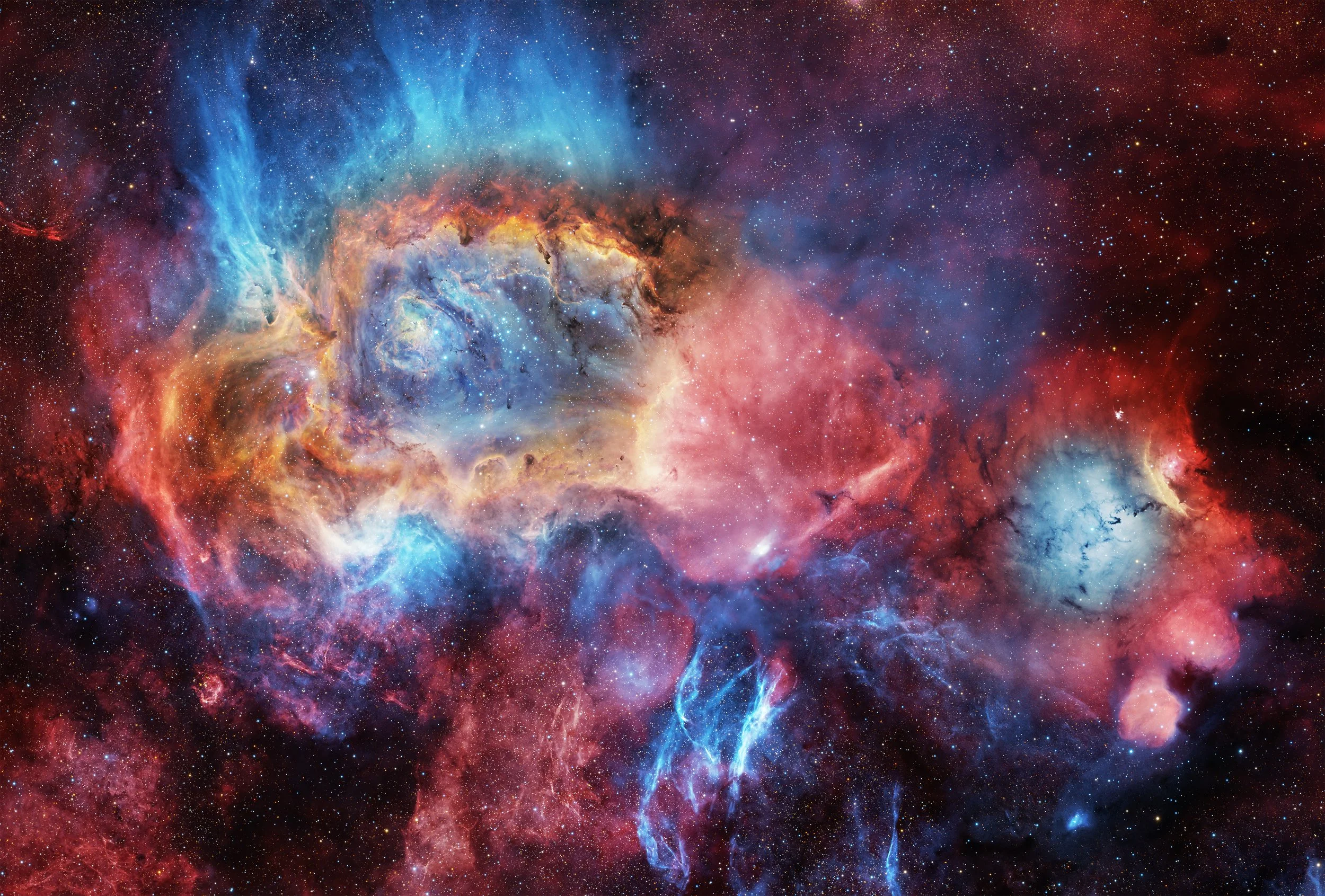
This richly detailed wide-field view captures a luminous crossroads of stellar birth and death in the constellation Sagittarius. At center left lies Messier 8, the Lagoon Nebula, a vast star-forming region where glowing hydrogen gas is sculpted by intense radiation from young, massive stars. Nearby, the Trifid Nebula, Messier 20, stands out through its striking contrast of blue reflection nebula and red emission gas, divided by dark lanes of cold dust that trace the earliest stages of stellar evolution.
Threaded through this vibrant complex is the faint supernova remnant G007.5−01.7, a delicate veil of energized gas left behind by the explosive death of a massive star. Its subtle filaments blend into the surrounding nebulae, revealing how stellar feedback enriches and reshapes the interstellar medium. Together, these objects illustrate the cyclical nature of the Milky Way, where star formation and stellar destruction coexist within the same dynamic environment, driven by gravity, radiation, and shock waves over millions of years.
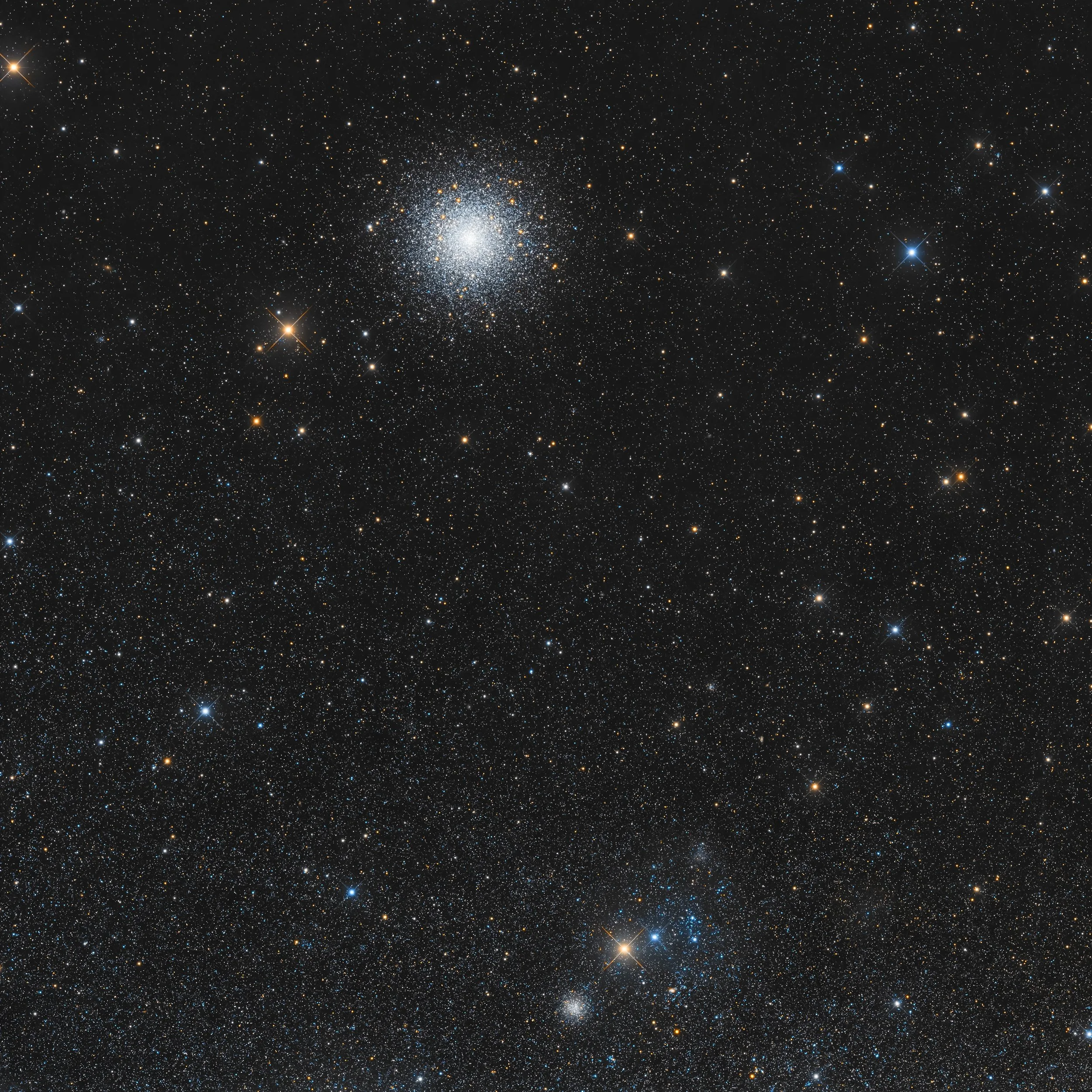
This festive star field centers on the globular cluster NGC 362, whose dense, luminous core and radiating chains of stars evoke the impression of a celestial Christmas tree crowned by a bright stellar star. Scattered foreground stars sparkle like ornaments, while subtle color variations give the field a warm, celebratory glow. The visual rhythm of bright points and faint background stars creates a natural holiday motif, turning this region of the southern sky into a fitting Christmas Day tableau.
Scientifically, NGC 362 is a compact globular cluster located in the constellation Tucana, gravitationally bound by hundreds of thousands of ancient stars. These stars formed early in the Milky Way’s history and are packed tightly toward the cluster’s center, producing its intense brightness and spherical structure. Seen near the outskirts of the Small Magellanic Cloud, NGC 362 offers a striking contrast between the ordered, ancient population of a globular cluster and the rich, layered star fields of the Galactic halo, reminding us that even the oldest stellar systems can still shine with seasonal beauty.
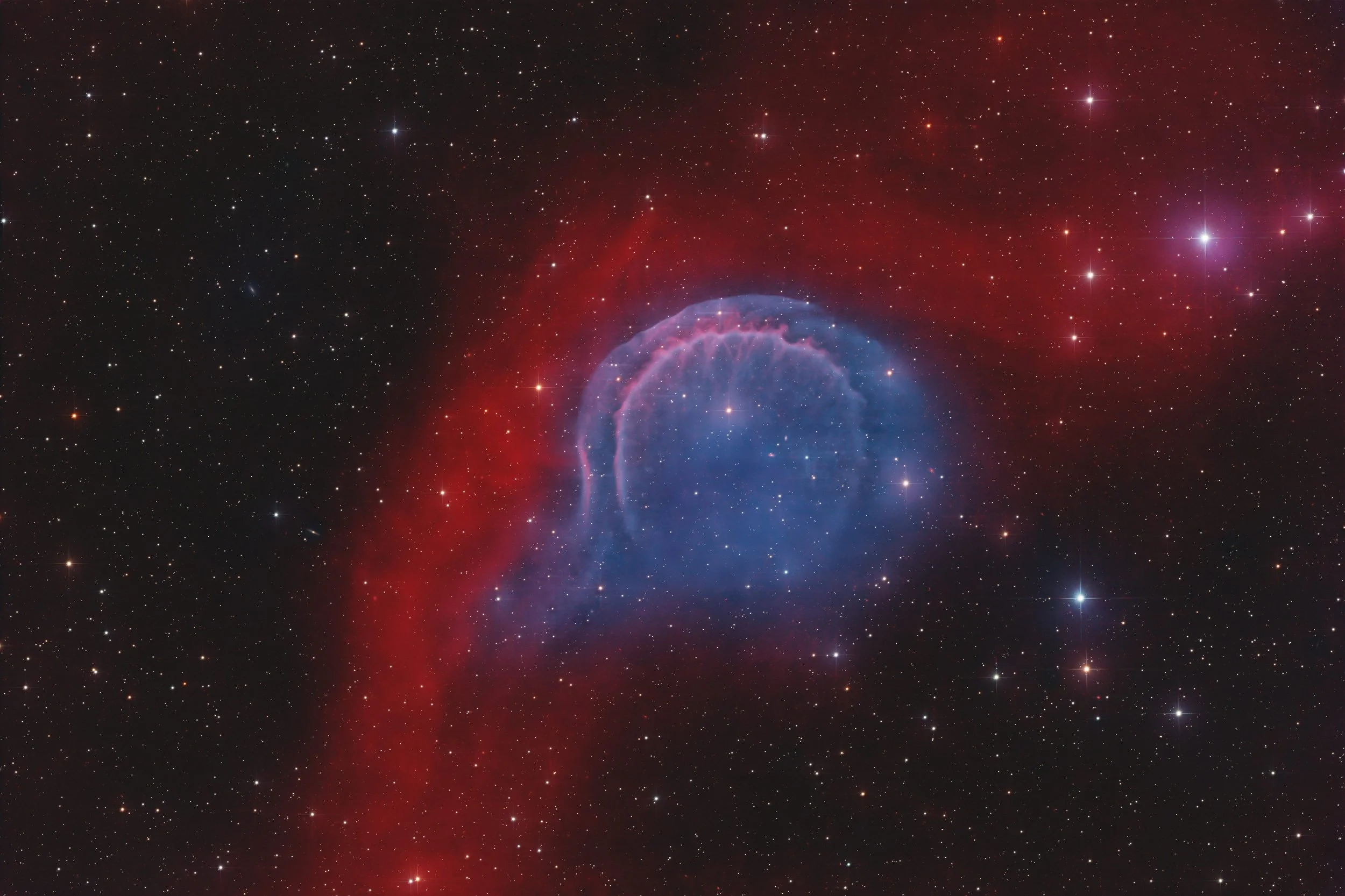
Hartl-Dengel-Weinberger 3 is an extremely faint and evolved planetary nebula, the remnant of a Sun-like star that shed its outer layers near the end of its life. What remains is a tenuous shell of ionized gas, now highly diluted and interacting with the surrounding interstellar medium. Its advanced age makes HDW 3 difficult to detect, as much of its original structure has dispersed and faded, leaving only subtle emission that traces the final stages of stellar mass loss.
In this deep image, the nebula appears as a delicate, translucent blue arc embedded within a broader field of red hydrogen emission. The contrasting colors reveal different excitation processes, with oxygen-dominated emission outlining the faint nebular shell while hydrogen gas in the background hints at unrelated Galactic structures along the line of sight. The scene highlights both the fragility and longevity of planetary nebulae, showing how the quiet death of a star can leave behind a ghostly imprint that persists for tens of thousands of years.
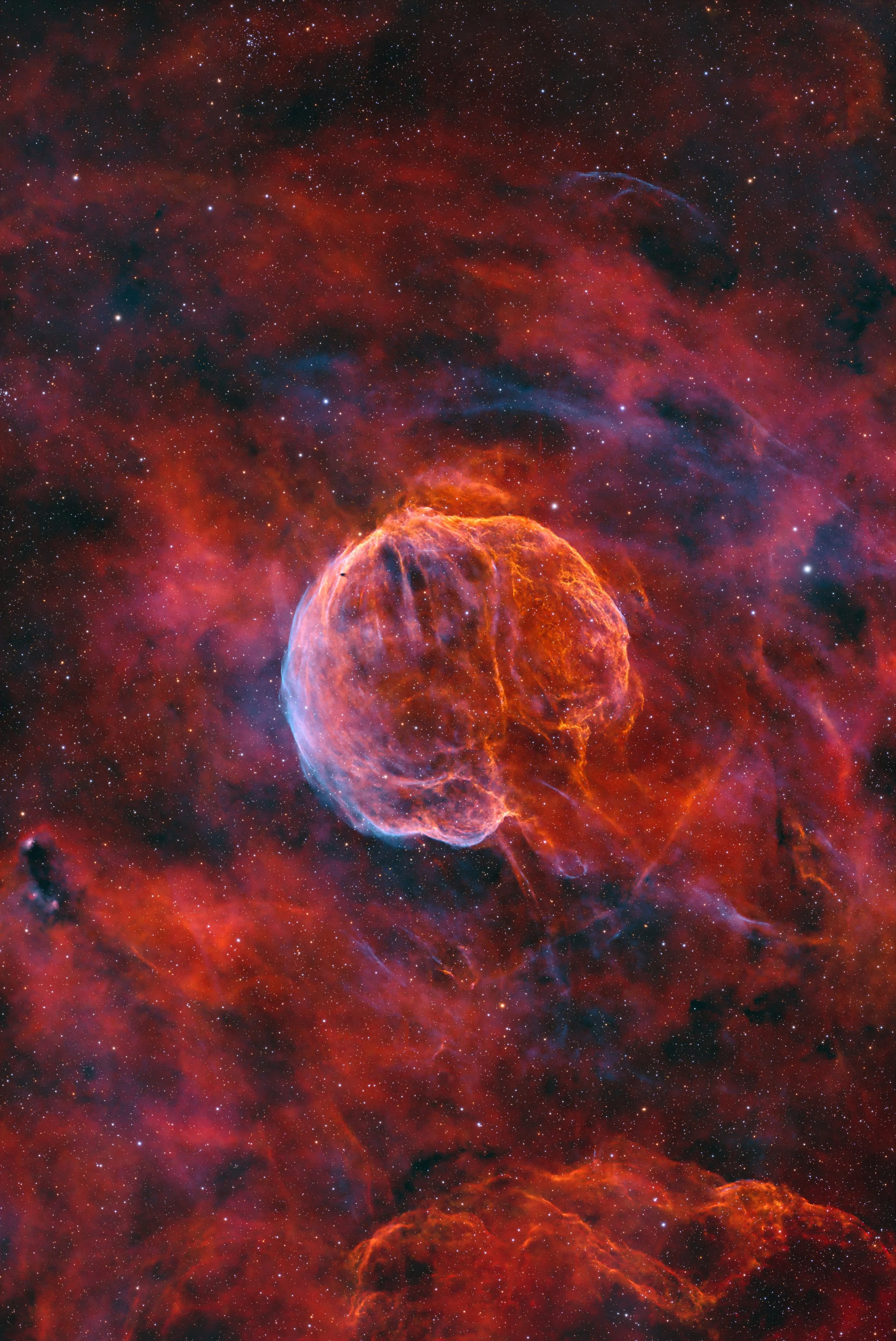
The Garlic Nebula, cataloged as CTB 1, is a supernova remnant located in the constellation Cassiopeia. It marks the expanding shock front from a massive star that ended its life thousands of years ago, sweeping up and ionizing the surrounding interstellar medium. The faint, nearly spherical shell traces regions of energized hydrogen, oxygen, and sulfur, revealing how stellar explosions enrich and restructure their galactic environment.
Captured with 84 hours of total exposure from Starfront Observatories in Rockwood, Texas, USA, this deep narrowband image brings out the delicate filaments and turbulent arcs that give CTB 1 its distinctive, clove-like appearance. The contrasting cool blue oxygen emission against warmer hydrogen and sulfur highlights the layered structure of the remnant, while the surrounding star field provides scale to the vast, slowly fading echo of a stellar death.
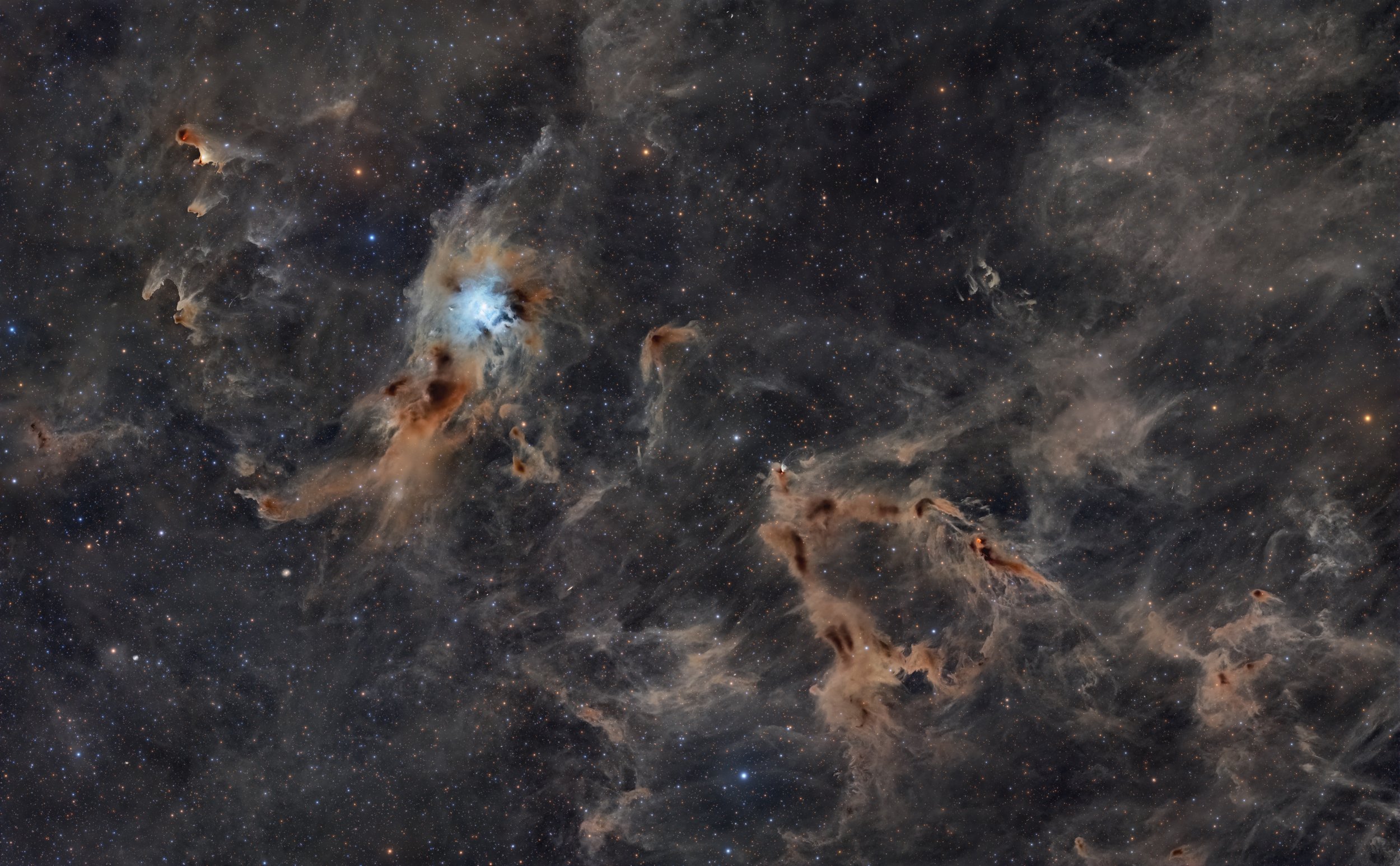
At the heart of this expansive four-panel mosaic lies the Iris Nebula, also cataloged as NGC 7023 or Caldwell 4, glowing with a vivid blue light produced by reflected starlight. This reflection nebula is illuminated primarily by the hot, young star HD 200775, whose radiation scatters off fine interstellar dust grains, giving the Iris its characteristic blue hue. Embedded within the nebula is the sparse open cluster OCL 235, whose stars are still closely linked to the dusty molecular environment from which they formed.
Surrounding the Iris Nebula is an intricate web of faint interstellar dust clouds, often referred to as galactic cirrus. These wispy structures trace cold, diffuse material within the Milky Way and are visible here through a combination of reflected starlight and subtle extinction against the dense star field. With over 81 hours of total integration, this mosaic reveals both the bright core of NGC 7023 and the delicate, large-scale dust flows that connect it to the surrounding interstellar medium, highlighting the complex interplay between stars, dust, and light.
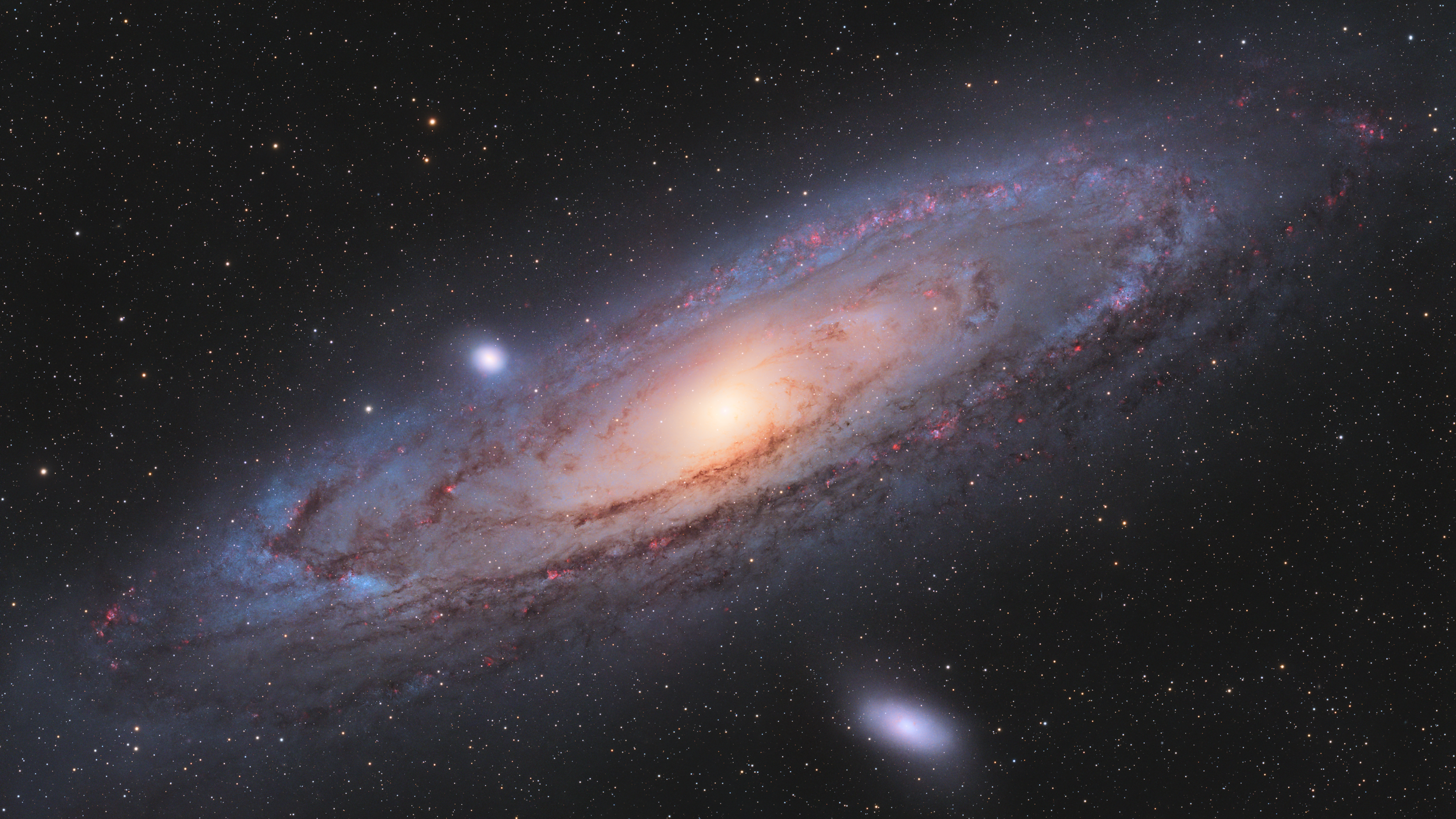
The Andromeda Galaxy (M31) dominates this two panel mosaic with its vast spiral disk seen at a slight inclination, revealing intricate dust lanes, star clouds, and glowing star forming regions traced by faint red emission. The bright central bulge marks the galaxy’s dense core, while its extended arms span well beyond what is typically visible in shorter integrations, highlighting the true scale of our nearest large galactic neighbor at roughly 2.5 million light years away.
Surrounding M31 are numerous foreground Milky Way stars and its prominent satellite galaxies, including M32 and M110, which appear as compact elliptical companions embedded in the same field of view. Captured from Vancouver, British Columbia, Canada, this deep RGB mosaic totaling more than 24 hours of exposure emphasizes both the subtle color gradients across Andromeda’s disk and the delicate structures formed by gas, dust, and billions of stars interacting over cosmic time.
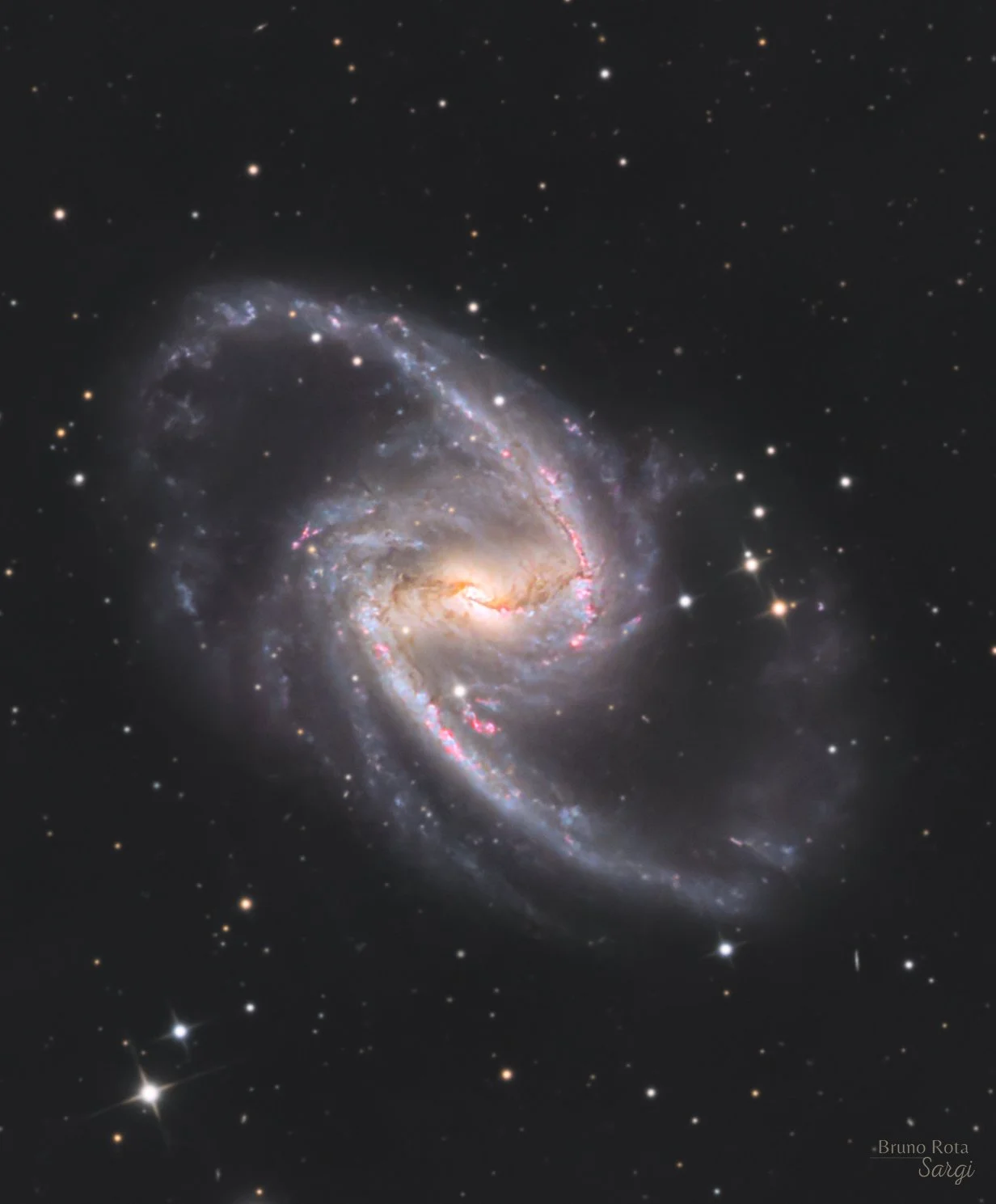
NGC 1365 is a massive barred spiral galaxy located in the Fornax constellation, approximately 56 million light-years from Earth. It is one of the most striking examples of a barred spiral, with a dominant central bar stretching across its core and feeding material into tightly wound spiral arms. Along these arms, pink Hα regions trace intense star formation, while blue clusters mark populations of young, massive stars. At the galaxy’s center lies an active nucleus powered by a supermassive black hole, whose influence shapes the inner structure and dynamics of the system.
This image reveals the delicate balance between structure and motion within NGC 1365. Dust lanes curve inward along the bar, guiding gas toward the core, while the outer arms fragment into luminous knots and filaments against the dark background of space. The surrounding star field and faint background galaxies emphasize both the scale of NGC 1365 and its isolation within the cosmic web, offering a detailed view of how bars drive evolution in large spiral galaxies.
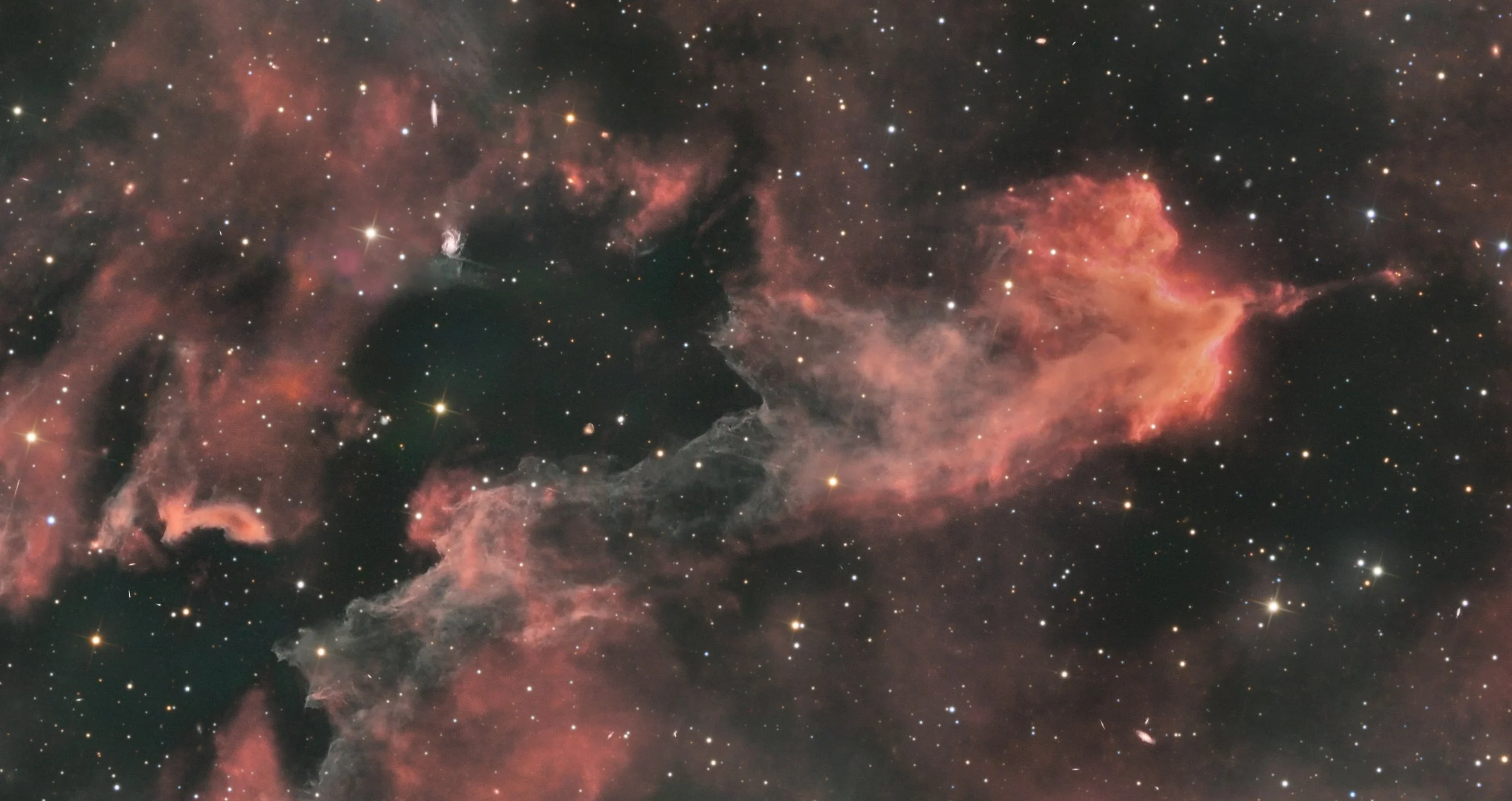
LBN 438 is a faint dark and emission nebula in the constellation Lacerta, cataloged by Beverly Lynds as part of her survey of obscure nebulae. The structure is shaped by dense interstellar dust that blocks background starlight while adjacent hydrogen gas glows faintly where it is energized by nearby stars. Subtle filaments and knots trace the turbulent boundary between illuminated gas and cold molecular material, offering a glimpse into the complex environments where stars may eventually form.
Nicknamed the Sandworm or Shai-Hulud for its sinuous, creature-like appearance, the nebula stretches across a rich Milky Way star field that enhances its dramatic silhouette. Captured from the Alentejo Remote Observatory, this image emphasizes the contrast between the dark, light-absorbing dust lanes and the softly glowing reddish hydrogen emission, revealing a rarely imaged structure that blends astrophysical processes with a striking visual form.
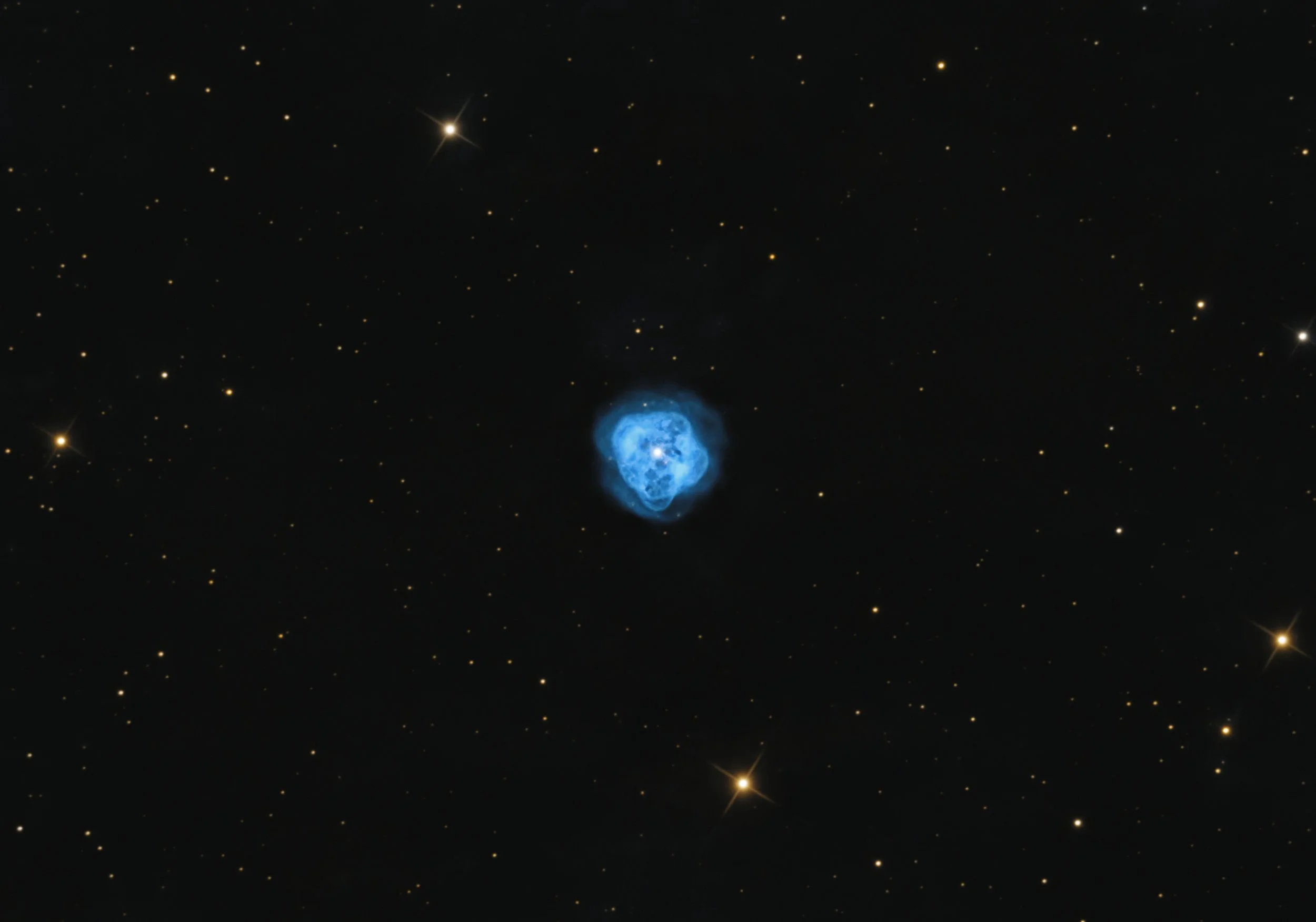
NGC 1514, often called the Crystal Ball Nebula, is a planetary nebula in the constellation Taurus, formed when a Sun-like star shed its outer layers near the end of its life. The expanding shell of ionized gas is energized by a hot central star system, causing oxygen-rich regions to glow blue while revealing a complex, layered structure that hints at multiple episodes of mass loss. The nebula lies roughly 1,500 light-years away and spans about two light-years across.
Set against a dense, star-filled background, this view emphasizes the nebula’s translucent appearance and softly contoured edges, giving it a floating, glass-like quality. Captured from New Delhi, India, the image contrasts the delicate, luminous gas with warm-colored field stars, highlighting both the fragile beauty of stellar death and the richness of the surrounding Milky Way.
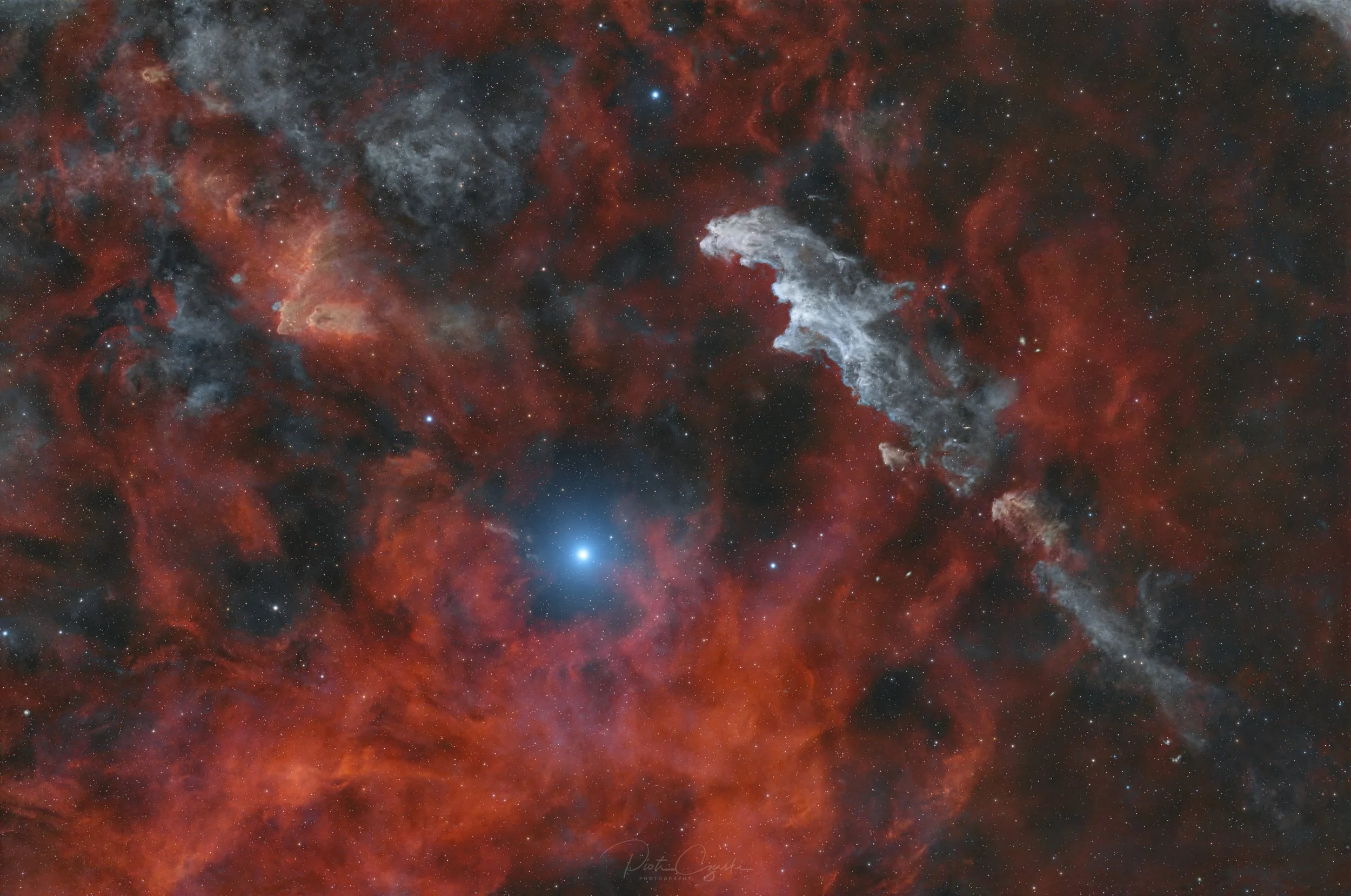
The Witch Head Nebula, IC 2118, appears in this deep wide field view as a delicate blue reflection nebula illuminated by starlight from Rigel, just beyond the frame in Orion. Rather than glowing from its own emission, the nebula’s fine dust grains scatter the intense light of this nearby supergiant, giving the region its ghostly blue appearance against the surrounding star field.
Extended integration reveals a subtle tapestry of faint Hα emission interwoven with dark dust clouds across the background, structures that are often lost in shorter exposures. These features trace the interaction of gas, dust, and radiation within the Orion Molecular Complex, offering a quiet but detailed look at how massive stars shape their surrounding interstellar environment.
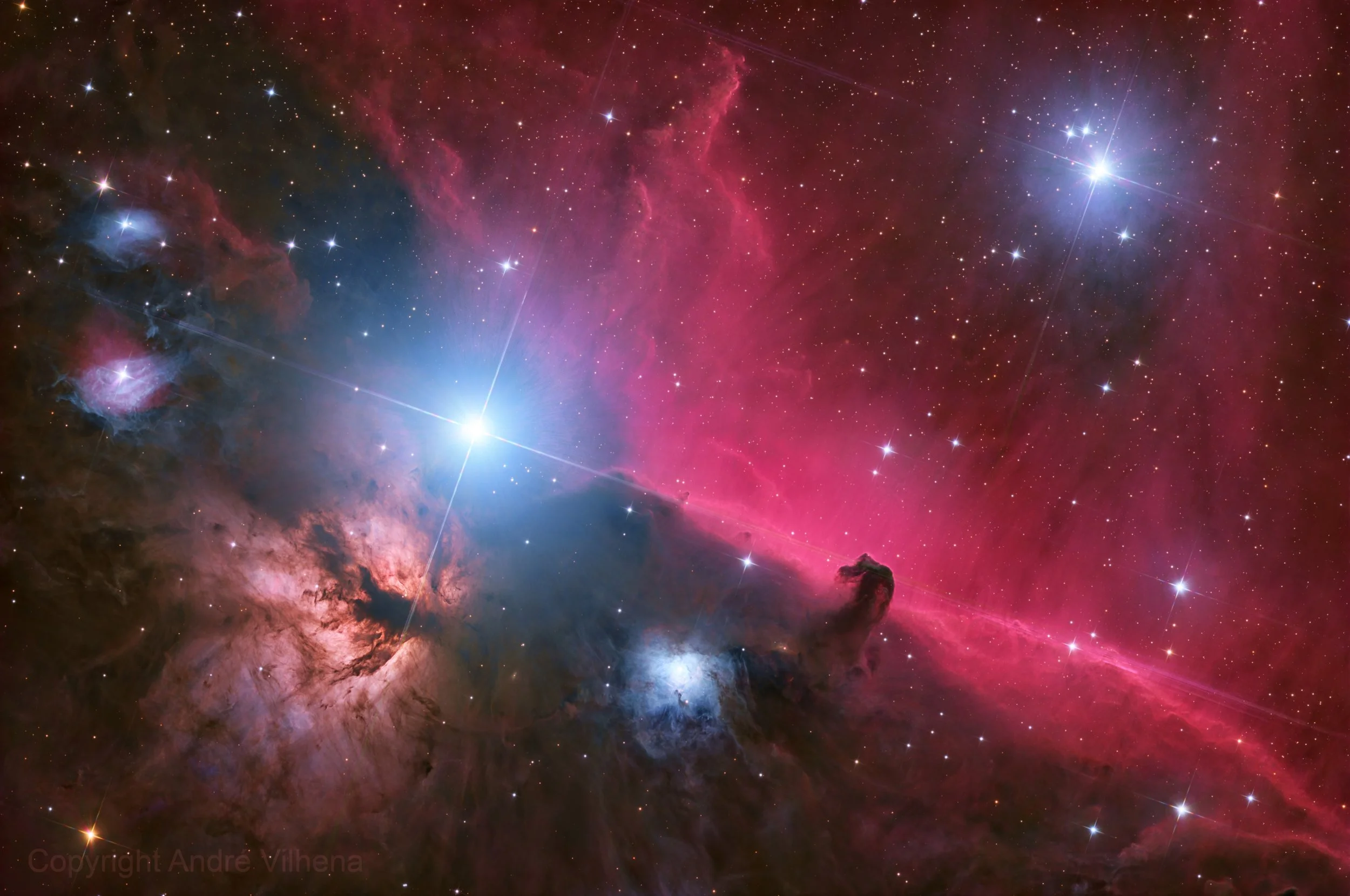
Silhouetted against the glowing hydrogen backdrop of IC 434, the Horsehead Nebula is a dense pillar of cold molecular gas and dust located in the constellation Orion, roughly 1,300 light-years from Earth. Cataloged as Barnard 33, this iconic dark nebula is shaped by intense ultraviolet radiation from nearby massive stars, which ionizes the surrounding hydrogen and slowly erodes the cloud’s edges. The contrast between the opaque dust and the luminous emission nebula behind it gives the Horsehead its unmistakable profile.
This image combines broadband RGB and luminance data with deep H-alpha exposure to reveal both the subtle dust structures within the nebula and the surrounding emission and reflection regions. The bright star illuminating the scene energizes the hydrogen gas, while embedded blue reflection nebulae trace starlight scattering off fine dust grains. Together, these elements showcase a dynamic stellar nursery where gravity, radiation, and interstellar matter interact on vast scales.
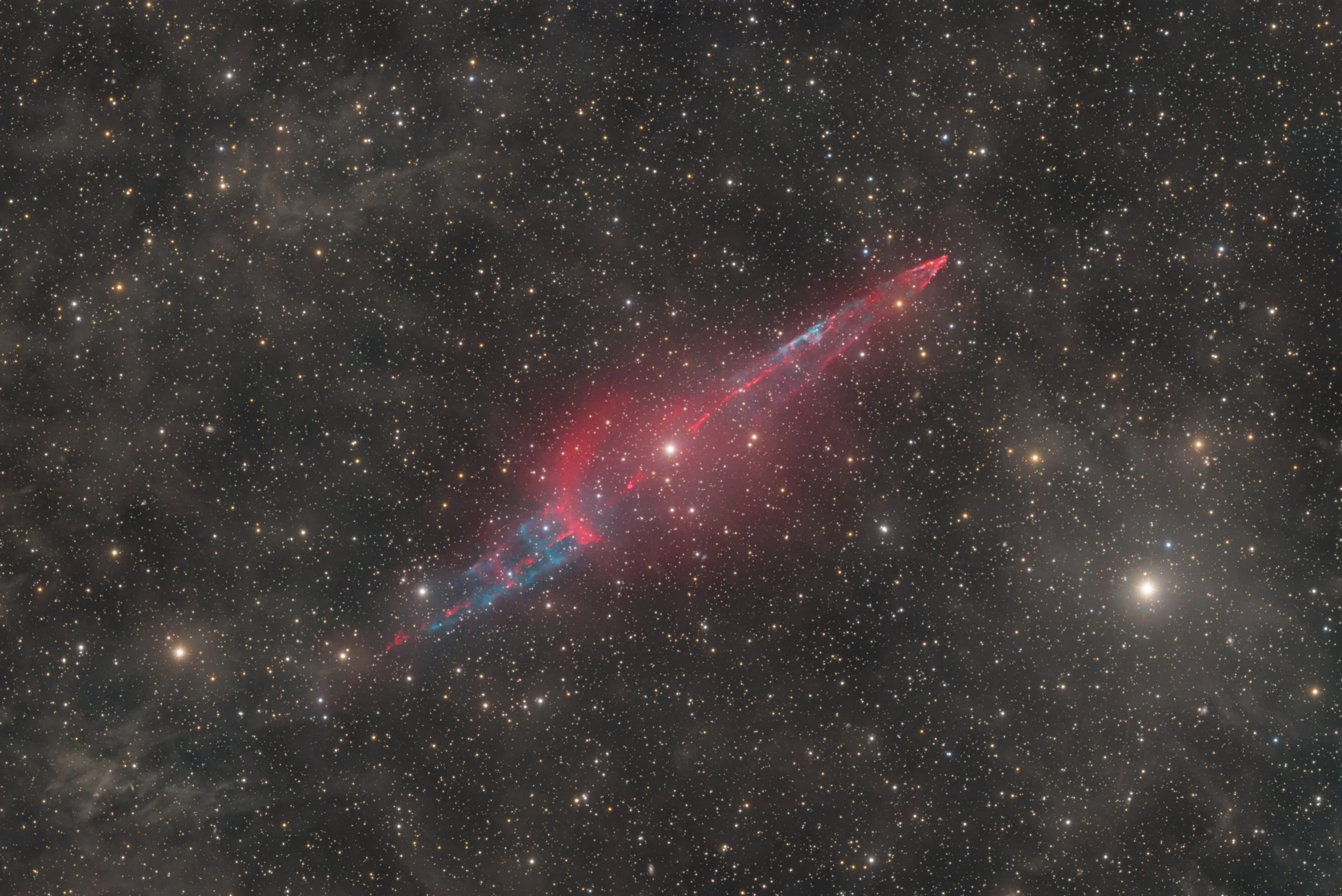
KX Andromedae displays a striking pair of collimated Hα jets driven by a dynamic mass-transfer process within this interacting binary system. Material from the secondary star overflows its Roche lobe and accretes onto the Be star, where it forms a dense circumstellar environment. As this material builds up, it is expelled perpendicular to the orbital plane in two opposing directions, forming the long, filamentary outflows seen here. The vivid reds trace ionized hydrogen, while the bluish knots reveal regions of shock-excited gas sculpted by the jet’s passage through the surrounding interstellar medium.
The Be star likely provides the ultraviolet radiation responsible for ionizing the jets, giving them their distinct Hα glow. Against a rich star field and faint dust, the structure stretches across the frame like a cosmic spear, showcasing the powerful consequences of stellar interaction. This view highlights a rare opportunity to witness stellar mass transfer in action, captured as a luminous, finely sculpted bipolar outflow.
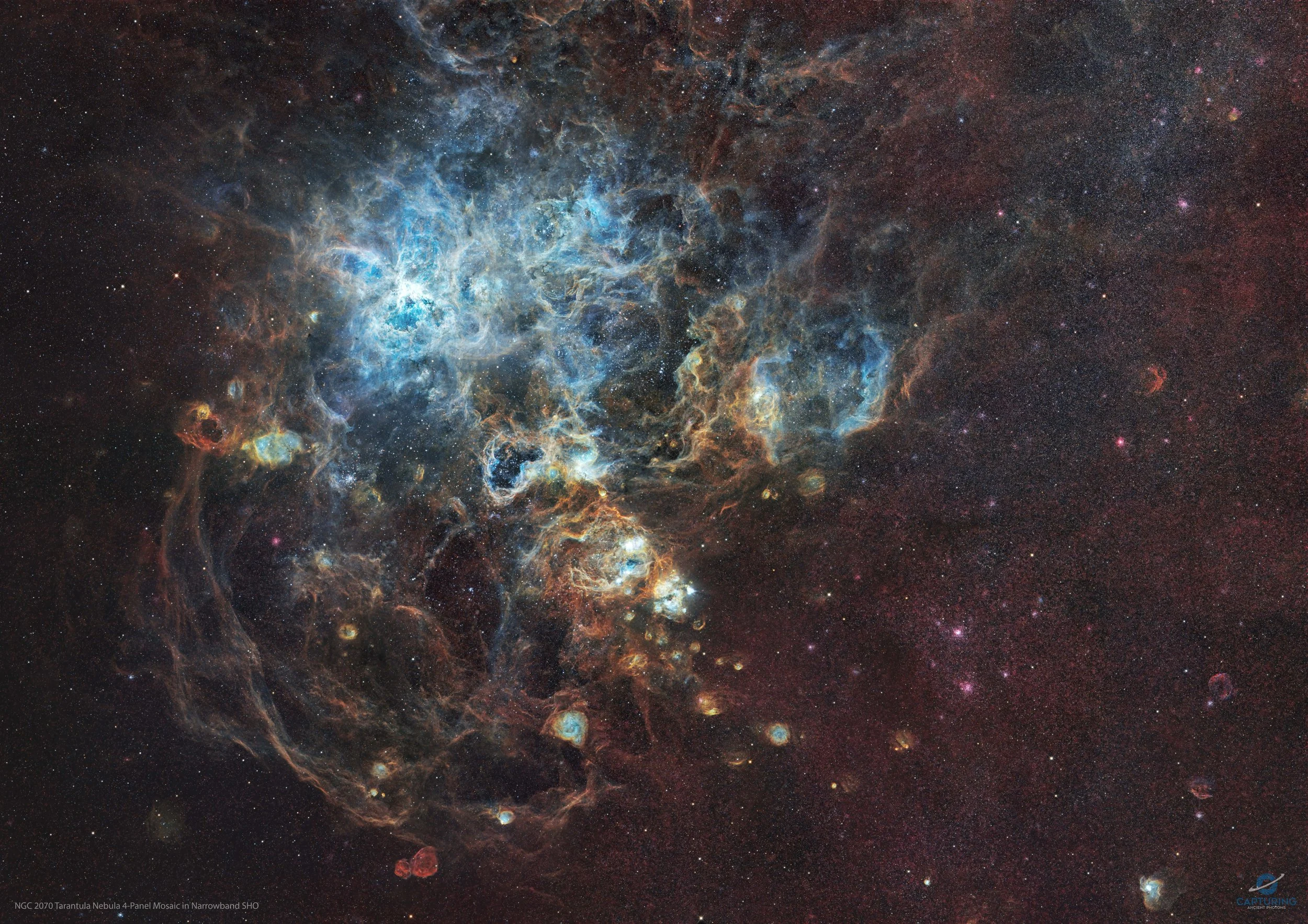
The Tarantula Nebula, cataloged as NGC 2070 or 30 Doradus, is the most active star forming region in the Local Group. Located in the Large Magellanic Cloud about 160 thousand light years away, it contains immense clouds of ionized hydrogen sculpted by powerful stellar winds and radiation from the massive stars in the central cluster R136. These young stars energize the nebula so intensely that the region outshines entire small galaxies, making it a striking example of how extreme star birth can shape and illuminate the interstellar medium.
Filaments, ridges, and cavities weave throughout the nebula, each tracing the aftermath of past generations of massive stars that have already ended their lives in supernova explosions. Shock fronts from those explosions continue to trigger new waves of star formation, creating a dynamic cycle of collapse and renewal. The Tarantula Nebula offers a rare look at large scale stellar feedback in real time and reveals what conditions may have been like in the early Milky Way when star formation rates were significantly higher.
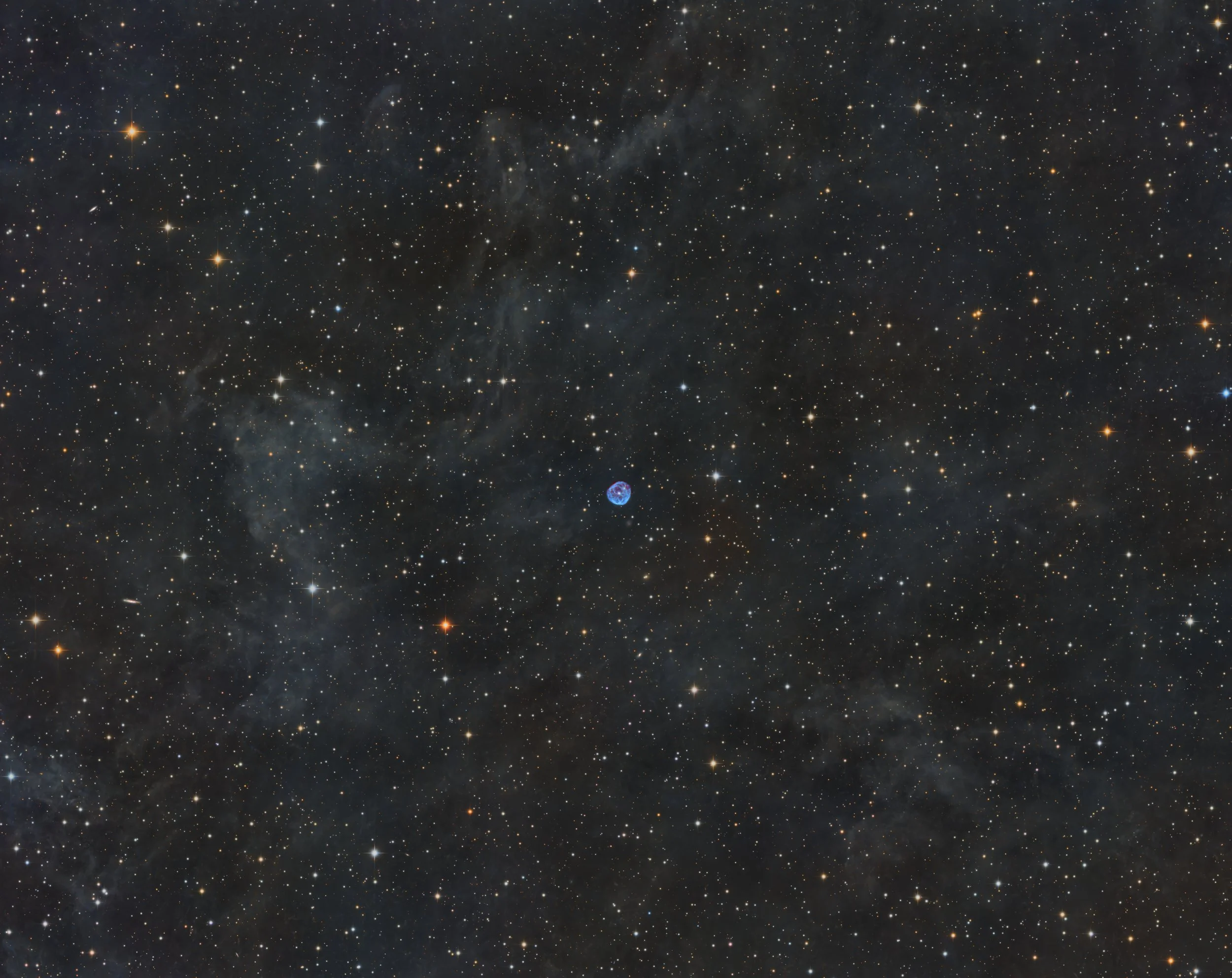
NGC 7094 sits as a delicate blue-green bubble in the center of a vast, dusty starfield in Pegasus. This faint planetary nebula surrounds a rare hybrid PG 1159 star, a dying stellar core transitioning between the planetary nebula and white dwarf phases. Its intricate ionized shell shines in OIII and Hβ emissions, producing the cool-toned glow that stands in vivid contrast to the warm field stars around it. The surrounding nebulosity is not produced by the nebula itself but instead belongs to the network of diffuse interstellar dust that threads through this region of the Milky Way.
Nearly 12 hours of LRGB exposure were needed to reveal the subtle cirrus-like dust structures across the frame. These faint clouds scatter starlight and create soft gradients that give the scene depth and texture. Against this dim backdrop, the compact nebula appears almost like a gem suspended in a wide and ancient cosmic fog, highlighting how small planetary nebulae truly are when placed within the broader galactic environment.
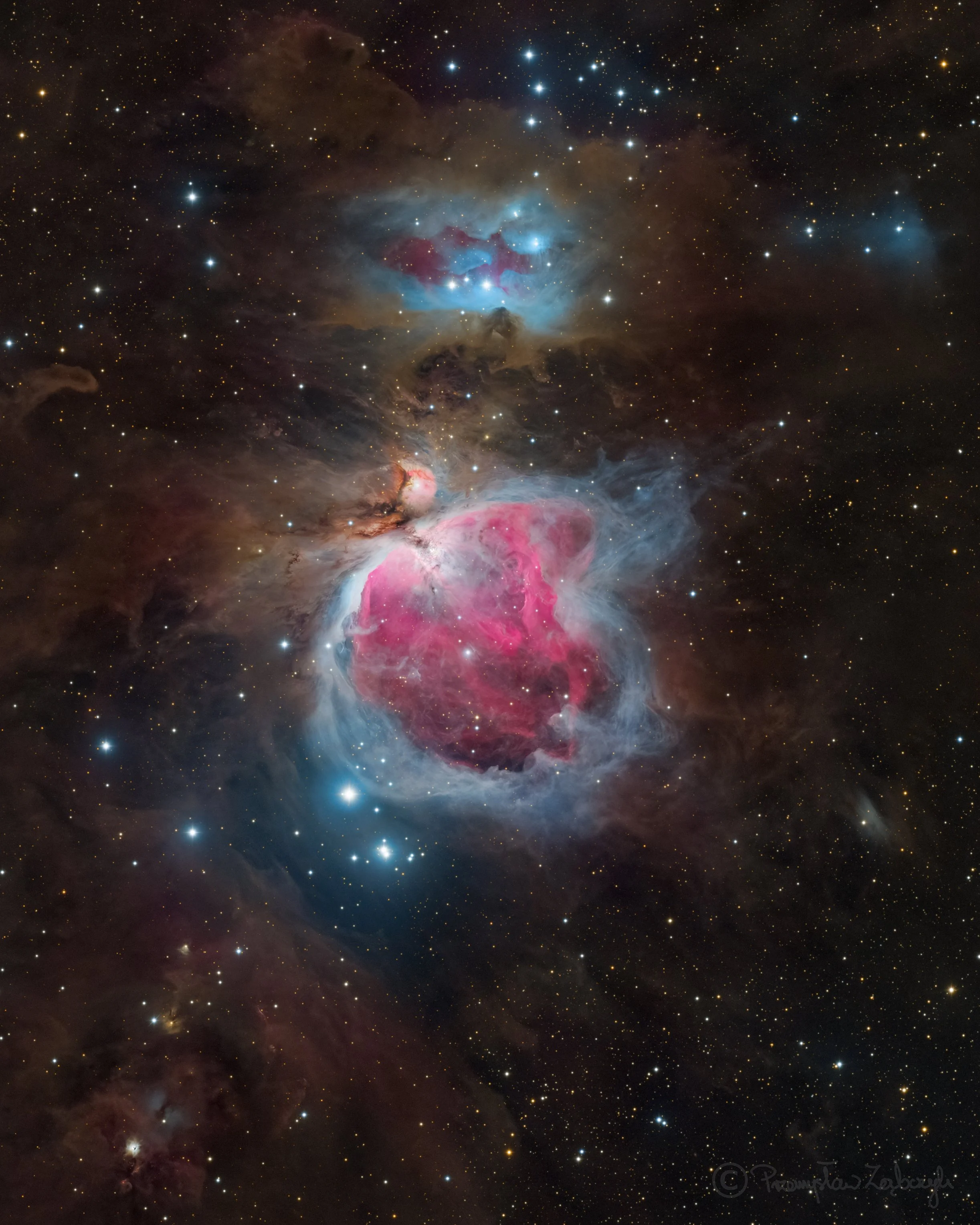
This deep broadband integration reveals the heart of the Orion Molecular Cloud Complex where massive stars are actively shaping their surroundings. At the center of the larger pink and white glow is the Orion Nebula (M42) illuminated by the Trapezium cluster whose intense ultraviolet radiation ionizes the surrounding hydrogen and sculpts dramatic waves of gas and dust. Subtle blue reflection regions intertwine with billowing red emission fronts that trace shock waves and turbulence in one of the closest and most studied stellar nurseries.
Above M42 sits the Running Man Nebula (NGC 1977–1975–1973) a trio of reflection and emission regions lit by hot young stars. Wisps of illuminated dust drift between the two complexes forming a continuous tapestry of scattered starlight and dark molecular clouds. This image combines over 20 hours of luminance and RGB exposures collected with a Takahashi FSQ-106EDX III and a Moravian G3-16200EC camera capturing an exceptionally smooth and detailed view of the most active star forming region in the winter sky.
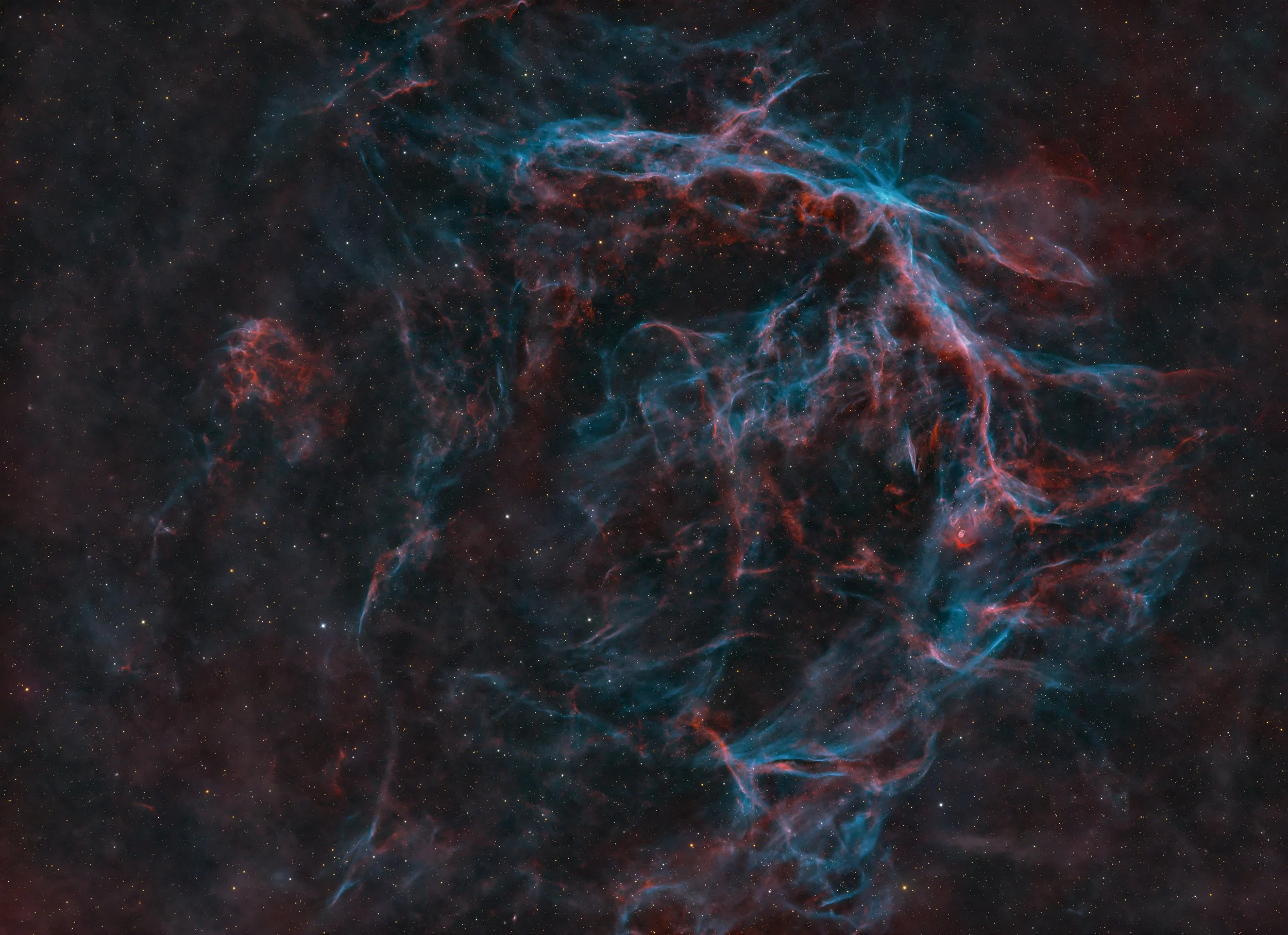
SNR G119.5+10.2 also known as CTA 1 is a faint and sprawling supernova remnant in Cepheus created by a massive star that exploded roughly 10 to 14 thousand years ago. Its interior hosts a weak pulsar whose energetic output continues to drive gas outward shaping the subtle filaments that arc across the field. Although the remnant was suspected to contain a pulsar when it was first identified in 1960 no signal was found until 2008 when sensitive observations finally revealed the faint emission. The surrounding structures show the diffuse glow of ancient shocked material slowly expanding into the interstellar medium.
Near the lower portion of the frame sits NGC 40 a compact planetary nebula often imaged on its own but rarely placed in context with the much larger and fainter CTA 1. In this deep 40 hour integration captured in HSO filters with an F2.2 RASA astrograph and an ASI6200MM camera from Pendleton Oregon the planetary appears as a bright knot against the sweeping remnants of the supernova. The combination highlights two very different stages of stellar evolution one from a dying low mass star and the other from the violent end of a massive one all sharing the same rich region of Cepheus.
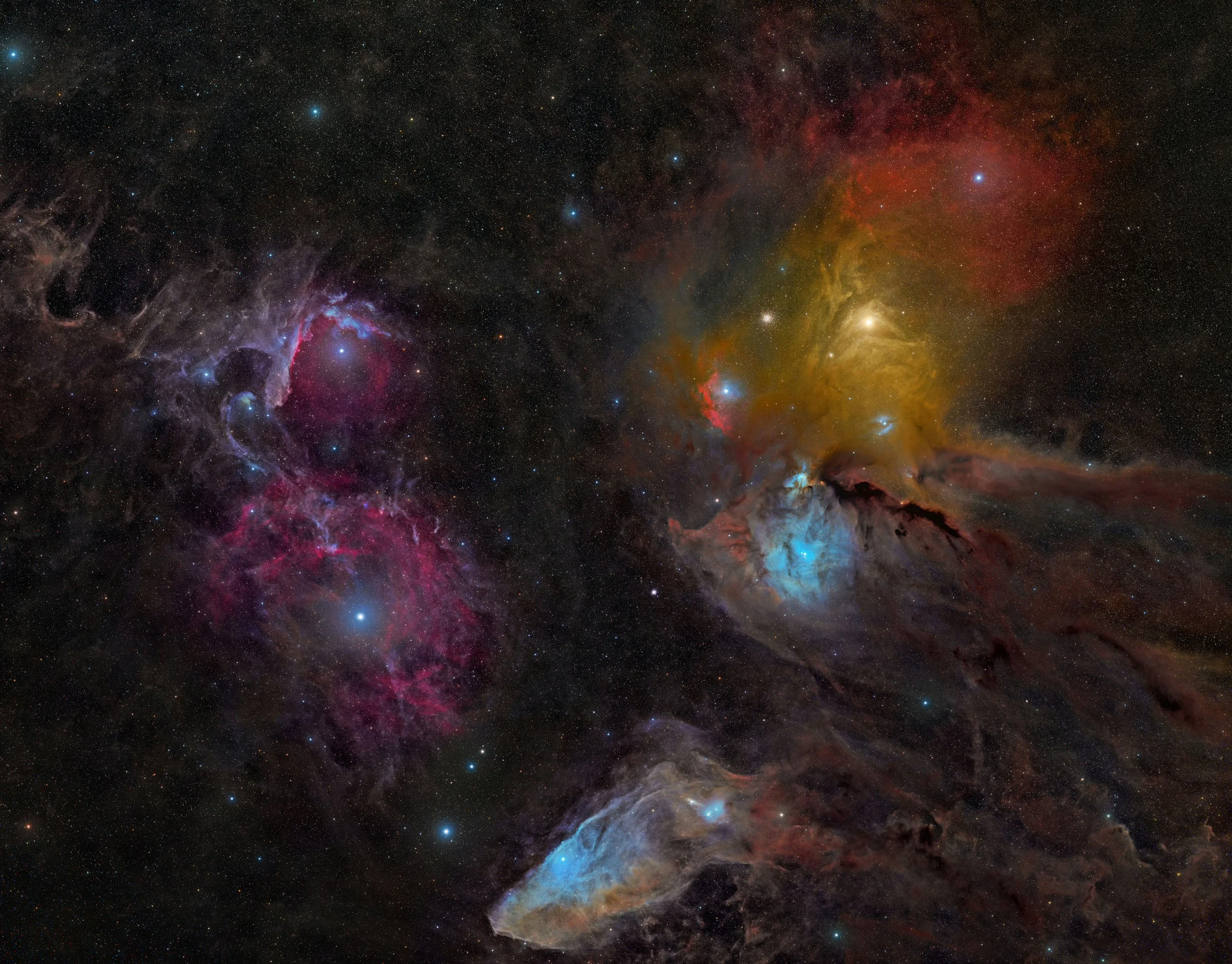
This 30-panel, 180-hour mosaic unifies some of the most dynamic and colorful regions of the summer sky, stretching from the Blue Horsehead Nebula through the Rho Ophiuchi complex and down into the reflection structures of SH2-1 and SH2-7. The field is a tapestry of competing processes: brilliant blue reflection nebulae sculpted by starlight, deep red hydrogen clouds marking active star birth, and golden dust lanes drifting across the frame like smoke illuminated from within. The mosaic’s immense depth reveals not only the well-known features but also the faint cirrus and transitional dust structures that connect them, showing how these regions belong to the same vast, evolving molecular environment.
The wide coverage and long integration time help preserve subtle color gradients across the complex. In the north, the Blue Horsehead arcs in reflective blue, its contours shaped by the illumination of nearby bright stars. At the core, Rho Ophiuchi blazes with an unusual mix of reflection, emission, and dense shadowed dust. Southward, SH2-1 and SH2-7 unfold in softer tones, their structures hinting at older, more diffuse stages of stellar evolution. This mosaic brings together these diverse environments into a single coherent scene, revealing the full interconnectedness of one of the sky’s most photogenic and scientifically rich regions.
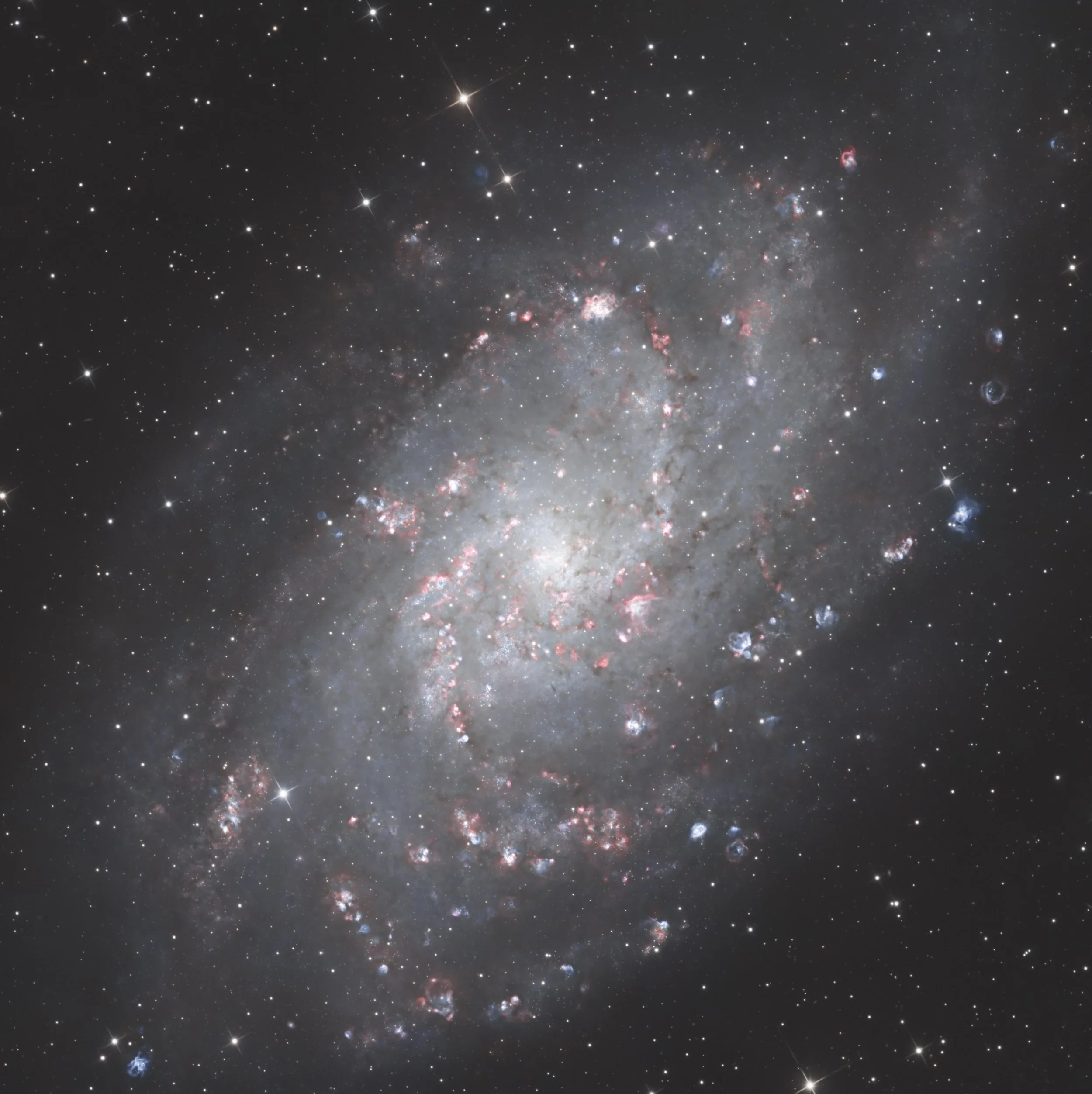
This deep HOO-RGB portrait of the Triangulum Galaxy (M33) reveals the galaxy’s sprawling spiral structure filled with luminous star-forming regions. The combination of long-exposure Hα and OIII highlights the vast network of ionized nebulae woven through the spiral arms, while the RGB data preserves the galaxy’s natural starlight and delicate dust lanes. The result is a scientifically rich view that shows M33 as an active, evolving system where clusters of young, hot stars energize the surrounding gas into glowing pink and blue emission.
Using two telescopes allowed both depth and detail: a 250 mm f/3 Newtonian captured 90 eight-minute exposures in Hα and OIII with a ZWO ASI 533 MC Pro, gathering the faint structural and ionized-gas features, while the Celestron RASA 8 provided 100 two-minute RGB frames to bring out the galaxy’s full-color continuum. Mounted together on a Sky-Watcher EQ6-R Pro, the dual-imaging approach produces a balanced and striking view of one of our Local Group neighbors, showcasing M33’s active stellar ecosystems and complex interstellar medium.
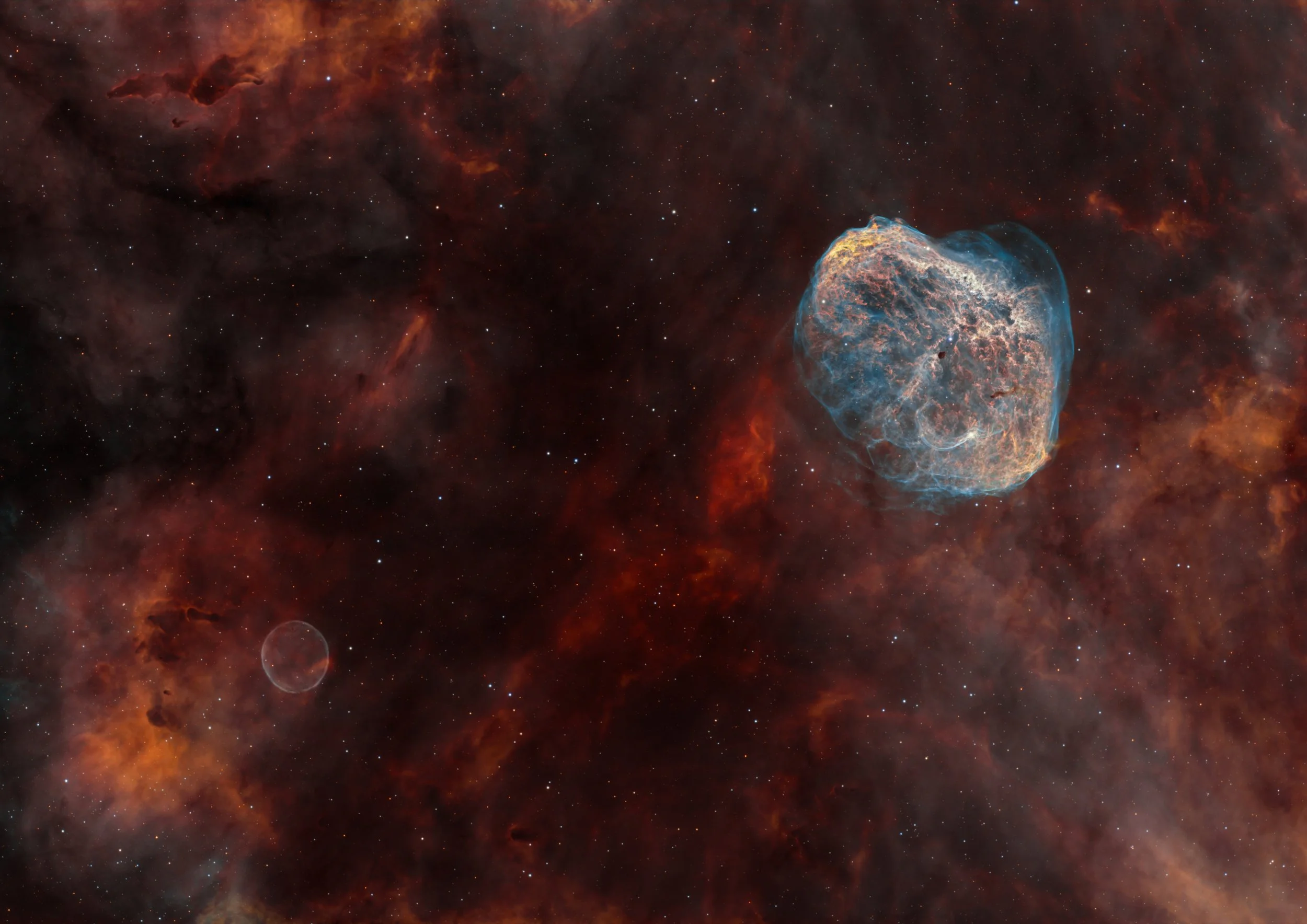
This narrowband portrait captures the Crescent Nebula and the elusive Soap Bubble Nebula suspended in the rich emission fields of Cygnus. The Crescent forms where a fast stellar wind from its Wolf Rayet star collides with slower material ejected in an earlier phase, sculpting a glowing shell of ionized hydrogen and oxygen. Nearby, the faint Soap Bubble reveals a nearly perfect sphere, a rare planetary nebula whose razor thin shell becomes visible only under deep integration.
Captured with the remote dual FF130 setup at Pixelskies in Southern Spain, this dataset blends contributions from both telescopes to resolve the intricate shock fronts and delicate filaments. The combination of careful acquisition by Jamie and Phil, meticulous pre-processing by Phil, and refined post-processing by Jamie brings forward subtle structures that are often hidden, including the Soap Bubble’s extremely low surface brightness envelope floating within the surrounding HII region.
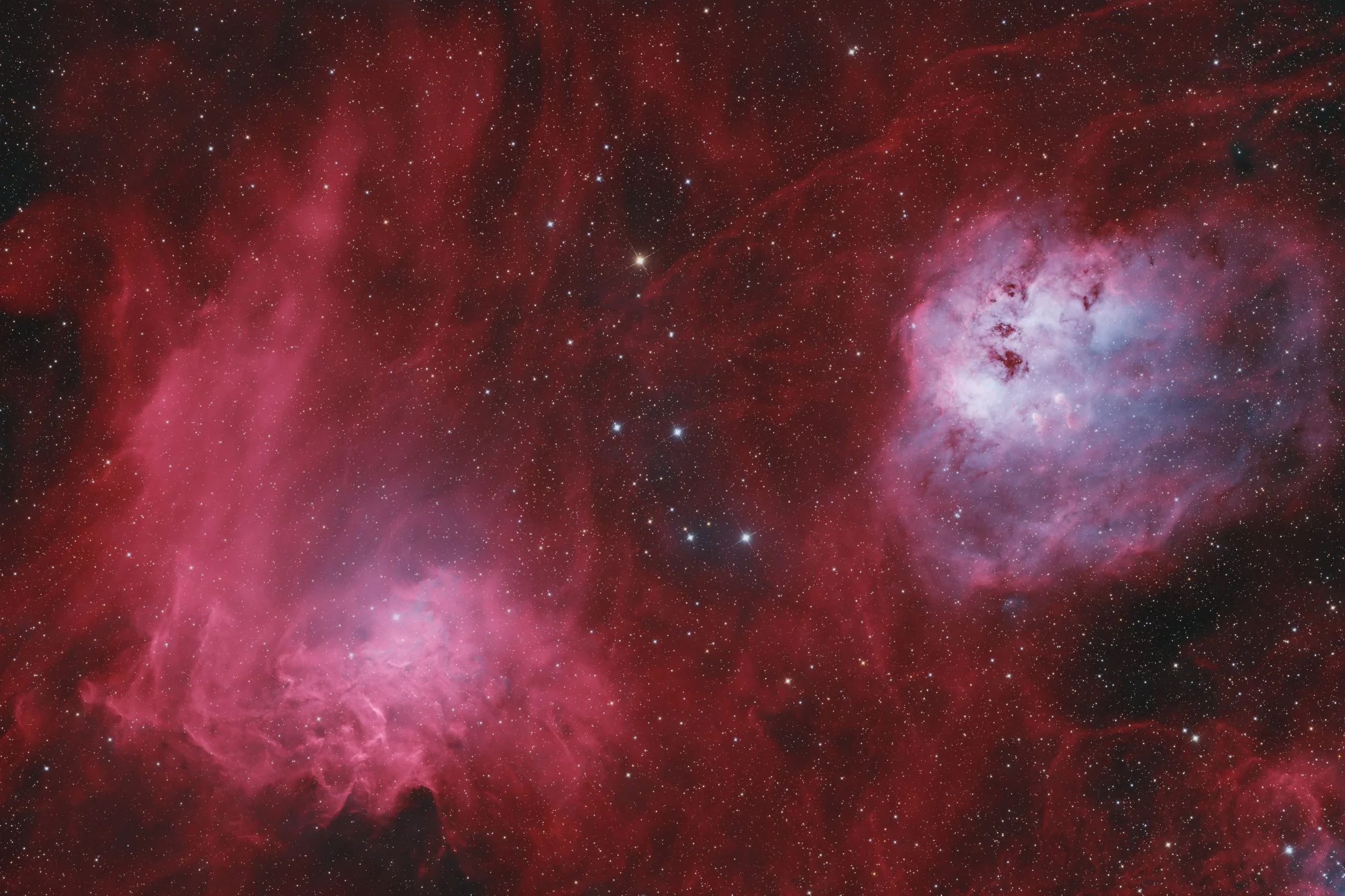
The Flaming Star Nebula (IC 405, left) and the Tadpole Nebula (IC 410, right) form one of Auriga’s most dynamic emission-reflection pairings. IC 405 glows in deep hydrogen emission shaped by the powerful ultraviolet radiation of the runaway O-type star AE Aurigae. Its delicate blue tones come from reflected starlight scattering off fine dust, while the surrounding crimson gas creates sweeping filaments that look almost fluid as they drift across the field. To the right, IC 410 reveals a brighter, more compact core where newly formed stars energize surrounding hydrogen. Embedded dark lanes and sculpted billows of gas give the nebula its textured appearance.
Across the frame, both nebulae are set inside a richly glowing hydrogen complex threaded with faint dust. The contrast between the soft, wispy emission of IC 405 and the denser, more structured glow of IC 410 highlights two different stages of stellar feedback shaping the same interstellar cloud. Together they form a dramatic portrait of star formation, radiation, and the turbulent processes that continually reshape the Milky Way’s nearby star-forming regions.

Captured from Wattle Flat in New South Wales, this view of NGC 55 reveals the galaxy almost perfectly edge-on, allowing its elongated stellar disk and extended halo to stand out with remarkable clarity. NGC 55 lies about 6.5 million light years away in the Sculptor Group and is often compared to the Large Magellanic Cloud in both mass and morphology. Seen from this angle, subtle knots of star formation, dust lanes, and pockets of young blue stars thread through the flattened disk while the halo rises above and below it as a faint but structured envelope of ancient stars.
The surrounding star field adds depth to the image by contrasting the warmer foreground stars of the Milky Way with the cool, diffuse glow of the galaxy's outskirts. The halo itself is an important region for studying how galaxies evolve, since it retains clues about past mergers, star formation bursts, and the gravitational shaping of the Sculptor Group. This deep exposure highlights the delicate gradients and faint extensions of NGC 55, turning a modest edge-on spiral into a rich study of galactic structure.

The Triangulum Galaxy, or M33, unfolds here as a loosely wound spiral set roughly 2.7 million light years away in the Local Group. Rich blue star-forming regions trace its arms, where clusters of massive young stars illuminate clouds of hydrogen that glow in soft pink. Unlike grand-design spirals, M33 lacks a dominant central bar, giving its structure a more open and irregular feel shaped by gravitational interactions and internal turbulence. The yellowish core marks an older stellar population that provides contrast to the active, dynamic arms.
This wide field view reveals not only the galaxy itself but also the faint, dusty background of the Milky Way through which we observe it. Subtle gradients and scattered interstellar material highlight just how much foreground structure lies between us and our neighboring galaxies. M33 remains one of the closest and most detailed external spirals available to amateur and professional astrophotographers, offering a deep look into ongoing stellar evolution across an entire galactic disk.
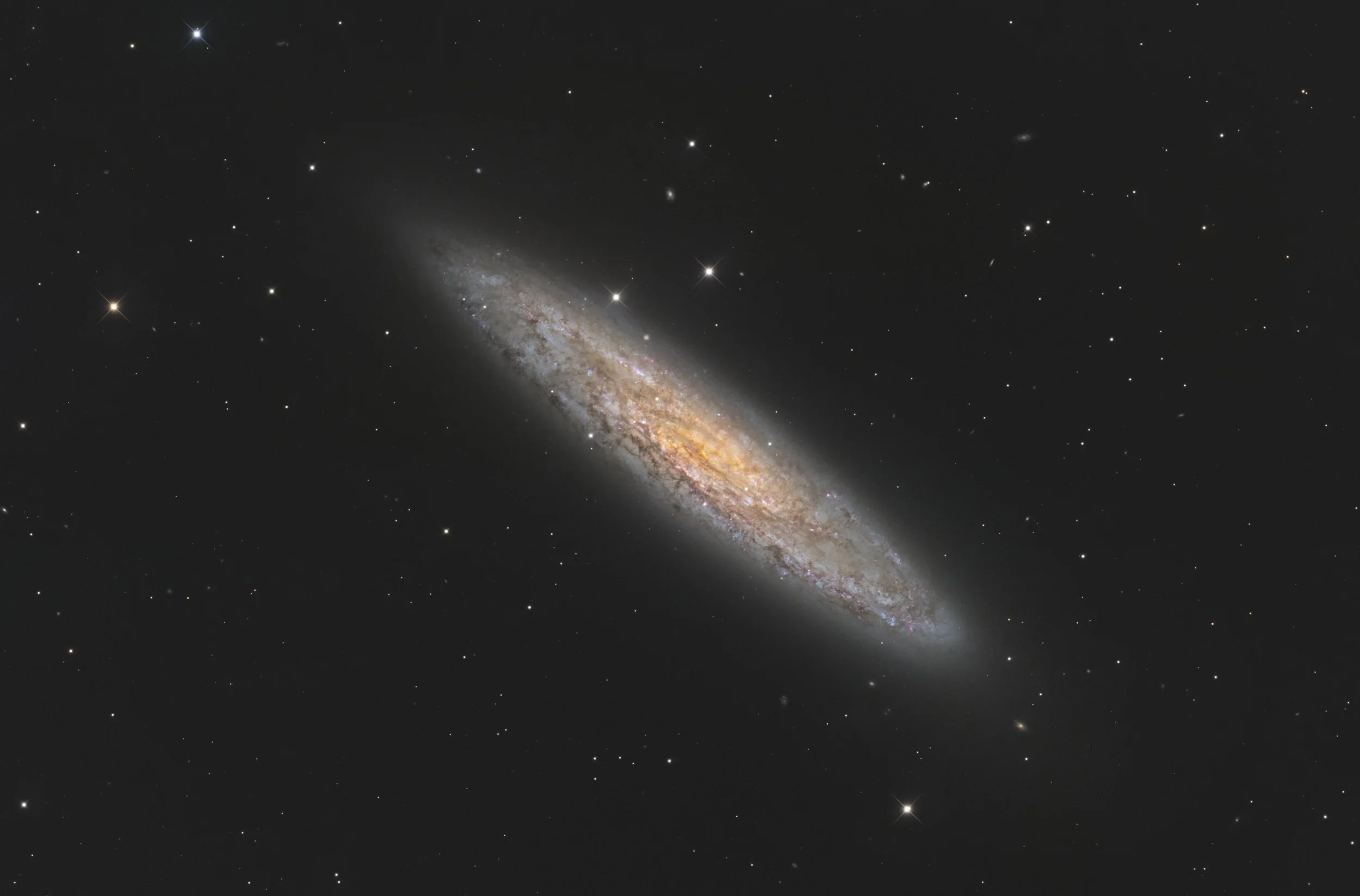
NGC 253, often called the Silver Coin Galaxy, is one of the brightest and dustiest spiral galaxies in the nearby universe. Seen here almost edge-on, its tilted disc reveals a turbulent star forming environment packed with glowing hydrogen regions, dense dust lanes, and clusters of young blue stars. The warm golden core shines through a veil of foreground dust where intense starburst activity is underway and driving powerful outflows that help shape the galaxy’s structure.
Located about 11 million light years away in Sculptor, NGC 253 anchors the Sculptor Group, one of the closest collections of galaxies to the Milky Way. Its proximity, brightness, and dramatic star forming regions have made it a favorite target for both astrophotographers and professional astronomers. Even in this deep image, the galaxy’s outer halo gently fades into the surrounding star field, hinting at its dynamic history of interactions and ongoing evolution.
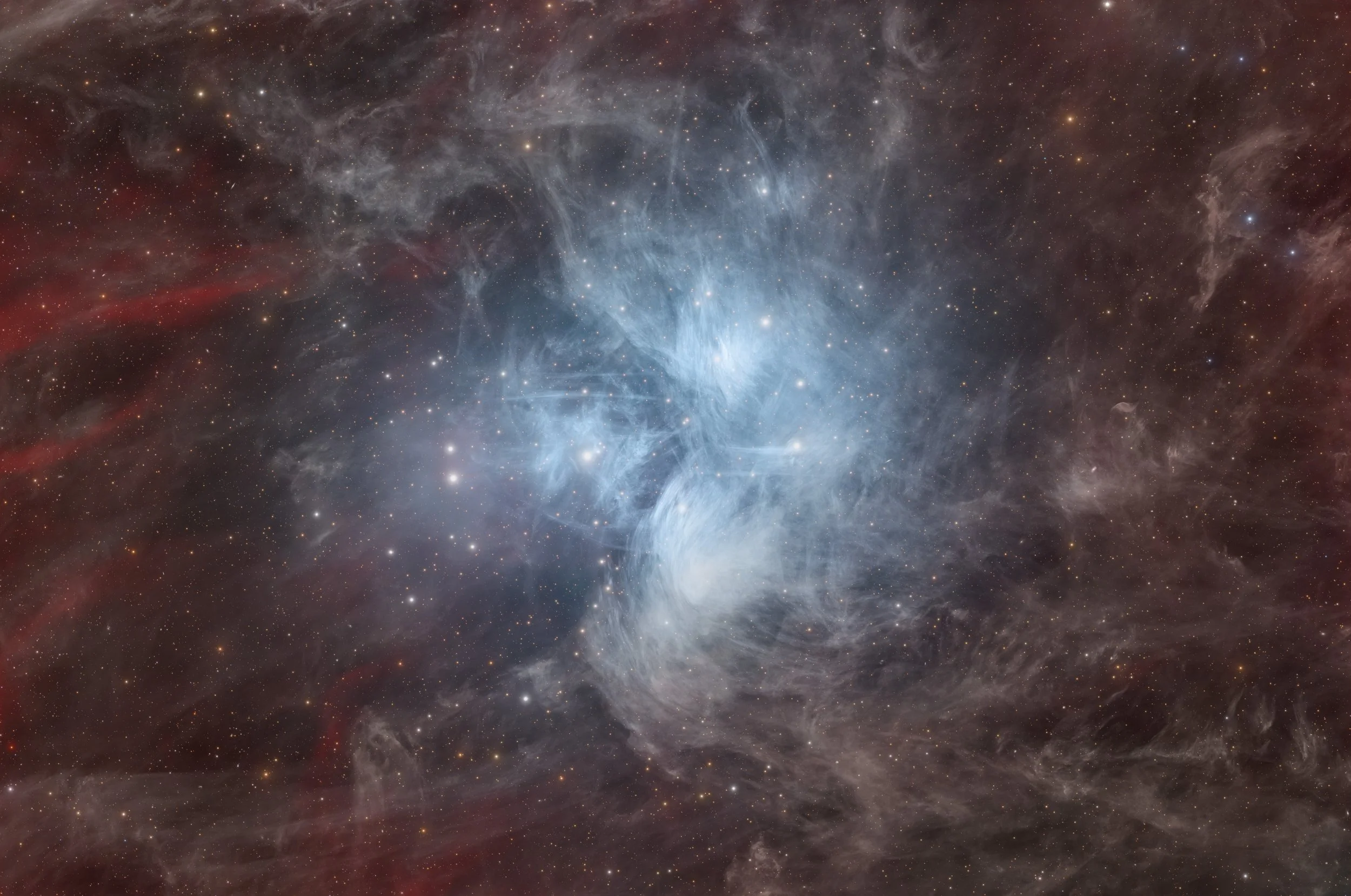
The Pleiades star cluster rises from a field of soft interstellar dust, and this deep collaboration from Texas and Morocco reveals just how complex that surrounding medium truly is. Long exposures in luminance highlight the delicate filaments of the Taurus Molecular Cloud, whose faint reflection material glows as starlight from the hot blue cluster members scatters across it. Although M45 is best known as a reflection nebula, the field contains surprising pockets of hydrogen gas that emerge only with significant integration time. This image brings that faint Hα emission to the forefront, showing that even the region around a bright, familiar cluster holds intricate structure shaped by stellar winds and ancient motions through the interstellar medium.
A secondary objective was to search for O III emission across the field, but results were minimal except for one small and intriguing exception. Off to the right of the cluster sits the galaxy UGC 2816 (LEDA 13557), a faint system that displays trace amounts of both Hα and O III. Its presence adds a subtle extragalactic layer to the composition, contrasting the youthful hot stars of the Pleiades with the quiet glow of a distant galaxy. Combined, these data sets reveal a region far richer and more complex than its naked-eye appearance suggests, blending dust, gas, and starlight into a sweeping portrait of this iconic cluster.
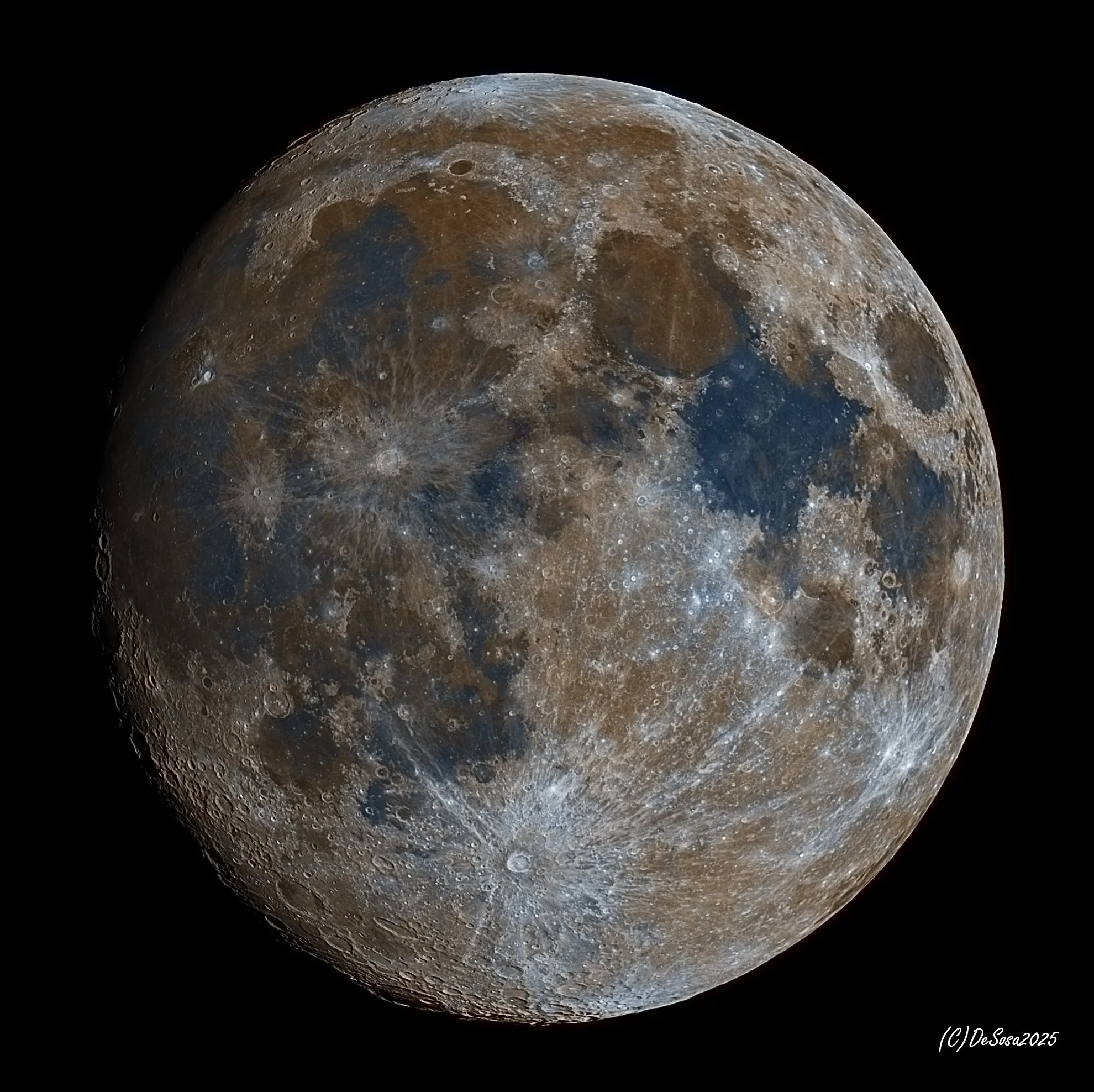
Although the Moon appears gray to the unaided eye, its surface contains subtle but genuine color variations that reveal the mineral composition of the lunar crust. Basaltic maria rich in iron and titanium take on cool blue hues, while highland regions dominated by anorthosite and iron oxides lean toward warmer browns and golds. These colors become visible when carefully enhanced from stacked, calibrated frames, allowing the mineral map of our nearest celestial neighbor to emerge with scientific clarity.
In this image, the interplay of lunar geology becomes strikingly apparent. Titanium-rich basalt flows trace ancient lava plains, while ejecta from long-ago impacts paints surrounding terrain with distinct mineral signatures. By bringing out these natural colors, the image turns the Moon from a seemingly monochrome world into a complex and dynamic record of volcanic activity, impact history, and surface evolution spanning billions of years.
LDN 1452 is a complex of cold, opaque molecular dust clouds in the Perseus constellation, silhouetted against the rich Milky Way background. These dark lanes trace dense regions where starlight is absorbed, revealing the turbulent structure of interstellar material shaped by gravity and nearby stellar activity. The intricate filaments and cavities mark sites where gas is condensing and being eroded by radiation from young stars.
Embedded within this environment lies NGC 1333, an active star-forming region illuminated by hot, newly formed stars whose blue light reflects off surrounding dust. The mix of reflection nebulosity, faint emission, and obscuring dust highlights multiple stages of stellar birth occurring side by side. Captured from Spinello (FC), Italy, this image emphasizes both the aesthetic contrast and the physical interplay between dark clouds and emerging stars within one of Perseus’s most dynamic nurseries.