

AAPOD2 Image Archives
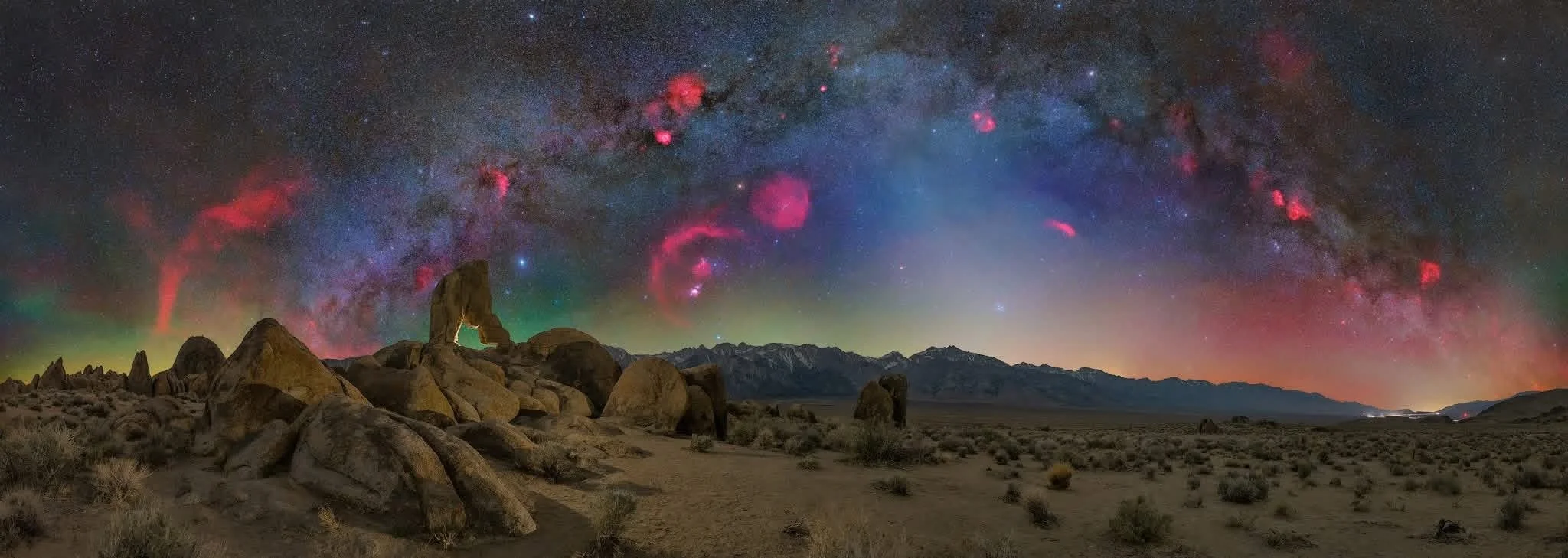
End of Orion Season
"End of Orion Season"
As we are slowly approaching the end of Orion season, here’s a panorama of the setting winter Milky Way arc over the iconic landscape of the Alabama Hills.
The amount of hydrogen-rich emission nebulae in this part of the Milky Way makes it one of my favorite subjects. As a special treat, part of the Gum Nebula is peeking like a flame over the southern horizon on the very left, collaborating with red and green airglow to beat the yellow light pollution from distant Los Angeles. Next to it, the Seagull Nebula soars high above Boot Arch, silhouetted against strong green airglow, while Orion sets over Mt. Whitney, the highest peak in the Sierra Nevada.
Further to the right, the zodiacal light almost drowns the Pleiades cluster and cuts through the Milky Way as a reminder of the Sun being not too far below the horizon. On the far right, the Heart and Soul Nebulae and the Cosmic Question Mark shine through red airglow as the Milky Way slowly dips below the northern horizon.
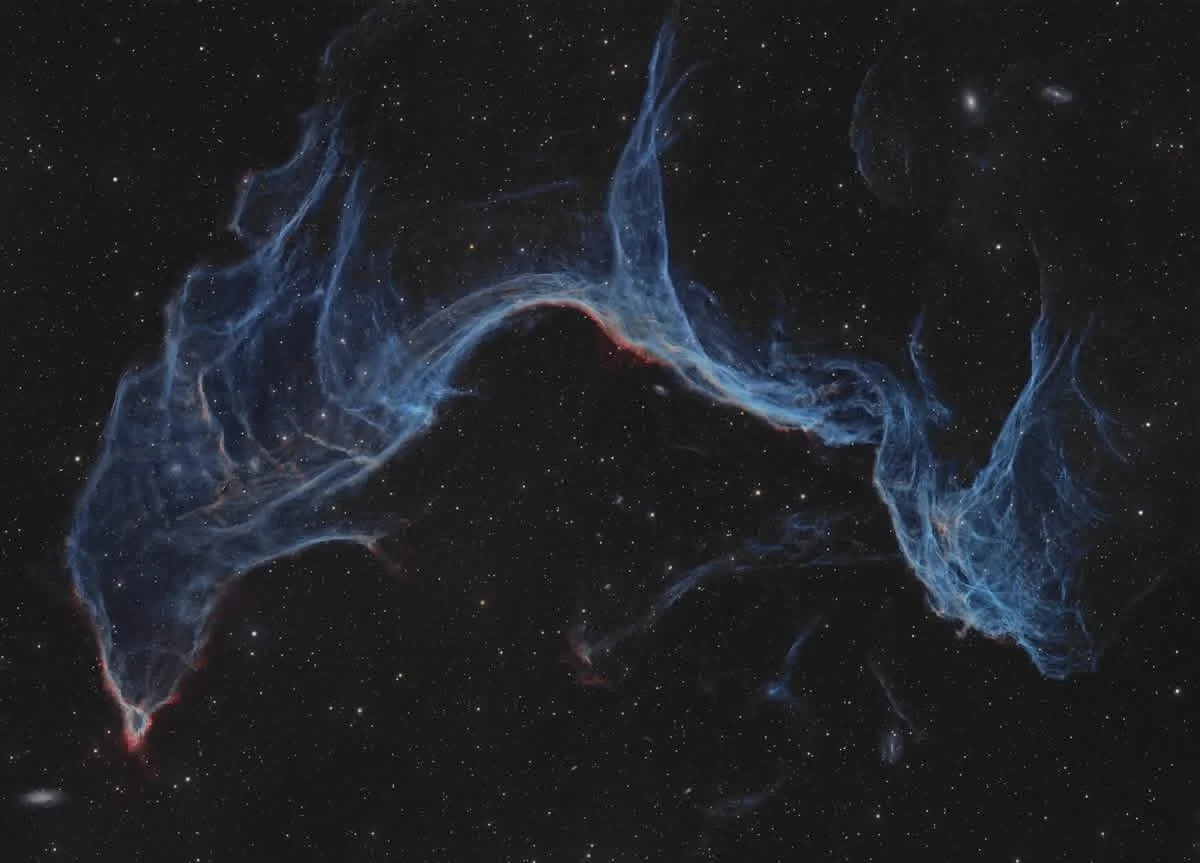
ESO 217-25 The Mermaid Nebula
A sea creature in Centaurus made not of water, but of the ghostly remains of a stellar explosion
ESO 217-25, often called the Mermaid Nebula or the Beta Fish Nebula, is the brightest optical portion of the much larger supernova remnant G296.5+10.0 in the constellation Centaurus. What appears here as an elegant web of luminous blue filaments and red shock fronts is only part of the full expanding debris field left behind by a star that exploded thousands of years ago.
The remnant is estimated to lie about 4,500 light-years away. In radio and X-ray observations, the full supernova remnant spans roughly 90 × 65 arcminutes, giving it an immense physical size of about 120 × 85 light-years. The optically prominent section captured here is much smaller, with the bright visible filamentary structure in this field covering roughly 26 × 19 arcminutes, or about 34 × 25 light-years at that distance.
What makes ESO 217-25 so striking is its extraordinary texture. Rather than forming a smooth shell, the remnant has broken into shock-compressed sheets, twisted streamers, and translucent oxygen-rich veils. The luminous blue filaments trace ionized oxygen, while the thin red edges mark hydrogen emission where the blast wave is still colliding with surrounding interstellar gas. The bright central arc is one of the most active visible sections of the shock front, while the fainter detached wisps reveal how fragile and diffuse the structure has become as the remnant continues to expand.
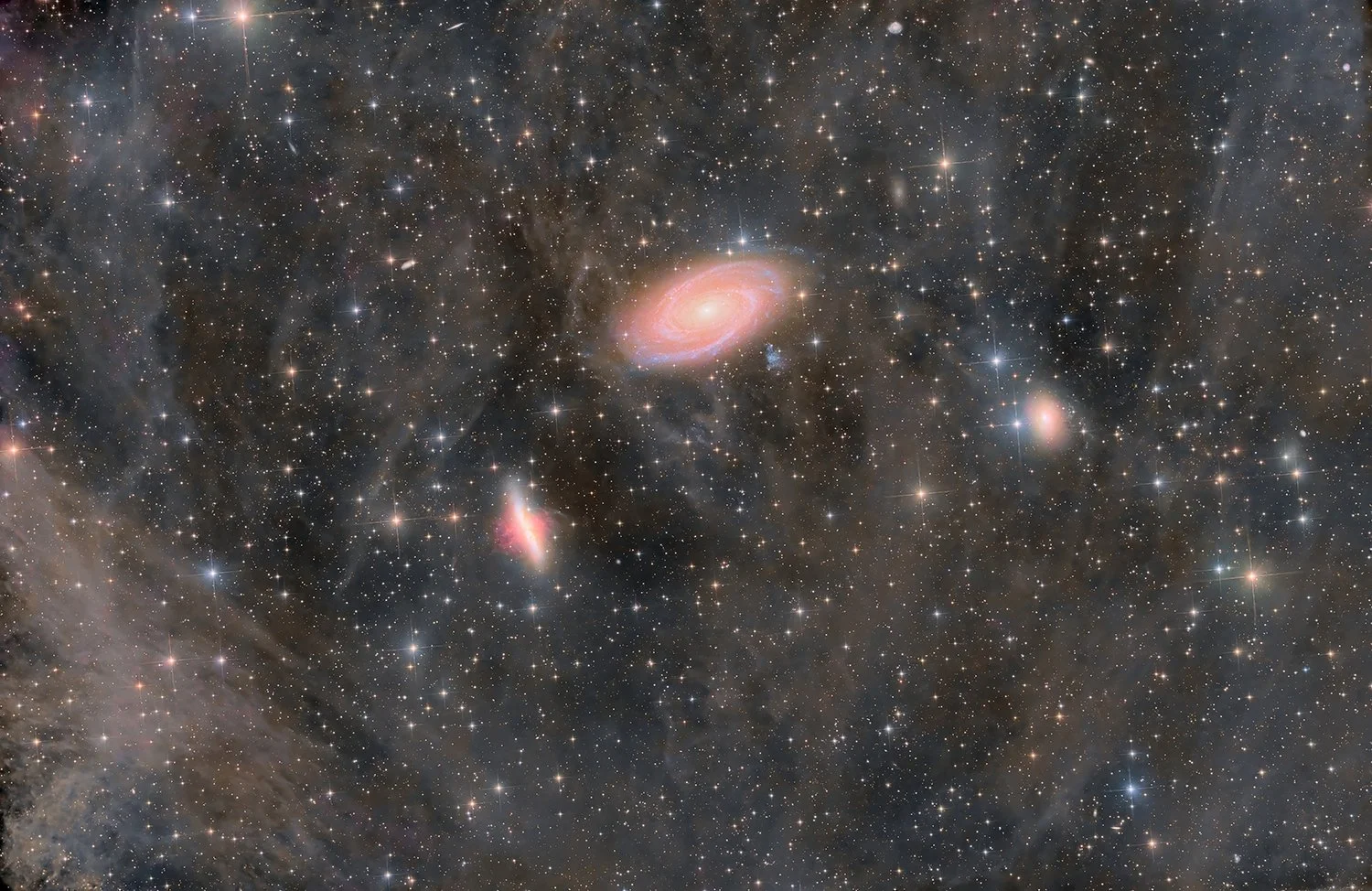
M81-M82-NGC3077
Messier 81 (M81), also known as Bode’s Galaxy, is a grand-design spiral galaxy located about 12 million light-years from Earth in the constellation Ursa Major. It is one of the brightest galaxies visible from the Northern Hemisphere and a popular target for amateur astronomers due to its well-defined spiral arms and luminous core. M81 contains a supermassive black hole at its center and exhibits active star formation, particularly along its sweeping arms. Its relatively close distance and face-on orientation make it an important object for studying galactic structure and evolution.
Nearby lies Messier 82 (M82), often called the Cigar Galaxy because of its elongated shape. In contrast to M81’s orderly appearance, M82 is a starburst galaxy undergoing intense episodes of star formation, likely triggered by gravitational interaction with M81. This interaction has caused massive flows of gas and dust, fueling the creation of new stars at a rate far higher than typical galaxies. M82 is also known for its dramatic outflows—vast streams of ionized gas blasting out from its core—making it a striking example of how galactic collisions can profoundly shape cosmic environments.