
APPOD2 2026 images

The Garlic Nebula (cataloged as CTB 1, LBN 576, or Abell 85) originated as a massive stellar explosion. Located roughly 10,000 light-years away in the constellation Cassiopeia, it is a expanding galactic supernova remnant (SNR).
Key Stages of Its Origin
Massive Star PrecursorThe origin traces back to a massive progenitor star estimated at 13 to 15 times the mass of our Sun. As the star ran out of nuclear fuel in its core, it could no longer produce the outward radiation pressure needed to support its own immense gravitational weight.
Core-Collapse Supernova Event Approximately 10,000 to 16,000 years ago, the star collapsed in a core-collapse supernova. The explosion blasted the star's outer layers into interstellar space at speeds of thousands of kilometers per second, dispersing gas enriched with heavy elements like oxygen, neon, and iron.
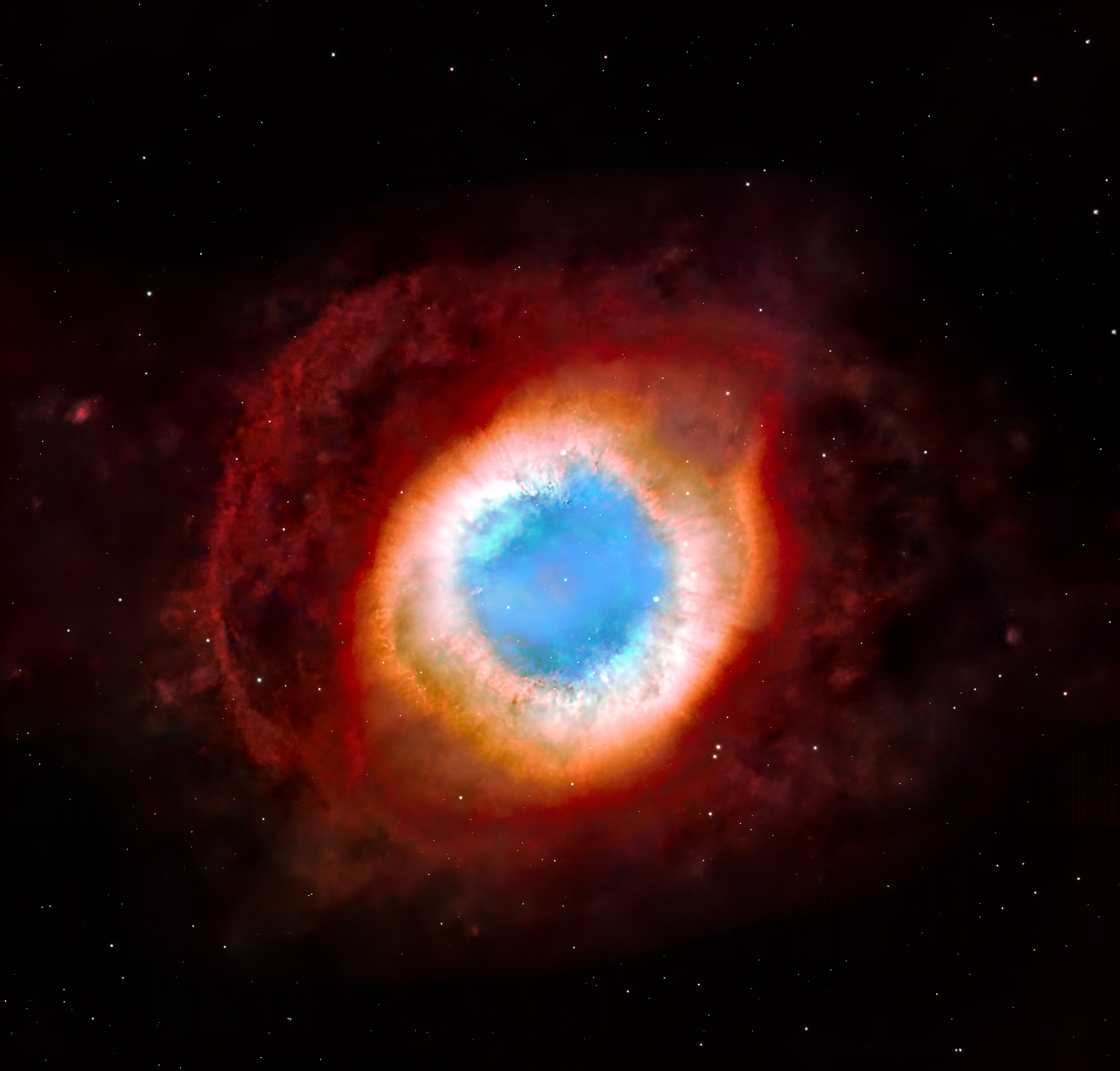
The Helix Nebula (NGC 7293), often referred to as the "Eye of God," is one of the closest and most studied planetary nebulae to Earth, located about 655 light-years away in the constellation Aquarius.
Its structure is a complex, three-dimensional arrangement resulting from the late-stage evolution of a Sun-like star.
High-energy ultraviolet radiation emitted by this central remnant energizes and ionizes the surrounding shell of expelled gases, causing them to glow vividly.
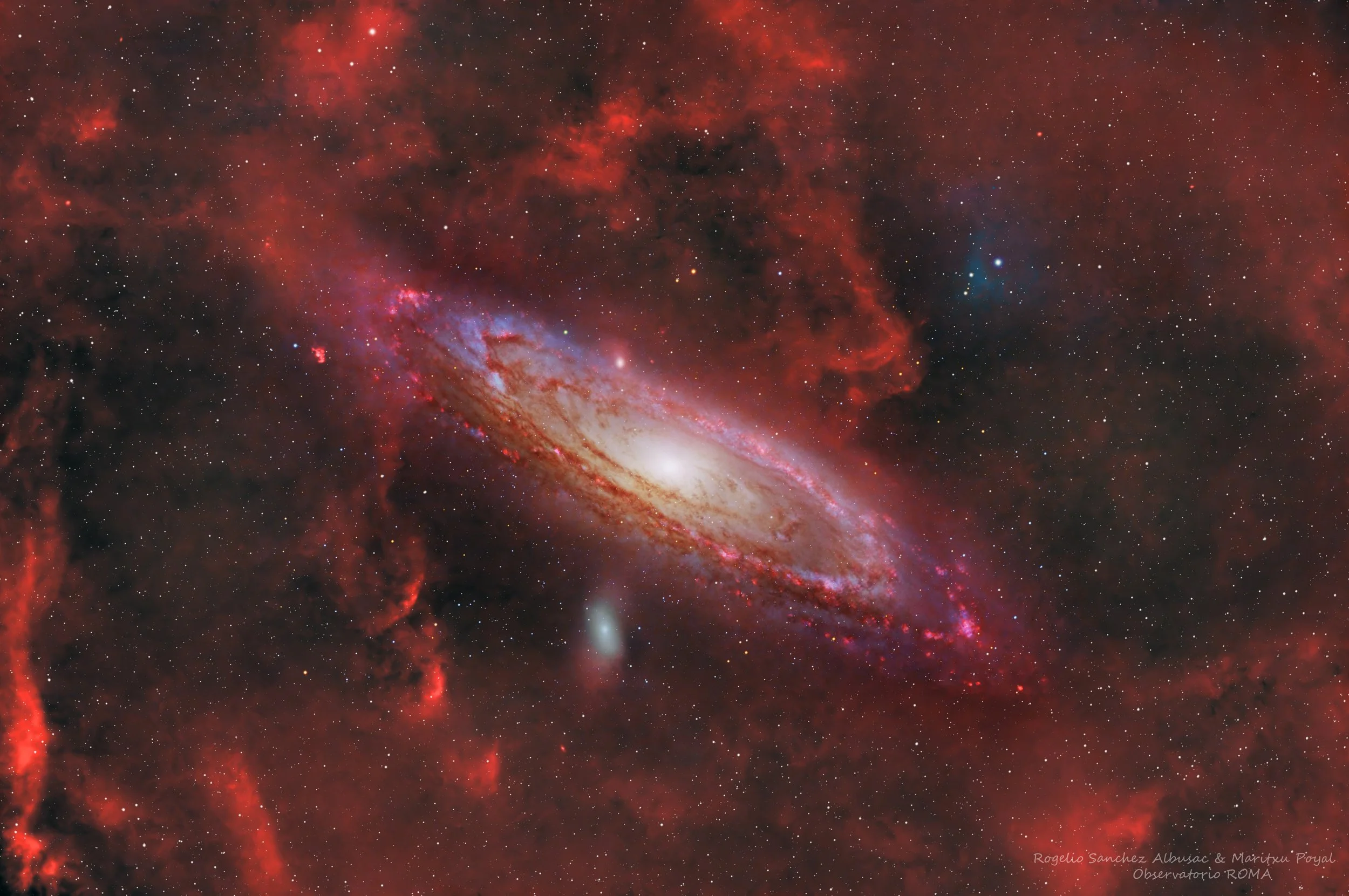
This image highlights large, faint hydrogen clouds (ionizing H-alpha emission gas) surrounding the Andromeda Galaxy (M31). These delicate molecular and atomic clouds—often referred to as galactic Cirrus or flux nebulae—are brought out in detail specifically by combining the targeted 3 nm Chroma H-alpha filter data with the wide-field broadband exposures.
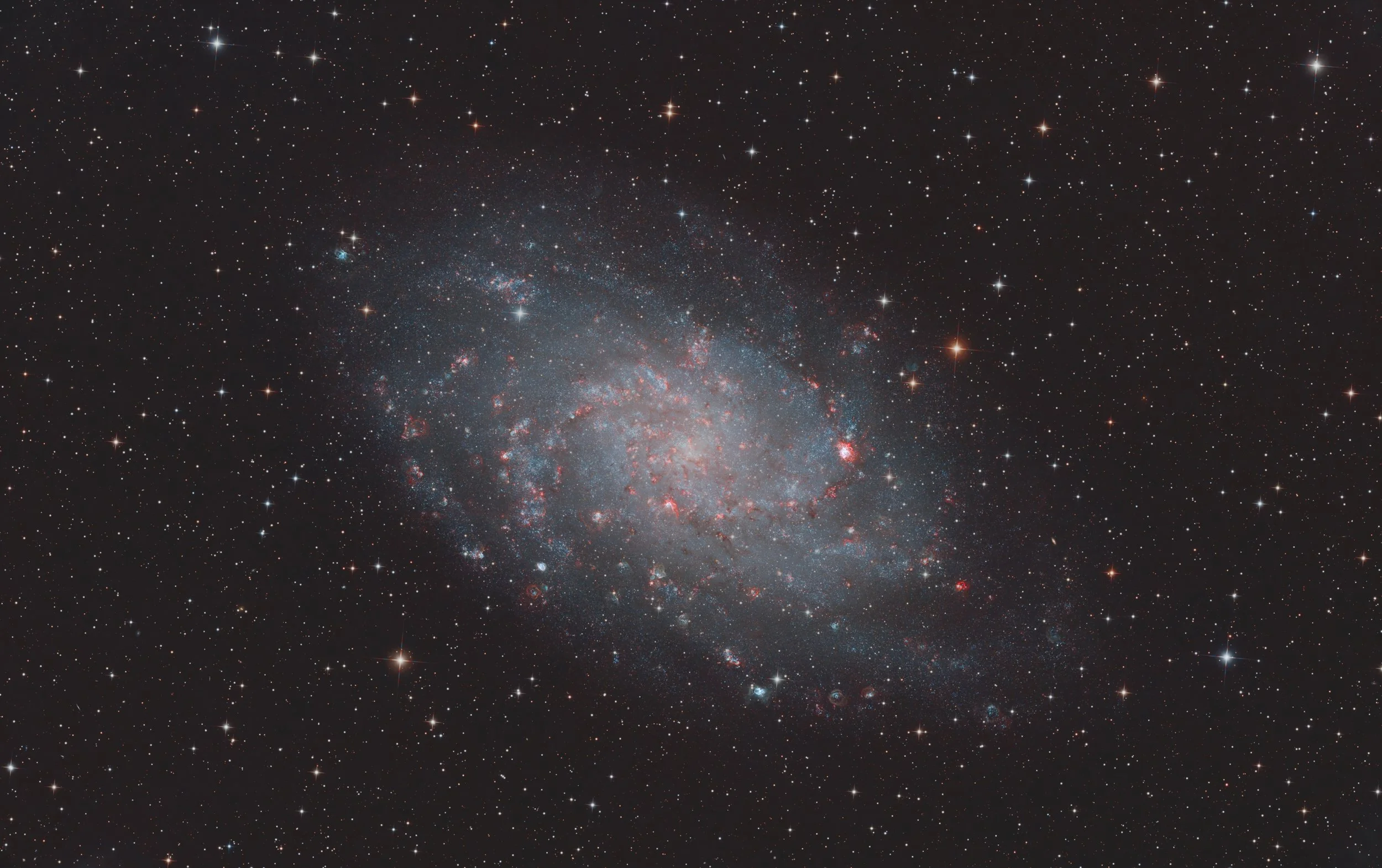
The Triangulum Galaxy (cataloged as Messier 33 or NGC 598) is a spiral galaxy located in the constellation Triangulum.
Key Characteristics
Location & Distance: Located roughly 2.73 to 3 million light-years from Earth in the northern sky's constellation Triangulum.
Local Group Member: It is the third-largest member of our Local Group of galaxies, behind the Andromeda Galaxy (M31) and our own Milky Way, and ahead of the Large Magellanic Cloud.
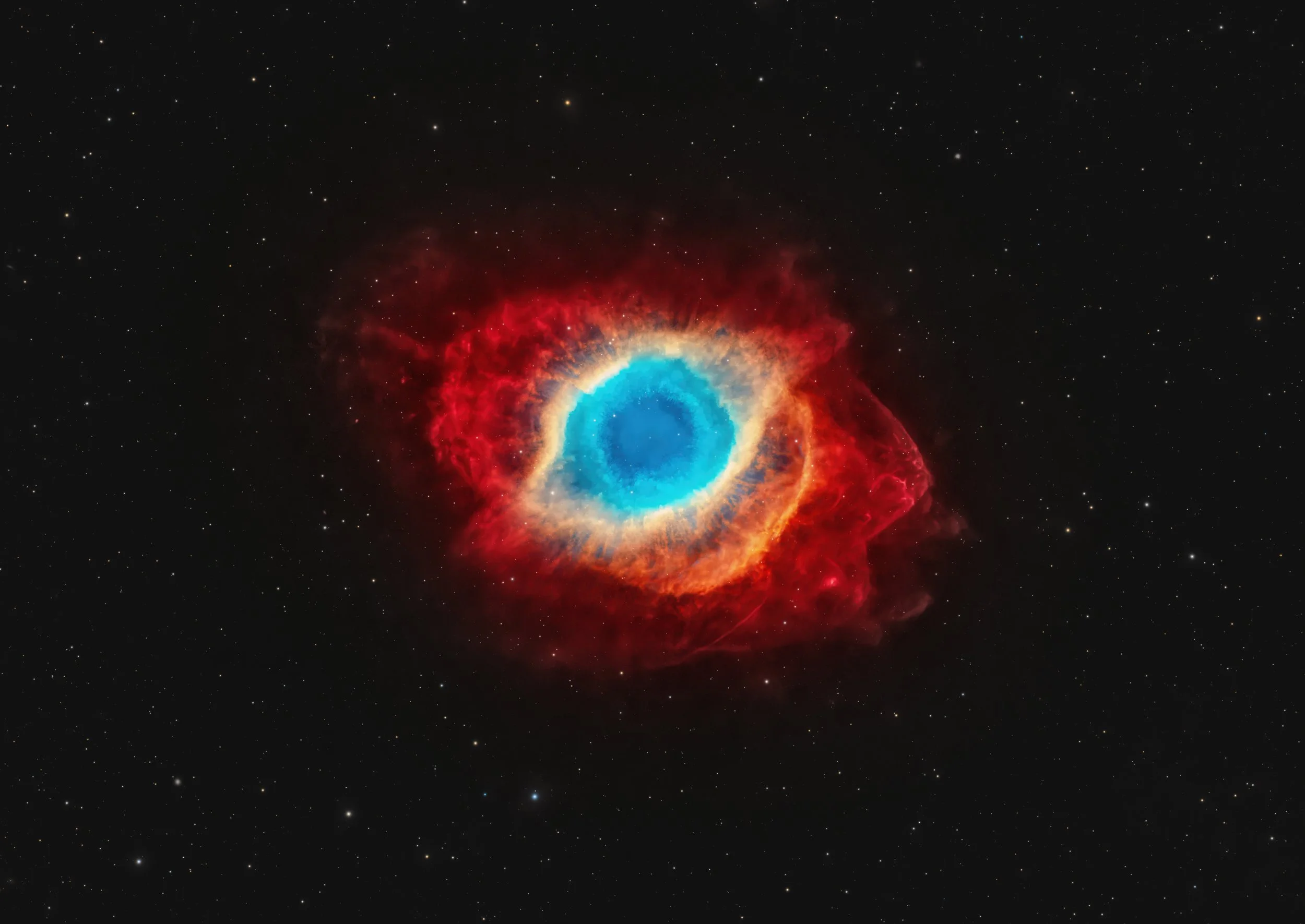
Helix Nebula (NGC 7293), commonly referred to as the "Eye of God" (or Eye of Sauron).
Type & Origins: It is a large, iconic planetary nebula located approximately 650 light-years away in the constellation Aquarius. It represents the expanding glowing gas shell cast off by a dying, Sun-like star at the end of its life, leaving behind a hot central white dwarf star.
Shape & Appearance: Its distinct ring-like structure with a glowing core and outer halo gives it a striking eye-like appearance when viewed from Earth. The outer layers expand at thousands of kilometers per second.
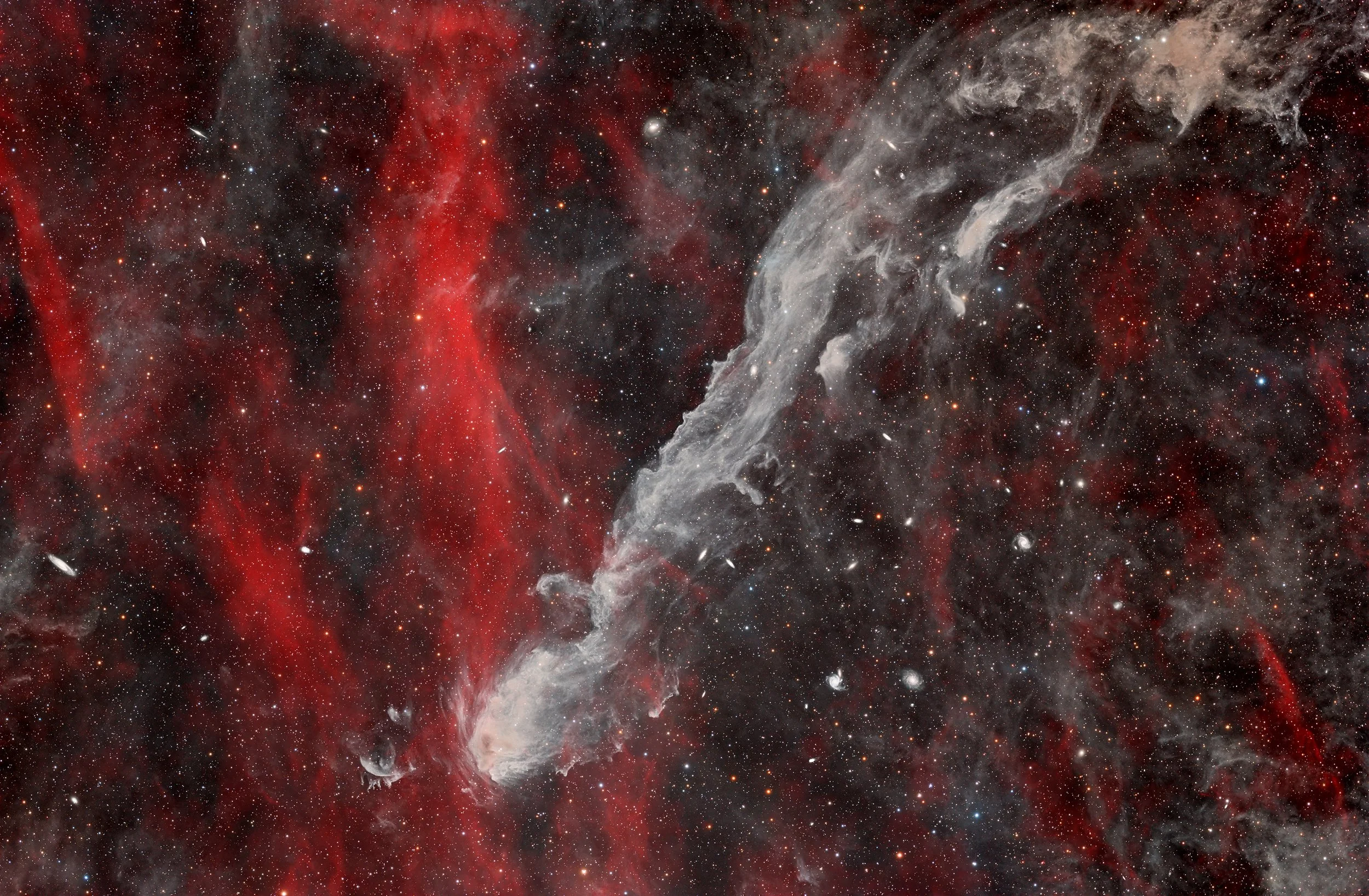
LBN 420 (Lynds Bright Nebula 420), popular in astrophotography as the Galileo Finger (or Galileo's Finger), is an intricate interstellar structure located in the constellation Lacerta.
It is predominantly a dark molecular cloud and reflection/dust cloud extension associated with the larger Great Lacerta Nebula complex (Sh 2-126). It is embedded with background hydrogen-alpha gas emission H\alpha that gives parts of the surrounding region a reddish glow.
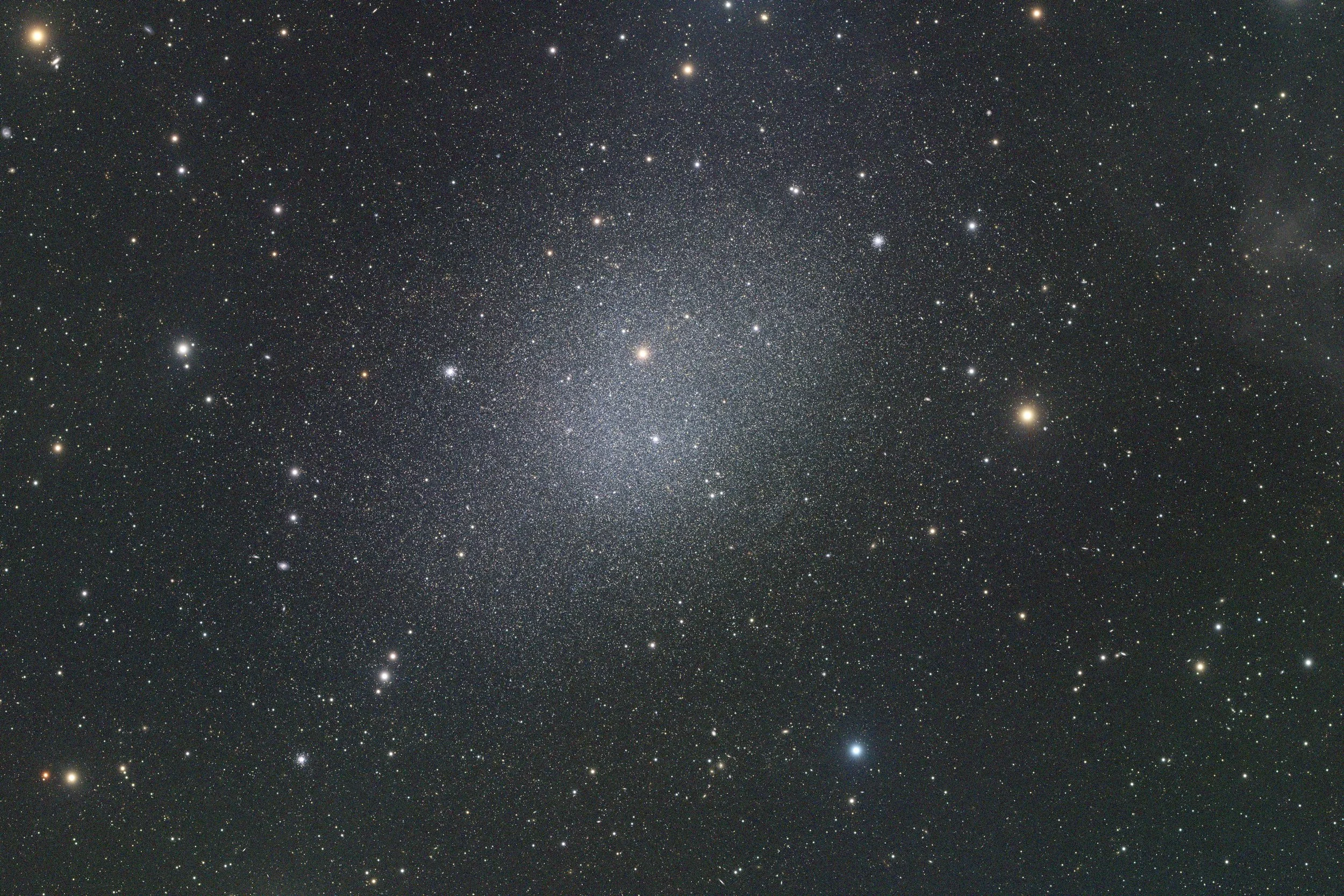
The Fornax globular clusters are a collection of six bound star clusters located within the Fornax Dwarf Spheroidal Galaxy (dSph), a satellite galaxy of the Milky Way located approximately 460,000–530,000 light-years away in the constellation Fornax.
Despite the galaxy's low overall density and low total mass, its globular cluster population is unusually rich.
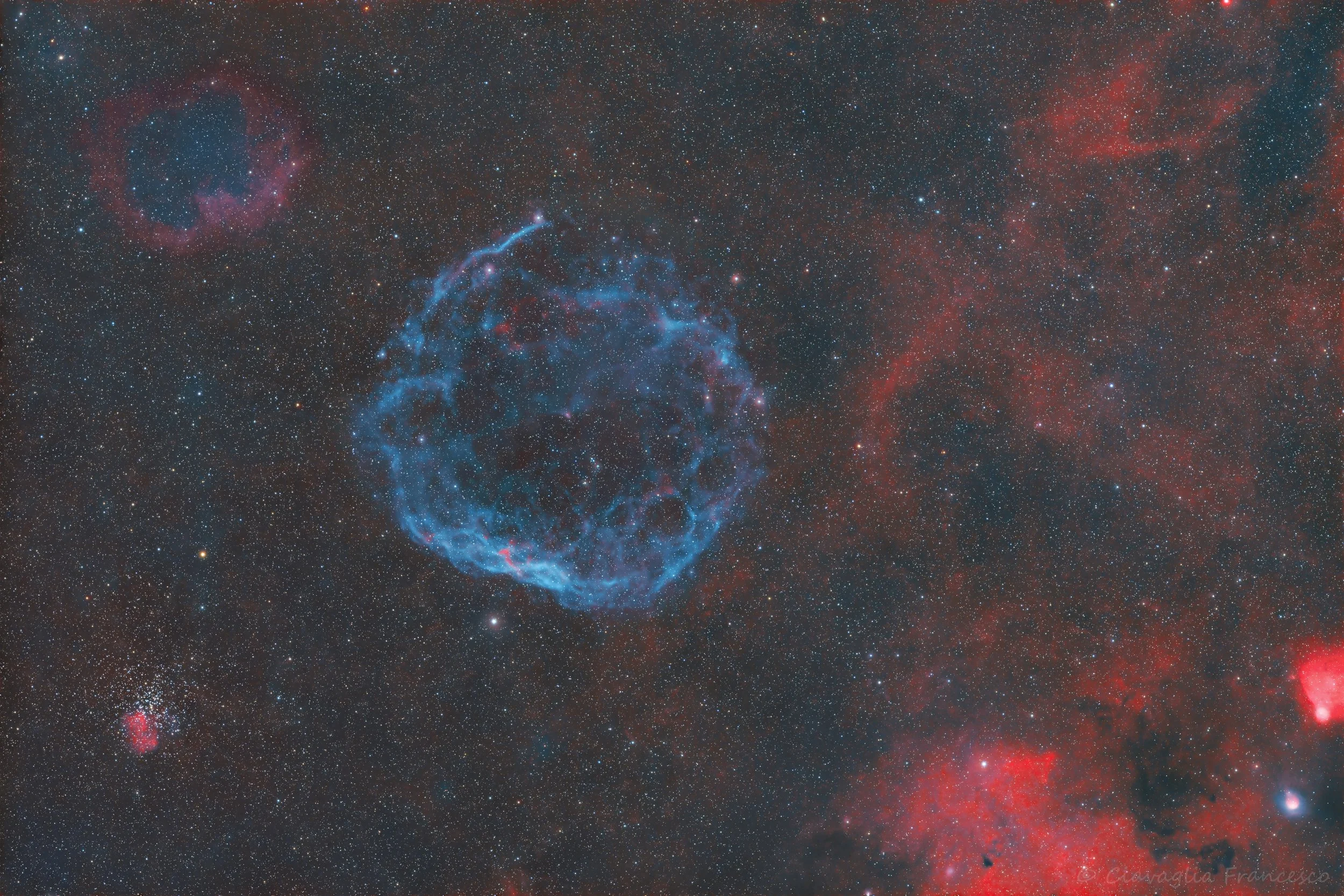
SNR G179.0+2.6, popularly known as the Buckyball Nebula, is a large, extremely faint supernova remnant located about 11,000 light-years away in the northern constellation Auriga. Expanding as a round, soccer-ball-like shell of gas and stellar debris from a massive star explosion estimated to have occurred roughly 50,000 years ago, it spans an apparent diameter of about 70 arcminutes in the sky—over twice the angular size of the full Moon. Although the remnant consists of hydrogen and helium, its visual appearance in deep-sky astrophotography is heavily dominated by doubly ionized oxygen [O III] emissions, which give its delicate filamentary structures a distinct bluish-green hue that requires specialized long-exposure narrowband imaging to capture.
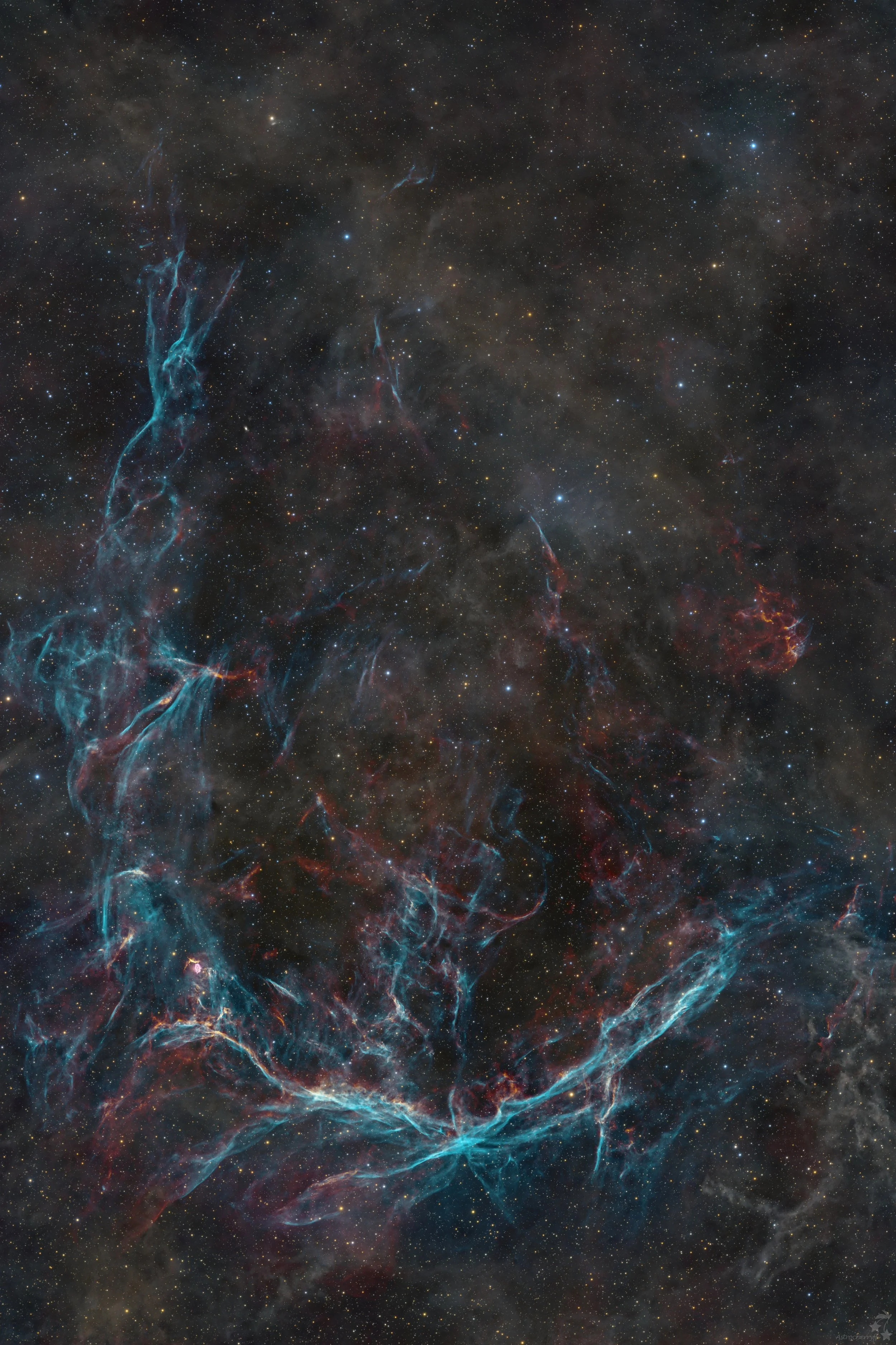
CTA 1 (a supernova remnant) earned the nickname "Burning Blue Dragon" because, unlike many other supernova remnants that emit more strongly in hydrogen, it glows much stronger in oxygen.
This strong oxygen emission creates vivid turquoise filaments in optical imaging, giving the remnant its distinct fiery, blue-dragon-like visual appearance.
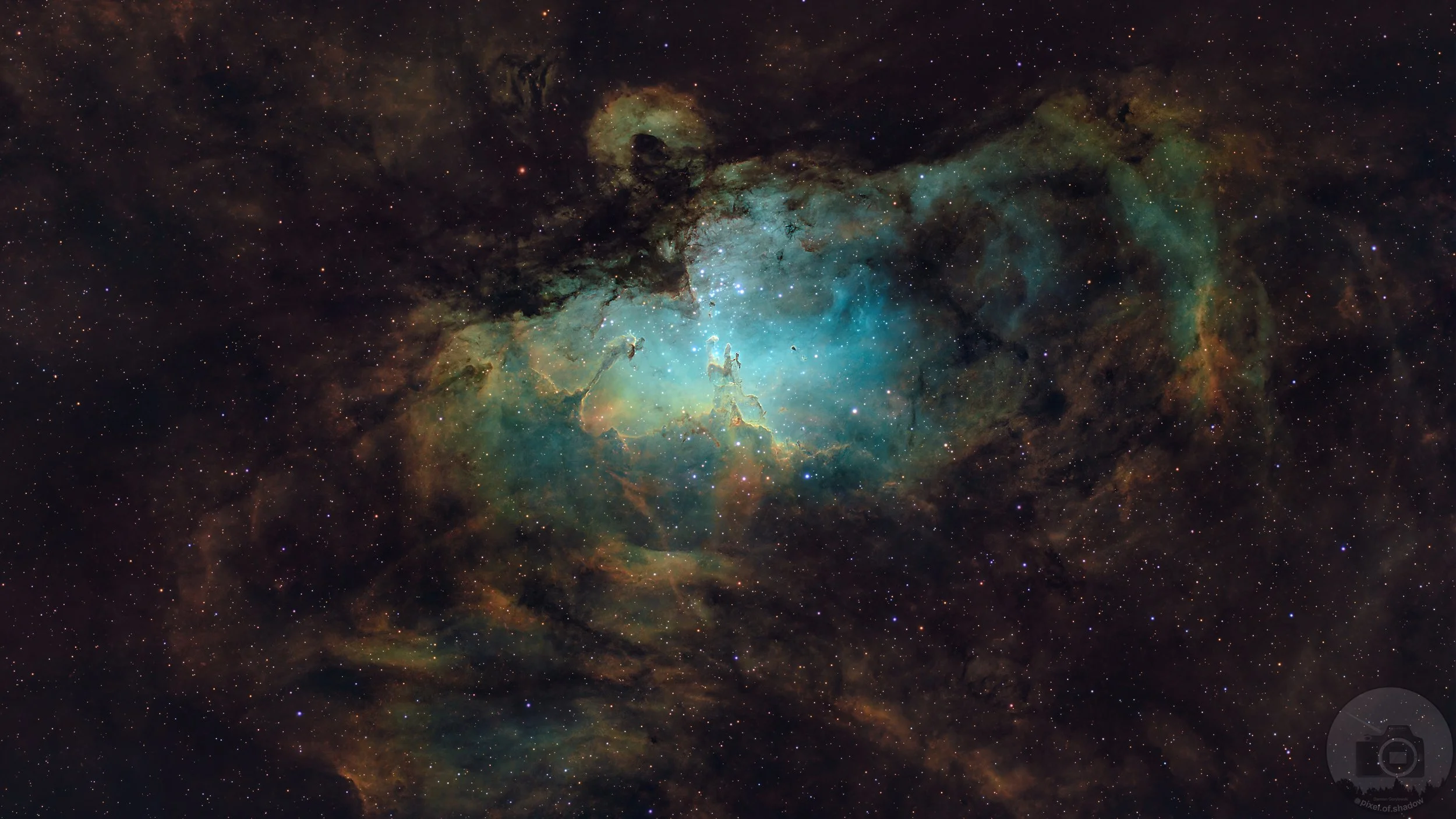
Located roughly 6,500 to 7,000 light-years from Earth within the Eagle Nebula (M16), the Pillars of Creation are towering columns of cold molecular hydrogen gas and cosmic dust—spanning up to 4 light-years in length—that serve as an active stellar nursery where gravitational collapse births new stars. The intense ultraviolet light and radiation from nearby hot young stars continuously erode these structures through a process called photoevaporation, exposing dense pockets of gas called Evaporating Gaseous Globules (EGGs) containing protostars while guaranteeing the pillars will completely dissolve over the next few million years.
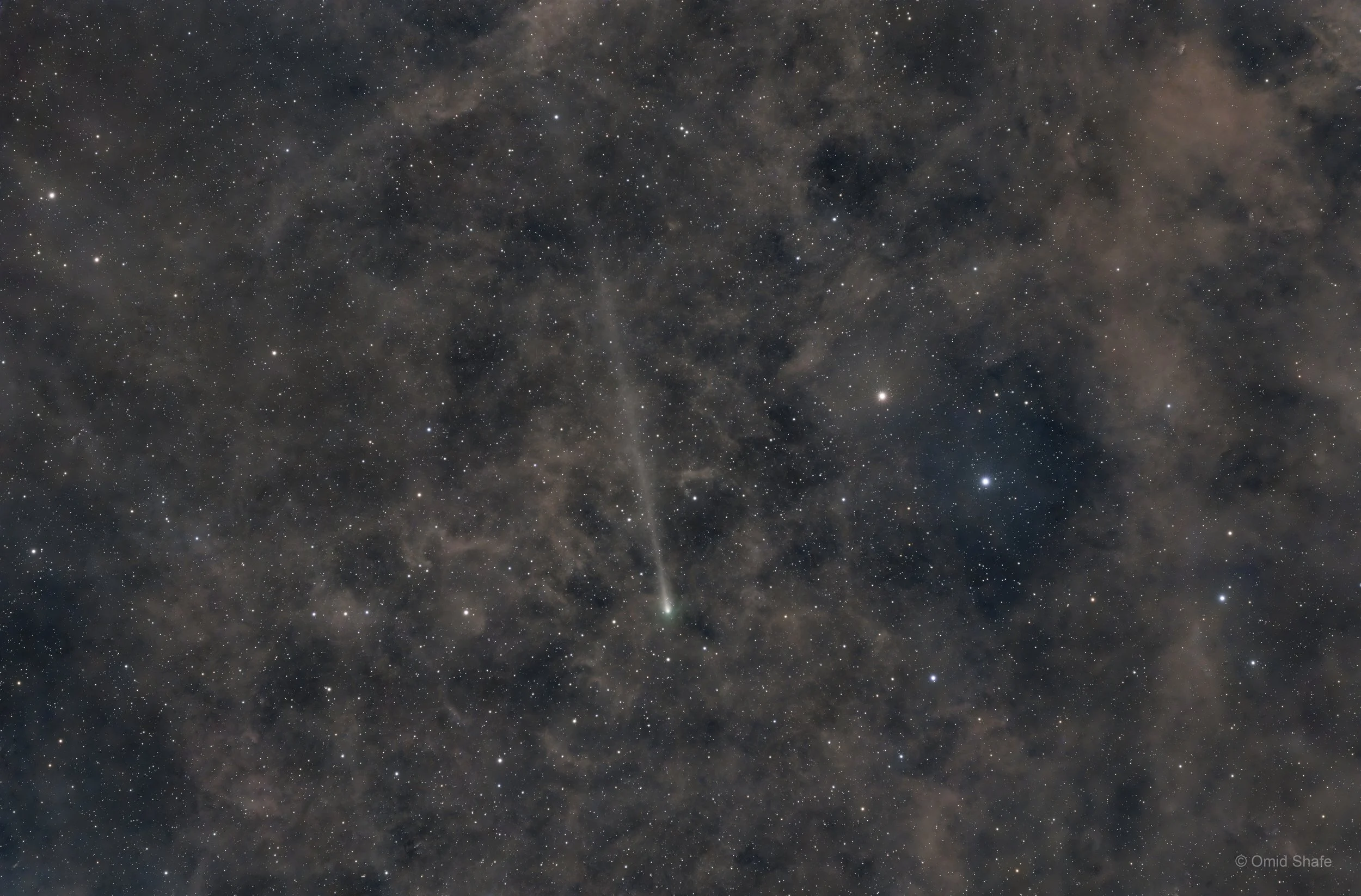
Comet 220P/McNaught is a periodic, Jupiter-family comet that completes an orbit around the Sun every 5.5 years. Discovered on May 20, 2004, by astronomer Robert H. McNaught, the comet follows an elliptical path ranging from a closest approach (perihelion) of 1.55 AU—just outside Mars's orbit—to a maximum distance (aphelion) of 4.68 AU. It possesses a small nucleus with an estimated radius under 1.3 km.
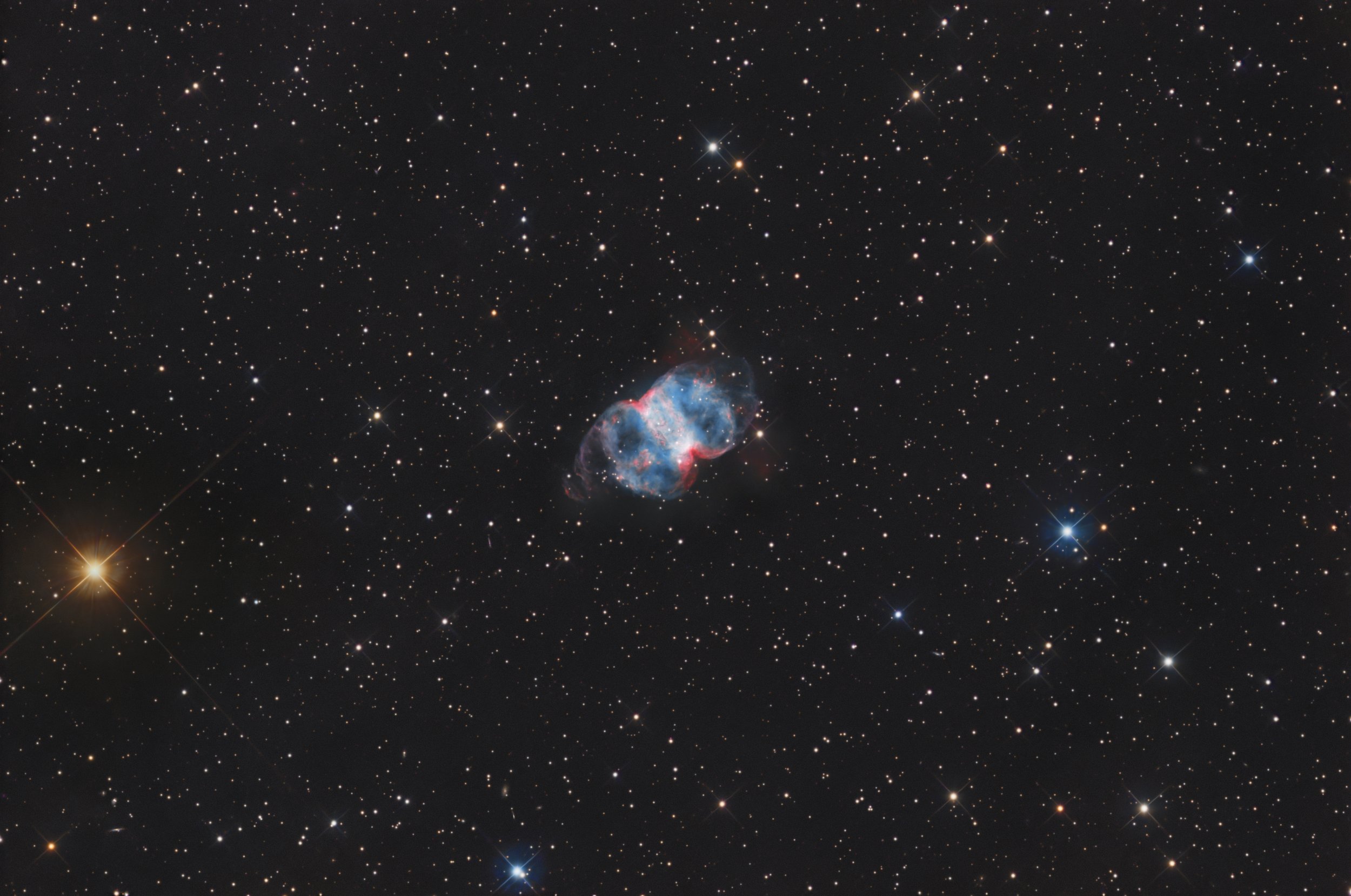
The Messier 76 (M76) nebula—commonly known as the Little Dumbbell Nebula—is a bipolar planetary nebula located roughly 2,500 to 3,500 light-years away in the constellation Perseus. Its complex 3D architecture is shaped by gas ejected from a dying star as it sheds its outer layers.
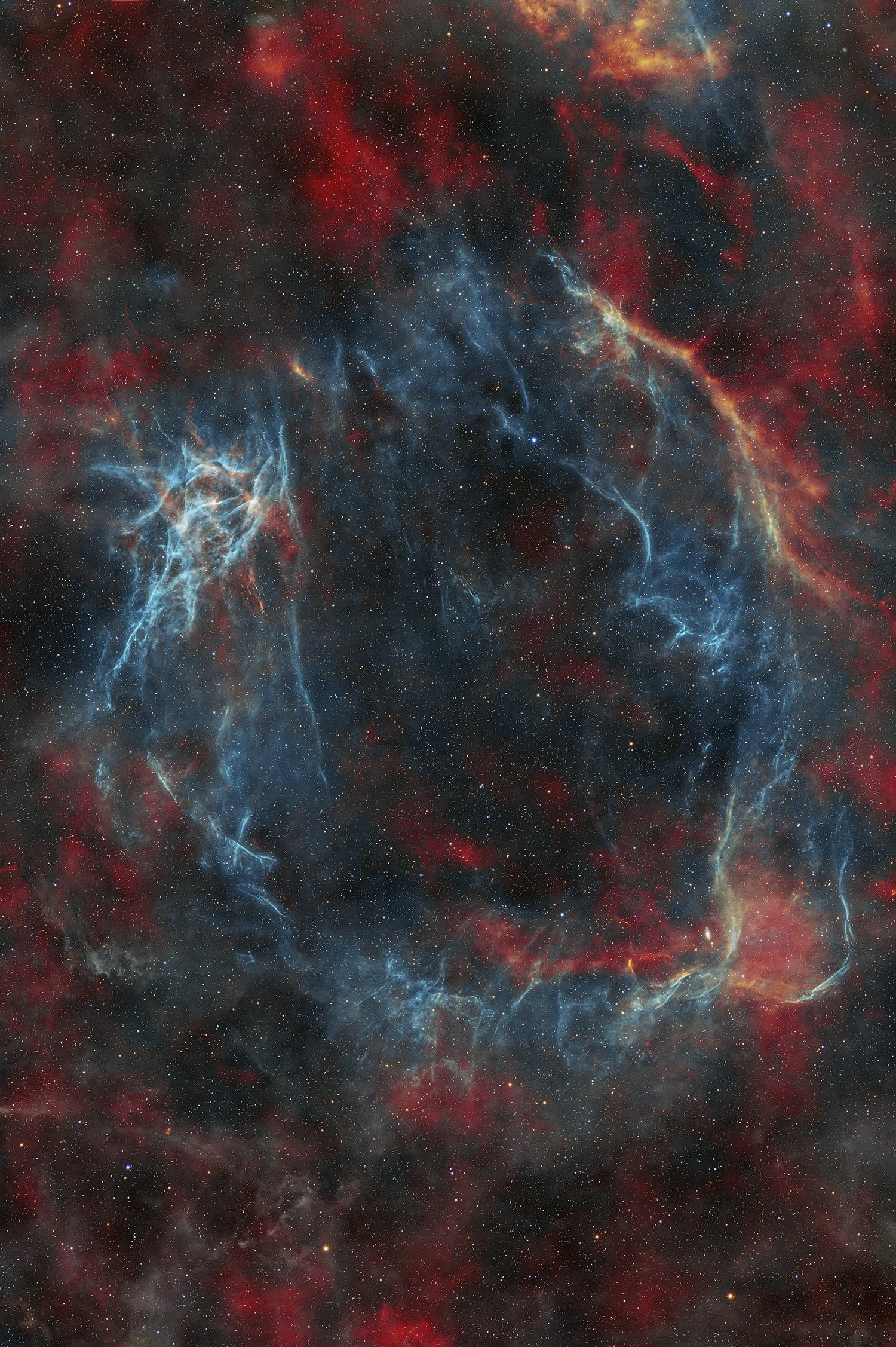
Located in the constellation of Cassiopeia, SNR G107.5-5.2 is a gigantic and extremely delicate supernova remnant, spanning approximately 3 degrees across the sky.
Discovered in 2023 by Bray Falls, Marcel Drechsler and their team, this structure is distinguished by its remarkably delicate ionized oxygen emission lines (OIII 500.7 nm). Its shock waves, forming what appear to be vast gaseous “draperies”, have earned the object the nickname The Nereides, in tribute to the sea nymphs of Greek mythology.
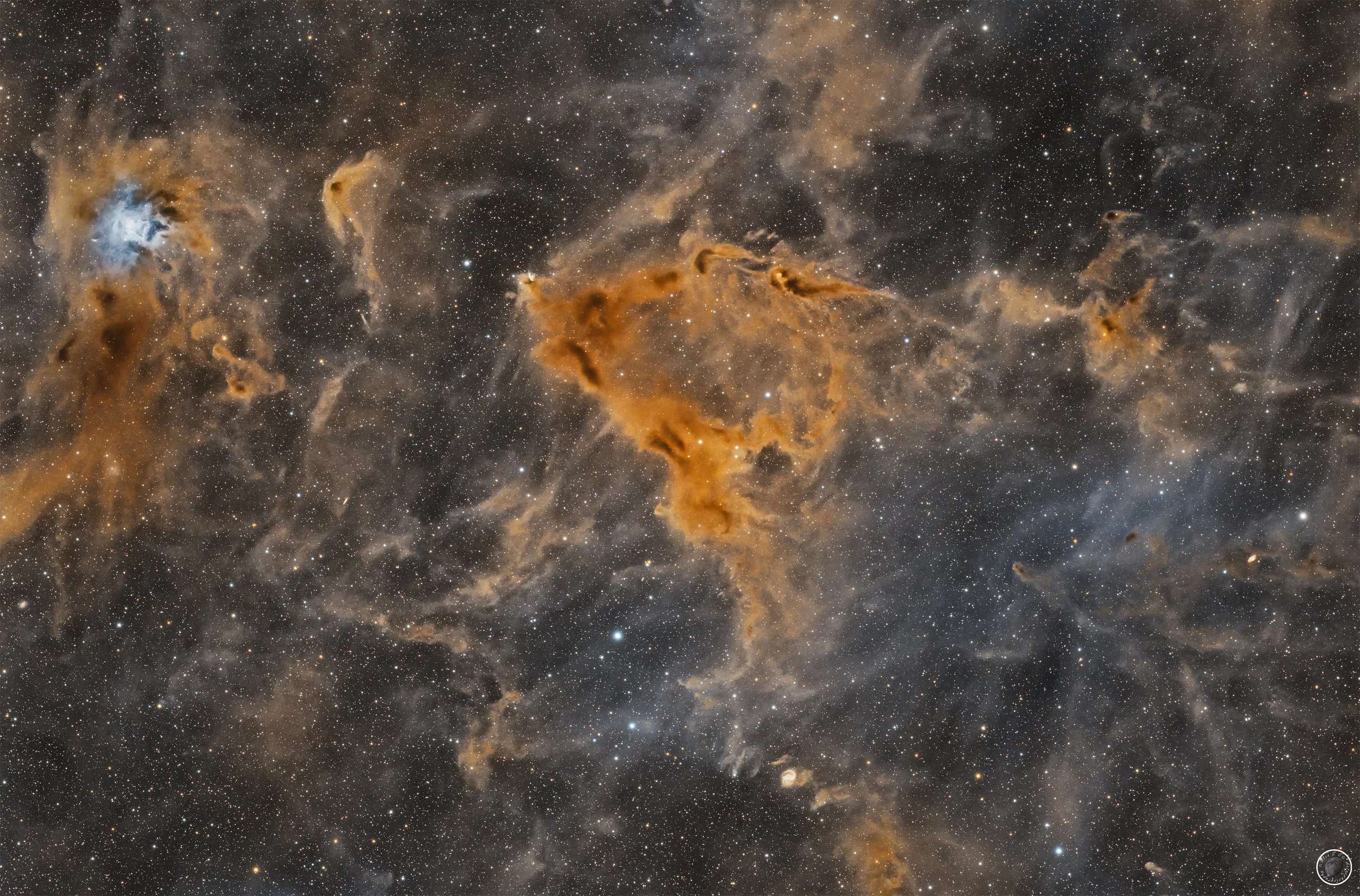
The Iris Nebula (NGC 7023) formed through a combination of star formation, light scattering, and stellar interaction with surrounding interstellar dust. Located approximately 1,300 light-years away in the constellation Cepheus, it spans about six light-years across.
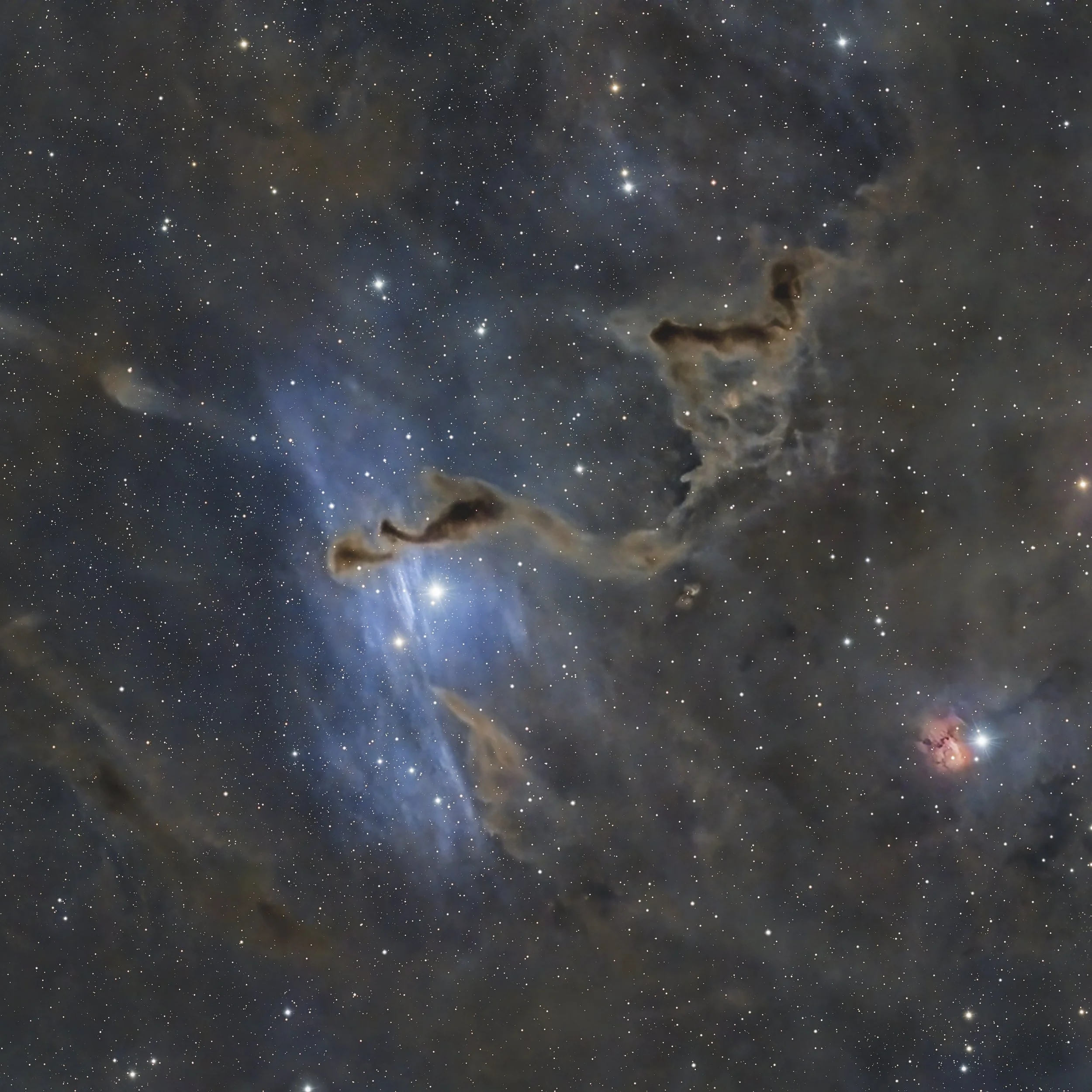
Deep in the constellation Cassiopeia lies LDN 1355, the "Helping Hand" nebula. Located approximately 1,400 light-years away, this dark nebula features vast clouds of cosmic dust silhouetted against a brilliant backdrop of stars, glowing alongside the reflection nebula vdB 9 and variable star SU Cassiopeiae.
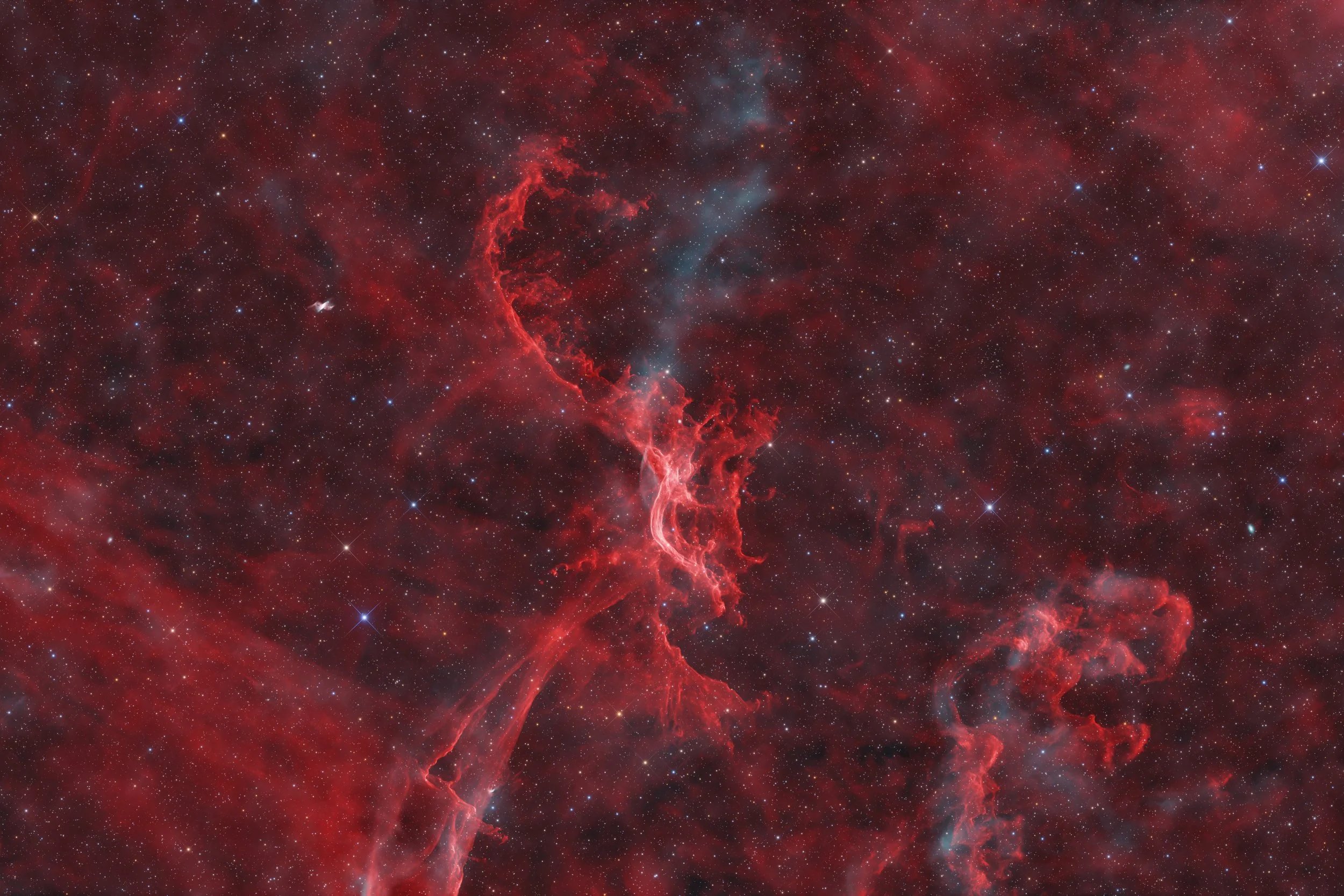
Sharpless 114 (Sh2-114, LBN 347), commonly referred to as the Flying Dragon Nebula, is a faint emission nebula located approximately 3,000 light-years away in the constellation Cygnus. Exhibiting a complex morphology with long, thread-like filaments of ionized gas, its spectral signature is dominated by deep red Hydrogen-Alpha emission alongside subtle doubly ionized oxygen cyan regions. While cataloged primarily as an ha region, its delicate arc structures and the absence of a clear central ionizing star lead astronomers to debate whether it is driven by ionizing stellar radiation, an ancient supernova remnant, or an energetic stellar wind-blown bubble interacting with the interstellar medium.
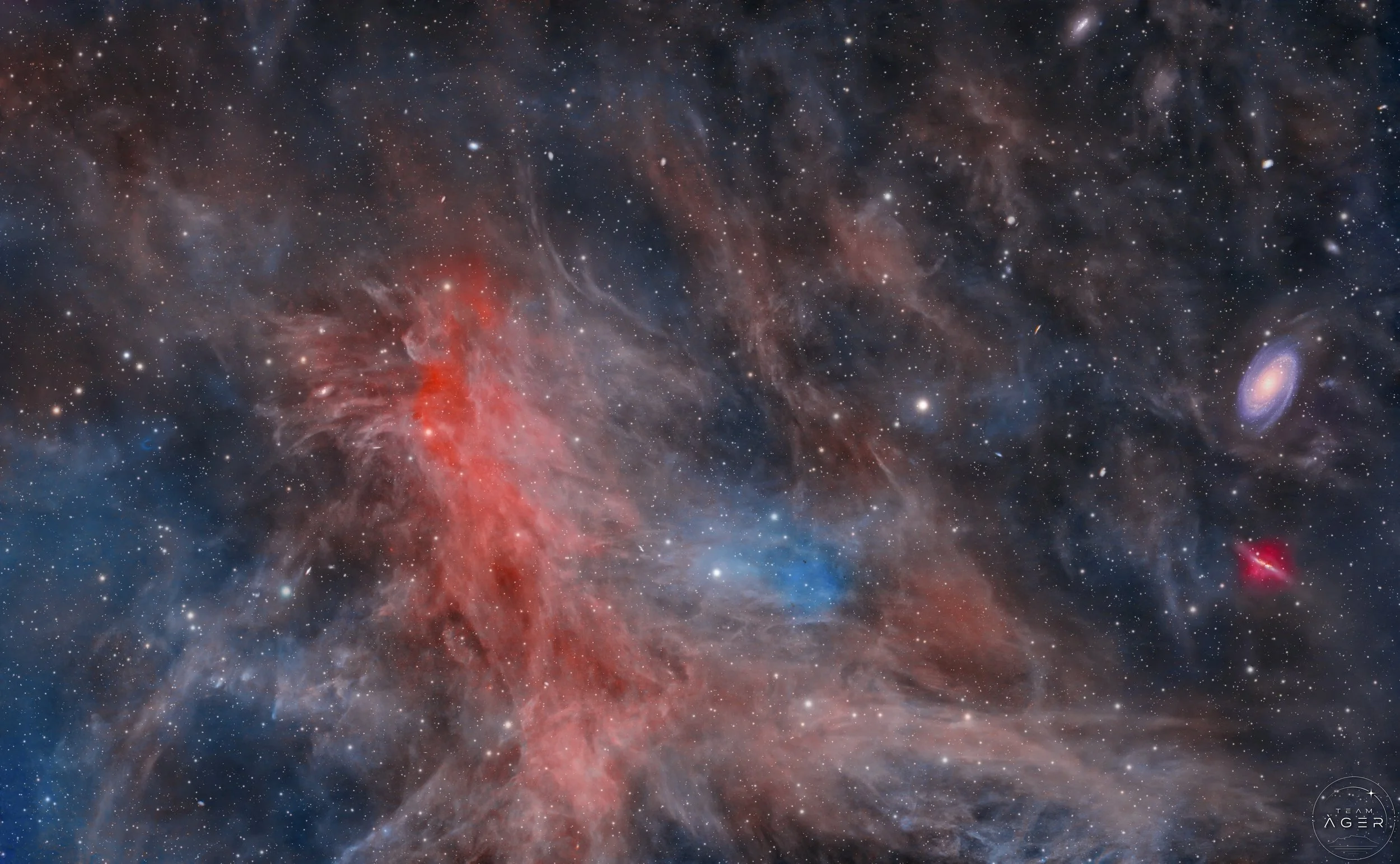
The Vulcan Nebula (cataloged as WPS 46) is a faint deep-sky emission and reflection nebula situated roughly two degrees west of the famous spiral galaxies Messier 81 and Messier 82 in the constellation Ursa Major. Discovered and brought to prominence by amateur astrophotographers capturing ultra-deep exposure widefield integration data, the object is embedded within extensive integrated flux nebula (IFN) clouds, dust and ionized gas floating above the plane of the Milky Way that are lit up by ambient starlight and ionized by surrounding stars like TYC 4376-968-1. Because of its extremely low surface brightness, bringing out its faint blue-green oxygen structures and hydrogen-alpha filaments requires hundreds of hours of total integration time across multiple optical systems and dark-sky sites.

Lunar regolith is a layer of fine dust, fragmented rock, glass spheres, and mineral grains covering the Moon's bedrock, formed by billions of years of meteoroid impacts, solar wind, and radiation exposure without atmospheric weathering or organic matter. Over 98% of its mass is composed of oxygen, silicon, iron, aluminum, calcium, magnesium, and titanium, primarily structured in minerals like plagioclase feldspar, pyroxenes, olivine, and ilmenite. Its composition varies significantly by region: the light-colored Lunar Highlands are rich in aluminum-heavy anorthosite, whereas the dark Lunar Maria feature basaltic flows higher in iron and titanium. Due to constant space weathering, regolith also unique features agglutinates (grains welded together by impact-melted glass), nanophase metallic iron, and embedded solar-wind volatiles like helium-3 and hydrogen.
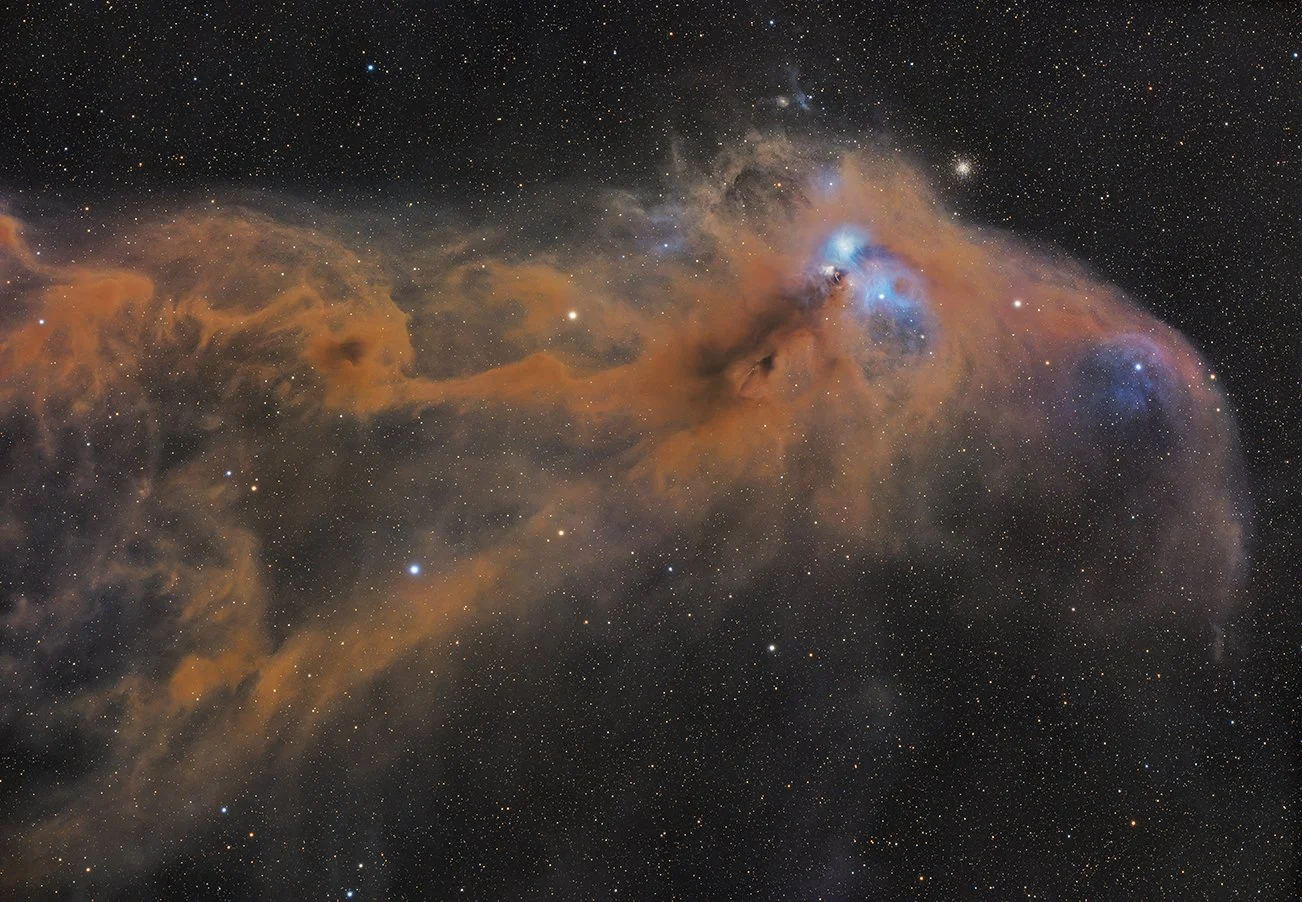
NGC 6726/6727 is a prominent pair of reflection nebulae located within the southern constellation Corona Australis, situated approximately 420 to 500 light-years from Earth. As reflection nebulae, they do not produce their own visible light through gas ionization; instead, fine interstellar dust particles efficiently scatter shorter wavelengths of starlight, creating a characteristic vibrant blue glow (Rayleigh scattering). This ethereal light is primarily energized and reflected by nearby hot, young stars embedded in the cloud, including the variable star TY Crs, as well as HD 176386 and HD 176269.
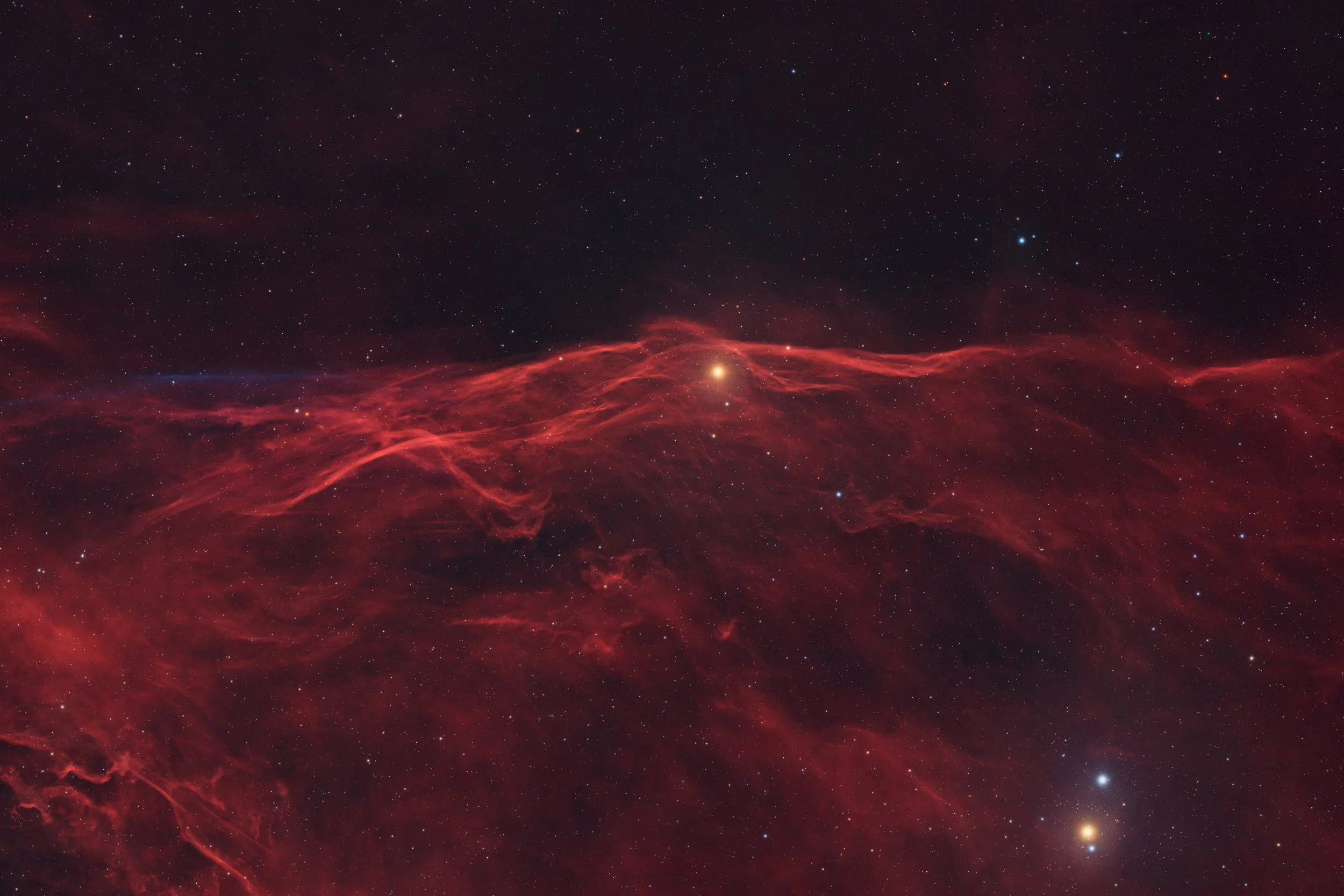
LBN 331 (also known as the "Cygnus Waves") is a faint, sweeping emission nebula situated in the Cygnus constellation near Omicron² Cygni (o2 Cyg) and 31/32 Cygni. Composed predominantly of delicate, filamentary tendrils of ionized hydrogen (Hα) and oxygen (O III), this low-surface-brightness deep-sky object is excited by radiation from neighboring massive stars and requires long-exposure astrophotography with narrowband filtering to properly capture against the dense background of the Milky Way plane.
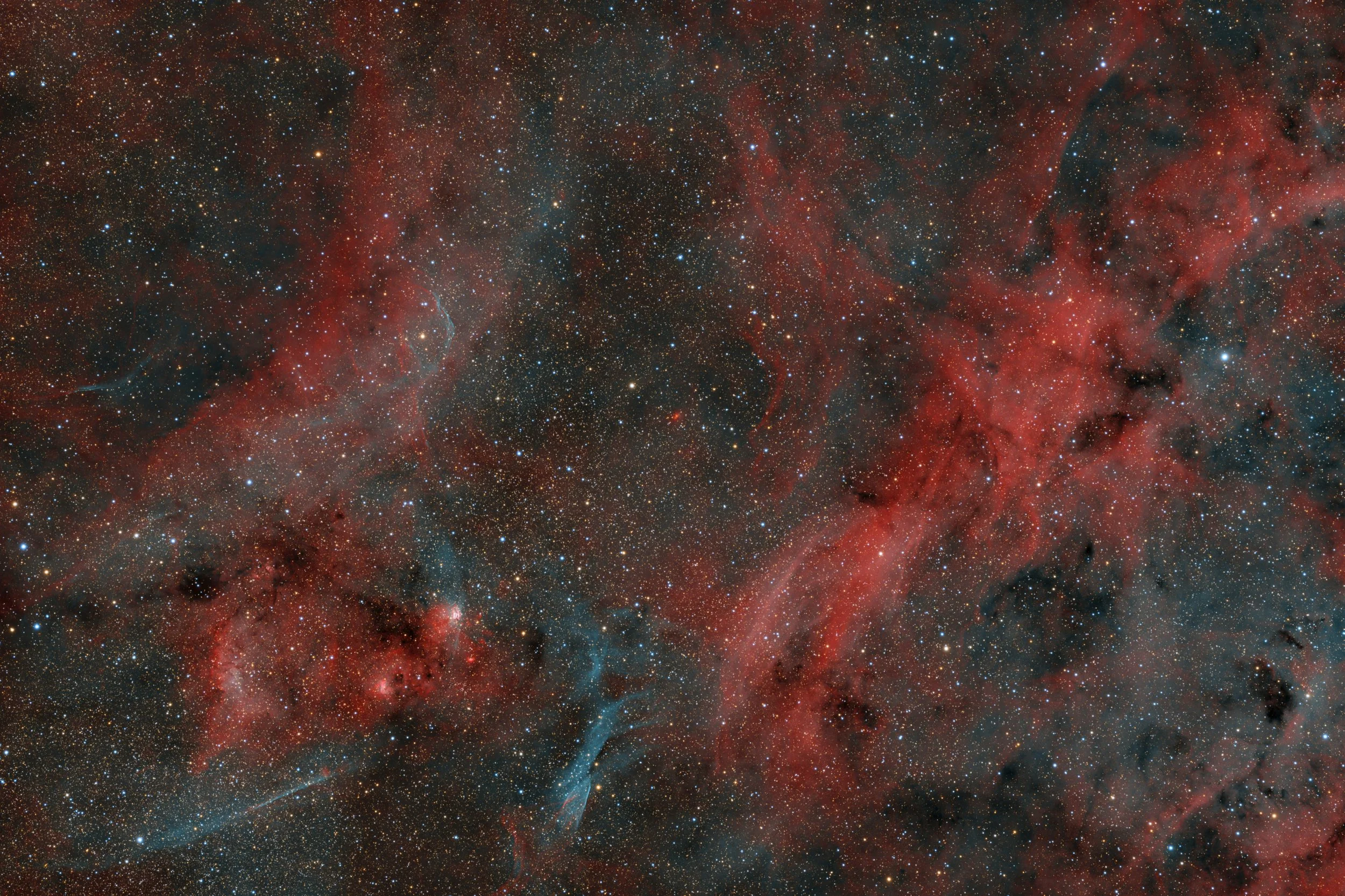
Sh2-99 (Sharpless 99) and Sh2-100 (Sharpless 100) are two H II emission nebulae and active star-forming regions located in the plane of the Milky Way within the constellation Cygnus.
Both regions are embedded in the larger W58 complex, a massive molecular cloud complex and powerful radio source situated thousands of light-years away along the Perseus Arm of the Milky Way.
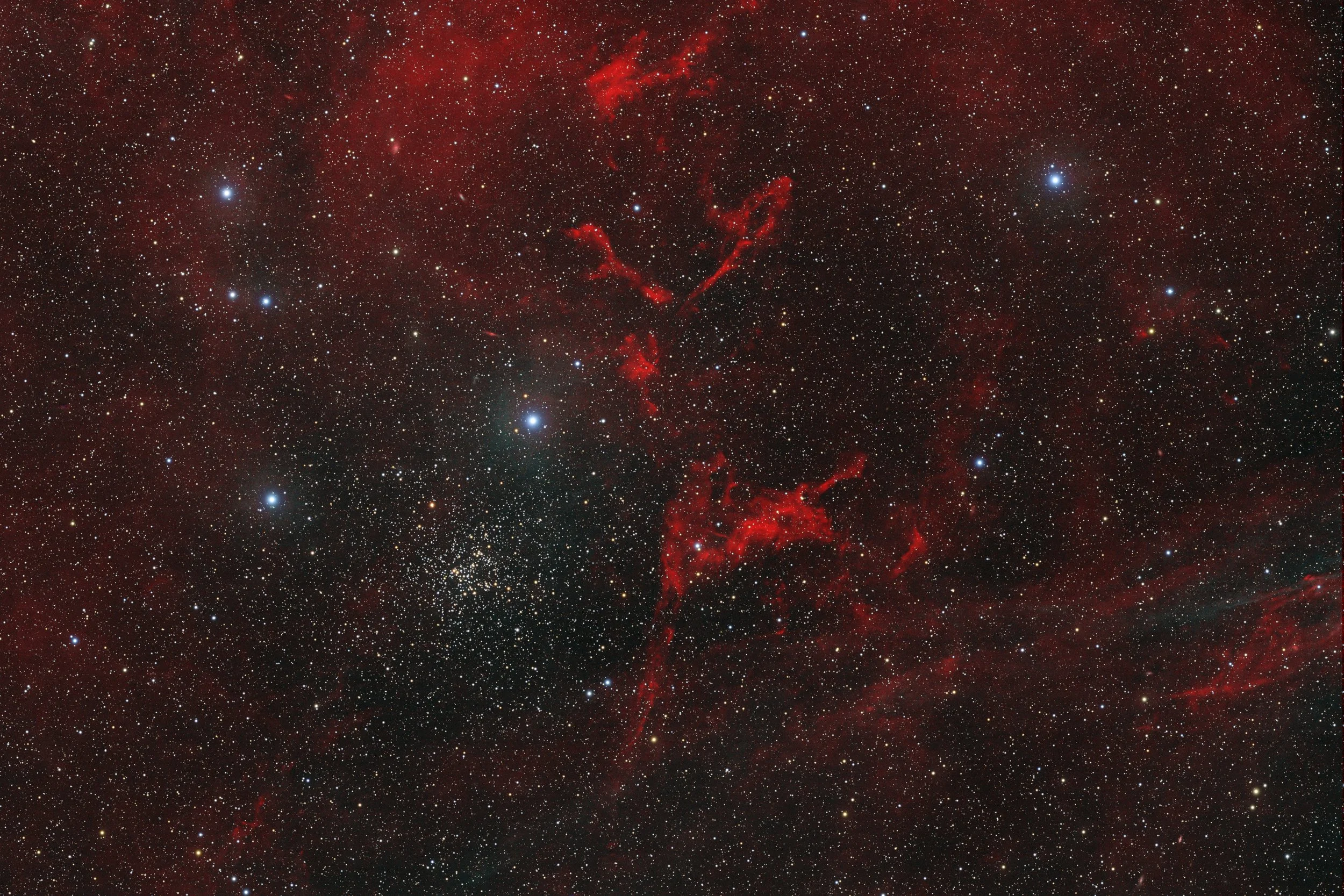
What makes NGC 6819 particularly remarkable to astronomers is its age and stellar population. Estimated to be between 2.3 and 2.5 billion years old, it is considerably older than typical open star clusters, which usually disperse after just a few hundred million years. Containing roughly 150 member stars, with its brightest individuals shining between 10th and 12th magnitude—its high star density and intermediate age made it a primary target for NASA's Kepler space telescope to study asteroseismology, starspots, and the long-term evolution of stars.
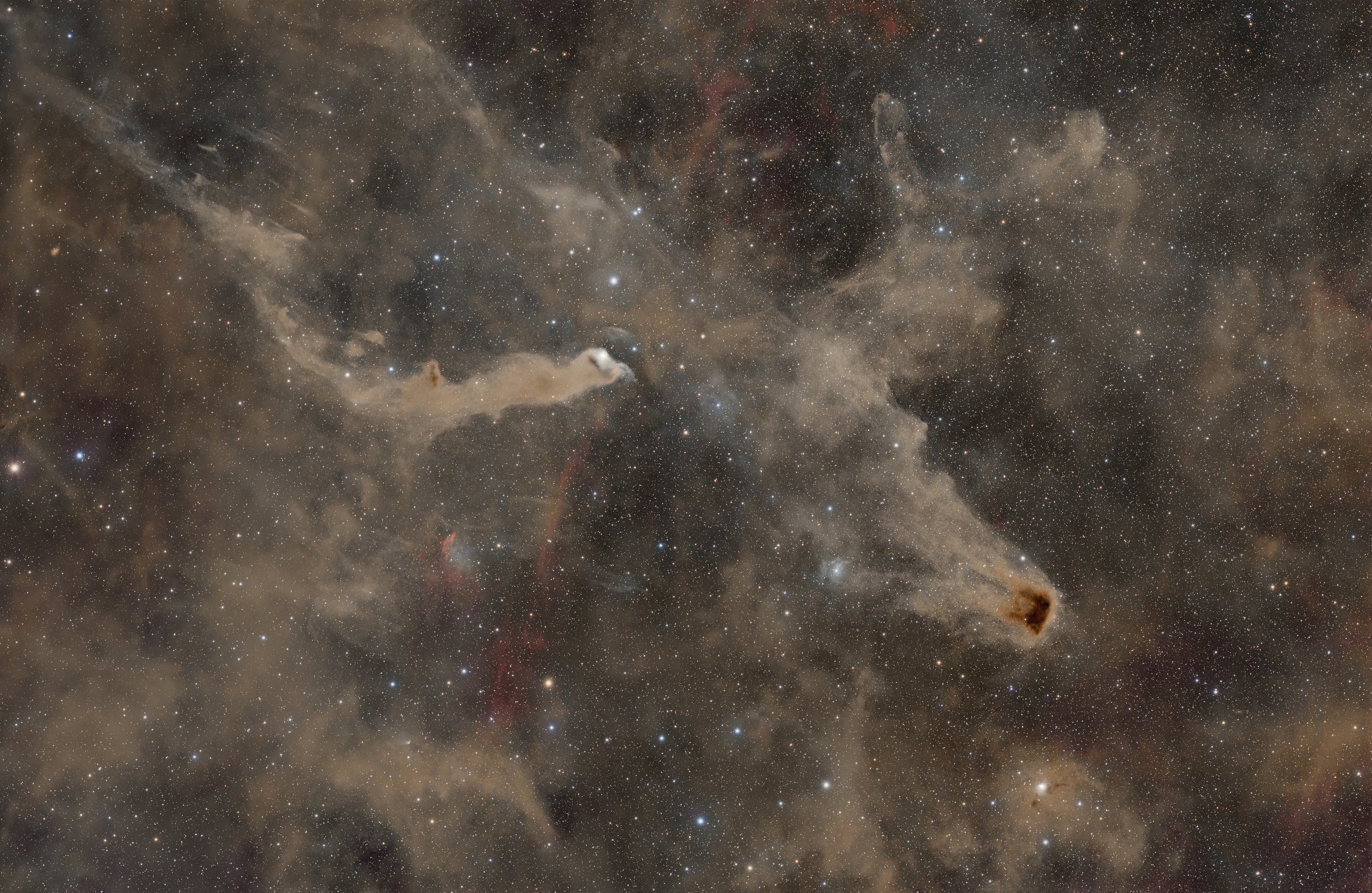
Silent and ancient, a cosmic serpent glides through the northern sky. Caught in the delicate interplay between dust and starlight, the reflection nebula vdB 152 glows like a celestial torch at the tip of a towering, opaque dust lane known as LDN 1221. Here in the Cepheus Flare, cosmic dust grains scatter the soft light of the embedded star BVD 111, painting the dark canvas of space with vivid shades of blue. Surrounding this stellar sanctuary, dense interstellar dust clouds cloak the background stars, weaving intricate dark lanes that reveal the quiet, ongoing birth of stars within our Milky Way.
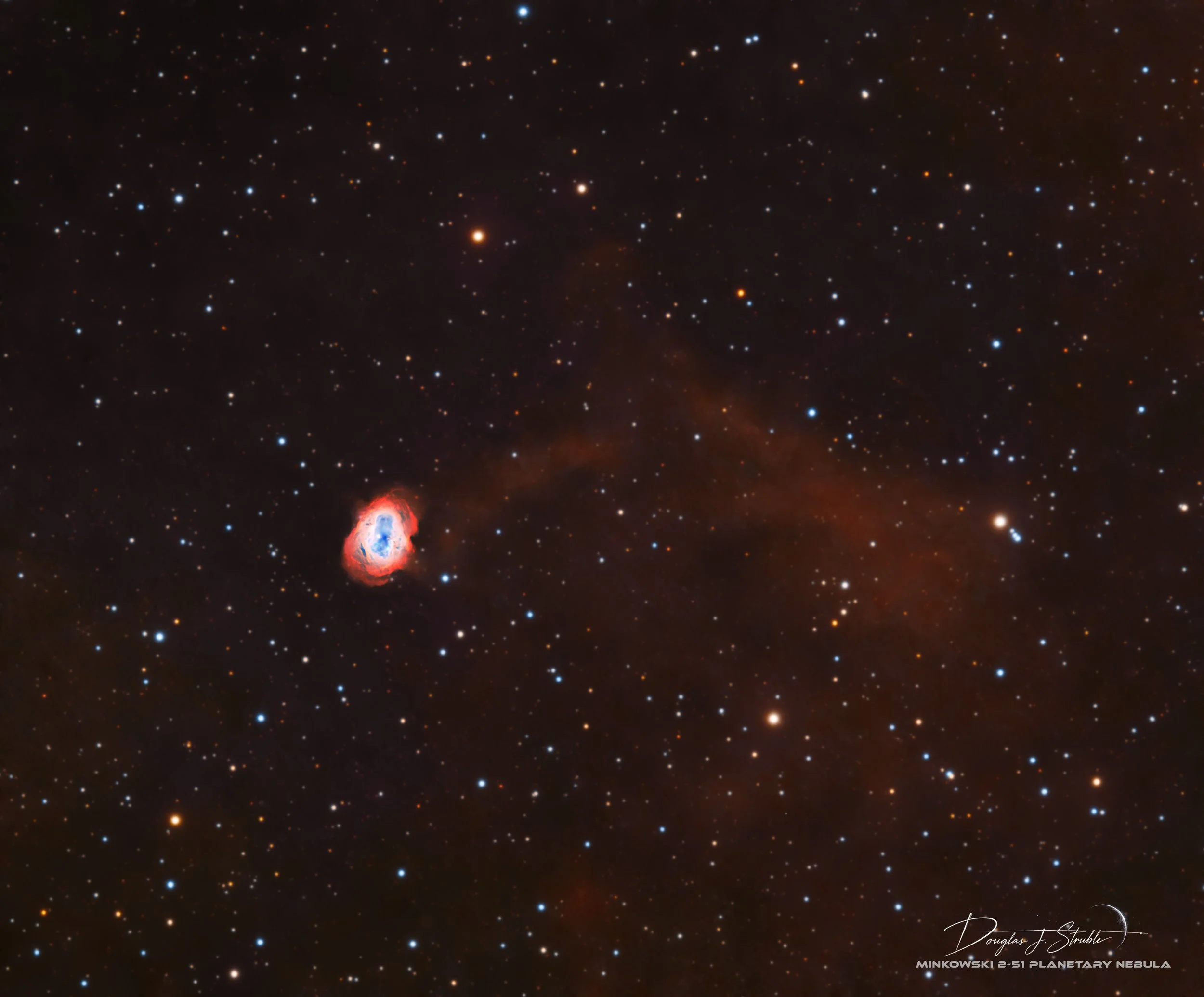
The Minkowski 2-51 Planetary Nebula (also designated as M 2-51 or PN G103.2+00.6) is a faint planetary nebula located roughly 6,300 light-years away in the constellation Cepheus. Discovered in 1947 by the German-American astronomer Rudolph Minkowski using objective-prism survey plates at Mount Wilson, the nebula represents the expanding, glowing shell of ionized gas expelled by an aging, low- to intermediate-mass star entering its final evolutionary stages. Sometimes informally nicknamed the "Little Ring Nebula," it measures under 1 arcminute in angular size (around 39 to 56 arcseconds) and shines dimly at an optical magnitude of approximately 13.5.
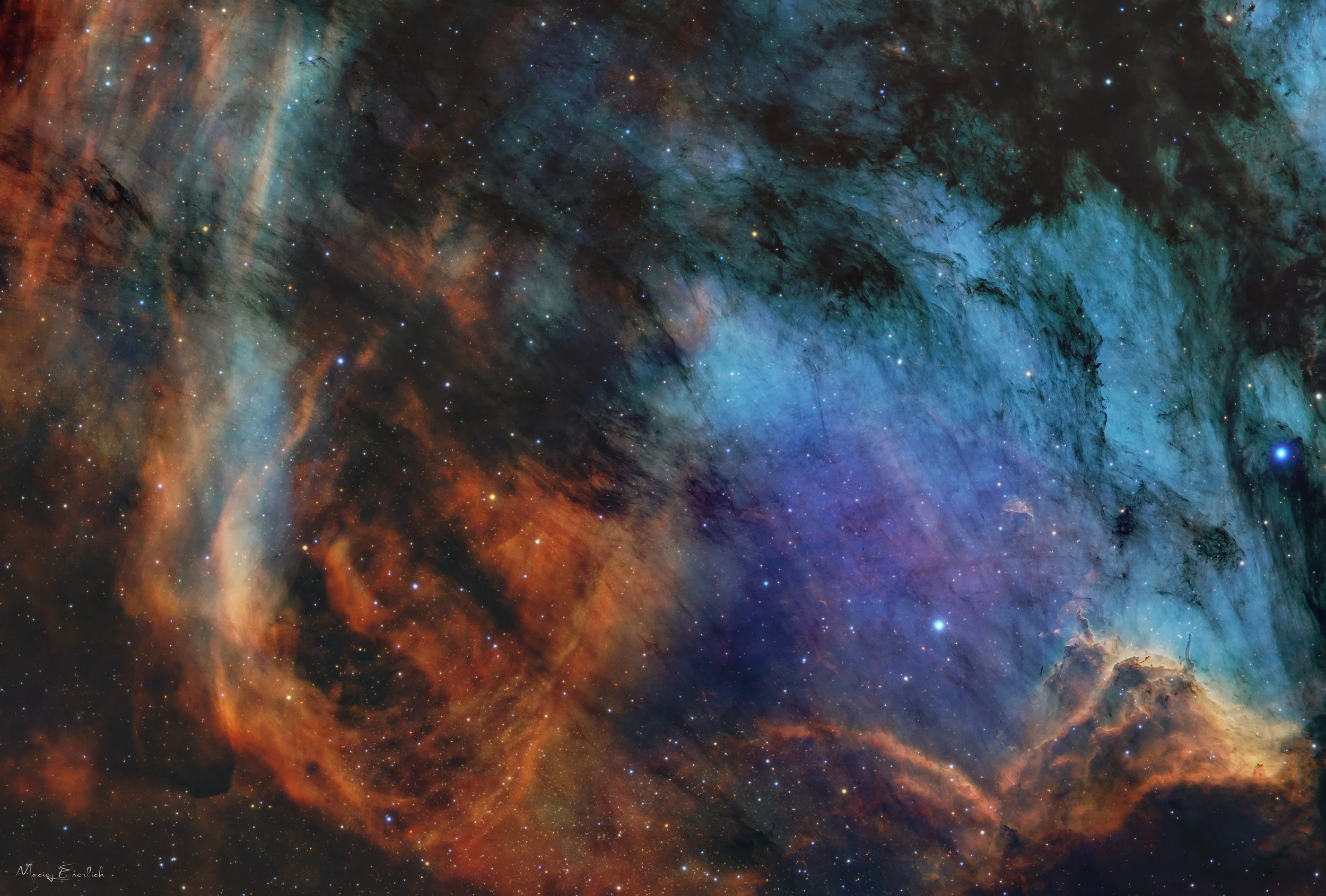
The Pelican Nebula (cataloged as IC 5070 and IC 5067) is a large emission nebula situated approximately 1,800 to 2,000 light-years away in the constellation Cygnus. Spanning roughly 30 light-years across, it is a dynamic star-forming region whose glowing, ionized gas clouds trace an outline resembling a pelican's head and bill. This visible glow is caused by strong ultraviolet radiation from nearby massive stars—most notably Deneb and the energetic stars in the neighboring North America Nebula (NGC 7000), from which the Pelican is separated by a dark, dense lane of interstellar dust known as LDN 935.
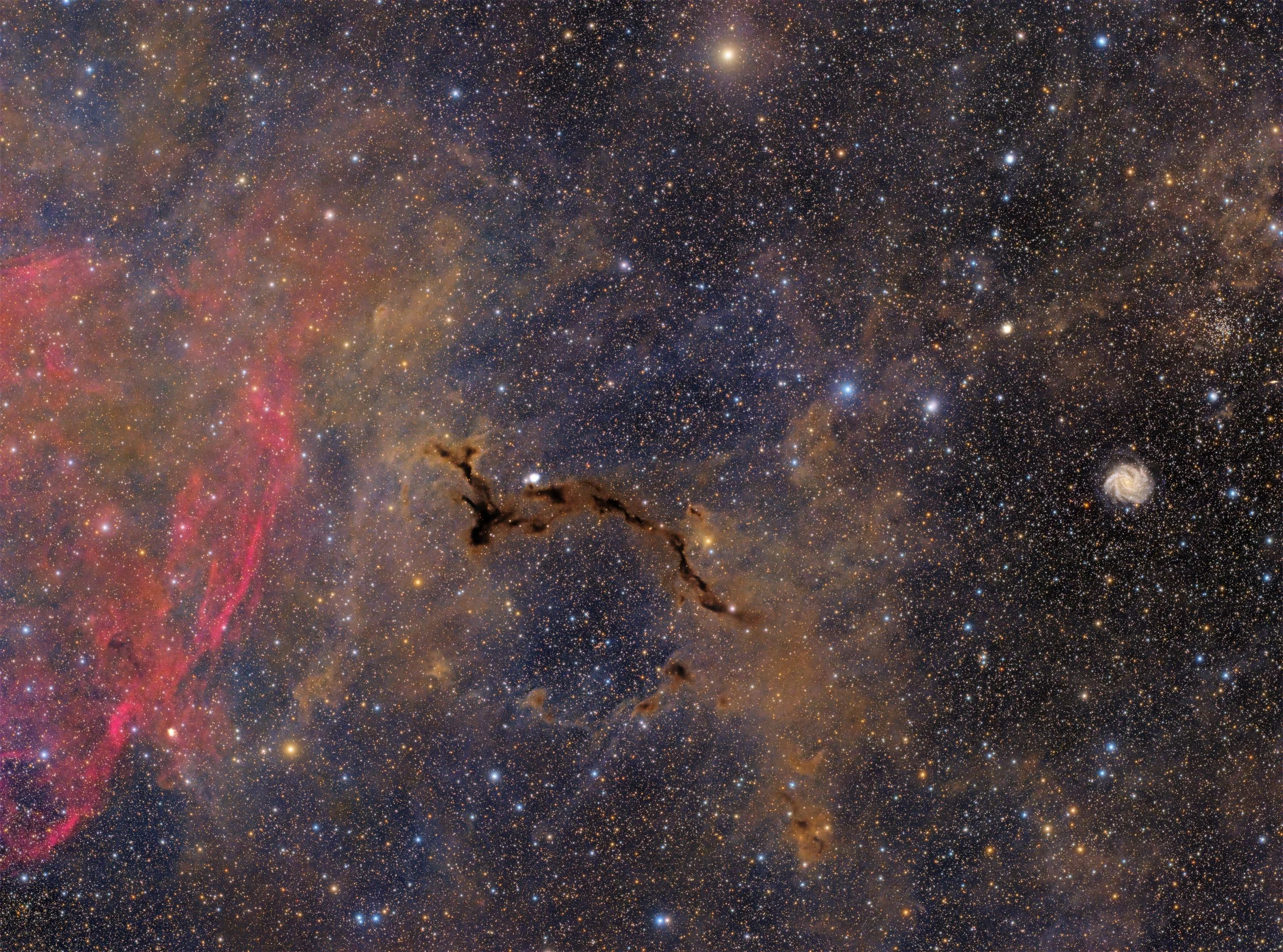
The Seahorse Nebula (cataloged as LDN 1082 or Barnard 150) is a prominent dark absorption nebula situated approximately 1,200 light-years away from Earth in the northern constellation Cepheus. Unlike glowing emission or reflection nebulae, this object is composed of dense, cold cosmic dust and interstellar gas that emits no visible light of its own. Instead, it acts as an opaque silhouette, obscuring the rich, bright star fields of the Milky Way lying directly behind it.
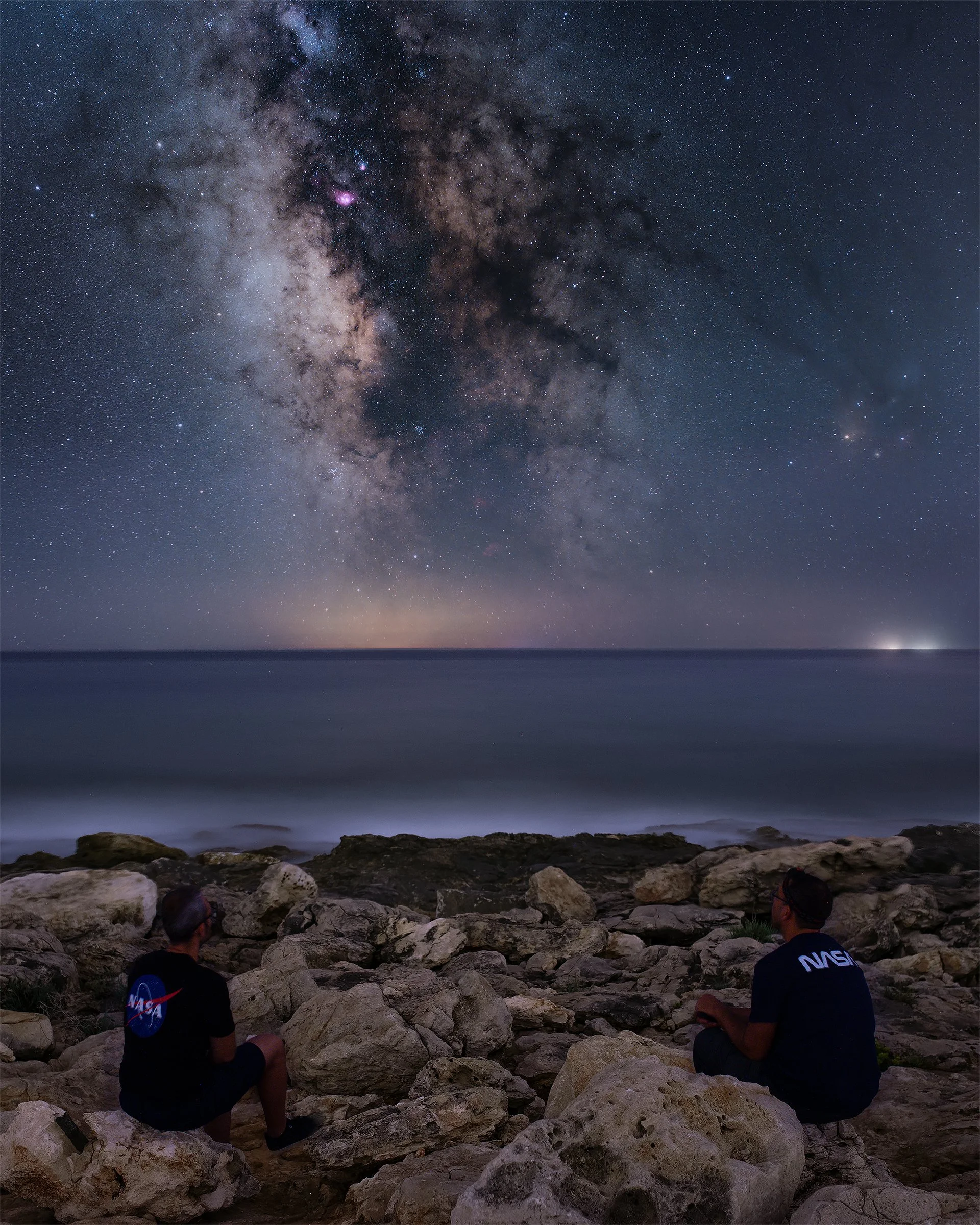
On the night between September 11 and 12, together with my dear friend Filippo, companion of countless astrophotography adventures, we planned a night photography session to bid farewell to the summer Milky Way. The noticeably cooler conditions compared with the previous months, together with the Galactic Center setting during the early hours of the evening, encouraged us to choose a nearby coastal location for our images.
Finally, with a sky free from the excessive humidity of summer, we had the chance to carry out more meaningful tests with our UV/IR-cut modified cameras and explore the wonders of the cosmos with greater accuracy and detail. The unique scenery offered by our coastline would also help enhance a spectacle that was already magnificent on its own.
With the best intentions, we spent hours taking exposures, trying to collect as much light as possible from stars and nebulae far away in both space and time.
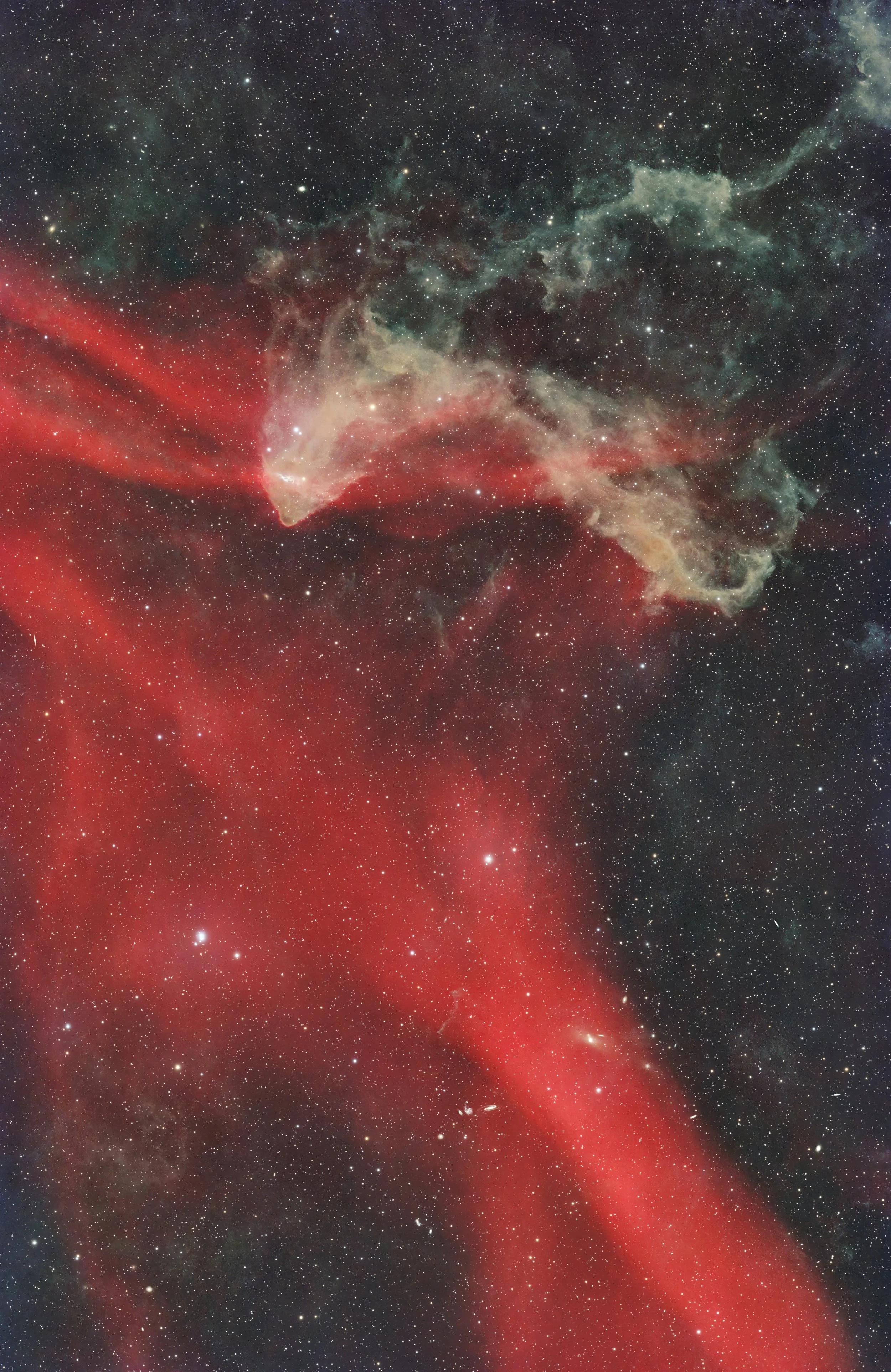
Apart from the Gecko Nebula itself and the dominating bright red hydrogen clouds the numerous „small“ background galaxies make this image special.
I collected the data for this image of the Gecko Nebula (LBN 437) in constellation Lacerta during 7 nights in August/September 2026 with a small refractor and an OSC camera from my balcony in Eltville, Germany - Bortle class 5.
The image represents 30.4 hours of total exposure time (15.9h without filter and 14.5h dual narrowband) - taken with following equipment:
telescope: Askar SQA85
camera: ZWO ASI2600MC Air
mount: ZWO AM5N
filter: Optolong L-eXtreme (Ha/OIII)
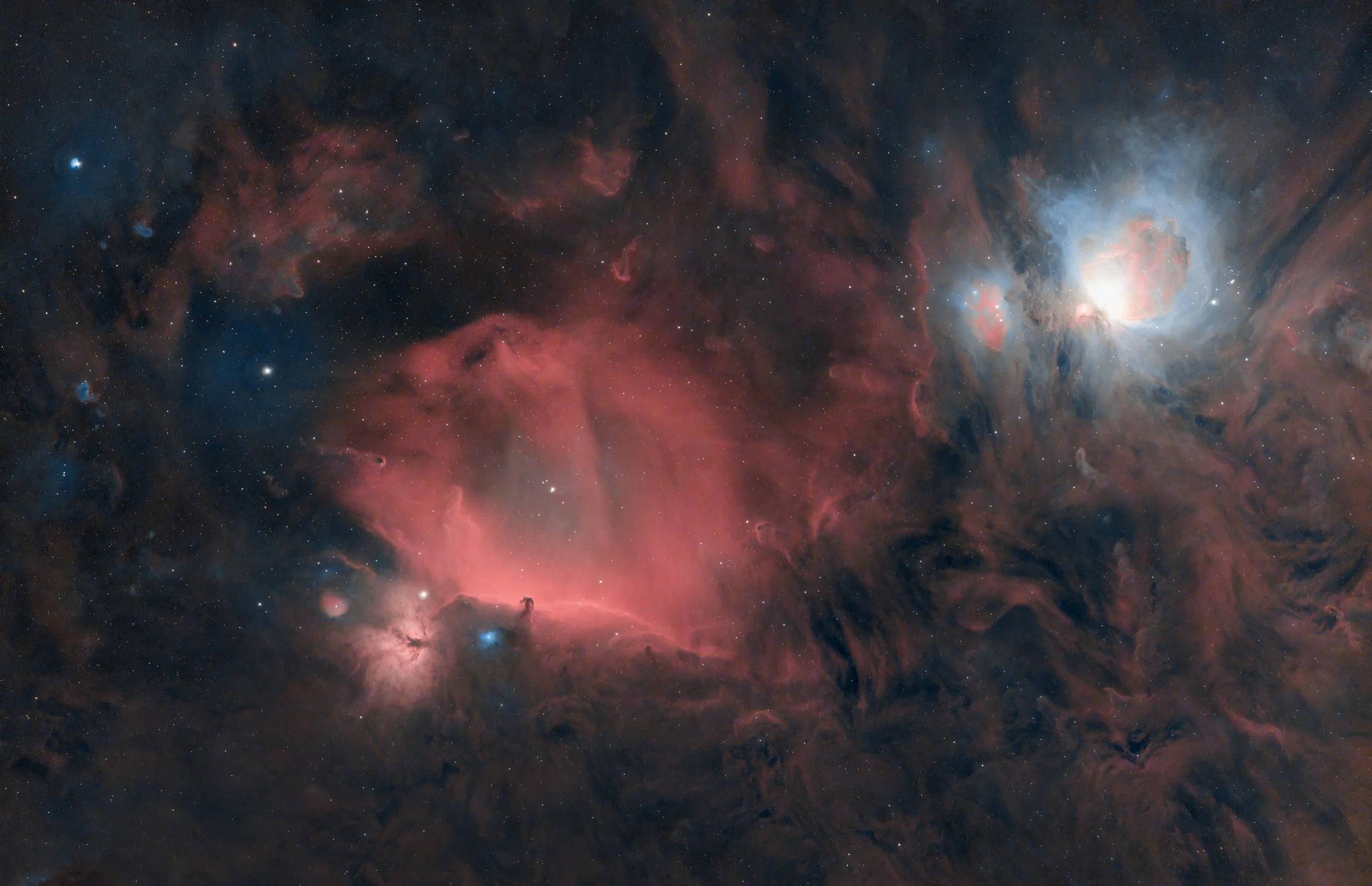
This wide-field view captures the famous Horsehead Nebula (Barnard 33), a dark cloud of dense interstellar dust silhouetted against the glowing red emission nebula IC 434 in the constellation Orion. Located roughly 1,300 to 1,500 light-years away near the star Alnitak, the region is sculpted by intense radiation and stellar winds from nearby massive stars, which ionize the surrounding hydrogen gas and light up neighboring reflection nebulae like NGC 2023.
Abell 347 featuring NGC 891 Formed early in cosmic history (around 10 to 12 billion years ago) through the gravitational collapse of giant primordial hydrogen gas clouds, which flattened out into a spinning galactic disk as stars ignited inside. Its prominent dark dust lane along the equator is created by ongoing star formation and interstellar dust inside its disk.