
AAPOD2 Image Archives
The Bubble Nebula and Its Stellar Neighborhood
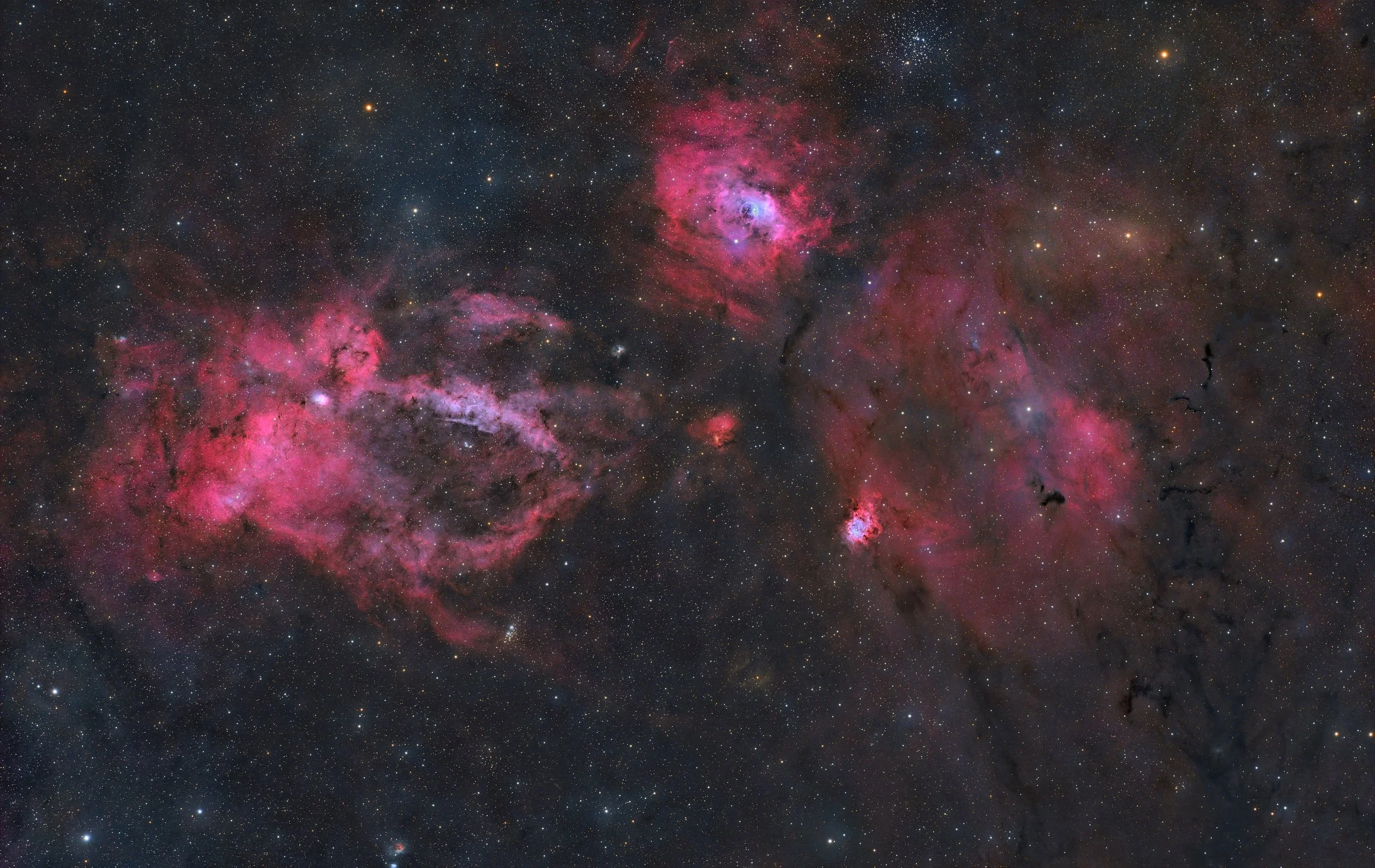
The region around NGC 7635, the Bubble Nebula, is a rich and energetic pocket of Cassiopeia filled with star forming activity and sculpted gas. The Bubble itself is created by the fierce stellar wind from the massive O type star BD+60 2522, which sweeps surrounding hydrogen into a nearly spherical shell. Nearby lies the sprawling emission complex Sh2 157, often called the Lobster Claw Nebula, where ultraviolet radiation from young stars excites clouds of hydrogen and sulfur. The contrast between the smooth bubble and the intricate filaments of Sh2 157 highlights the different ways massive stars shape their environments.
Sharing the same cosmic neighborhood are the open cluster M52 and the star forming region NGC 7538. M52 provides a dense field of young, hot stars that glitter against the nebular backdrop. NGC 7538 hosts some of the largest known protostellar objects in the Milky Way and continues to give birth to new stars within heavily obscured molecular clouds. Together these objects form a vibrant landscape that demonstrates how stellar winds, radiation, and gravity interact to carve the structure of the galactic plane.
The Bubble Nebula in SHO
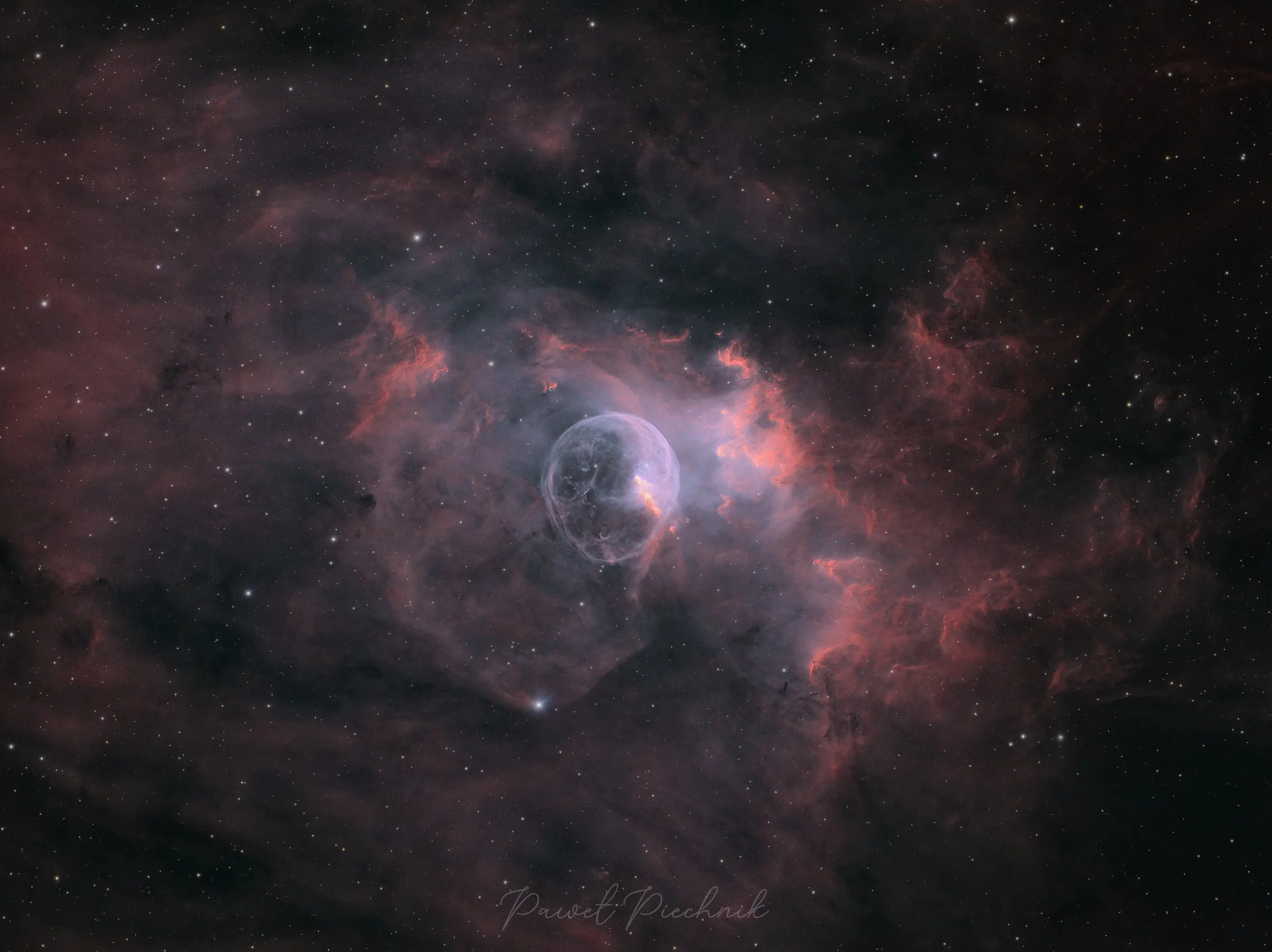
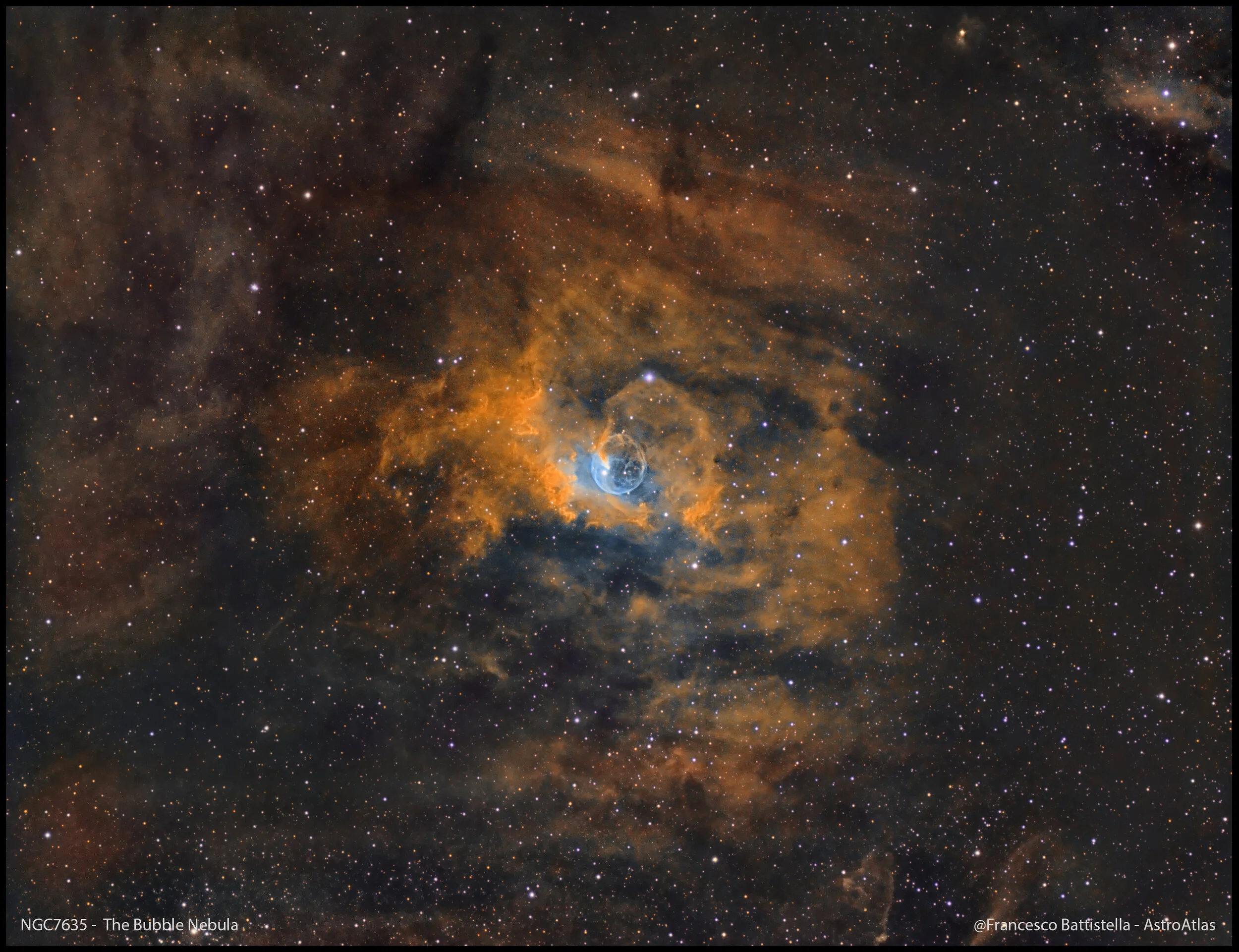
This striking portrait of the Bubble Nebula (NGC 7635) was created from 11.5 hours of imaging through narrowband filters in the SHO palette. Located in the constellation Cassiopeia, the nebula is formed by the powerful stellar wind from a massive, hot Wolf–Rayet star, which sculpts the surrounding interstellar gas into its signature spherical shell. The rich interplay of ionized hydrogen, sulfur, and oxygen gases creates a layered appearance, with subtle colors highlighting the structure of this cosmic bubble.
In this view, the central bubble appears to float within a glowing cloud of filaments and dust, surrounded by faint nebulosity that extends well beyond the central shell. The long integration reveals the nebula’s intricate texture and depth, offering a detailed look at the forces shaping star-forming regions in our galaxy.

NGC 7635 Bubble Nebula deep close-up
The Bubble Nebula, designated NGC 7635, is a stunning celestial wonder located in the constellation Cassiopeia. This breathtaking emission nebula is a region of active star formation, where massive stars at the center emit intense ultraviolet radiation, causing the surrounding gas to glow brilliantly. What makes the Bubble Nebula particularly captivating is its spherical, bubble-like structure, created by the powerful stellar winds and radiation from a central massive star known as BD+60°2522. This stellar wind compresses the surrounding interstellar material, sculpting the gas and dust into a shell-like form. The Bubble Nebula is a visual testament to the dynamic interplay between massive stars and the cosmos, offering astronomers a glimpse into the ongoing birth and evolution of stars in our Milky Way galaxy.
Bubbling Rose
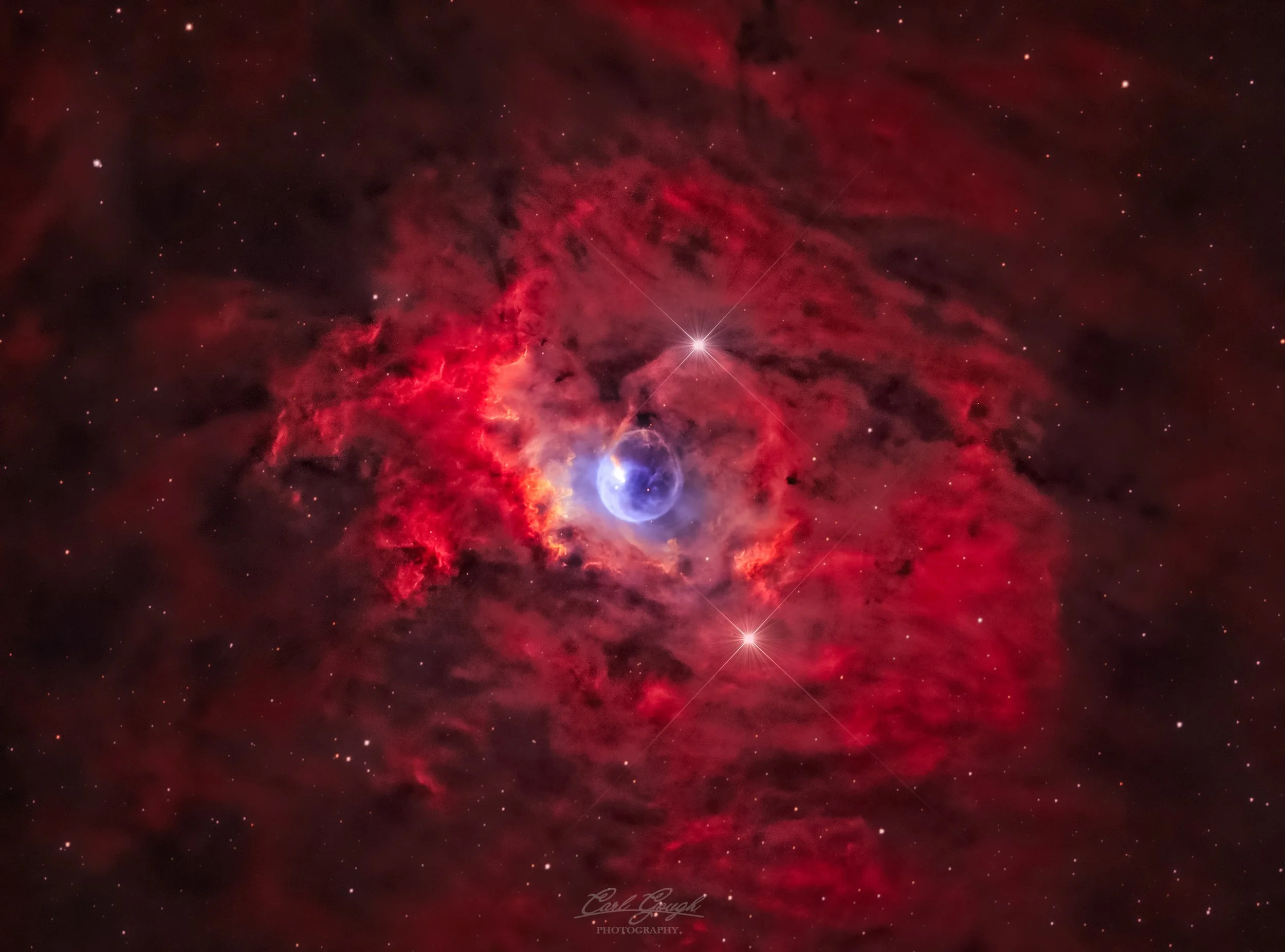
Image Description and Details : After a few months off while i had planetary equipment on the mount. The RC is now back on the mount for some deep sky imaging again. Starting with the Bubble nebula or NGC 7635. 8000 light years away in the constellation Cassiopeia. Captured from my Bortle 5 backgarden in west sussex over many nights. I also added the data i captured back in 2021, as it's a target i find fascinating and keep returning to. Capture details:118x 600 Ha. 63x 600 oiii and 58x 600 sii.Equipment details: EQ6-rASI 1600mmBaader 1.25" narrowband filtersOrion RC 8"
Copyright: Carl Gough

Ngc7635
Image Description and Details : NGC 7635 Bubble Nebula
Distance from Earth: 11,090 light years
NGC 7635 (sometimes known as the Bubble Nebula or C 11) is a diffuse nebula visible in the constellation of Cassiopeia, towards the border with Cepheus.
It is a HII region, at the southern vertex of which there is an empty structure, caused by the pressure of the radiation of a central star of blue color (spectral class O), SAO 20575, of ninth magnitude, whose stellar wind reaches 2000 km / s; it is a blue Giant, which is also responsible for the ionization of the nebula, which emits its own light. Its distance from the Sun is estimated at 11,000 light-years.
Meade RCX 14 "
Ioptron Cem120
Moravian G2-8300
Astronomik filters
21x240s CCD
19x240s RGB
41x600s Ha
Copyright: Luca Dinoi
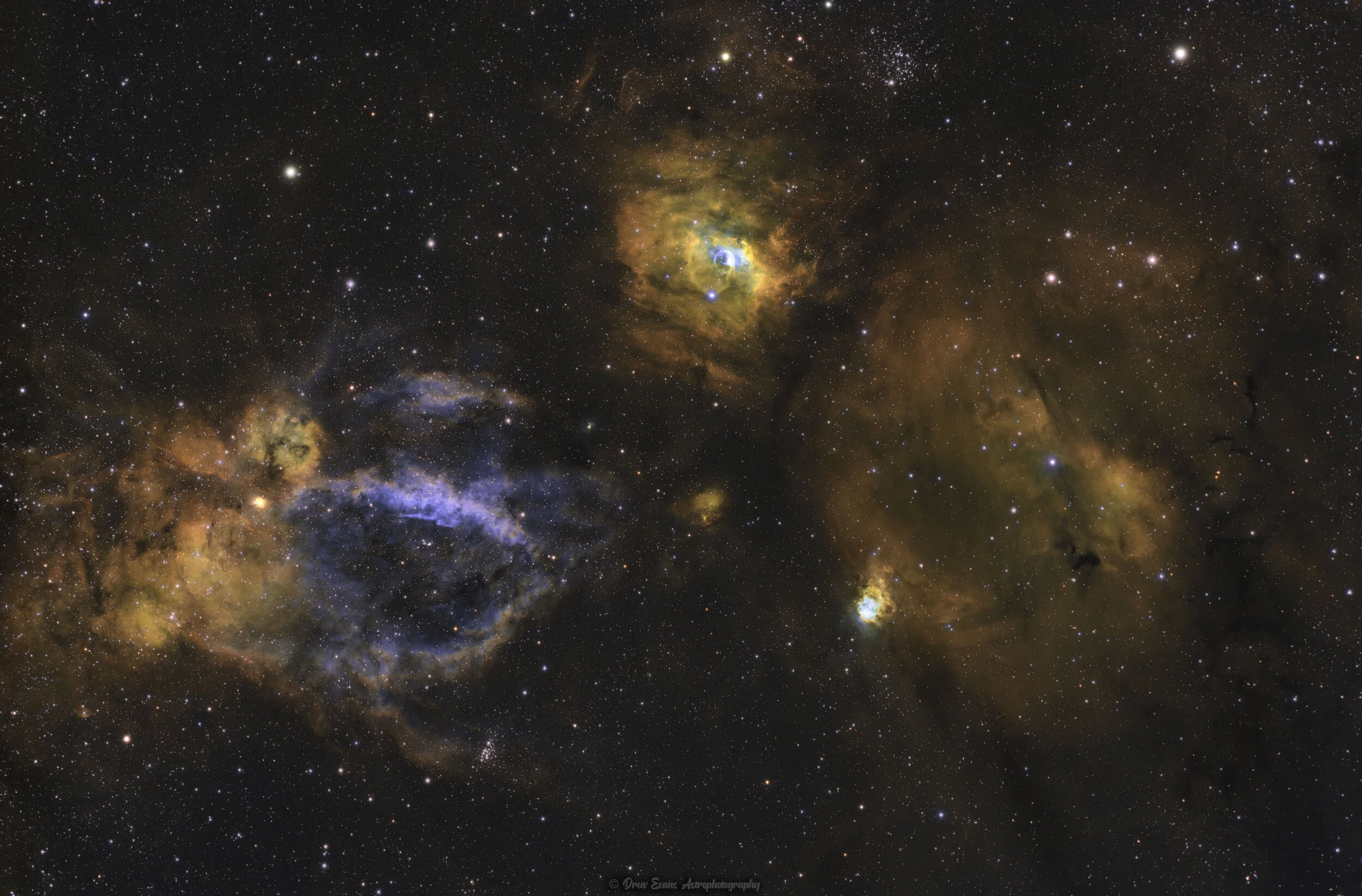
LOBSTER CLAW & BUBBLE NEBULA
The LOBSTER CLAW (SH2-157) & BUBBLE NEBULA (SH2-162), or Sharpless 157 (Sh2-157), is an emission nebula, around 12,000 light-years from Earth between the Cassiopeia and Cepheus constellations. There are several interesting features in this nebula rich region, including the Bubble Nebula, NGC 7635 (or Sh2-162), a HII region emission nebula which lies in a surrounding shell, and excited by the star SAO 20575. Also in the frame are the Wolf-Rayet massive star WR 157, two large open clusters of stars NGC 7510 and NGC 7654, and the nebula NGC 7538, which is home to the largest yet discovered protostar, 300 times the size of our solar system! This image was captured over the span of a week totaling 14.2 hours in narrowband. Each filter was mapped to the Hubble Palette. OTA: William Optics GT81 using 0.8x Flat6A-81 reducerMount: Celestron CGX-LCamera: ZWO ASI294MM ProGain: 100 Night 13nm Sii 22x600s3.7 hours Night 27nm Oiii 30x600s5 hours Night 33nm Ha 22x900s5.5 hours 14.2 hours total Cooling Temperature: -10 CelsiusAuto-guiding: ZWO ASI174MM Mini and ZWO M48 OAGControl: ZWO ASIAIR Pro Flagstaff, AZ - Bortle 4 skies Calibrated in Astro Pixel Processor with darks and flatsProcessed in Pixinsight and Lightroom
Copyright: Copyright: Drew Evans
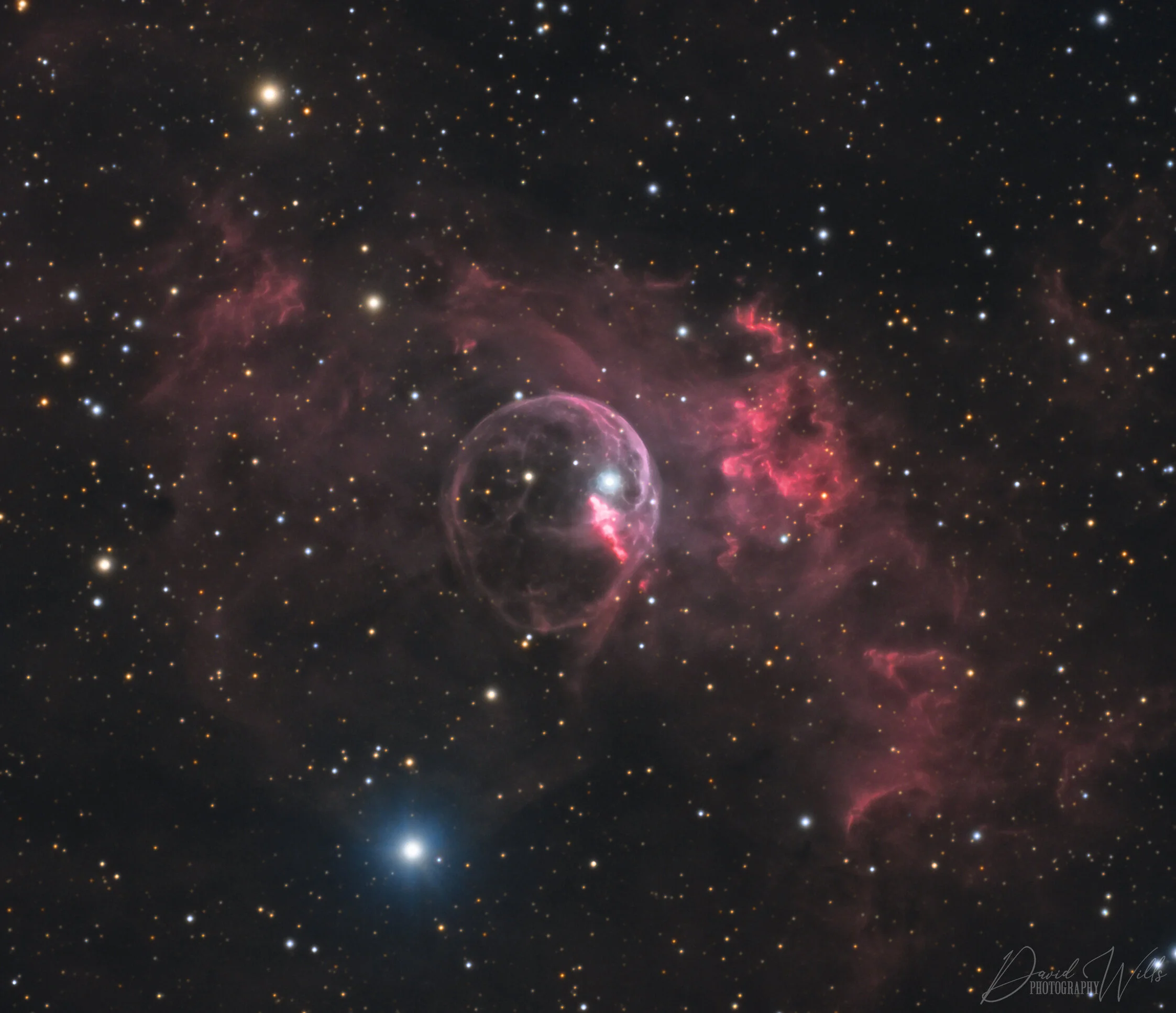
NGC 7635 The Bubble Nebula
Image Description and Details : NGC 7635 The Bubble Nebula captured by David Wills at PixelSkies, Castillejar, Spain
Red 583 x 30s
Green 1483 x 30s
Blue 468 x 30s
Ha 74 x 300s
21 hrs 8 mins hours in total.
Equipment used:
Telescope: Celestron 8" Edge HD
Camera: Xpress Trius SX-694 Pro Mono Cooled to -10C (Binned x2)
Image Scale: 0.8
Guiding: OAG
Filters: Astronomik Ha
Mount: iOptron CEM60 "Standard" GOTO Centre Balanced Equatorial Mount
Image Acquisition: Voyager
Observatory control: Lunatico Dragonfly
Stacking and Calibrating: Pixinsight
Processing: Pixinsight 1.8, Photoshop CC
Copyright: David Wills
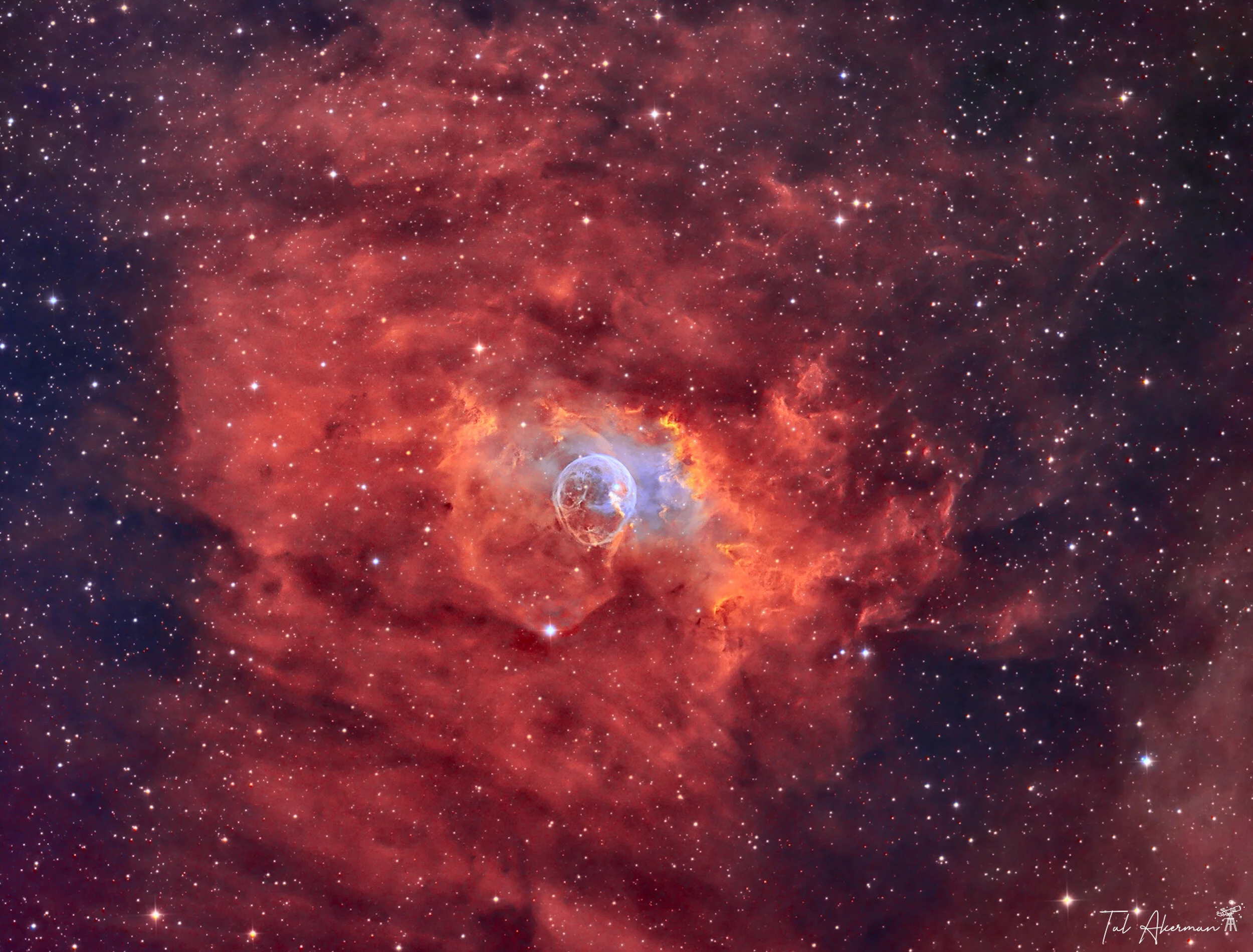
The Bubble Nebula
Image Description and Details :
53 Hours of SHO and RGB Stars !
This project was in my bucket list for a long time, mainly because the Bubble was the reason I started with astrophotography.
oh boy I'm happy with this final version
Astrodon Ha 3nm - 80x900s (20 hours)
Astrodon Oiii 3nm - 60x900s (15 hours)
Astrodon Sii 3nm - 60x900s (15 hours)
Chroma Red - 60x60s
Chroma Green - 60x60s
Chroma Blue - 60x60s
Telescope - GSO RC 8" Carbon Tube
Mount iOptron CEM70
Camera - ZWO ASI 1600mm Pro
Guide Camera - OAG + ZWO ASI174mm Mini
Copyright: Tal Akerman
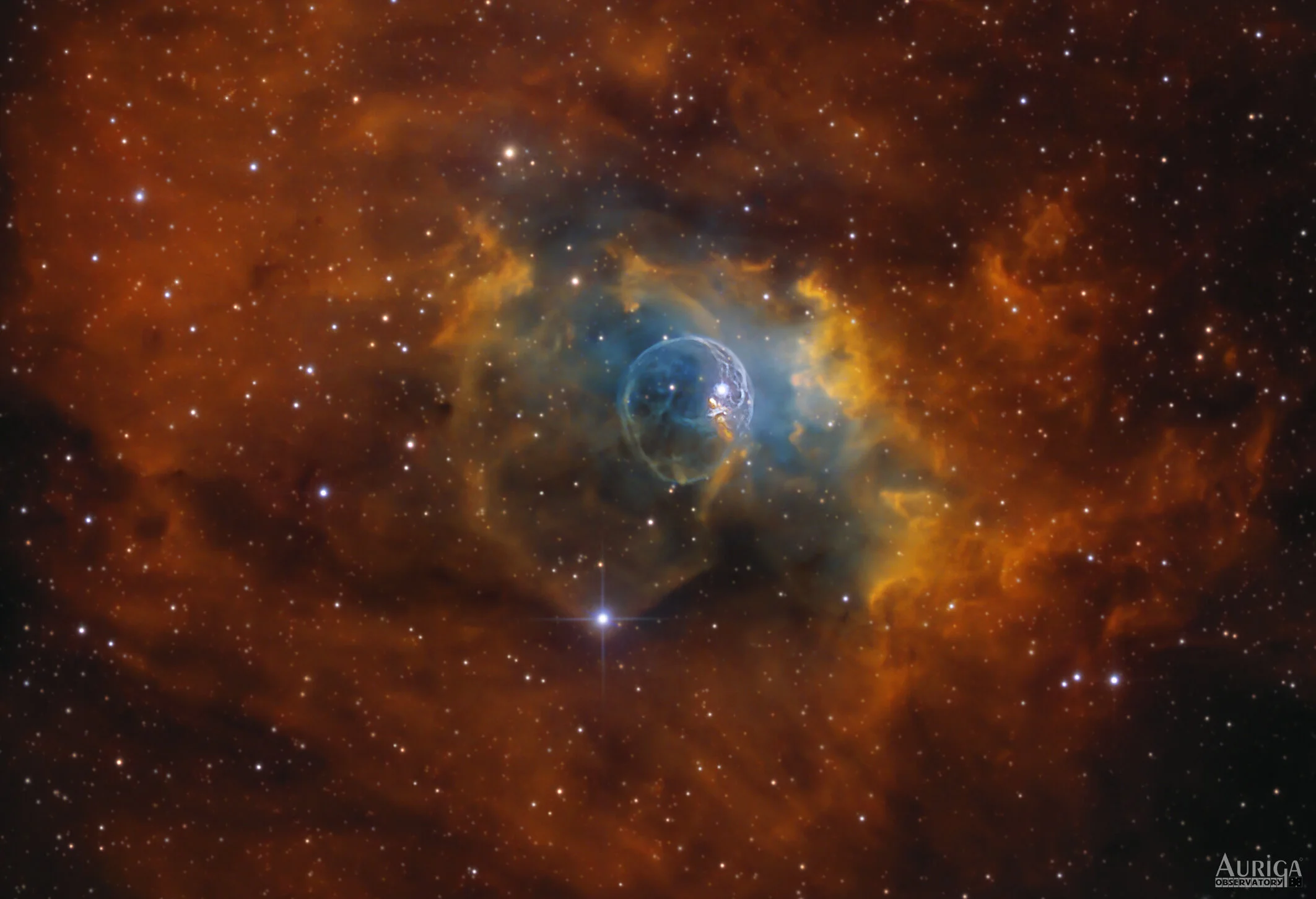
NGC 7635 the Bubble Nebula, SHORGB
Image Description and Details :
"Auriga" private Observatory - Russia - Moscow Region - Makeikha
Photo shooting: August - 14, 17, 18, 19, 20, 21, 22; September: 06, 11, 12; October - 10
Accumulation: 42.2 hours
Baader Planetarium H-alpha 1.25" CCD 7 nm: 121x600" bin 1x1
Baader Planetarium OIII 1.25" CCD 8.5nm: 71x600" bin 1x1
Baader Planetarium SII 1.25 CCD 8nm: 47x600" bin 1x1
Astronomik RGB 1.25" Type IIc: 47x180" bin 1x1
Telescope: SkyWatcher Quattro 8S
Shooting Camera: ZWO Optical ASI 1600-MM COOLED
Mount: SkyWatcher EQ 8 PRO Mount
Telescope Guide: SkyWatcher EvoGuide 50ED
Guide camera: ZWO ASI ZWO 120mm mini
Focus Reducer: Tele Vue Paracorr Type-2
Copyright: Sviatoslav Lips
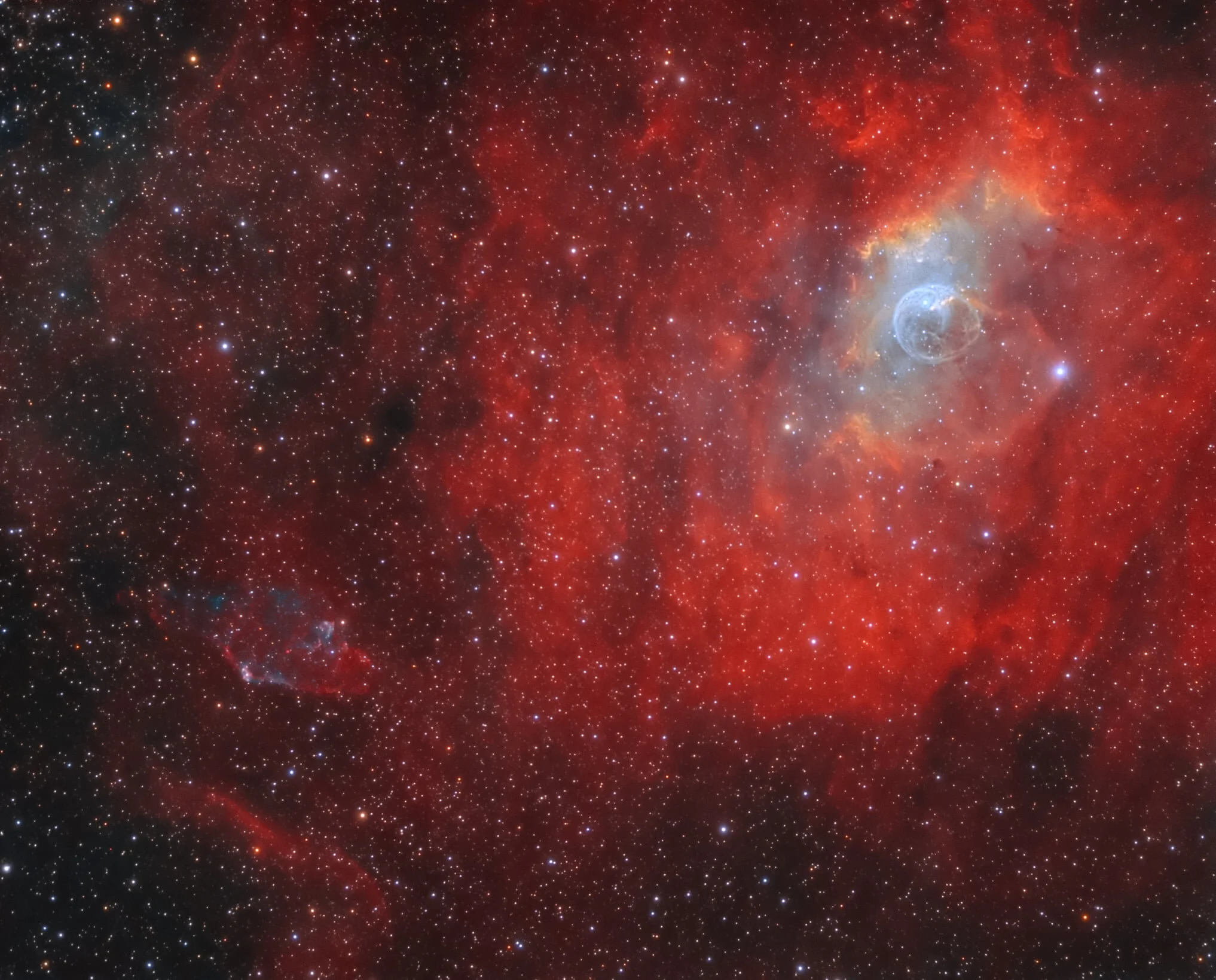
Planetary nebula KjPn 8 and Bubble Nebula
Planetary nebula KjPn 8 (PN G112.5-00.1, K3-89) and Bubble Nebula (NGC7635) in the constellation Cassiopeia.KjPn 8 (PN G112.5-00.1, K3-89) is a bipolar planetary nebula which was discovered by M.A.Kazaryan and Eh.S.Parsamyan in 1971 and independently by Kohoutek in 1972. It is one of the strangest and possibly most unique planetary nebulae in the sky. In my image, we see it on the left side of the frame below the center. Planetary nebula consists of a compact red core (apparent size is about 3–4 arcsec in diameter) surounded by a huge bipolar lobe structure that measures 12x5 arcminutes. There is the possibility that the two separate structures are two separate planetary nebulae formed from both members of a binary star system moving onto the planetary nebula phase within a few thousand years of each other.
This image taken over several nights in November 2020.R-channel - 20 x 150 sec. bin 1x1;G-channel - 20 x 150 sec. bin 1x1;B-channel - 20 x 150 sec. bin 1x1;Ha- 46 x 600 sec. bin 2x2;OIII- 74 x 600 sec. bin 2x2.Total integration time about 22:30 hours.
My setup: Telescope 8" Celestron Schmidt-Cassegrain (SCT) CPC800 GPS (XLT) on the equatorial wedge, focal reducer Starizona Night Owl 0.4х, Feq=864mm, camera Starlight Xpress Trius SX694, SX mini filter wheel, filters Astrodon LRGB E-series gen.2, Astrodon Ha 5nm, Astrodon OIII 3nm.Capture and processing software: MaxIm DL6, PHD2, PixInsight, StarTools, Photoshop CC, Zoner photo studio 14.North at the top.
Copyright: Boris Vladimirovich

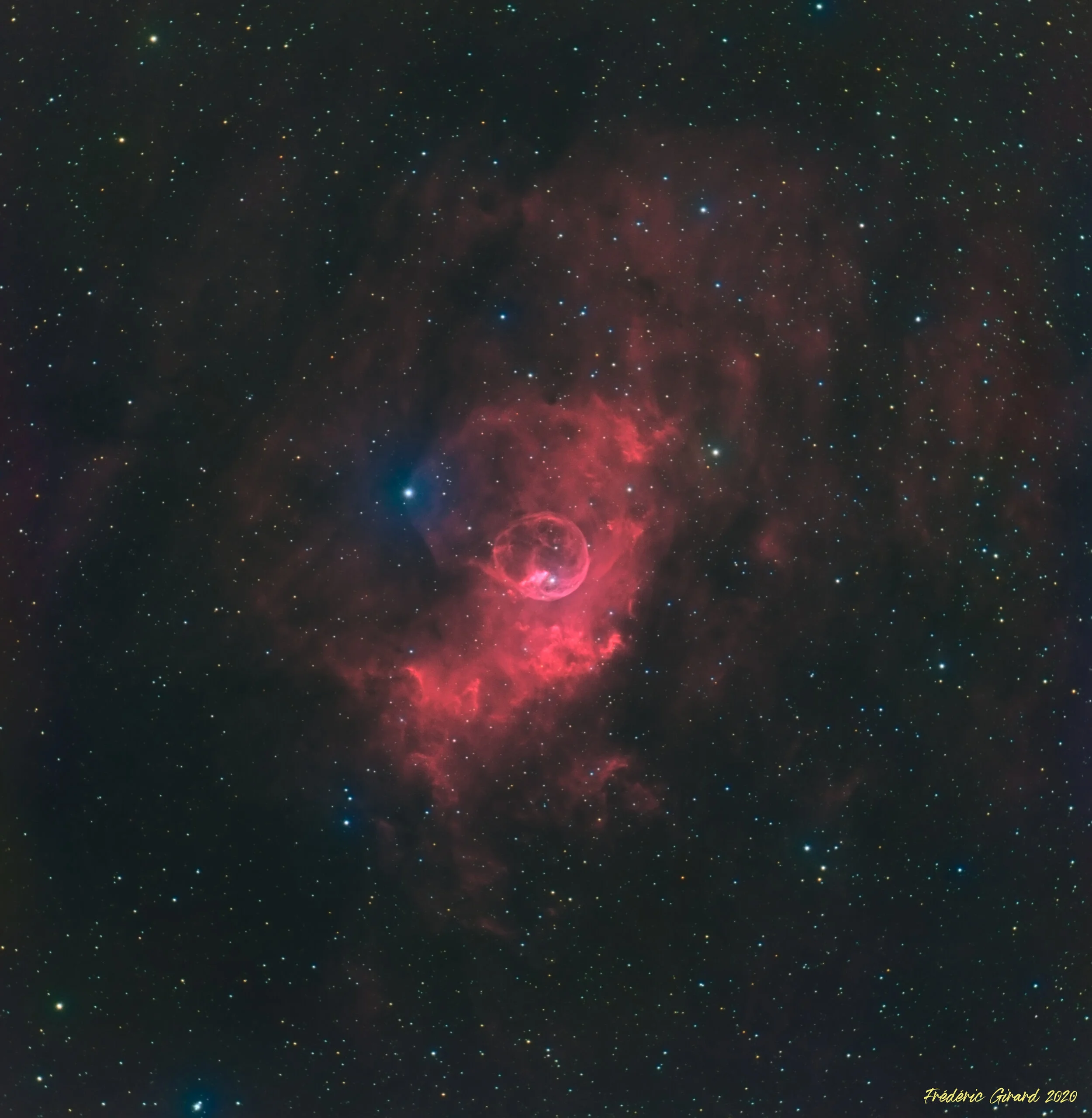
Bubble Nebula - ngc7635 - Ha-rvb
A unique celestial object, a soap bubble-shaped nebula called ngc7635, discovered in 1787 by William Herschel, an English astronomer. The nebula is located in the constellation of Cassiopeia (between Cassiopeia and Cepheus in fact) and its diameter is about 10 light years. This bubble shape is designed thanks to the stellar wind created by the star SAO 20575, just next to it, a little off-centered, very dense and warm. This star is expected to explode as a supernovae in a few tens of millions of years.
This image results from the composition of photos taken with different color filters and in H-Alpha for fine details.
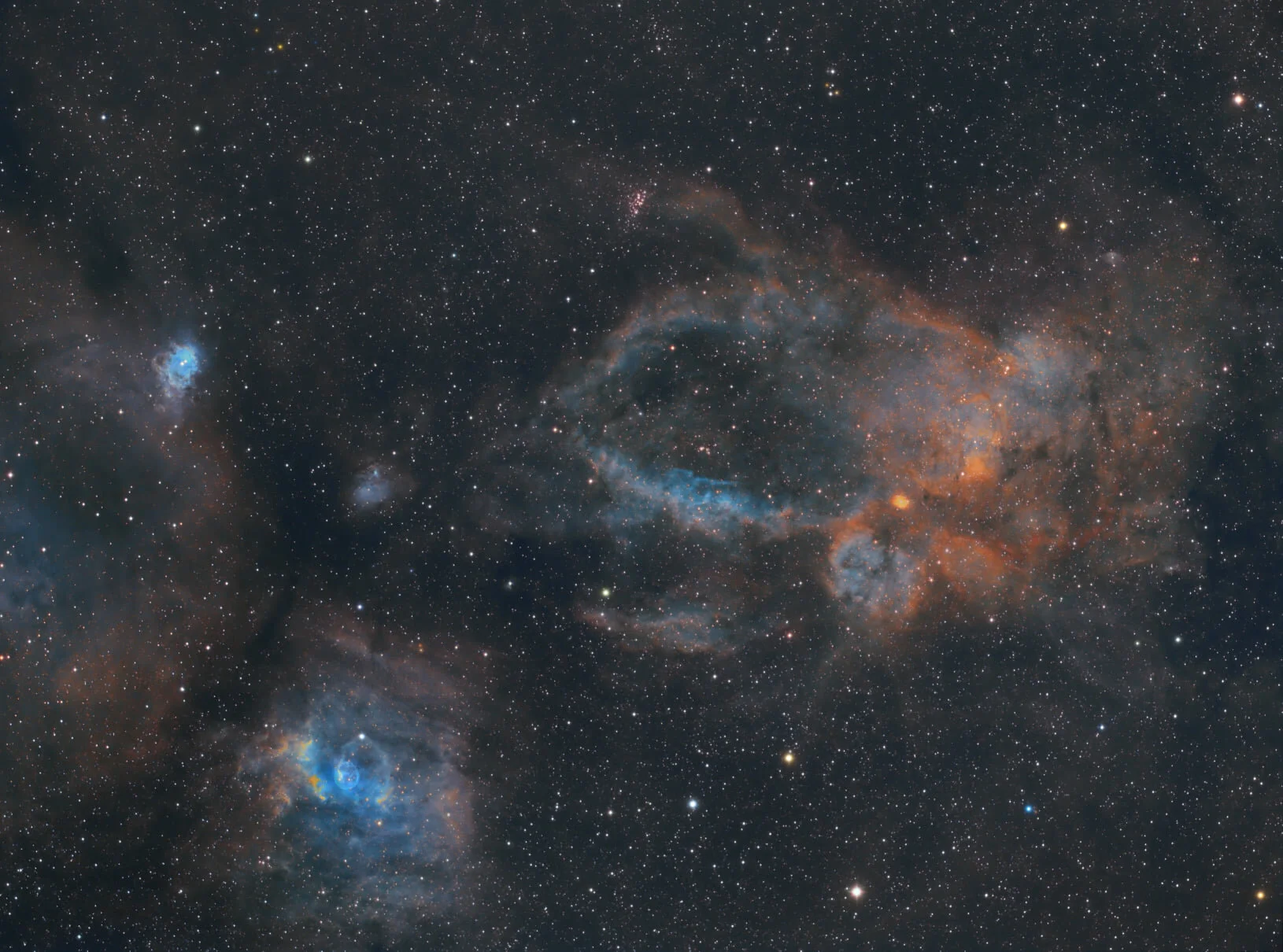
Lobster Claw (Sh2-157), Bubble Nebula, and More
Lobster Claw (Sh2-157), Bubble Nebula, and More
Scope: Takahashi FSQ-106EDX IV
Camera: QSI 683wsg-8
Mount: Software Bisque Paramount MX+
Ha: 35x900" -20C bin 1x1
Astrodon OIII: 22x900" -20C bin 1x1
Astrodon SII: 20x900" -20C bin 1x1
Integration: 19.2 hours
Copyright: Craig Patterson