

AAPOD2 Image Archives
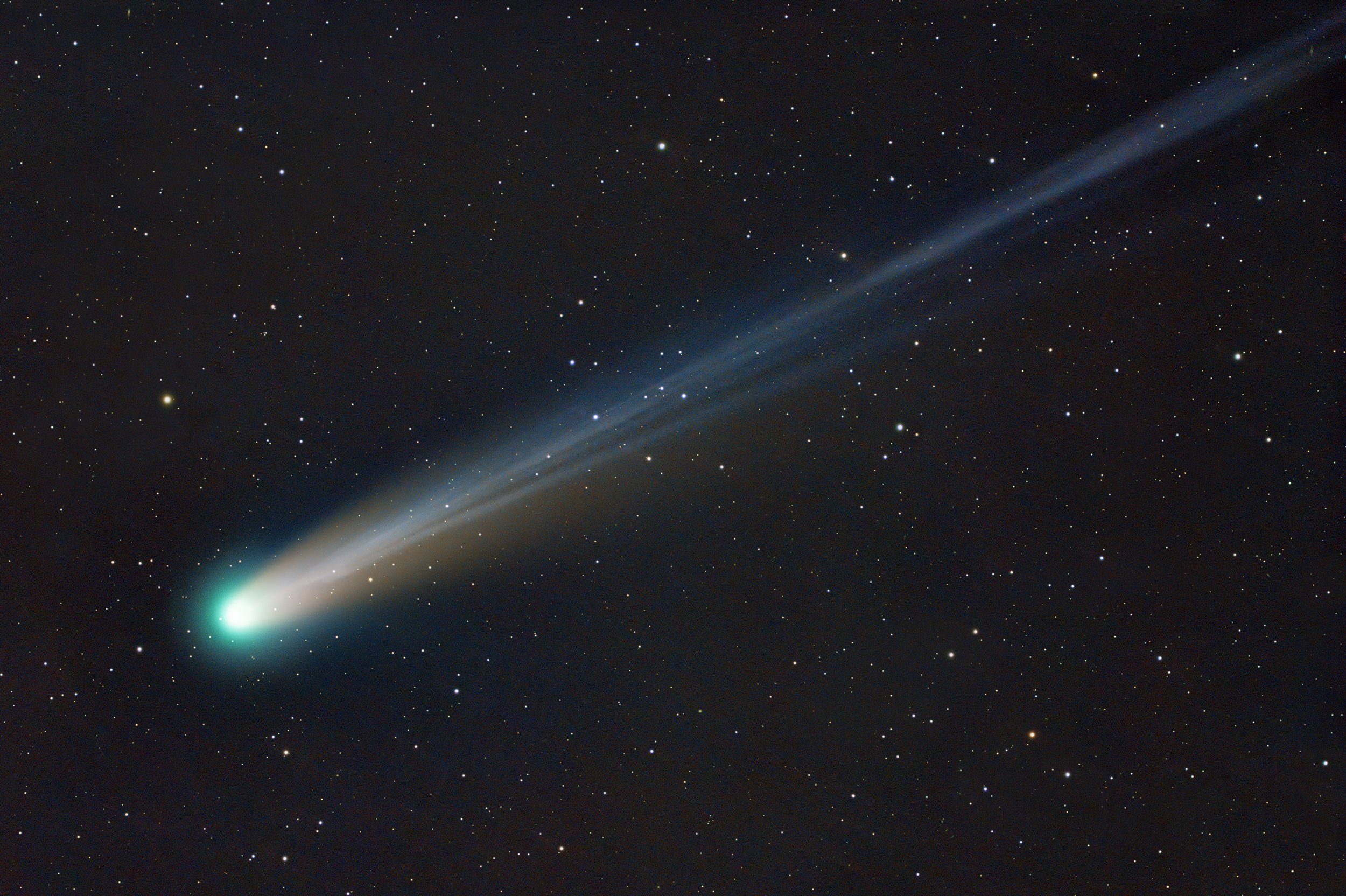
Comet C/2025 A6 (Lemmon) — October 13, 2025
Captured from the Aosta Valley in the western Alps, this image reveals Comet Lemmon streaking through the northern sky, displaying a striking contrast of colors: a vivid green coma and a beautifully extended blue ion tail. The cyan–blue tail, rich in ionized molecules such as CO⁺, forms under the influence of the solar wind, while the green glow arises from diatomic carbon (C₂) fluorescing in sunlight. The complex, braided structure of the tail reflects the comet’s active nucleus as it responds to changing solar conditions.
Discovered on January 3, 2025 by the Mount Lemmon Survey, C/2025 A6 (Lemmon) is now rapidly brightening as it approaches perihelion on November 8, 2025, when it will pass just 0.53 AU from the Sun. Its closest approach to Earth occurs on October 21, at a distance of about 0.60 AU, making it an easily observable comet for northern observers. Currently around magnitude 5–5.7, it may peak between magnitude 3.5 and 4.5, potentially visible to the naked eye under dark alpine skies. With an orbital period of roughly 1,350 years, Comet Lemmon offers a rare glimpse of a visitor from the outer Solar System, its glowing trail marking both its journey and the Sun’s invisible wind.
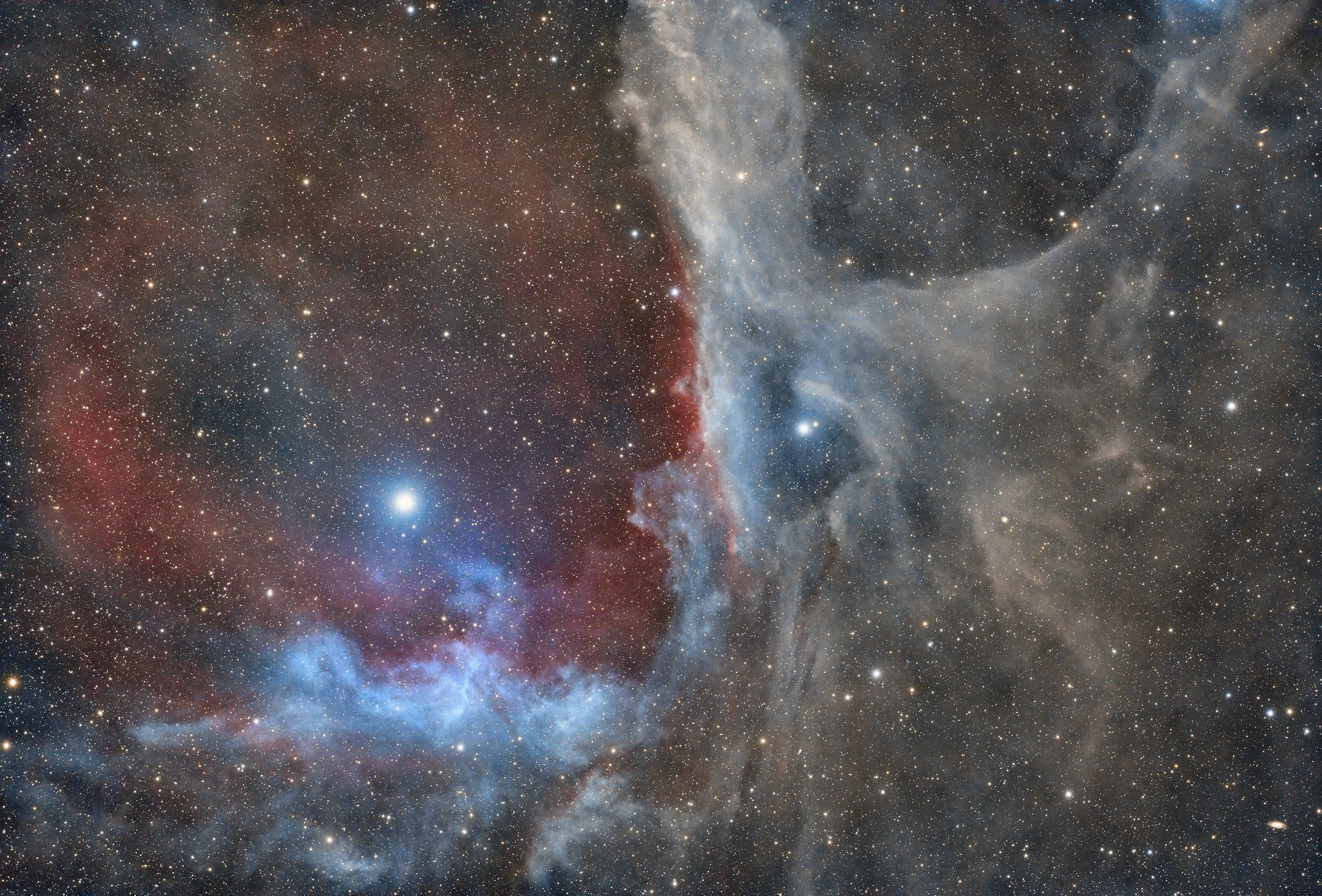
Pi Scorpii and the Blue Reflection Nebula Sh2-1
Dominating the lower left of this frame is the brilliant blue star Pi Scorpii, embedded in a swath of glowing interstellar dust and gas. The surrounding nebula, cataloged as Sh2-1, is a striking reflection nebula located in the constellation Scorpius. Illuminated by the hot B-type star, the dust reflects and scatters starlight, creating the characteristic blue glow.
To the right of Pi Scorpii lies an extensive field of faintly glowing interstellar cirrus and dark molecular dust. These structures are part of a larger complex of nebulae threading through this region of the sky, including faint emission nebulae that appear red from ionized hydrogen. The bright star to the right-center is HD 147165 (also known as Sigma Scorpii), further contributing to the illumination of the nebular material.
This deep image was captured from Tivoli Southern Sky in the Khomas region of Namibia, one of the darkest observing sites on Earth. The pristine southern skies reveal not only the bright nebulae, but also faint, extended dust structures often lost to light pollution.