

AAPOD2 Image Archives
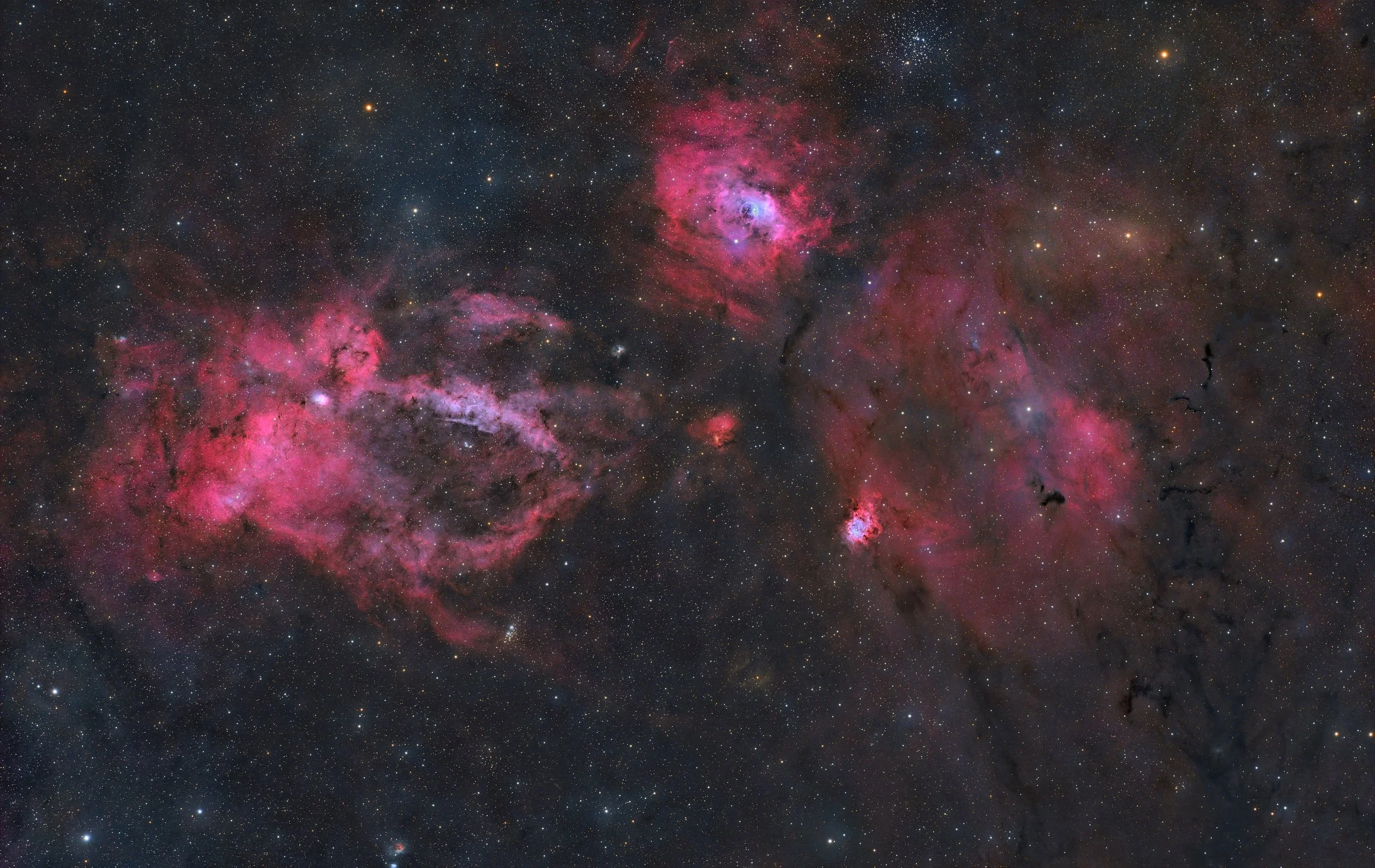
The Bubble Nebula and Its Stellar Neighborhood
The region around NGC 7635, the Bubble Nebula, is a rich and energetic pocket of Cassiopeia filled with star forming activity and sculpted gas. The Bubble itself is created by the fierce stellar wind from the massive O type star BD+60 2522, which sweeps surrounding hydrogen into a nearly spherical shell. Nearby lies the sprawling emission complex Sh2 157, often called the Lobster Claw Nebula, where ultraviolet radiation from young stars excites clouds of hydrogen and sulfur. The contrast between the smooth bubble and the intricate filaments of Sh2 157 highlights the different ways massive stars shape their environments.
Sharing the same cosmic neighborhood are the open cluster M52 and the star forming region NGC 7538. M52 provides a dense field of young, hot stars that glitter against the nebular backdrop. NGC 7538 hosts some of the largest known protostellar objects in the Milky Way and continues to give birth to new stars within heavily obscured molecular clouds. Together these objects form a vibrant landscape that demonstrates how stellar winds, radiation, and gravity interact to carve the structure of the galactic plane.

Iris Nebula and Neighborhood
The Iris Nebula (NGC 7023) glows softly amid a delicate tapestry of interstellar dust in the constellation Cepheus. Its central star illuminates the surrounding filaments of gas and dust, producing the characteristic bluish reflection nebula, while fainter tendrils of the surrounding clouds hint at the subtle complexity of this star-forming region. This field also captures the neighboring faint nebulae, revealing the intricate structures of the local interstellar medium.
This image was composed from 380 exposures of 300 seconds in Luminance with drizzle applied twice, along with 90 exposures of 300 seconds each in RGB, also drizzled twice. Calibration frames included 20 flats of 5 seconds at -10°C, 30 dark flats of 5 seconds at -10°C, and 30 dark frames of 300 seconds at -10°C, ensuring precise background and color fidelity.