
AAPOD2 Image Archives
LDN 1622, the Boogeyman Nebula
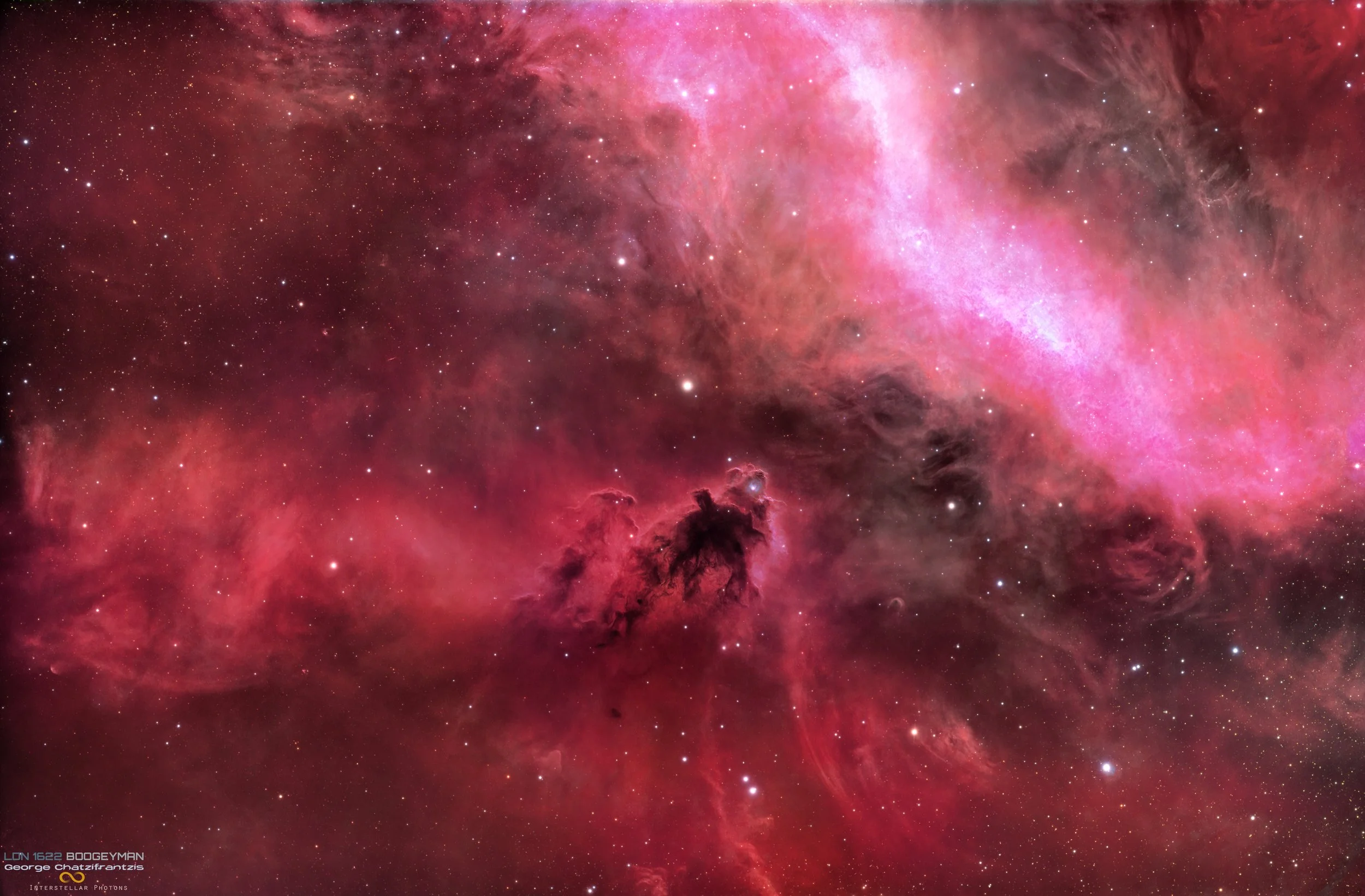
LDN 1622, popularly known as the Boogeyman Nebula, is a dark molecular cloud embedded along the edge of the Orion–Eridanus region, set against a rich backdrop of hydrogen emission. The nebula itself is not emitting light but is instead visible in silhouette, its dense dust obscuring the bright H-alpha glow of ionized hydrogen behind it. Subtle internal structures and curling tendrils reveal turbulence within the cloud, where gravity and external radiation fields shape the dust into sharp, organic forms. The surrounding red emission traces vast ionized regions energized by nearby hot, young stars, highlighting the contrast between star forming light and starless darkness.
This image combines 15 hours of H-alpha with 3 hours of RGB data, captured from the Interstellar Observatory in Greece, allowing both the faint dust absorption and the surrounding emission to be rendered with depth and texture. The wide field emphasizes how small and isolated LDN 1622 is compared to the immense glowing clouds around it, reinforcing its eerie, claw like appearance. Scenes like this offer a glimpse into the earliest stages of star formation, where cold, opaque clouds quietly gather mass long before new stars ignite within them.

Sh2-129, Outters 4, Barnard 150, NGC 6946 & NGC 6939
This wide-field image brings together several striking deep-sky objects in the constellation Cepheus. On the left lies Sharpless 2-129, the Flying Bat Nebula, glowing in rich hydrogen emission. Nestled inside it is the elusive Outters 4, or Squid Nebula, a faint oxygen-rich bipolar outflow thought to originate from a hot central star.
To the right, dark dust lanes of Barnard 150, also called the Seahorse Nebula, cut through the glowing background. Further outward, two distant island universes appear: NGC 6946, the Fireworks Galaxy, and the open cluster NGC 6939. Together, this frame captures a tapestry of emission nebulae, dark nebulae, star-forming regions, and galaxies, highlighting the remarkable diversity of structures within a single region of the northern sky.
Merope Nebula & IC 349
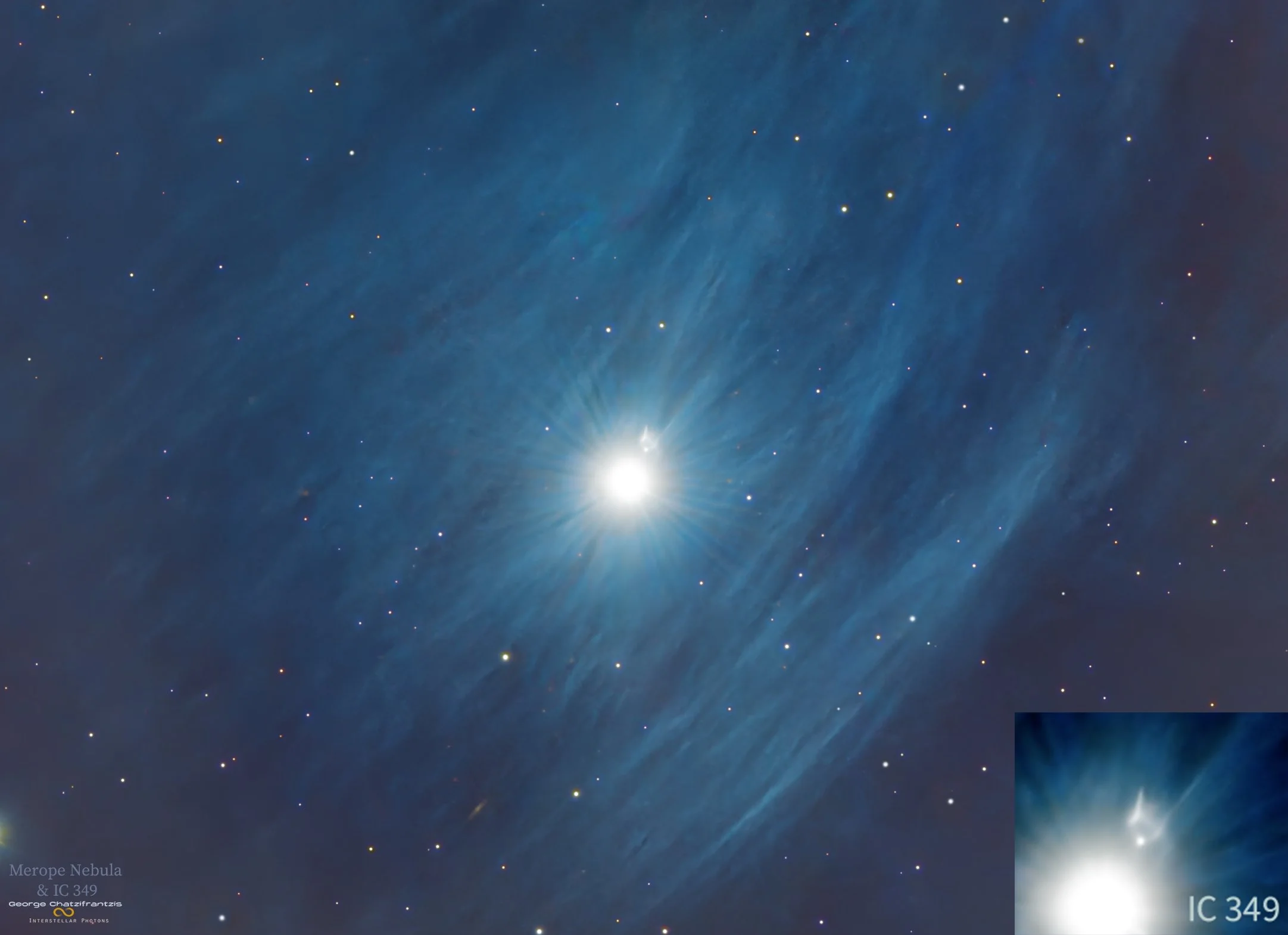
Nestled within the brilliant glow of the Pleiades star cluster (Messier 45), the Merope Nebula (NGC 1435) and its elusive companion, IC 349 (sometimes called Barnard's Merope Nebula), offer a mesmerizing glimpse into the intricate dance between starlight and interstellar dust.
The Merope Nebula is a striking reflection nebula, its delicate wisps of dust illuminated by the brilliant blue-white star Merope, one of the brightest members of the Pleiades. Unlike emission nebulae that glow due to ionized gases, reflection nebulae simply scatter and reflect starlight, creating an ethereal blue glow. The fine, thread-like structures seen in this image are the result of complex interactions between radiation pressure, magnetic fields, and the movement of interstellar material.
Lying just 0.06 light-years (or 13,000 AU) from Merope, IC 349 is a tiny but incredibly bright knot of dust, appearing almost like a cometary streak in deep images. First observed by E.E. Barnard in 1890, this compact cloud is being sculpted by the intense radiation and stellar winds from Merope, causing its structure to evolve in real time on astronomical scales.
This high-resolution image, enhanced with LRGB data, brings out the finest details of the nebula’s structure—revealing the turbulence, filaments, and interplay of light that make this region of the Pleiades one of the most visually stunning in the sky.