

AAPOD2 Image Archives
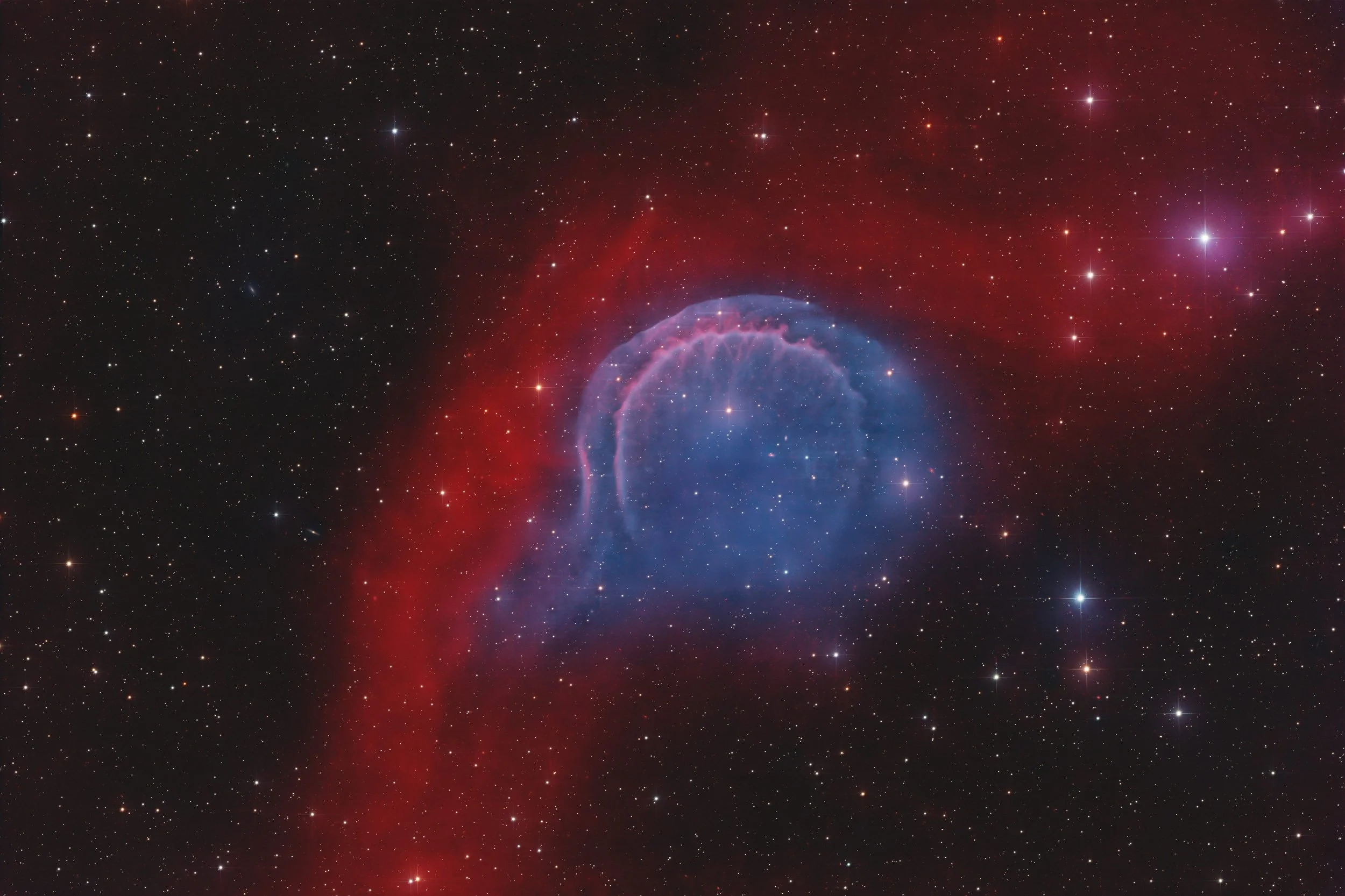
Hartl-Dengel-Weinberger 3 (HDW 3)
Hartl-Dengel-Weinberger 3 is an extremely faint and evolved planetary nebula, the remnant of a Sun-like star that shed its outer layers near the end of its life. What remains is a tenuous shell of ionized gas, now highly diluted and interacting with the surrounding interstellar medium. Its advanced age makes HDW 3 difficult to detect, as much of its original structure has dispersed and faded, leaving only subtle emission that traces the final stages of stellar mass loss.
In this deep image, the nebula appears as a delicate, translucent blue arc embedded within a broader field of red hydrogen emission. The contrasting colors reveal different excitation processes, with oxygen-dominated emission outlining the faint nebular shell while hydrogen gas in the background hints at unrelated Galactic structures along the line of sight. The scene highlights both the fragility and longevity of planetary nebulae, showing how the quiet death of a star can leave behind a ghostly imprint that persists for tens of thousands of years.
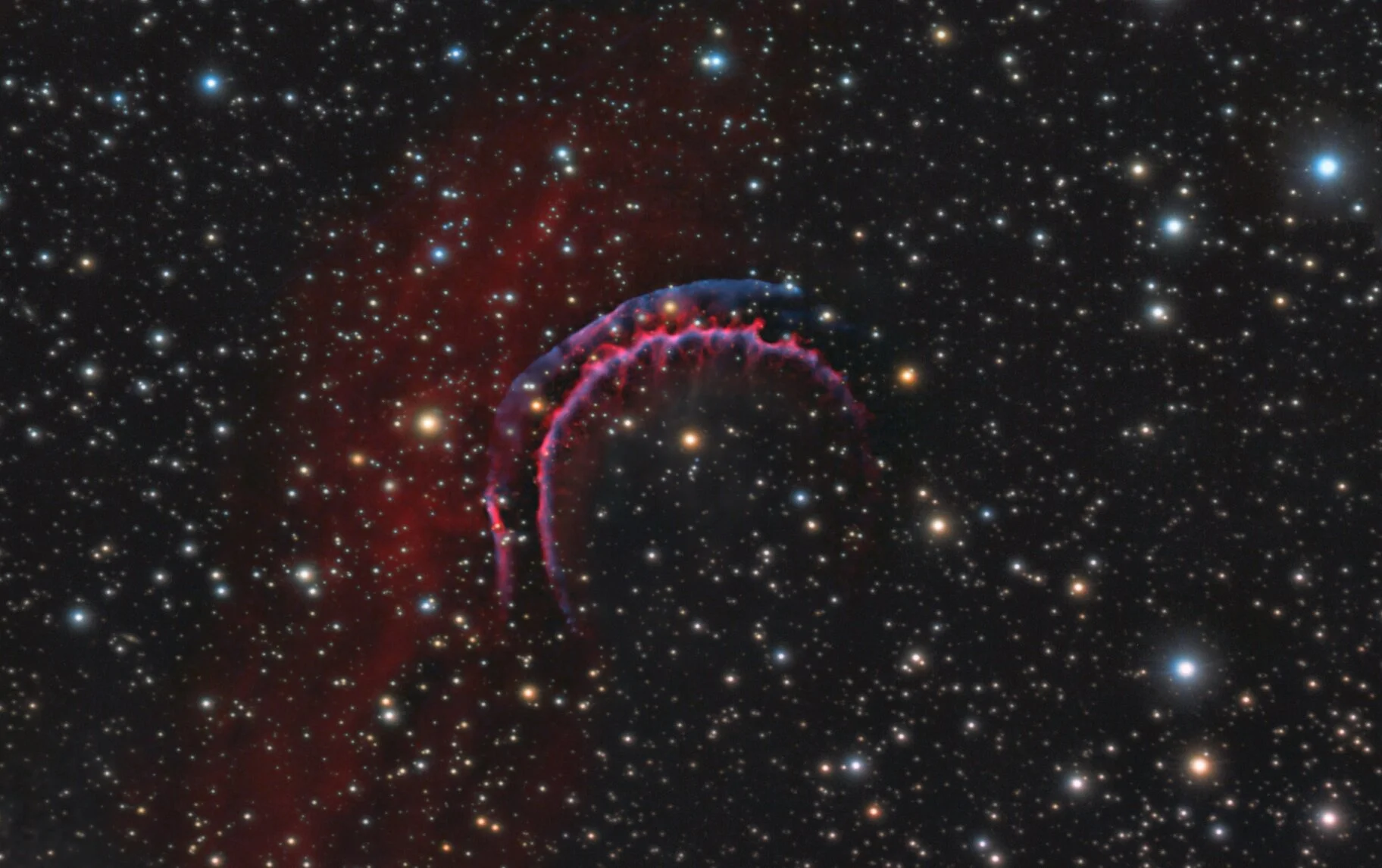
Hartl-Dengel-Weinberger 3 (HDW 3)
Hartl-Dengel-Weinberger 3 (HDW 3) is an extremely faint ancient planetary nebula in the constellation Perseus. It is so faint that it is very rarely imaged.
The progenitor star is the small blue star at the 5 o-clock position just below the large yellow star in HDW 3. The progenitor is not, as one would expect, in the centre of the nebula. This is because it is moving rapidly in a north-westerly direction. It is moving through a dense area of interstellar medium (ISM). This ISM is slowing down HDW 3, creating a shock front and the unusual "braided" appearance. As the star isn't slowed by the ISM it has continued to move and is thus no longer at the centre of HDW 3 and is slowly overtaking HDW 3. This causes the shock front to be brighter as it's getting more ultraviolet radiation, whereas the opposite side of HDW 3 is getting less UV radiation and has become invisible. This movement of the star causes differential excitation of the shell. OIII emission, which requires higher energy of the ionizing radiation than HII emission, only happens close to the star.
EQUIPMENT USED
Twin APM TMB LZOS 152 refractors
10Micron GM2000 HPS mount
Twin QSI6120 CCD cameras
Astrodon filters
IMAGE CAPTURE
5nm H-Alpha: 76x1800 bin 2x2
3nm OIII: 51x1800 bin 2x2
Luminance: 39x300 bin 1x1
Red: 20x300 bin 1x1
Green: 20x300 bin 1x1
Blue: 17x300 bin 1x1
Total integration: 71.5 hours
Pixel scale: 0.534 arcsec/pixel
Field radius: 0.359 degrees
Capture dates: 15 November - 8 December 2019
Capture location: Fregenal de la Sierra, Spain
Copyright: Peter Goodhew