
AAPOD2 Image Archives
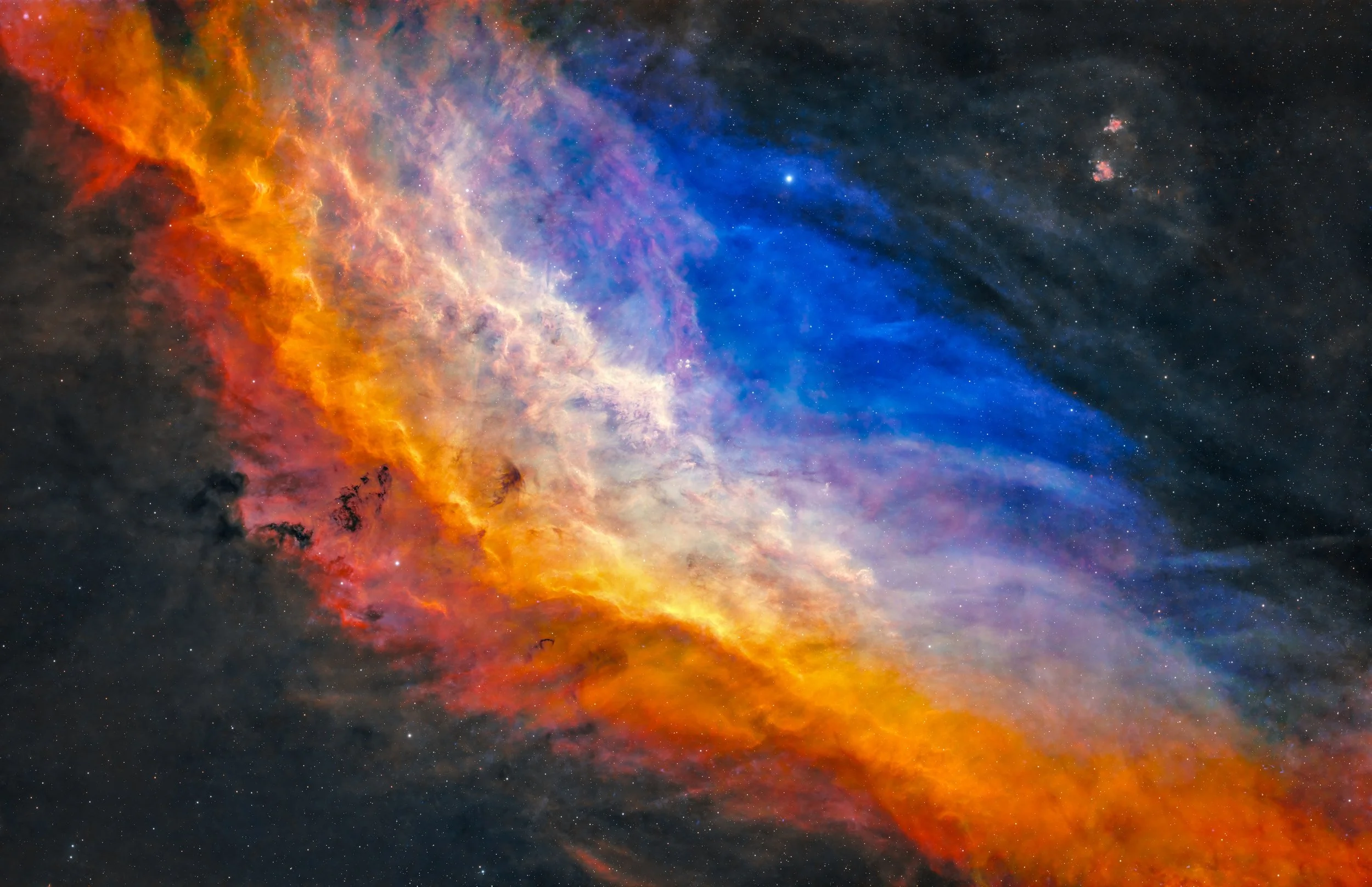
The California Nebula in SHO
The California Nebula, cataloged as NGC 1499, is a vast emission nebula in the constellation Perseus, stretching nearly 100 light-years across. In this SHO narrowband presentation, ionized hydrogen dominates the structure, while sulfur and oxygen reveal layered filaments, knots, and subtle shock fronts within the glowing gas. The nebula’s elongated shape and complex internal texture are sculpted by energetic radiation from the hot star Xi Persei, which excites and ionizes the surrounding interstellar medium.
Captured from a Bortle 7 sky, this image demonstrates the power of narrowband imaging in overcoming light pollution. By isolating specific emission lines, faint structures and contrast within the nebula emerge despite challenging urban conditions. The result highlights both the large-scale flow of ionized gas and the finer details embedded within it, offering a scientifically rich and visually striking view of one of the sky’s most recognizable emission nebulae.
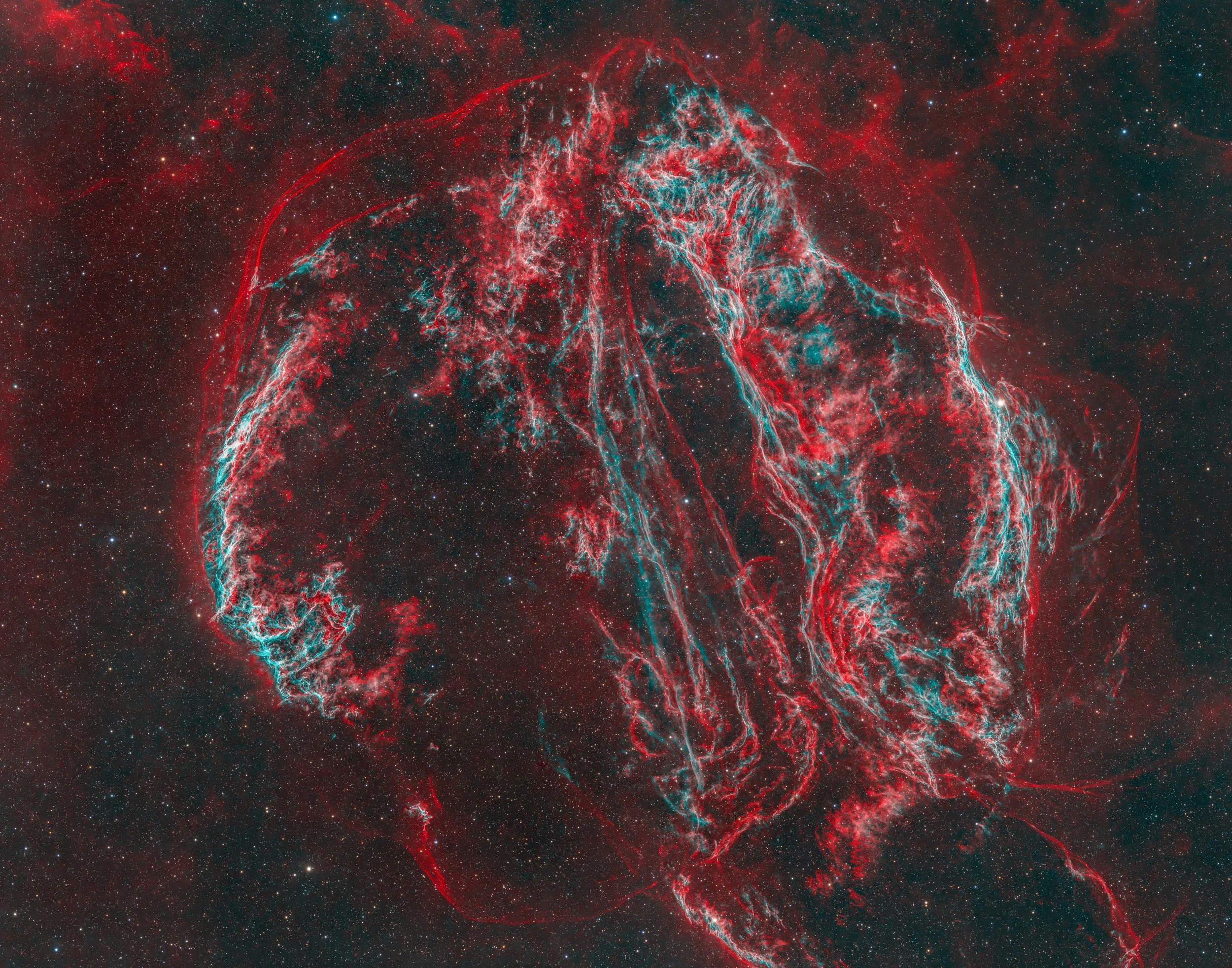
Veil Nebula in HOO
Like a cosmic ghost drifting through Cygnus, the Veil Nebula’s tangled filaments glow eerily in red and teal light—remnants of a massive star that met its end about 10,000 years ago. The nebula’s delicate structure traces the expanding shock waves from that ancient supernova, its wispy forms resembling torn veils or spectral smoke.
Captured under Bortle 7 skies, this two-panel mosaic spans over 25 hours of integration in HOO narrowband. The contrasting hydrogen and oxygen emissions lend the scene an otherworldly, almost haunted glow—perfect for Halloween night, when even the cosmos seems to wear a ghostly disguise.

The North America Nebula and the Pelican Nebula in SHO
Drifting in the rich star fields of Cygnus, the North America Nebula (NGC 7000, lower left) and the Pelican Nebula (IC 5070, right) form one of the most striking emission complexes in the northern sky. Separated by a dense band of dark dust, these glowing clouds of hydrogen, sulfur, and oxygen stretch across dozens of light-years, sculpted by stellar winds and ultraviolet radiation from massive, young stars hidden within. The familiar continental outline of NGC 7000 is unmistakable, while the Pelican reveals intricate folds of gas and dust resembling its avian namesake.
Captured here in the SHO Hubble Palette, the false-color mapping highlights regions of ionized gases, with hydrogen in green, sulfur in red, and oxygen in blue. The interplay of bright emission and dark lanes demonstrates both the creative and destructive forces at work, where new stars are born even as radiation hollows out great cavities in the nebulae. Together, they showcase the Cygnus region as one of the most photogenic nurseries of the Milky Way.
