

AAPOD2 Image Archives
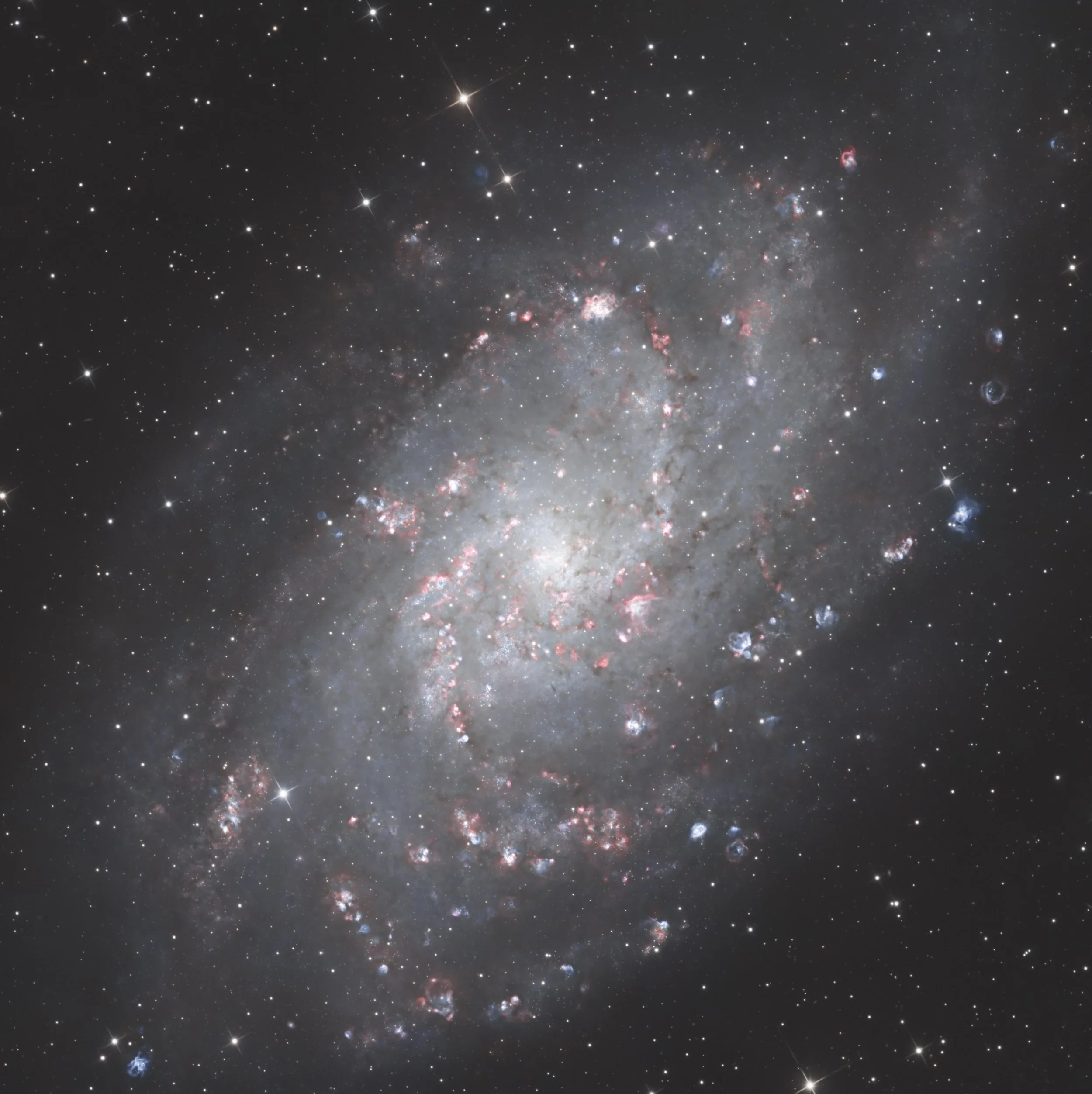
Messier 33 The Triangulum Galaxy
This deep HOO-RGB portrait of the Triangulum Galaxy (M33) reveals the galaxy’s sprawling spiral structure filled with luminous star-forming regions. The combination of long-exposure Hα and OIII highlights the vast network of ionized nebulae woven through the spiral arms, while the RGB data preserves the galaxy’s natural starlight and delicate dust lanes. The result is a scientifically rich view that shows M33 as an active, evolving system where clusters of young, hot stars energize the surrounding gas into glowing pink and blue emission.
Using two telescopes allowed both depth and detail: a 250 mm f/3 Newtonian captured 90 eight-minute exposures in Hα and OIII with a ZWO ASI 533 MC Pro, gathering the faint structural and ionized-gas features, while the Celestron RASA 8 provided 100 two-minute RGB frames to bring out the galaxy’s full-color continuum. Mounted together on a Sky-Watcher EQ6-R Pro, the dual-imaging approach produces a balanced and striking view of one of our Local Group neighbors, showcasing M33’s active stellar ecosystems and complex interstellar medium.

M33 The Triangulum Galaxy
The Triangulum Galaxy, or M33, unfolds here as a loosely wound spiral set roughly 2.7 million light years away in the Local Group. Rich blue star-forming regions trace its arms, where clusters of massive young stars illuminate clouds of hydrogen that glow in soft pink. Unlike grand-design spirals, M33 lacks a dominant central bar, giving its structure a more open and irregular feel shaped by gravitational interactions and internal turbulence. The yellowish core marks an older stellar population that provides contrast to the active, dynamic arms.
This wide field view reveals not only the galaxy itself but also the faint, dusty background of the Milky Way through which we observe it. Subtle gradients and scattered interstellar material highlight just how much foreground structure lies between us and our neighboring galaxies. M33 remains one of the closest and most detailed external spirals available to amateur and professional astrophotographers, offering a deep look into ongoing stellar evolution across an entire galactic disk.
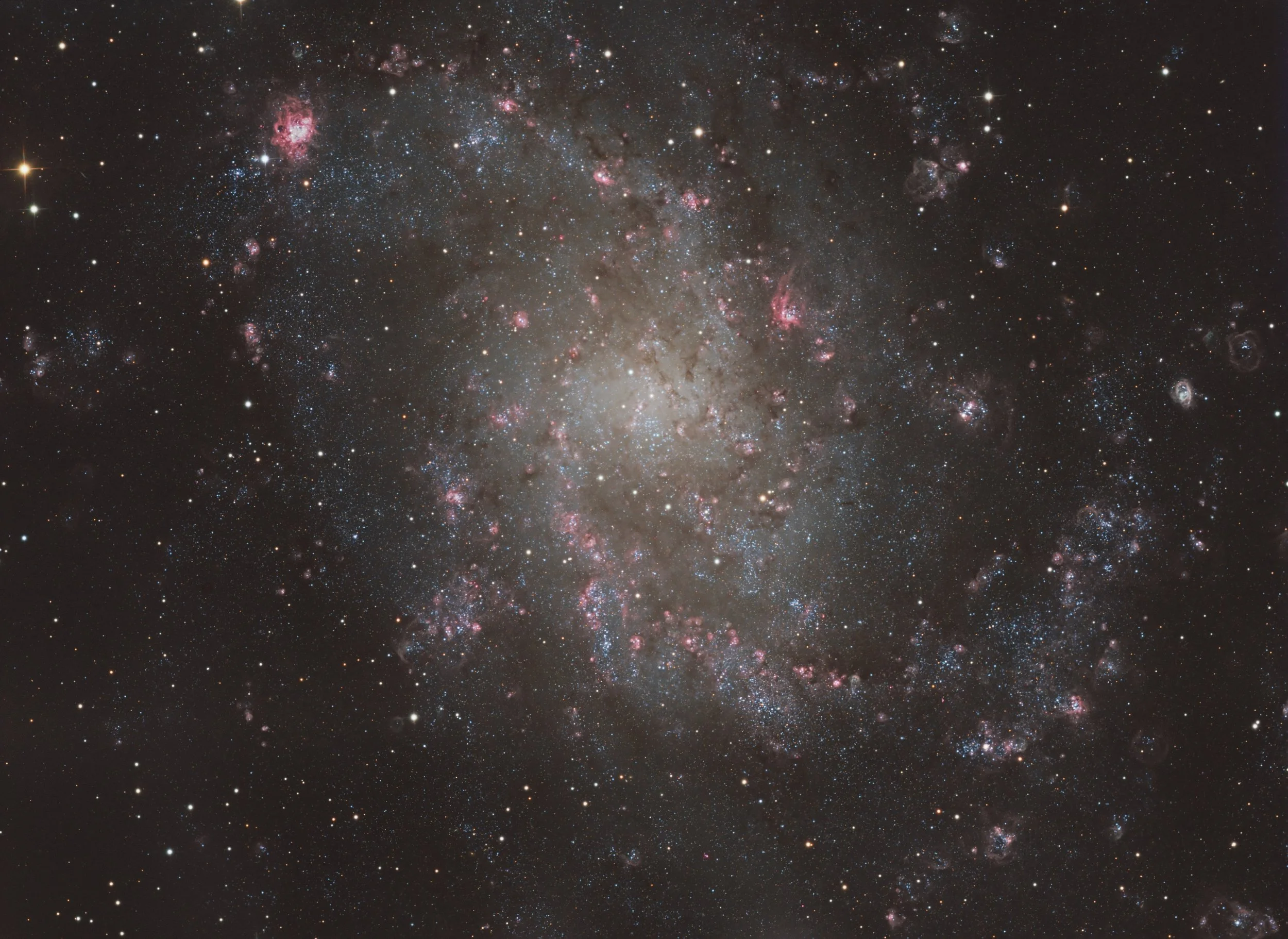
The Triangulum Galaxy (M33) from Fregenal de la Sierra, Spain
Captured under the dark skies of Fregenal de la Sierra, Spain, this deep exposure reveals the Triangulum Galaxy (M33) in remarkable detail. At a distance of about 2.7 million light-years, M33 is the third-largest member of the Local Group after Andromeda and the Milky Way. The image shows its loosely wound spiral arms traced by glowing H II regions, blue star-forming clusters, and intricate dust lanes extending from the bright core. The subtle pinkish patches mark vast clouds of ionized hydrogen where new stars are being born.
Using a 20-inch Ritchey-Chrétien telescope, a total of 21 hours and 40 minutes of LRGB and Hα data were gathered through 10-minute guided exposures. This long integration highlights the galaxy’s faint outer arms and extended halo structure, bringing out M33’s complex web of emission nebulae and delicate color gradients. The result offers a vivid portrait of one of the nearest and most photogenic spiral galaxies beyond our own.