

AAPOD2 Image Archives
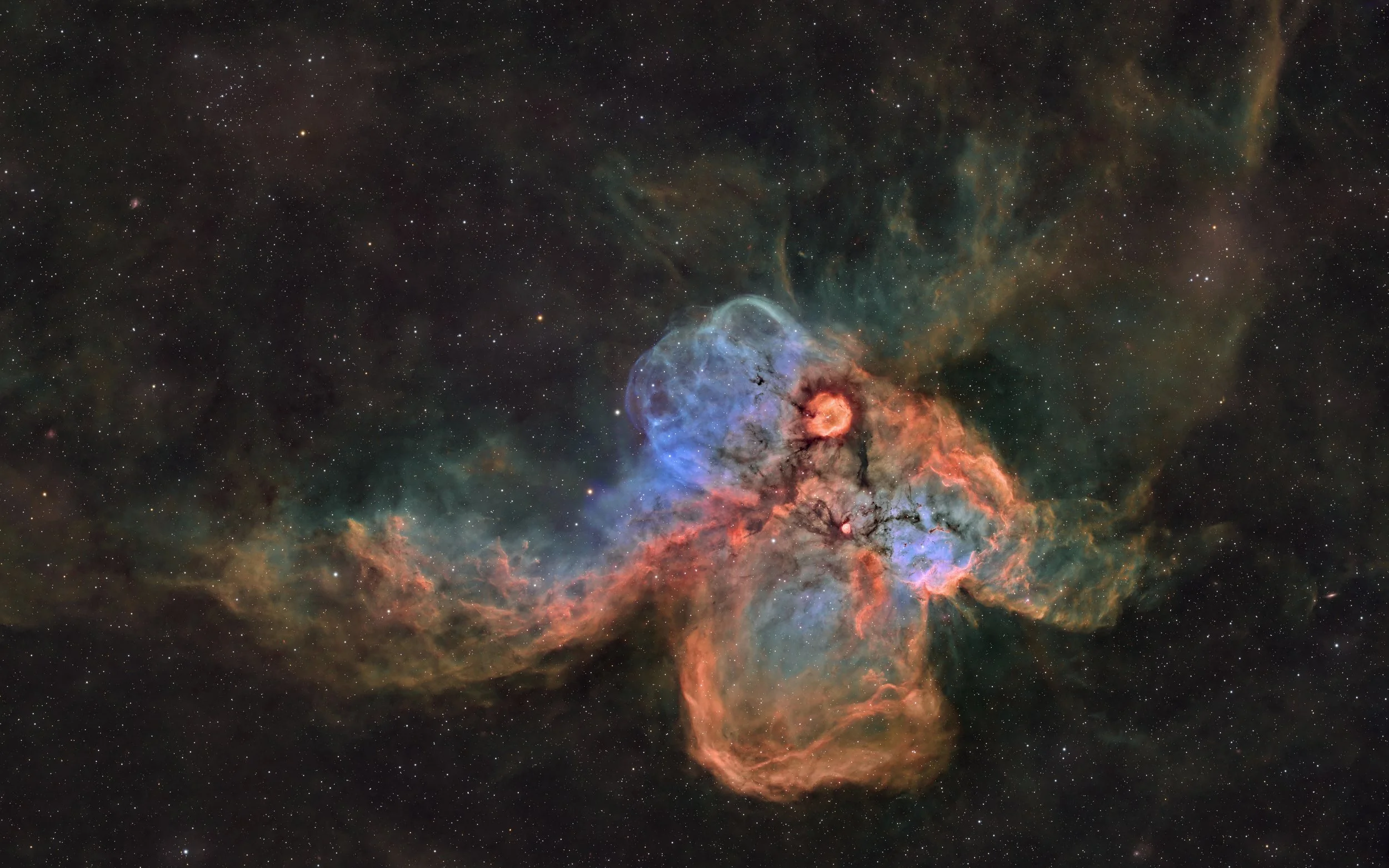
NGC2467 - Skull and Crossbones Nebula
NGC 2467, often called the Skull and Crossbones Nebula, is a dynamic star-forming region located roughly 13,000 light-years away in the constellation Puppis. This complex emission nebula is part of a larger molecular cloud where intense ultraviolet radiation from young, massive stars ionizes surrounding hydrogen gas, producing the glowing red structures seen throughout the field. Embedded clusters sculpt the nebula’s shape through stellar winds and radiation pressure, carving cavities and bright rims while triggering new generations of star formation along compressed gas fronts.
Rendered here in a narrowband palette, the image highlights ionized hydrogen, oxygen, and sulfur, revealing intricate filaments, shock fronts, and dense dust lanes that give rise to the nebula’s skull-like appearance. Blue tones trace energized oxygen near the hottest stars, while warmer reds and golds map hydrogen-rich regions and expanding shells. Against a backdrop of faint Milky Way star fields, NGC 2467 appears as a turbulent crossroads of creation, where stellar feedback continuously reshapes the surrounding interstellar medium.
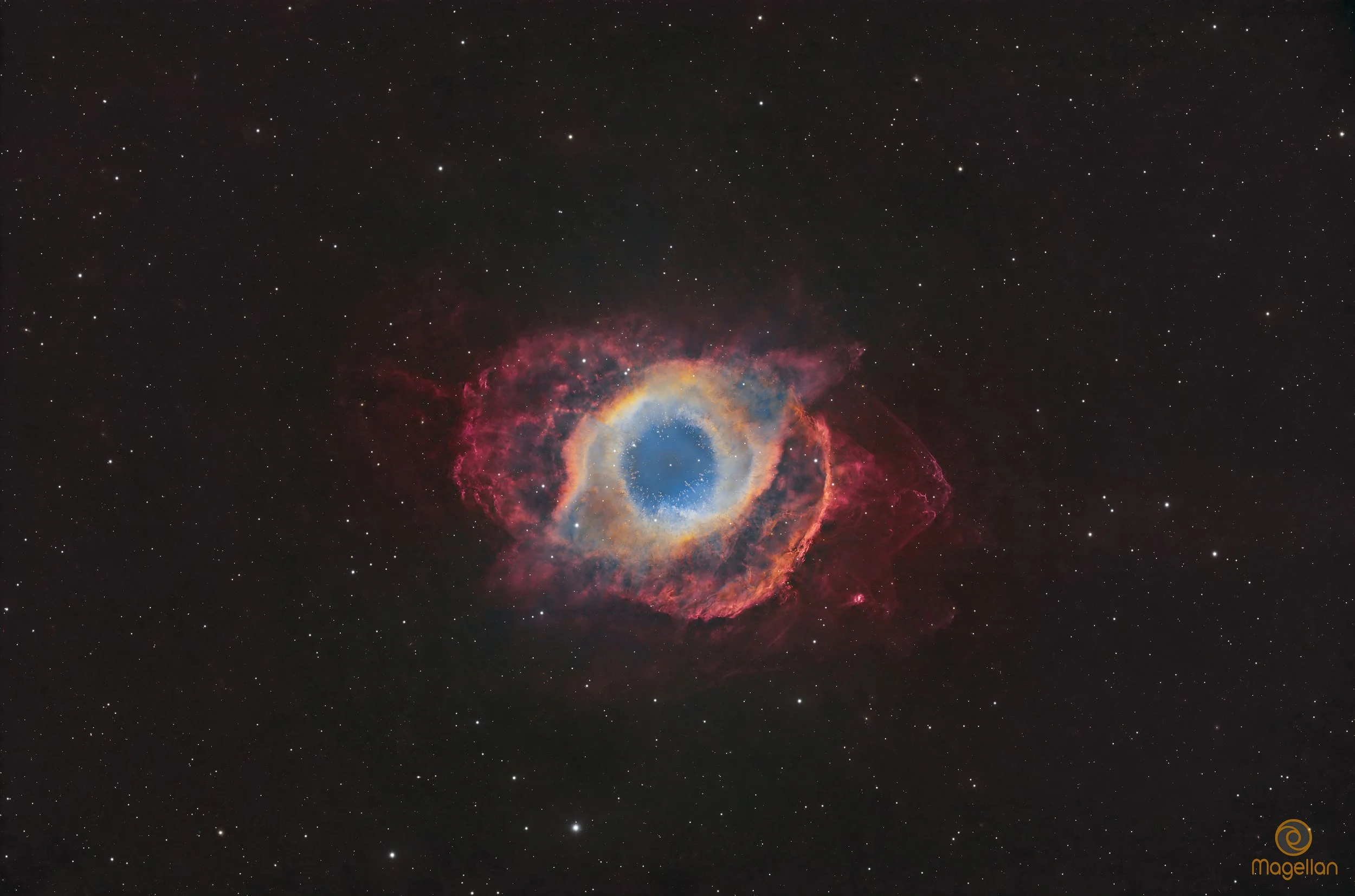
Deep View of the Helix Nebula
NGC 7293, better known as the Helix Nebula, is a planetary nebula located approximately 655 light-years away in the constellation Aquarius. Often nicknamed the “Eye of God” for its shape, the Helix represents the final stages in the life of a Sun-like star, as it sheds its outer layers into space. The exposed stellar core, a white dwarf, remains at the center, illuminating the surrounding gases in vivid emission.
This image is a deep and highly detailed view composed of more than 115 hours of integration: 289 exposures in H-alpha, 186 in SII, 180 in OIII (each 600 seconds), and shorter RGB exposures to preserve color fidelity. The resulting composite reveals intricate filaments of ionized gas and the faint outer halo, rarely captured in such clarity. The contrast between the bright inner ring and the extended tendrils of gas adds striking dimensionality to this iconic object.