

AAPOD2 Image Archives
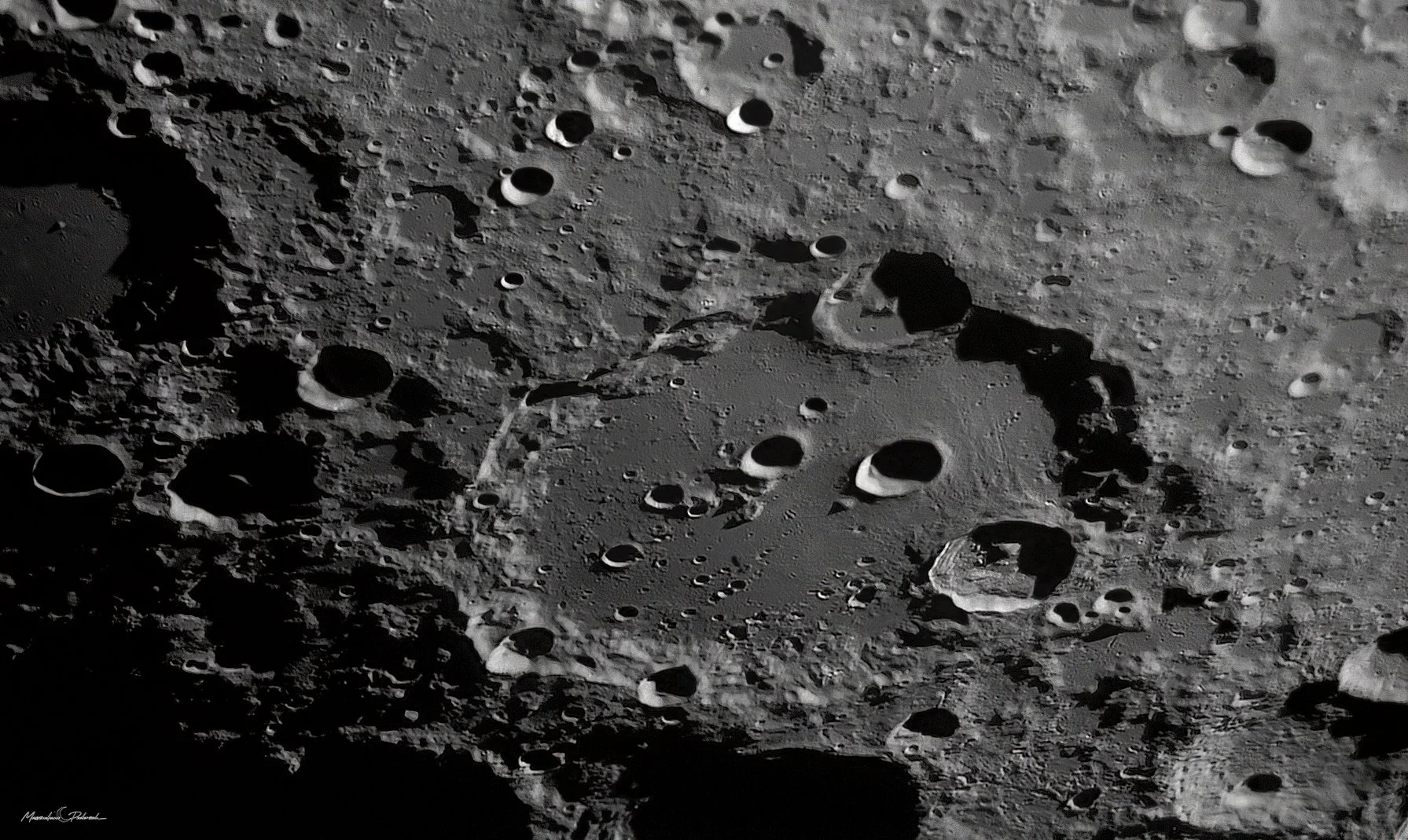
Clavius crater
Dominating the rugged southern highlands of the Moon, the ancient impact structure Clavius—beautifully captured here by astrophotographer Massimiliano Pedersoli—stands as one of the most spectacular craters visible from Earth. Spanning an impressive 230 kilometers in diameter and plunging 3.5 kilometers deep, this Nectarian-era giant dates back roughly 4 billion years and is so vast that its curvature would hide the rim from an observer standing at its center. Beyond its sheer visual grandeur, which features a cascading arc of tapering sub-craters across its floor, Clavius holds immense scientific importance; in 2020, NASA's airborne SOFIA telescope detected molecular water trapped within its sunlit soil, transforming it into a crucial strategic focal point for future human exploration under the Artemis program. To resolve this incredible level of detail from Montecampione, Italy, Pedersoli masterfully paired a Sky-Watcher 355/1650 GoTo Dobsonian telescope with a ToupTek G3M662M camera, an Artesky 3x Barlow lens, and a 685nm IR-pass filter to cut through atmospheric turbulence and bring the lunar landscape into razor-sharp focus.

Mineral Moon
This enhanced view of the Moon reveals its hidden colors, representing subtle variations in the composition of its surface. The reddish-brown hues indicate iron-rich basaltic plains, known as lunar maria, while bluish tones highlight areas with a higher concentration of titanium. These color differences are not visible to the naked eye but can be brought out through careful processing, offering a mineralogical map of Earth's only natural satellite.
The image was captured near first quarter, when the interplay of sunlight and shadow emphasizes the rugged terrain of lunar highlands and cratered regions. The Moon, about 3,474 kilometers across, has been geologically inactive for billions of years, yet its surface preserves the history of impacts and volcanic activity that shaped it. This mineral view gives a scientific twist to a familiar object, showing how much diversity lies within its gray appearance.