

AAPOD2 Image Archives
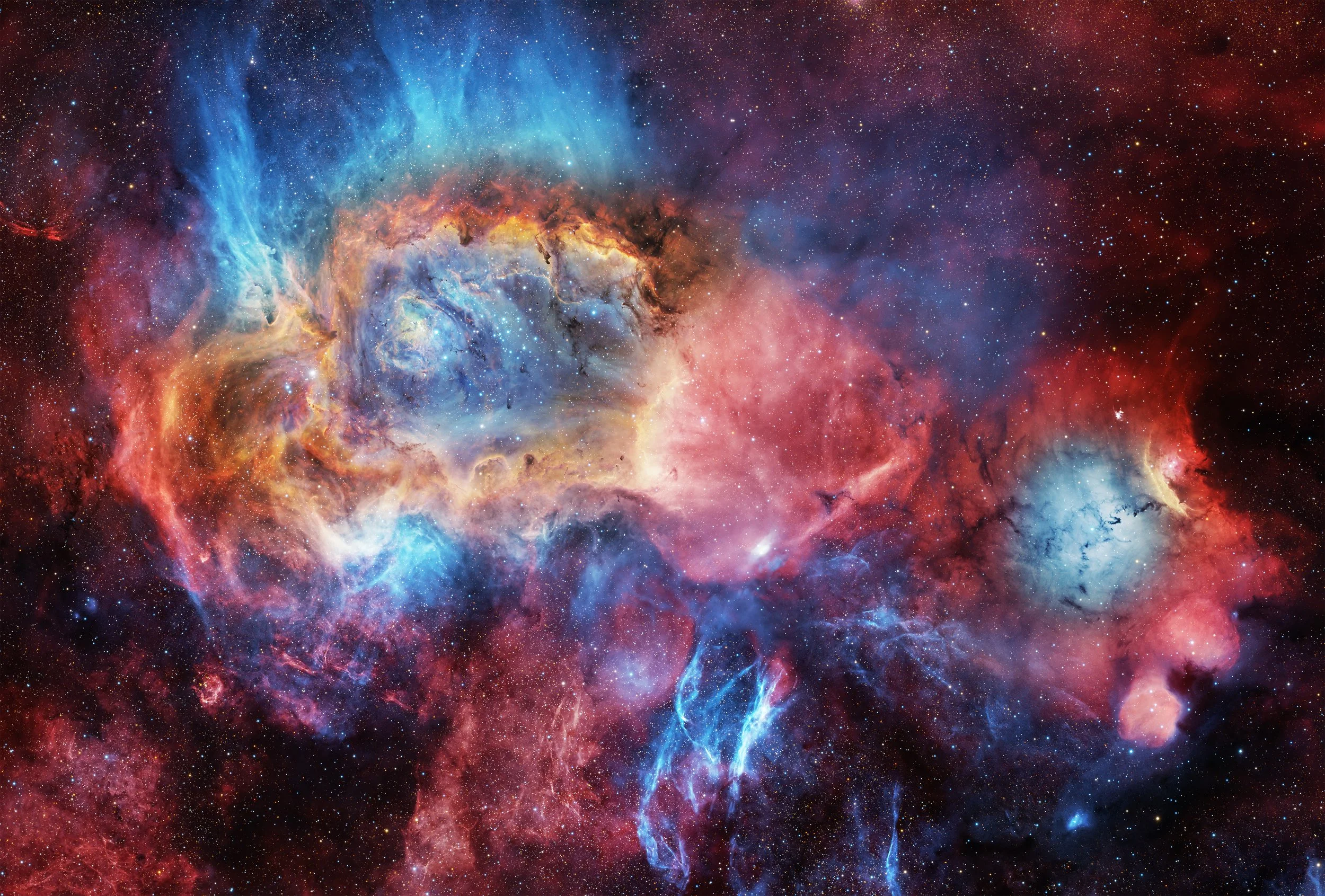
Messier 8, Messier 20, and Supernova Remnant G007.5−01.7
This richly detailed wide-field view captures a luminous crossroads of stellar birth and death in the constellation Sagittarius. At center left lies Messier 8, the Lagoon Nebula, a vast star-forming region where glowing hydrogen gas is sculpted by intense radiation from young, massive stars. Nearby, the Trifid Nebula, Messier 20, stands out through its striking contrast of blue reflection nebula and red emission gas, divided by dark lanes of cold dust that trace the earliest stages of stellar evolution.
Threaded through this vibrant complex is the faint supernova remnant G007.5−01.7, a delicate veil of energized gas left behind by the explosive death of a massive star. Its subtle filaments blend into the surrounding nebulae, revealing how stellar feedback enriches and reshapes the interstellar medium. Together, these objects illustrate the cyclical nature of the Milky Way, where star formation and stellar destruction coexist within the same dynamic environment, driven by gravity, radiation, and shock waves over millions of years.
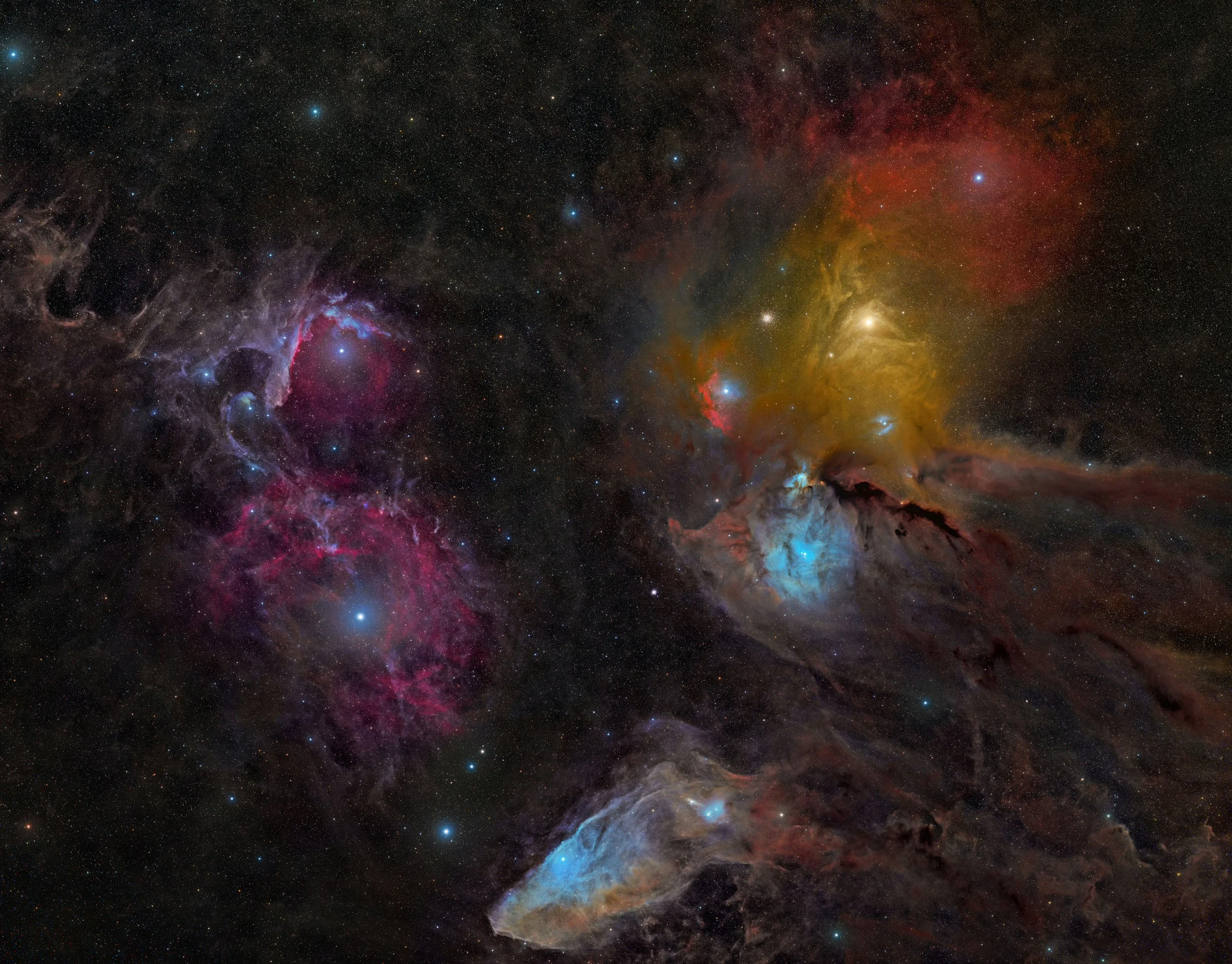
Blue Horsehead, Rho Ophiuchi and SH2-1/SH2-7 — 30-Panel, 180-Hour Mosaic
This 30-panel, 180-hour mosaic unifies some of the most dynamic and colorful regions of the summer sky, stretching from the Blue Horsehead Nebula through the Rho Ophiuchi complex and down into the reflection structures of SH2-1 and SH2-7. The field is a tapestry of competing processes: brilliant blue reflection nebulae sculpted by starlight, deep red hydrogen clouds marking active star birth, and golden dust lanes drifting across the frame like smoke illuminated from within. The mosaic’s immense depth reveals not only the well-known features but also the faint cirrus and transitional dust structures that connect them, showing how these regions belong to the same vast, evolving molecular environment.
The wide coverage and long integration time help preserve subtle color gradients across the complex. In the north, the Blue Horsehead arcs in reflective blue, its contours shaped by the illumination of nearby bright stars. At the core, Rho Ophiuchi blazes with an unusual mix of reflection, emission, and dense shadowed dust. Southward, SH2-1 and SH2-7 unfold in softer tones, their structures hinting at older, more diffuse stages of stellar evolution. This mosaic brings together these diverse environments into a single coherent scene, revealing the full interconnectedness of one of the sky’s most photogenic and scientifically rich regions.