

AAPOD2 Image Archives

Barnard’s Galaxy (NGC 6822)
Barnard’s Galaxy, or NGC 6822, floats 1.6 million light-years away in the constellation Sagittarius—a modest island universe with a rich cosmic history. This deep-sky image, captured from Río Hurtado, Chile, using a CDK-17 telescope and over 25 hours of integration, showcases the galaxy’s scattered stellar population and wisps of hydrogen-alpha emissions through carefully blended RGB and Hα data.
Discovered in 1884 by Edward Barnard and later studied by Edwin Hubble, this unassuming galaxy became the first irregular galaxy proven to lie beyond the Milky Way. Hubble’s observations, made in 1925, helped shift our understanding of the cosmos, establishing that the universe is filled with galaxies far beyond our own. Though faint to the eye, NGC 6822’s legacy remains anything but.
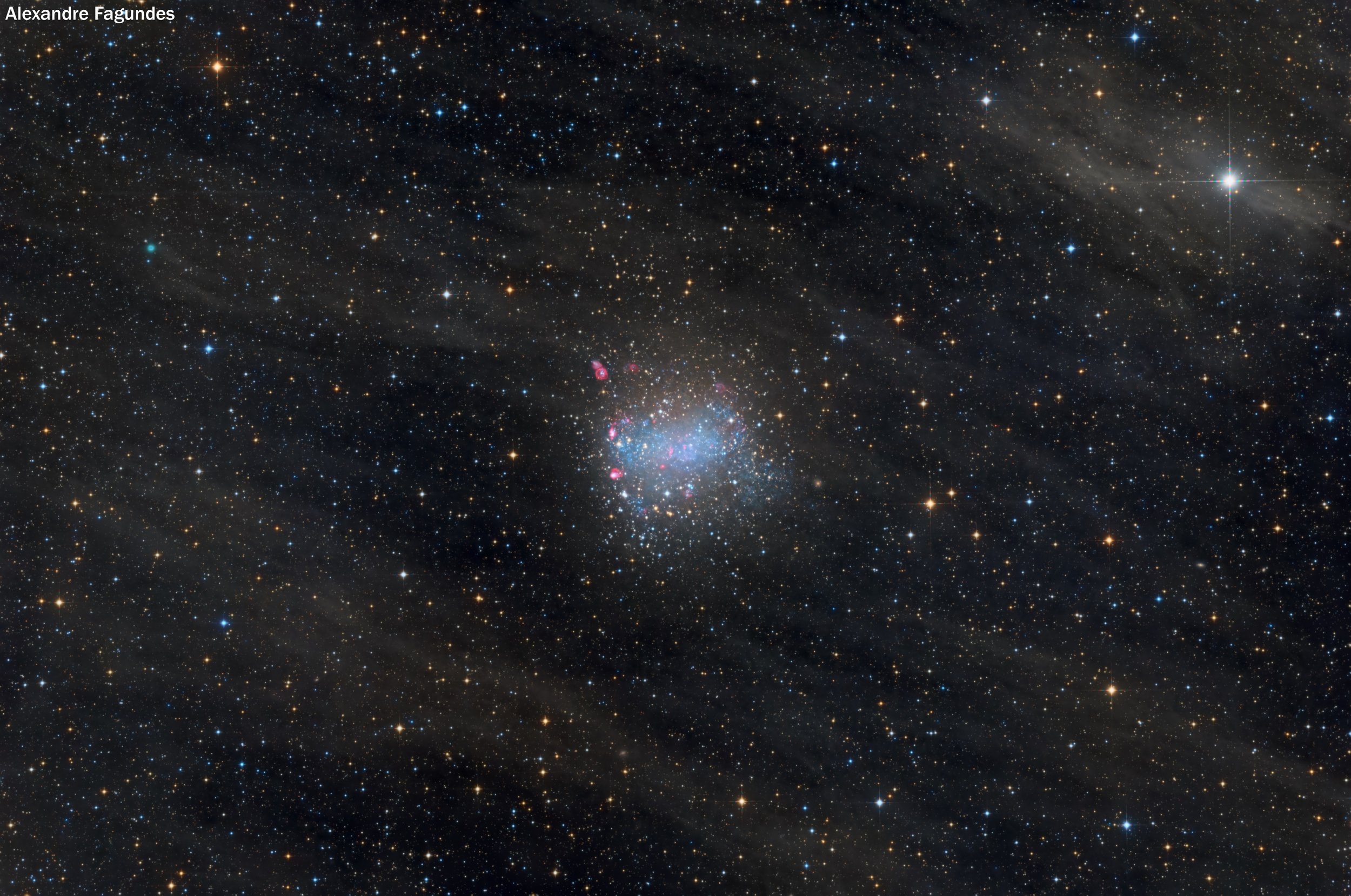
The Barnard Galaxy (NGC 6822)
NGC 6822, affectionately known as Barnard's Galaxy, is a small, irregular dwarf galaxy situated in the constellation Sagittarius. Despite its modest size, this celestial gem has captivated astronomers with its intricate structure and stellar richness. Lying about 1.6 million light-years away from our Milky Way, NGC 6822 is considered a satellite galaxy of our own, orbiting the larger Milky Way. Its irregular shape is the result of gravitational interactions with its host galaxy. Within its boundaries, NGC 6822 hosts a diverse population of stars, from young, hot, blue stars to older, cooler, reddish stars, making it a valuable object of study for understanding the evolution of galaxies and the birth and life cycles of stars. This distant galaxy continues to reveal its secrets to astronomers and serves as a testament to the diverse and wondrous objects that populate our cosmic neighborhood.

The Barnard's Galaxy and IFN
Barnard's Galaxy (NGC 6822) takes center stage in this image. Amidst a backdrop of scattered star clusters and other celestial marvels, this capture unveils an elusive wonder known as the Integrated Flux Nebula (IFN). This delicate luminosity originates from the interstellar medium within our own Milky Way galaxy. Capturing the IFN's faint presence stands as a substantial challenge, demanding precise processing techniques, and optimal conditions of a dark night sky. This image provides an opportunity to peer into the intricate interplay between stars, gas, and dust that fills the expanse of interstellar space.