

AAPOD2 Image Archives
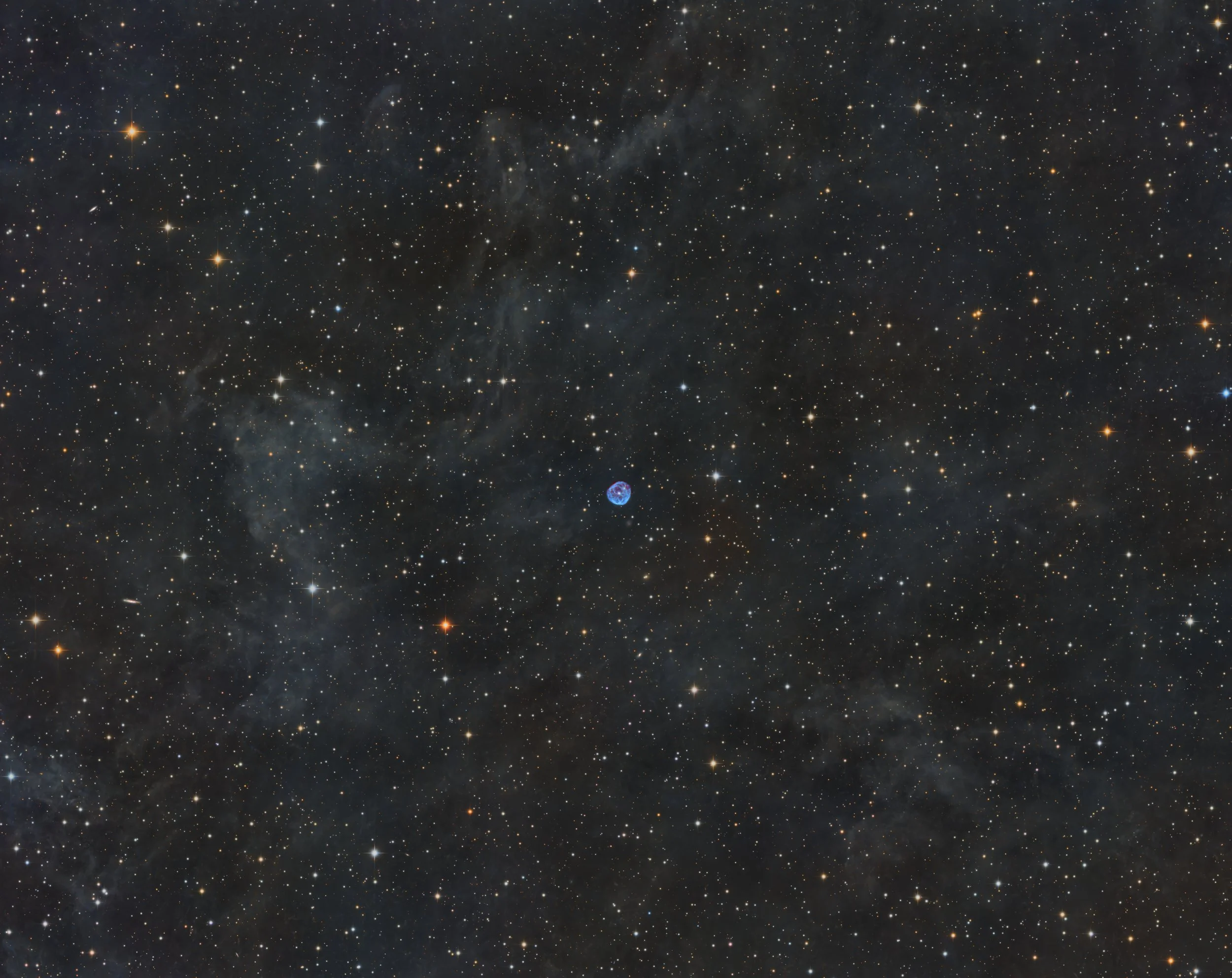
Ngc 7094 et ses poussières
NGC 7094 sits as a delicate blue-green bubble in the center of a vast, dusty starfield in Pegasus. This faint planetary nebula surrounds a rare hybrid PG 1159 star, a dying stellar core transitioning between the planetary nebula and white dwarf phases. Its intricate ionized shell shines in OIII and Hβ emissions, producing the cool-toned glow that stands in vivid contrast to the warm field stars around it. The surrounding nebulosity is not produced by the nebula itself but instead belongs to the network of diffuse interstellar dust that threads through this region of the Milky Way.
Nearly 12 hours of LRGB exposure were needed to reveal the subtle cirrus-like dust structures across the frame. These faint clouds scatter starlight and create soft gradients that give the scene depth and texture. Against this dim backdrop, the compact nebula appears almost like a gem suspended in a wide and ancient cosmic fog, highlighting how small planetary nebulae truly are when placed within the broader galactic environment.
![NGC 7094 and the Rarely Imaged “Shenron Nebula” [O III]](https://images.squarespace-cdn.com/content/v1/5debd4b16fcd7b02905712ff/17383bd5-691c-4545-a90a-6b3e1e98a558/NGC+7094+%26+Shenron+Nebula_HQ_WM.jpg)
NGC 7094 and the Rarely Imaged “Shenron Nebula” [O III]
At the center of this richly detailed wide-field view lies NGC 7094, a faint planetary nebula in the constellation Pegasus, showcasing its delicate blue-green glow from doubly ionized oxygen ([O III]). Surrounding it is an intricate tapestry of dusty interstellar cirrus, laced with faint red hydrogen emission. Cutting dramatically across the frame, the shimmering cyan ribbon known as the “Shenron Nebula” [O III] Arc reveals a rarely imaged ionization front, its ethereal form resembling a mythical dragon winding through the cosmic clouds. This combination of a planetary nebula and expansive, unrelated foreground structures creates a striking juxtaposition of astrophysical phenomena within the same celestial canvas.