
AAPOD2 Image Archives
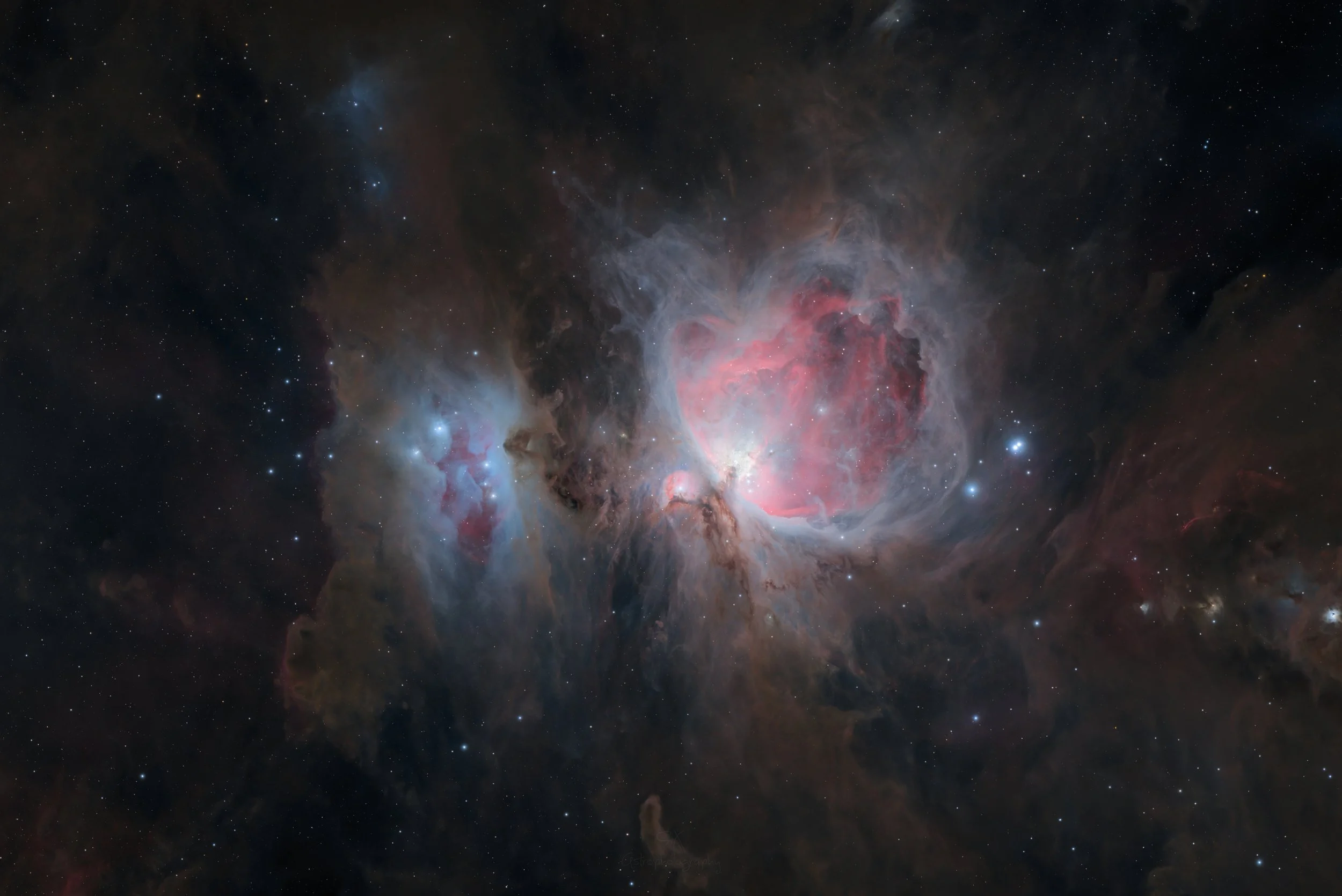
M42 - The Great Nebula in Orion
M42, the Great Nebula in Orion, is the nearest massive star-forming region to Earth at about 1,350 light-years away. This immense cloud of hydrogen, oxygen, and dust is energized by the Trapezium Cluster at its core, where several extremely young and hot stars flood the surrounding gas with ultraviolet radiation. That radiation causes the nebula’s hydrogen to glow red while oxygen and scattered starlight create blue and cyan tones, revealing a layered structure of ionized gas, reflective dust, and darker molecular clouds.
What makes M42 so scientifically important is that it offers a front-row view of how stars are born. Within these luminous curtains are hundreds of protostars and protoplanetary disks, some already sculpted by stellar winds and radiation from their massive neighbors. The sweeping arcs, glowing cavities, and dark filaments seen here trace shock fronts, evaporation flows, and gravity-driven collapse, capturing a moment in the ongoing transformation of cold interstellar matter into a new generation of stars and planetary systems.