

AAPOD2 Image Archives
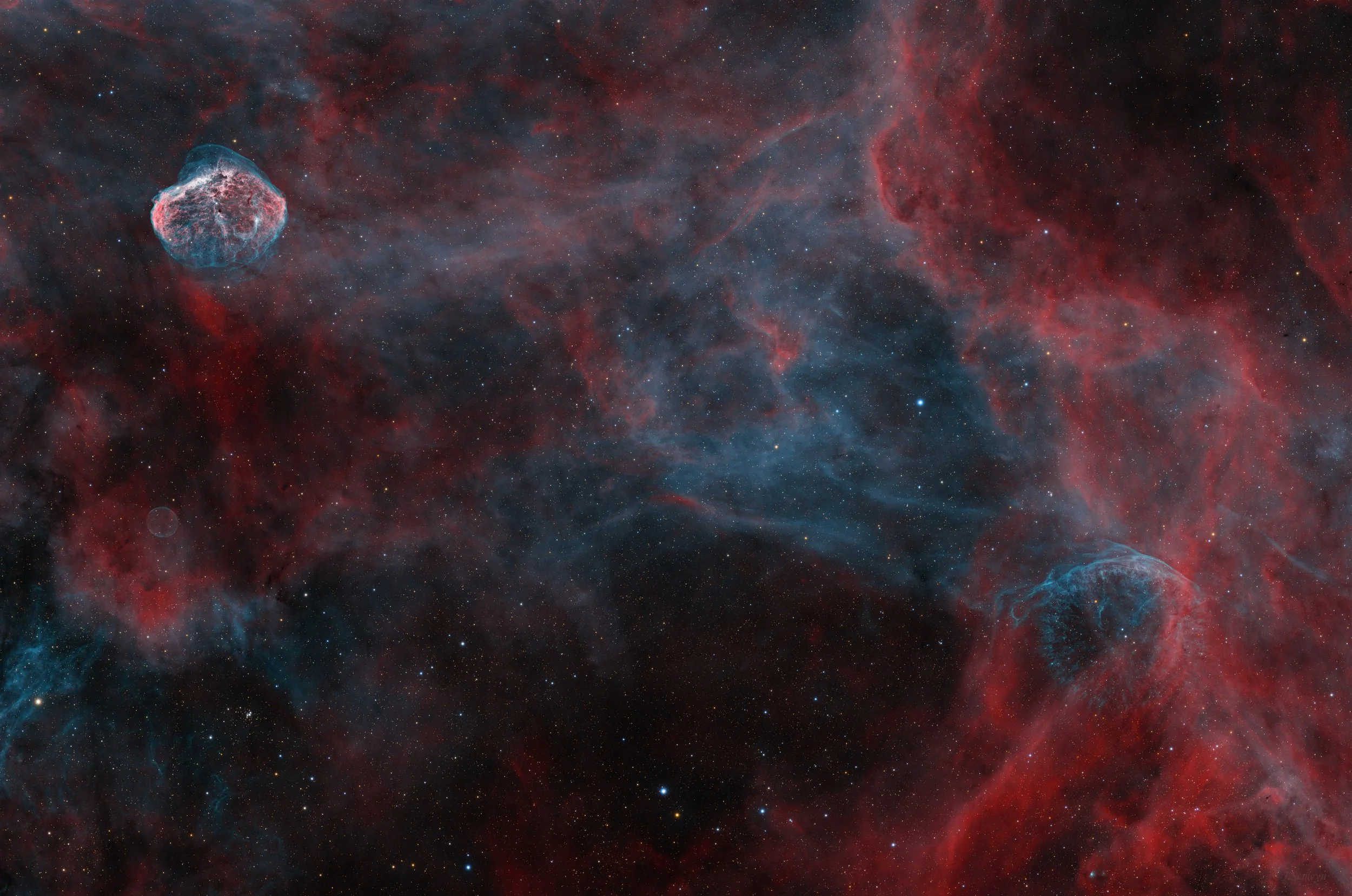
Two Wolf-Rayet Stars in Cygnus
In the rich star fields of Cygnus, two massive stars nearing the end of their lives sculpt the interstellar medium with fierce stellar winds. At left, WR 136 energizes the Crescent Nebula (NGC 6888), its powerful outflows colliding with earlier ejected material to form a glowing shell of hydrogen and oxygen. To the lower right, WR 134 produces its own fainter bubble-like arc, a delicate filamentary structure of ionized gas shaped by intense ultraviolet radiation.
These Wolf-Rayet stars represent a brief and violent stage of stellar evolution, a precursor to their eventual supernova explosions. The image reveals the contrast between the bright, turbulent Crescent Nebula and the more subtle, sprawling arcs of WR 134, both immersed in the broader hydrogen-rich clouds of Cygnus. Together they highlight the transformative power of massive stars and the beauty of their interactions with the galactic environment.
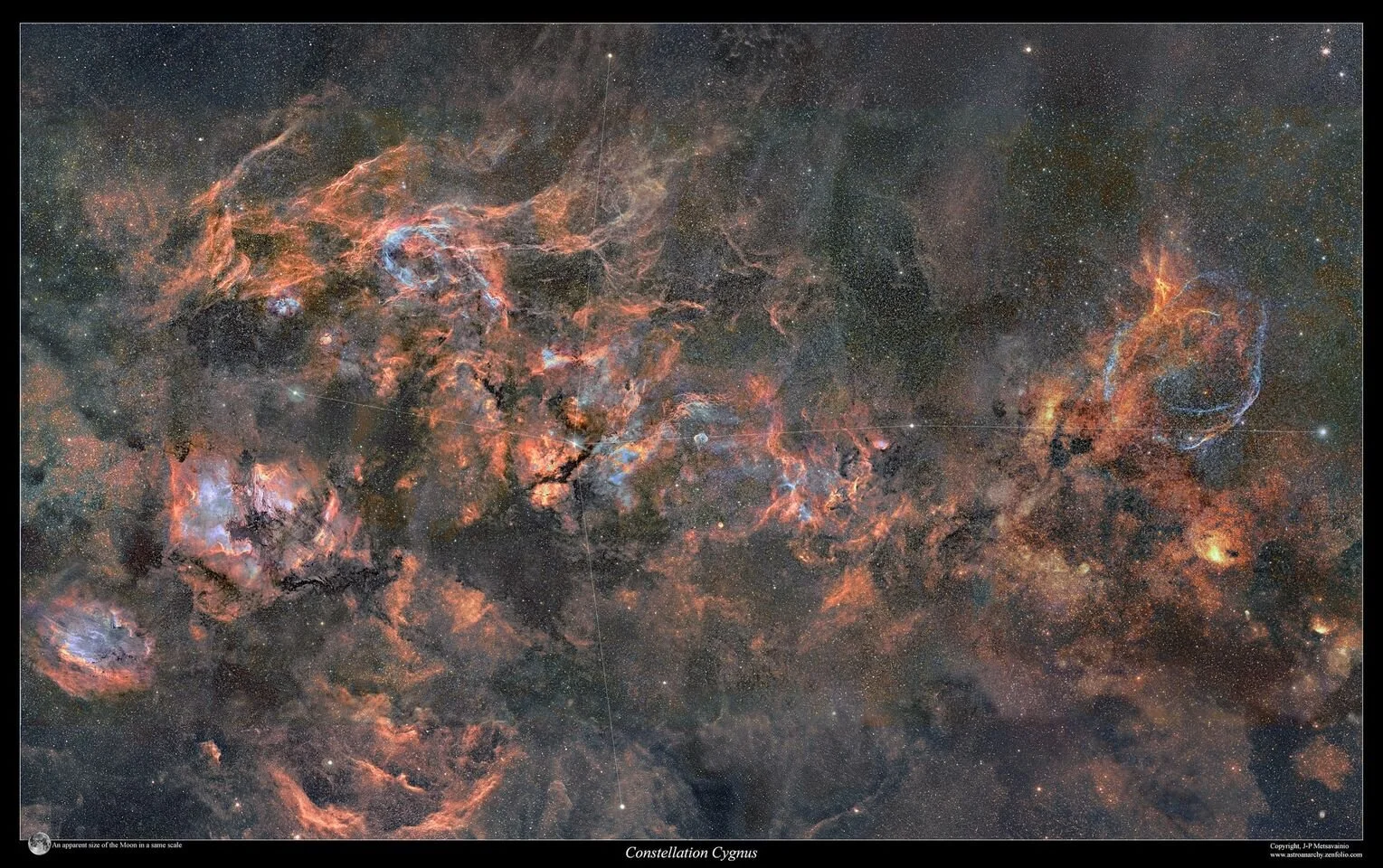
cygnus mosaic
I have started this imaging project back at 2010. My aim was to make a high resolution mosaic covering the constellation Cygnus. Work like that takes time and patience, especially since I have worked so, that many of the individual sub mosaics or frames have been published as an individual artworks. Here is a poster format presentation about all of longer focal length images used for this mosaic beside wide field panels.
As a result I have now a huge 37 panel (And 58 long focal length sub-panel) mosaic panorama covering 28 x 18 degrees of sky. I have collected photons way over 600 hours during past ten years for this photo. The full size mosaic image has a size of about 25.000 x 15.000 pixels.
In the orientation image above, there are three large supernova remnants visible, first the Cygnus Shell W63 , bluish ring at upper left quarter, secondly the large SNR G65.3+5.7 at utmost right and finally the third is a brighter SNR, the Veil nebula just outside of field of view at bottom center. (Image is partly overlapping with large mosaic but I didn't want to include it yet due to artistic composition.)Beside three supernova remnants there are two Wolf Rayet stars with outer shell formations. NGC 6888, the Crescent Nebula at center of the image and the WR 134, it can be seen as a blue arch just right from the Crescent Nebula, near the Tulip nebula.Next to the Tulip Nebula lays a Black hole Cygnus X-1, it's marked in small closeup image of the Tulip Neula at center right in orientation image above.
There are 37 base panels with shorter focal length tools (300mm f2.8 Tokina and 200mm f1.8 Canon) There is also 59 sub-panels used, they are shot with my old 12" Meade and 11" Celestron Edge scopes.
Copyright: J-p Metsavainio