

AAPOD2 Image Archives
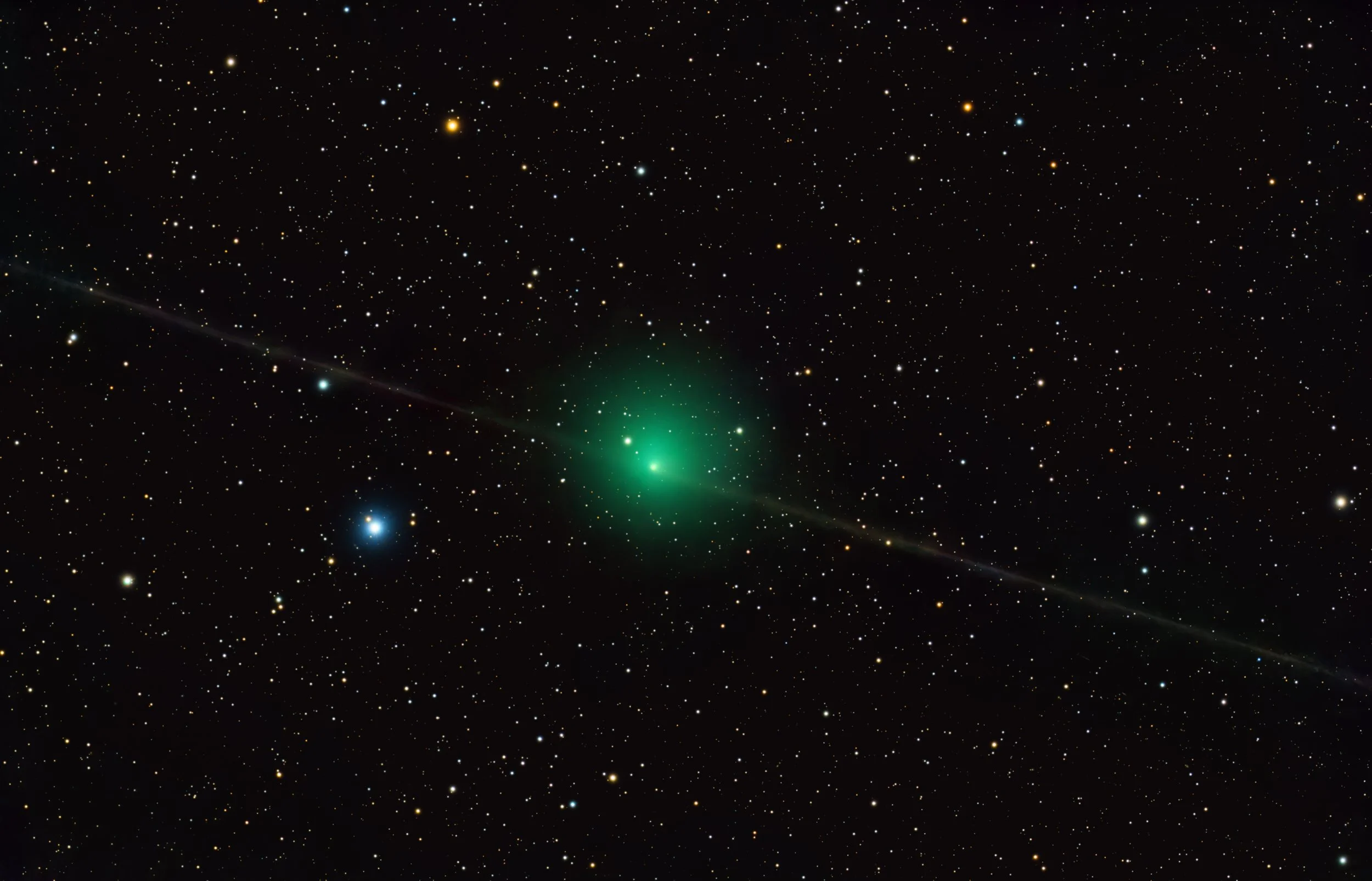
Comet 10P-Temple
Comet 10P/Tempel 2 is a short-period, Jupiter-family comet with an orbital period of approximately 5.4 years. Captured in this telescopic exposure from July 21, 2026, the comet displays a bright, well-condensed nuclear region surrounded by a characteristic greenish coma, a hue primarily produced by the fluorescence of diatomic carbon and cyanogen gases as volatile ice sublimates under solar ultraviolet radiation. Extending across the nucleus is a thin, linear feature—not a typical radiation-driven dust tail, but a permanent debris trail composed of larger millimeter- to centimeter-sized particles deposited over past perihelion passages. Because Earth crossed the comet’s orbital plane around July 20, this edge-on viewing geometry enhanced the trail's apparent surface brightness, projecting it as a striking, narrow spike while the comet shone at magnitude 13.4 in the constellation Capricornus, roughly 64.4 million kilometers from Earth.
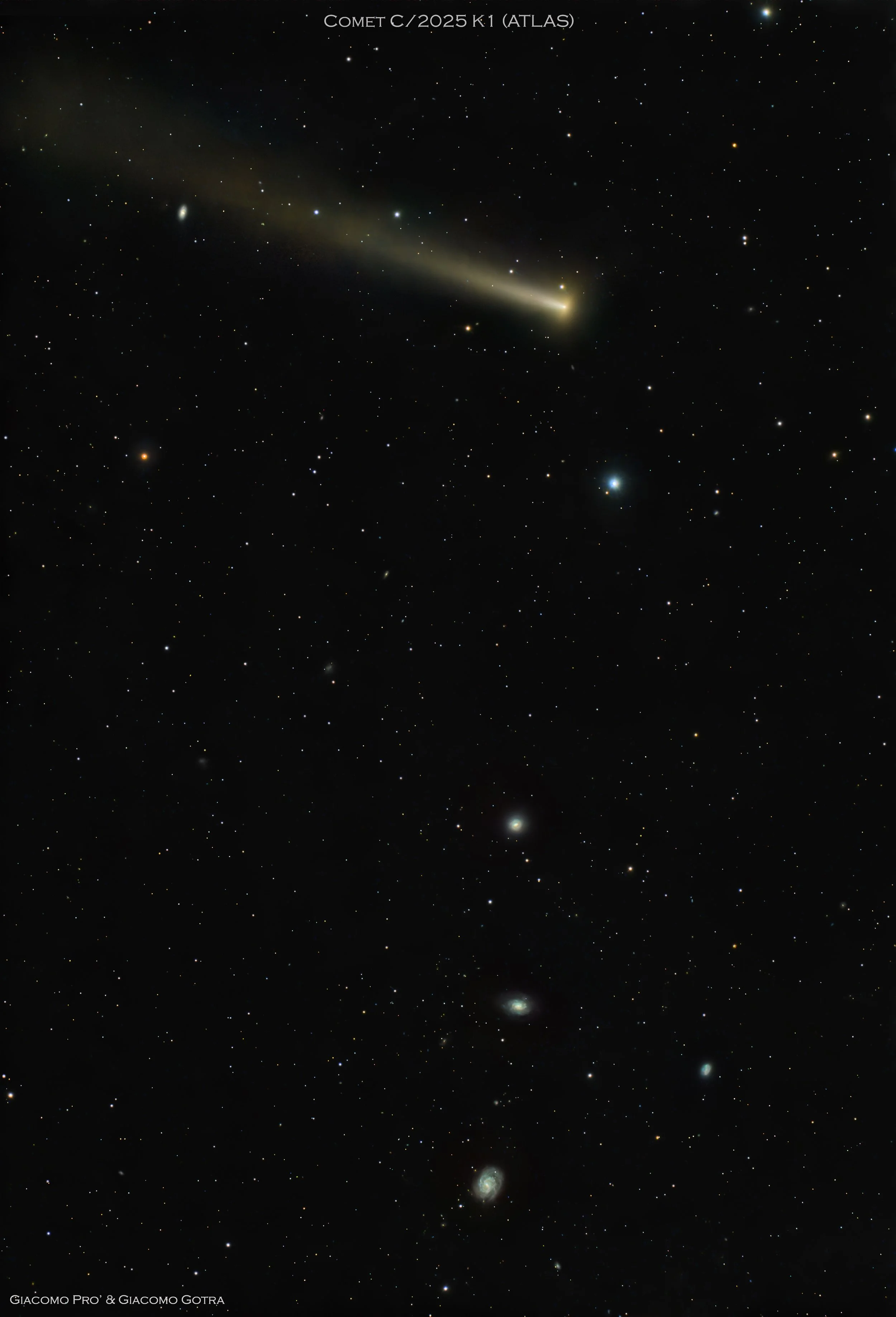
Comet C/2025 K1 (ATLAS)
Discovered by the ATLAS survey in May 2025, Comet C/2025 K1 is one of the most intriguing new visitors to the inner Solar System. Unlike short-period comets bound to the Sun for millennia, K1 follows a long, hyperbolic path suggesting it may be making its first—and possibly only—trip through our neighborhood before heading back into interstellar space. The bright nucleus glows with reflected sunlight while the yellow-tinged dust tail extends millions of kilometers, formed as solar radiation pushes dust away from the comet’s core.
In this image, the comet passes through a star-rich field sprinkled with distant galaxies, including the spiral galaxies visible in the lower half of the frame. The scene highlights how dynamic and interconnected the cosmos is—objects from the cold outer reaches of the Solar System momentarily crossing paths with galaxies billions of light-years away.

ngc 1333
In the serene realms of the Perseus constellation, NGC 1333 emerges as a stellar masterpiece, a reflection nebula adorned with the cosmic glow of youthful stars. This celestial oasis, situated within the Perseus Molecular Cloud, serves as a stellar nursery, where the interstellar medium births new generations of luminous orbs. Approximately 1,000 light-years from Earth, NGC 1333 captivates with its ethereal hues and intricate structures, crafted by the interplay of starlight and surrounding dust. This cosmic portrait not only illuminates the beauty of NGC 1333 but also invites contemplation of the ongoing celestial ballet, where the cosmic dance of creation unfolds in the heart of the Perseus constellation.