

AAPOD2 Image Archives
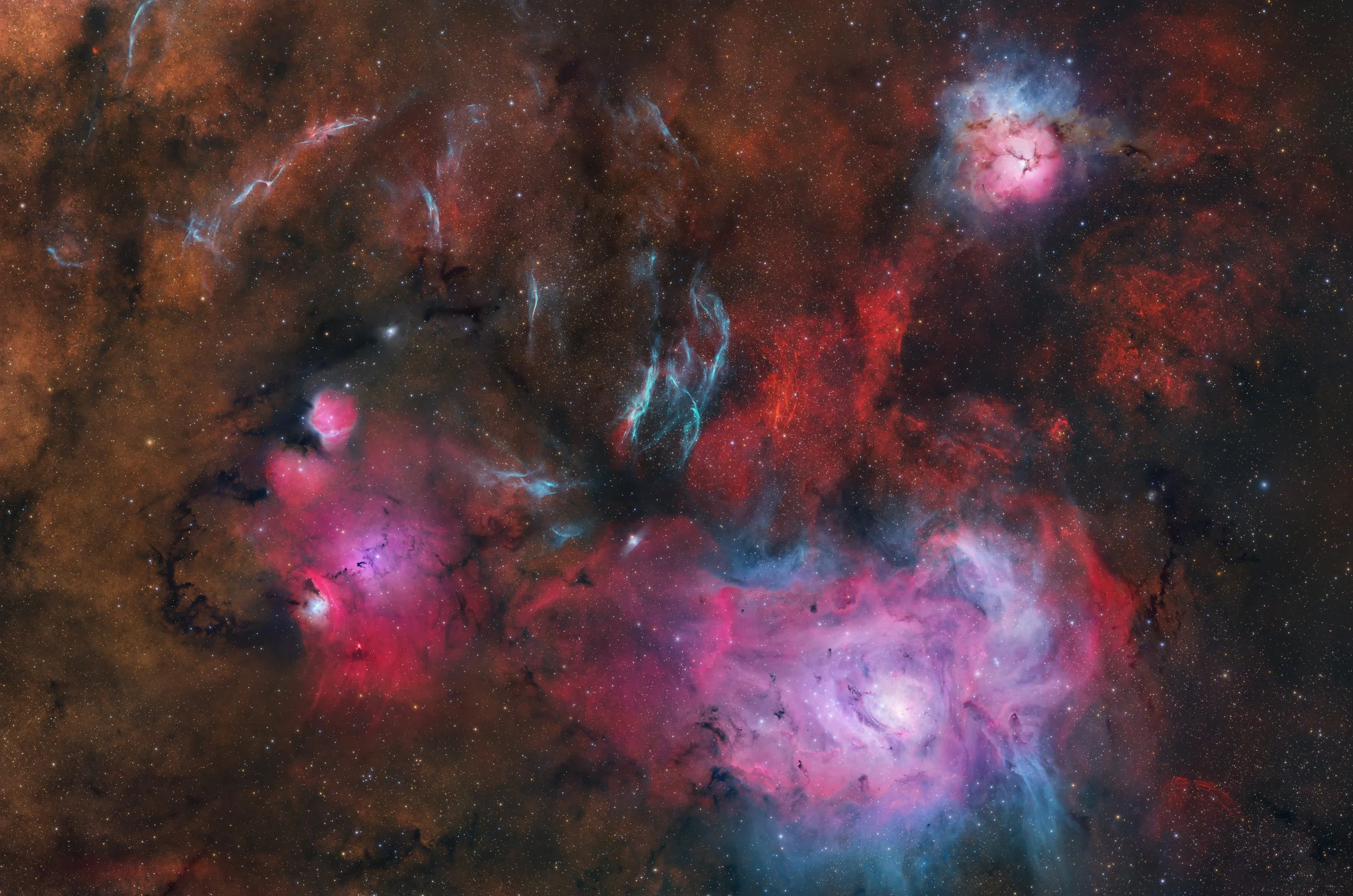
SNR G007.5-01.7 “Taz” Near the Lagoon Nebula
Adjacent to the Lagoon Nebula (M8) lies the faint supernova remnant SNR G007.5-01.7, informally known as “Taz” for its distinctive shape. This remnant consists of delicate O III–rich filaments, the cooling and recombining gas from a massive star’s explosion thousands of years ago. The shock fronts, driven outward into the interstellar medium, excite oxygen atoms, producing the characteristic teal emission captured through narrowband filters. Its low surface brightness and location within a crowded Milky Way field make it a challenging target for deep imaging.
The object’s proximity to the bright emission of M8 often obscures its presence, requiring careful exposure balancing and extended integration time to separate its subtle filaments from background nebulosity. Observations like this provide rare opportunities to study the dynamics of supernova remnants interacting with surrounding molecular clouds in a dense galactic region. Such remnants contribute to the chemical enrichment of the interstellar medium, dispersing heavy elements forged in the progenitor star’s core.
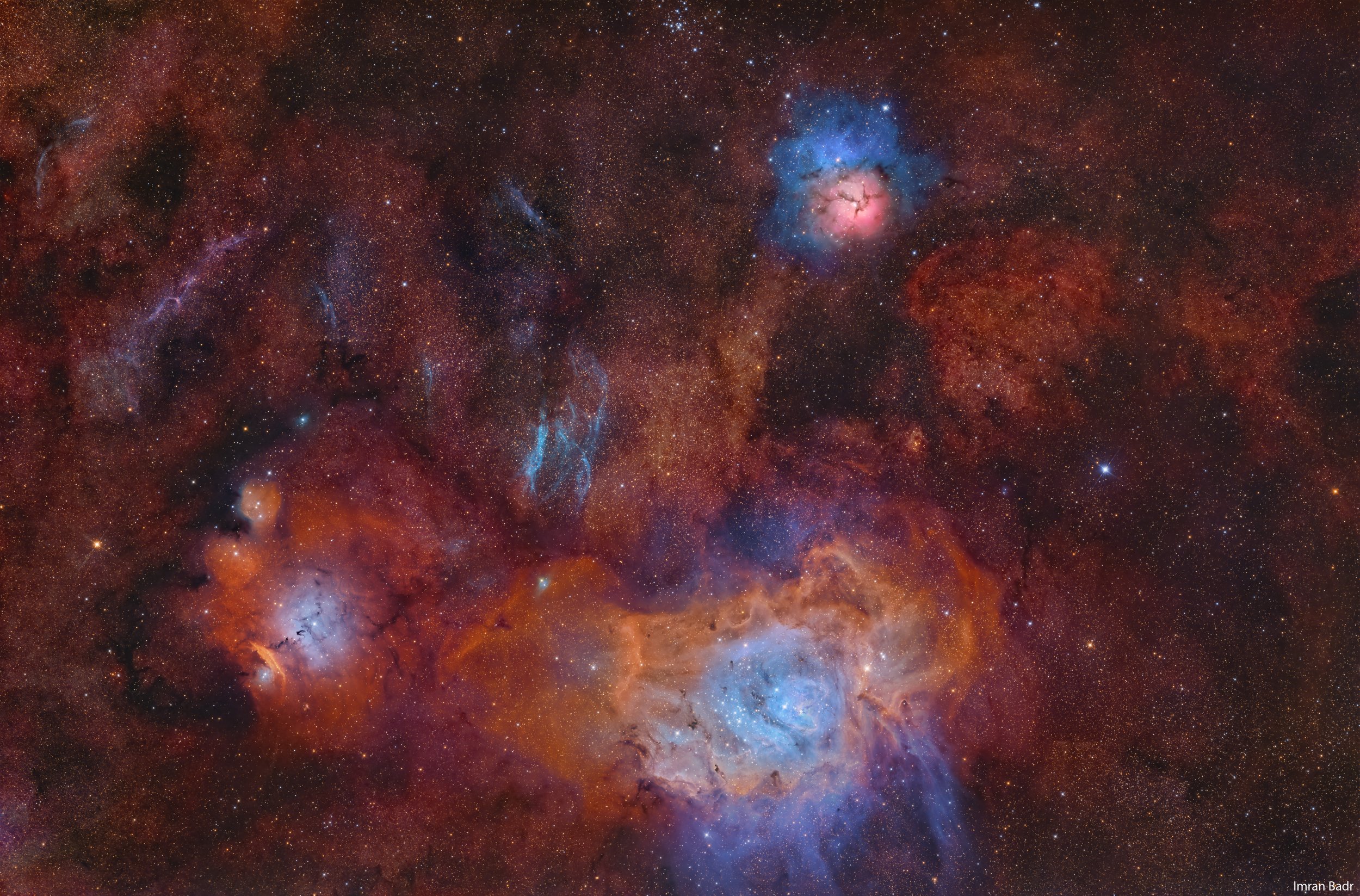
Lagoon, Trifid, and the Ghost of G007.5–01.7
This vibrant wide-field mosaic captures the rich H II region of Sagittarius, home to two of the most iconic star-forming regions in the night sky—the Lagoon Nebula (M8) and the Trifid Nebula (M20). Rendered in the SHORGB palette, the image highlights colorful emission structures: blue-green oxygen regions, sulfur filaments, and active hydrogen zones swirling around massive stars and dark dust lanes.
Ghosting faintly in the background is the elusive supernova remnant G007.5–01.7, an ancient stellar explosion now barely visible in optical wavelengths. Its faint blue filaments and arcs weave through the frame like a hidden fossil, adding depth and cosmic history to an already breathtaking stellar nursery.
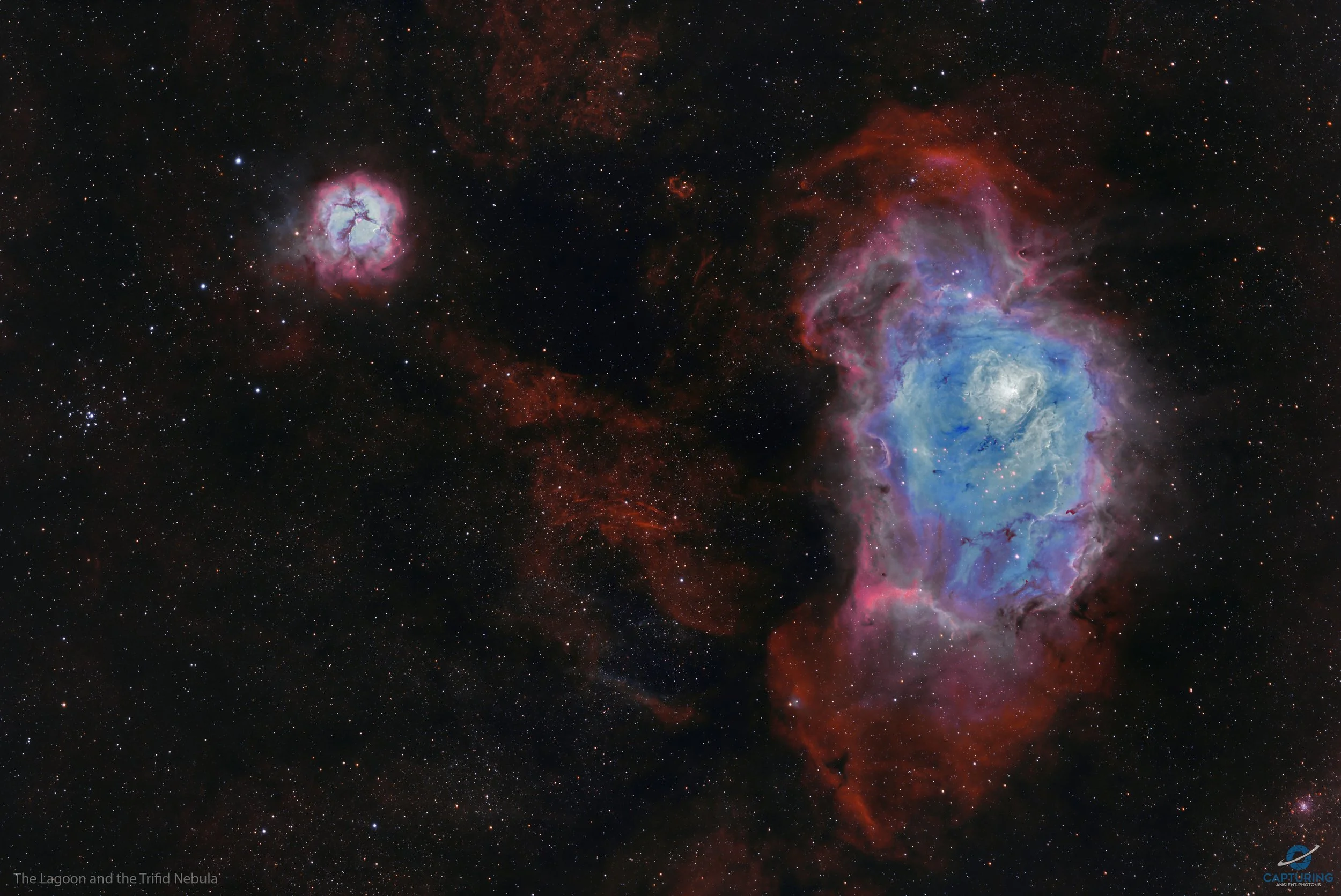
The Lagoon and Trifid Nebula in Foraxx/HSO
This image captures the stunning beauty of the Lagoon Nebula (M8) and the Trifid Nebula (M20) in the narrowband color palette of Foraxx/HSO (Hydrogen-Alpha, Sulfur, and Oxygen). Situated in the constellation Sagittarius, these celestial wonders showcase their intricate structures and vivid colors in this composite view.
The Lagoon Nebula, resembling a celestial lagoon surrounded by dark lanes of interstellar dust, is a region of intense star formation. In contrast, the Trifid Nebula exhibits its distinctive three-lobed appearance, with blue reflection nebulae, dark lanes, and pink emission regions. The Foraxx/HSO color scheme emphasizes the unique emissions of hydrogen, sulfur, and oxygen, revealing the dynamic interplay of gas and dust within these nebulous regions. This image is not only a visual feast but also a scientific treasure trove, offering valuable insights into the birth and evolution of stars in our galaxy.
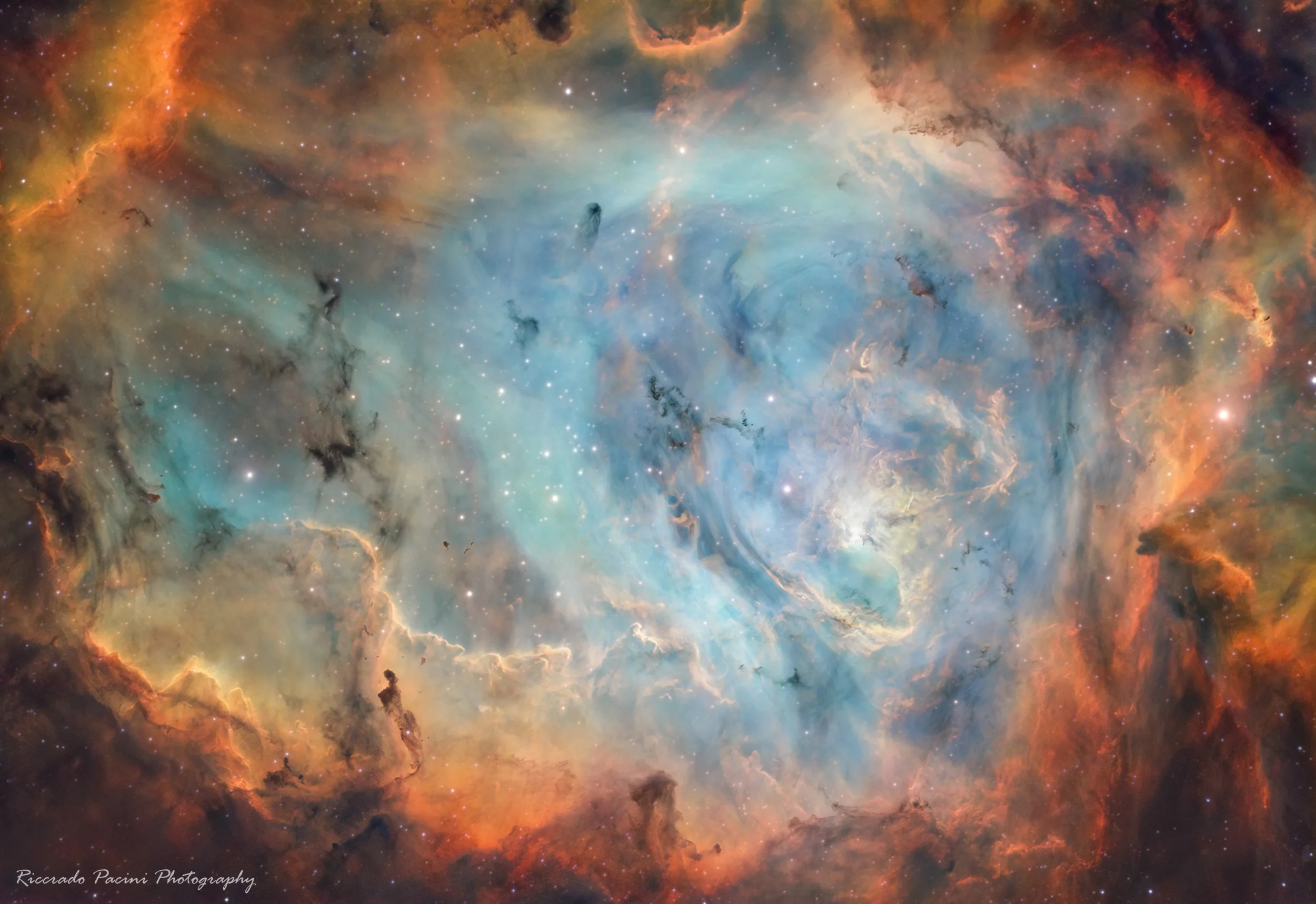
Dive into the lagoon
Image Description and Details : Inage captured between the 6th and 8th of June From bortle 9 area. Target at its highest reached 27° above the horizon Gear used Celestron edgehd 8 reduced 0.7x As294MM pro Antila 3nm SHO filters Processed in astropixel processor and finished in photohsop Total integration time little less than 12h
Copyright: Riccardo Pacini
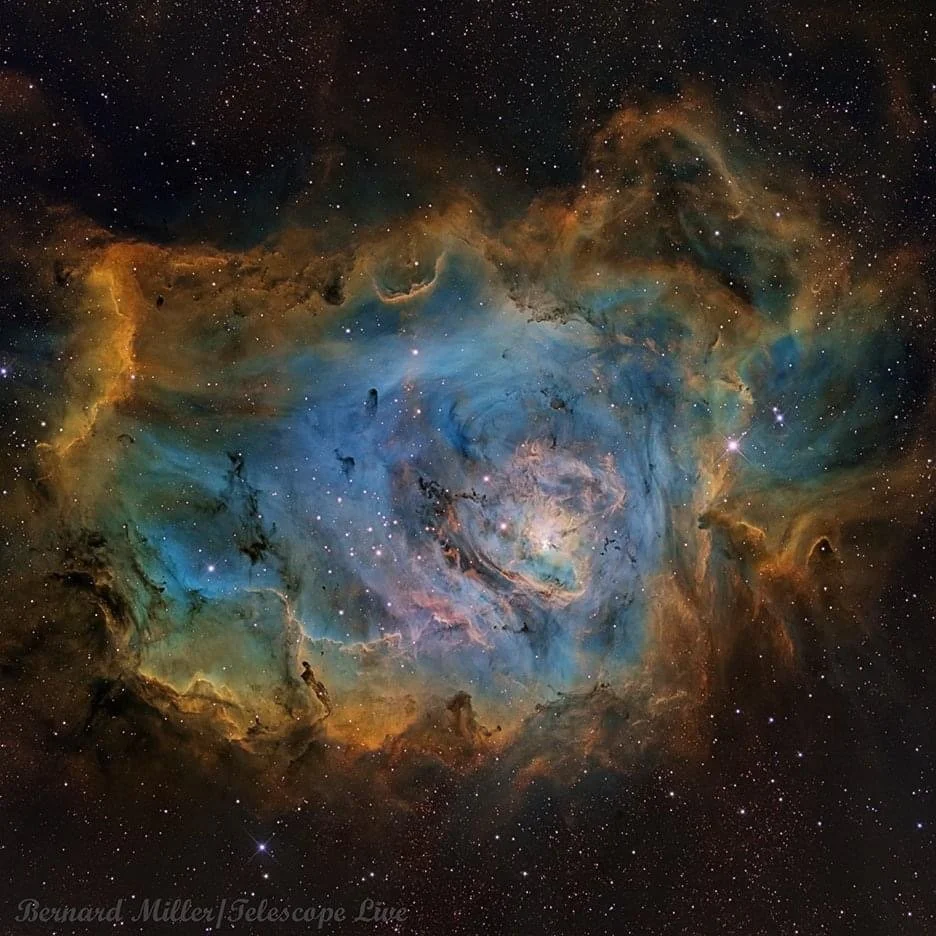
M8
This is an image of M8, also known as the Lagoon Nebula. It is an emission nebula about 4,100 light years away in the constellation Sagittarius. The nebula measures about 110 by 50 light years and has a number of Bok Globules throughout.
May 15, 2022
Location: Rio Hurtado, Chile
Telescope: ASA 500N
Camera: FLI PL 16803
Mount: ASA DDM85
Ha: 6x5 minutes (binned 1x1)
OIII: 6x5 minutes (binned 1x1)
SII: 6x5 minutes (binned 1x1)
Copyright: Bernard Miller

LAGOON NEBULA
Image Description and Details :
Exposition:
30x600 '' with Ha filter (1x1 binning).
24x600 '' with SII filter (2x2 binning).
24x600 '' with OIII filter (2x2 binning).
Equipment: QHY9, TS 65 Quadruplet (f / 6.5), EQ6-R and Lunático autoguiding.
Software: Astrophotography Tools, PHD Guiding 2.6.5, PixInsight 1.8.
Place: Nerpio, Albacete (Spain).
Copyright: ASTROMONOS - ANTONIO SANCHEZ DEL MAZO