

AAPOD2 Image Archives

Mineral Moon
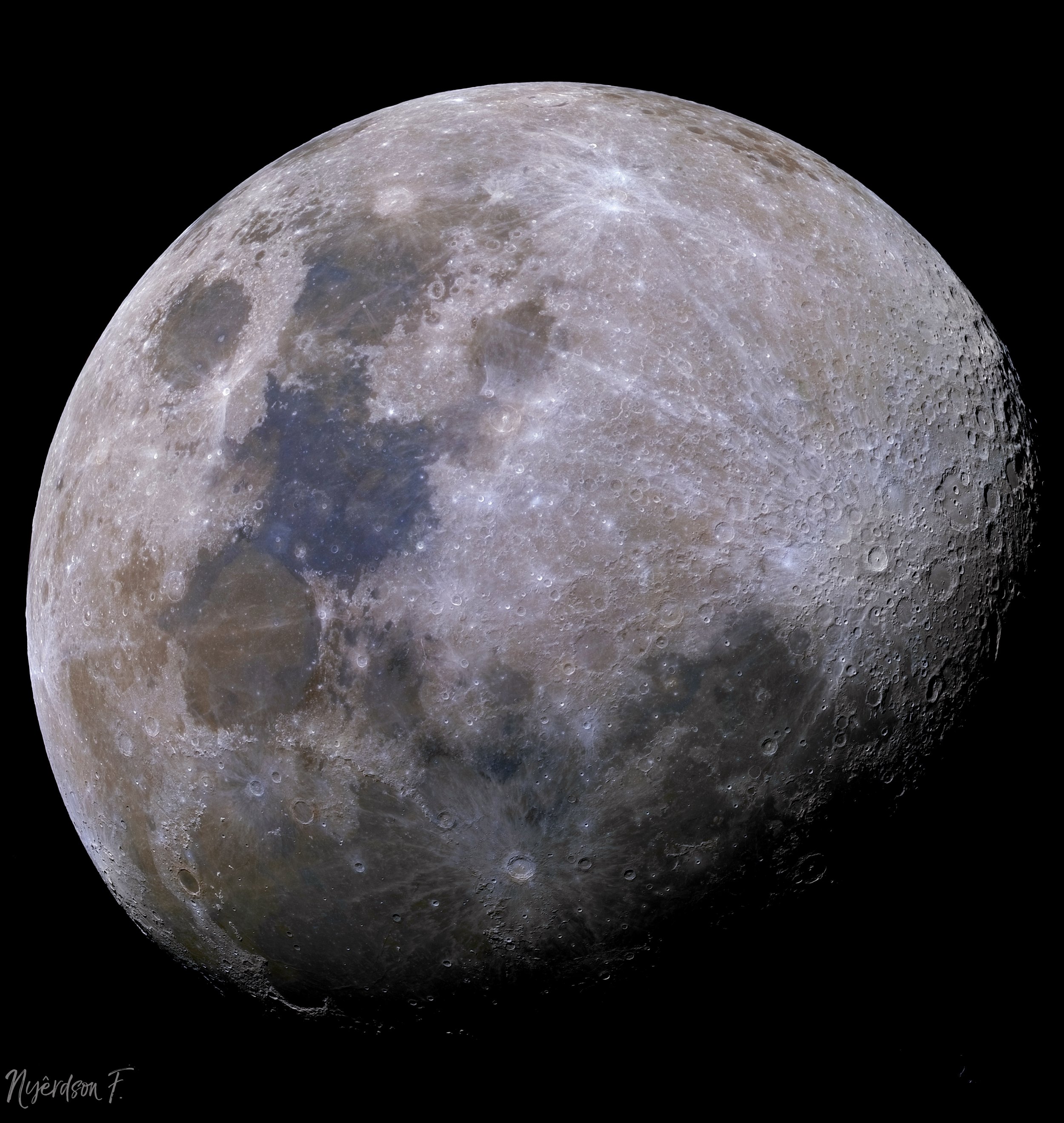
This enhanced view of the Moon reveals its hidden colors, representing subtle variations in the composition of its surface. The reddish-brown hues indicate iron-rich basaltic plains, known as lunar maria, while bluish tones highlight areas with a higher concentration of titanium. These color differences are not visible to the naked eye but can be brought out through careful processing, offering a mineralogical map of Earth's only natural satellite.
The image was captured near first quarter, when the interplay of sunlight and shadow emphasizes the rugged terrain of lunar highlands and cratered regions. The Moon, about 3,474 kilometers across, has been geologically inactive for billions of years, yet its surface preserves the history of impacts and volcanic activity that shaped it. This mineral view gives a scientific twist to a familiar object, showing how much diversity lies within its gray appearance.
CRESCENT GIBBOUS MOON REVEALS ITS MINERALS
The Crescent Gibbous Moon, bathed in sunlight, unveils a spectacular display of its hidden mineral diversity, revealing a lunar landscape painted in subtle yet scientifically significant hues. While the Moon often appears monochromatic to the naked eye, specialized imaging techniques bring out the geological secrets of its surface, showcasing the distribution of various elements across its rugged terrain.
This enhanced image, captured using mineral mapping techniques, highlights the Moon’s crustal composition in vivid detail. The blue and violet tones indicate areas rich in titanium-bearing basalts, found primarily in the lunar maria, vast plains formed by ancient volcanic activity. In contrast, the reddish and brown hues trace the presence of iron-rich materials and highland regions composed of anorthosite—a mineral abundant in aluminum that forms the Moon’s ancient crust.
The transition from the illuminated portion to the dark lunar terminator offers a breathtaking contrast, revealing long, jagged shadows cast by crater walls and towering mountain ranges. This interplay of light and shadow enhances the dramatic topography of impact craters, ridges, and volcanic plains, offering a glimpse into the Moon’s violent past shaped by asteroid impacts and internal geological activity.
By utilizing multispectral imaging and color enhancement, this image transforms the Moon from a familiar celestial neighbor into a richly textured and scientifically revealing world—one whose mineral composition provides key insights into the history of our solar system and the processes that shaped planetary bodies.