
AAPOD2 Image Archives
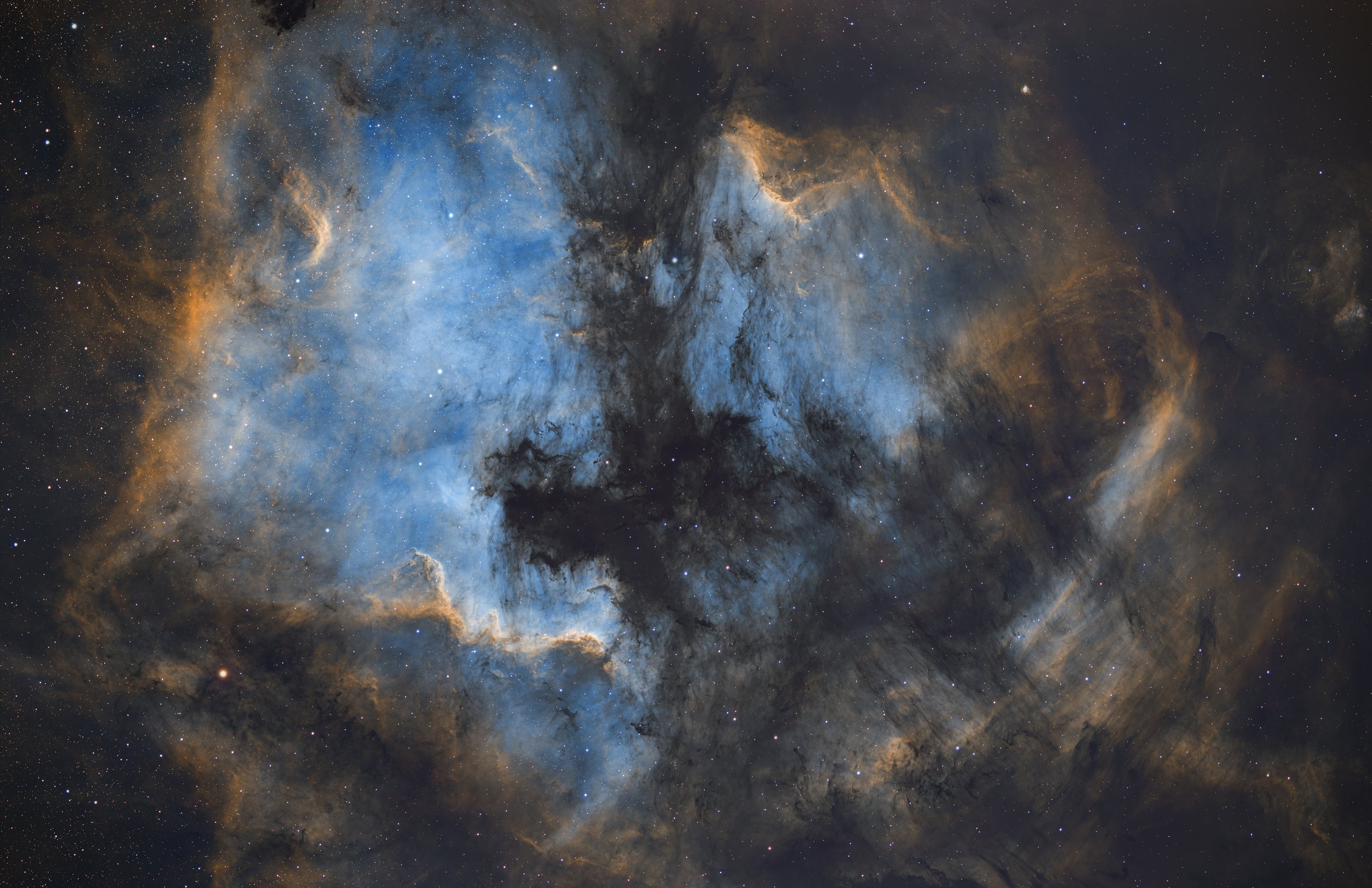
NGC 7000, The North America Nebula
NGC 7000, commonly known as the North America Nebula, is a vast emission nebula located roughly 2,600 light-years away in the constellation Cygnus. Its familiar continental outline is shaped by dense clouds of interstellar dust that obscure the glowing hydrogen gas behind them, carving out prominent features such as the Gulf of Mexico and the eastern coastline. The blue regions trace scattered starlight and oxygen emission, while warmer gold tones highlight ionized hydrogen energized by nearby massive stars, revealing the complex interplay between radiation and cold molecular material.
This image was captured from East Texas under Bortle 3 skies, allowing faint dust structures and subtle color gradients to emerge with exceptional clarity. The composition emphasizes the contrast between luminous gas and opaque dust, giving the nebula a sculpted, almost terrestrial appearance. Scenes like this showcase an active star forming environment, where radiation from young stars reshapes the surrounding clouds and prepares the raw material from which future generations of stars will eventually form.
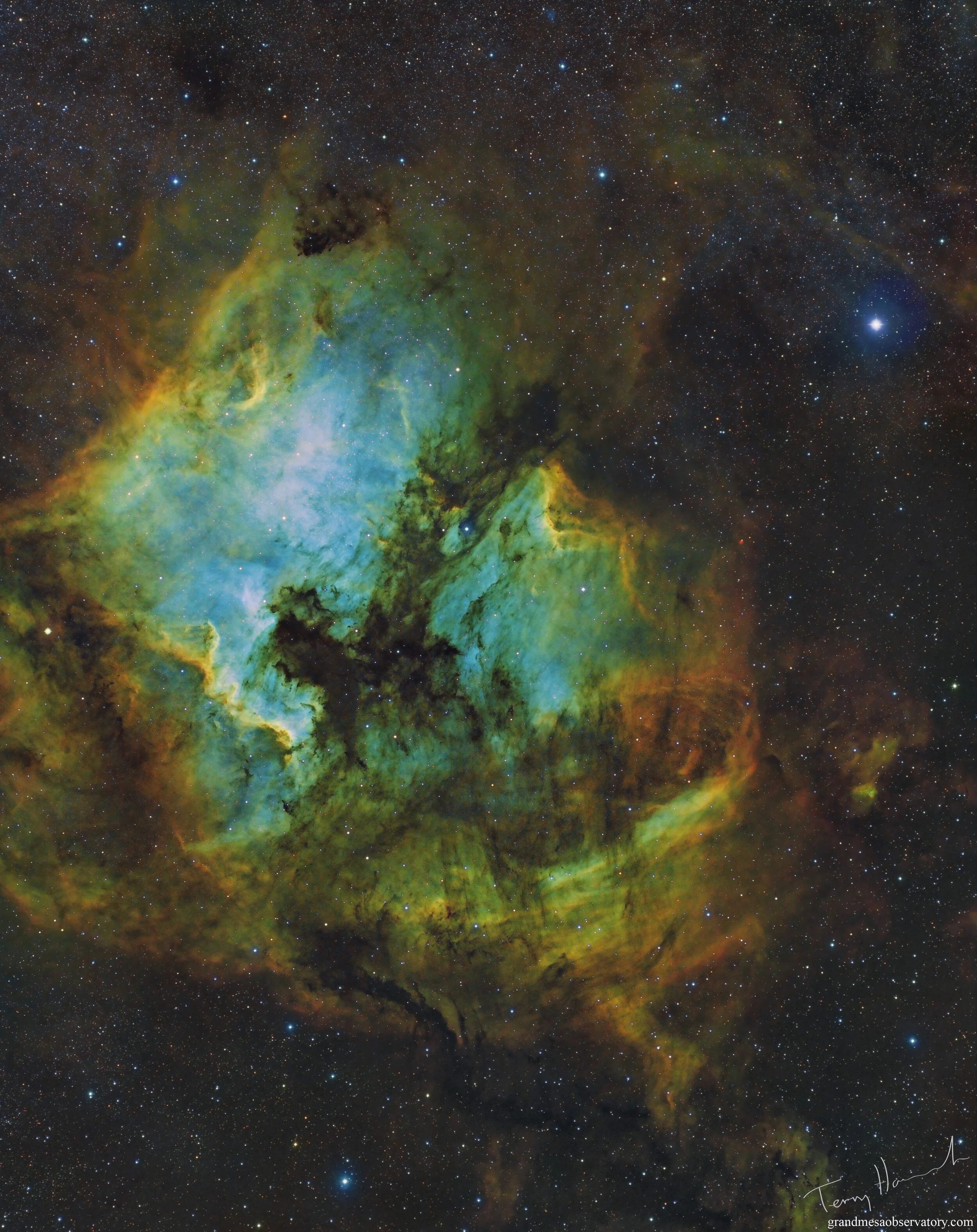
Cosmic Continent The Sequel (SHO)
Image Description and Details :
Several years ago I captured this beautiful region of Sky and called it “The Cosmic Continent”
Here is my latest Hubble Palette (SHO) version, a very wide view of The North America Nebula otherwise known as NGC7000 using data from Grand Mesa Observatory’s System 1a the William Optics Redcat together with a QHY16200A Monochrome CCD, this combination is giving a field of view of approximately 6 x 5 degrees
The William Optics Redcat with QHY16200A and its 7 position filter wheel is now available at Grand Mesa Observatory for subscription, see here for details.
https://grandmesaobservatory.com/equipment
In this Hubble Palette version the H-Alpha is mapped to green, SII is mapped to red and OIII is mapped to the blue channel. I removed the stars using Starnet and replaced them with the naturally colored stars from the broadband image, while the colors in this image are not the true colors, the narrowband filters used in the making of this Hubble Palette image reveal much more of the hidden gasses not visible in a broadband image.
Captured over 7 nights in May and June 2020 for a total acquisition time of 15 hours.
The North America Nebula (NGC 7000 or Caldwell 20) is an emission nebula in the constellation Cygnus that resembles the shape of North America and The Gulf Of Mexico. It lies at a distance of approximately 1800 light years away from us.
This image contains some very interesting areas such as The Cygnus Wall which is representative of Mexico and Central America, the nearby emission objects Pelican Nebula (IC5070) and the faint emission nebula IC5068
Technical Details
Captured and processed by: Terry Hancock
Location: GrandMesaObservatory.com Purdy Mesa, Colorado
May 5th, 20th, 21st, 25th, 29th, 31st, June 8th
HA 240 min 24 x 900 sec
OIII 255 min 25 x 900 sec
SII 225 min 23 x 900 sec
LRGB 180 min 9 x 300 sec
Filters by Chroma
Camera: QHY16200A
Gain 0, Offset 130 Calibrated with Flat, Dark and Bias Frames.
Optics: William Optics Redcat 51 APO @ F4.9
EQ Mount: Paramount MEII
Image Acquisition software Maxim DL6
Pre Processing in Pixinsight
Post Processed in Photoshop CC
Star Removal by Starnet
Copyright Information: Terry Hancock