
AAPOD2 Image Archives
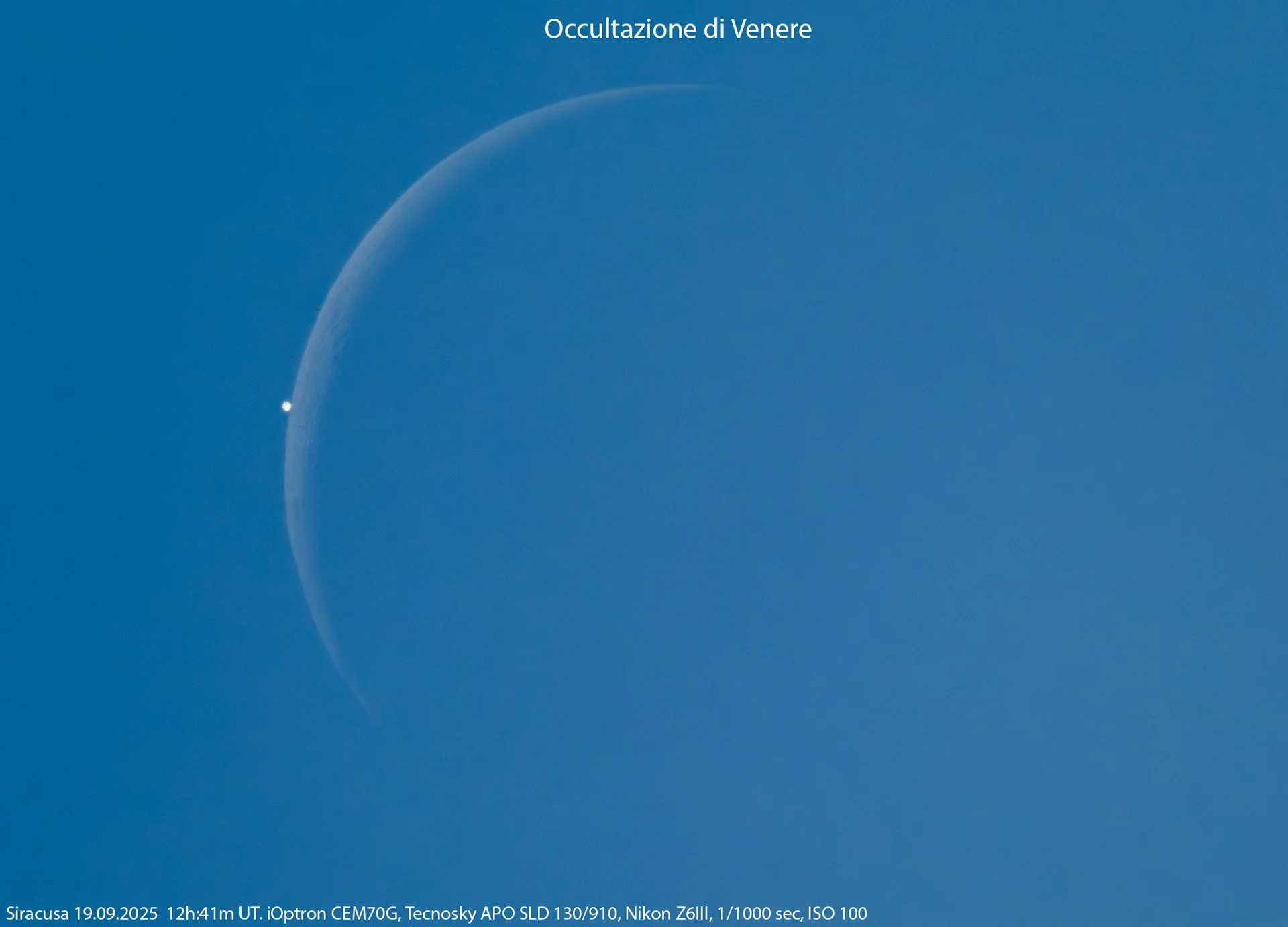
The Moon Occults Venus
In this rare celestial alignment, the Moon passes directly in front of Venus, temporarily hiding the brilliant planet behind its illuminated limb. Such events, known as occultations, are striking both visually and scientifically, as they provide opportunities to study the thin crescent of Venus as it disappears and reappears against the lunar edge. From Earth, the sudden vanishing of a bright planet against the sharp boundary of the Moon’s disk is a dramatic reminder of the constant motions of our solar system’s bodies.
This image was taken from Syracuse, Italy, on September 19, 2025, at 12:41 UT. The setup included an iOptron CEM70G mount paired with a Tecnosky APO SLD 130/910 refractor and a Nikon Z6III camera. A 1/1000-second exposure at ISO 100 captured the delicate balance of brightness between the lunar surface and Venus, preserving both the rugged detail of the Moon’s limb and the dazzling point of the planet.
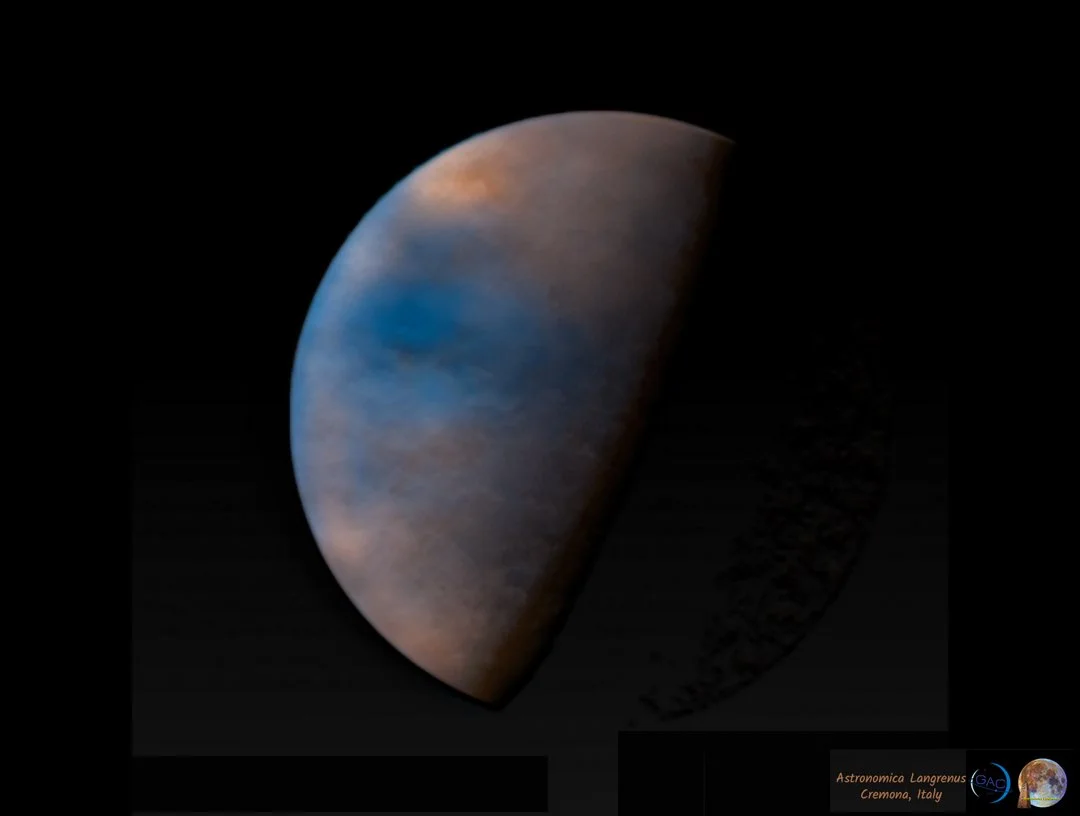
Venus Overcast in Infrared and Ultraviolet
Venus, often called Earth's sister planet, is perpetually shrouded in a dense atmosphere of carbon dioxide and sulfuric acid clouds. This striking false-color image, captured from Cremona, Italy, reveals its thick cloud layers using infrared and ultraviolet filters. The result shows intricate atmospheric features normally hidden from optical telescopes. Subtle cloud structures become visible here due to the blending of two separate spectral ranges: deep infrared, which penetrates lower cloud levels, and ultraviolet, which highlights high-altitude cloud tops.
The image was acquired on June 26, 2025, using a 255 mm F/20 Maksutov Rumak telescope and a ZWO ASI 462 Mono camera. Frames were captured with IR-pass and UV-pass filters, stacking 28,000 out of 35,000 frames in infrared at 250 fps and 3,000 out of 5,000 in ultraviolet at 30 fps. The final composition is presented in IR-IR-UV channels to simulate a color view of Venus's invisible atmosphere.
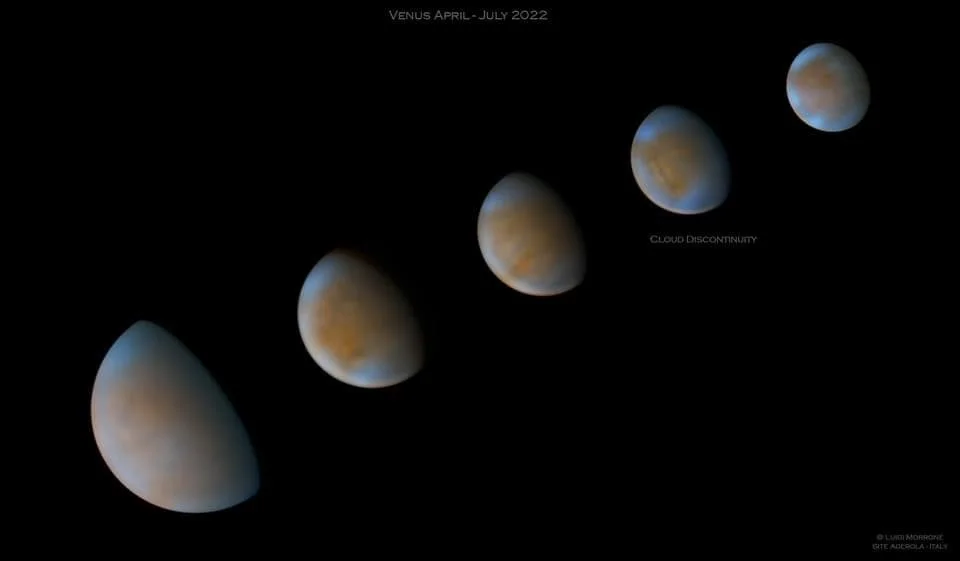
Venus
A collection of Venus images taken from my observatory in the period April-July 2022.
The images combine Infrared, 820-920nm, and Ultraviolet, 320-380nm, data.
A Cloud discontinuity is also visible in one of the images.
The setup used:C14 Edge HD, Fornax52 mount, ASI 290mono, FFC Badder Barlow, Baader UV320-380nm, Baader SLOAN z-s'820-920nm.
Agerola-Amalfitan Coast-Italy
Copyright: Luigi Morrone
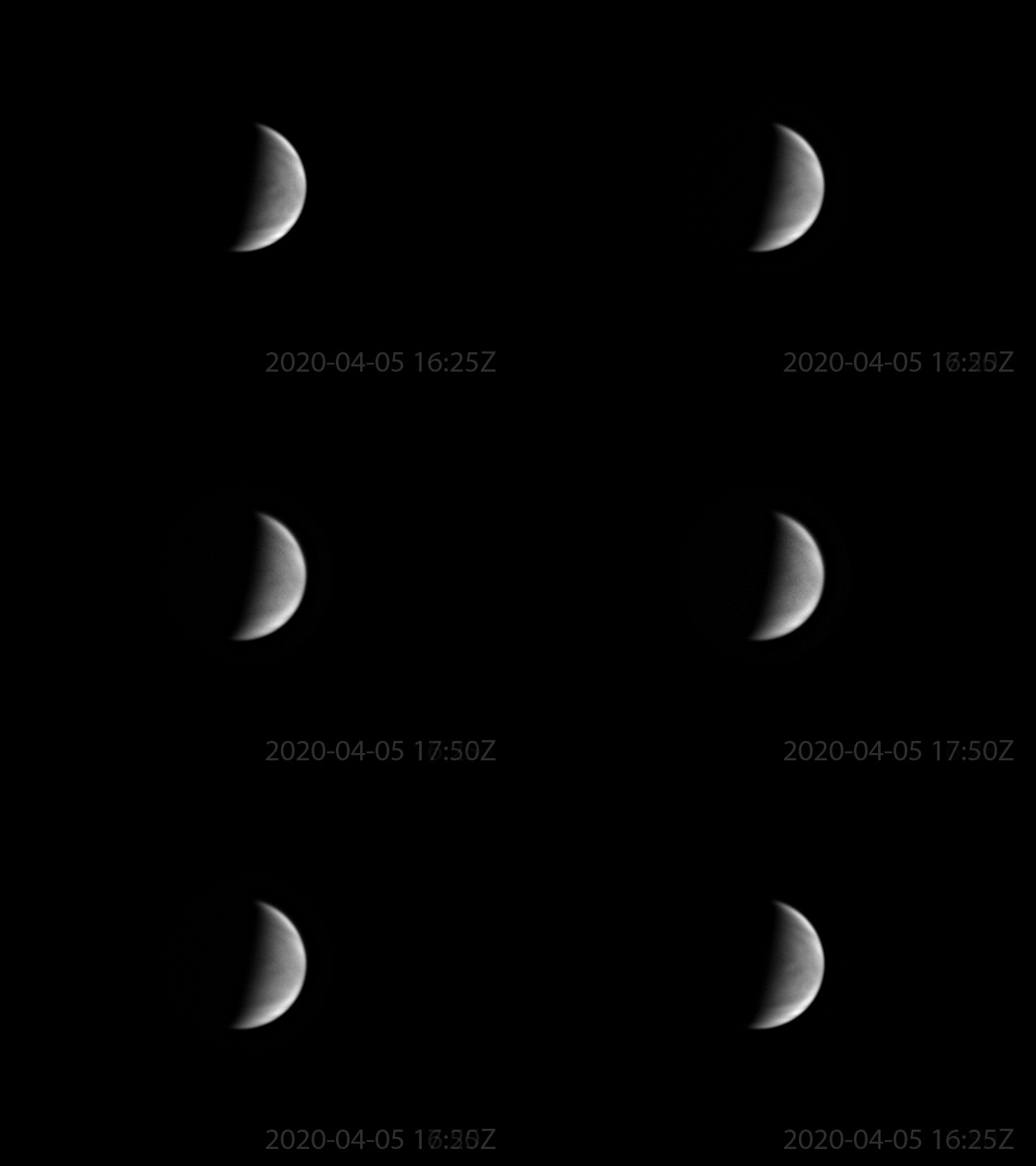
Winds on Venus
Using the same gear as yesterday, the N150/750, the motorized filter wheel, the green and Calcium K line filters and the cooled ASI 178MM, all guided by the soapbox, I imaged Venus. On this day the atmosphere was kind enough to allow me to photograph not only a still, but also the movement, even though the second frame shows a considerable decrease in details.
Copyright: Pál Váradi Nagy