
AAPOD2 Image Archives

Melotte 15
Image Description and Details :
Melotte 15 in the Heart of IC 1805.
William Optics FL132, WO GS61 guide, CGEM, Atik 460ex, ZWO mini, ZWO EFW, Astrodon NB 3nm Ha, Sii, Oiii filters. PHD2/SGP/Pixinsight/PS.
13 hours total exposure Bortle 9
Copyright: Alex Dean
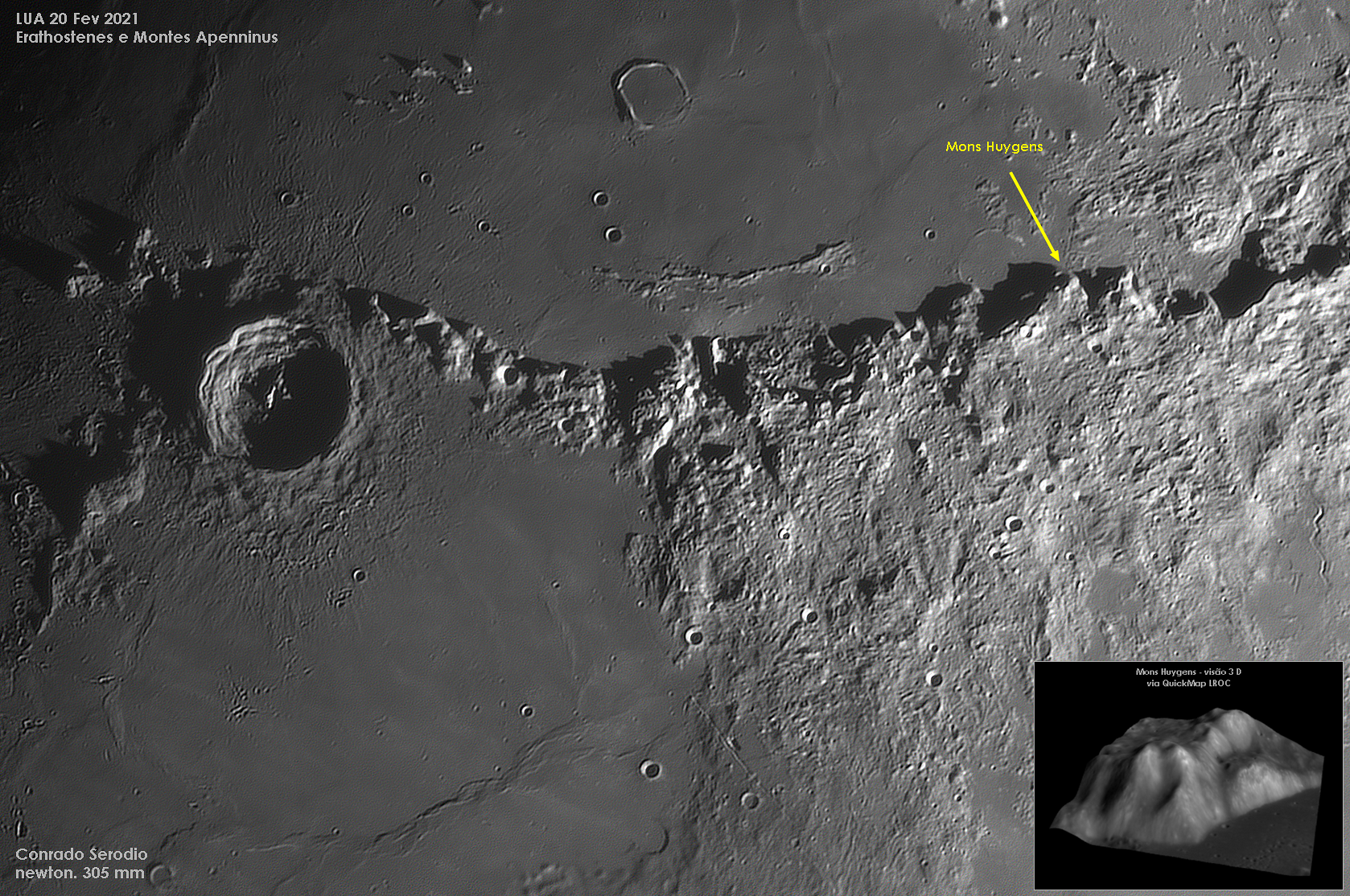
Moon Montes Apeninnus and Eratosthenes crater
Image Description and Details :
Registration on Feb. 20 of a set of interesting formations on the edge of the Mare Imbrium, starting with the Eratothenes crater (diam. 58 km, depth 3600 meters), where the mountain range of the Apeninnus Mountains begins, extending for 953 km formed by the rubble the great impact that created the Mare Imbrium. Apeninnus is home to some of the highest peaks on the visible face of the Moon, including Mons Huygens which according to the most recent and accurate assessments reaches 4950 meters.In the upper part of the image, it is also possible to observe a ghost crater Wallace, remnant of a crater formed in the Imbrian period (3.8 ~ 3.2 a.a.) that was filled by lava and formed edges located 400 meters above the surface.In the box, a perspective view (generated through QuickMap) of Mons Huygens.Tele GSO 305 mm @ f / 12, ASI290MM camera
Copyright: Conrado Serodio

Uranus and its Satellites Retrogradation Curve
Image Description and Details :
I present to you a study on the retrogradation curve of the planet Uranus and its satellites made from December 2020 to February 2021. Retrogradation, or retrograde movement, is the recoil that a celestial body seems to describe when observing it from distant stars. It took 8 nights to image the planet with 50 luminance images of 10 seconds each in bin1 + 20 RGB images of 2 seconds each in bin2 and after assembly, process and annotations of the positions of the planet by date I looked for the position of the satellites visible on these images. So on these images we can distinguish Oberon and Titania, and from time to time we see Umbriel.FPS: 10 fpsexpo: 100msGain: 500total image: 10,000Focal length: 5400Drizzle 3
Copyright: Georges Astrophotography
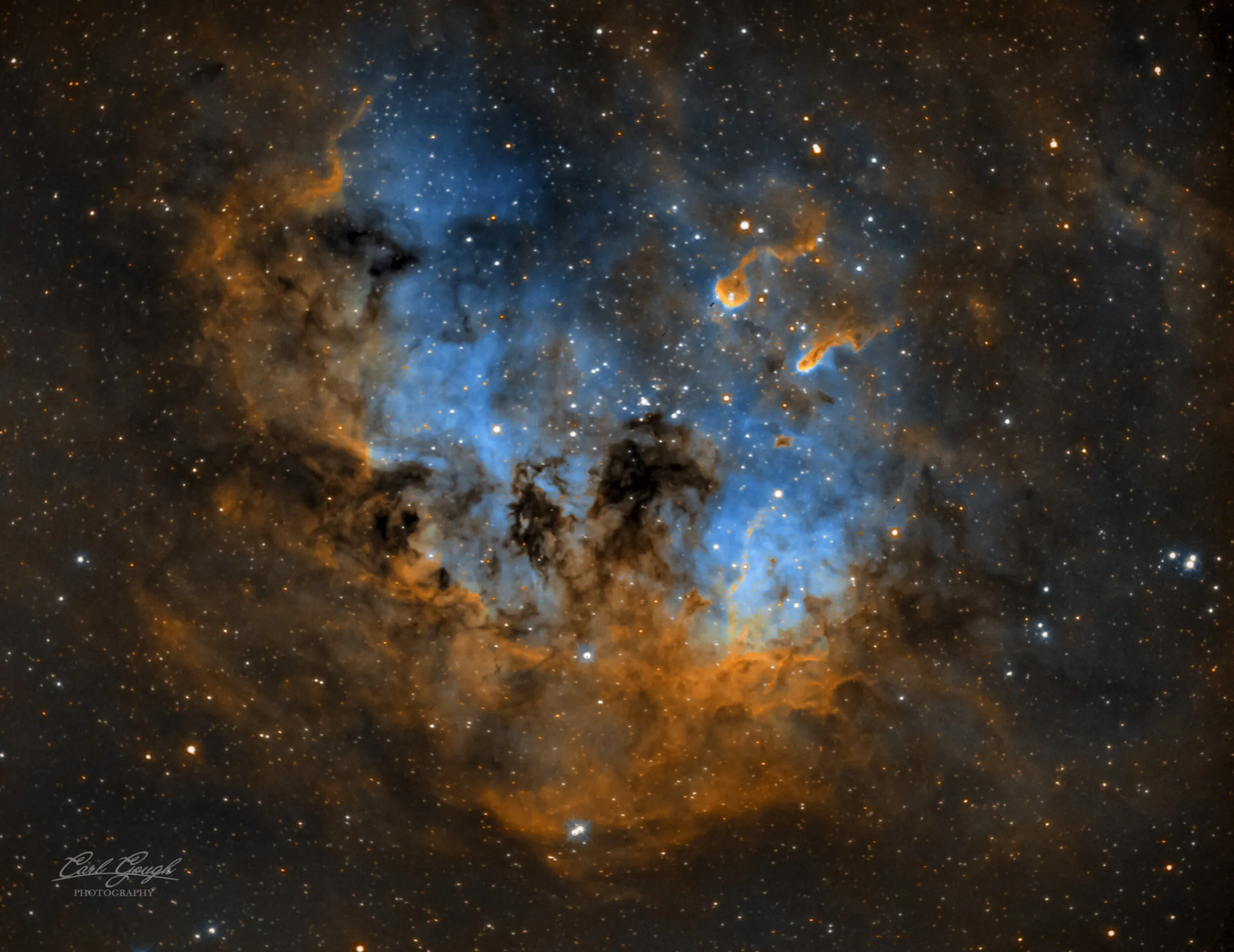
IC410 - The Tadpoles
Image Description and Details :
The Tadpole nebula or IC 410 is an emission nebula in the constellation Auriga. It lies approximately 12,000 light years from earth.
I don't believe its name needs any explanation, it's one of the few I can see immediately, and I've always struggled with most. This nebula reminds me of a line in one of my favorite songs. "We're just 2 lost souls swimming in a fish bowl". Of course Pink Floyd isn't everyone's thing!
equipment:
Orion RC 8" with CCD47
ZWO ASI 1600MM (-20, gain 139)
Altair 70mm guide scope and ZWO ASI 224 MC
Skywatcher EQ6-r
Integration:
HA - 67x 600 sec
OIII - 5x 600 sec
SII - 5x 600sec
Copyright: Carl Gough

A Sunflower in a Sea of Shattered Stars
Image Description and Details :
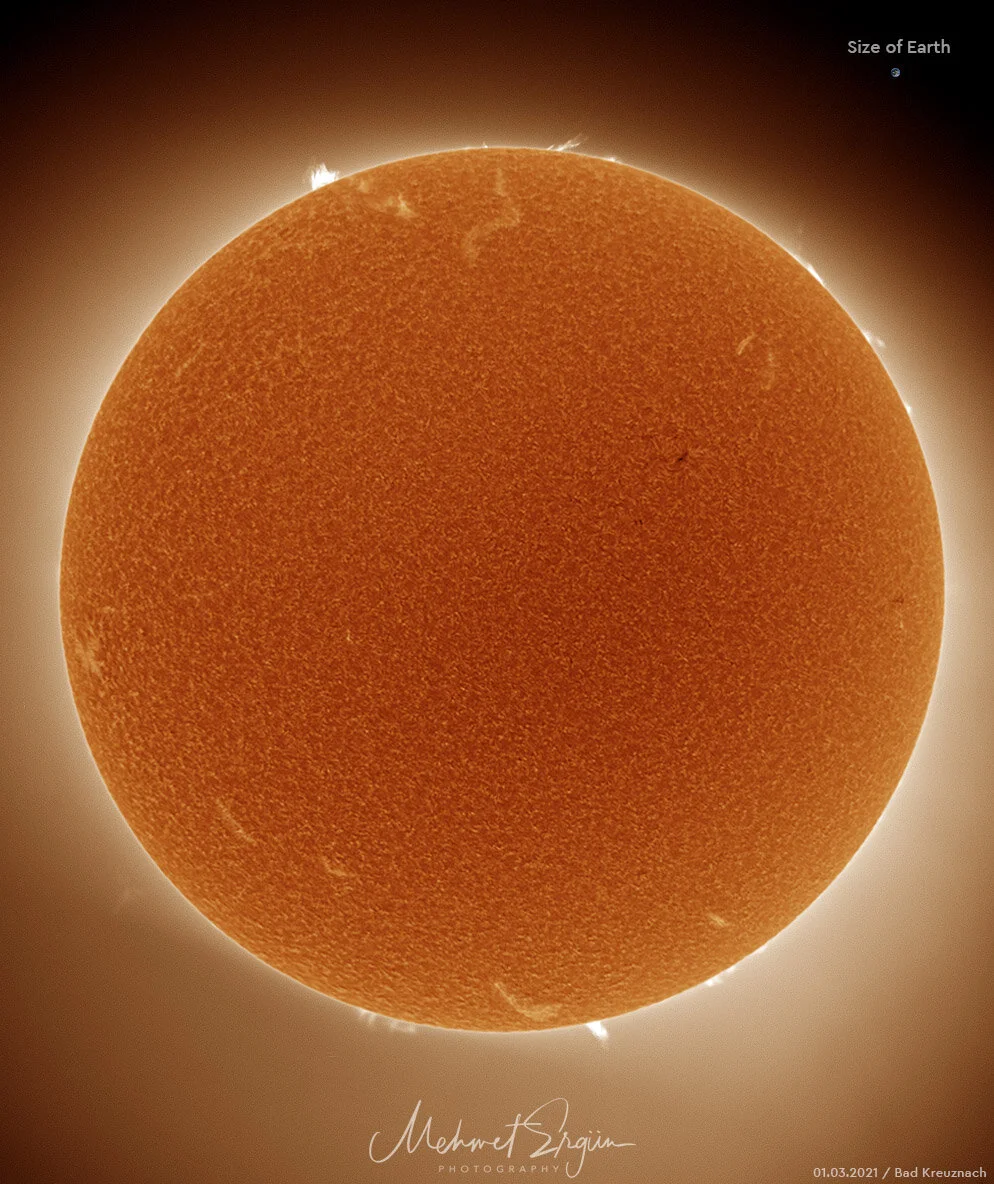
This image shows the galaxy M63, also known as the Sunflower Galaxy. What sets this galaxy apart from other spiral galaxies is its extensive halo and tidal stream. These streams often occur when a galaxy has a close encounter with a nearby satellite galaxy. The result is a big stream of remnants of the satellite galaxy.The image was taken throughout February(13.02, 18.02, 20.02, 22.02, 01.03.) and early March, party out of my backyard, party from a dark site, both located near Freiburg in Germany.The gear used was the following: Celestron RASA8, QHY183M, Skywatcher EQ6, TS-Optics LRGB filters. The exposures were mainly 90sec at Gain 0, though some had 60s subs because of the moon. Total integration time amounts to 25hours.Processing was mainly done in PixInsight, although I also used Adobe Photoshop and AstroPixelProcessor. The main challenge was to bring out all the faint dust without "blowing up" the stars and details, PixInsights multiscale processing certainly helped a lot in making that possible.
Copyright: Julian Shroff
With Your Heart and Your Soul
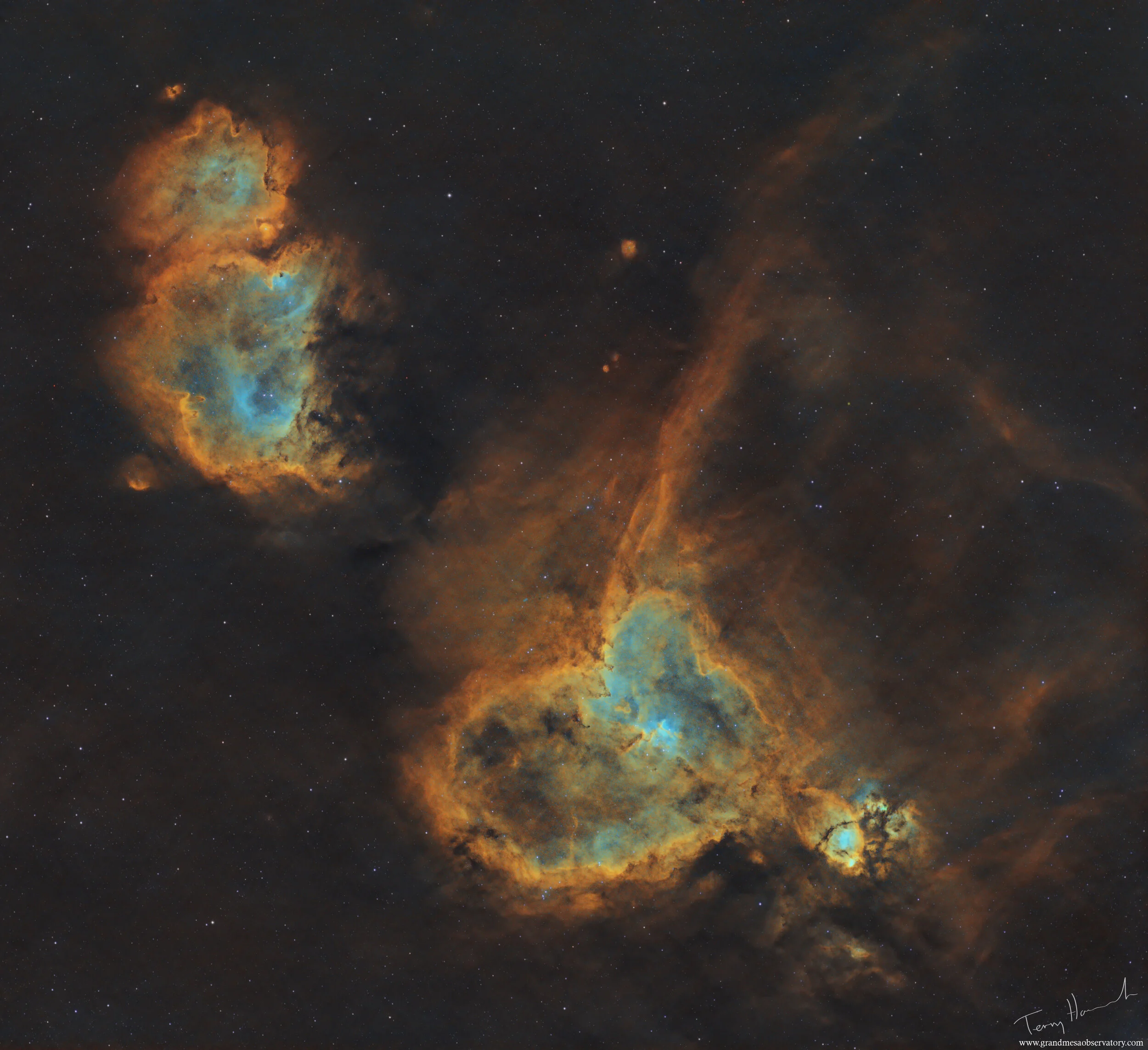
Here is my latest Hubble Palette (SHO) version, a very wide view of The Heart IC1805 and Soul Nebula IC1848 using data from Grand Mesa Observatory’s System 1a the William Optics Redcat together with a QHY16200A Monochrome CCD, this combination is giving a field of view of approximately 6 x 5 degrees, In this Hubble Palette version the H-Alpha is mapped to green, SII is mapped to red and OIII is mapped to the blue channel. Captured over 6 nights in 2020 and 2021 for a total acquisition time of 15.3 hours. 7000-7500 light-years distant in the constellation of Cassiopeia lie the emission nebulae colloquially known as the Heart and The Soul Nebulae. The gasses (mostly hydrogen) that comprise the nebulae are being ionized by the stars within the region and as a result, the gasses glow, much like a neon sign. The pressures exerted upon the material by the stars nearby are causing the material to become compressed. When enough of the gas becomes highly compacted, it triggers the birth of new stars. In effect, this is a beautiful snapshot of a multimillion-year process of an enormous cloud of dust and gas transforming itself into new stars. Technical Details Captured and processed by: Terry Hancock Location: GrandMesaObservatory.com Purdy Mesa, Colorado Sep 29th, Oct 14th, 16th, Nov 11th 2020, Jan 1st and 2nd 2021 HA 270 min 27 x 600 sec OIII 340 min 34 x600 sec SII 310 min 31 x 600 sec Filters by Chroma Camera: QHY16200A Gain 0, Offset 130 Calibrated with Flat, Dark and Bias Frames. Optics: William Optics Redcat 51 APO @ F4.9 EQ Mount: Paramount MEII Image Acquisition software Maxim DL6 Pre Processing in Pixinsight Post Processed in Photoshop CC Star Removal by Starnet
Copyright: Terry Hancock

Ou4 - Giant Squid
Image Description and Details:
A nebula, Ou4, that I find very pretty so at the beginning of July, I started to photograph it. It is carried out in hoorvb. until October I got 113 hours of exposure in order to prepare for this image.
OIII 200X900S
HA 260X600S
RVB 240X300S
Copyright Information: Rémi Méré
van den Bergh 18 in Perseus
Image Description and Details :
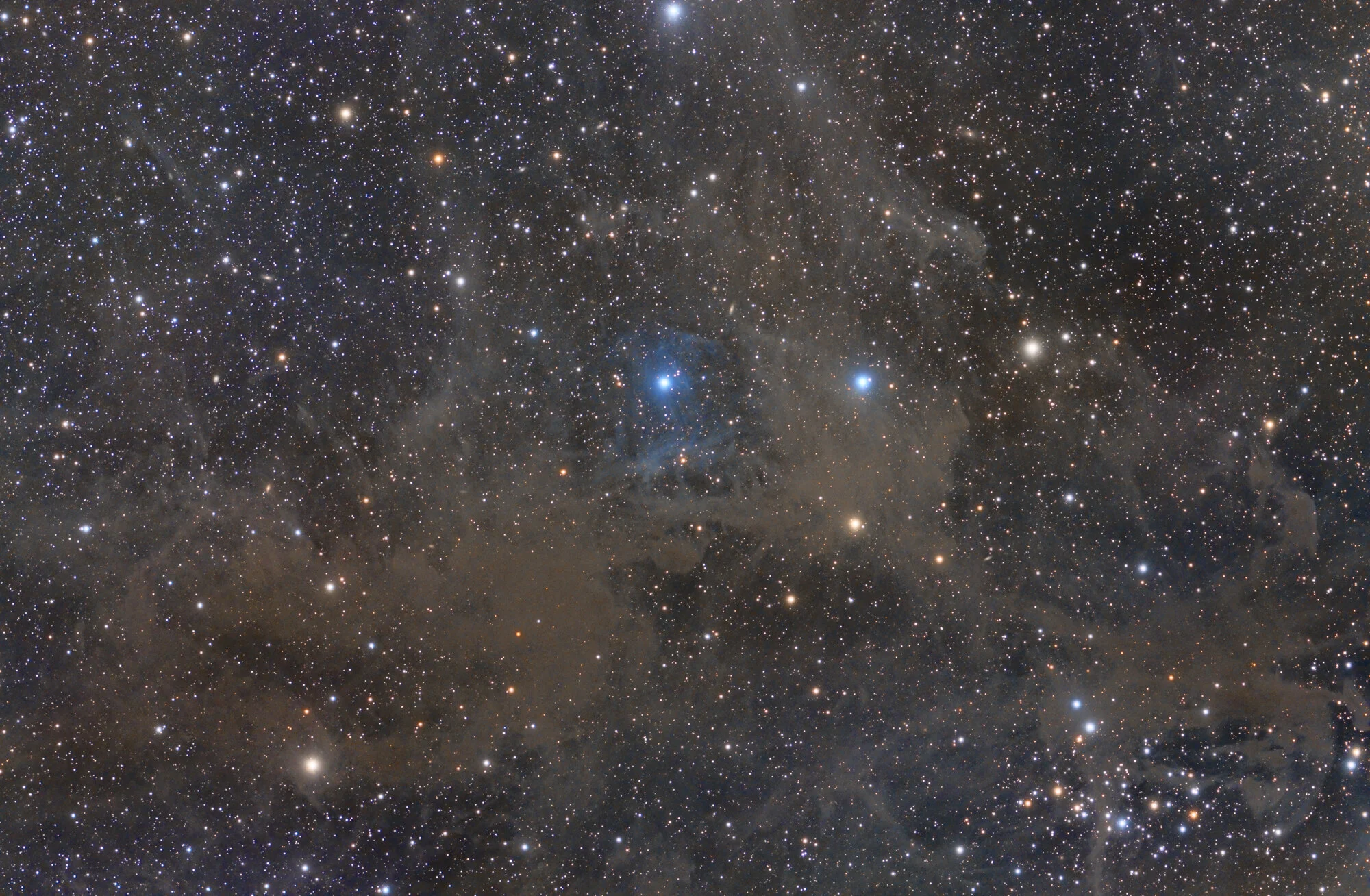
Situated on the edge of the Perseus molecular cloud, van den Bergh 18 is a small, faint reflection nebula (blue, center). It is surrounded by various LDN and LBN dark nebulae, as well as several PGC galaxies and the open star cluster NGC1342, (bottom right). This image consists of LUM + one shot color data simultaneously captured from two scopes: a CFF 135mm APO refractor with a ZWO ASI6200MM CMOS camera, and a CFF105mm APO refractor with a ZWO ASI2600MC CMOS camera. In total, there is 26 hours of data for this image, processed with PixInsight.
Copyright: Joel Short
Mars Near Opposition
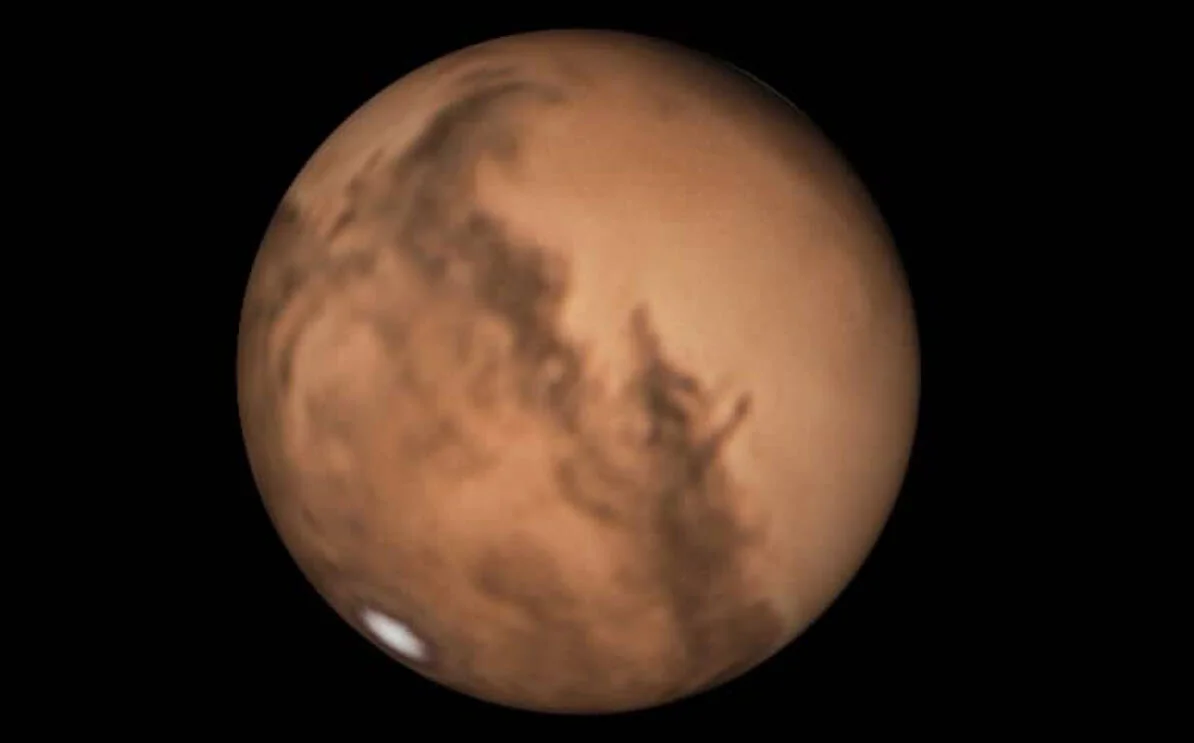
This map rotation is approximately 13 of Mars's 23.5 hrs rotation.
asi120mc 0SC
Meade 10" Newtonian EQ. Starfinder series
5x Powermate
Copyright: John Cox
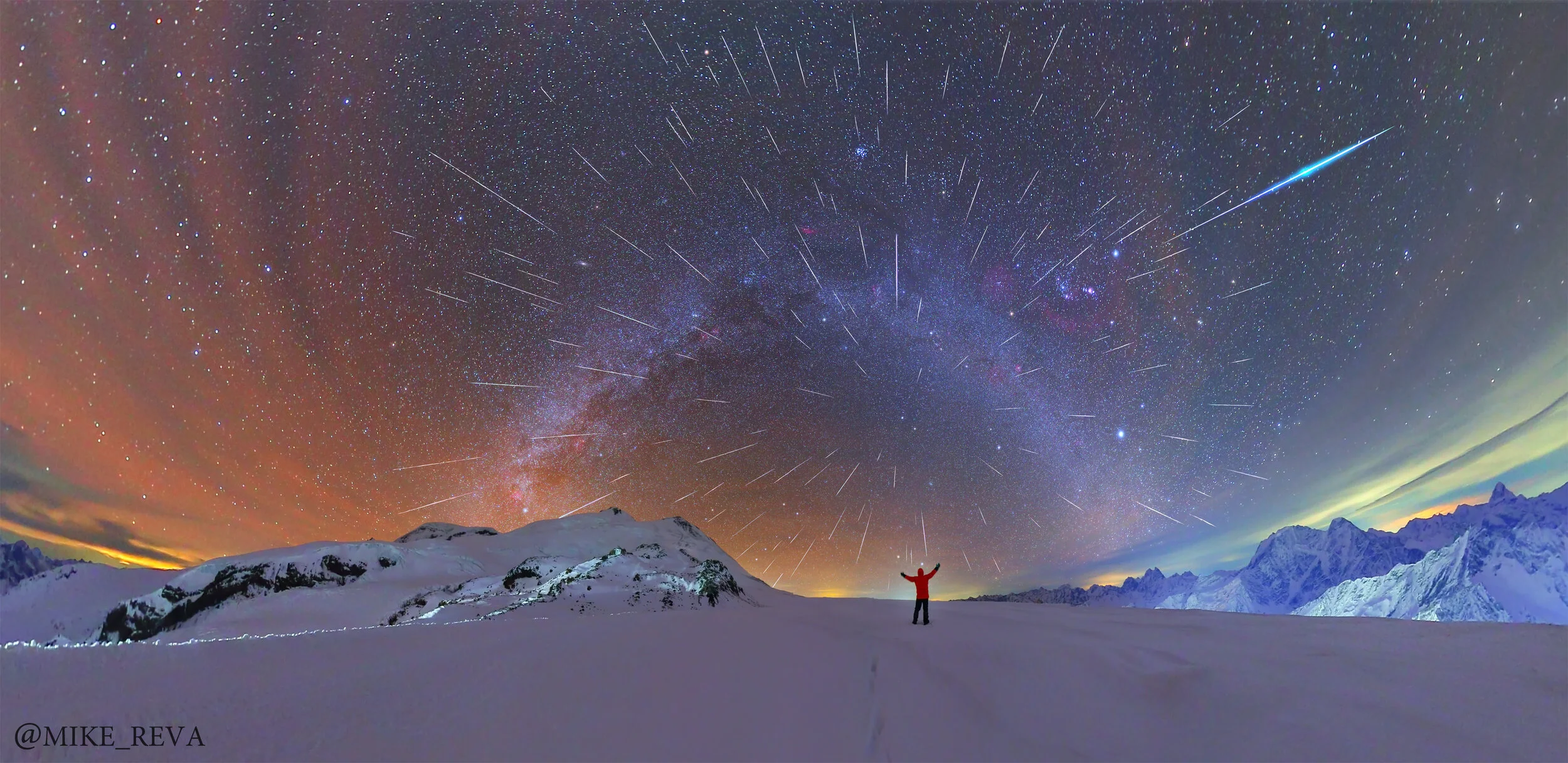
Make a wish
Image Description and Details :
Geminids 2020 meteor shower composite panorama. This years maximum night was really crazy for me. I spent 10 hours on the slope of Elbrus mountain at an altitude of 4000m with completely clear sky and fascinating transparency of the atmosphere. Luckily the weather was calm with modest wind and just -15C degrees.I was lucky to witness ~720 Geminid meteors, catching ~150 of them in frames as my cameras made continiously 1300+ shots. Was easily the most impessive meteor shower i've seen so far with, thanks to unique observing conditions. Canon 6Da + Tamron15-30 f2.8 iso5000 20s - 16shots pano for the sky is stereographic projectionContinious shooting on 2 cameras for meteors:Canon 6Da + Tamron15-30 f2.8 iso6400 30s - 720 shots.Canon 5D2 + Samyang 24 f2.0 iso5000 20s - 600 shots.
Copyright: Mike Reva
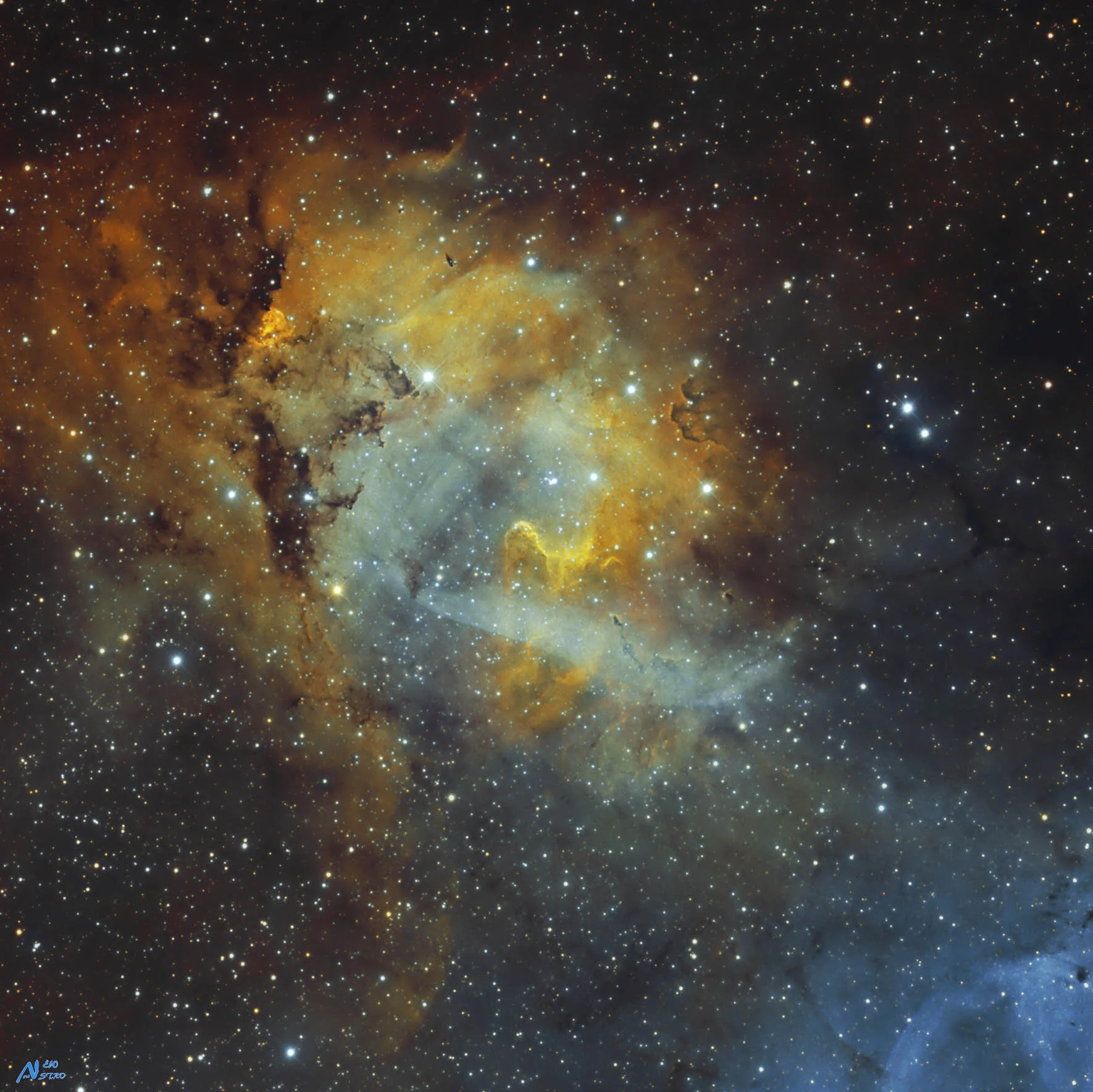
Sh2-132 HOO
Image Description and Details :
Sh2-132 in HOOrvb made by Team AstroNew in France in the region of Normandy (Perche) and in Lorraine (côtes de Meuse) . This Team is composed of Francis Bozon, Stéphane Gueyraud.Sh2-132 is a large emission nebula visible in the constellation of Cepheus. It is located on the southern edge of the constellation, on the border with the constellation Lacerta, along the plane of the Milky Way.These acquisitions were made with Newton telescopes (250-900 F/D 3,6), on Eq8 mount and Moravian G2 4000 camera.The exposure times are as follows:Ha= 53X20'O3=50X20' Red= 9x5'Green =23x5'Blue=15x5'That is a total time of about 38,25 hours.
Copyright: Francis Bozon, Stéphane Gueyraud
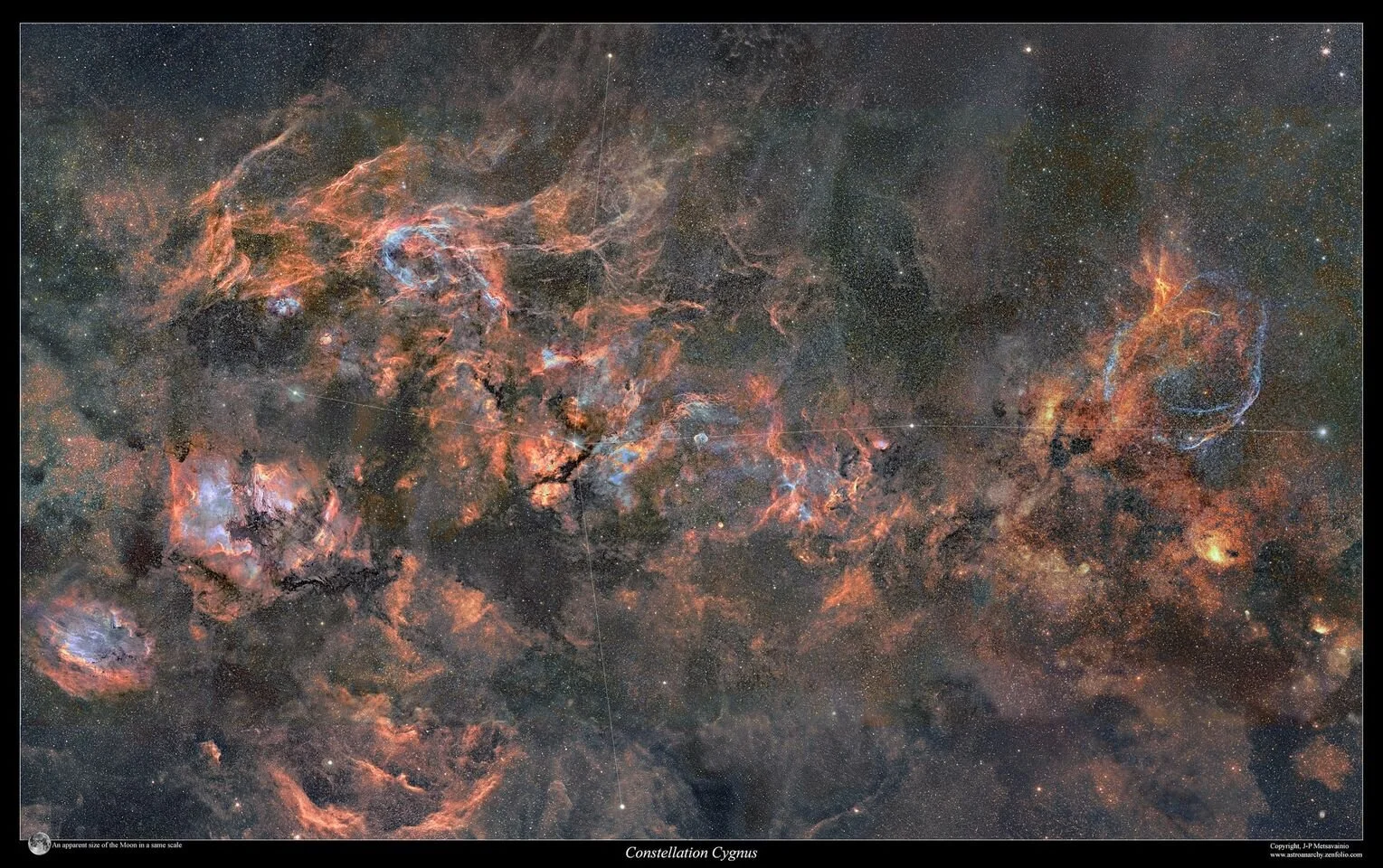
cygnus mosaic
I have started this imaging project back at 2010. My aim was to make a high resolution mosaic covering the constellation Cygnus. Work like that takes time and patience, especially since I have worked so, that many of the individual sub mosaics or frames have been published as an individual artworks. Here is a poster format presentation about all of longer focal length images used for this mosaic beside wide field panels.
As a result I have now a huge 37 panel (And 58 long focal length sub-panel) mosaic panorama covering 28 x 18 degrees of sky. I have collected photons way over 600 hours during past ten years for this photo. The full size mosaic image has a size of about 25.000 x 15.000 pixels.
In the orientation image above, there are three large supernova remnants visible, first the Cygnus Shell W63 , bluish ring at upper left quarter, secondly the large SNR G65.3+5.7 at utmost right and finally the third is a brighter SNR, the Veil nebula just outside of field of view at bottom center. (Image is partly overlapping with large mosaic but I didn't want to include it yet due to artistic composition.)Beside three supernova remnants there are two Wolf Rayet stars with outer shell formations. NGC 6888, the Crescent Nebula at center of the image and the WR 134, it can be seen as a blue arch just right from the Crescent Nebula, near the Tulip nebula.Next to the Tulip Nebula lays a Black hole Cygnus X-1, it's marked in small closeup image of the Tulip Neula at center right in orientation image above.
There are 37 base panels with shorter focal length tools (300mm f2.8 Tokina and 200mm f1.8 Canon) There is also 59 sub-panels used, they are shot with my old 12" Meade and 11" Celestron Edge scopes.
Copyright: J-p Metsavainio

NGC 1365
Barred spiral galaxy NGC 1365 is truly a majestic island universe some 200,000 light-years across. Located a mere 60 million light-years away toward the chemical constellation Fornax, NGC 1365 is a dominant member of the well-studied Fornax galaxy cluster. This impressively sharp color image shows intense star forming regions at the ends of the bar and along the spiral arms, and details of dust lanes cutting across the galaxy's bright core. At the core lies a supermassive black hole. Astronomers think NGC 1365's prominent bar plays a crucial role in the galaxy's evolution, drawing gas and dust into a star-forming maelstrom and ultimately feeding material into the central black hole.Location/Date – El Sauce, Chile, December 2020Imaging System – Planewave 17” CDK, 10 Micron GM3000, FLI ML16803 Chroma FiltersExposure – LRGB, 9 hoursProcessing – Pixinsight
Credit/Copyright – Casey Good / Good Astronomy

VdB 158
Image Description and Details :
Telescope: Takahashi FSQ106EDX (f/5)Mount: Takahashi EM-400 Temma2Camera: Atik 16200 (KAF-16200)Guider: Lunático EZG-60 + SXLodestarFilters: Astrodon Gen2 LRGB I-Series 50,8mm + IDAS LPSFocuser: RoboFocus Rev3.1Capture: MaxIm DL + AstroMaticProcessing: PixInsight Core + Photoshop CC 2019Esposure:L: 71x600s bin1RGB: 30x300s bin2Total: 19h 30mPlace: Las Inviernas and Montejo de Tiermes, Guadalajara, España
Copyright: Alvaro Ibañez Perez
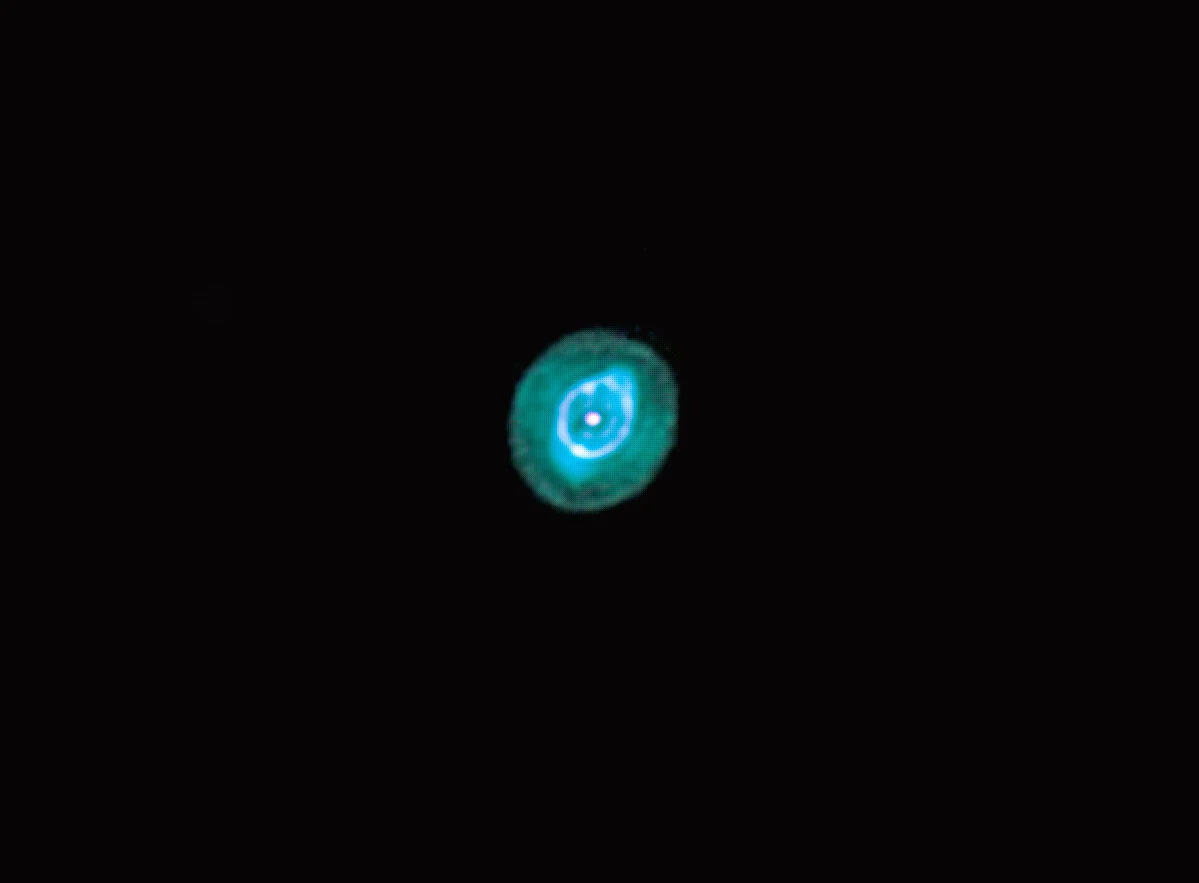
The Ghost Of Jupiter A.K.A The Eye Nebula (NGC3242)
Image Description and Details :
I did a Live stack with Gain 50 and Gain 120 each with ASI294MC-Pro, and drizzle-integrated.Place: Backyard East Pattaya Thaiand (Bortle Class 6, Moon Phase 82.9%)Date:23nd / Feb / 2021 1:24(UTC+7)TS TSRC10T Carbon Truss Prime Focus (250mm F/8 f/2000mm)CCD: ZWO ASI294MC ProFilter: Optolong L-ProMount :iOptron CEM70G
Copyright: Taro Seki Astropical.uk

Stellar Nursery in Perseus
Our Milky Way is actually full of dust, but hidden in the black starry background, it is not easy to see. Only by accumulating a long time of exposure, the dust that pervades the stars will show up, presenting rich details of intricate complexity.
This large patch of dust in the picture is part of the Perseus molecular cloud, located at the junction of Taurus, Aries, and Perseus, about 1,000 light years away from the Earth. The dust with a total mass equivalent to 10,000 suns is gathered in clusters or twisted into twists. The thick areas are dense and opaque, and darker than space itself.
In this darkest corner, new light is gestating.
The dust near the center, a little red light came out from it, that was a star cluster forming in it. Beside this dust, a newborn star dispelled the haze, illuminating the surroundings with bright light, and became the brightest deep sky object in this area.
In the new Chinese year of the ox, may the world sweep away the dust, dispel darkness, and reappear light.
Location: Hebei Kangbao Galaxy Observatory
Filming time: November 7, 2020-February 4, 2021
Telescope: Sharpstar 150 2.8 HNT
Camera: QHY268C
Mount: Aton iOptron CEM70/CEM60
Guide : QHYCCD OAG-M
Guide camera: QHY5L-II-M
Number of shots: 130×1000 seconds, 70×300 seconds
Cumulative exposure: 41.9 hours
Shooting software: APT
Processing software: PixInsight, PhotoShop
Copyright: Steed Yu

M83 The Southern Pinwheel galaxy
Another nice project made with Olivier Désormières from the SADR Team (acquisition Arnaud Peel and Olivier Désormières, processing Arnaud Peel): a complete new version with new RGB in bin 1x1 this time: I tried to keep as much as possible the faint details in the Hapha globules and enhanced the spiralSo thanks a lot to Olivier for the acquisition of a great Luminance and RGB with the Sadr association setup , Newton 14'' in Chile.I select the best FWHM subs for the luminance.60s subs were made not to burn the center of the galaxy.Red 20 subs@300s -20°C bin 1 gain highBlue 20 subs@300s -20°C bin 1 gain highGreen 20 subs@300s -20°C bin 1 gain highLight 30 subs@60s -20°C, gain highLight 39 subs@300s -20°C, gain highLight 81 subs@600s -20°C, gain highHalpha 45 subs@300s -20°C, gain highTotal exposure : 26h05
Copyright: Arnaud Peel