
AAPOD2 Image Archives
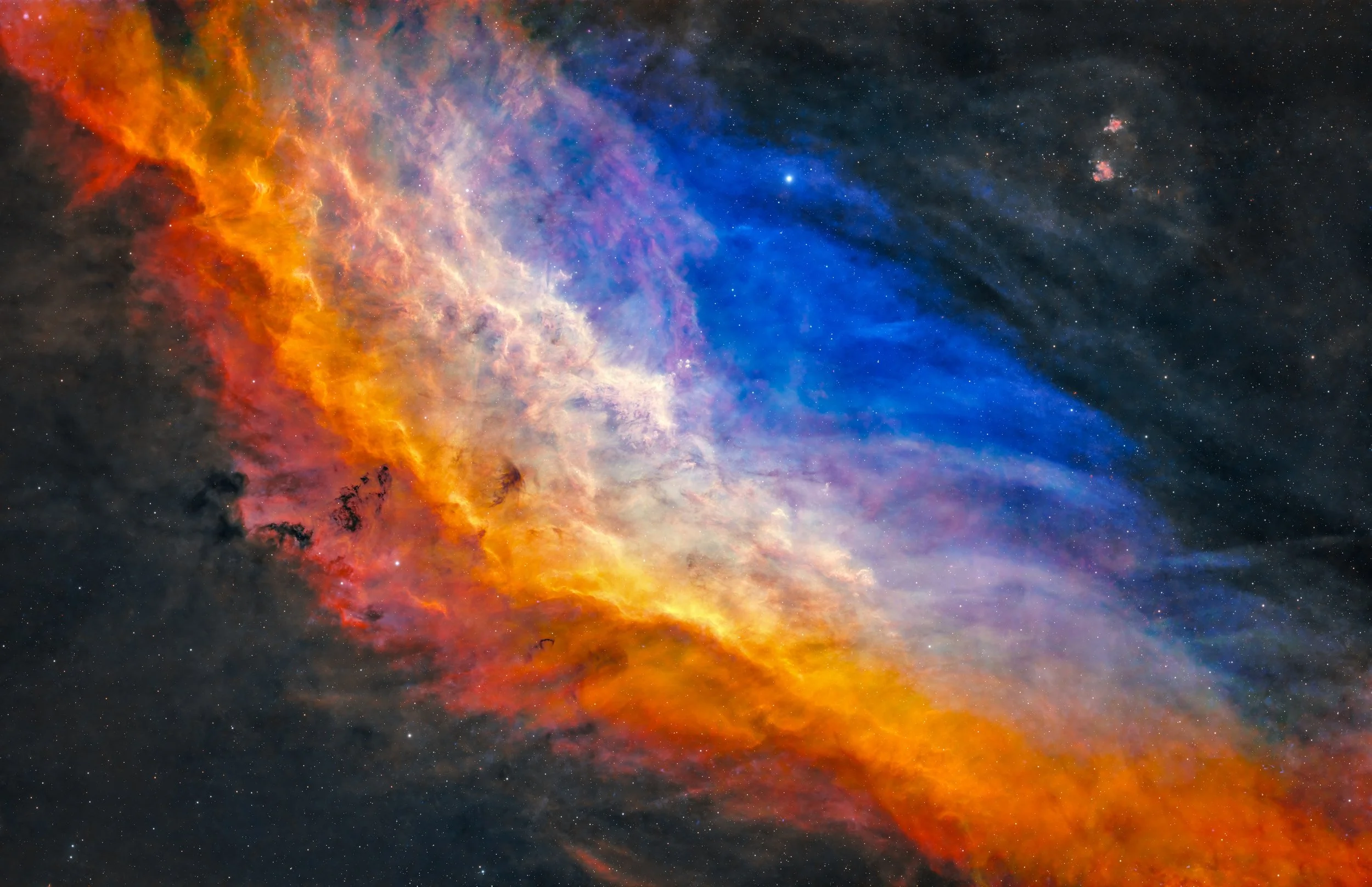
The California Nebula in SHO
The California Nebula, cataloged as NGC 1499, is a vast emission nebula in the constellation Perseus, stretching nearly 100 light-years across. In this SHO narrowband presentation, ionized hydrogen dominates the structure, while sulfur and oxygen reveal layered filaments, knots, and subtle shock fronts within the glowing gas. The nebula’s elongated shape and complex internal texture are sculpted by energetic radiation from the hot star Xi Persei, which excites and ionizes the surrounding interstellar medium.
Captured from a Bortle 7 sky, this image demonstrates the power of narrowband imaging in overcoming light pollution. By isolating specific emission lines, faint structures and contrast within the nebula emerge despite challenging urban conditions. The result highlights both the large-scale flow of ionized gas and the finer details embedded within it, offering a scientifically rich and visually striking view of one of the sky’s most recognizable emission nebulae.
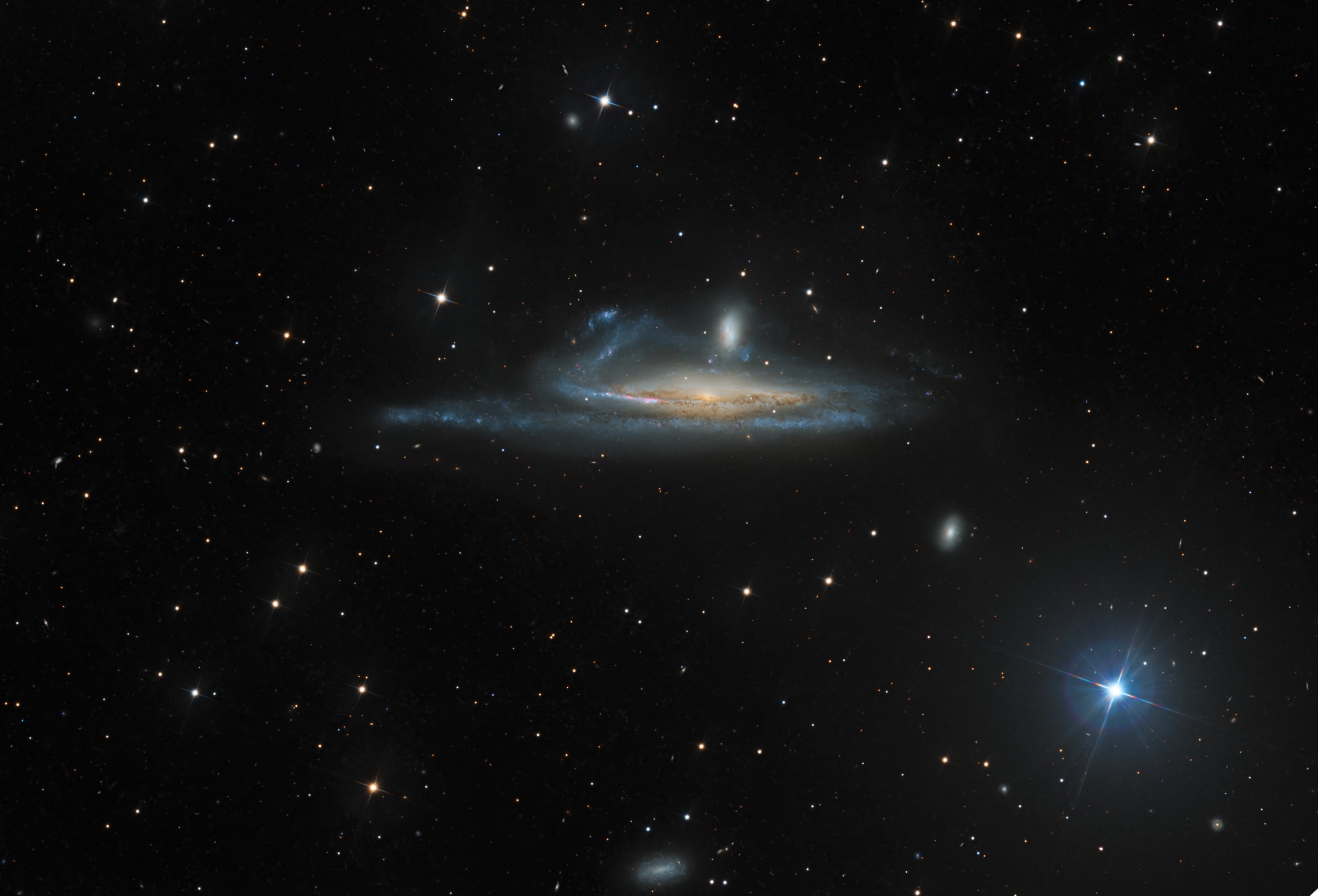
NGC 1532 and Companion Galaxy NGC 1531
NGC 1532 is a massive barred spiral galaxy located in the constellation Eridanus, seen here nearly edge-on. Its flattened disk stretches across the frame, marked by a bright central bulge, dark dust lanes, and faint bluish regions tracing spiral arms rich in young stars. The edge-on perspective emphasizes the galaxy’s impressive size, spanning well over 100,000 light-years, and reveals subtle vertical structure within the disk shaped by gravity and rotation.
Just above the main disk lies NGC 1531, a smaller companion galaxy whose distorted shape betrays a strong gravitational interaction. Tidal forces between the two systems are triggering star formation and warping NGC 1532’s spiral structure, effects that will continue to evolve over hundreds of millions of years. Scattered throughout the background are countless distant galaxies, adding depth and context to this dynamic scene within the Eridanus galaxy group.
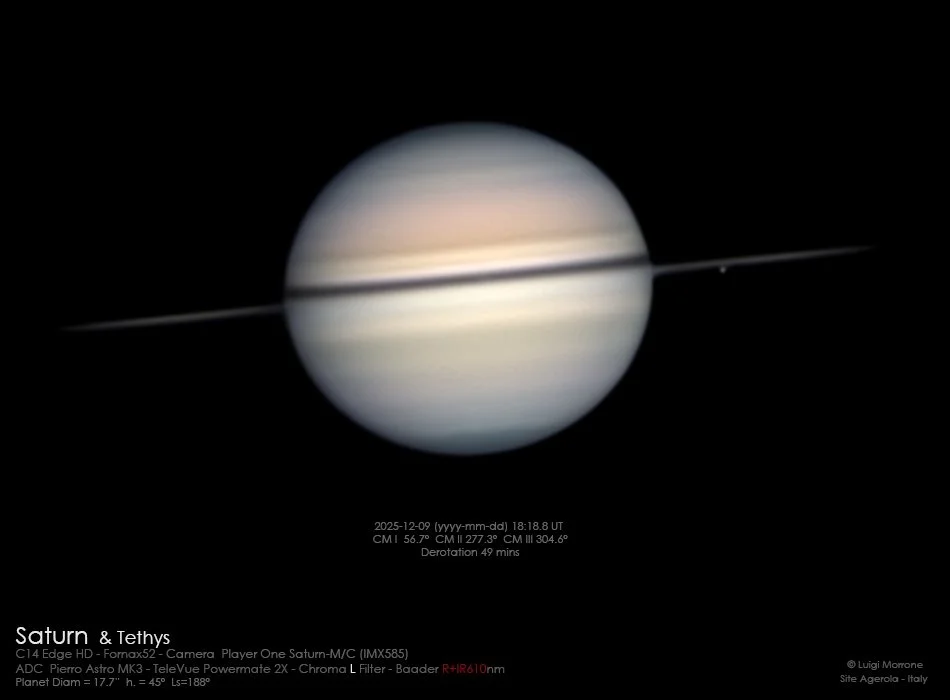
Saturn and Tethys Near Ring Plane
Saturn is captured here under very good seeing conditions, revealing subtle atmospheric banding across the planet’s pale golden disk. At the time of observation, Saturn’s ring system was approaching a ring-plane crossing, causing the normally broad rings to appear exceptionally thin. This geometry emphasizes the dark ring shadow cast across the planet’s equatorial regions, a striking visual marker of the Sun’s low angle relative to the ring plane.
To the right of the planet, the icy moon Tethys appears closely aligned with the narrow rings, creating a compelling sense of depth and scale. With a diameter of about 1,060 kilometers, Tethys orbits Saturn every 1.9 days and is composed largely of water ice. Its proximity to the rings in this view is a line-of-sight effect, but it highlights the intricate and dynamic architecture of the Saturnian system, where moons, rings, and shadows interact in constantly changing configurations.
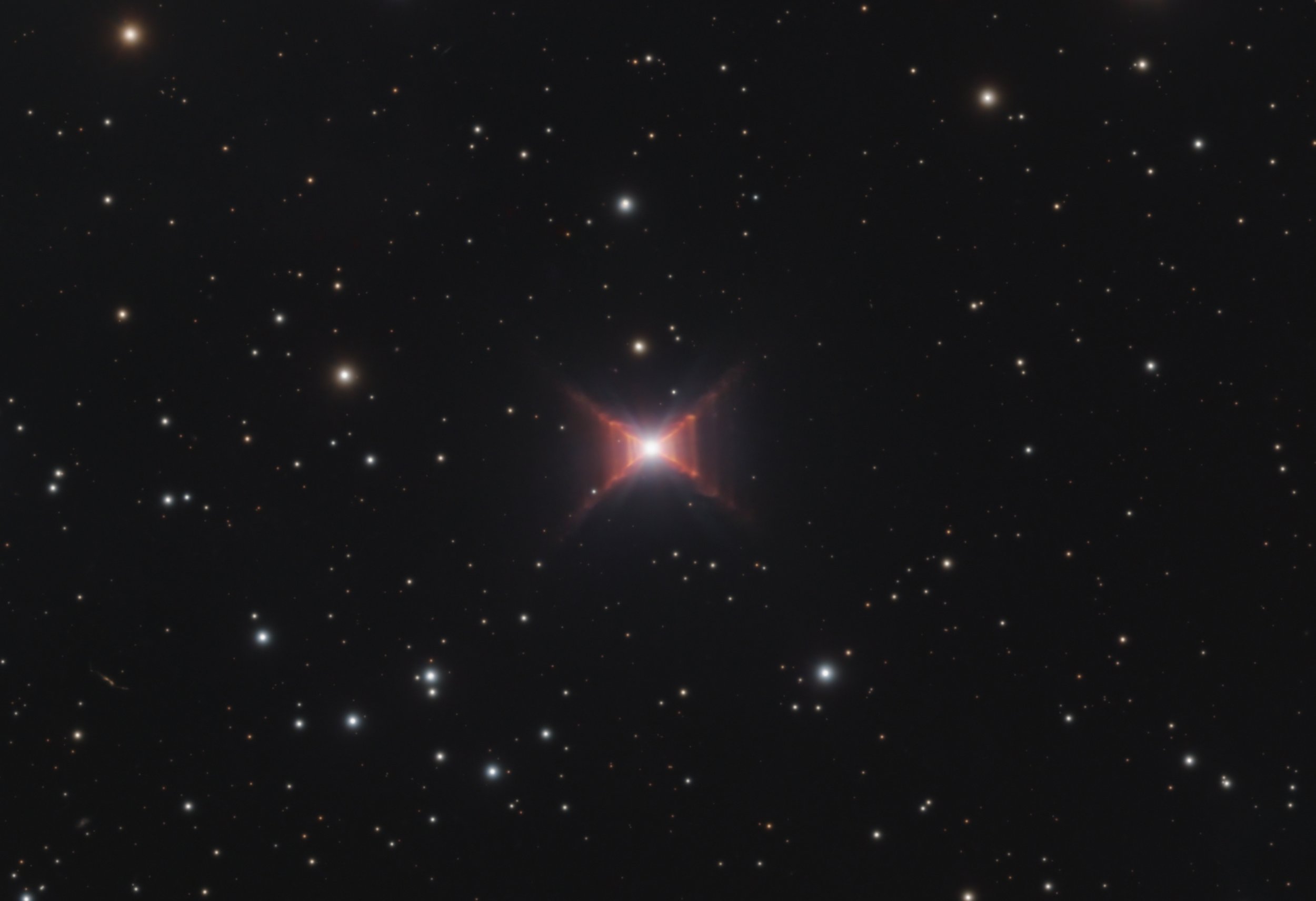
The Red Rectangle Protoplanetary Nebula
The Red Rectangle is a protoplanetary nebula located in the constellation Monoceros at a distance of roughly 2,300 light years. It represents a brief transitional phase in stellar evolution, when a Sun like star has left the asymptotic giant branch but has not yet formed a fully developed planetary nebula. At its center lies a close binary system embedded within a dense, edge on disk of dust and gas. Radiation and stellar winds from this system are funneled into two opposing outflows, producing the sharply defined, X shaped geometry that gives the object its distinctive name.
The striking red color arises from complex carbon rich molecules and dust grains that fluoresce under intense ultraviolet radiation from the central stars. Viewed from Earth, the bipolar cones are intersected by our line of sight and partially obscured by the dusty disk, creating the illusion of a rigid geometric structure suspended in space.