

AAPOD2 Image Archives
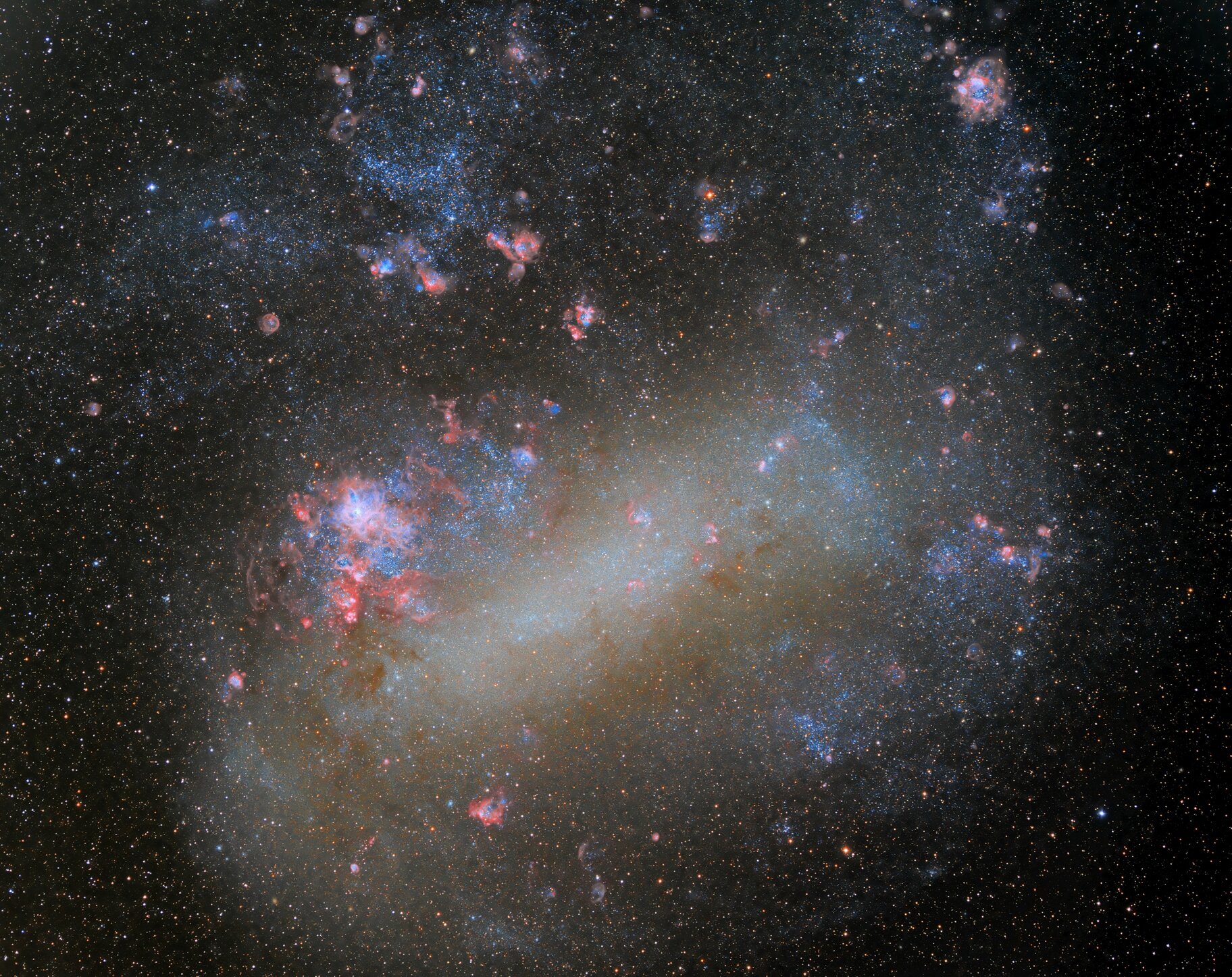
The Large Magellanic Cloud (LMC)
The Large Magellanic Cloud (LMC) is a satellite galaxy of the Milky Way. At a distance of about 50 kiloparsecs. The LMC is classified as a Magellanic spiral. It contains a stellar bar that is geometrically off-center, suggesting that it was a barred dwarf spiral galaxy.
The picture was taken in the remote observatory of ChileScope with telelens nikon 200 f2 and a camera fli 16200.
The set was HaLRGB and was 40min of Ha and 15 min in LRGB.
Copyright: Javier Flores
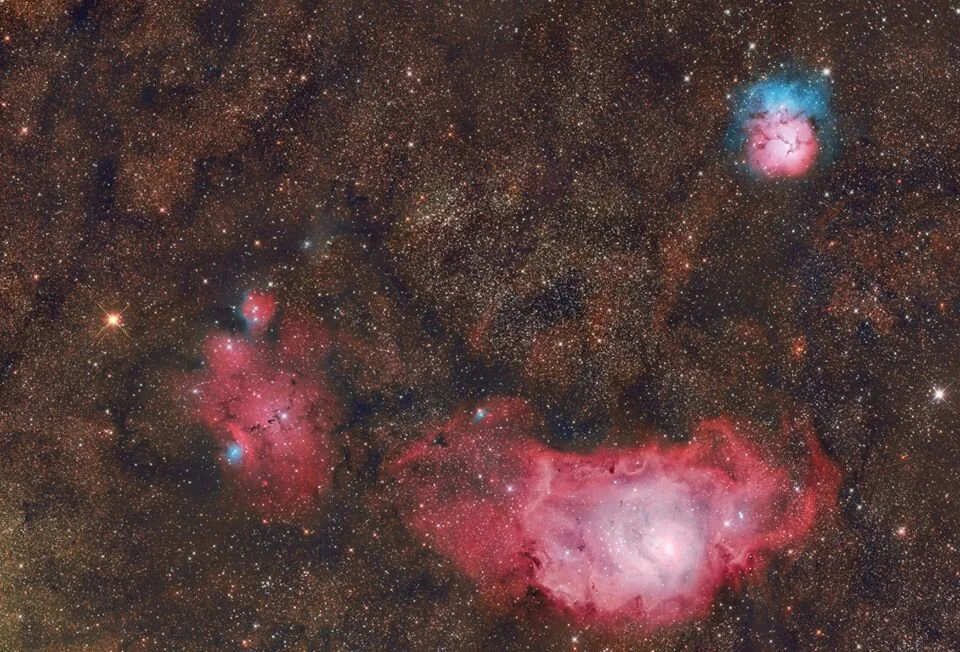
Mosaic in Sagittarius
305mm Reflector + AZ / EQ-6.
Canon 6D mod.
Cooling box.
Coma corrector.
Cls-ccd filter
48 x 300 ISO 1600
Copyright: Adriano de Oliveira
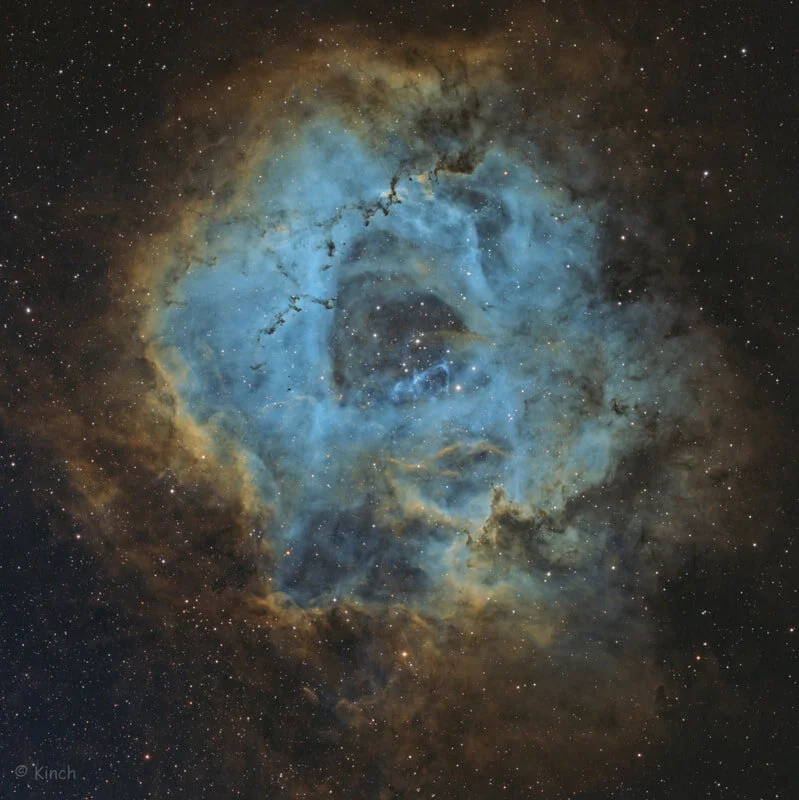
Rosette Nebula
Imaging telescopes or lenses: Takahashi FSQ130ED
Imaging cameras: FLI ML16200 ADT
Mounts: Takahashi EM 400 Temma 2M
Guiding telescopes or lenses: Takahashi FS60CB
Guiding cameras: QHY CCD QHY 5 II
Focal Extender / Reducer: None
Software: Sequence Generator Pro SGP (for capture) PHD 2 (guiding), Astro Pixel Processor & PixInsight,
Filters: Astrodon Ha, OIII, SII.
Accessories: Robofocus Focuser, ATIK EFW3
Original Resolution: 3570 x 4225
Dates: 1st Jan to 4th Jan 2020
Frames:
Astrodon Ha 30 x 10'
Astrodon OIII 30 x 10'
Astrodon SII 36 x 10'
Total integration = 16 hours.
Copyright: Brendan Kinch


Clavius and Moretus
Imaging telescope or lens: Celestron C14 EDGE HD
Mount:CGE Pro
Software: Fire Capture, AS!2, Photofiltre - Irfan
Filtro: Baader Planetariun IR Pass 685
Copyright: Avani Soares

NGC 1365
NGC 1365 taken at Martin Pugh Astrophotography in Australia.
NGC 1365 is barred spiral galaxy in the Fornax cluster. Within the larger long bar stretching across the center of the galaxy appears to be a smaller bar that comprises the core, with an apparent size of about 50″ × 40″.
This second bar is more prominent in infrared images of the central region of the galaxy, and likely arises from a combination of dynamical instabilities of stellar orbits in the region, along with gravity, density waves, and the overall rotation of the disc. The inner bar structure likely rotates as a whole more rapidly than the larger long bar, creating the diagonal shape seen in images. The spiral arms extend in a wide curve north and south from the ends of the east-west bar and form an almost ring like Z-shaped halo.
Astronomers think NGC 1365's prominent bar plays a crucial role in the galaxy's evolution, drawing gas and dust into a star-forming maelstrom and ultimately feeding material into the central black hole.
NGC 1365, including its two outer spiral arms, spreads over around 200,000 light-years. Different parts of the galaxy take different times to make a full rotation around the core of the galaxy, with the outer parts of the bar completing one circuit in about 350 million years. NGC 1365 and other galaxies of its type have come to more prominence in recent years with new observations indicating that the Milky Way could also be a barred spiral galaxy. Such galaxies are quite common — two thirds of spiral galaxies are barred according to recent estimates, and studying others can help astronomers understand our own galactic home.
Copyright: Albert Barr
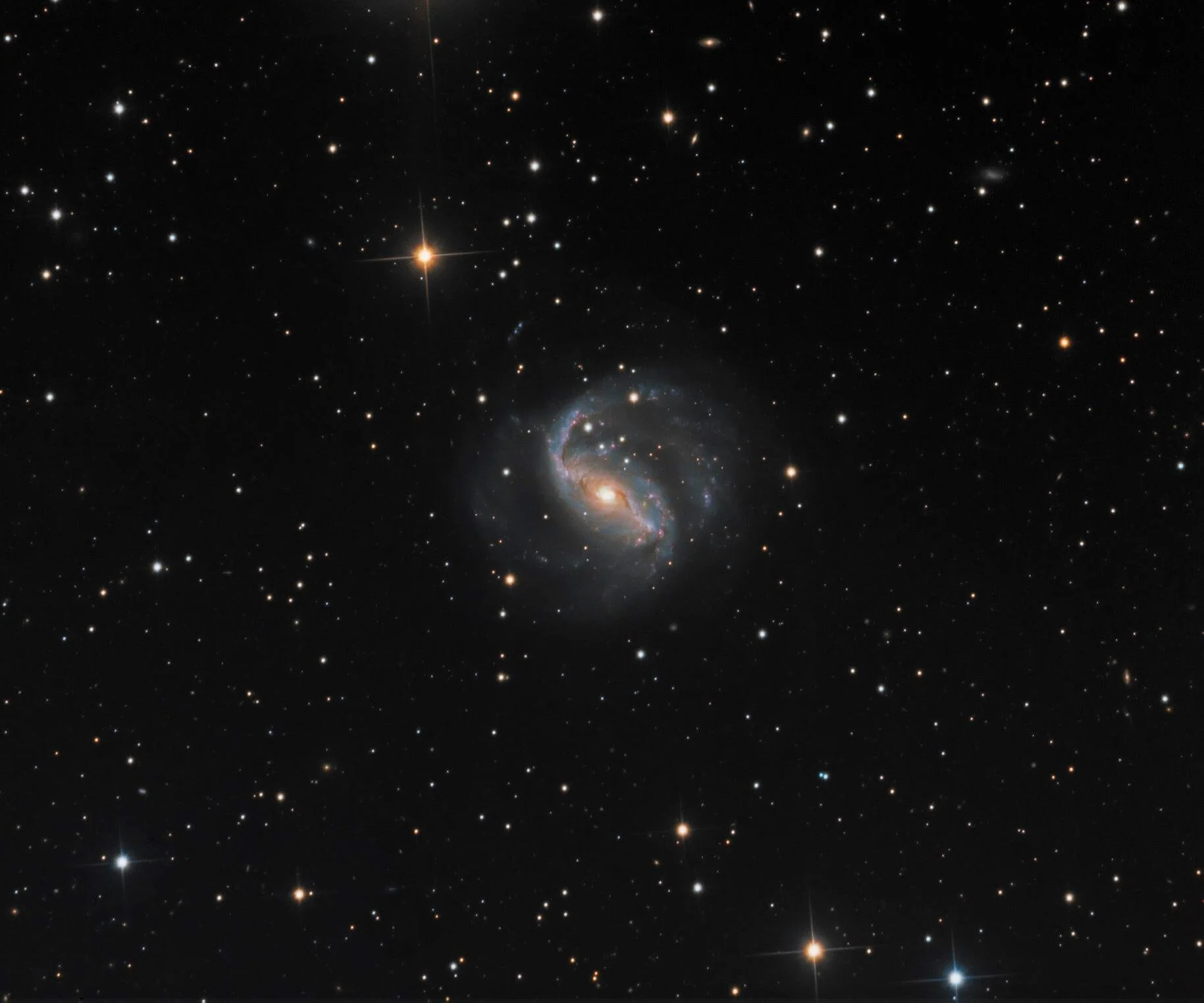
NGC 1672 in Dorado
NGC 1672 is a barred spiral galaxy located in the constellation Dorado. It was originally thought to be a member of the Dorado Group, however, this membership was later rejected.
NGC 1672 has a large bar which is estimated to measure around 20 kpc. It has very strong radio emissions emanating from its nucleus, bar, and the inner portion of the spiral arm region. The nucleus is Seyfert type 2 and is engulfed by a starburst region. The strongest polarized emissions come from the northeastern region which is upstream from its dust lanes. Magnetic field lines are at large angles with respect to the bar and turn smoothly to the center.
It was taken with a 36.8 cm F9 Ritchey Chretien telescope using a SBIG STXL16200 CCD camera. The exposure is a LHaRGB image with about 9 hours total imaging time.
Copyright: Steve Crouch
AAPOD2 Title: NGC 1672 in Dorado
AAPOD2 Page Link: https://www.aapod2.com/blog/ngc-1672-in-dorado
Sumbit Your Photo!

Star trails of the Great Pyramid
(Egyptian Pharaoh Khufu BC.2589 ~ BC. 2566)
Location: Al Giza Desert, Egypt
Camera: Nikon D750, ISO200, F5.6
Lens: Nikon 24-70mm (38mm)
Exposures: 20 sec x 430
Tripod: Horusbennu
Copyright: Young-Dae Kim
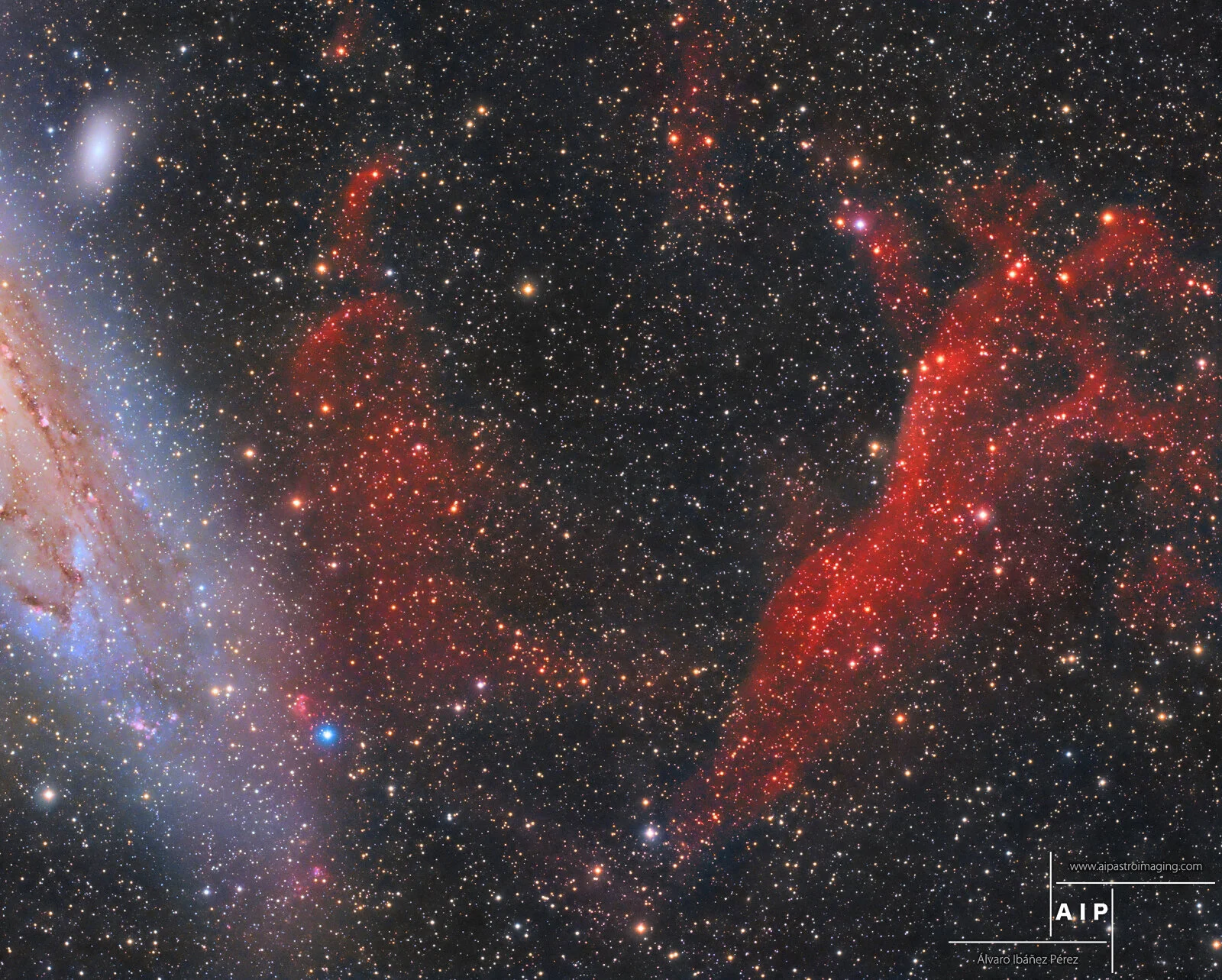
Andromeda Clouds in HaRGB
Here is an image of Andromeda Clouds in HaRGB, with 23 hours of total exposure.
Captured during 6 nights of New Moon from Pioz, Guadalajara, Spain.
It is the biggest project I have done since I started doing astrophotography and it is an honor for me to be one of the few astrophotographers who have photographed these strange clouds in color.
You can see more information and photos in my section of the website:
https://aipastroimaging.com/m31-ha-clouds-hargb/
In full resolution:
This photo was taken with this setup:
Telescope: Takahashi FSQ106EDX (f/5)
Mount: Takahashi EM-400 Temma2
Camera: Atik 16200 (Kodak KAF16200)
Guider: Lunático EZG-60 + SXLodestar
Filters: Baader Ha 7nm, Baader LRGB
Focuser: RoboFocus Rev3.1
Date: November and December 2018
Place: Pioz, Guadalajara, España
Software: MaxIm DL + AstroMatic
Processing: PixInsight Core + Photoshop CC
Exposure: Ha: 80x900s bin2, RGB: 12x300s bin2.
Total: 23h
Copryright: Álvaro Ibáñez Pérez
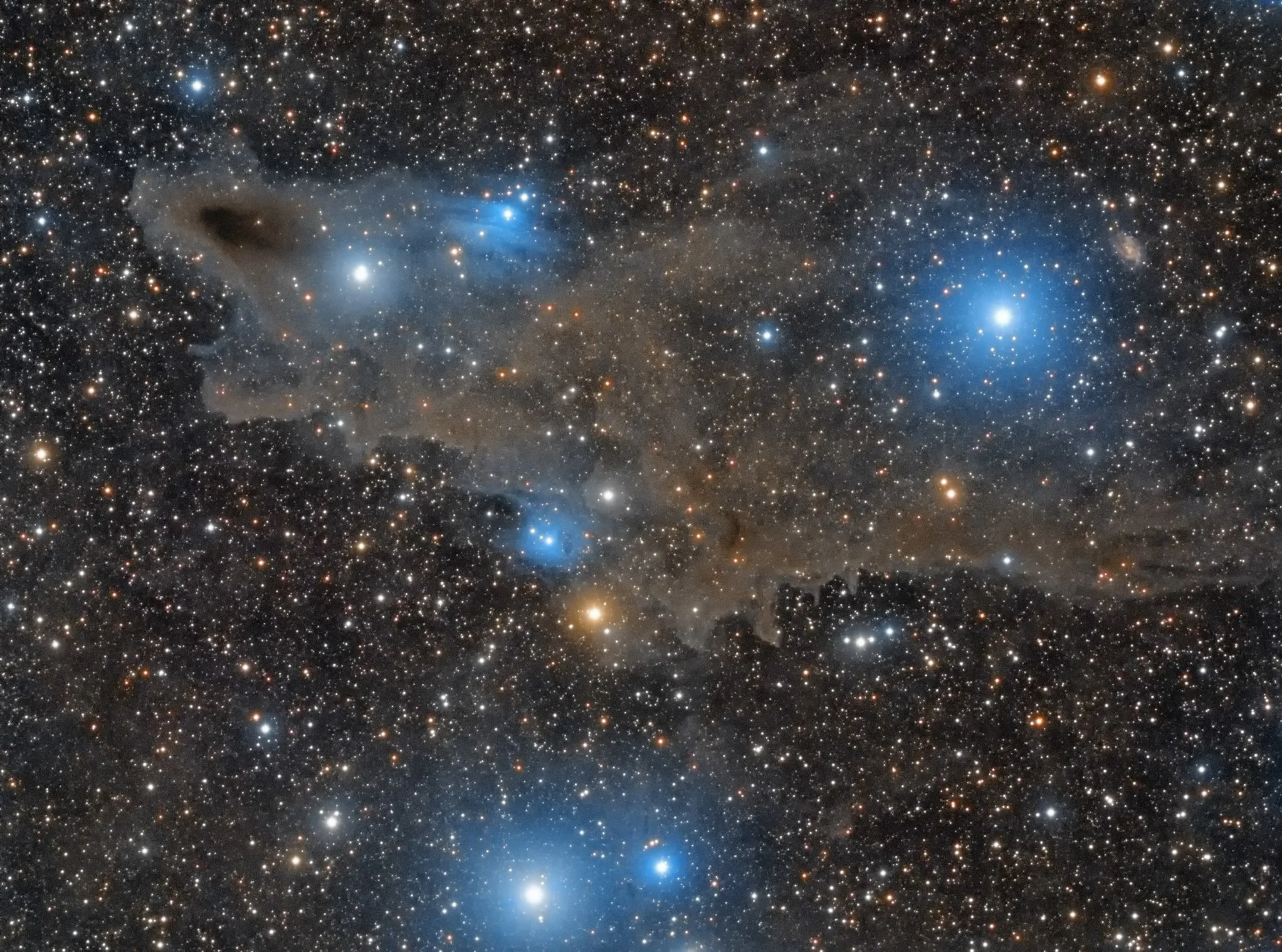
The Shark Nebula (LDN1235)
This image shows the Shark Nebula (LDN1235) in the constellation of Cepheus.
This is a nice cloud of gas and dust which is highlighted by the light of nearby stars.
Telescope: TMB92 @ f/5.5
Camera: QSI583ws
Mount: Skywatcher EQ6
Exposures:
L: 53 x 600s
R: 9 x 600s
G: 9 x 600s
B: 9 x 600s
Total: 13,3 hours
Copyright: André Van Der Hoeven

Solar Eruption
LUNT LS100THa PT (Single Stack) / B1800 / Barlow 3X / DMK31AU03
LucamRecorder-AutoStakkert!2-ImPPG-PS5
Copyright: Peter Desypris
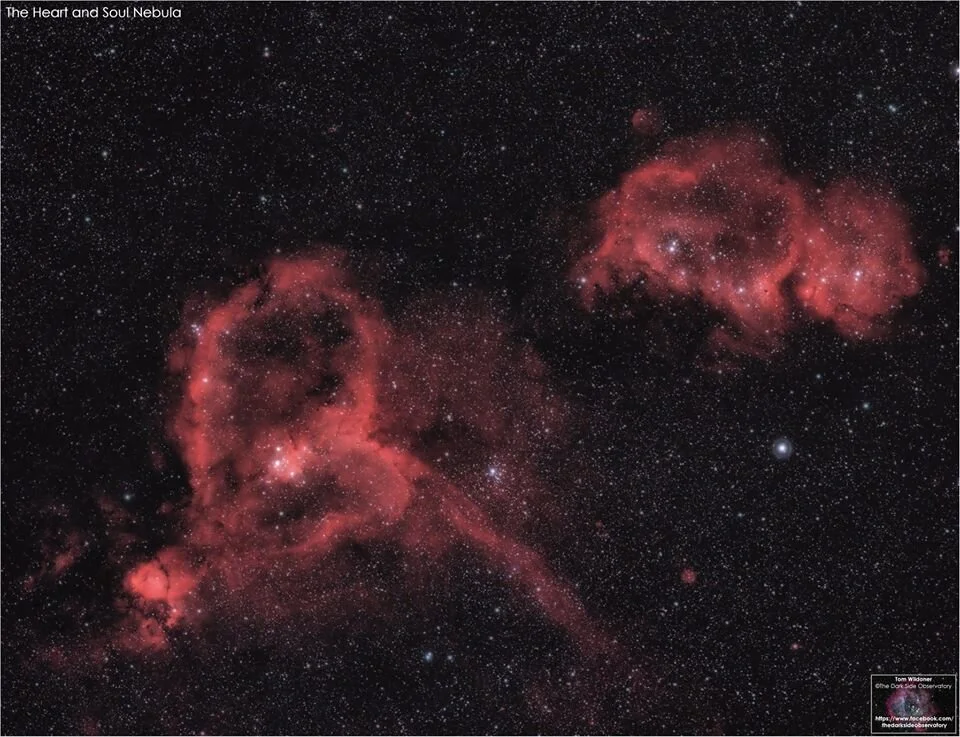
Heart and Soul Nebula
Tech Specs: Williams Optics Redcat 51 APO, Celestron CGEM-DX mount (pier mounted), ZWO ASI071MC-Pro, Optolong L-eNhance 2” filter, each panel was 60 x 60 second exposures at a GAIN of 200, one hour total exposure with dark/bias frames, guided using a ZWO ASI290MC and Orion 60mm guide scope. Captured using Sequence Generator Pro (SGP) v3.03. Image date: November 25, 2019. Location: The Dark Side Observatory, Weatherly, PA, USA.
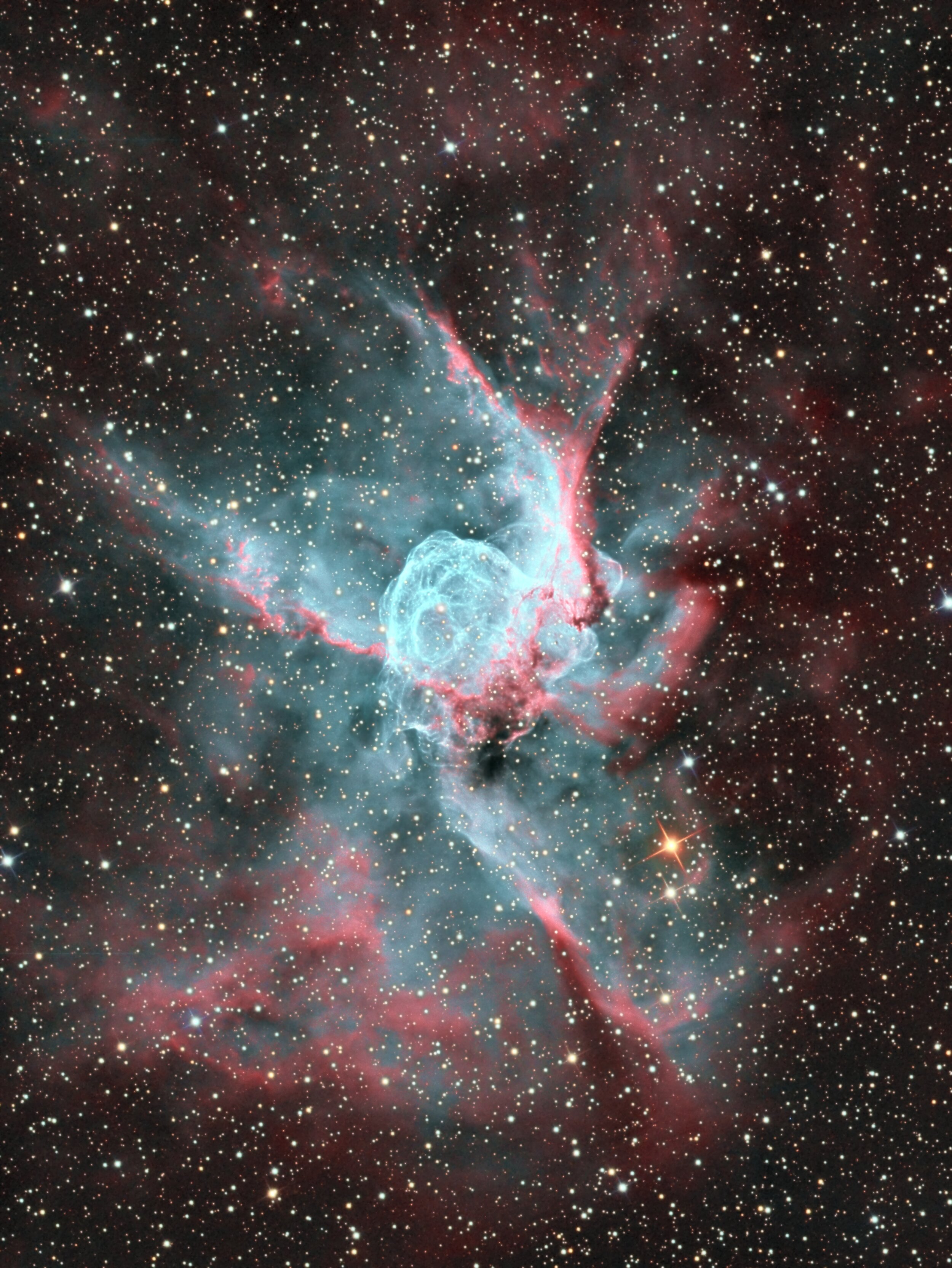
Thor’s Helmet
Thor’s Helmet (NGC 2539, Sh2-298, Gum 4) is an emission nebula in Canis Major. The powerful Wolf-Rayet star WR7 near the centre of the nebula is causing the gases to glow. That star is thought to be in a brief pre-supernova stage, and could explode in the cosmically-not-too-distant future. This object is thought to be similar to the Bubble Nebula, but the energy from WR7 has blown the gas in Thor’s Helmet into more complex shapes. Thor’s Helmet also contains much more oxygen structures than the Bubble Nebula. Oxygen gives the teal-coloured structure; hydrogen provides the reds. This nebula contains hundreds of solar masses of ionized gases (the gases that are glowing), along with hundreds of thousands of solar masses of unionized material. The age of the nebula is uncertain, with estimates ranging from 78,500 to 236,000.
This data used to create this image was acquired from Yass, New South Wales, Australia by my friend, expert astrophotographer Martin Pugh. Thank you Martin!
Tekkies:
SBIG STXL-11002 camera, Astrodon Ha, O3, R, G and B filters, Planewave 17″ CDK, Paramount ME. Equipment control with the SkyX, scripted with CCDAutopilot. All pre-processing and processing in PixInsight, except that master calibration frames were made using CCDStack. Data Acquired by Martin Pugh, from Yass, NSW, Australia.
3x10m R and B, 4x10m B, 18x20m Ha and 13x30m O3 unbinned frames (total=14hr10m).
Image scale is 0.63 arcsec per pixel for this camera / telescope combination.
Copyright: Ron Brecher
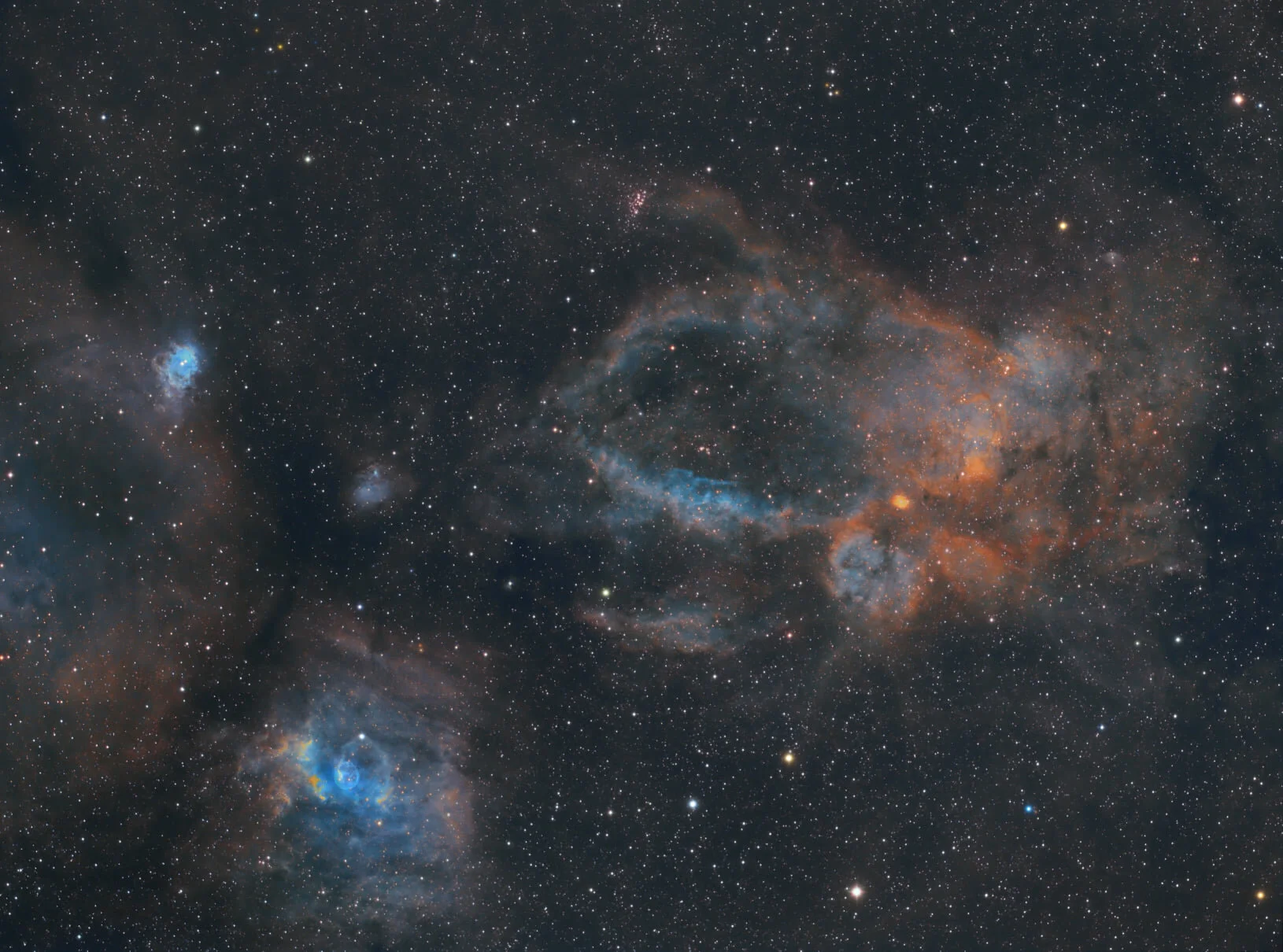
Lobster Claw (Sh2-157), Bubble Nebula, and More
Lobster Claw (Sh2-157), Bubble Nebula, and More
Scope: Takahashi FSQ-106EDX IV
Camera: QSI 683wsg-8
Mount: Software Bisque Paramount MX+
Ha: 35x900" -20C bin 1x1
Astrodon OIII: 22x900" -20C bin 1x1
Astrodon SII: 20x900" -20C bin 1x1
Integration: 19.2 hours
Copyright: Craig Patterson
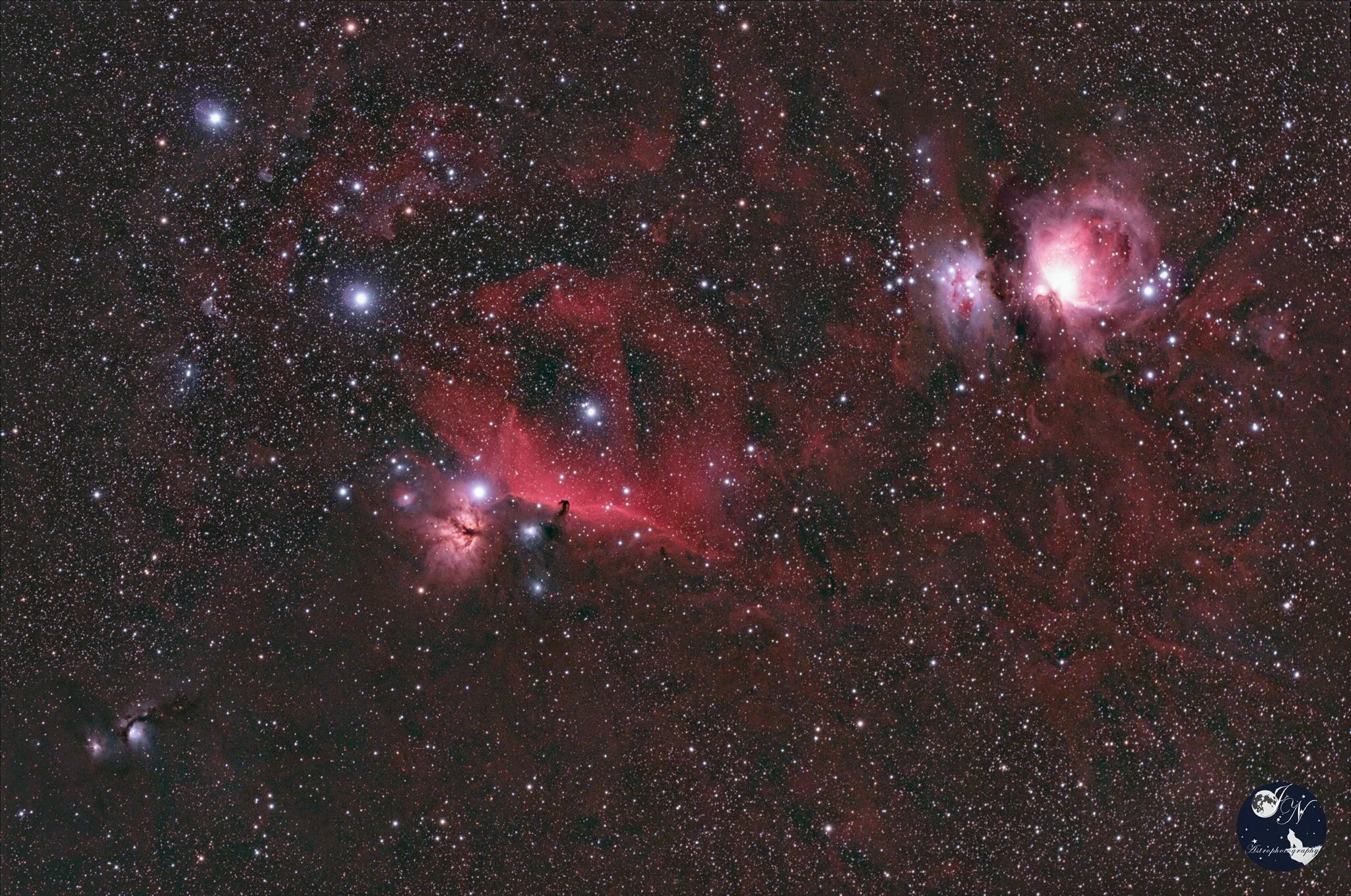
The Great Orion-Nebula, the Horsehead- & Flame Nebula and M78
In this capture you can find the emission nebula (M42), a combination of emission and reflection nebula (IC434) and the reflection nebula (M78). Other objects can be found in addition to the three main actors in the photograph. Down under the capture details I named all objects in the field I am familiar with.
This picture shows emission nebula (M42), a combination of emission and reflection nebula (ic434) and a pure reflection nebula (M 78).
List of objects:
M42, NGC1975 (Running Man), NGC1981, NGC1999, IC430, Orion AD N Complex, IC434, NGC2024, NGC2023, IC432, NGC1990, CR70, M78, NGC2071
Stars:
Alnitak, Alnilam and Mintaka
Tech.Details:
Scope: William Optics Spacecat 51
Cam: Nikon D810 Astrocool
Filter: Hutechidas Lps D1
Exif.: 55 x300" ISO 1600
Image Copyright: JN-Astrophotography
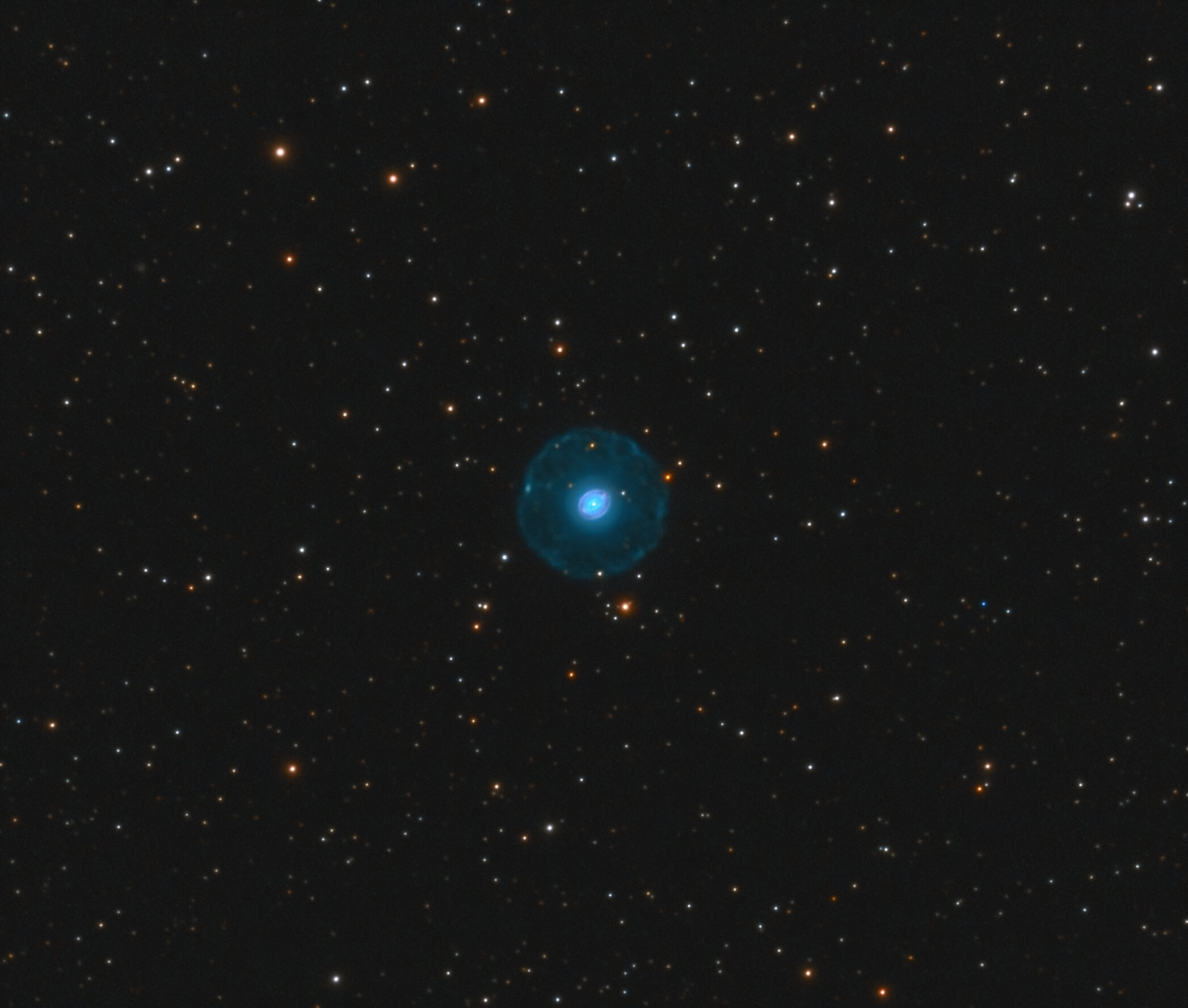
The Blinking Nebula, NGC 6826 (Caldwell 15, PK 83+12.1)
The Blinking Nebula, NGC 6826 (Caldwell 15, PK 83+12.1) is a planetary nebula located in the constellation Cygnus.
The nebula is located at a distance of about 2000 light years, the central part has a visible size of 27″x 24″ and a visual magnitude of 8.8m.
Date taken in August 2019.
R-channel - 158 x 5 sec. bin 1x1;
G-channel - 158 x 5 sec. bin 1x1;
B-channel - 158 x 5 sec. bin 1x1;
Ha- 38 x 600 sec. bin 1x1;
OIII- 36 x 600 sec. bin 1x1.
Total integration time about 13 hours.
Setup: Telescope 8" Celestron Schmidt-Cassegrain (SCT) CPC800 GPS (XLT) on the equatorial wedge, focal reducer Starizona 0.75x, Feq.= 1626mm, camera Starlight Xpress Trius SX694, SX mini filter wheel, filters Astrodon LRGB E-series gen.2, Astrodon Ha 5nm, Astrodon OIII 3nm.
Capture and processing software: MaxIm DL6, PHD2, PixInsight, StarTools, Photoshop CC, Zoner photo studio 14.
North at the top.
Copyright : Boris Vladimirovich
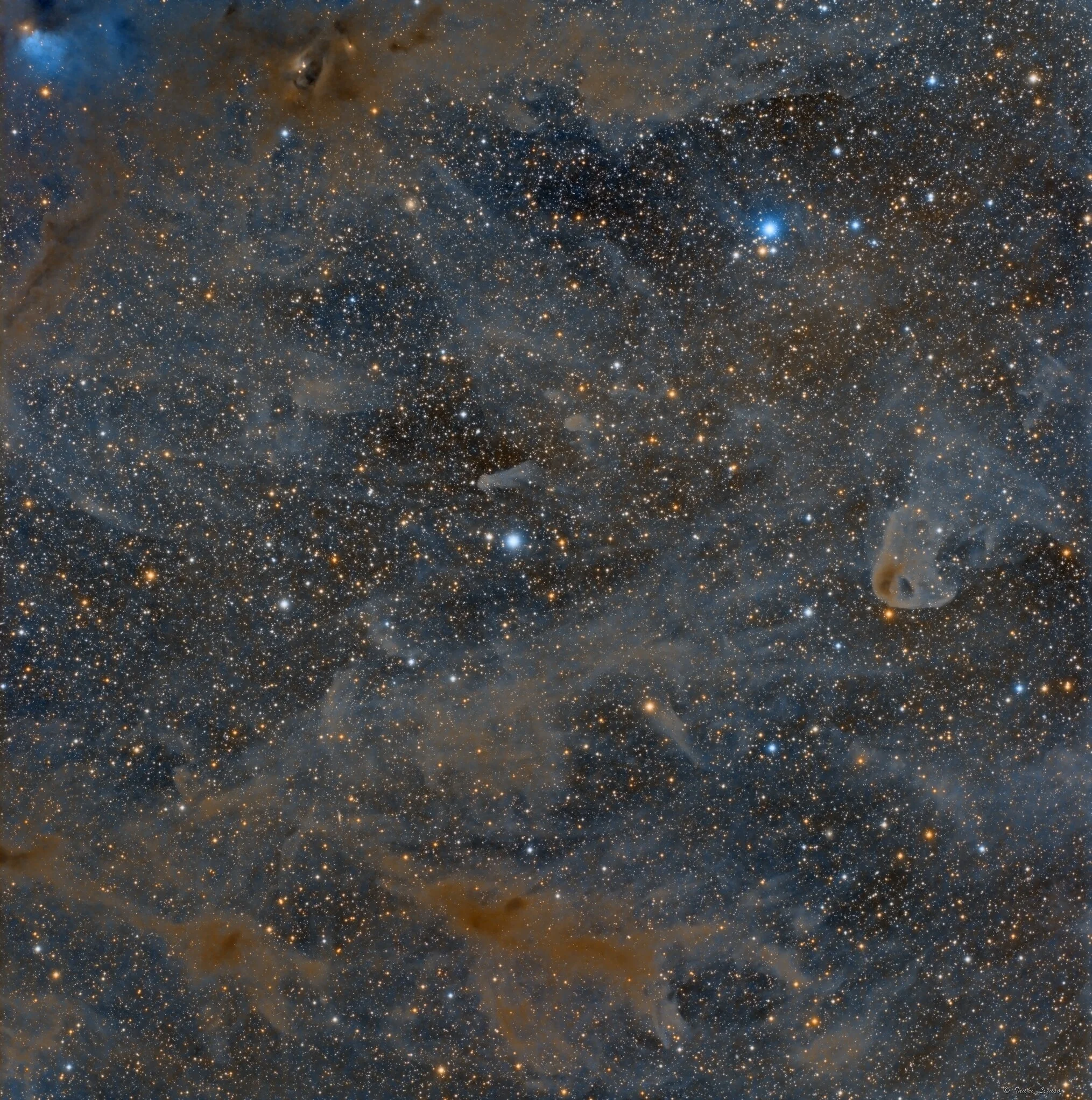
Taurus Molecular Cloud
This image is a small part of the Taurus Molecular Cloud centered near the variable star 44 Tauri.
Below star 44 Tau extends through center of field the large faint nebula called IC 360. Lower center and left are bright dusty nebulas Barnard 208 and B 210. Center right is located LBN 777 also known as the Baby Eagle nebula. In the upper left are B 209, B 211 and B 10.
Object: IC 360, LBN 777, B 208, B 209, B 210, B 211.
Exposure: 22 x 300s (L) + 12 x 300s (R) + 12 x 300s (G) + 12 x 300s (B).
Processing: PixInsight Core 1.8.
Telescope: Takahashi FSQ-106EDX3 on EM-200Temma2M. Seletek Armadillo / Focusmax.
Camera: Andor Apogee U16M / AFW-50-7S ( - 20ºC ). Astrodon E-Series genII filters.
Guiding: FS-60CSV, QHY-5, PHDguiding.
Date: 2ndof December 2019
Copyright: Iñaki Lizaso