

AAPOD2 Image Archives
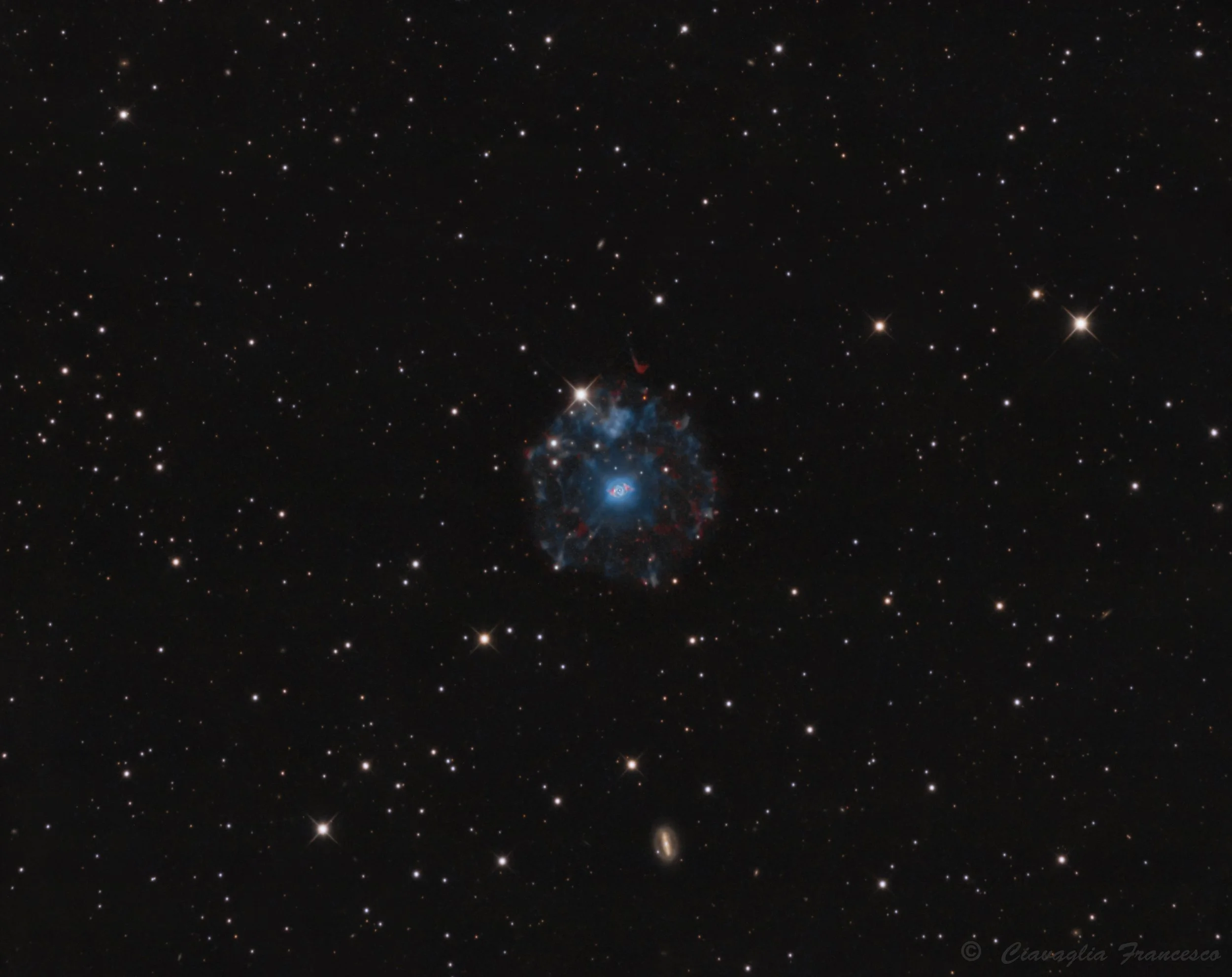
NGC 6543 Cat's Eye Nebula
The Cat's Eye Nebula AKA NGC 6543, a planetary nebula in the northern constellation of Draco, discovered by William Herschel.

Mars , the Flaming Star and Tadpole Nebula
Mars, the red planet is by joined by IC 405 and IC 410 two large emission nebulae. The 3 targets lined up in the constellation Auriga for this this widefield image.
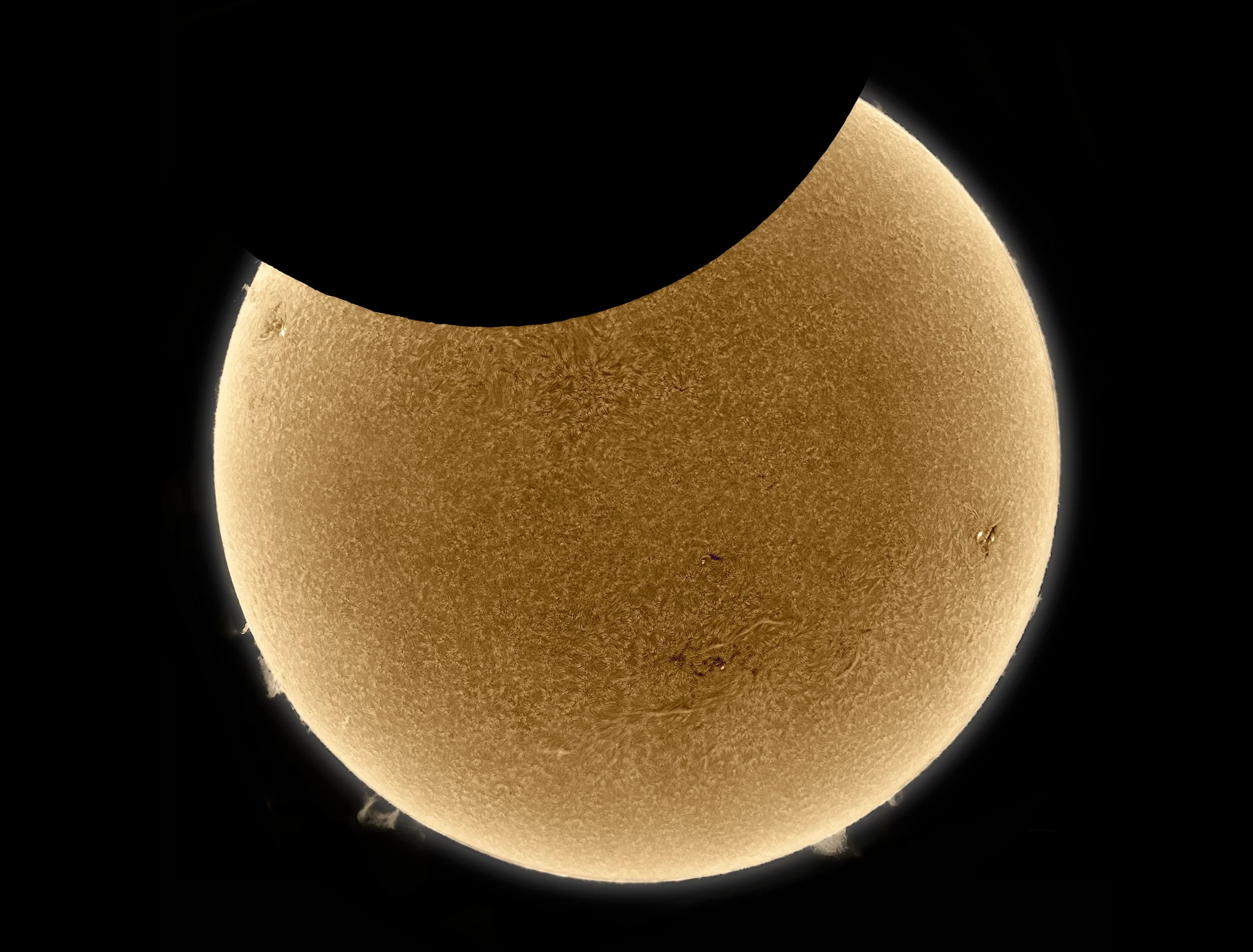
Partial solar Eclipse of the Sun
In that great journey of the stars through space, about the mighty, all-directing Sun, the pallid, faithful Moon, has been the one companion of the Earth.
A Solar Eclipse: Ella Wheeler Wilcox - 1850-1919
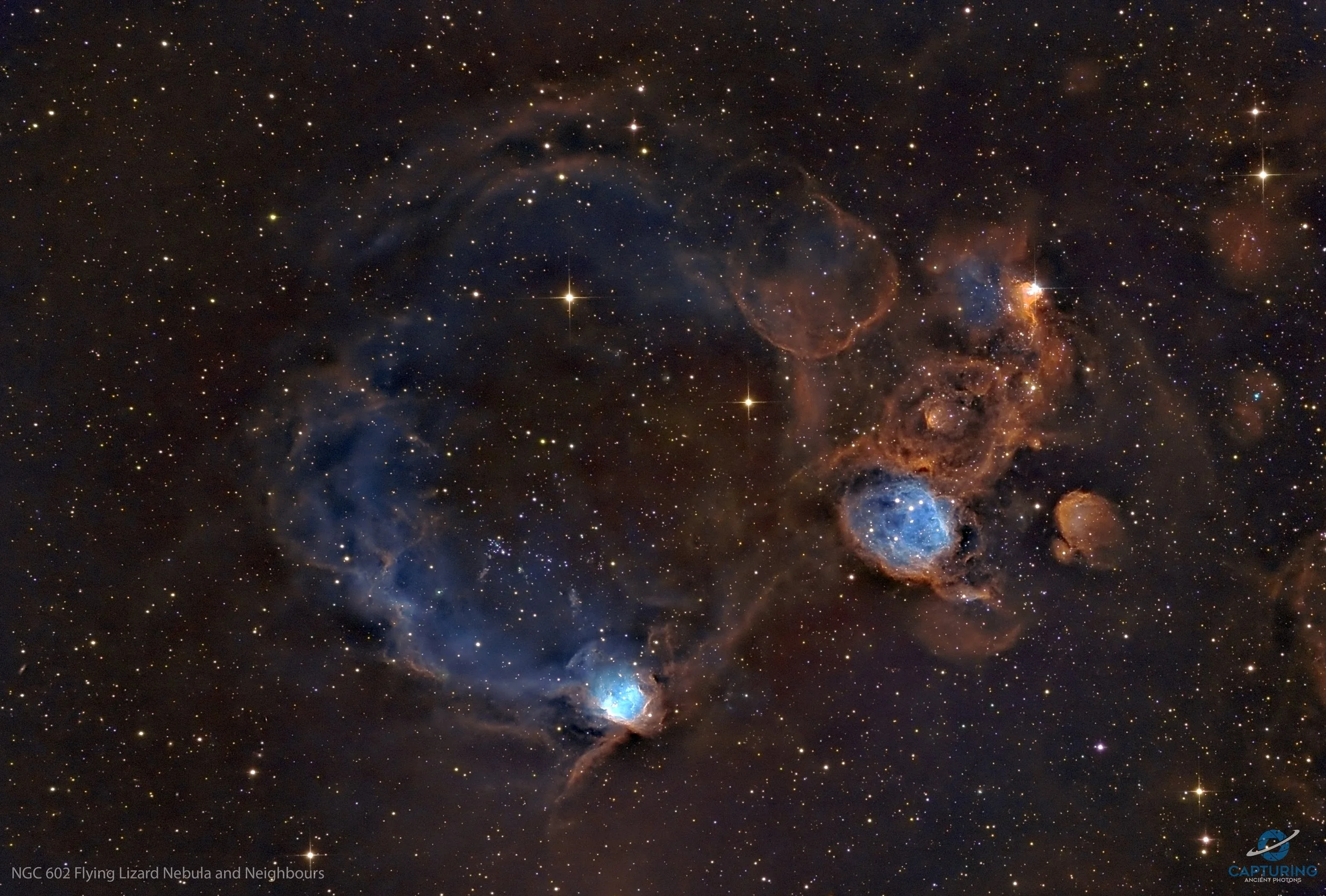
NGC 602 Flying Lizard Nebula and Neighbors
Image Description and Details :
NGC 602 or the Flying Lizard Nebula and its neighbors lie near the outskirts of the Small Magellanic Cloud (SMC) some 200,000 light-years away. 204 x 300s SHO subs shot @-10C spread across 5 nights for a total integration time of about 17hrs Equipment used:Skywatcher 10" f4 Newtonian 250PSkywatcher F4 Aplanatic Coma CorrectorSkywatcher NEQ6 Pro Hypertuned by Astronomy Academy PerthZWO ASI2600MM Pro Cooled CameraPrimaluce Sesto Senso2 Electronic FocuserWilliam Optics Uniguide 50/200mm guidescopeZWO ASI290MM Mini Guide CameraZWO Electronic Filter WheelAntlia Pro 36mm unmounted filtersRollon rolloff modified shed observatoryBortle 5Data acquisition software: NINA Astronomy SoftwareProcessing software: PixInsight and Photoshop CC
Copyright: Capturing Ancient Photons
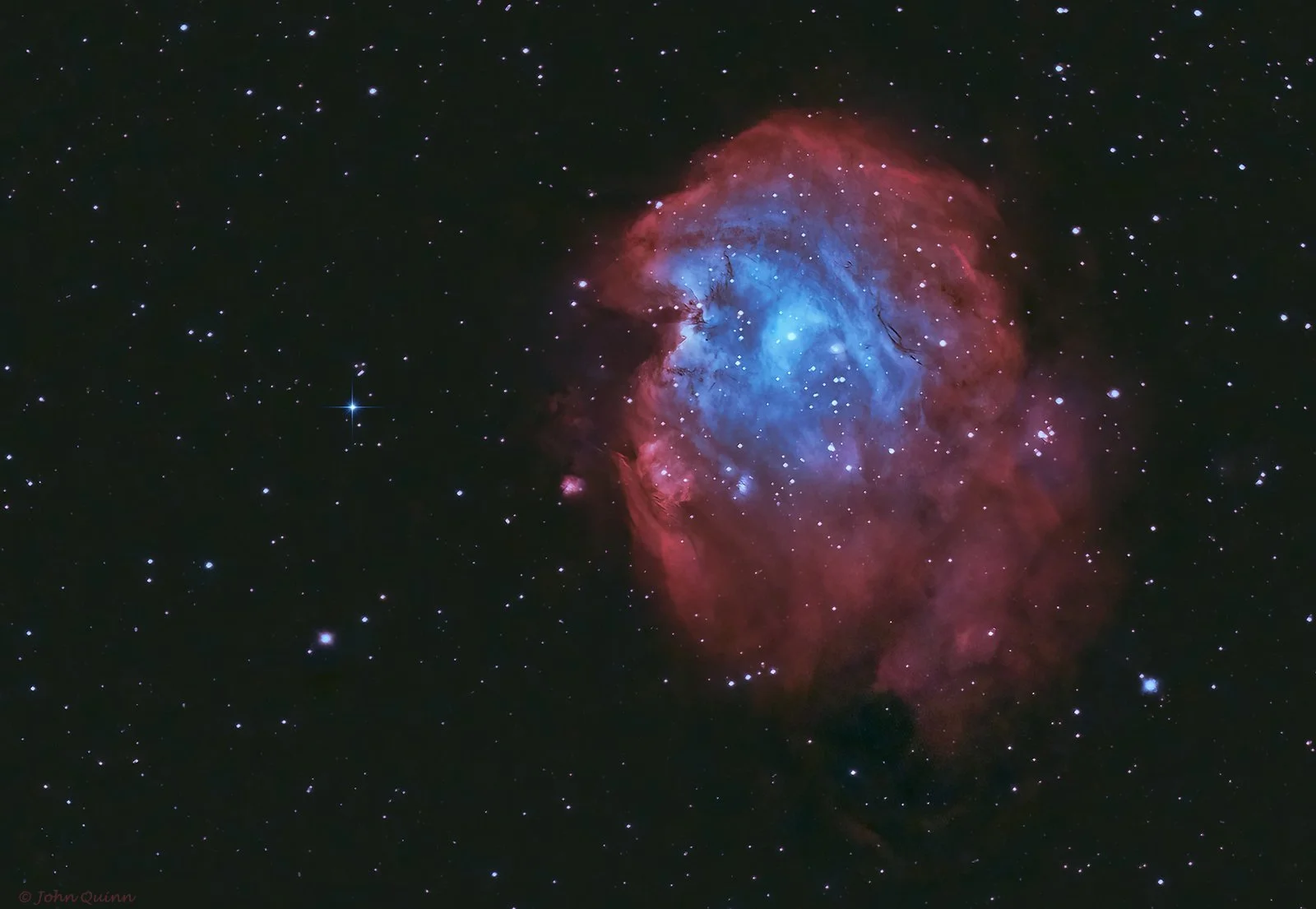
The Monkey Head Nebula
Image Description and Details :
NGC 2174, also known as the Monkey Head Nebula, is an emission nebula home to active star formation, and is about 6400 light years from Earth.Nearly 7 hours of data, RASA 8, ASI071 MC PRO, ASIAIR PRO, Radian Triad Ultra Quadband. EQ 6-R ProBortle 6
Copyright: John Quinn
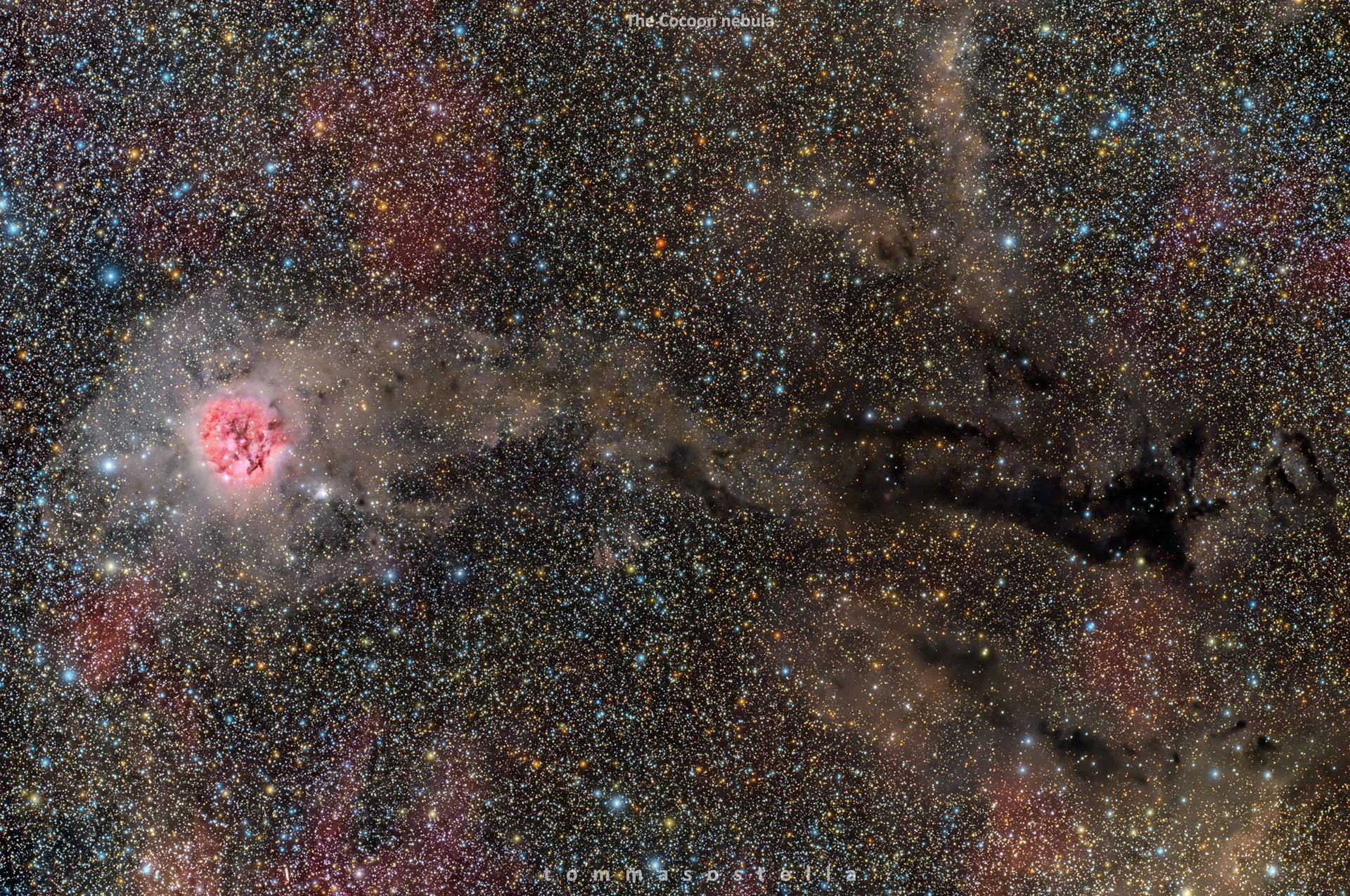
The Cocoon nebula & B168
Image Description and Details :
For this photo I integrated narrow field shots of 2018 (carried out with newton 200/800) with wide field exposures (carried out with apo triplet) of 2022.Lights were acquired in Taranto (Italy) in August 2018 and September 2022.Technical data--------------Total integration: 15hSky: Bortle 6Lights: 885x40s (2018, ZWO ASI 224) + 60x300s (2022, Omegon veTEC571)Telescope: Skywatcher 200/800 Wide Photo + TS PhotoLine Triplet FPL53 102@564mm Camera: ZWO ASI 224mc + Omegon veTEC571Mount: Skywatcher AZ-EQ6 GTFilters: Optolong L-ProProcessing: DeepSkyStacker, Photoshop CC, PixInsight
Copyright: Tommaso Stella
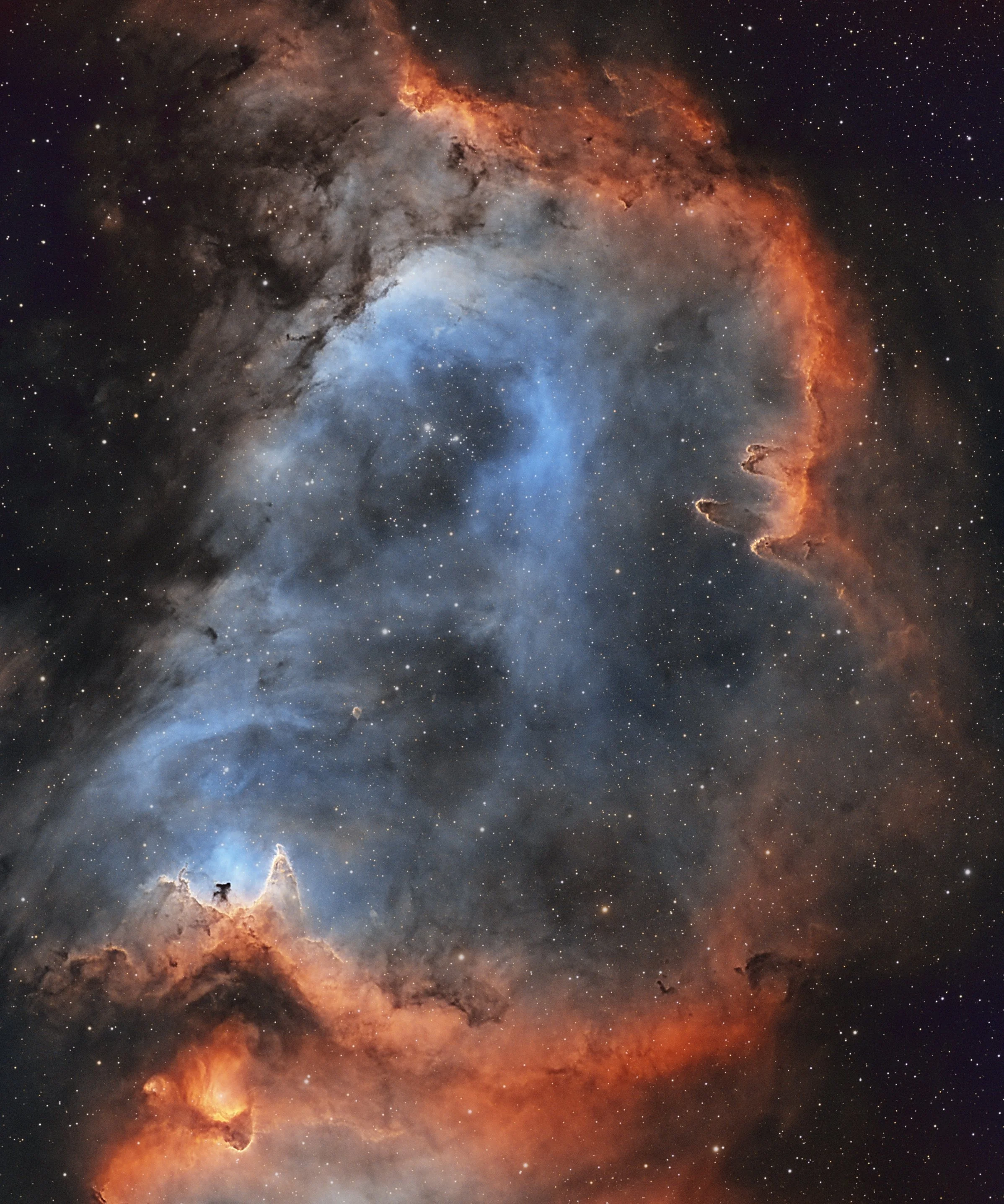
westerhout 5
Image Description and Details :
My longest integration yet. This is a total of 25.13hrs combined 5 minutes exposures on Ha/S2/O3 (not counting the 5% obligatory throw-away exposures). Image was taken using an Svbony 102ED scope paired with an ASI294mm through 2" 3nm Antlia filters. All mounted on an AM5 mount, guided by a Skywatcher 50ED+ASI120mini.
Copyright: Paul Capino
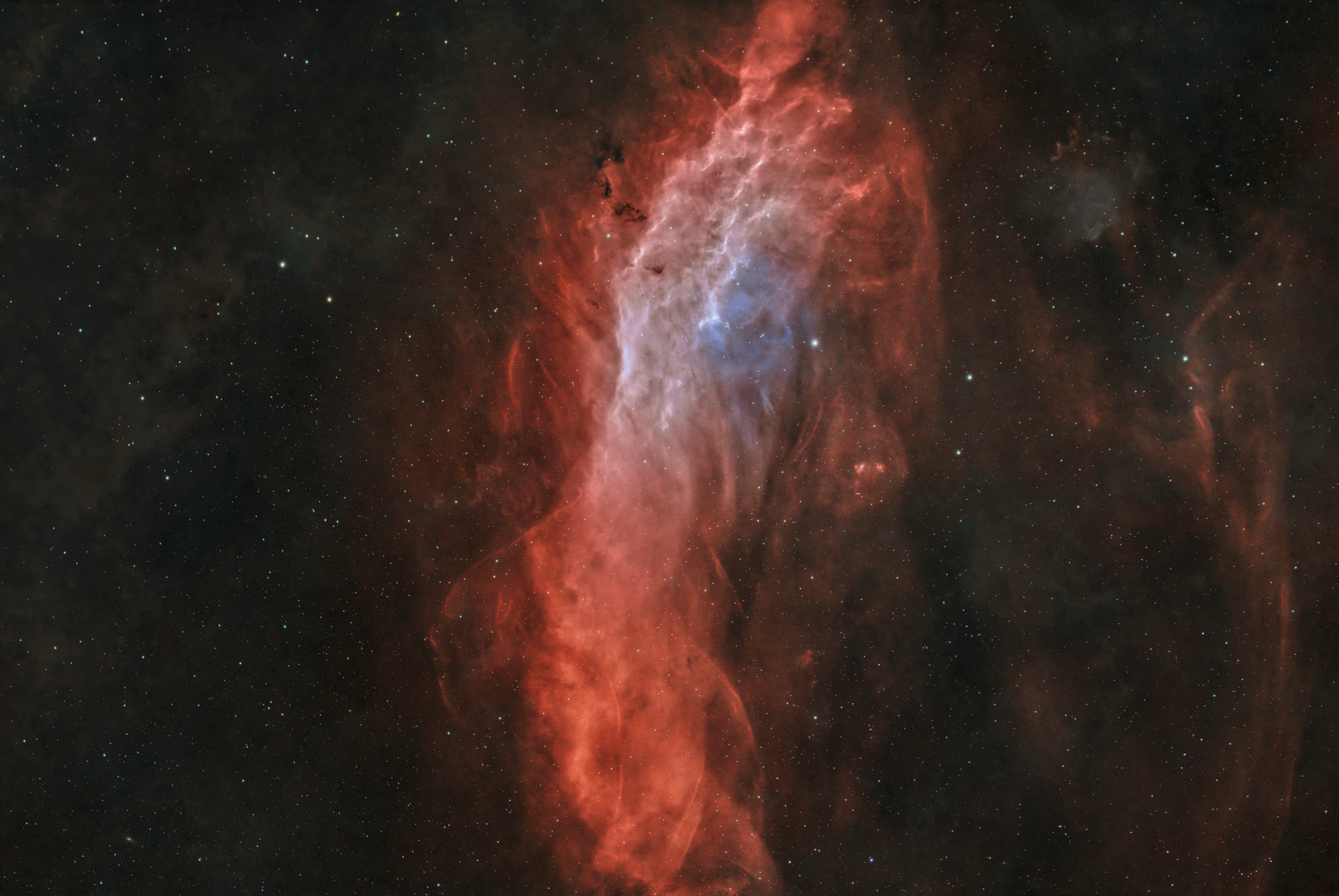
California Nebula
Image Description and Details :
The California Nebula. 110 hours of integration, imaged for 29 nights over the course of 2 months.It seems rare that I see images of the California Nebula with more than 40-50 hours, so I wanted to pile on a lot of data and see what details I could bring out.Imaging details:Imaging Telescope: OPT Telescopes TPO UltraWide 180 f/4.5Imaging Camera: ZWO Astronomy Cameras ASI2600MC ProMount: Sky-Watcher USA EQ6-R ProFilters:Baader Planetarium Fringe Killer 2"Optolong Astronomy Filter L-eXtreme 2"Accessories: ZWO ASIAIR Plus, ZWO EAFBaader Fringe Killer 2": 350×5″ (29′ 10″)Optolong L-eXtreme 2": 818×480″ (109h, 4min)
Copyright: Jeffrey Horne

M27
Image Description and Details : The Dumbbell Nebula is a planetary nebula located in the constellation Vulpecula at about 1227 light years. It was discovered by Charles Messier on 12 July 1764 and is the first observed planetary nebula in the history of astronomy. It is number 27 in his catalogue.
This object is particularly bright and has a very large apparent diameter, with the brightest part being 1/5 that of the Moon. With an expansion rate of 6.8 arcseconds per century, its age is estimated at 3 000 to 4 000 years.
The central star (the origin of the nebula) has an apparent magnitude of 13.5, which makes it difficult for an amateur astronomer to observe. It is a white dwarf with a very hot blue colour (85 000 K).
The peculiar shape of the luminous part of the nebula has earned it the name Dumbbell Nebula.
Looking at this nebula, we can see the end of our own solar system in 5 billion years.
Photo taken in South Portugal in Remote de France by the ARO team, from
04/08 to 28/09/22.
Set-Up: Astrosib RC 400 (F/D 8) on DDM 85 ASA mount. Camera Moravian G3 16200.
52 Hours in H,O,L,R,G,B
Copyright: Team ARO
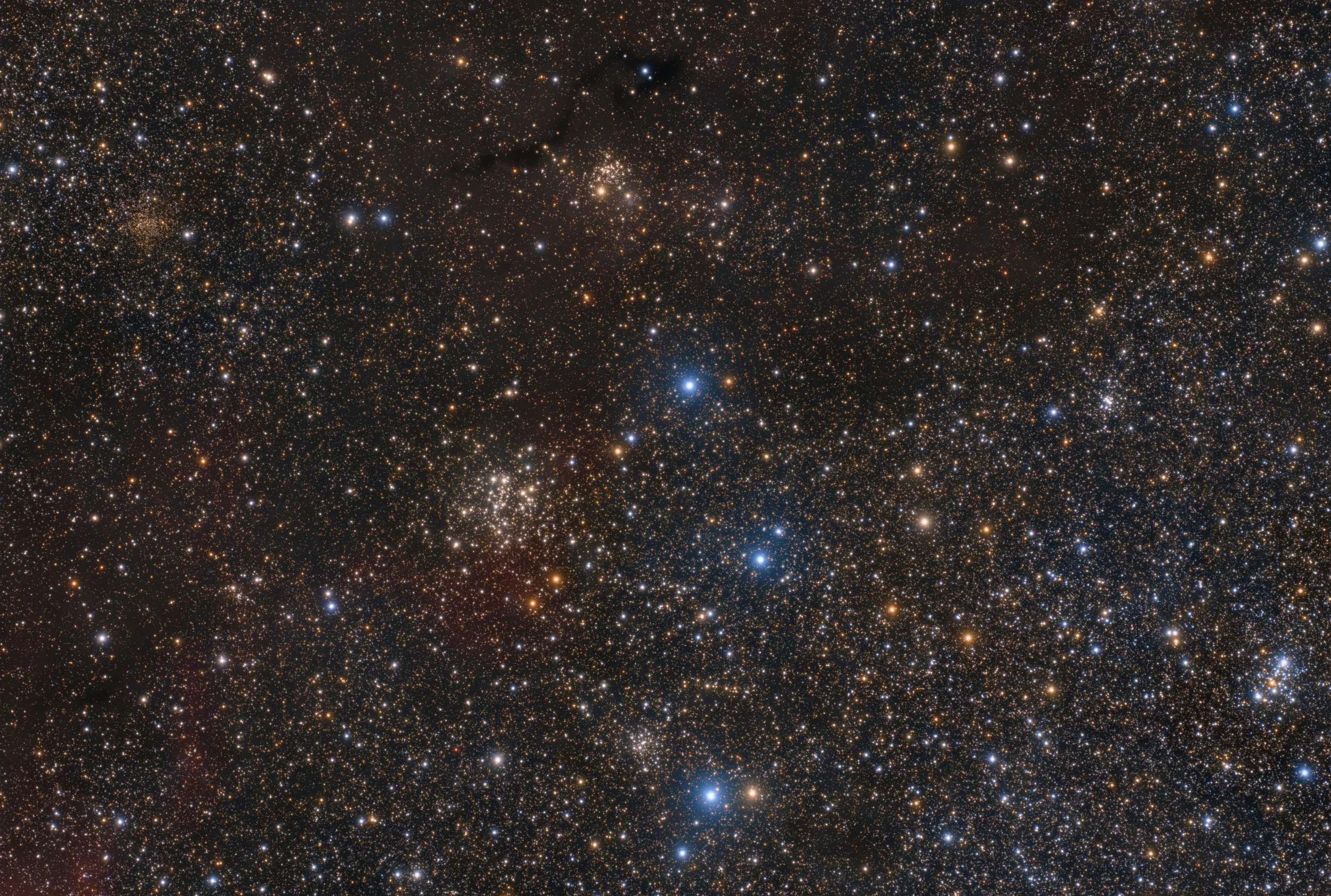
Cassiopeia’s "Open Clusters"
Image Description and Details :
A short trip to Cassiopeia has brought out this impressive star field. It is teeming with star clusters and galactic dust. Since there are delicate foothills of Ha areas in this region, I have decided to collect additional Ha data in addition to the LRGB data.Telescope: Takahashi FSQ-85EDCamera: ZWO ASI2600MM ProMount: Sky-Watcher EQ6-R ProFilters:Baader Blue (B-CCD) 36 mm · Baader Green (G-CCD) 36 mm · Baader H-alpha 6.5nm (CMOS-Optimized) 36 mm · Baader Red (R-CCD) 36 mm · Baader UV/IR Cut / Luminance 36 mmSupport:Takahashi Flattener for FSQ-85EDX (TKA37582)Guiding: Primaluce Lab 60mm Compact Guide scope, ZWO ASI120MM MiniDatum: 25. Oktober 2022 · 26. Oktober 2022 · 27. Oktober 2022 · 29. Oktober 2022 · 4. November 2022
Copyright: Stefan "Harry" Thrun
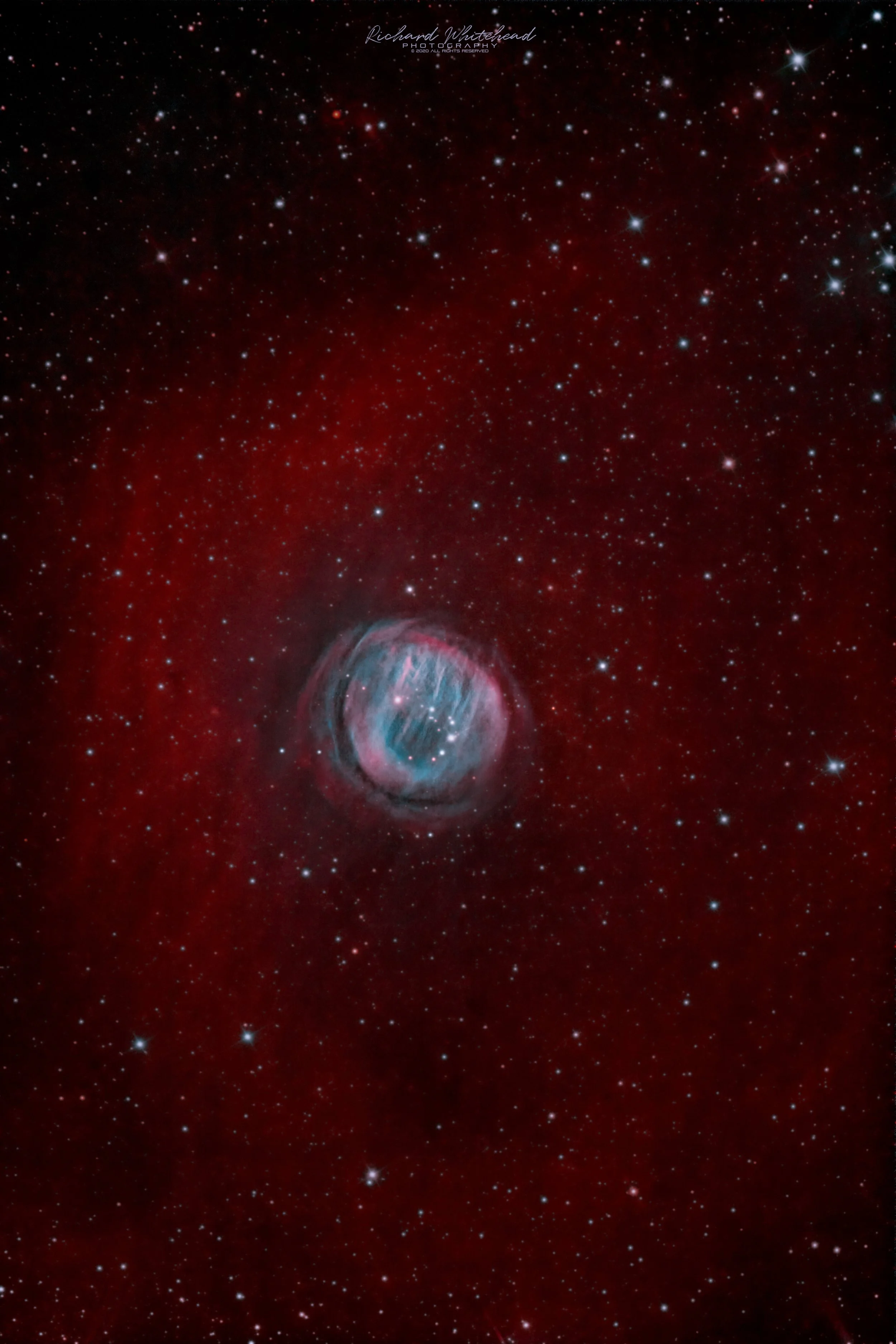
The Bear Claw Nebula
Image Description and Details :
The Bear Claw Nebula Sh2-200 is a very low brightness planetary Nebula discovered by Stuart Sharpless and incorporated into his catalog in 1959, although it wasn't until 2017 that it was spectroscopically confirmed as a planetary nebula!Planetary Nebulae are so called because to astronomers in years past, they looked disc-like, like a planet!.They are actually the remnants of a star reaching the end of its life and exploding into space, its outer layers, this will be the fate, one day of our sun.This is a very highly evolved and ancient planetary nebula.Someone has to call these objects, to me it looks more like a snow globe set adrift in a sea of glowing hydrogen ( that's the red background)Another fact that makes this image interesting is the halo of ionized Hydrogen gas that surrounds it. This is thought not to be linked to the planetary nebula, but the result of the extremely hot remnant star at its center ionizing the surrounding interstellar hydrogen.Tech stuffLocation: Animas, NMScope : Planewave CDK14Mount : Planewave L-350Camera : ZWO 6200 Mm Pro HOO ImageHa (Antlia 4.5nm) 25 x30 mins, OIII (Antlia 4.5nm) 25x30minsTotal Integration time 25 hoursProcessed in Pixinsight and PS
Copyright: Richard Whitehead 2022

NGC 225 The Sailboat Cluster
Image Description and Details :
SW 130PDSHeq5pro QHY268C Baader CMOS optimized 2" UV/IR Pegasus pocket powerbox Pegasus flatbox Beelink miniPC/Mango travel router 210x180" Gain 56 Offset 11 mode 1 Location: Mt. Parnon, GreeceShot with NINA processed in Pixinsight
Copyright: George Karantzalos

The Orion Nebula and The Running Man
The Orion Nebula, AKA Messier 42 (or M42), is a very near, star-forming region, located approximately 1,350 light-years away and is about 2 million years old.
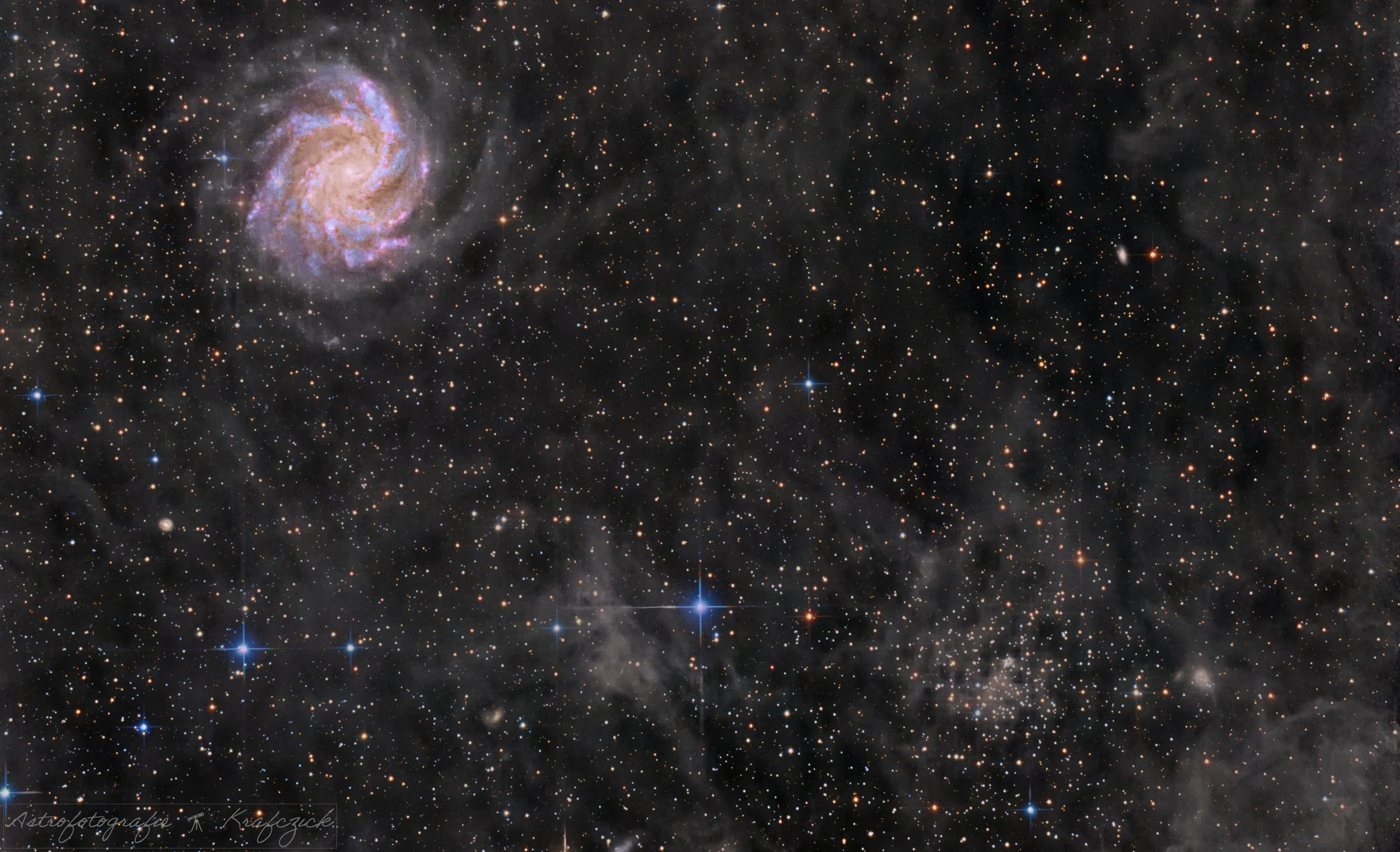
NGC 6946 + NGC 6939 firework galaxy
Image Description and Details : 273×180″(13h 39′) (gain: 120.00) -15°C bin 1×1Darks:30Flats:30Flat Darks:30TS-Optics PHOTON 200mm/8" f/5 Newtonian ZWO ASI294MC ProSky-Watcher EQ6-R Pro Optolong UV/IR cut 2"Baader 2" MPCC Mark III Newton Coma Corrector ZWO ASIAIR PlusSVBony SV106 50mm Guide ScopeZWO ASI120MM MiniBortel 4Queidersbach/Germany
Copyright: Bryan Krafczick
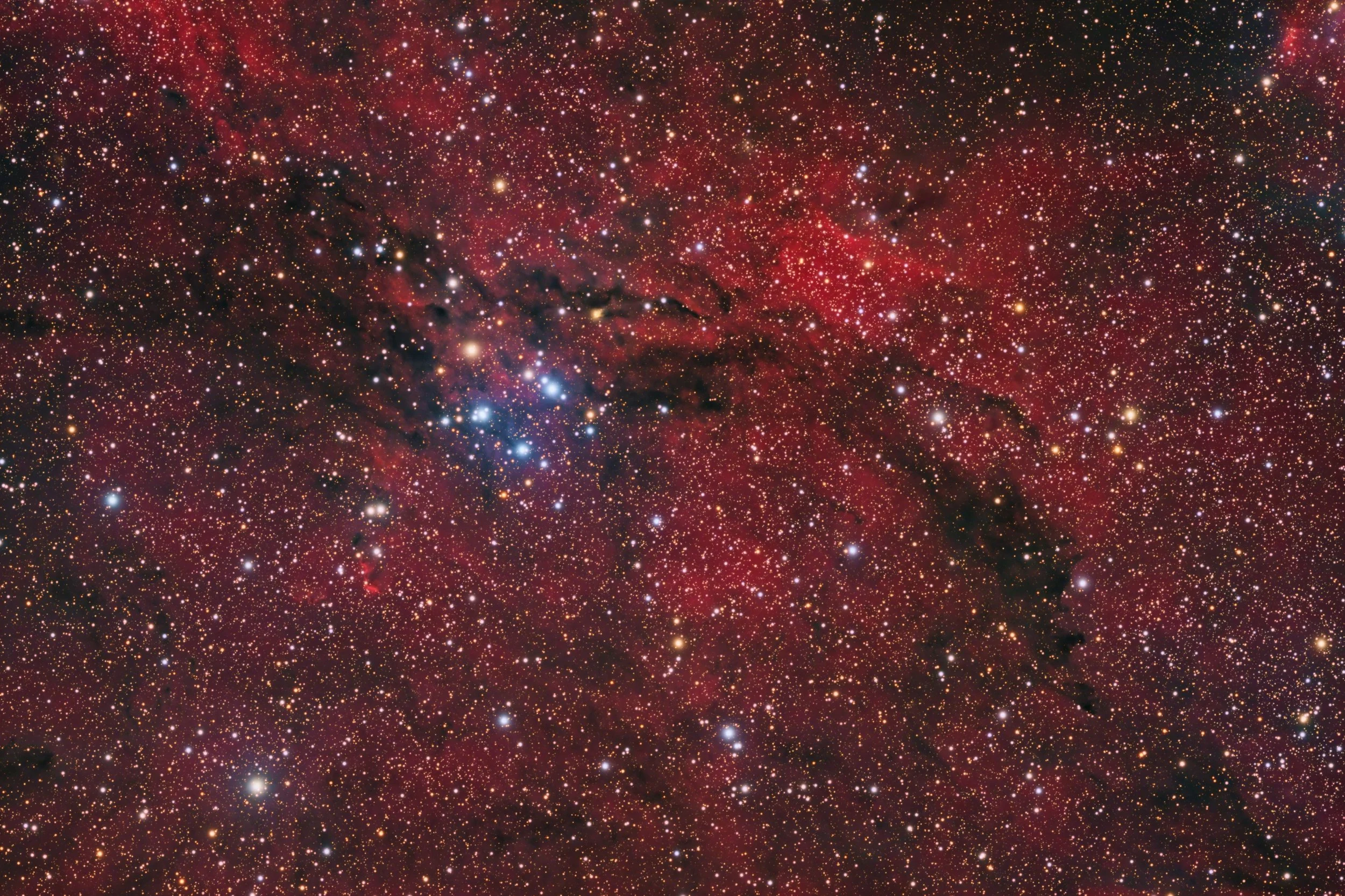
Dark Nebula along the Cassiopeia/Camelopardalis Border
Image Description and Details : About 3 degrees east of the famous Soul Nebula and right on the border between Cassiopeia and Camelopardalis lies a rather long area of dark molecular clouds within a larger area of background HII emission. A good portion of these molecular clouds are part of Lynds Catalog of Dark Nebulae which is a list assembled by Beverly Lynds in the 1950s-1960s. These dense molecular clouds are often areas of star formation and indeed there is at lease one easily visible young stellar object (YSO) within the image and nine LDN objects (1378-1386). The annotated image circles these LDN objects along with a few background galaxies. This area also has a large area of HII emission and some brighter un-catalogued emission nebula and is part of the larger Sharpless 2-202 area. Just left of center is the large (29 arc minute) Stock 23 open star cluster which lies 1200 light years distant.
Scope: Stellarvue SVX 152T, Camera: ZWO ASI 6200, Paramount MyT. Image taken from 24-30 Sept 22 at the Okie Tex Star party. 180min of Luminance, 240min or Red, Green and Blue, 1200min of Ha. 14.3hrs total.
Copyright: Jonathan Talbot
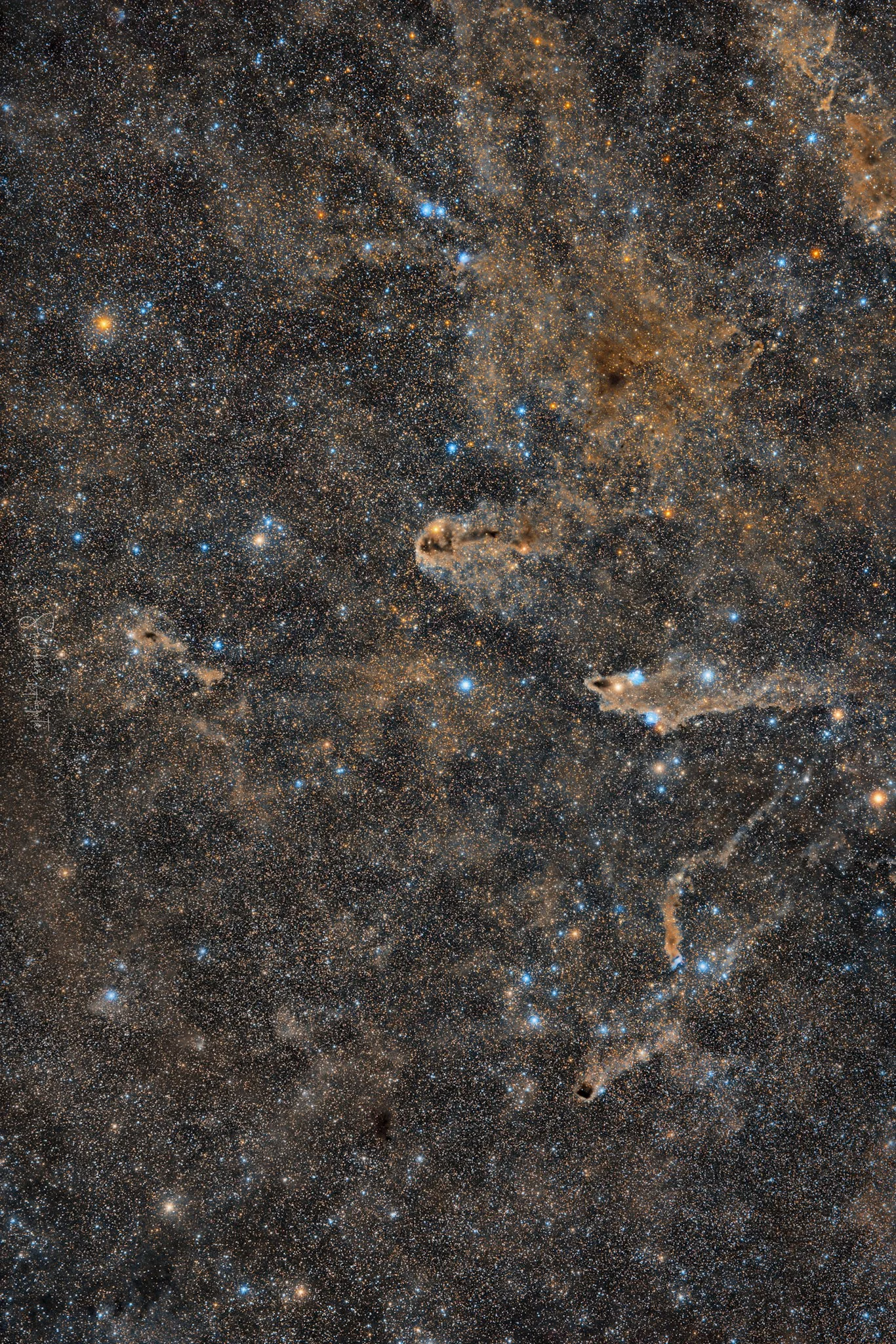
Race of the Fish Nebulae in Cepheus
Image Description and Details : This widefield image consists of the extremely dusty patch of the Cepheus constellation. The region contains a plethora of dark and bright nebulae belonging to the Lynd's dark and bright sky catalogue, the more notable of them being the three nebulae named after the fishes LDN 1251 or the Rotten fish or Angler fish Nebula, LDN 1235 or the Shark Nebula, and VBD 152 or Barnard 175 also sometimes referred as the Eel nebula, which all seem to be engrossed in some sort of a race.
Equipment:
Nikon Z5
Samyang 135 f2
Fornax Lightrack ii
EXIF:
180 n 240s subs shot over 2 sessions
Calibrated with flats
Total Integration: 6h 33m
Processed in PixInsight and Photoshop
Shot under Bortle 1 skies in Spiti Valley, India.
Copyright: Copyright: Shikhar Gupta
ic1396
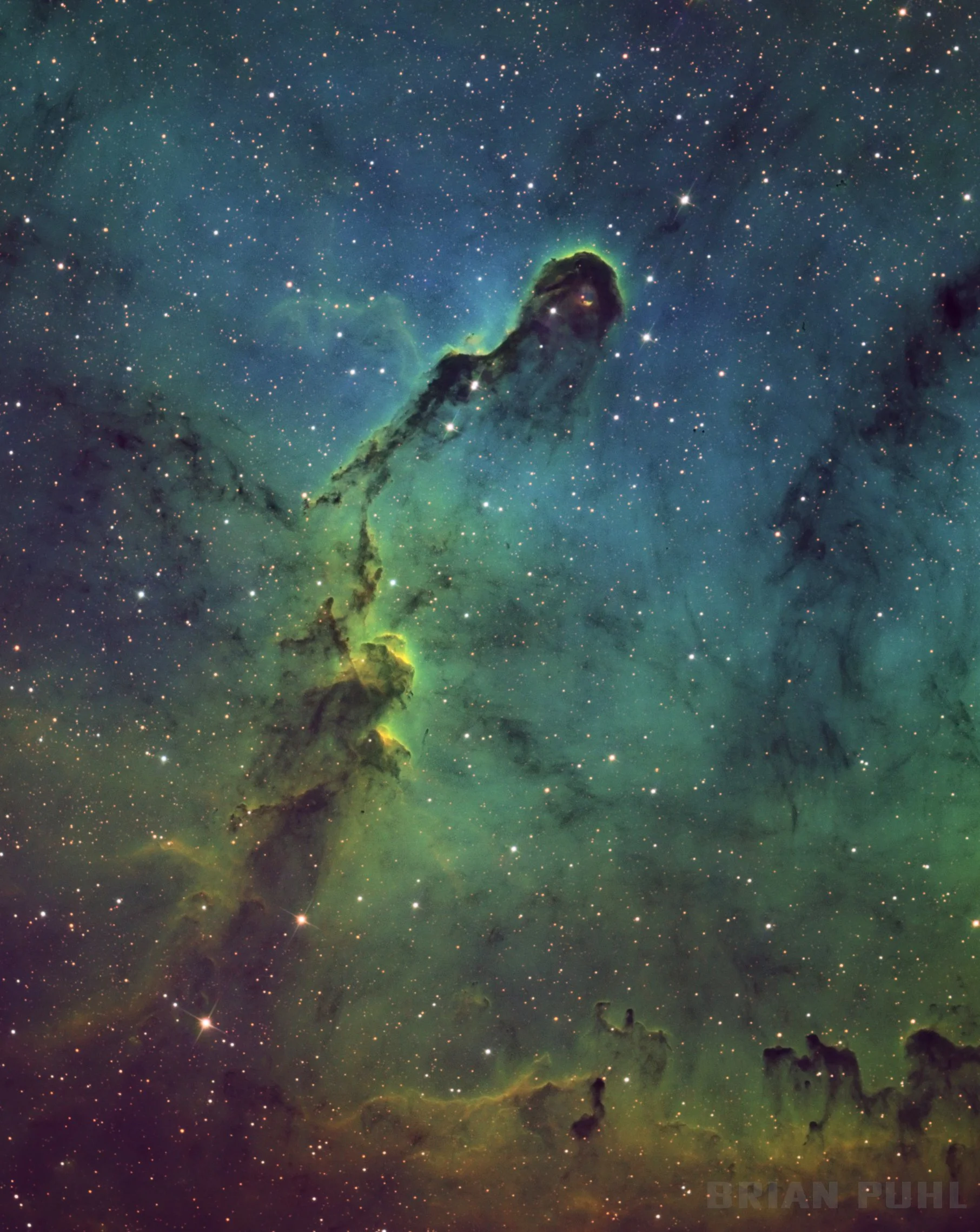
Image Description and Details : Taken over 4 nights with my 8" newtonian, there are approximately 12 hours total with a small addition of RGB integration purely for the color stars. While most people use SCNR to remove the green, I particularly enjoy it on this target; it adds a nice taste of color depth. I am also fond of the stars glowing through the 'bullet hole' iof the trunk.
TPO 8" F/4 Newtonian
QHY-268M with Antlia 3nm 2" SHO filters
Paracorr 2" Coma Corrector (Final FL 920mm, F 4.5)
EQ6-R Pro
Copyright: Copyright: Brian Puhl
ngc 1333
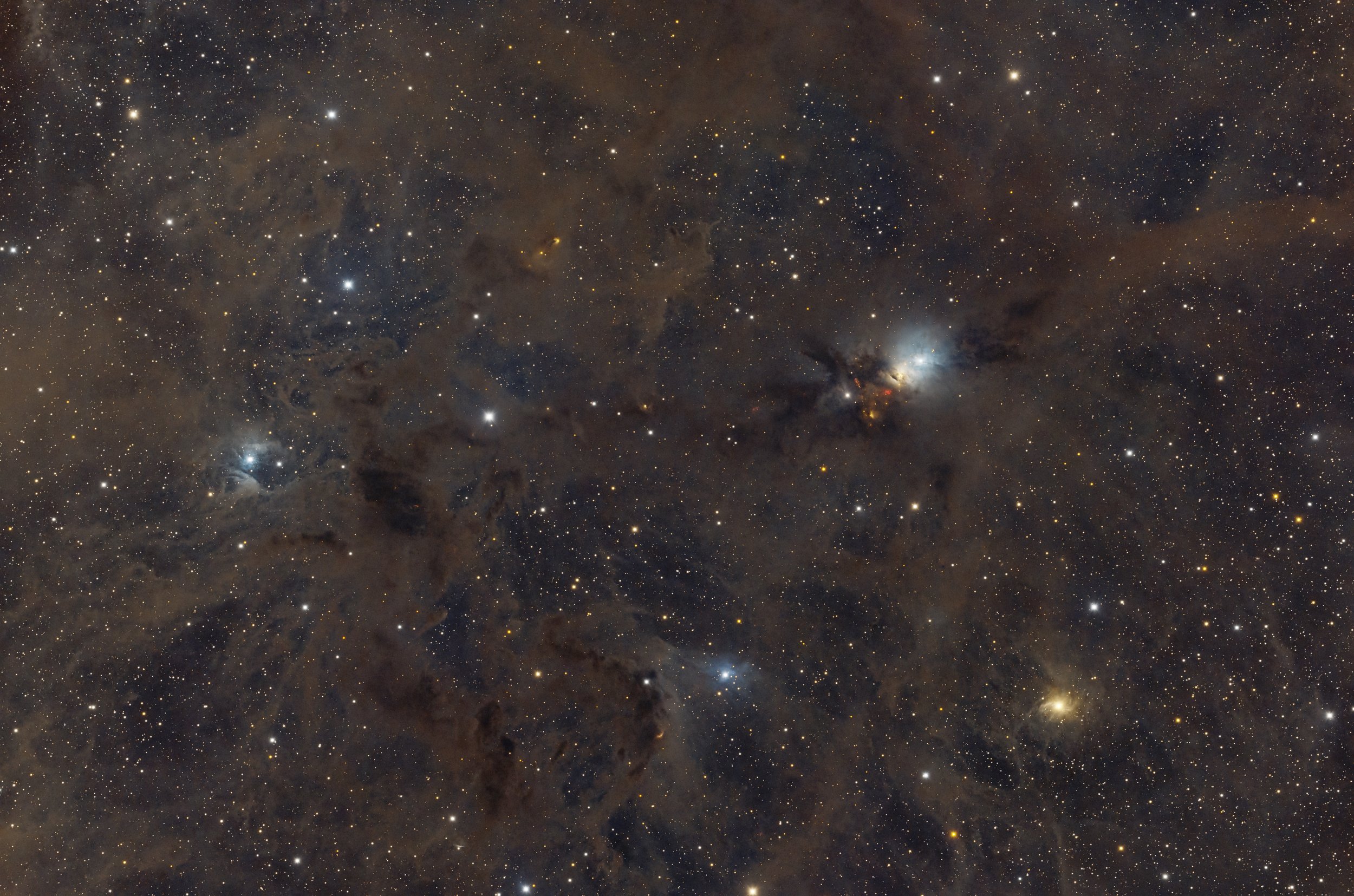
Image Description and Details : The picture was taken to show the area around NGC1333.
It was taken in one night from my backyard.
Image details:
220 min of total integration time.
110 x 120sec of light frames.
Calibrated with 30 darks, 15 flats and 15 dark flats.
Equipment used:
Celestron RASA 8 (400mm f2)
Omegon veTEC 571C
Skywatcher HEQ5 Pro
ZWO ASI 120mm Mini and a 50mm Guide Scope
ZWO EAF
Controlled by NINA
Edit with:
APP, Siril and Photoshop
Copyright: Christian Göppert

Toal Lunar Eclipse 2022 - from Farmington Hills, Michigan
Image Description and Details : The image was shot during the few clear minutes during maximum totality. The image is comprised of a stack of the best 25% of the frames.
Captured using the Celestron Evolution 8 with F6.3 focal reducer and ASI 294 MC Pro. recorded in Firecapture. Stacked in Autostakkert and processed in Photoshop.
Copyright: Michael Shapiro
Witch head nebula
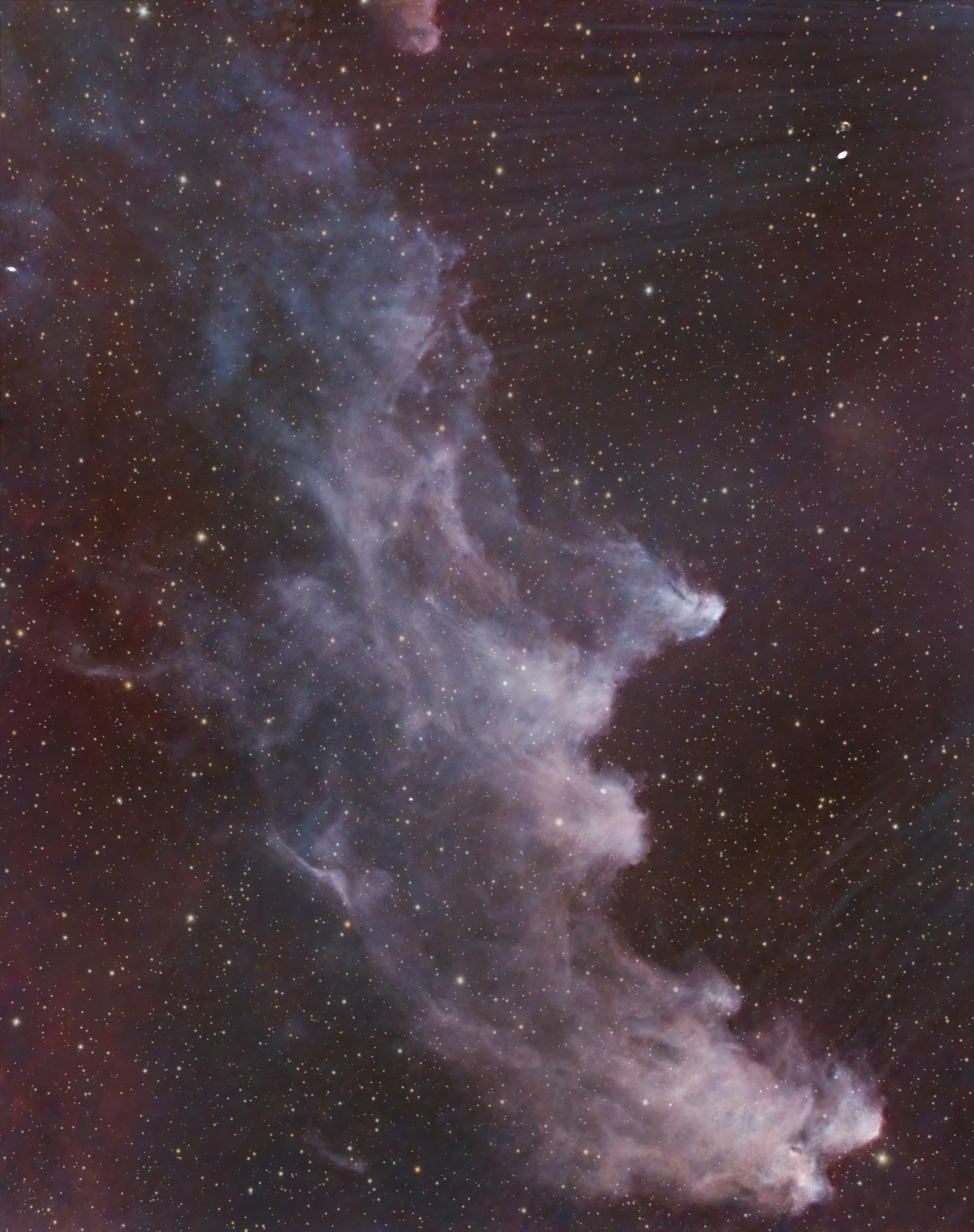
Image Description and Details : Witch Head Nebula
[NGC1909 | IC2118 | LBN956]
Magnitude: +13.0
Distance: 899 ly
Constellation: Eridanus
This faint nebula resembles a shape that of a witches head. It was believed to be a remnant from of a supernova. Categorized as a reflection nebula. It is illuminated by a nearby blue supergiant star Rigel.
SCT 8”, Hyperstar v4, ZWO(ASI294MC Pro, ASIAR Pro, ASI290mm, EAF) | EQ6R P
94X120” | IDAS LPS D3
Gain: 100, -10 °C
APP, PS(Camera Raw + Plug-ins)
10/20/2022
Bortle 5 Ca, USA
Copyright: Paul Diosomito