

AAPOD2 Image Archives
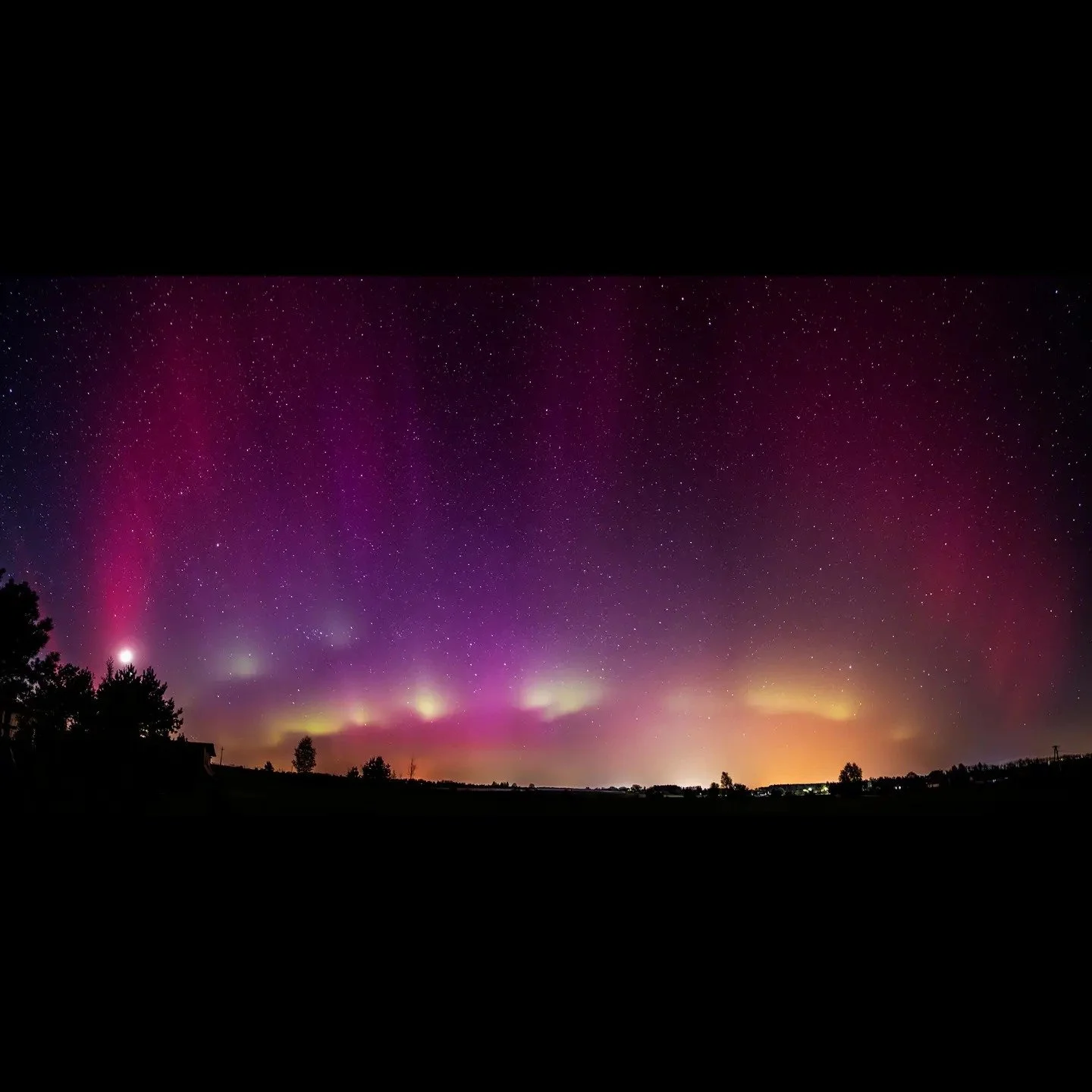
Aurora
Image Description: Last night surprised me a million times. What was that even...?
I was sitting quietly outside my house on this ultra warm evening at the telescope when the guiding gave me problems and EAF started driving like possessed... I said a few indecent words, moved from the chair to get rid of "this state" and looked at the sky.
I didn't do it well, because I started rubbing my eyes with surprise, after wk... no trace, just a tide of euphoria, a run for my camera that I haven't yet figured out from the Baltic sand, as well as the tripod
... and a long one into the field bit muddy but it didn't matter.
I even shouted at the Young one to get it together and saw it with his own eyes
Waves spilled across the northern horizon, slightly green, and above my head I looked every moment at a growing pillar, entering the zenith.
51°... N, 21°... E
How is this even possible..?! I was not interested in it at all.
Thought I would give a call to those who would like to see it in person.
I stood in this mud, between the green grain and the greenish sky, I called, I caught my breath, I called again, I turned the blinker on between ... and I absorbed all of myself.
The dawn has taken many forms... From the poles, to the waves, to the bubbles, the souls that came and went - from the west side of the sky, to the north, to the east... Unbelievable.
I couldn't sleep in a very long time.. until three with minutes I trampled the path around the house...
I took some pictures, although they didn't need much, I assembled panoramas of which the shorter one is ok (5 horizontal frames), but the longer one (10 vertical frames) strongly bent by PS, plus stratrails with a free bolid (? ), plus a couple of individual frames.
Technically: Canon 7Dmk2 + Canon 10-22 mm, on a tripod, in the north of Puława and Nitrogen Plants, in the northwest Electronics Kozienice.
Copyright: Kamila Mazurkiewicz Osiak
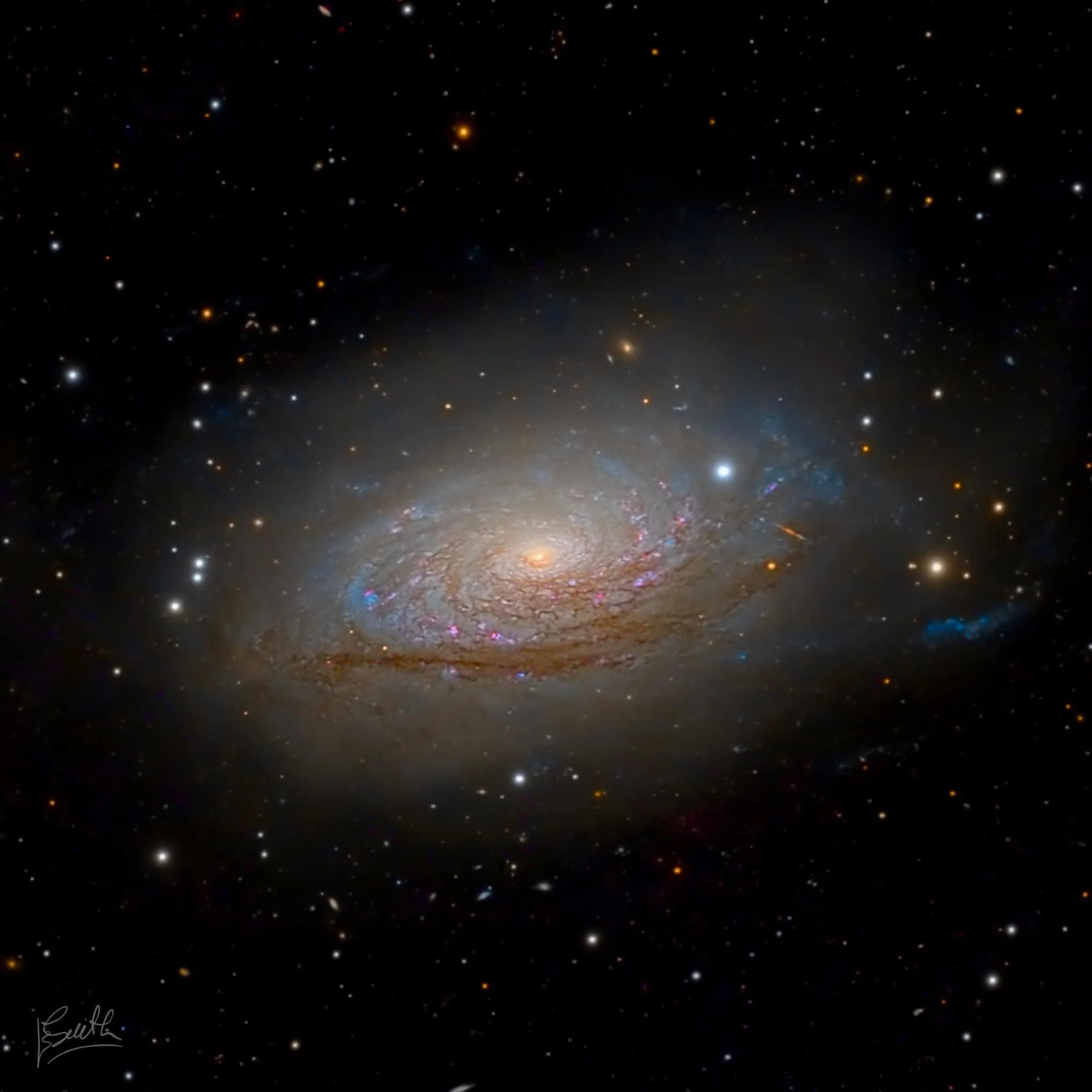
M 63 Sunflower Galaxy
Image Description: M63 lies at a distance of 27 million light years from our own Galaxy in the constellation of Canes Venatici. Its size is approximately 99,000 x 57, 000 light years.
To the lower left of the Galaxy there are horizontal dust lanes presumed to be not part of the disk, but lay in front of the Galaxy.
The spiral pattern is mostly fragmented indicating possible supernovas exploding in star formation regions.
Imaged over 5 nights using various combinations of angular rotation and guiding. The next time I image this Galaxy I will use a much longer focal length as this image is a tight crop of the original field of view.
Technical summary:
Captured: 14,15,19,20,21-03-2023
Imaging Sessions: 5
Location: Gérgal, Andalucía, Spain
Bortle Class: 4
Total Integration: 24h 55m
Filters:
Red 42x 300s 3h 00m BIN 2 Gain 100 -5C SQM 20.6
Green 43x 300s 3h 35m BIN 2 Gain 100 -5C SQM 20.5
Blue 43x 300s 3h 35m BIN 2 Gain 100 -5C SQM 20.6
UV/IR 171x 300s 14h 15m BIN 2 Gain 100 -5C SQM 20.6
Pixel Scale: 0.8 arcsec/pixel
Telescope: Celestron C11 Edge HD x0.7 f/7 @ 1960mm fl
Image Camera: ZWO ASI 6200MM Pro
Guiding: ZWO OAG L with ZWO ASI 192MM Mini
Filters: Astronomik R, G, B, UV/IR
Mount: Skywatcher EQ6-R Pro
Computer: Minix NUC
Capture software: NINA, PHD2
Processing Software: PixInsight, Adobe Lightroom
Copyright: Eric Smith

Crater Lake
"Crater Lake"
Crater Lake National Park has been on my wish list for a big Milky Way panorama ever since my first visit several years ago.
5 years and several attempts later, I finally found perfect conditions during my visit in late June 2022. I was surprised that a thick snow cover was still present. It kept me from reaching my planned shooting location, but it nicely framed the crater rim at my alternate spot.
EXIF
Canon EOS R, astro-modified
Tamron 15-30mm f/2.8 @ 15mm
IDAS NBZ-Filter
iOptron SkyTracker Pro
Sky:
Panorama of 7 panels, each a stack of 6x 90s @ ISO1600, unfiltered & 3x 180s @ ISO6400, filtered
Foreground:
Panorama of 7 panels, each 15s @ ISO400 during twilight
Copyright: Ralf Rohner
NGC 3293
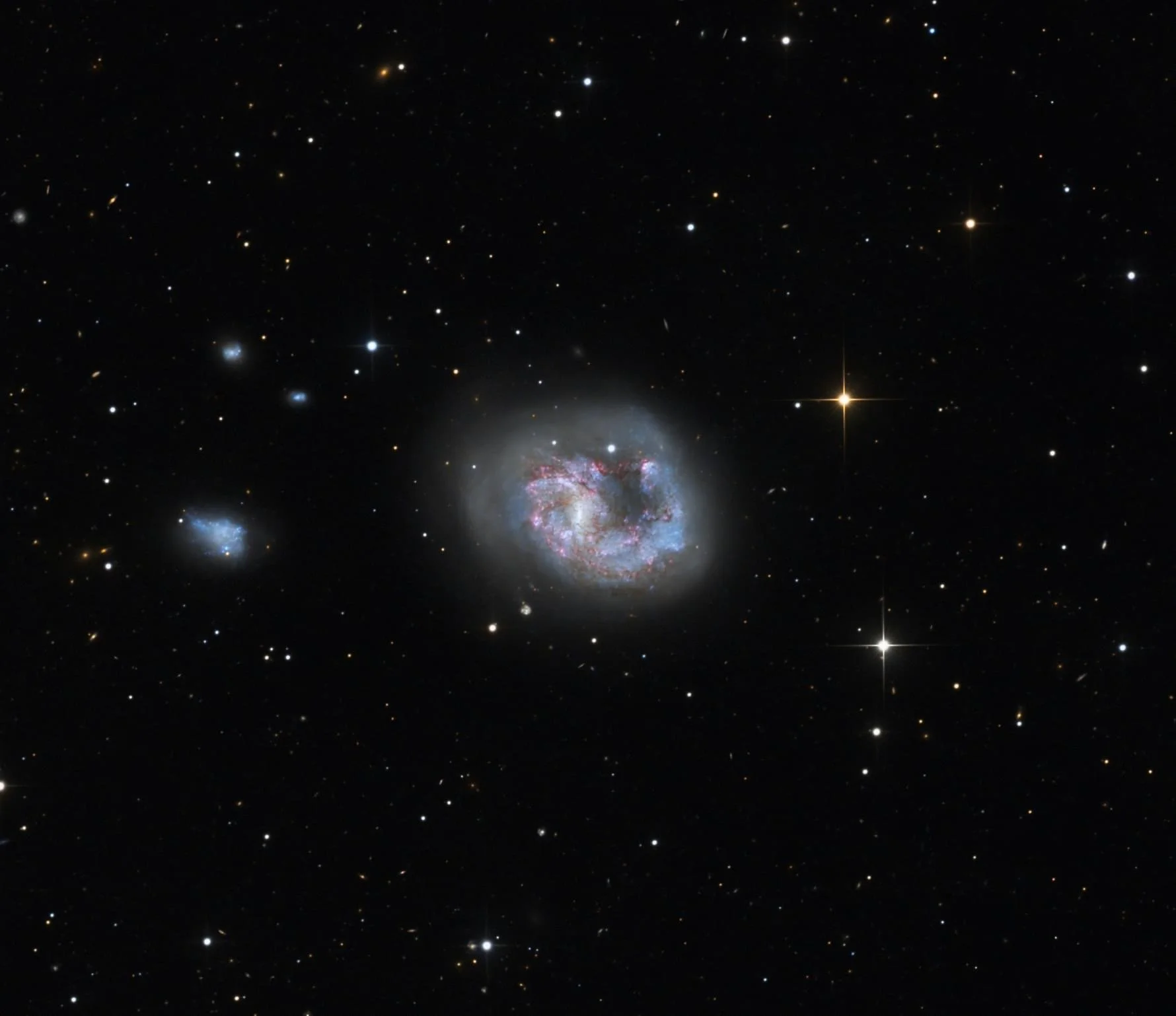
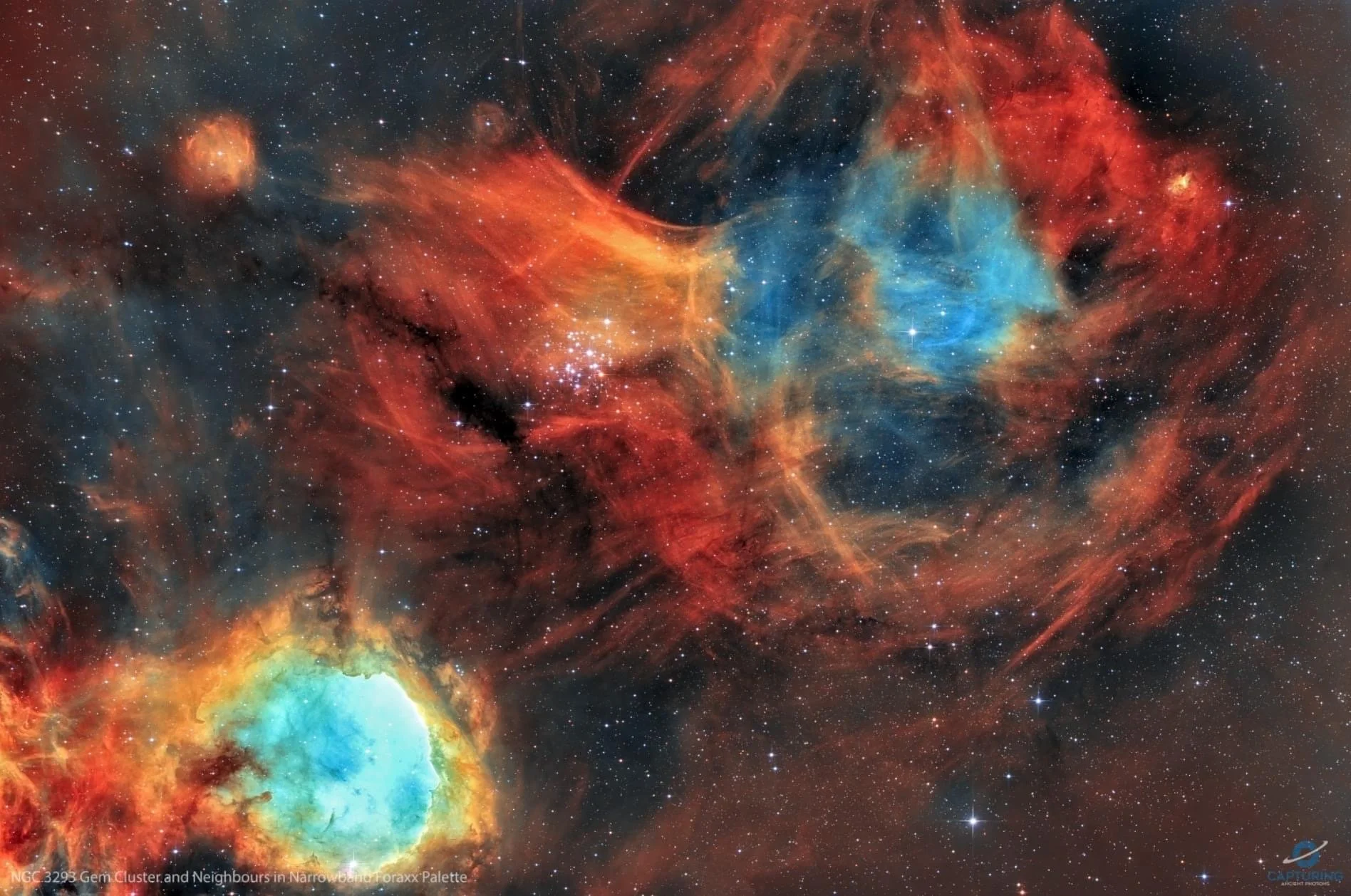
NGC 3293 is an Open Cluster consisting of more than 100 stars brighter than magnitude 14 and within some impressive surrounding Ha nebulosity. This cluster which is around 9,00 light-years from Earth is located in the constellation Carina and shares the cosmic neighborhood with the popular NGC 3324 Gabriela Mistral.
94 x 300s SHO and 116 x 30s RGB subs shot @0C across 5 nights for a total integration time of about 9hrs
Equipment used:
Skywatcher 10" f4 Newtonian 250P
Skywatcher F4 Aplanatic Coma Corrector
Skywatcher NEQ6 Pro Hypertuned by Astronomy Academy Perth
ZWO ASI2600MM Pro Cooled Camera
Primaluce Sesto Senso2 Electronic Focuser
William Optics Uniguide 50/200mm guidescope
ZWO ASI290MM Mini Guide Camera
ZWO Electronic Filter Wheel
Antlia Pro 36mm unmounted filters
Rollon rolloff modified shed observatory
Bortle 5
Data acquisition software: NINA Astronomy Software
Processing software: PixInsight and Photoshop CC

Sh2-284 - The Finger
Image Description and Details : Sh2-284 is a very large emission nebula about 17,000 light years from us in an outer arm of our galaxy. As with a number of emission nebulas like it, its central region contains an open cluster of massive, young, hot stars whose stellar winds are clearing out the center and creating a bubble or cave-like structure while creating pillars and cometary globules at the edges. Once such pillar in Sh2-284 (on the right) looks like an index finger pointing at the center of the nebula in a "We're Number 1" sort of way.
Details: Celestron EdgeHD 1100 with 0.7x reducer; 10Micron GM1000; ZWO ASI6200MM; Chroma broadband filters for the stars and 3nm narrowband filters for the nebula; Bortle 8; 19h 13' integration time.
Copyright: Timothy Martin
M106 - The cosmic funnel
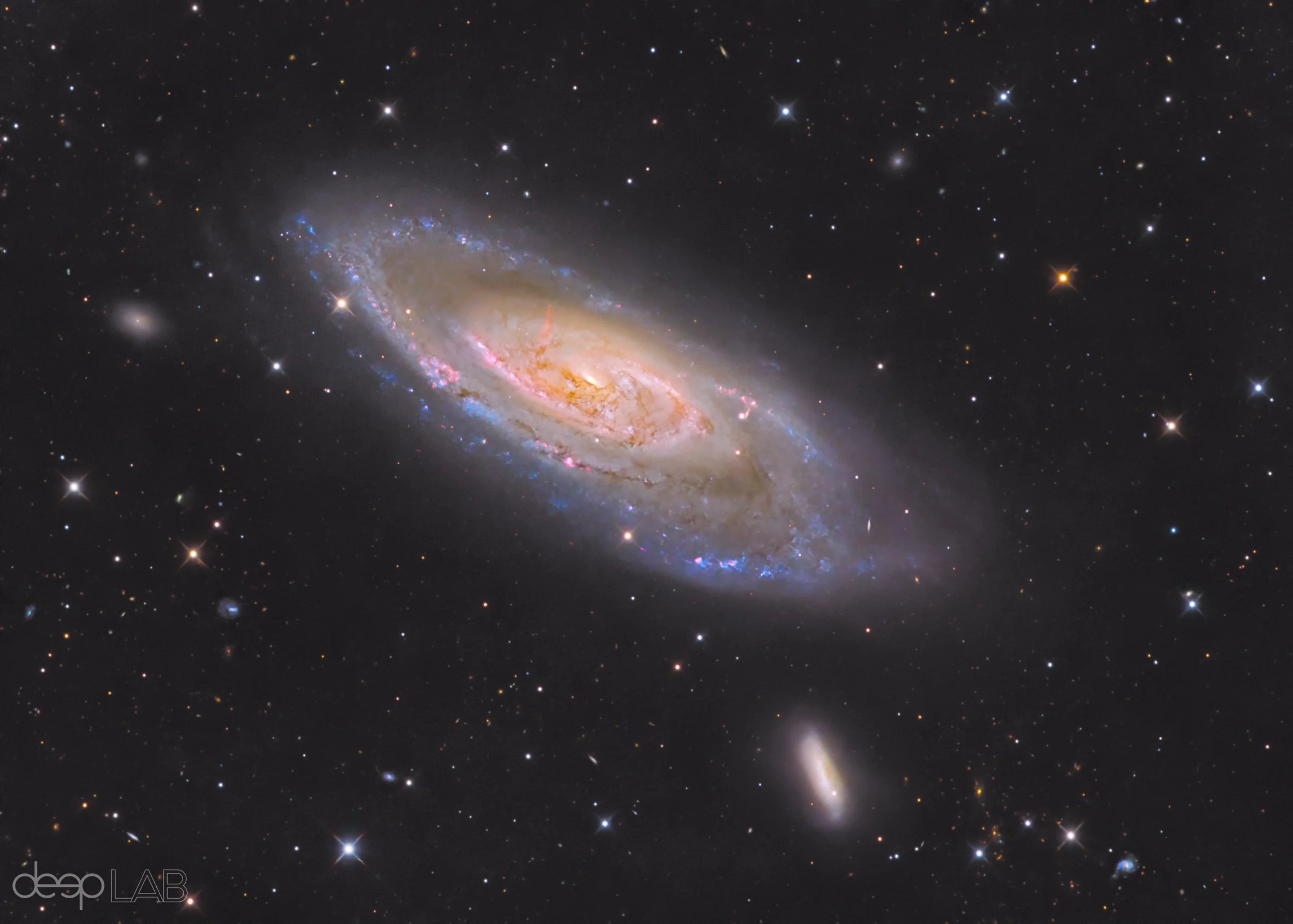
Image Description and Details : The last work of LAB1 observatory of our DeepLab project, processed by Massimiliano Peri.
The M106 requires 2 month to reach the result: rain, wind and moon were out enemy!
Instrumentation:
SCOPE: Tecnosky RC12 Carbon Truss
CAMERA: ZWO ASI2600MM Pro
MOUNT: iOptron CEM120
Acquisition details:
Optolong Blue 2": 45×180″(2h 15′)
Optolong Green 2": 46×180″(2h 18′)
Optolong H-Alpha 7nm 2": 39×600″(6h 30′)
Optolong Luminance 2": 90×300″(7h 30′)
Optolong Red 2": 47×180″(2h 21′)
Copyright: DeepLab Project
April Sun
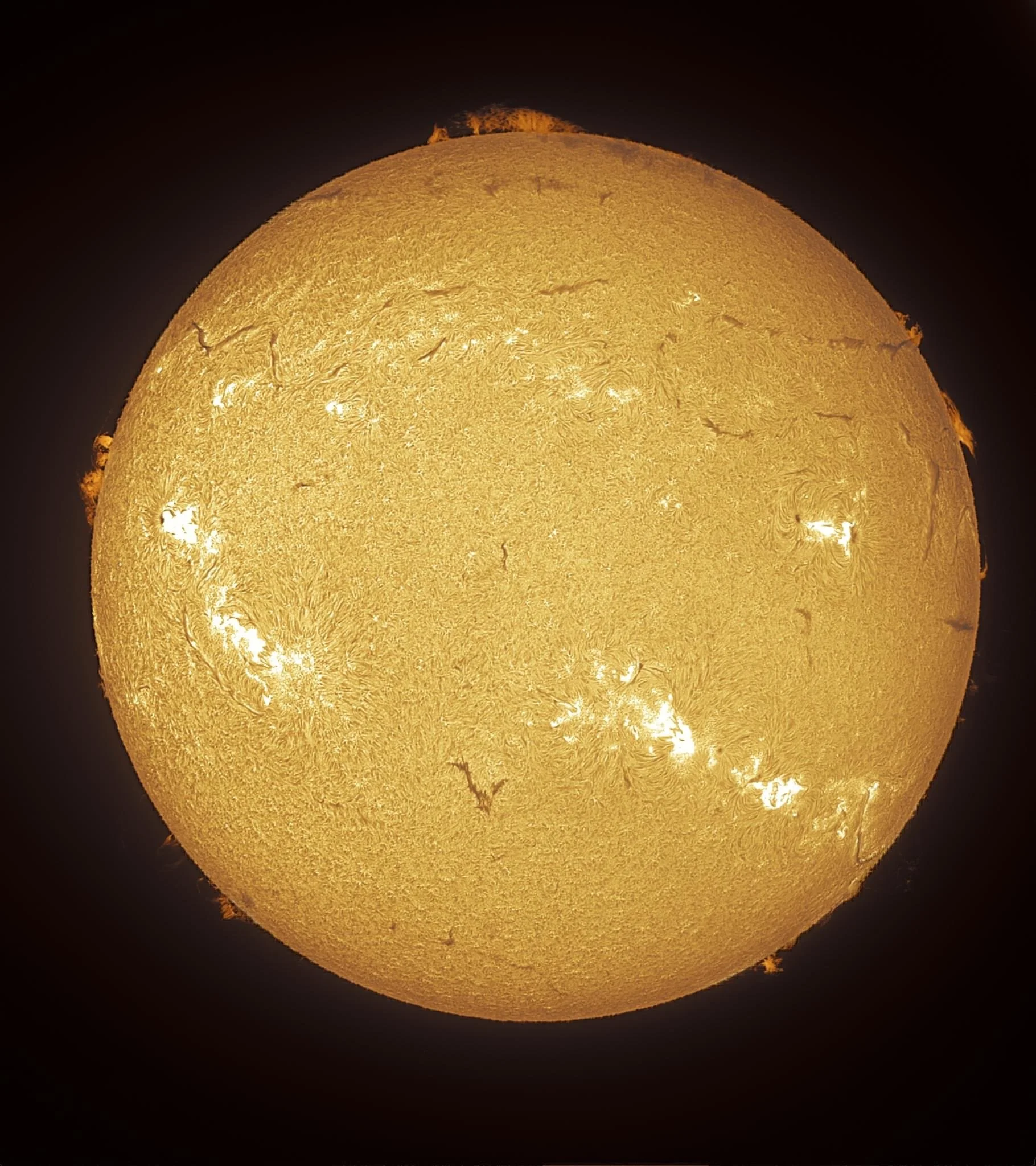
Sun disc on April 15th, 2023.
How frustrating when the clouds followed the sun for an hour after everything is set up and ready to go....
With so many previous practices, I think I have figured out a way to produce high-resolution Solar disc images. Originally I have to produce a higher-resolution image using 2 panels mosaic with 2X Barlow. However realizing that the magnification of a Barlow actually depends on the distance from the Barlow lens to the camera sensor, I decided to put the Barlow lens closer to the sensor by screwing it directly onto the camera. The solar disc is not fitting perfectly in a single frame of my Apollo M-Max. My next project idea will be using this configuration to make a good quality timelapse.
Scope: Lunt60DS50, B1200
Mount: Sky-Watcher Solar Quest
Camera: Apollo M-Max
Barlow: Celestron Omni 2X
Shutter: 7ms, gain:219, Exposure: 90s; 135fps
Drizzle 3X
https://www.astrobin.com/qcmwz7/
FireCapture, Imppg, Photoshop
Copyright: Benjamins Astrophotography Hub
Ngc6888
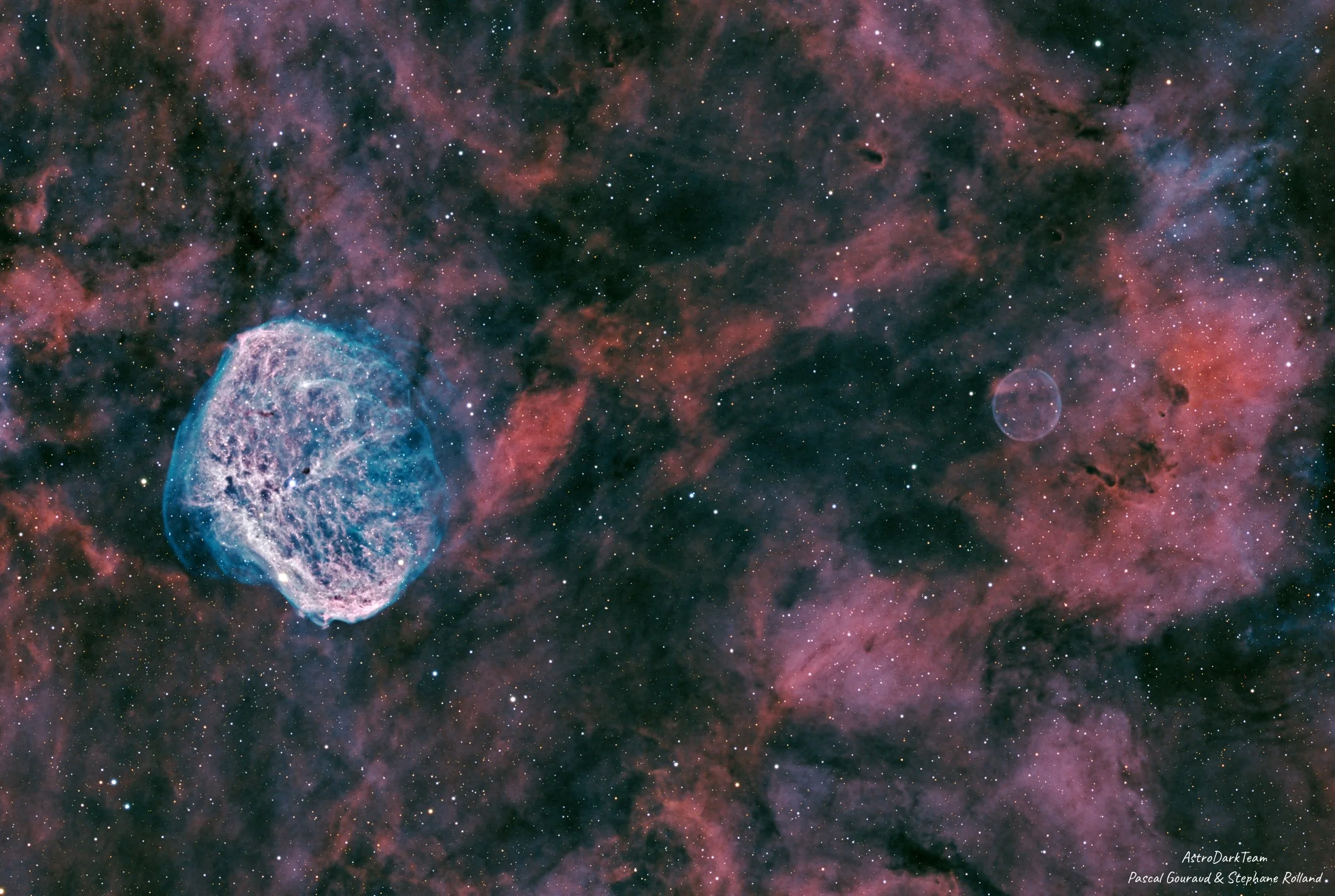
Image Description and Details : Our 7th deep sky target, imaged from the remote observatory in Portugal by the AstroDarkTeam composed of Pascal Gouraud and Stéphane Rolland.
We have been installed 18 month ago and already more than 550 hours of imaging!
Thanks again to the French Astro ARO team for the efficient and effective management of this superb site that hosts us.
We propose this time the Crescent Nebula (on the left) and the Soap Bubble Nebula (on the right),these two beauties of the sky evolve within an ample clouds of gas and dust drift through rich star fields along the plane of our Milky Way Galaxy toward the Cygnus constellation.
Technical Details :
239 images for a total of 30 h have been integrated between the September 22th 2022 and the November 05th 2022. To build this HOO image, we used 9.5 h for HA, 12.75 h for OIII, 2.75 h for R, 2 h for G, 2.75 h for B from a TOA telescope 130mm in diameter, 1000mm focal length, Moonlite Nightcrawler 35 focuser/rotator,
ASI2600MM monochrome camera cooled to -10 degrees, ZWO filter wheel with 36mm Chroma SHO 3nm and LRGB filters.
Autoguiding optical splitter ZWO with Camera ASI290MM, EQ8-R Mount Software MaxPilote, The Sky X Pro, Focus Max V3.
PixInsight processing.
Copyright: Copyright: AstroDarkTeam
Mirrored star trail
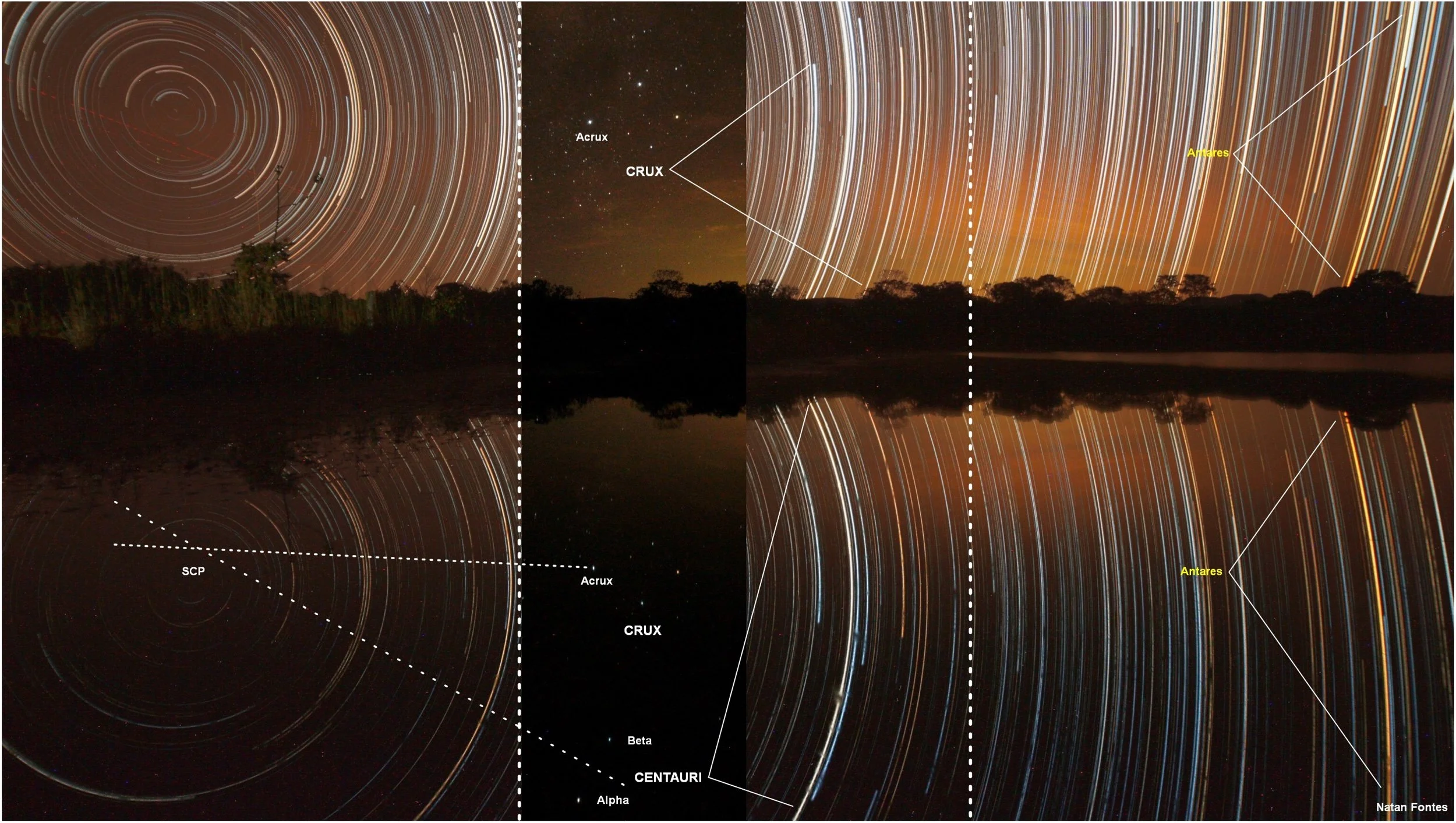
Image Description and Details : The constellation Crux, very present in the sky of the Southern Hemisphere, is the smallest of the 88 constellations (IAU), it served as an important point of reference for the location of the South direction, in the period of the great navigations, from the 15th century onwards.
The pole rotation records show the beautiful star trails, but hide the wonderful constellations, stars and planets that appear as curved lines. In this photo, the brightest star trails predominantly around the South Celestial Pole (SCP) appear, but also the beautiful constellations and stars that would otherwise be hidden. In the center, a part of one of the original photos was inserted to highlight the constellations Crux and Centaurus (Alpha and Beta) present during the capture, showing their star trails, both the upper part (of the sky) and the lower part ( of the lake), mirrored in a beautiful and serene lake.
On the right side of the photo, the star Antares, records a beautiful yellowish star trail.
At the bottom of the original photo (center) are the Crux and Centaurus constellation mirrored in the lake, with dashed lines (left), pointing to the region near the South Celestial Pole in mirrored form, recording a basic technique to find the region near the SCP.
The 1,136 photos that make up this record (over six and a half hours of capture) were taken in the Midwest of Brazil, during the 13th Brazilian Astrophotography Meeting (13th EBA – Encontro Brasileiro de Astrofotografia), in July 2022.
Equipment: Canon EOS REBEL T4i camera, with power bank, Bower 14mm ED AS IF UMC 2.8 lens, battery-powered lens heater and Manfrotto Fixed Tripod. Programs: Startrails, IrfanView 64 and Affinity Photo.
Copyright: Natan Fontes
Vela Widefield
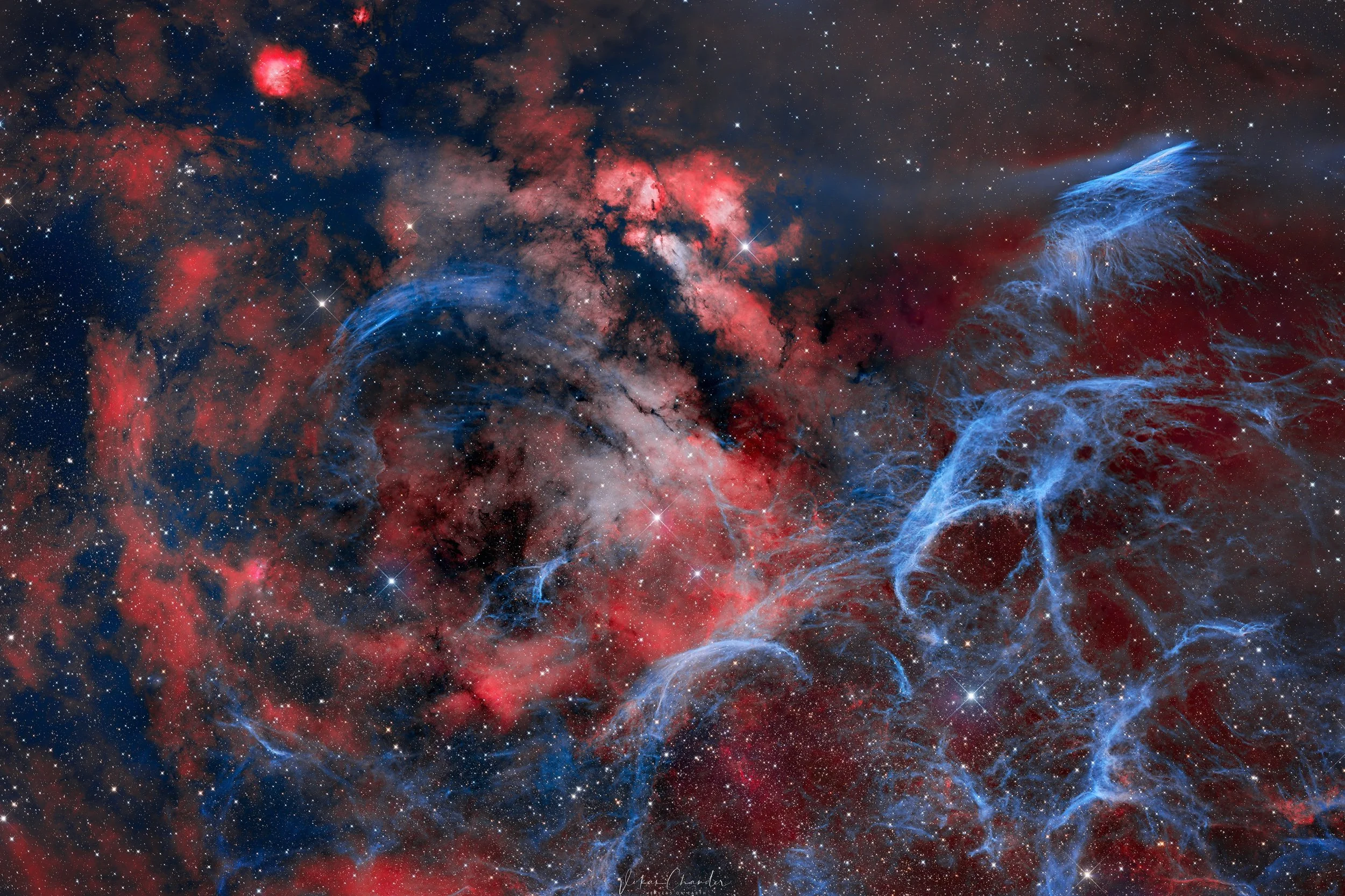
Image Description and Details : Vela Widefield!
Call me a widefield junkie if you will…. the wider the better !! And if it is in the Southern Hemisphere, then that’s the icing on the cake. This 2 panel mosaic spans about 6 degrees across a widefield region in the constellation of Vela. The blue gas clouds are from the remnants of the Vela Supernova and one can see NGC 2736, or the Pencil Nebula glow brightly on the right of the frame. The nebula's shape suggests that it is part of a supernova shock wave that has encountered a region of dense gas. It is this interaction that causes the nebula to glow and form ripples. RCW 38 dominates the center of the frame and is an HII region with dark clouds enshrouding recently formed stars. The gases and clouds come together to form a rich tapestry of glowing reds and dark blacks. Also seen in the image are RCW 39 and 40 amongst lots of other fine details…..
Telescope: Takahashi E160ed
Camera: Zwo 6200mm pro
Mount: Software Bisque Paramount MX+
Observatory : Deep Sky Chile
2 Panel Mosaic
L = 300s x 36
R= 300s x 24
G= 300s x 24
B= 300s x 24
Ha = 300s x 24
Oiii = 600s x 24
Total integration = 15hrs per panel, 30hrs total
Software = NINA, Pixinsight
Copyright: vikas chander
Towards Orion
"Towards Orion"
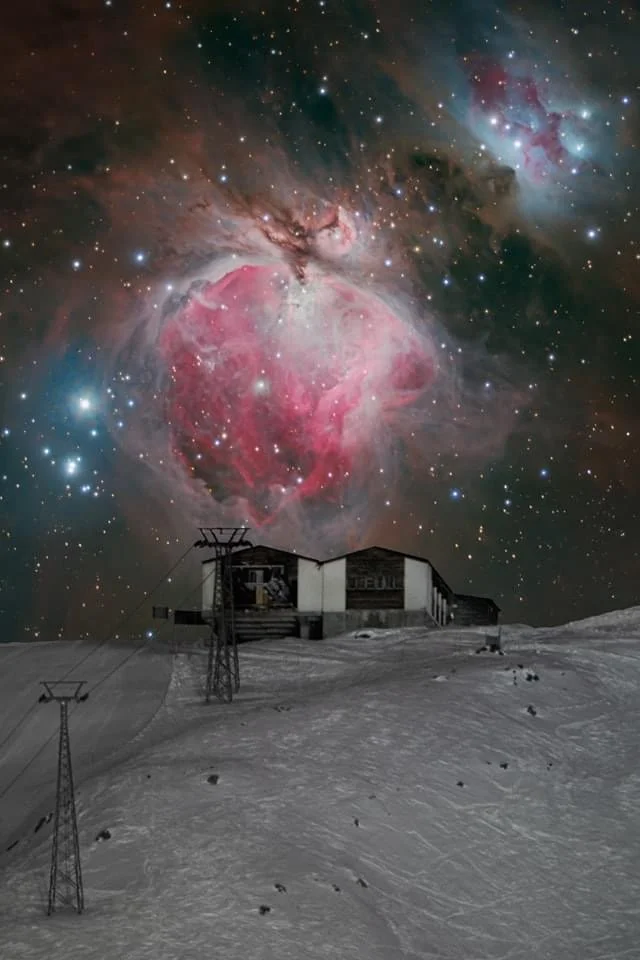
Befor you draw your conclusions, let me explain this image: The sky and foreground were captured back to back at the same focal length and with the same equipment from a single tripod position.
The camera position was roughly 2 miles away from the mountain station, and the telescope/camera combination has an extremely narrow field of view of only 1.5° x 2°. The resulting telephoto compression makes the otherwise tiny Orion Nebula appear huge.
Two years ago, I had already captured a similar deepscape, but I was never really satisfied with it. The problem was lacking data for my sky, especially in the green channel, as clouds moved in towards the end of the imaging session.
Of course, I could have recaptured the missing data or the entire Orion Nebula from a different place, but that's not my style. After waiting two years for an opportunity to reshoot the image, I finally got my chance this February.
The weather this time was perfect, which made capturing the sky pretty straightforward, but otherwise, the conditions were still as demanding as 2 years ago.
Getting the foreground in focus with a monochrome micro 4/3rd astro-cam and RGB filters through a 500mm f/5.6 telescope is a real pain. Furthermore, snowcats grooming the slopes caused constantly changing, extremely bright illumination. Considering this, I am quite happy that I was able to capture a usable foreground.
EXIF
Cameta: ZWO ASI 1600MM Pro (cooled monochrome MFT astro-cam)
Telescope: William Optics Megrez 88 (500mm f/5.6)
Filters: Baader HaRGB
Other equipment: ZWO EFW and EAF
Autoguider: ZWO ASI 385MC
Mount: Equatoriallly mounted Skywatcher AZ-GTI
Rig control: ASIair
Sky:
25min RGB (each) (30s, 10s & 3s subs)
21min Ha (7 x 180s)
Foreground:
5x 60s RGB (each)
10 x 60s Luminance
Copyright: Ralph Rohner
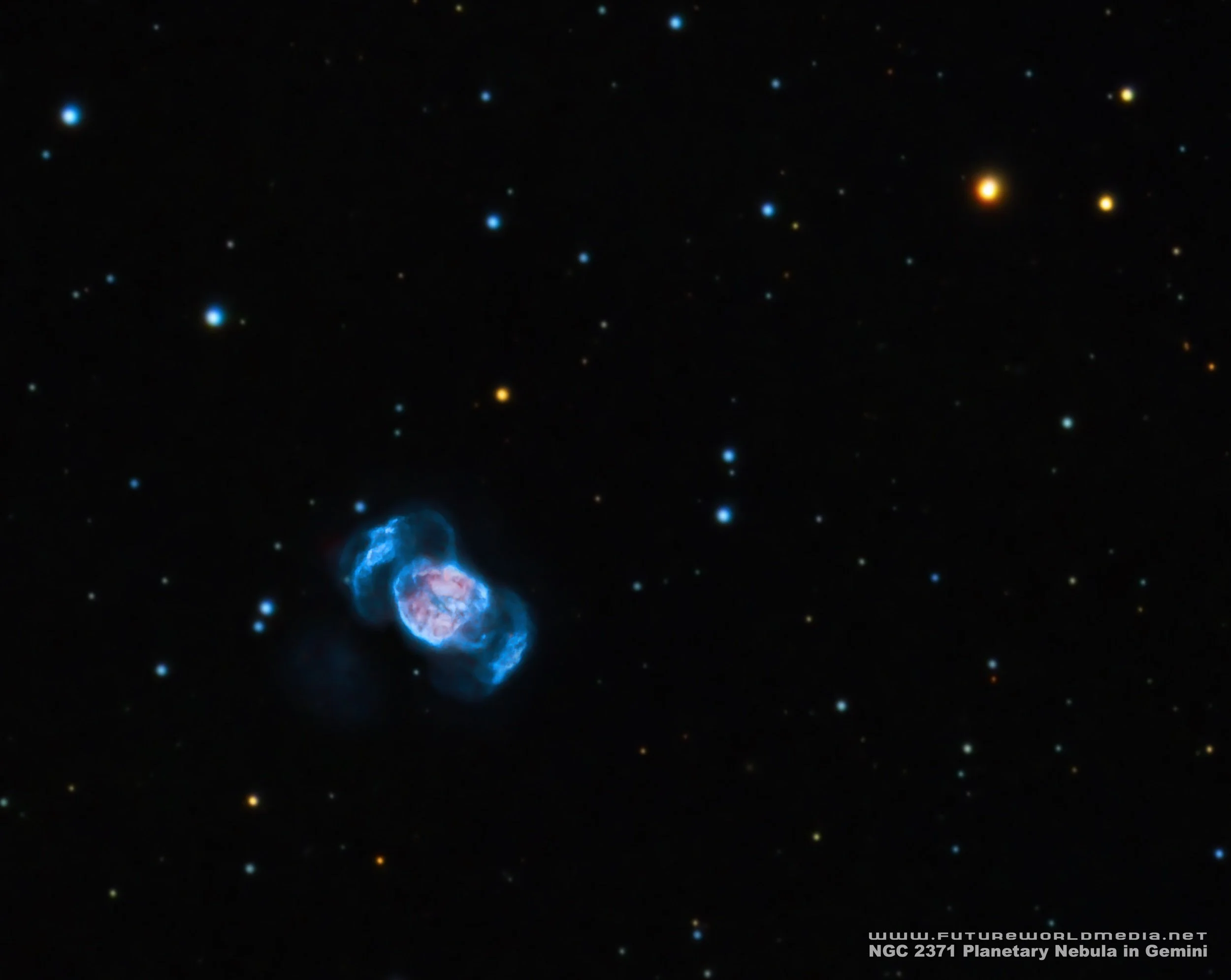
NGC 2371 Planetary Nebula
Image Description and Details : I first attempted this tiny planetary nebula back in 2019.
I decided to attempt it again by piling on more data, adding in RGB for star color and even tried drizzling the data at 3x instead of 2x. I am much happier with the results. It still took a lot of massaging of the data to get it where I wanted it to be, however.
NGC 2371 is a planetary nebula, the glowing remains of a Sun-like star. The remnant star visible at the centre of NGC 2371 is the super-hot core of the former red giant, now stripped of its outer layers. Its surface temperature is a scorching 240,000 degrees Fahrenheit. NGC 2371 lies about 4,300 light-years away in the constellation Gemini. It is one of the largest planetary nebulas known, measuring roughly three light-years across.
It confused astronomers when it was first studied. Rather than being classified as a single object, it was instead recorded as two objects, named NGC 2371 and NGC 2372, owing to its symmetrical lobed structure.
It is filled with dense knots of gas, fast-moving jets that appear to be changing direction over time, and expanding clouds of material streaming outwards on diametrically opposite sides of the remnant star.
Copyright: Douglas J Struble
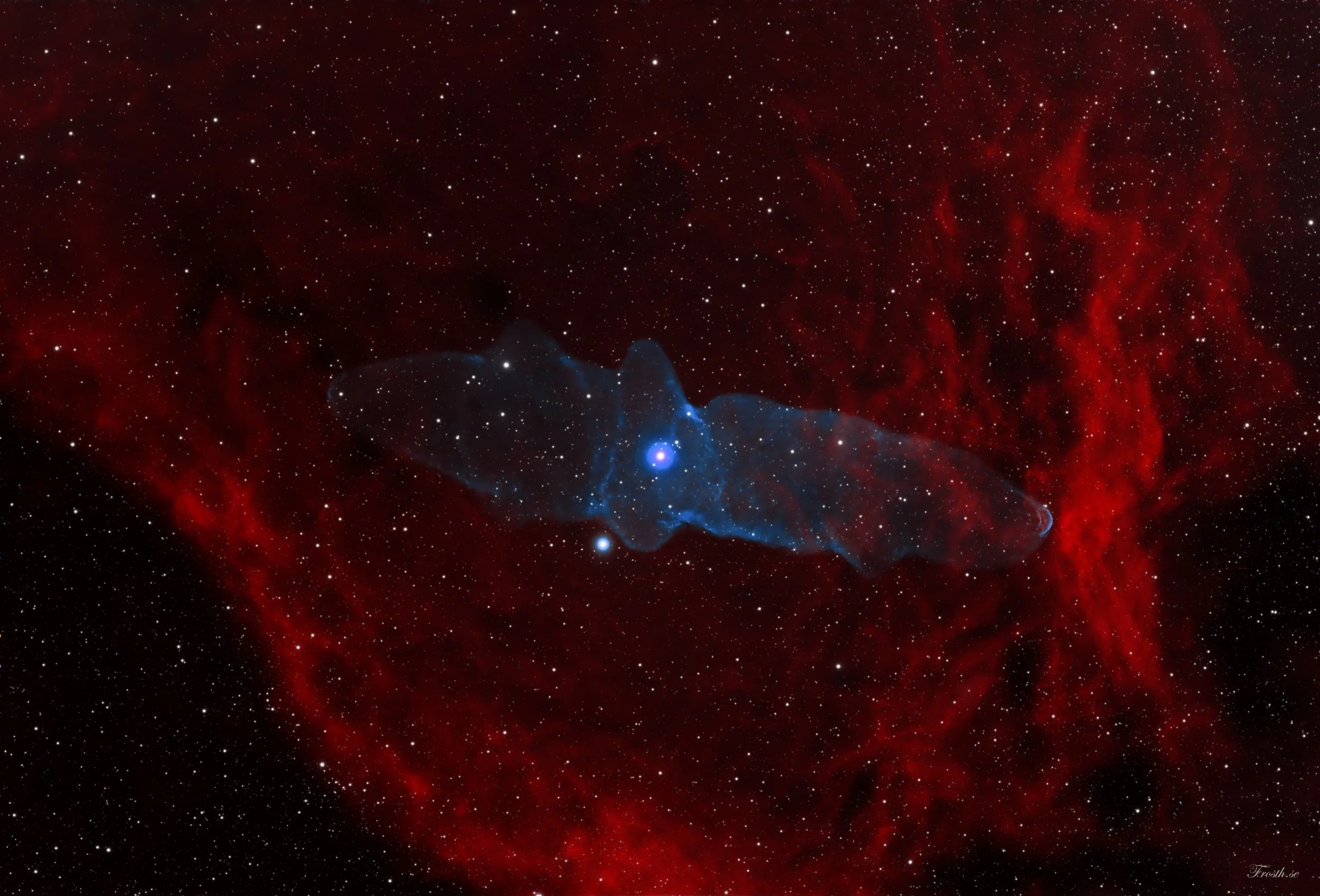
SH2-129 & OU4 - Flying Bat & Squid Nebula
Image Description and Details : Data gathered at 13 different nights between 2023-01-01 and 2023-03-30.
Data for this image: 197x300s Ha, 181x300s O-III.
Total number of exposures 378 with a total integration time of 31,5 hours.
Processing: PixInsight with ForaxX HO palette with HA stars.
Equipment: SkyWatcher EvoStar 80ED Pro (0,85x FR/FF) and ZWO ASI294MM Pro on SkyWatcher HEQ5 Pro with SkyWatcher EvoGuide 50ED and ZWO ASI120MM Mini. ZWO Ha and OIII filters.
Copyright: Mårten Frosth
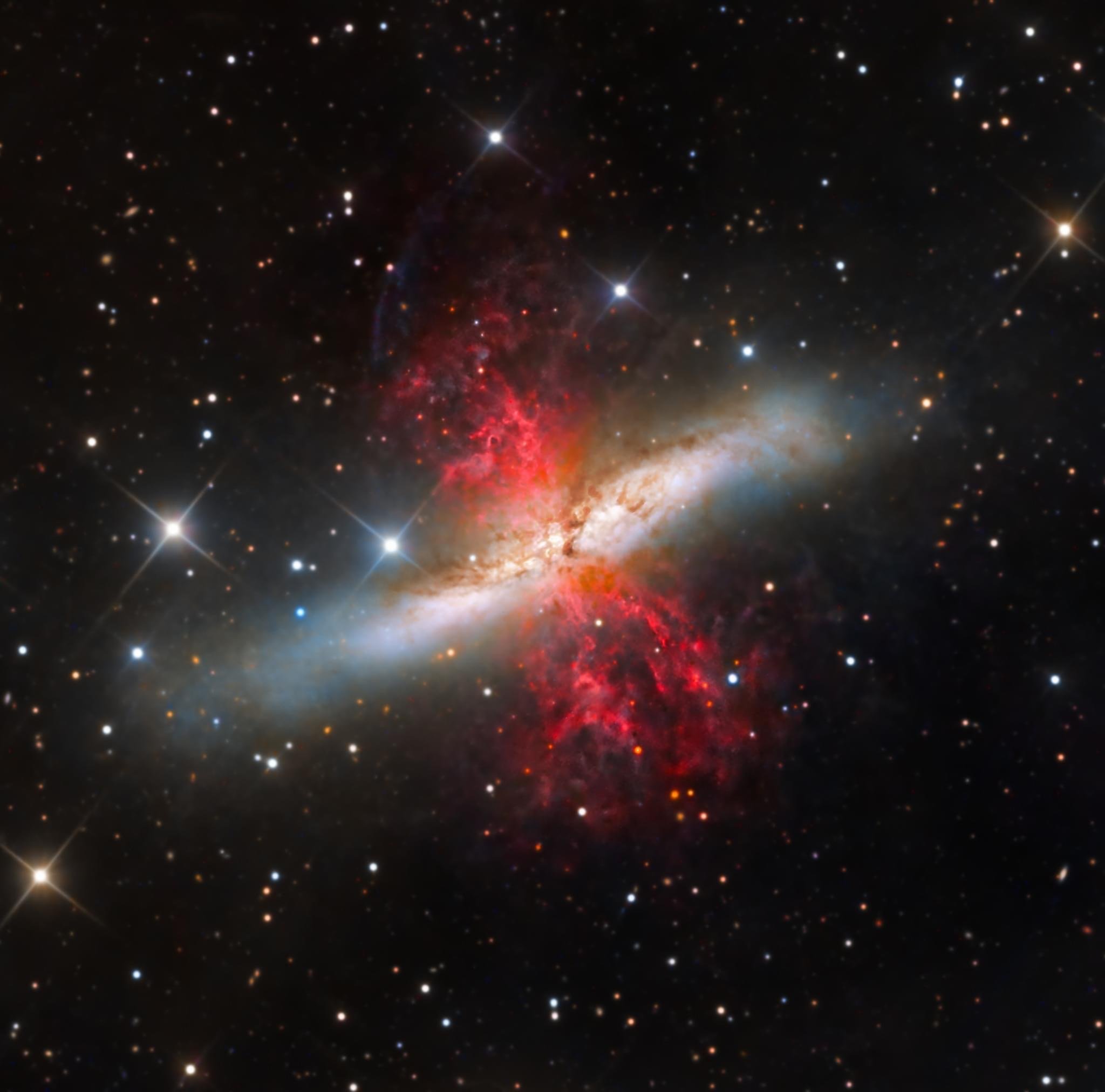
M82
Image Description
This is an image of M82, also known as the Cigar Galaxy. It is a starburst galaxy about 12 million light years away in the constellation Ursa Major. It is about five times more luminous than the Milky Way and its central region is about one hundred times more luminous. The starburst activity is thought to have been triggered by interaction with neighboring galaxy M81.
January 21 - February 22, 2017
December 16, 2021 - January 26, 2022
Location: Rancho Hidalgo, NM
Telescope: Planewave CDK-17
Camera: Apogee CG16M (2017 Data)
Camera: FLI PL16803 (2022 Data)
Mount: Paramount ME
Luminance: 59x20 minutes (binned 1x1)
Ha: 12x30 minutes (binned 1x1)
Red: 28x15 minutes (binned 1x1)
Green: 27x15 minutes (binned 1x1)
Blue: 28x15 minutes (binned 1x1)
Copyright 2023 Bernard Miller
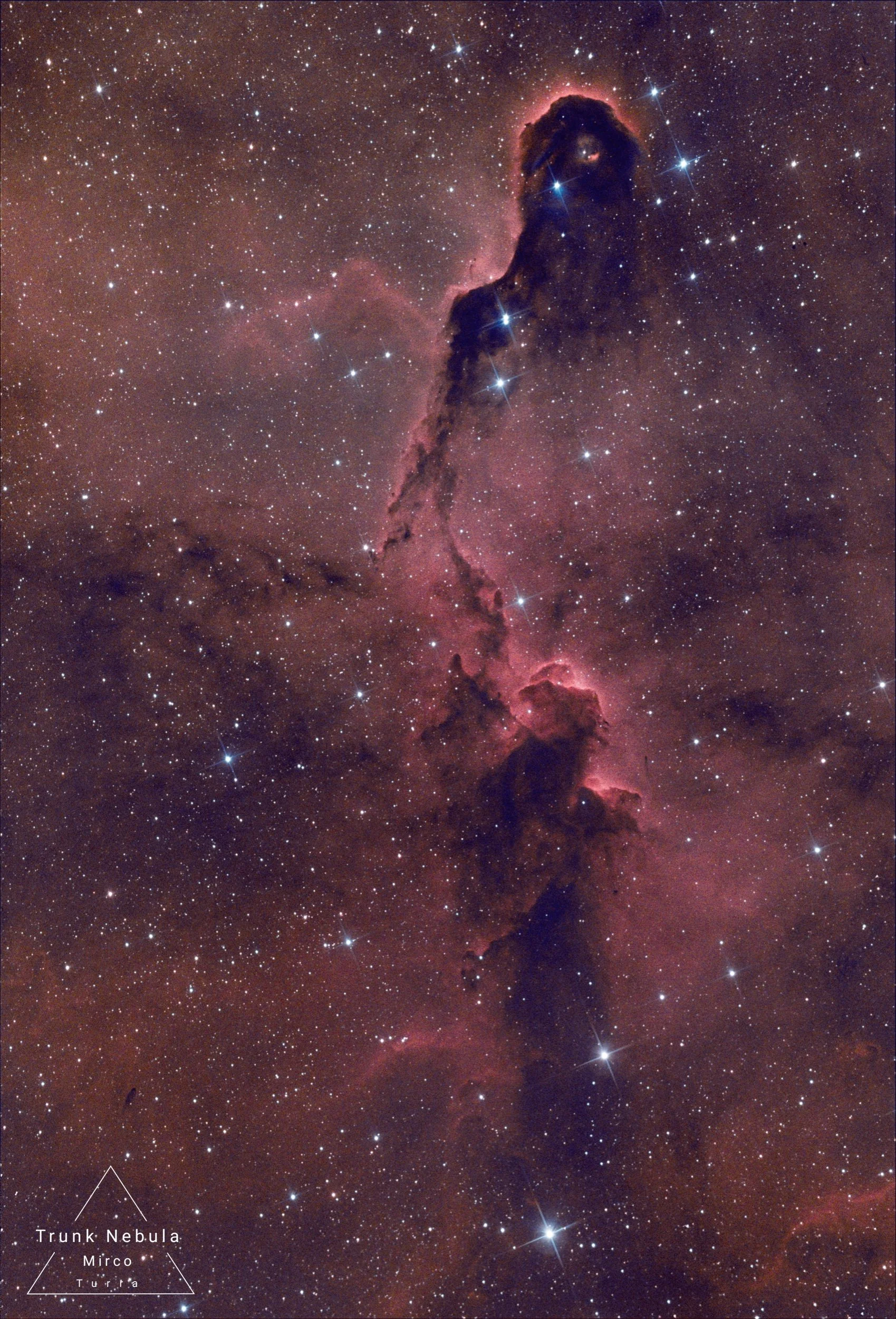
Elephant Trunk Nebula
Image Description and Details : Nebulosa Proboscide di Elefante IC1396 nella costellazione di Cefeo.
Newton 10' f5
Neq6 pro
Asi294Mc Pro T 0°
Guida Asi224Mc
Filtro L_eNhance
Light 45x300"
Dark 21
Flat 31
Acquisizione N.I.N.A.
Post DSS, Pixinsight, Photoshop Camera Raw
Scatto prima periferia di Ferrara Bortle 5.5
Copyright: mirco turra
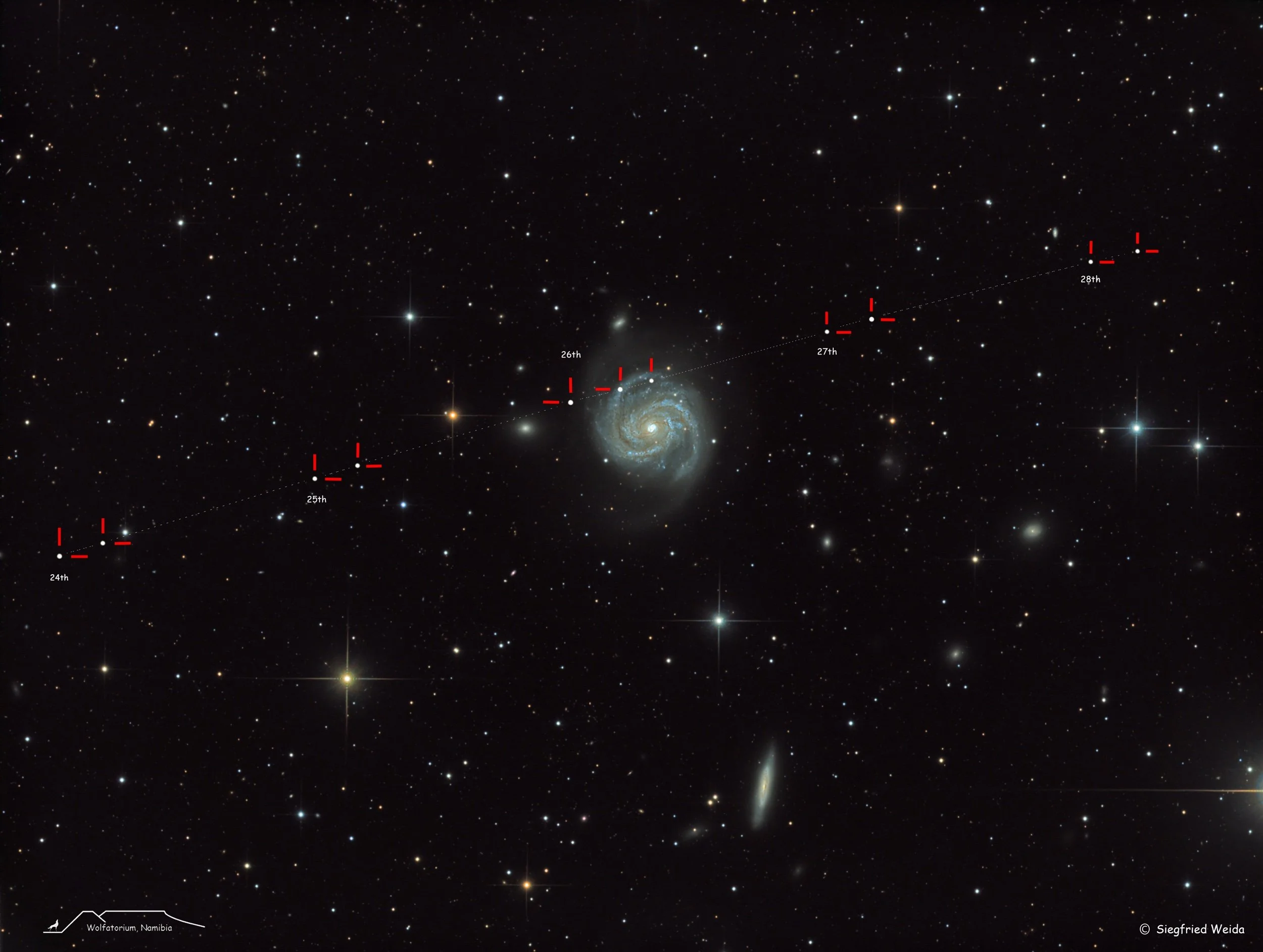
Ceres meets Galaxy
Image Description and Details : The Dwarf Planet or Asteroid CERES crossed my field of view of the galaxy M100 in constellation coma berenices from 24th to 29th of March 2023, imaging from Augsburg (Germany) with the private remote scope "Wolfatorium" in Hakos, Namibia. To document this "transit", short images where taken at 21.00 and 1.00 CET every day. Additional images were taken at 4.30 on the night of crossing the galaxy. The whole field was imaged with much longer exposures for two nights before CERES entered the frame. The Asteroid images were made starless and the single - strong dimmed - CERES copied into the galaxy frame.
Telescope: 10"-Newtonian f/4
Camera: ASI 1600 MM Pro @ -15°C & gain 139/10
Filter: Baader L-RGB
Galaxy: L 84 x 120s, RGB 24 x 60s each
CERES: LRGB 1s each
Processing: PixInsight, Photoshop
Copyright: copyright: Dr. Siegfried Weida

Maffei I & II galaxies
Image Description and Details : Maffei I and II Galaxies.
Shots taken with RC8" 0.75x reducer.
QHY163M mono camera and IR685nm filter as luminance.
Star colors made with QHY163C color camera and L-PRO light pollution filter.
2 panels mosaic.
Technical details:
QHY163M with infrared pass filter IR685nm: 24 x 10min.
QHY163C with L-PRO filter: 20 x 3min.
Total whole mosaic shooting: 10 hours.
Both cameras were set with the following parameters: Gain= 300, Offset= 100, T= -25°C.
Made Dark, Flat and Dark-flat.
From my home: Vigevano (Pavia), Italy.
Copyright: Roberto Frassi