
AAPOD2 Image Archives
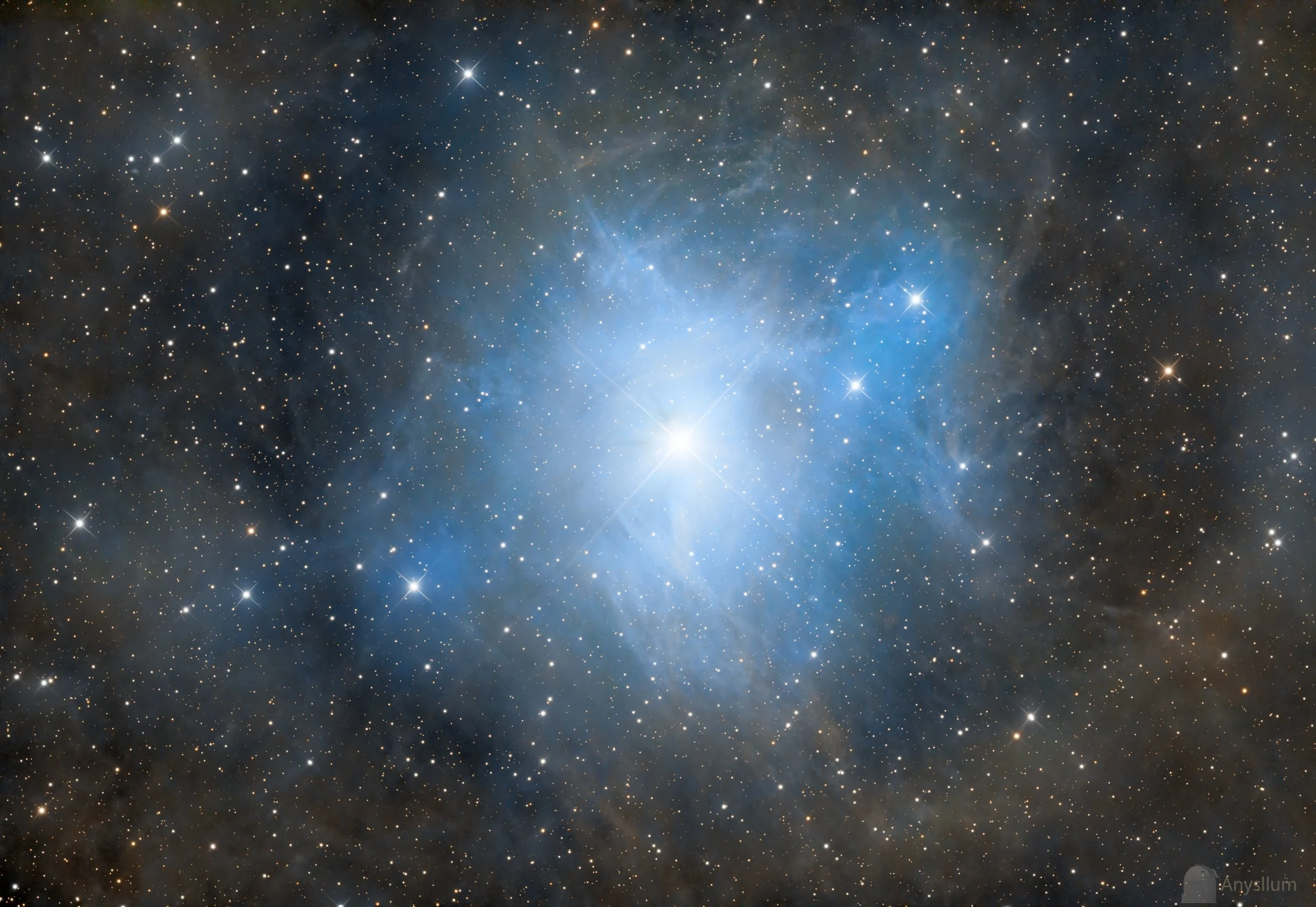
VdB 10 - Reflection nebula in Perseus
VdB 10, a striking blue reflection nebula in the constellation Cassiopeia, lies approximately 1,000 light-years away. This delicate nebula reflects the light of a nearby star, creating a soft, ethereal glow. Accompanying it is LBN 680, a faint and complex region of interstellar dust and gas. Together, these structures illustrate the interplay of starlight and cosmic material in the Milky Way, with VdB 10’s bright, scattered light contrasting beautifully against the darker, more subdued textures of LBN 680.
This view was captured from Ager in Lleida, Spain, using a personal telescope setup under pristine skies. The intricate details of these nebulae require long exposures to reveal their subtle beauty, making them a rewarding target for astrophotographers. The scene highlights the hidden treasures of the night sky, where seemingly empty spaces come alive with light, shadow, and the whispers of star-forming processes.

The Star Clusters of Cassiopeia: A Stellar Showcase
The rich starfields of Cassiopeia host a stunning array of celestial wonders, highlighted by the open star clusters NGC 654, NGC 659, NGC 663, and IC 166. These clusters, lying roughly 7,000 to 8,000 light-years away, are scattered across the Perseus arm of the Milky Way, each hosting dozens to hundreds of young, hot stars. Their bluish hues and tight groupings stand out against the dense backdrop of the Milky Way, making them a captivating sight for both observers and astrophotographers.
Adding depth to the scene are several dark nebulae, including LDN 1337, whose dense clouds of interstellar dust obscure the light from stars behind them. Captured from Hannover, Germany, using a personal telescope setup, this view combines bright and dark regions to showcase the complexity of our galaxy’s structure. The interplay of vibrant star clusters and shadowy nebulae reminds us of the dynamic processes shaping the cosmos, from star birth to the formation of intricate dust clouds.
Saturn and the Moon: A Celestial Encounter
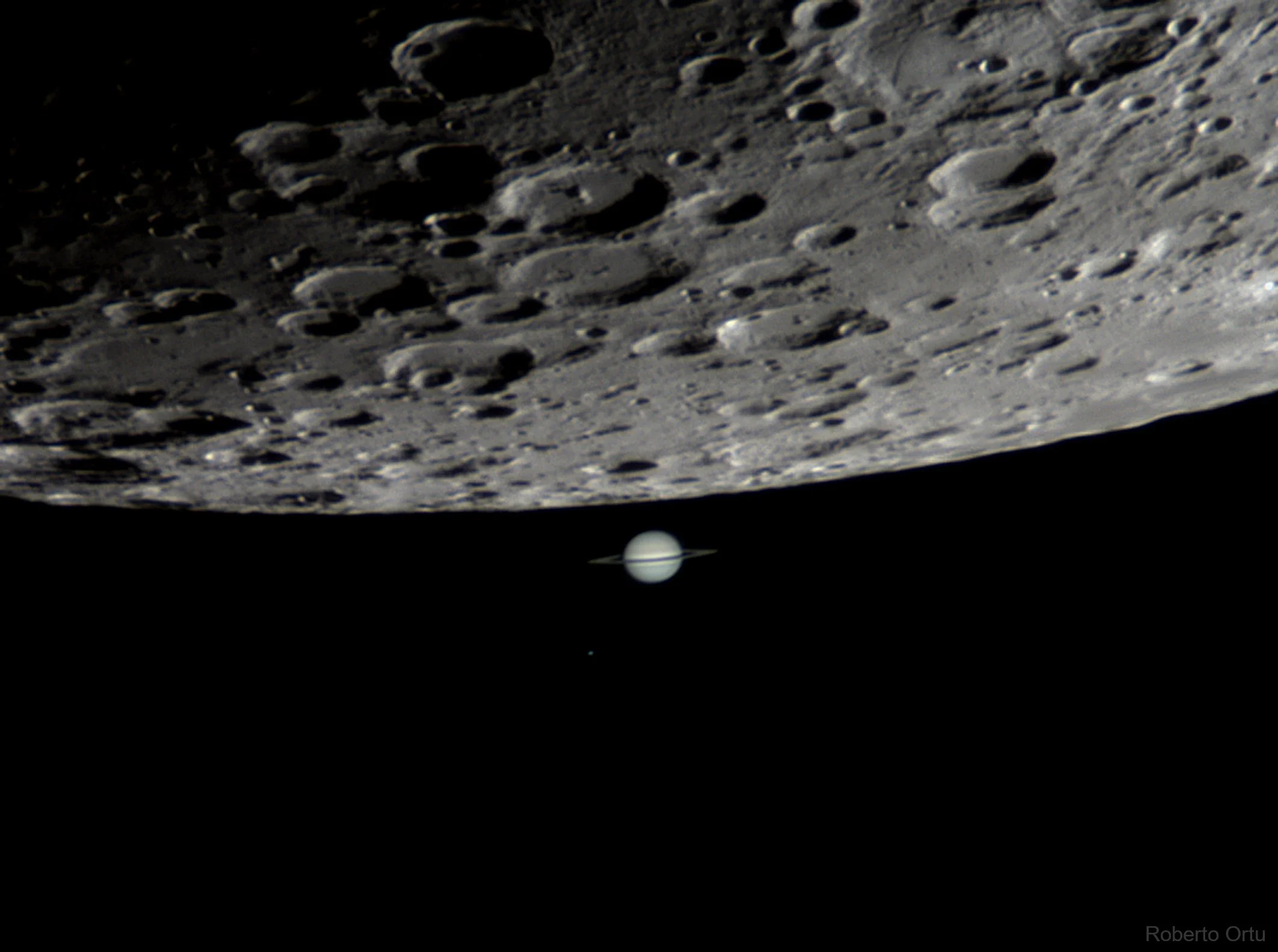
On January 4, 2025, Saturn emerged from behind the Moon in a breathtaking occultation event. Captured at this moment, the southern lunar surface showcases its densely cratered terrain, including striking features such as Clavius and Tycho, whose dramatic shadows accentuate the Moon’s rugged beauty. Saturn, with its iconic ring system tilted gracefully, adds a touch of elegance to this dynamic scene, its golden hue contrasting against the stark, gray lunar surface.
Nearby, the bright star 85 Aquarii adds its light to the composition, a distant companion to this celestial alignment. Such occultations provide a rare and awe-inspiring perspective on the Solar System, illustrating the intricate motions of planetary bodies as viewed from Earth. The juxtaposition of the Moon’s craters, Saturn’s rings, and the distant starlight reminds us of the vast scales and intricate beauty of the universe.
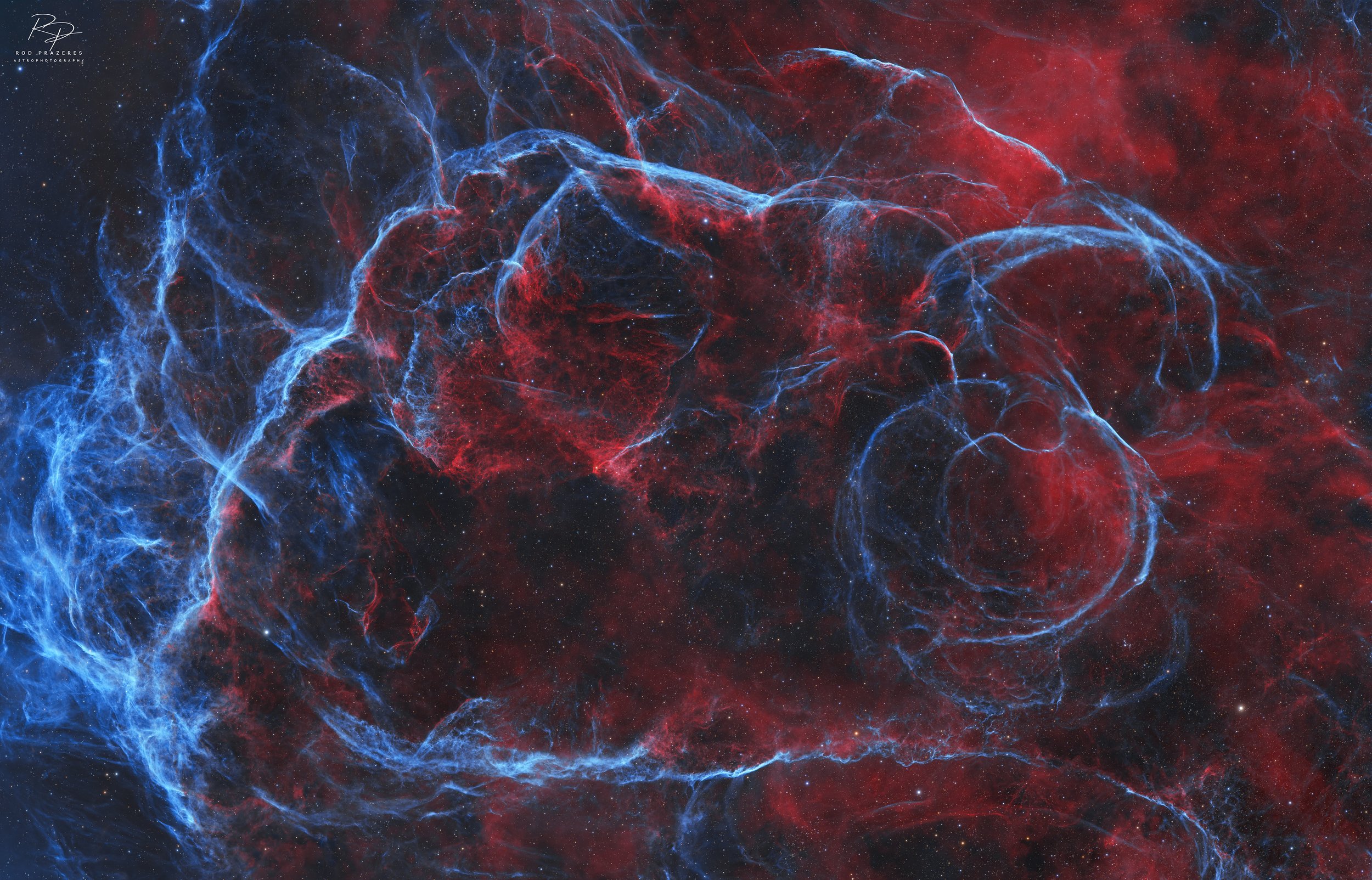
A Supernova’s Legacy": GUM 16 - Vela SNR
Gum 16, an expansive emission nebula in the constellation Vela, lies intertwined with the Vela Supernova Remnant, a spectacular tapestry of gas and dust created by the explosive death of a massive star approximately 11,000 years ago. Gum 16 is part of the greater Gum Nebula, one of the largest known emission regions, spanning hundreds of light-years. Within this complex lies the legacy of stellar death and renewal, as shockwaves from the supernova interact with nearby molecular clouds, triggering new star formation.
Captured from Hillcrest, QLD, Australia, under Bortle 6 skies, the intricate details of this region are revealed through a mix of glowing hydrogen gas and tangled filaments of the supernova remnant. The Vela Pulsar, a rapidly spinning neutron star, continues to energize the surrounding material with powerful jets of radiation. Together, Gum 16 and the Vela SNR present a vivid portrait of the interconnected life cycles of stars, where destruction becomes a catalyst for creation in the ever-changing cosmos.
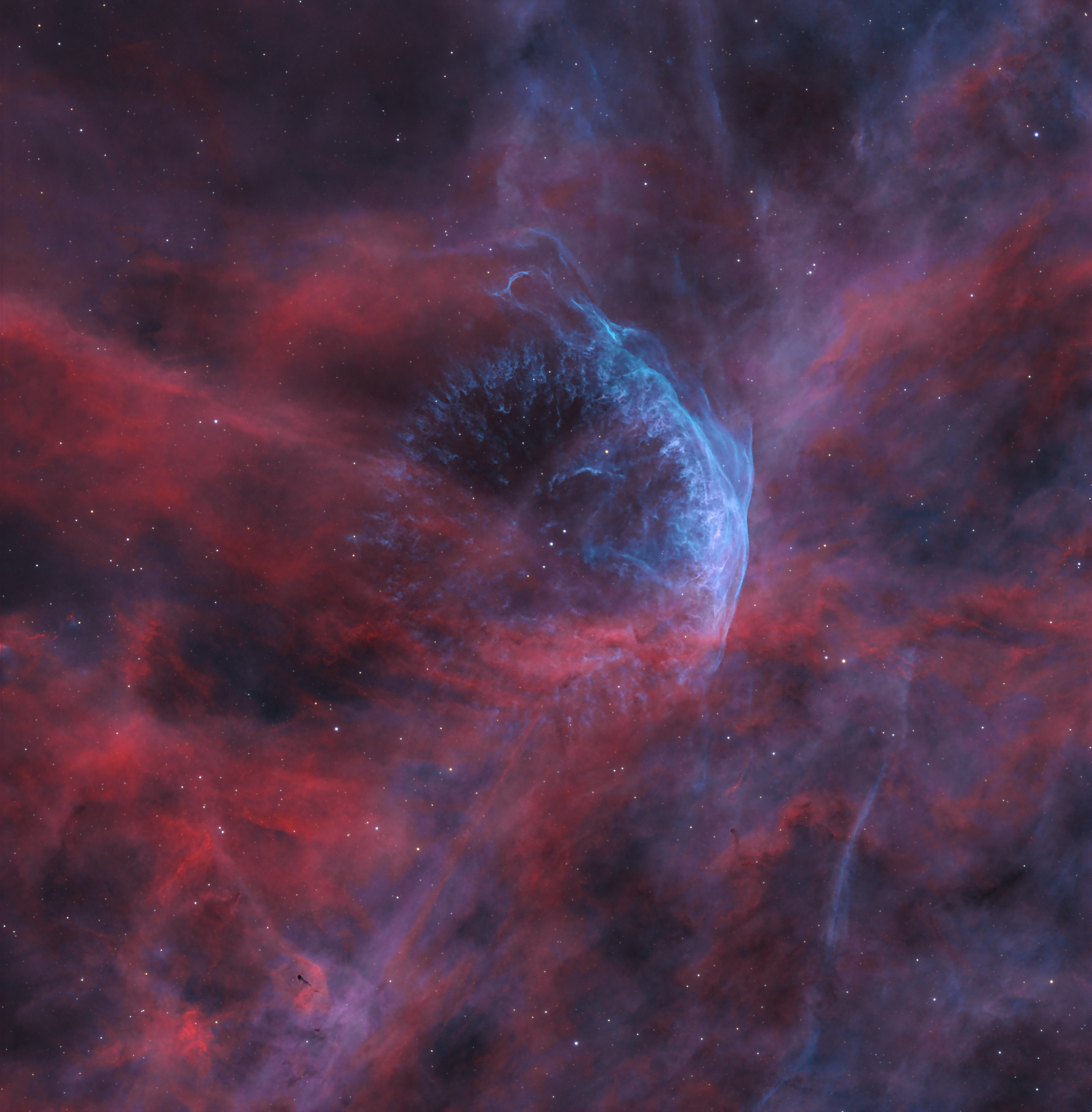
WR134 and her friends (94 hours)
WR 134, a massive Wolf-Rayet star in the constellation Cygnus, anchors a dramatic cosmic scene surrounded by her "friends"—neighboring stars and intricate nebulae shaped by their stellar winds. This luminous blue star, approximately 6,000 light-years away, is in a late, short-lived phase of stellar evolution, shedding mass through intense winds at speeds exceeding 1,000 kilometers per second. The energetic interactions between these winds and the surrounding interstellar medium have sculpted a delicate bubble of ionized gas, glowing faintly in hydrogen-alpha light.
This stunning portrait of WR 134 and her companions was the result of a collaborative 94-hour imaging effort by four amateur astrophotographers. Working together with hydrogen-alpha and oxygen-III filters, they captured the faint structures surrounding WR 134, along with contributions from nearby Wolf-Rayet stars like WR 135 and WR 136. Their combined skill and dedication reveal the ephemeral beauty of massive stars near the end of their lives, enriching the cosmos with heavy elements and energy as they prepare for their ultimate fate as supernovae.
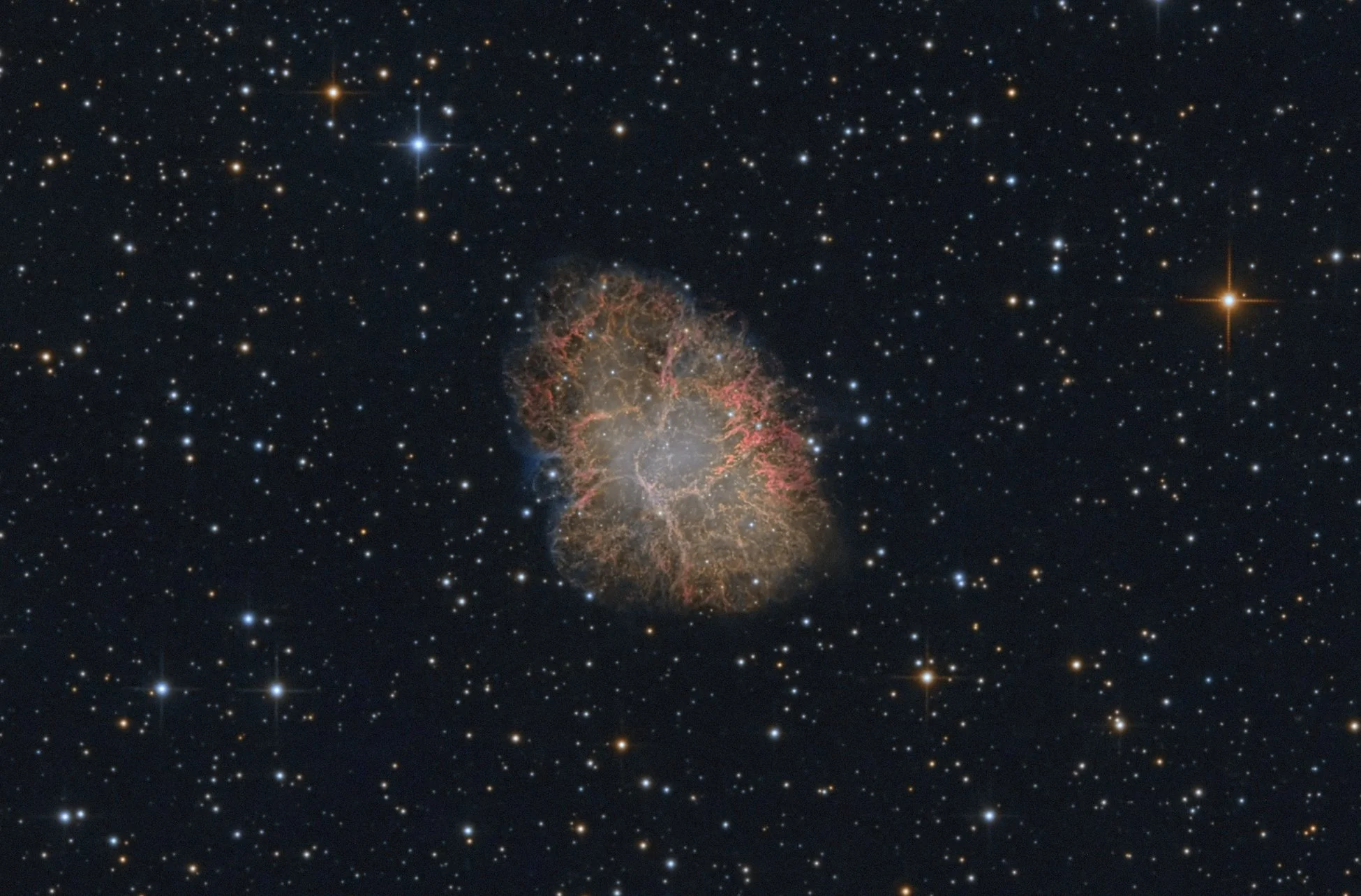
M1 - Crab nebula
M1, the Crab Nebula, is a supernova remnant located in the constellation Taurus, approximately 6,500 light-years away. This cosmic cloud of gas and dust marks the explosive death of a massive star, first observed as a supernova in 1054 CE by astronomers across the globe. At its core lies a rapidly spinning neutron star, or pulsar, emitting beams of radiation that sweep across space like a lighthouse, energizing the surrounding nebula and causing it to glow brightly in multiple wavelengths.
Observed from Hofheim near Frankfurt, Germany, M1 reveals a fascinating blend of structure and color. The filaments of the nebula, rich in hydrogen and helium, are interwoven with heavier elements like oxygen and sulfur, ejected during the supernova. The nebula continues to expand at nearly 1,500 kilometers per second, offering a dynamic view of the aftermath of stellar destruction. Despite its tumultuous origin, the Crab Nebula stands as a beacon of cosmic renewal, illuminating the intricate cycles of life and death in the universe.
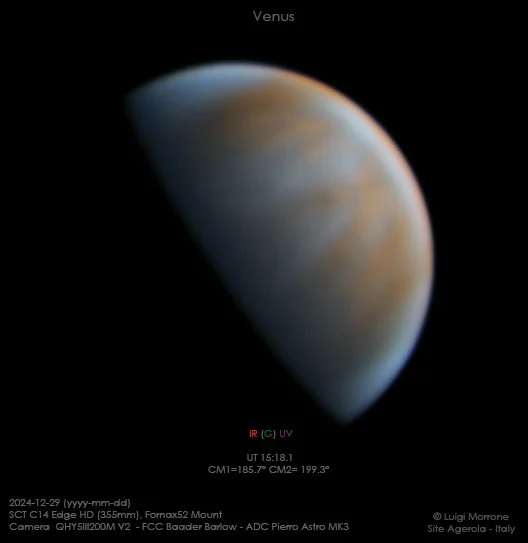
Venus color
Captured under excellent seeing and transparency on December 29, 2024, this image of Venus reveals its elusive cloud structures in both the near-infrared and ultraviolet bands. The planet’s thick carbon dioxide atmosphere, shrouded in layers of reflective sulfuric acid clouds, displays striking contrasts when imaged across different wavelengths. In the ultraviolet (350 nm), high-altitude haze and dynamic cloud patterns are prominent, while the near-infrared (820-920 nm) highlights subtle thermal emissions and deeper atmospheric layers.
This detailed observation was made using a Celestron C14 Edge HD telescope mounted on a Fornax 52, paired with high-sensitivity equipment including the QHY5III200M V2 camera and Baader and Chroma filters. The advanced setup, combined with an ADC Pierro Astro MK3 for atmospheric dispersion correction, allowed for remarkable clarity. Taken from Agerola on the Amalfitan Coast of Italy, the image demonstrates the beauty and complexity of Venus’s atmosphere—a dynamic world constantly sculpted by fierce winds and solar radiation.

IC405-IC410 LRVB
IC 405, the Flaming Star Nebula, and IC 410, home to the Tadpoles, form a stunning pair of emission and reflection nebulae in the constellation Auriga, approximately 1,500 and 12,000 light-years away, respectively. IC 405 glows in rich reds and blues as ultraviolet radiation from the hot, massive star AE Aurigae excites hydrogen gas and scatters starlight off surrounding dust. Meanwhile, IC 410 showcases a pair of dense, tadpole-shaped structures—stellar nurseries shaped by intense stellar winds—set against the glowing hydrogen background.
Captured under the skies of Provence-Alpes-Côte d’Azur, France, these nebulae highlight the dramatic interplay between young stars and the interstellar medium. Their contrasting hues and forms—IC 405’s flowing, fiery streaks versus IC 410’s compact, textured clusters—offer a vivid portrait of stellar evolution. Together, they exemplify the creativity of the cosmos, crafting beauty from chaos in the vast expanse of Auriga.
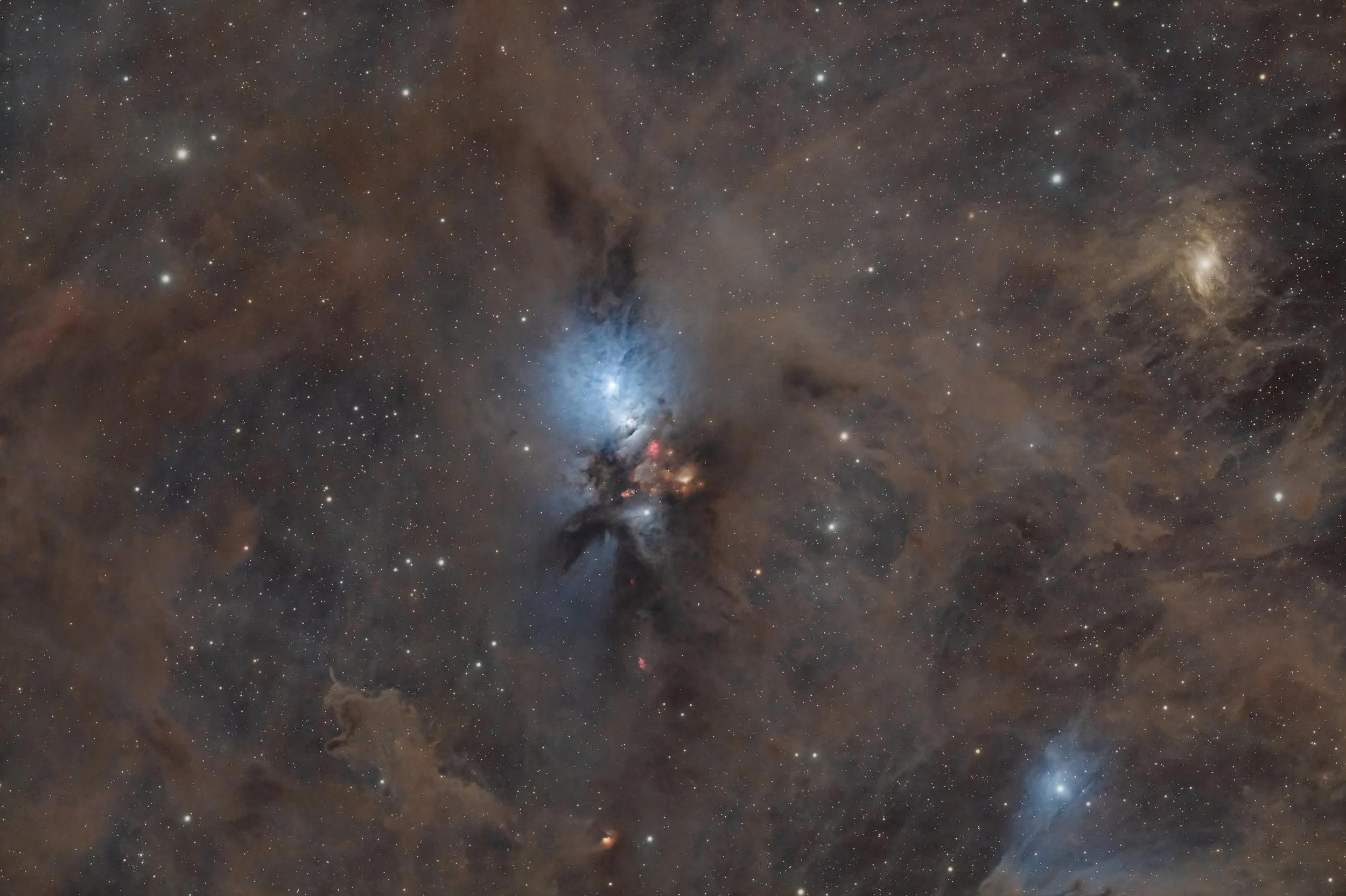
NGC1333
NGC 1333, a vibrant reflection nebula in the Perseus molecular cloud, lies approximately 1,000 light-years away. This stellar nursery is a hotbed of star formation, with newborn stars illuminating the surrounding gas and dust. The nebula’s bluish hue arises from the scattered light of these young stars, while embedded pockets of dark, dusty material hint at regions still collapsing under gravity to form new stellar systems.
Observed from Biars-sur-Cère in Occitanie, France, NGC 1333 offers a glimpse into the chaotic early stages of star birth. This region is teeming with energetic phenomena, including jets and outflows from protostars, which carve intricate structures into the surrounding material. Despite its relative proximity, the nebula remains a challenge for observers, requiring dark skies to fully appreciate its intricate blend of light and shadow—a dynamic portrait of cosmic creation.
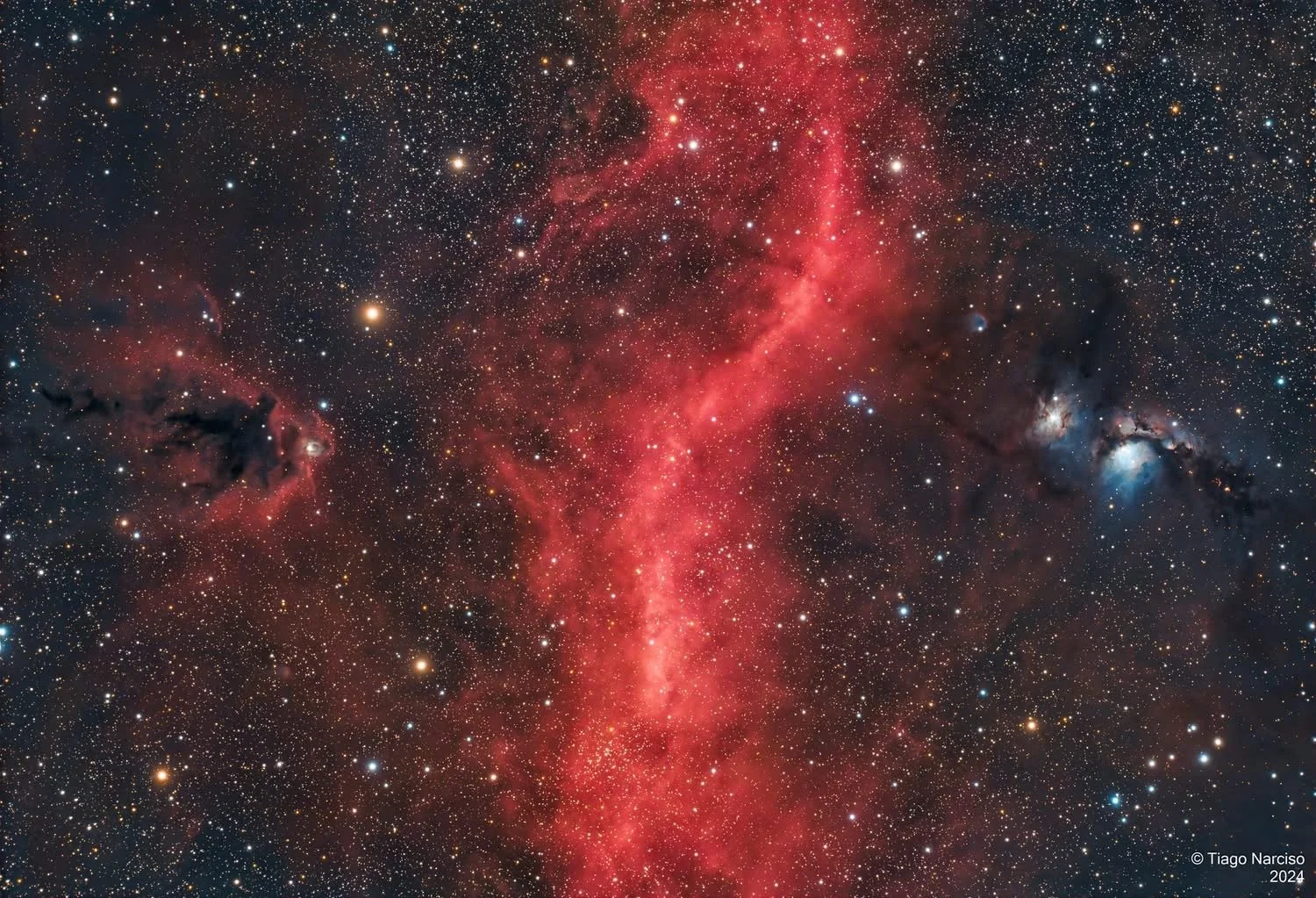
LDN 1622
LDN 1622, often called the Boogeyman Nebula, is a dark nebula located in the constellation Orion, approximately 500 light-years away. This enigmatic cloud of dust and gas blocks the light of background stars, creating a ghostly silhouette against the brighter regions of the Orion Molecular Cloud Complex. Its eerie shape has earned it its spooky nickname, but this nebula is far from lifeless—hidden within its dark tendrils are pockets of dense gas where new stars may be forming.
The Boogeyman Nebula is illuminated faintly by scattered starlight and the glow of nearby young stars, giving it a subtle, reddish hue in long-exposure images. Its proximity and position make it a fascinating but challenging target, as its dark nature requires excellent contrast and minimal light pollution to reveal its hauntingly beautiful details.
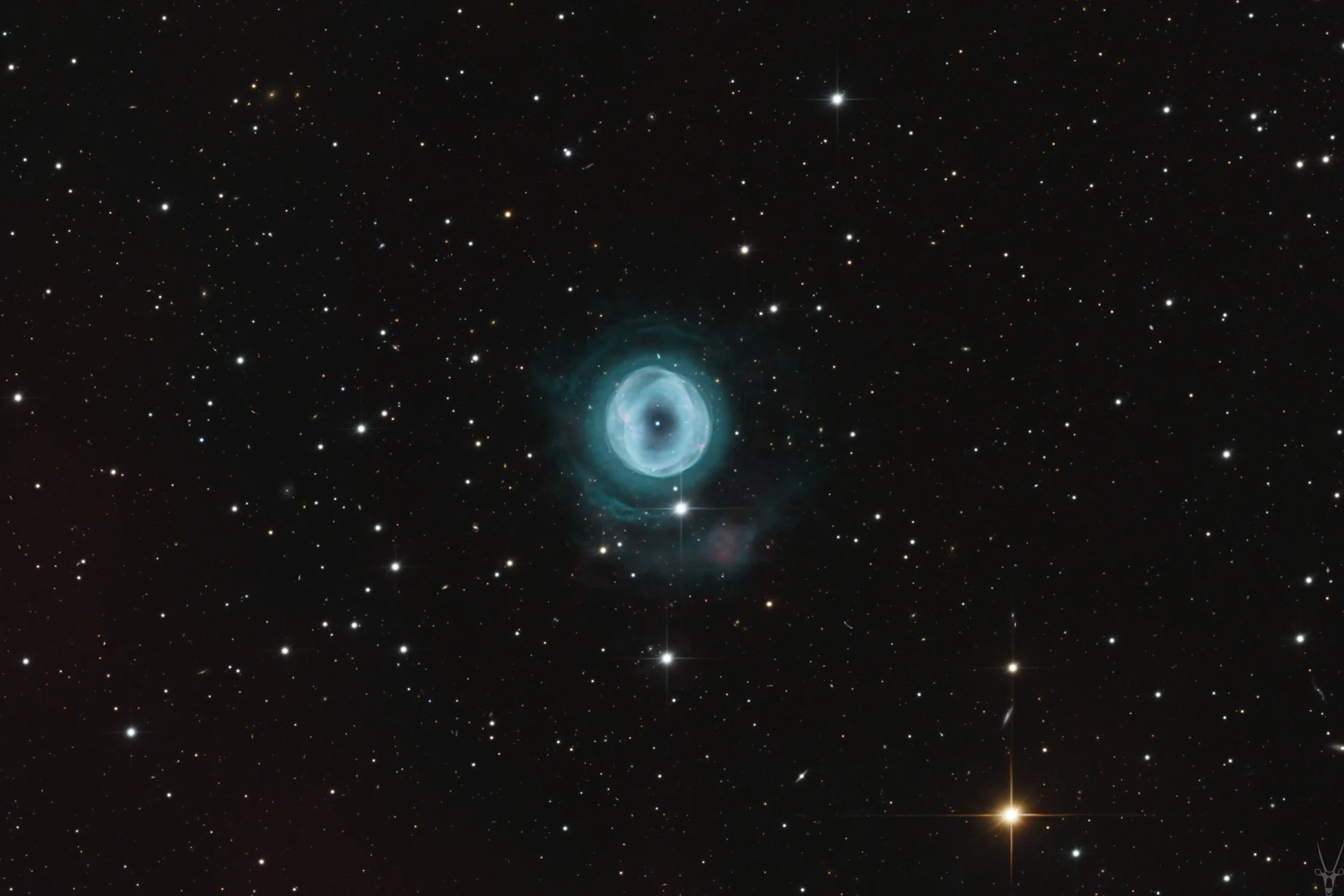
IC 5148
IC 5148, known as the Spare Tire Nebula, is a planetary nebula about 3,000 light-years away in the constellation Grus. This stunning object represents the final stages of a Sun-like star, shedding its outer layers as it transitions into a white dwarf. One of the fastest-expanding planetary nebulae known, its gas shell moves outward at an impressive 50 kilometers per second. The nebula's delicate, circular structure, with hues dominated by ionized oxygen, glows as ultraviolet radiation from its central star energizes the ejected material.
Located at Namibia’s Gemsbock Observatory, within the Rooisand Desert Ranch, IC 5148 benefits from some of the clearest skies on Earth, free of light pollution and ideal for deep-sky observation. Its faint, ethereal beauty is best captured under these pristine conditions, revealing its layered complexity and relatively young age of just a few thousand years. Discovered in the late 19th century, this celestial jewel offers a glimpse into the future of our Sun and the cyclical nature of stellar life in the cosmos.
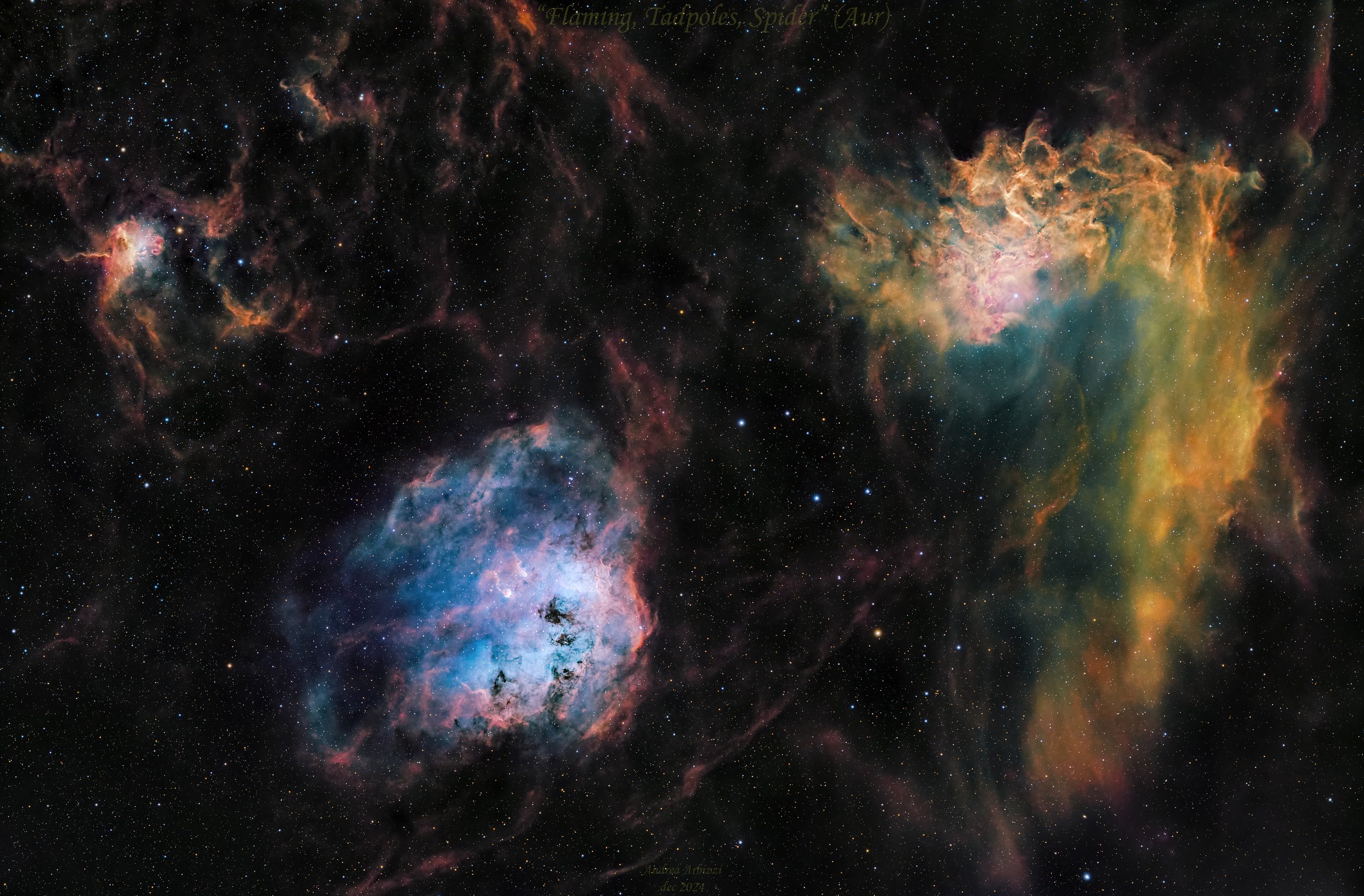
Flaming star, Tadpole and Spider” nebulae
Flaming Star, Tadpole, and Spider Nebulae
In the heart of the winter Milky Way, the Flaming Star (IC 405), Tadpole (IC 410), and Spider (IC 417) nebulae form a mesmerizing trio of emission and reflection nebulae in the constellation Auriga. These celestial marvels lie between 10,000 and 12,000 light-years away, offering a glimpse into the interplay of star formation and interstellar gas. The Flaming Star Nebula, energized by the bright star AE Aurigae, combines glowing hydrogen gas and blue reflection nebulae in a captivating display. Meanwhile, IC 410, home to the “Tadpoles,” showcases dense star-forming regions resembling their namesake creatures, shaped by stellar winds.
The Spider Nebula, IC 417, appears entwined with its companion, the Fly Nebula (NGC 1931), in a delicate dance of gas and dust illuminated by young, massive stars. Observed under light-polluted skies in Modena, Italy (SQM 18.4–18.8, Bortle 7.5–8), these nebulae challenge astrophotographers with their faint, intricate structures. Yet even here, the brilliance of this cosmic trio reminds us of the dynamic processes shaping the Milky Way, bridging vast distances with their light.
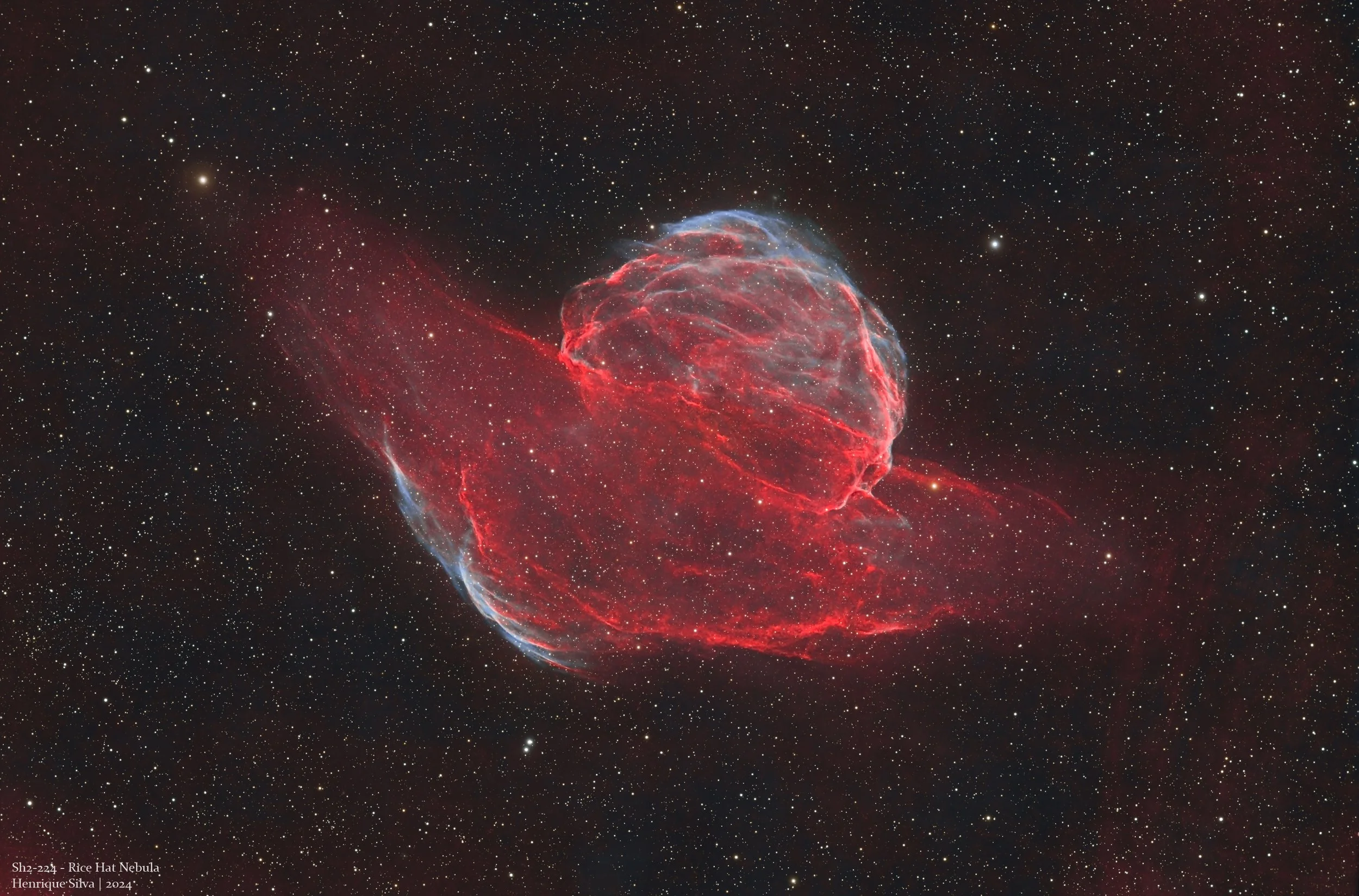
Sh2-224 -The Rice Hat nebula
Sh2-224: The Rice Hat Nebula
Sh2-224, whimsically nicknamed the Rice Hat Nebula, is a striking supernova remnant located in the constellation Auriga, roughly 14,000 light-years away. Its distinctive crescent-like shape, resembling a traditional rice hat, arises from the violent shockwaves and expanding shell of material left behind by a massive star’s explosive death. The intricate structure of Sh2-224 is the result of its interaction with surrounding interstellar material, carving out bubbles and filaments as the shockwave propagates outward.
Observed from Sabugo, Portugal, this faint and delicate remnant challenges observers under suburban skies. The nebula emits primarily in hydrogen-alpha light, revealing its glowing, reddish hues and intricate arcs. Sh2-224 is not just a visual marvel but also a glimpse into the power of supernovae, which seed the cosmos with heavy elements and drive the evolution of galaxies.

The Fly and The Spider
The Fly and The Spider Nebulae
Entwined in the constellation Auriga, the Spider Nebula (IC 417) and its smaller companion, the Fly Nebula (NGC 1931), form a fascinating pair of emission nebulae approximately 10,000 light-years away. The Spider’s sprawling, web-like filaments are regions of active star formation, shaped by stellar winds and radiation from its young, massive stars. Nearby, the compact Fly Nebula glows brightly, its core a mix of reflection and emission nebulae surrounding a dense cluster of newborn stars.
Captured from Strakonice, Czech Republic, these nebulae present a stunning contrast: the Spider’s sprawling, diffuse arms versus the Fly’s bright, concentrated glow. Together, they illustrate the dynamic processes at work in stellar nurseries, where gravity and radiation sculpt the interstellar medium into these complex, ethereal forms. Despite the light pollution, their intricate beauty shines through as a testament to the creativity of the cosmos.

The Sun after its maximum
This captivating mosaic of the Sun, composed of five meticulously aligned panels, offers a glimpse of our star as it begins to settle into a quieter phase following its solar maximum. The intricate textures of the solar surface, including active regions, sunspots, and swirling plasma, are captured in extraordinary detail. The dynamic chromosphere reflects the Sun’s immense power, even as it transitions to a more subdued state in its 11-year solar cycle.
What better way to celebrate the start of a New Year than by looking at the cosmic powerhouse that sustains life on Earth? Just as the Sun begins its gradual decline in activity, the arrival of January invites us to reflect on cycles of change and renewal in our own lives.
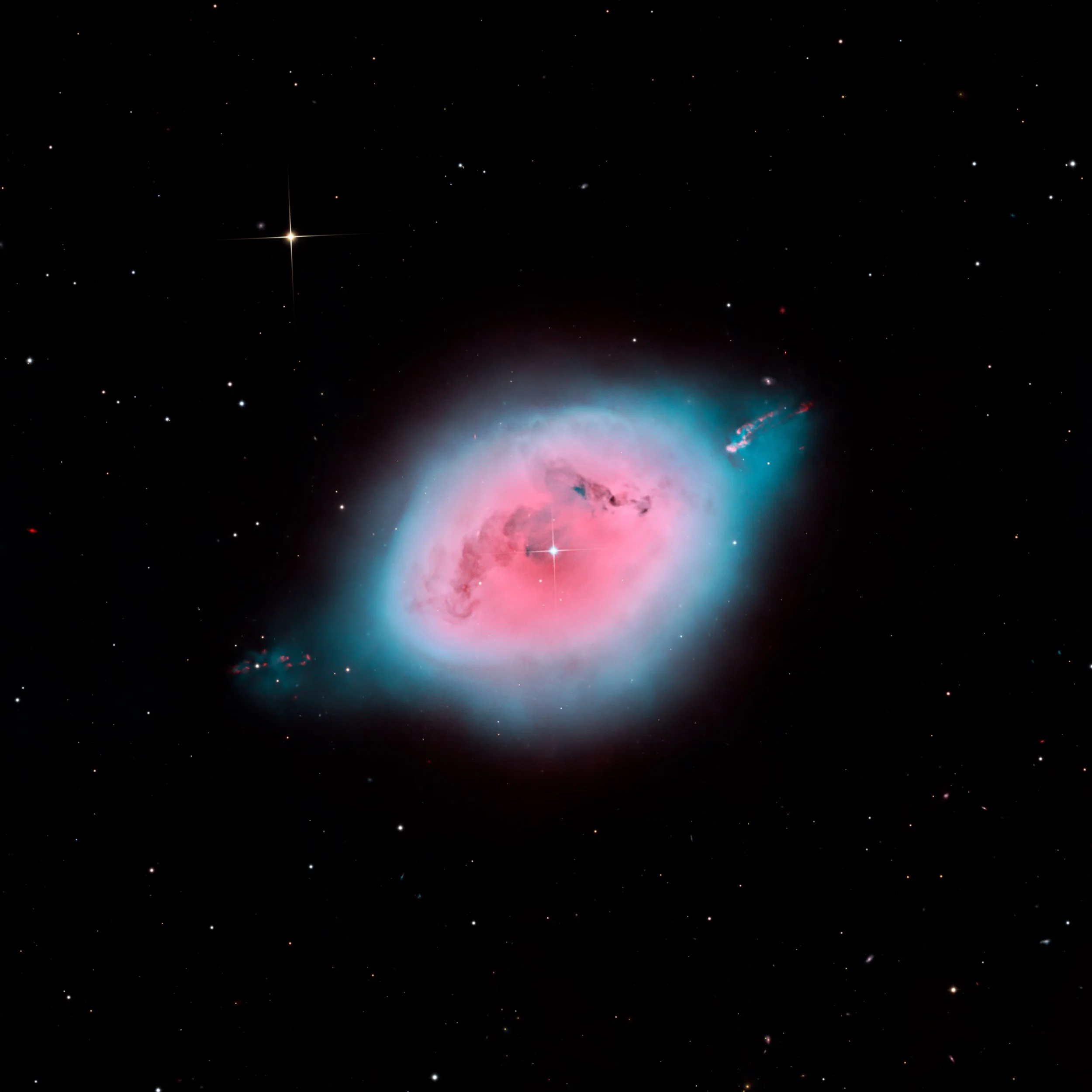
NGC 1360: The Robin’s Egg of the Cosmos
Delicate and luminous, the Robin's Egg Nebula (NGC 1360) graces the constellation Fornax, offering a perfect symbol for New Year’s Day. Like the fragile egg it resembles, this planetary nebula represents new beginnings and infinite potential—a celestial reminder of the opportunities the year ahead holds.
Its soft blue glow comes from ionized gas, ejected by a dying star at its center, creating an elegant elliptical shape. This quiet transformation reflects the cycles of life and time, as one chapter ends and another begins.
Just as a robin’s egg protects the promise of new life, NGC 1360 invites us to look forward with hope and wonder, embracing the beauty and possibility of a fresh start under the vast expanse of the cosmos.
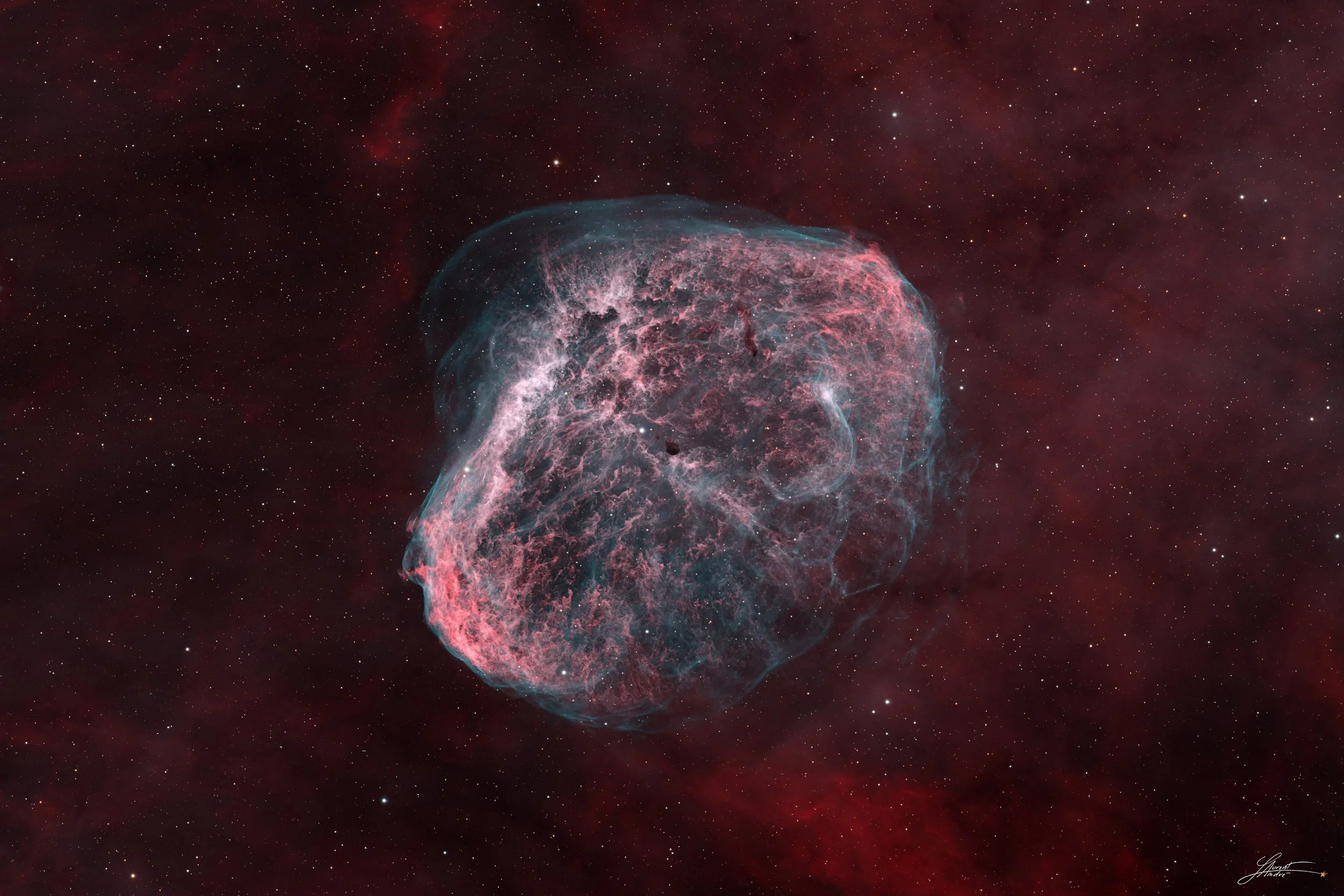
NGC6888 -The Crescent Nebula
Lighting up the constellation Cygnus, the Crescent Nebula (NGC 6888) shines like cosmic fireworks, a fitting farewell to the year that was. This glowing arc of gas and dust is the product of a massive Wolf-Rayet star nearing the end of its life. Intense stellar winds collide with material shed from the star’s earlier phases, sculpting this vibrant and dynamic structure.
Its fiery hues and intricate filaments mirror the brilliance of a midnight celebration, where endings and beginnings collide in a dazzling display. Spanning about 25 light-years, the Crescent Nebula serves as a reminder that even as one chapter closes, the universe is always creating something new and beautiful.
From all of us at AAPOD2, Happy New Year to our amazing members! May the year ahead be filled with clear skies, stunning captures, and endless wonder. 🌌✨

WR 134 region
In the constellation Cygnus, the brilliant Wolf-Rayet star WR 134 casts its influence across the cosmos, sculpting a stunning bubble of ionized gas that glows like a delicate cosmic wreath. This celestial feature is a powerful testament to the dynamic life cycles of massive stars.
The nebula’s faint yet intricate arcs, shaped by intense stellar winds, symbolize the beauty of transformation and renewal—an ideal image to ring in the new year. WR 134 serves as a reminder that even the most tumultuous forces can create breathtaking works of art in the universe, echoing themes of resilience and the promise of fresh beginnings.
As the new year dawns, this cosmic masterpiece invites us to marvel at the wonders of change and embrace the possibilities that lie ahead, just as the stars shape and reshape the cosmos around them.

Sh2-240 The Spaghetti Nebula
Stretching across the constellation Taurus, Sh2-240, also known as the Spaghetti Nebula, is a breathtaking remnant of a supernova explosion that occurred over 40,000 years ago. Its intricate, filamentary structure weaves a delicate tapestry of gas and dust, glowing faintly as it expands through the void.
The Spaghetti Nebula is a fitting symbol for New Year's Day, representing the passage of time and the interconnected nature of the universe. Its soft, ethereal tendrils remind us that even in the aftermath of explosive endings, beauty and transformation can emerge, weaving together the threads of the past and the promise of the future.
As we gaze at this cosmic masterpiece, it inspires us to reflect on our own journey through time and look forward to the new paths that await in the year ahead.
