Cosmic Masterpieces: Celebrating the June 2026 AAPOD2 Winners
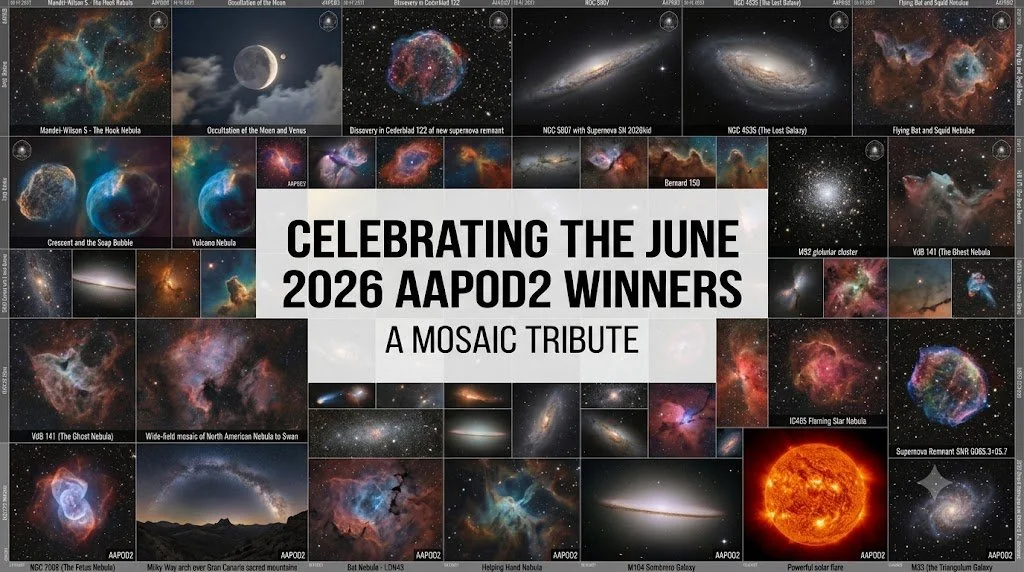
Astrophotography is more than just a technical pursuit; it is a profound bridge between cutting-edge science and fine art. Throughout June 2026, the Amateur Astronomy Photo of the Day (AAPOD2) community showcased an unparalleled array of deep-sky structures, solar system dynamics, and atmospheric phenomena. From newly discovered supernovae in distant islands of stars to elusive planetary nebulae right in our cosmic backyard, these images remind us of the sheer scale, depth, and beauty of the universe.
In this comprehensive review, we dive deep into all the winners of June 2026, highlight the absolute standouts of the month with direct links, and unearth some fascinating astronomical facts that make these images even more breathtaking.
The Standout Highlights of June 2026
While every single image selected by AAPOD2 this month represents incredible skill, dark-sky dedication, and processing prowess, a select few truly pushed the boundaries of amateur astrophotography. Here are the most outstanding images of June, along with why they captured our attention.
1. The Hook Nebula (Mandel-Wilson 5) – June 30
Closing out the month with absolute brilliance, the image of Mandel-Wilson 5 - The Hook Nebula is a masterclass in capturing Integrated Flux Nebulae (IFN). Unlike classic emission nebulae powered by nearby stars, IFNs are faint clouds of dust illuminated by the collective glow of our entire Milky Way galaxy. Capturing the delicate, ghostly tendrils of the Hook Nebula requires extraordinarily dark skies, long integration times, and ultra-low-noise sensors. The contrast between the rich background stars and the dust structures makes this an elite cosmic portrait.
2. The Occultation of the Moon and Venus with Clouds – June 24
Astrophotography isn't always about deep-sky integration; sometimes it's about being in the right place at the exactly right millisecond. The Occultation of the Moon and Venus with Clouds stands as a mesmerizing planetary landscape. Capturing the exact moment Venus slides behind or emerges from the lunar limb requires rigorous geometric planning. The addition of passing atmospheric clouds creates a cinematic, ethereal mood that bridges our earthly atmosphere with the wider solar system.
3. A New Discovery in Cederblad 122 – June 23
Amateur astrophotographers are increasingly contributing to real scientific discoveries. This was fully demonstrated by the image of a Suspected unknown Supernova Remnant imaged in Cederblad 122 in the constellation Centaurus. By utilizing highly specialized narrowband filters ($H\alpha$ and $[OIII]$) and dedicating dozens of hours of exposure time to a overlooked region of the southern sky, this imager revealed faint, expanding shockwaves that may have skipped professional surveys.
4. NGC 5907 & Supernova SN 2026kid – June 17
Speaking of cataclysmic cosmic explosions, June 17 brought us a direct look at cosmic destruction and rebirth with NGC 5907 – Knife Edge Galaxy & Supernova SN 2026kid. The Knife Edge Galaxy is already a fan favorite due to its perfectly edge-on orientation, revealing sharp, dark dust lanes slicing across its galactic core. However, the addition of the freshly minted supernova SN 2026kid makes this specific capture a historical document—a snapshot of a star dying millions of light-years away.
5. NGC 4535: The Lost Galaxy – June 12
Nicknamed for its hazy, ethereal appearance in smaller telescopes, NGC4535 - The Lost Galaxy is anything but lost in this breathtaking high-resolution rendition. Located in the Virgo Cluster, this barred spiral galaxy shows off brilliant, sprawling spiral arms loaded with young, hot blue star clusters and pink star-forming nebulae. The image showcases exceptional structural tracking, pulling out delicate features from a target sitting over 50 million light-years from Earth.
6. The Cosmic Duo: Flying Bat and Squid Nebulae – June 9
Capturing one nebula is a feat; capturing two overlaying structures with completely different elemental signatures is legendary. The capture of the Flying Bat and Squid nebulae (Sh2-129 and Ou4) represents one of the most difficult challenges in modern imaging. The giant Squid Nebula (Ou4) emits almost exclusively in the ultra-faint $[OIII]$ wavelength (doubly ionized oxygen), requiring immensely clean data to pull out of the background noise, while the Flying Bat provides a deep red Hydrogen-alpha framework.
7. The Crescent and the Soap Bubble – June 18
Another spectacular testament to patience is The Crescent and the Soap Bubble. While NGC 6888 (The Crescent) is a bright, energetic emission nebula molded by a fierce Wolf-Rayet star, the Soap Bubble Nebula (PN Ju 1) is a perfectly spherical, incredibly dim planetary nebula discovered only in 2008 by an amateur. Balancing the bright details of the Crescent with the ghostly, transparent bubble is a true processing triumph.
Fascinating Cosmic Facts from the June Winners
Behind every spectacular image lies a fascinating scientific story. Here are a few incredible facts inspired by the objects captured throughout June:
The Ghostly Soap Bubble: The Soap Bubble Nebula (featured on June 18) went unnoticed by professional astronomers for decades because it is perfectly superimposed on a bright emission region in Cygnus. It is so faint that it requires dozens of hours of exposure through custom oxygen filters just to register a faint outline.
The Supernova Next Door: In the June 17 winner featuring NGC 5907, we see SN 2026kid. When a supernova like this occurs, the single exploding star can briefly outshine the entire host galaxy containing billions of stars.
The Flying Dragon's Breath: The Sh2-114 nebula (June 16), affectionately known as the Flying Dragon Nebula, is an extremely complex filamentary structure. Astronomers still debate its exact origins, though it is highly suspected to be an ancient supernova remnant whose expanding shells have been distorted by interstellar magnetic fields.
A Day-by-Day Journey Through June 2026
To appreciate the sheer diversity of targets throughout the month, let’s look at the complete tapestry of the universe that the AAPOD2 winners wove across June:
June 1: Vulcano Nebula – An explosive start to the month with rich dust clouds and intense star-forming regions.
June 2: Barnard 150 – A dark, snaking absorption nebula in Cepheus that completely blocks out the light of background stars.
June 3: M92 – One of the oldest and most tightly packed globular star clusters in the northern sky, offering brilliant resolution down to the core.
June 4: VdB 141 – Popularly known as the Ghost Nebula, this reflection nebula features eerie cosmic shapes illuminated by embedded newborn stars.
June 5: North American Nebula to Swan – A breathtaking wide-field mosaic tracing the dense, hydrogen-rich lanes of our inner galactic arm.
June 6: IC405 – The Flaming Star Nebula, displaying intricate waves of gas driven by the runaway star AE Aurigae.
June 7: Supernova Remnant SNR G065.3+05.7 – Faint, wispy filaments of oxygen and hydrogen gas spanning light-years across the cosmos.
June 8: NGC 7008, the Fetus Nebula – A planetary nebula with highly unusual, complex structures and intense contrasting hues.
June 10: Milky Way Arch over the Sacred Mountains of Gran Canaria – A stunning nightscape demonstrating the flawless blend of terrestrial landscape and the cosmos.
June 11: Bat Nebula - LDN43 – A dense, dark cloud resembling a cosmic bat flying across a star-filled stellar nursery.
June 13: Helping Hand Nebula – Cosmic dust clouds that resemble a hand reaching out across the void of interstellar space.
June 14: Messier 100 – A majestic grand-design spiral galaxy showing clear, symmetric spiral arms and a brilliant nucleus.
June 15: Venus Color – Highlighting rare, subtle atmospheric color variations on our closest planetary neighbor.
June 19: NGC 7023 – The Iris Nebula, shimmering in deep, reflection-blue dust lanes surrounded by dark interstellar matter.
June 21: M104 Sombrero Galaxy – A breathtaking, deep look at one of the universe's most iconic galaxies, featuring an immense bulge and razor-sharp dust lane.
June 22: Boom... a powerful solar flare breaks the silence! – Our own dynamic star throwing out a massive prominence, captured in H-alpha solar detail.
June 25: The Headphone Nebula – A perfectly symmetrical, faint planetary nebula resembling a modern pair of headphones floating in deep space.
June 26: PN LoTR 5 in Coma Berenices – A highly rare planetary nebula centered around an intriguing binary star system.
June 27: LDN 1228 Lrgb & HaLrgb – A dark nebula complex showing the dramatic visual difference when combining broadband and narrowband data.
June 28: Bernes 149 and surrounding - Molecular cloud Lupus 3 – A dark cosmic incubator where future solar systems are currently condensing.
June 29: M33, the Triangulum Galaxy – Our close galactic neighbor, peppered with vast, red HII star-forming factories easily resolved across its face.
The Evolution of Amateur Astrophotography
What makes the June 2026 archive so profound is how it mirrors the technological leaps in the amateur astronomy community. The inclusion of high-quantum-efficiency monochrome sensors, ultra-narrowband filters, and automated remote observatories has allowed backyard astronomers to gather data that matches professional space telescope standards from a couple of decades ago.
More importantly, it showcases the power of patience. Capturing deep-sky objects like the Lupus 3 Molecular Cloud or The Hook Nebula is an exercise in time travel—gathering photons that left their sources thousands or millions of years ago, matching them frame by frame, and carefully balancing colors to reveal hidden stellar artwork. We salute all the talented imagers who earned a well-deserved spot on the AAPOD2 archive this June!