

AAPOD2 Image Archives
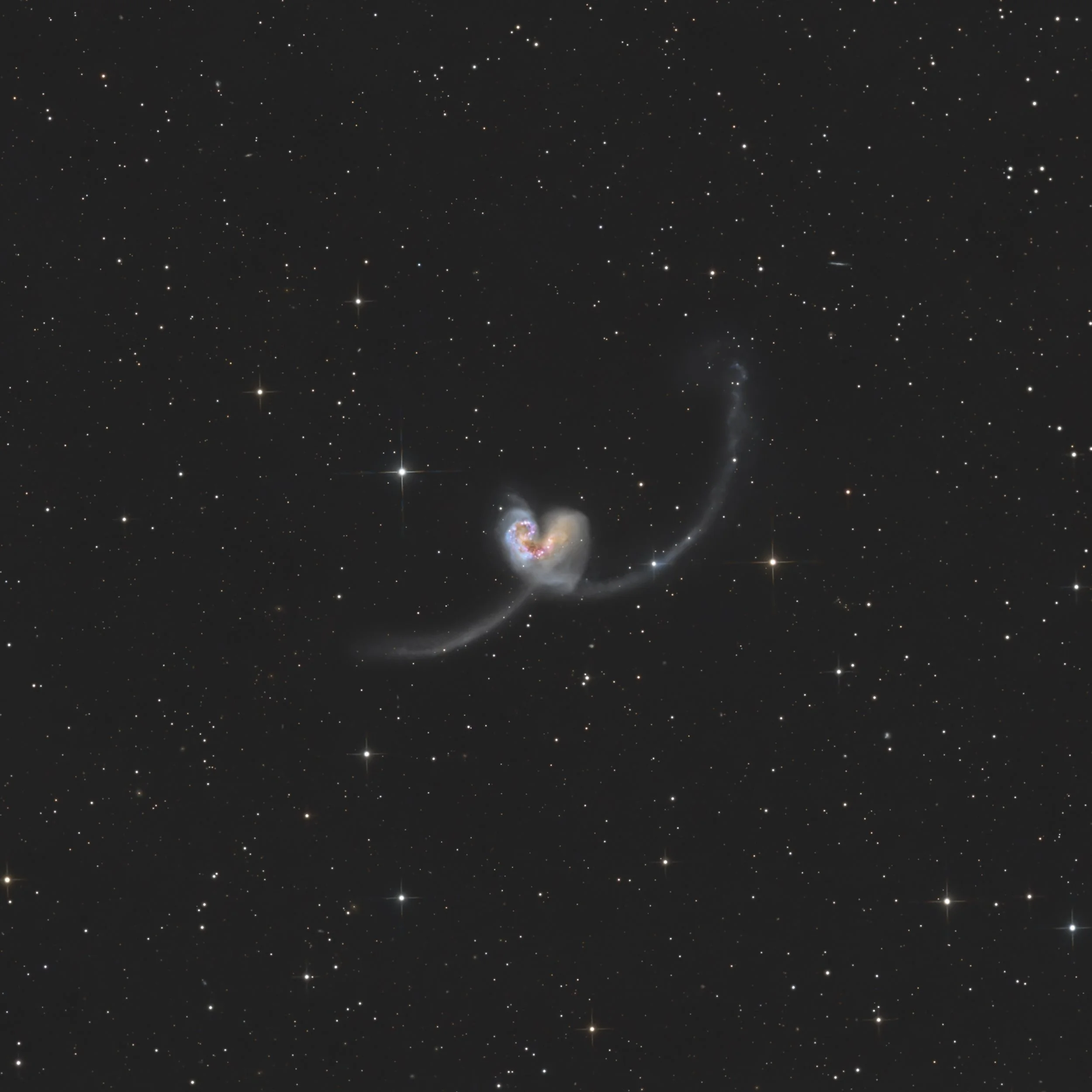
The Antennae Galaxies - NGC 4038 and 4039
The Antennae Galaxies are among the most spectacular objects in the deep sky. Located about 45 million light-years away in the constellation Corvus, they are the result of an ongoing collision between two spiral galaxies, known as NGC 4038 and NGC 4039.
Their nickname comes from the long, luminous structures shaped like antennae that extend on either side of the system. These “antennae” are actually tidal tails, formed by the intense gravitational interaction between the two galaxies. As they draw closer, their stars, gas, and dust are violently disturbed, creating these stretched and elegant shapes.
This galactic collision does not occur in total chaos: stars rarely collide directly due to the enormous distances between them. However, clouds of gas are strongly compressed, triggering intense star formation activity. The Antennae Galaxies thus act as a true cosmic laboratory where thousands of new stars are born, often grouped into very bright stellar clusters.
Observed in detail by telescopes such as the Hubble Space Telescope, these galaxies provide astronomers with a valuable glimpse of what the future of our own galaxy, the Milky Way, might look like when it collides with the Andromeda Galaxy in several billion years.
Eventually, the Antennae Galaxies will fully merge to form a single large galaxy, likely elliptical in shape. This process, although violent on a cosmic scale, is actually a fundamental mechanism in the evolution of galaxies in the universe.
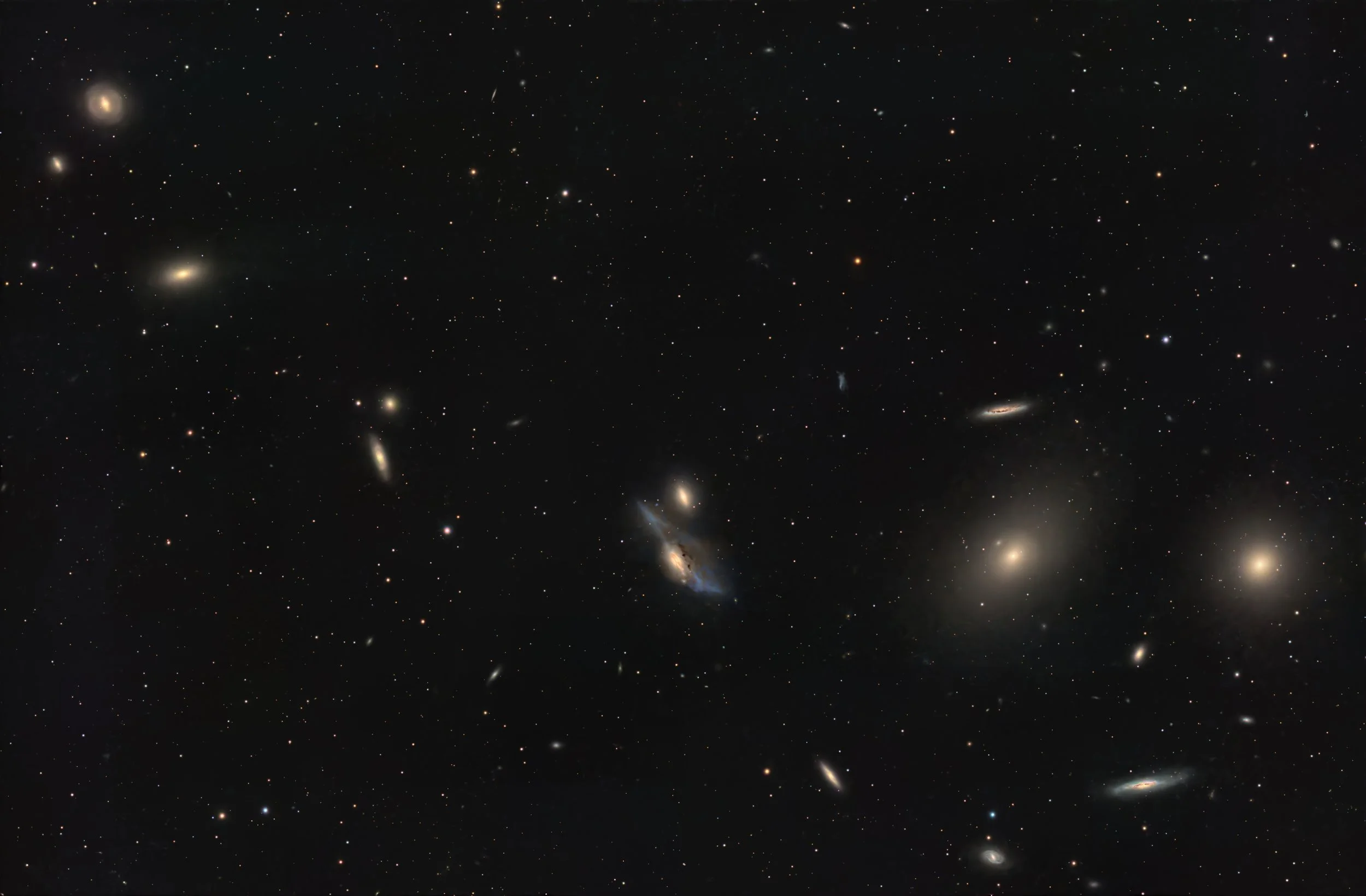
Markarian’s Chain
Markarian’s Chain is the name of the curved chain of galaxies that arcs through this image. This chain is part of the Virgo Galaxy Cluster, the centre of which is about 54 million light years away. The Virgo Cluster contains about 1,500 galaxies and is estimated to have a total mass of about 10 quadrillion times the Sun’s (1 quadrillion = 1 million billion). This image captures just a small portion of the Virgo cluster. I also imaged this chain of galaxies in a much wider fieldalmost a decade ago.
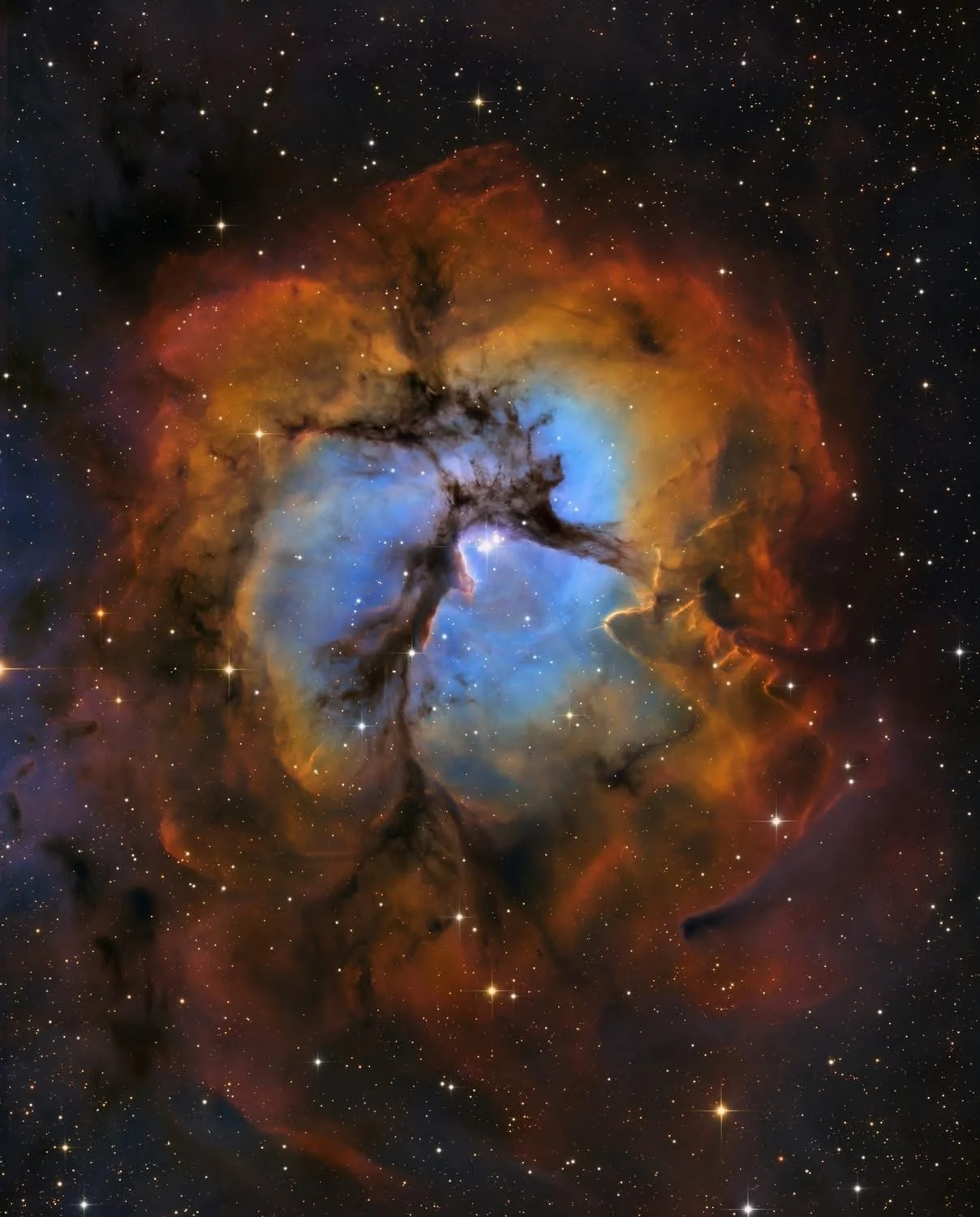
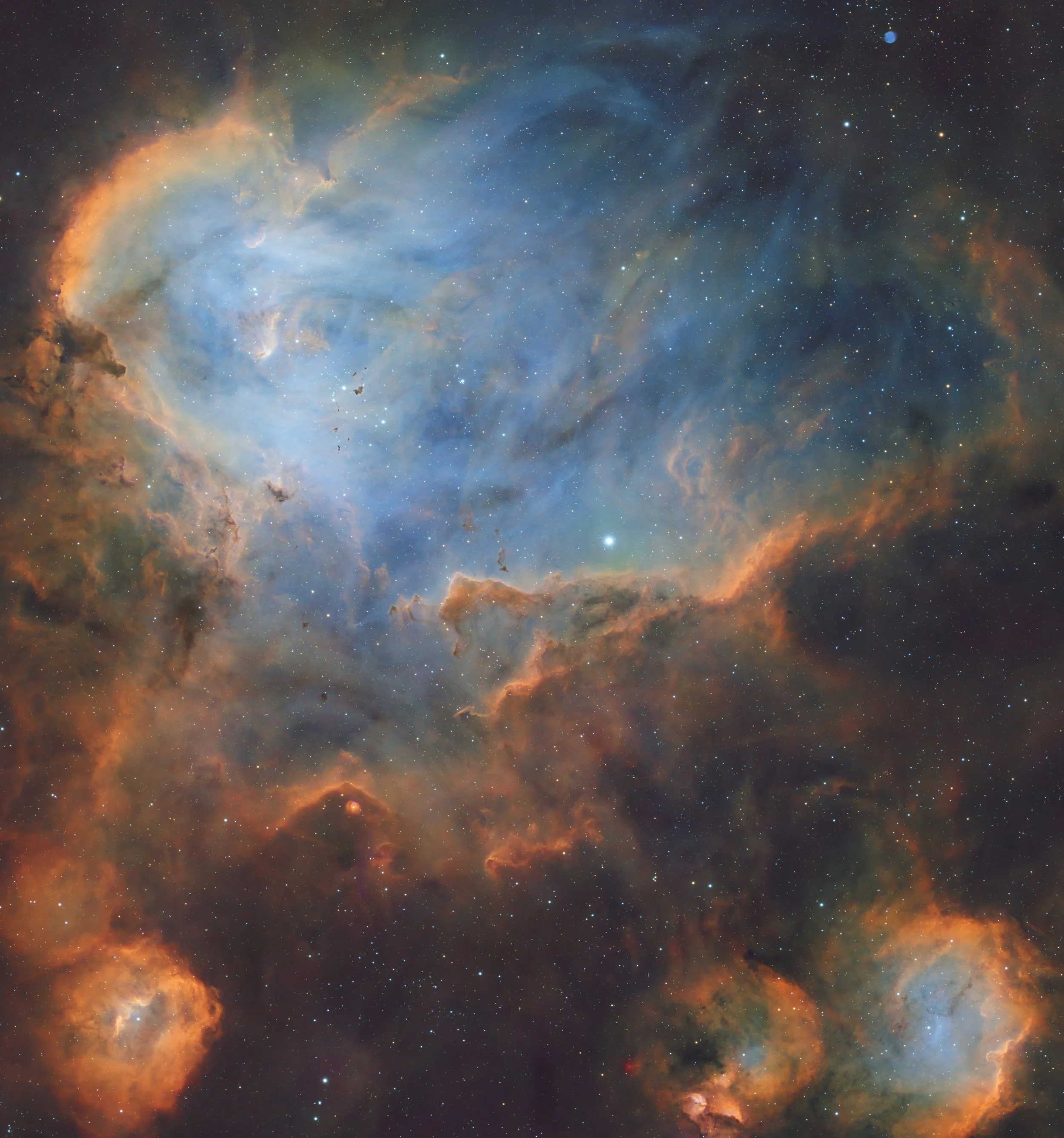
IC2944
The IC 2944 nebula, commonly known as the Running Chicken Nebula, is undoubtedly one of the most captivating targets in the night sky. The Hubble Palette (SHO) remains my preferred choice for this object for good reason: it dramatically enhances the contrast of the cosmic dust, reveals exquisite details within the dark Bok globules, and even captures a faint planetary nebula tucked into the upper right field of view. This entire region is truly a rich tapestry of stunning structures.
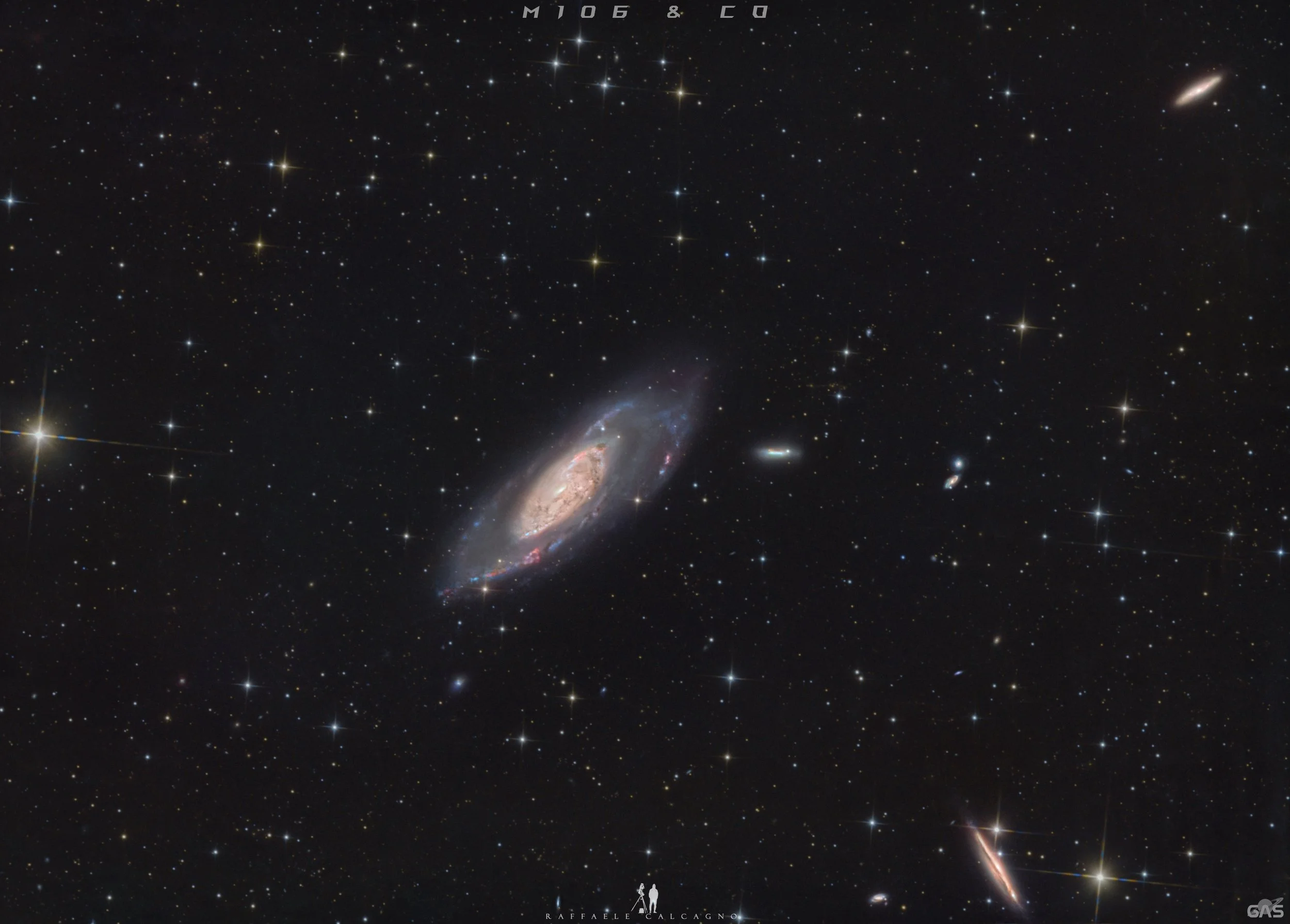
M106 & CO.
M106 Galaxy (NGC 4258), a spiral galaxy located in the constellation Canes Venatici, is a breathtaking sight. With its well-defined spiral arms and bright core, M106 spans about 30,000 light-years in diameter and lies approximately 23.5 million light-years from Earth. It is a fascinating galaxy, known for its active nucleus and the presence of a supermassive black hole at its center.
But M106 is not alone in this frame: the field is dotted with countless other galaxies. Beyond the most prominent ones—such as NGC 4217, NGC 4226 (bottom right), NGC 4248, NGC 4252 (adjacent to the right of M106), and NGC 4220 (top right)—there are many more, fainter galaxies populating the background. I noticed them during the image processing. Every tiny bright dot, no matter how small, could be a distant galaxy, millions or even billions of light-years away, each with its own unique story and characteristics.
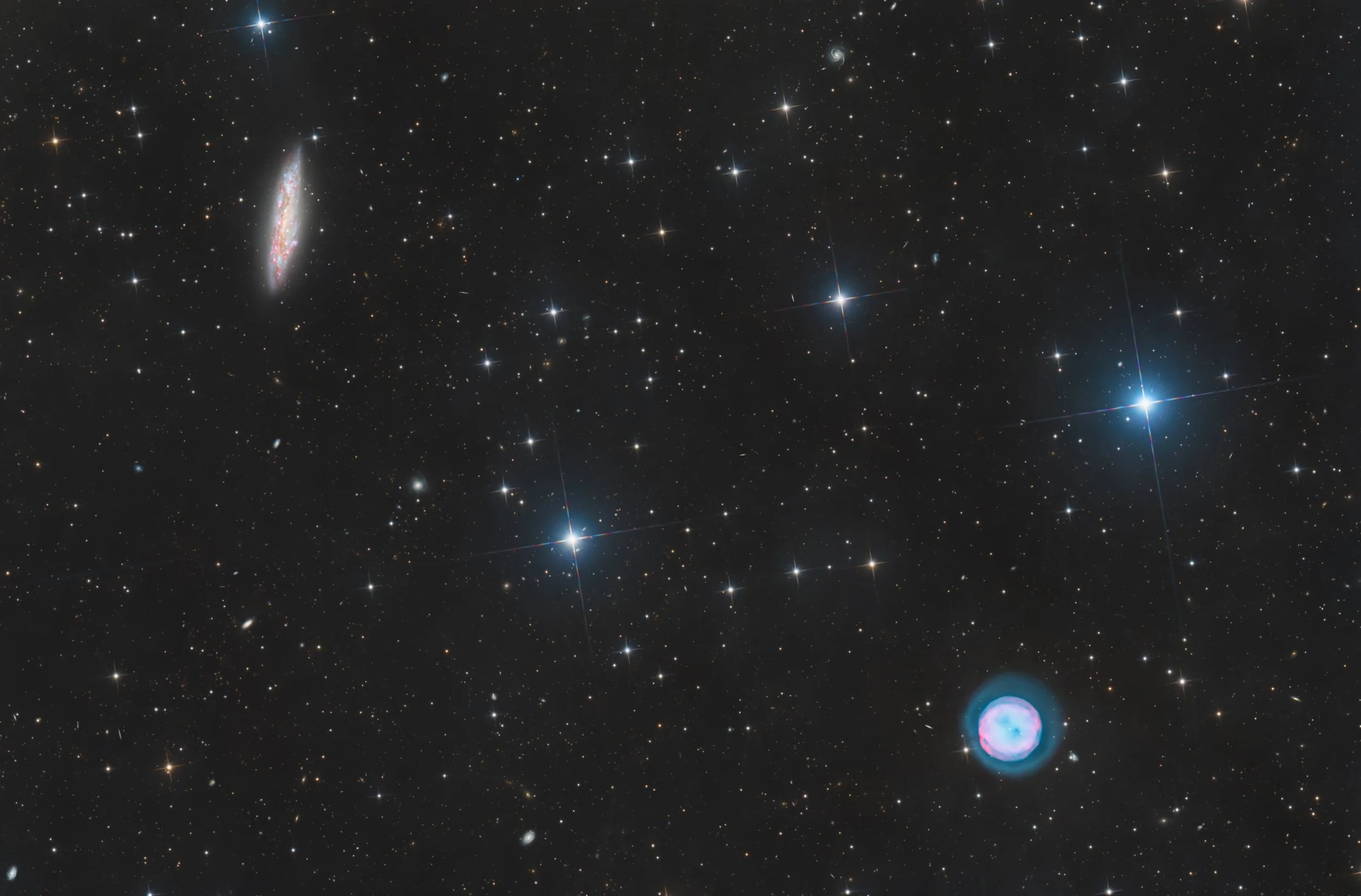
M108 and M97 LRVB HOO
Description and Details:
This iconic duo in Ursa Major features M108, a barred spiral galaxy seen edge-on, alongside M97, the well-known Owl Nebula.
The data was captured in LRGB complemented with Ha and OIII to bring out the full richness of the planetary nebula. Its brightness particularly surprised me, as it is already clearly visible even in the LRGB data alone.
A continuum subtraction was applied to the Ha and OIII channels to better isolate the emission signal while preserving a natural look. The galaxy also reveals an interesting and different aspect in these wavelengths.
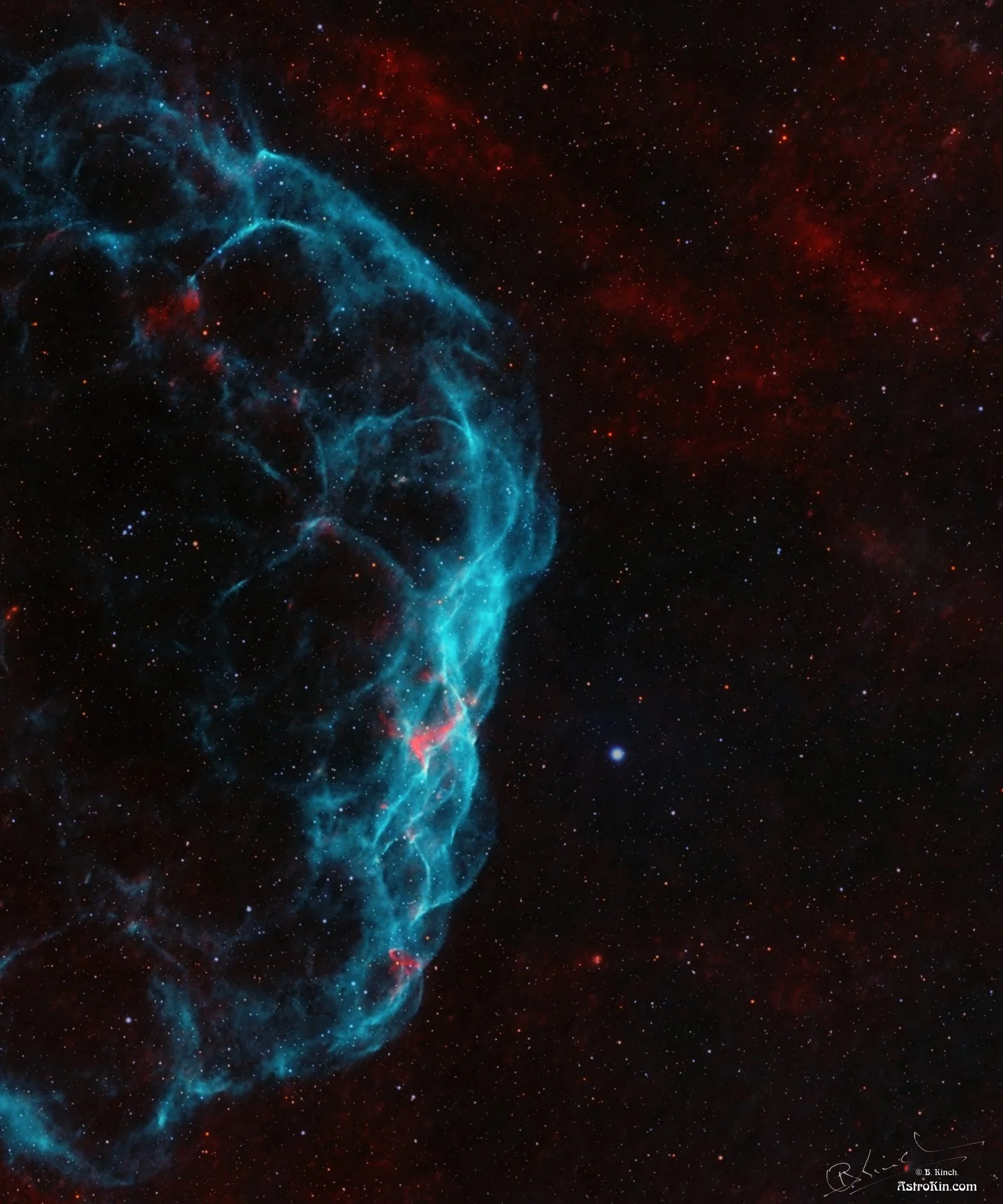
SNR G179.0+2.6
The old supernova remnant SNR G179.0+2.6 in the constellation Auriga is dominated by OIII emissions. They form a mixture of diffuse and filamentary structures that together form a round closed shell with a diameter of about 70 arcmin - about two full moons to our eyes.
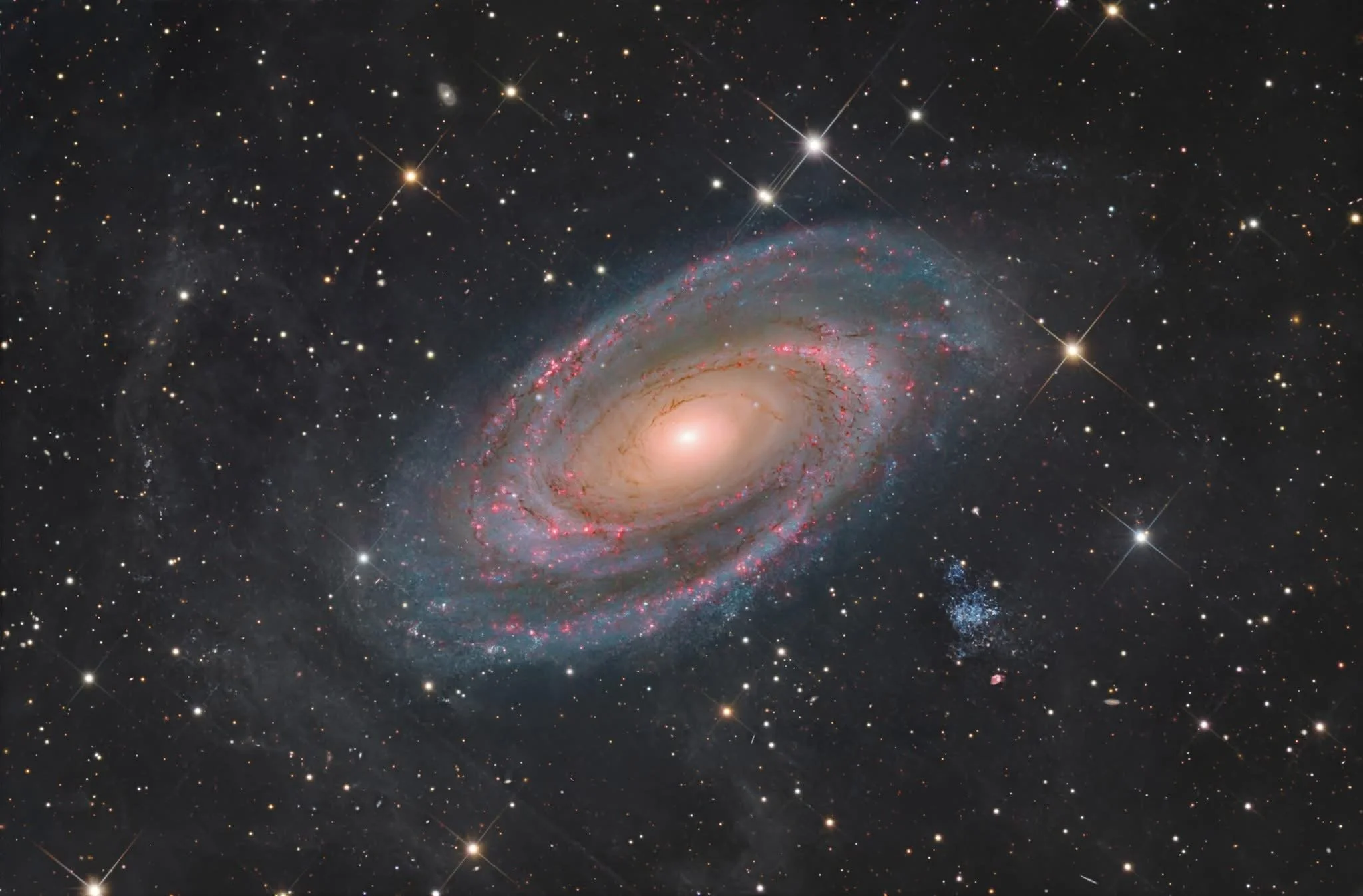
M81 or Bode Galaxy
M81 (NGC 3031), also nicknamed the Bode Galaxy, is a nearby spiral galaxy located about 12 million light years in the constellation of the Great Bear. So this galaxy and its neighbor M82 are among the closest galaxies to ours.
M81 is a large-style spiral galaxy, i.e. with well-defined spiral arms. Its diameter equals about 96,000 light-years, close but smaller than that of the Milky Way (~100,000 light-years from its lowest estimate).
M81 was discovered by German astronomer Johann Elert Bode in 1774, who also discovered M82 (NGC 3034) on the same night. These two galaxies are named after the Bode Nebula. M81 was rediscovered independently by the French astronomer Pierre Méchain in August 1780, who reported it to his friend Charles Messier. Messier observed M81 on 9 February 1781
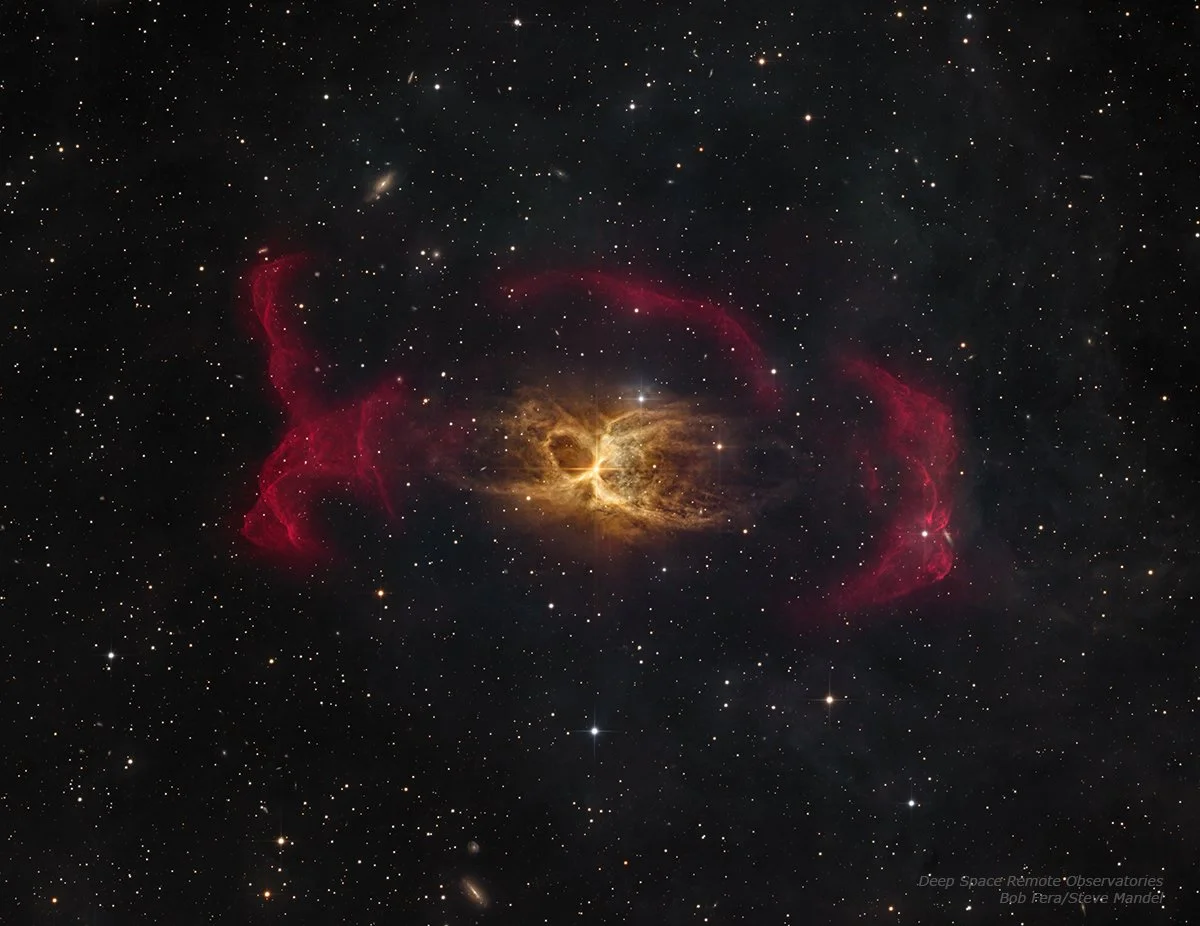
The Toby Jug Nebula
IC 2220 - The Toby Jug Nebula in CarinaIC 2220 is a reflection nebula located about 1,200 light years from Earth. It's made of gas and dust reflecting the light of a central red giant star nearing the end of its life.
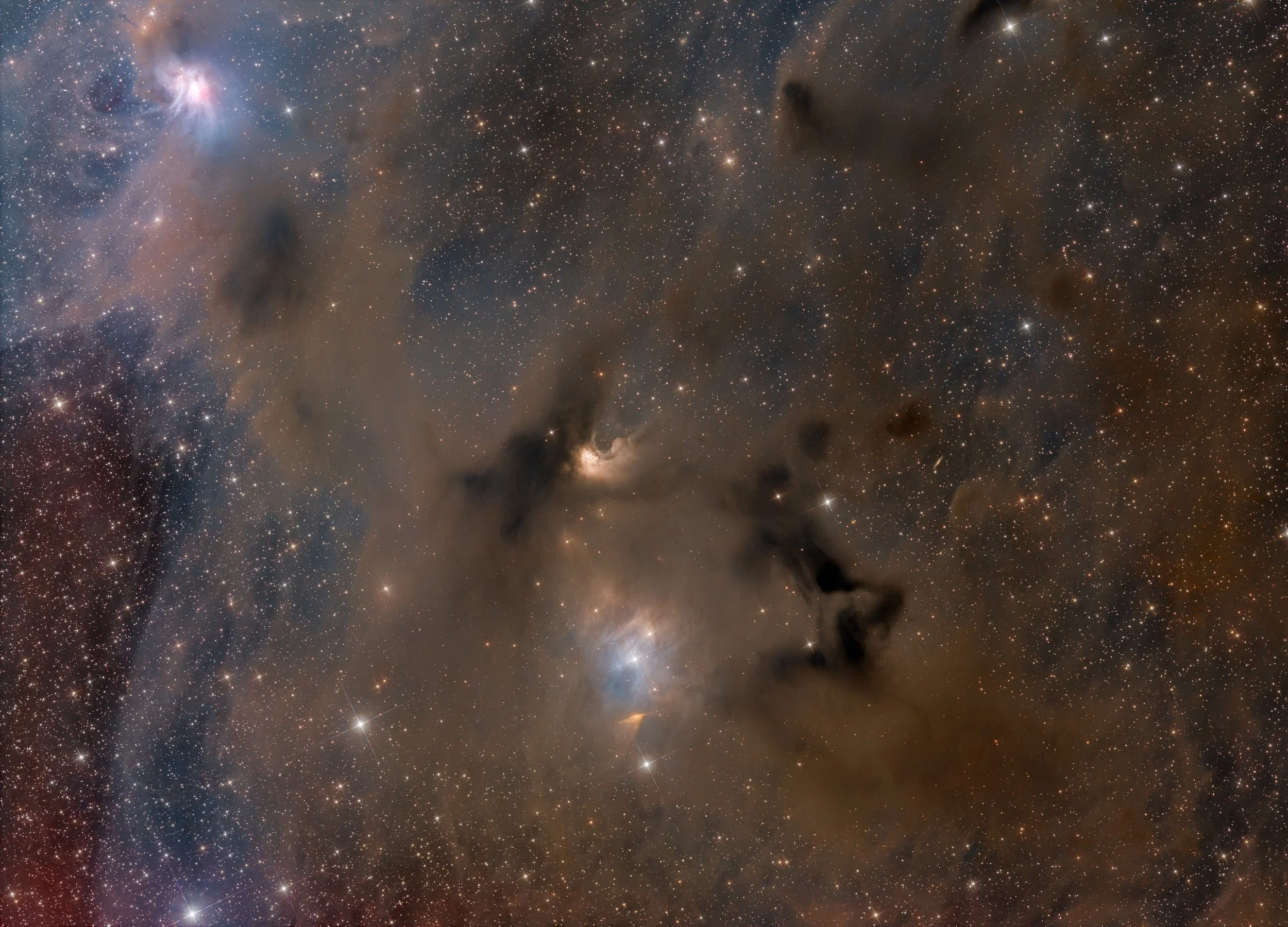
CED110 & CED111 in Chamaleon
Nestled within the dusty lanes of the Chamaeleon I molecular cloud, CED 110 glows as a faint reflection nebula illuminated by a cluster of young, newly formed stars. Unlike emission nebulae that shine from energized gas, this delicate structure reveals itself by scattering starlight off fine interstellar dust, producing a soft bluish hue. The region is rich with protostars and embedded infrared sources, making it an active laboratory for studying the earliest stages of stellar evolution hidden deep within cold molecular material.
Located roughly 500 light-years away in the southern constellation Chamaeleon, CED 110 is part of a broader network of dark clouds and faint nebulae that trace the structure of this nearby stellar nursery. Long-exposure imaging unveils intricate filaments of dust and subtle variations in brightness, shaped by stellar winds and gravitational collapse. Though faint to the eye, CED 110 offers a quiet but profound glimpse into the processes that give rise to stars like our Sun, emerging slowly from the obscuring veil of cosmic dust.
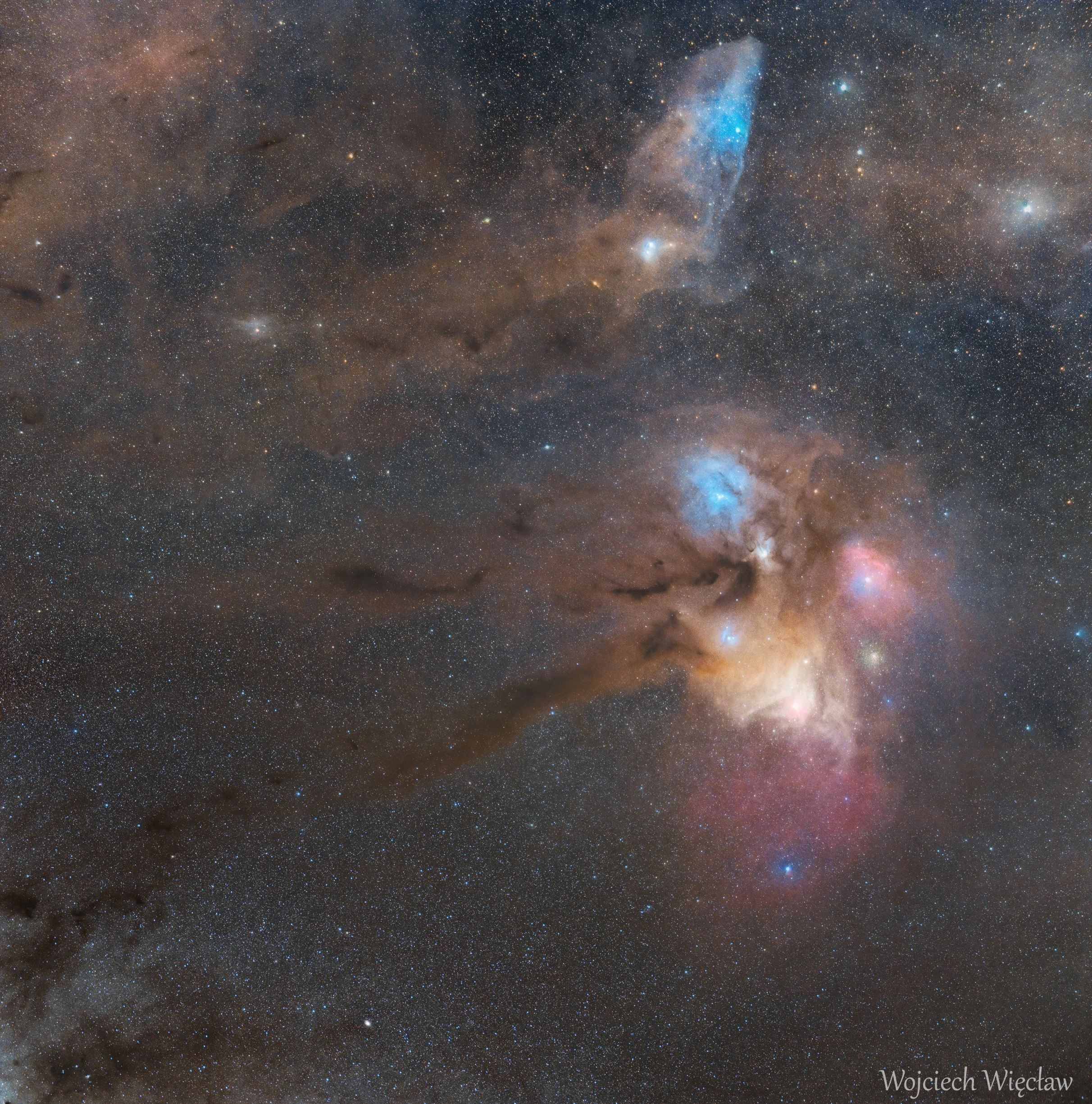
Rho Opiuchi and Blue Horsehead
The Rho Ophiuchi Cloud Complex is one of the closest and most visually striking stellar nurseries to Earth, located about 400 light years away in the direction of the constellation Ophiuchus. This vast complex of gas and dust is illuminated by nearby bright stars, creating a rich tapestry of colors. The characteristic blue hues arise from starlight scattering off fine dust particles, while deep reds trace glowing hydrogen gas energized by young, hot stars. Dark, sinuous lanes of opaque dust weave through the scene, obscuring background light and giving the region its dramatic contrast and depth.
Beneath its beauty lies an active site of star formation, where dense pockets of gas collapse under gravity to ignite new stars. Many of these newborn stars remain hidden within the dust, detectable only in infrared wavelengths. The region also contains the bright star Antares nearby, whose warm glow often adds a golden tint to wide-field views of the complex. As one of the nearest laboratories for studying stellar birth, Rho Ophiuchi offers both a vivid visual spectacle and a valuable glimpse into the processes that shape stars and planetary systems.
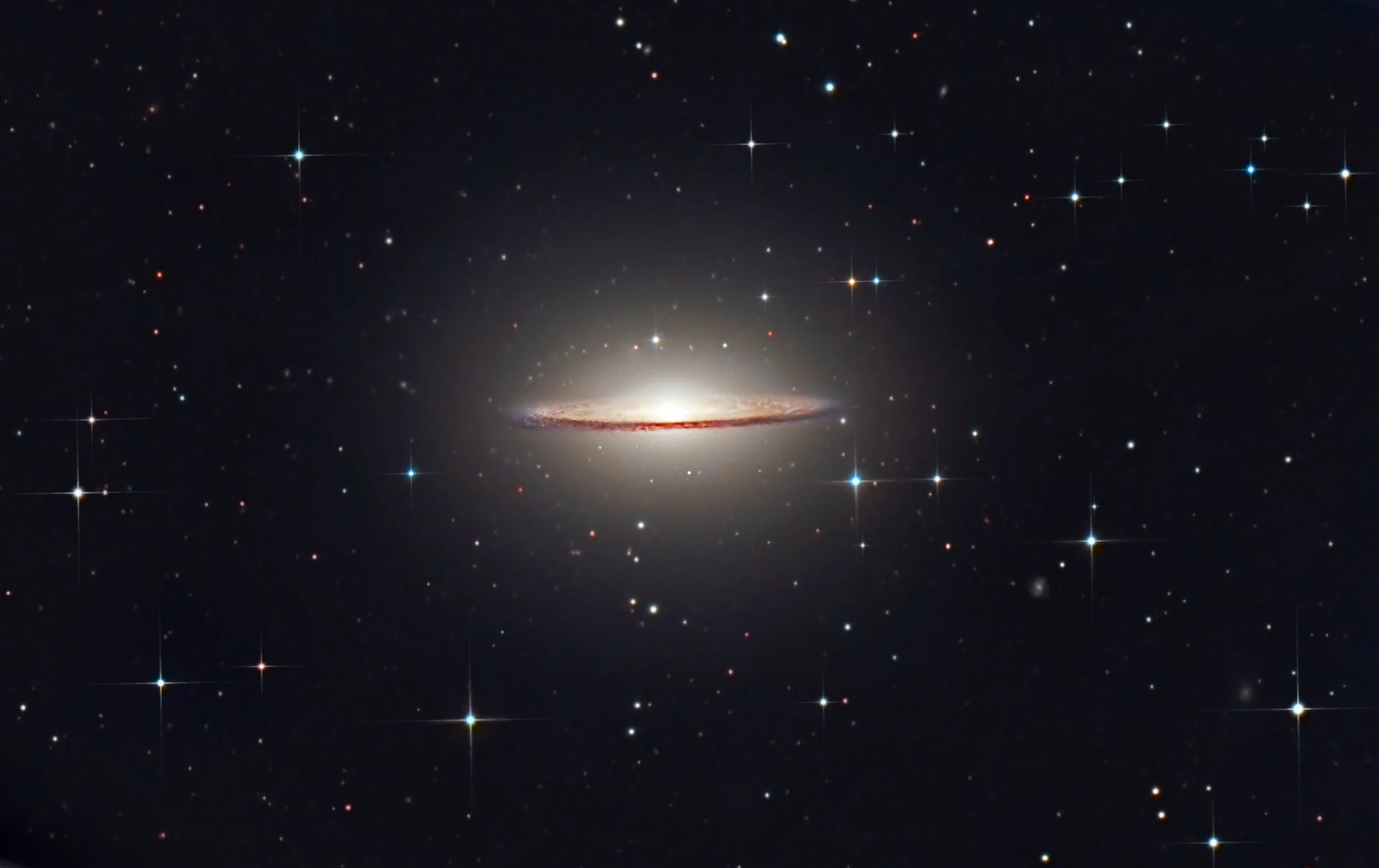
Beyond The Halo
Known as the Sombrero Galaxy, M104 is one of the most visually striking galaxies in the nearby universe. Seen nearly edge-on from our vantage point in the constellation Virgo, its defining feature is a broad, dark dust lane that slices cleanly across a luminous, spheroidal bulge of stars. This dramatic contrast gives the galaxy its iconic “hat-like” appearance. At a distance of roughly 30 million light-years, the Sombrero spans about 50,000 light-years and contains a massive central bulge, hinting at a rich and complex formation history that blends traits of both spiral and elliptical galaxies.
Beneath its elegant structure lies a powerhouse core. M104 harbors a supermassive black hole estimated to be over a billion times the mass of the Sun, contributing to the galaxy’s intense central brightness. The surrounding disk, though relatively subdued in star formation compared to more active spirals, is laced with cold dust and gas that absorb and scatter light, creating the prominent silhouette visible in deep imaging. With its symmetry, sharp dust features, and glowing halo, the Sombrero Galaxy remains a favorite target for astrophotographers and a compelling example of galactic structure and evolution.
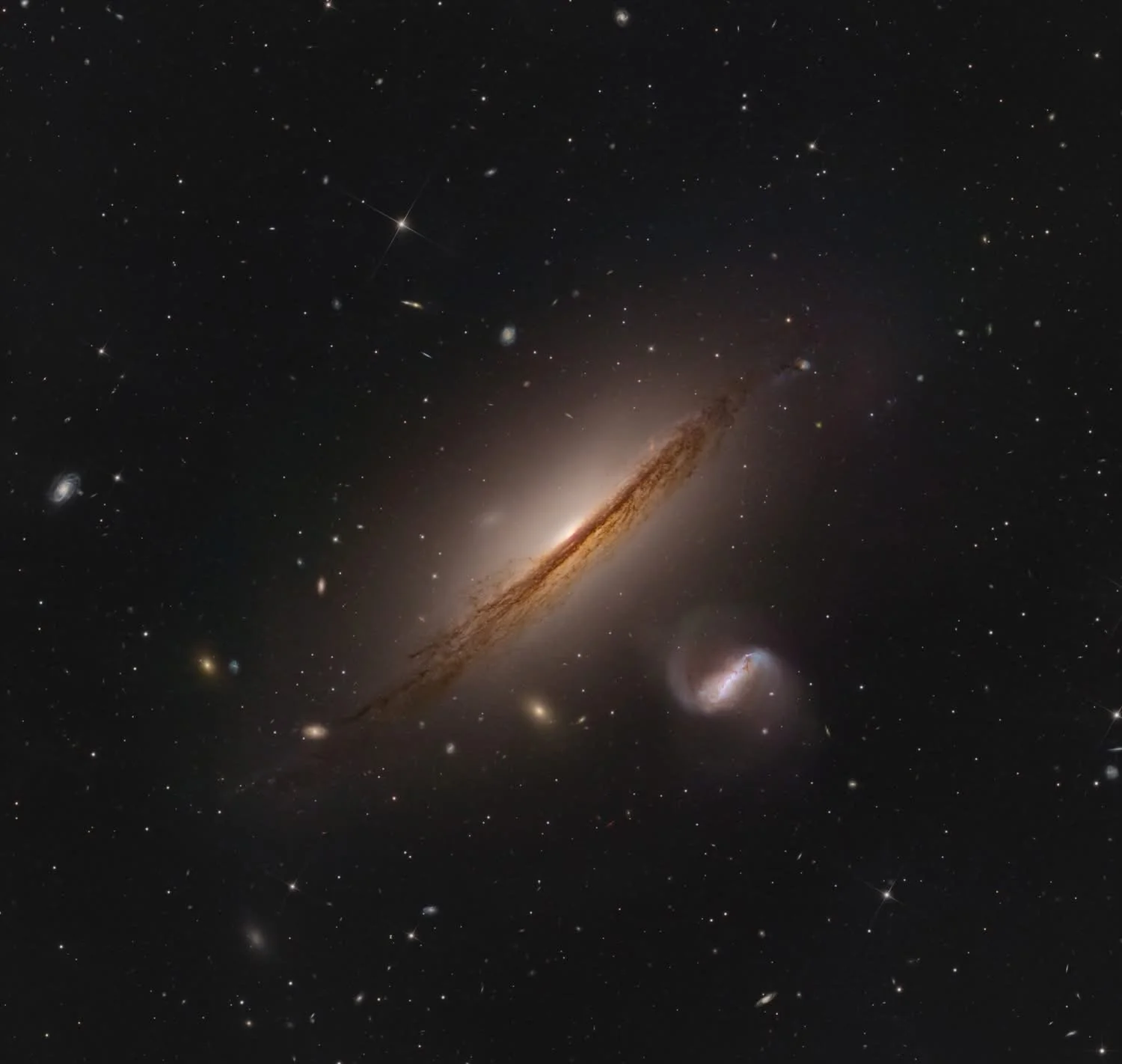
NGC 5078
A luminous disk split by shadow, with a disturbed spiral companion caught in a close gravitational encounter
NGC 5078 is an edge-on spiral galaxy classified as SA(s)a? edge-on in the constellation Virgo. Its bright central bulge shines through a prominent dust lane that is notably uneven and asymmetric, hinting at a disk that is no longer in perfect equilibrium. Subtle warping and flaring are visible along the outer edges of the disk, and the surrounding halo shows a slight imbalance in brightness—signatures of gravitational disturbance rather than a pristine, isolated structure.
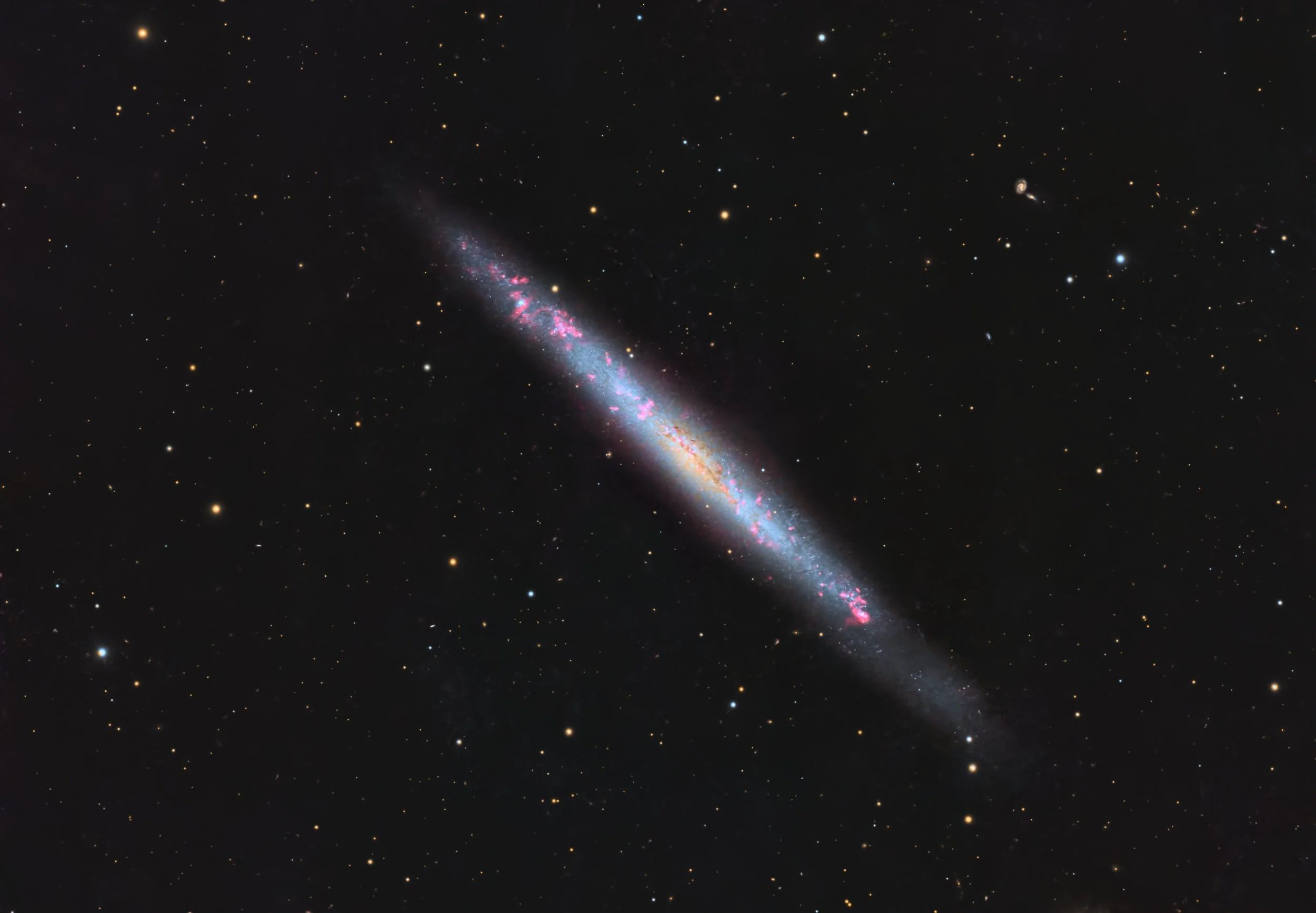
Silver Needle Galaxy
NGC 4244 is a loose edge-on spiral galaxy. It is also catalogued as Caldwell 26 and nickanamed the Silver Needle Galaxy. It lies a little more than 14 million light years away from us in the constellation of Canes Venatici (the Hunting Dogs), and is a member of a nearby galaxy cluster called the M94 Galaxy Group.
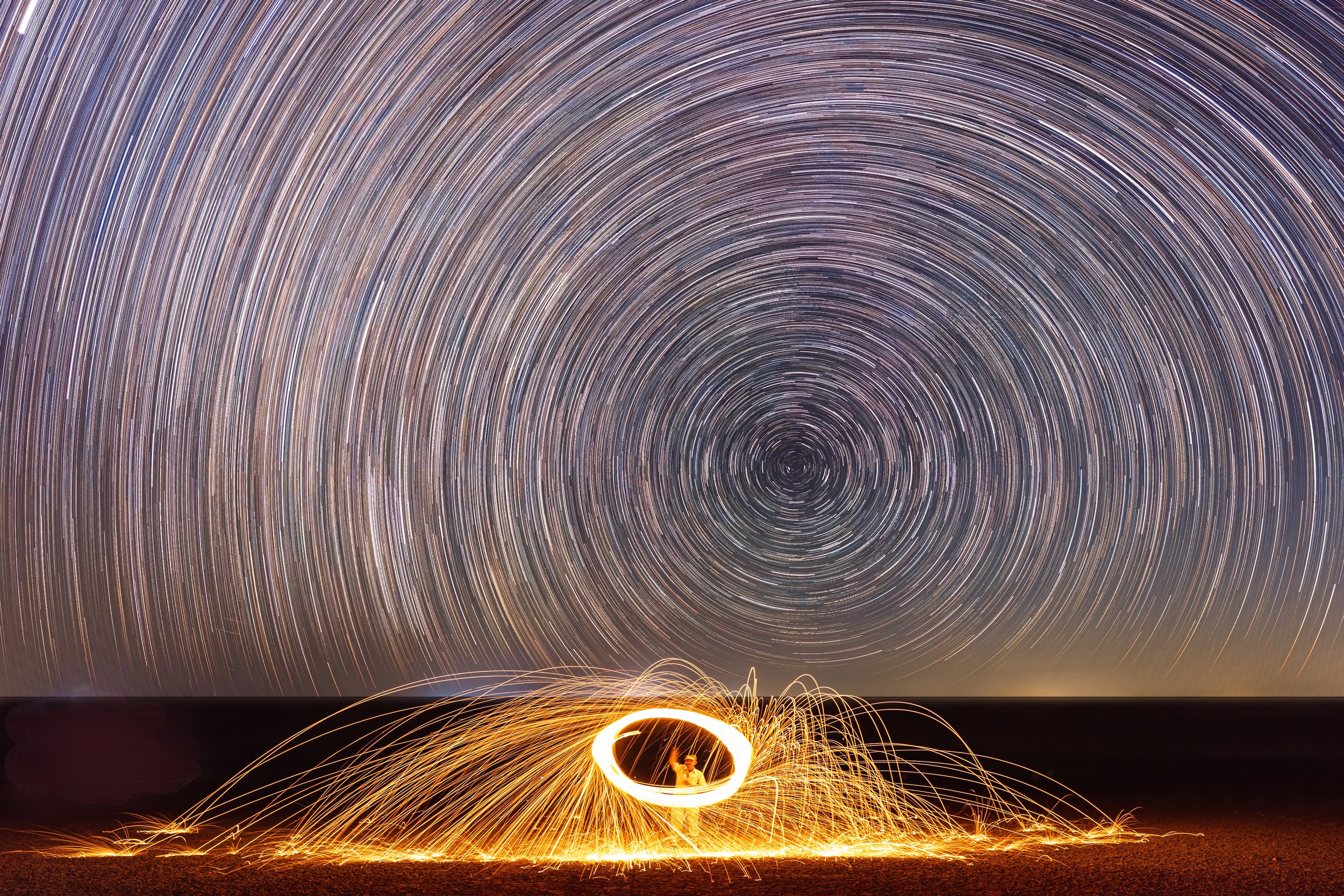
Orbit of Fire
Created during a session of Milkyway Saga, this frame captures the silent motion of the night sky through star trails, with a moment of creative expression on Earth.
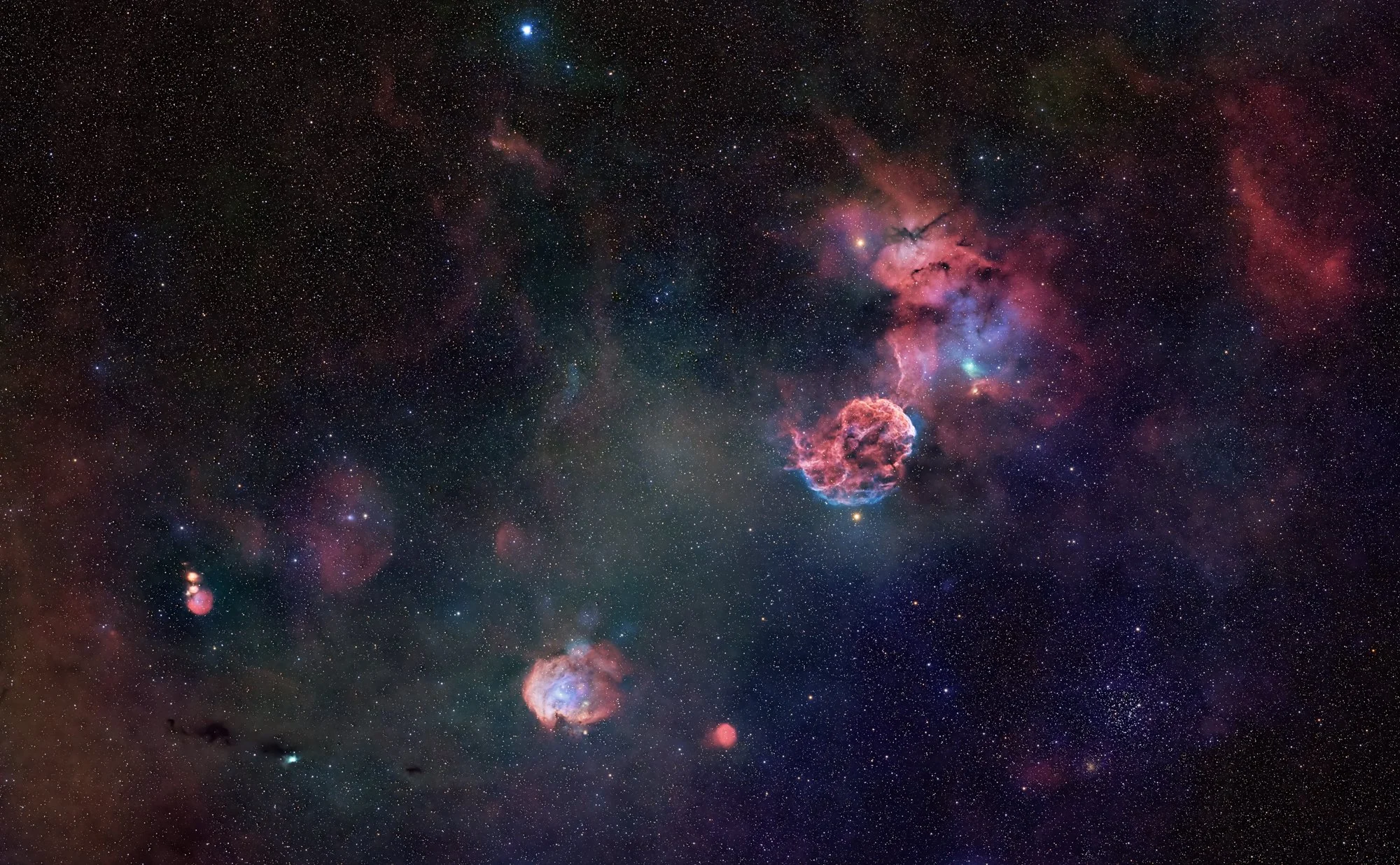
Jellyfish and Monkey head nebulas
Description and Details: Near the upper right is the Jellyfish Nebula (IC 443), the remains of a supernova that exploded occurred when a massive star approached the end of its life and exploded between 30,000 and 35,000 years ago leaving behind a neutron star and an expanding shell of ionized gasses that is estimated to be around 70 light years across. Its glowing, wispy shape comes from the expanding shockwave crashing into surrounding gas.
In the lower left is the Monkey Head Nebula (NGC 2174), a large cloud of gas about 6,400 light-years away where new stars are actively forming. The bright cluster inside it, NGC 2175, is made up of young stars that are lighting up the surrounding nebula.
The Jellyfish Nebula itself is closer, at about 5,000 light-years away.
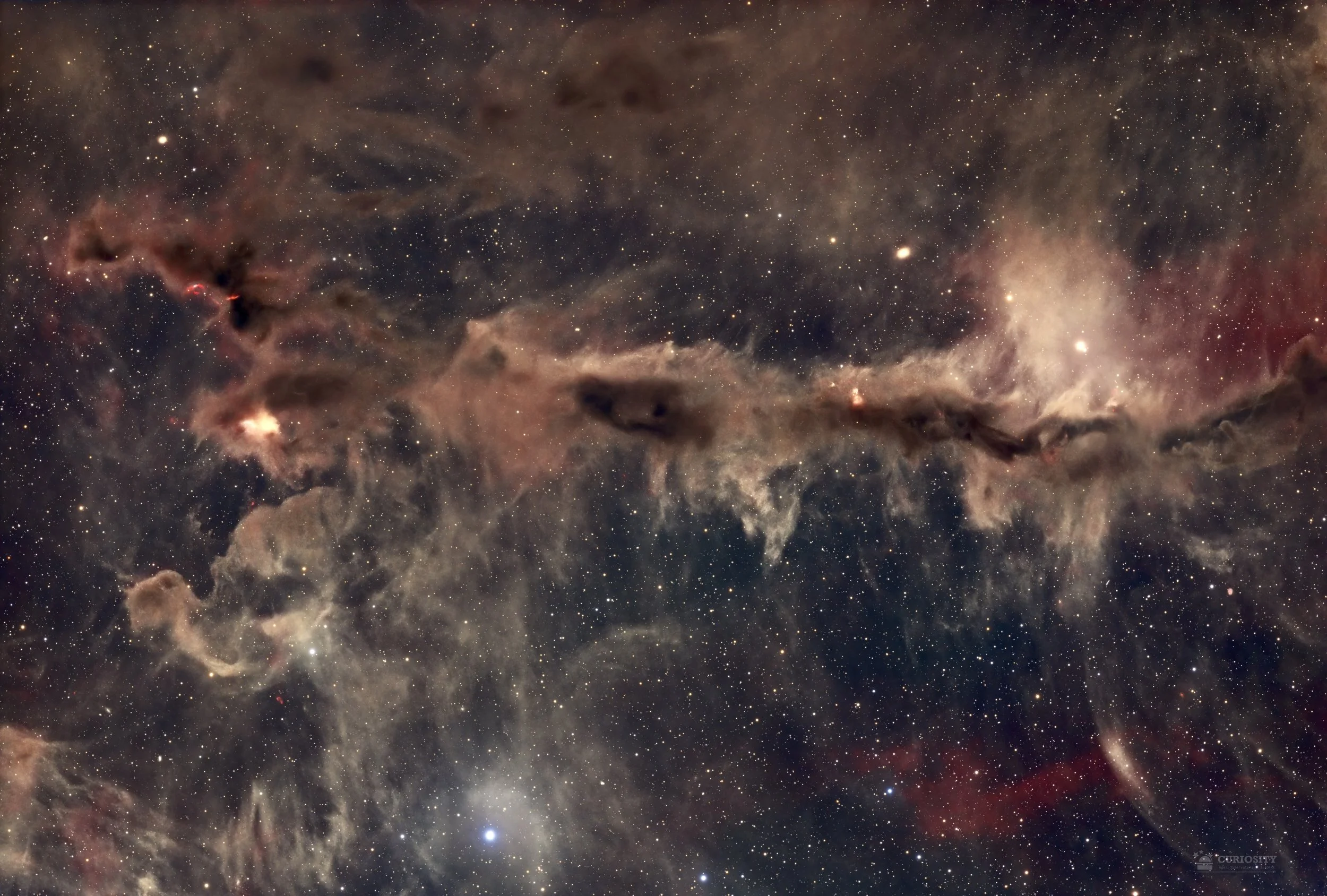
The Dark Scorpion in Taurus - Barnard 216
Description and Details: Barnard 216 (B216) is a dark nebula located in the constellation of Taurus, at an approximate distance of ~450 light-years. It is part of the Taurus Molecular Cloud complex, one of the nearest and most extensively studied star-forming regions.
B216, together with B213, B217, and B218, forms an extended absorption structure where dense dust obscures the background stellar field.
In addition to broadband data, Hα emission has been integrated, revealing faint ionized hydrogen that appears as a red glow and provides additional context to the surrounding interstellar medium.
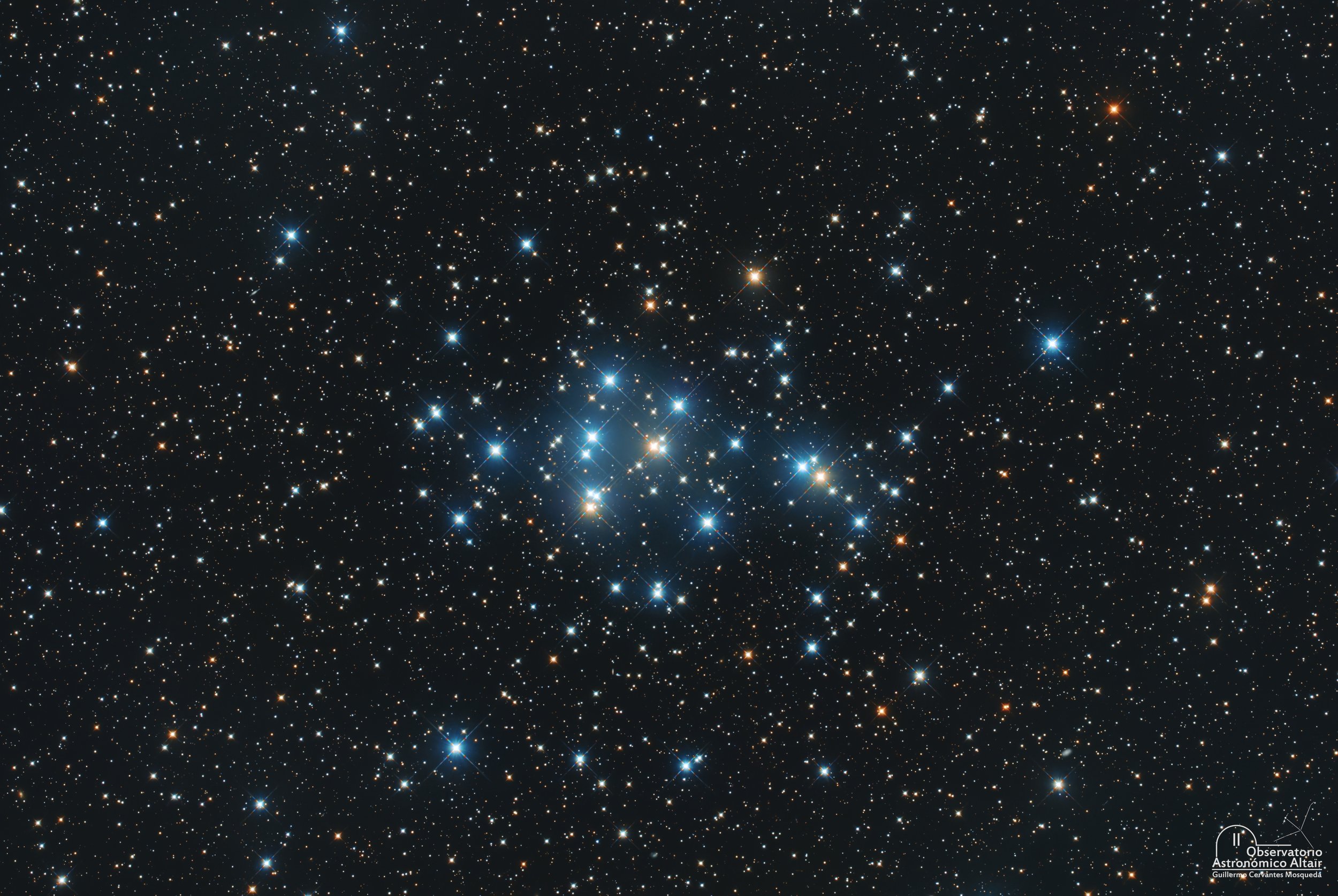
M44: The Beehive Cluster
One of the nearest and brightest open star clusters in the night sky, the Beehive Cluster, also known as Messier 44, has been admired since antiquity as a faint hazy patch visible to the naked eye in the constellation Cancer. Located about 575 light-years away, this sprawling collection contains several hundred stars loosely bound by gravity, all formed from the same giant molecular cloud roughly 600 million years ago. Through binoculars or a small telescope, that soft glow resolves into a rich swarm of suns, giving the cluster its enduring nickname and making it one of the sky’s most inviting deep-sky treasures.
The Beehive offers more than simple visual charm, serving as a nearby laboratory for studying stellar evolution in a shared environment. Its stars span a range of masses and brightnesses, while the cluster’s age places it in an important middle stage between younger open clusters and older, more dispersed stellar groups. Framed against the darker background of interstellar space, M44 reminds us that stars are often born together in luminous families, slowly drifting apart over cosmic time as the galaxy reshapes their once-crowded home.
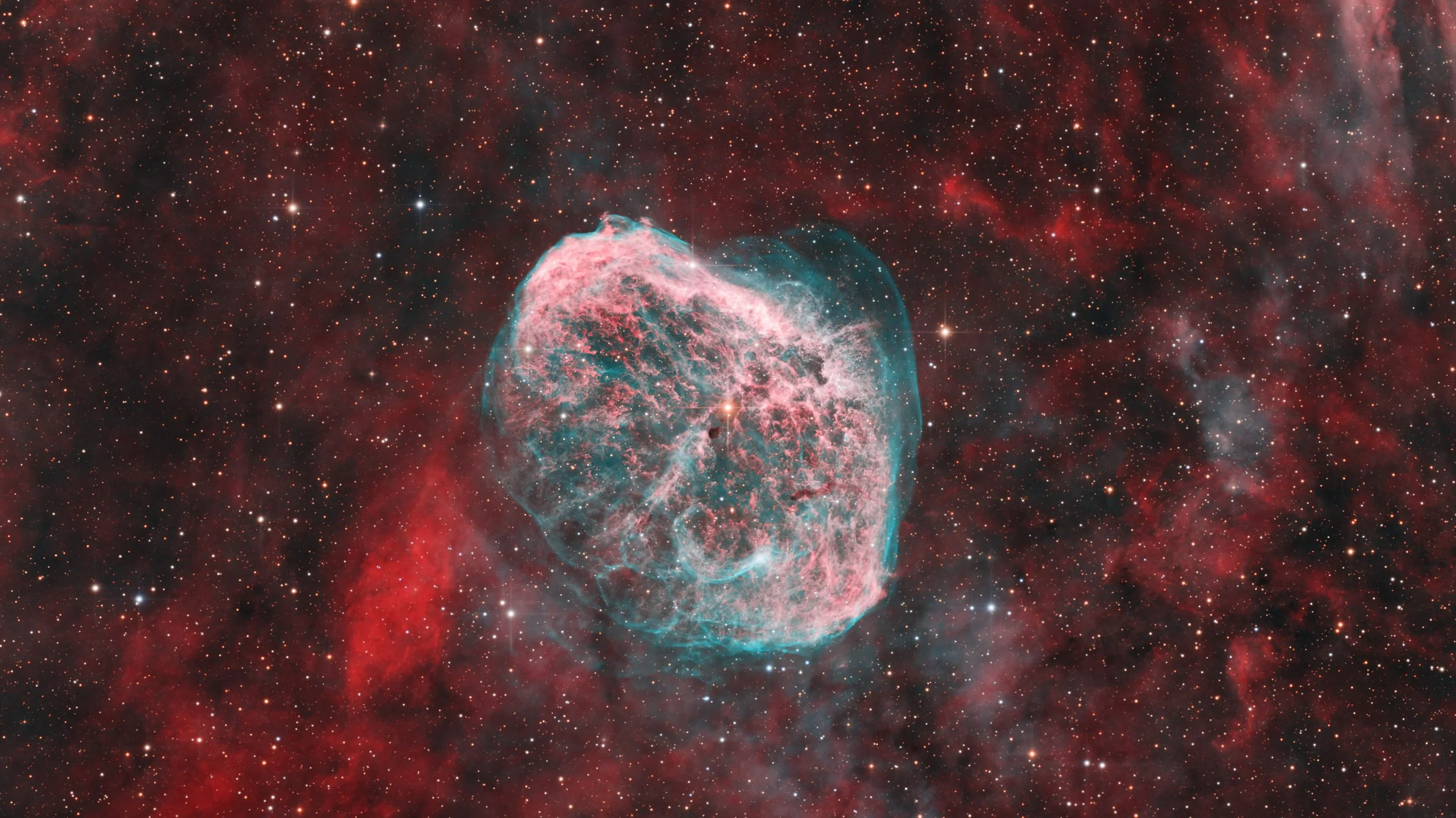
Crescent Nebula
Crescent Nebula (NGC 6888)
Blown into space by the fierce stellar winds of a massive Wolf-Rayet star, the Crescent Nebula, cataloged as NGC 6888, is a glowing shell of ionized gas in the rich starfields of Cygnus. Roughly 5,000 light-years away, this emission nebula marks a brief and violent phase in the life of a star nearing its explosive end. The nebula’s intricate arcs and filaments formed as fast, energetic winds from the central star slammed into slower material ejected earlier in its evolution, compressing the gas into the luminous, sculpted bubble seen here.
Often imaged in narrowband light, the Crescent Nebula reveals a dramatic contrast between hydrogen, oxygen, and sulfur emissions, highlighting both its delicate internal texture and chaotic outer shock fronts. These glowing tendrils trace the interaction between stellar outflows and the surrounding interstellar medium, offering a striking look at how massive stars reshape their cosmic neighborhoods long before they end as supernovae. In both science and beauty, NGC 6888 stands as a vivid reminder that even a star’s final chapters can create structures of extraordinary complexity.