
Discovery of Extended Hα Clouds and New Filaments Near Centaurus A
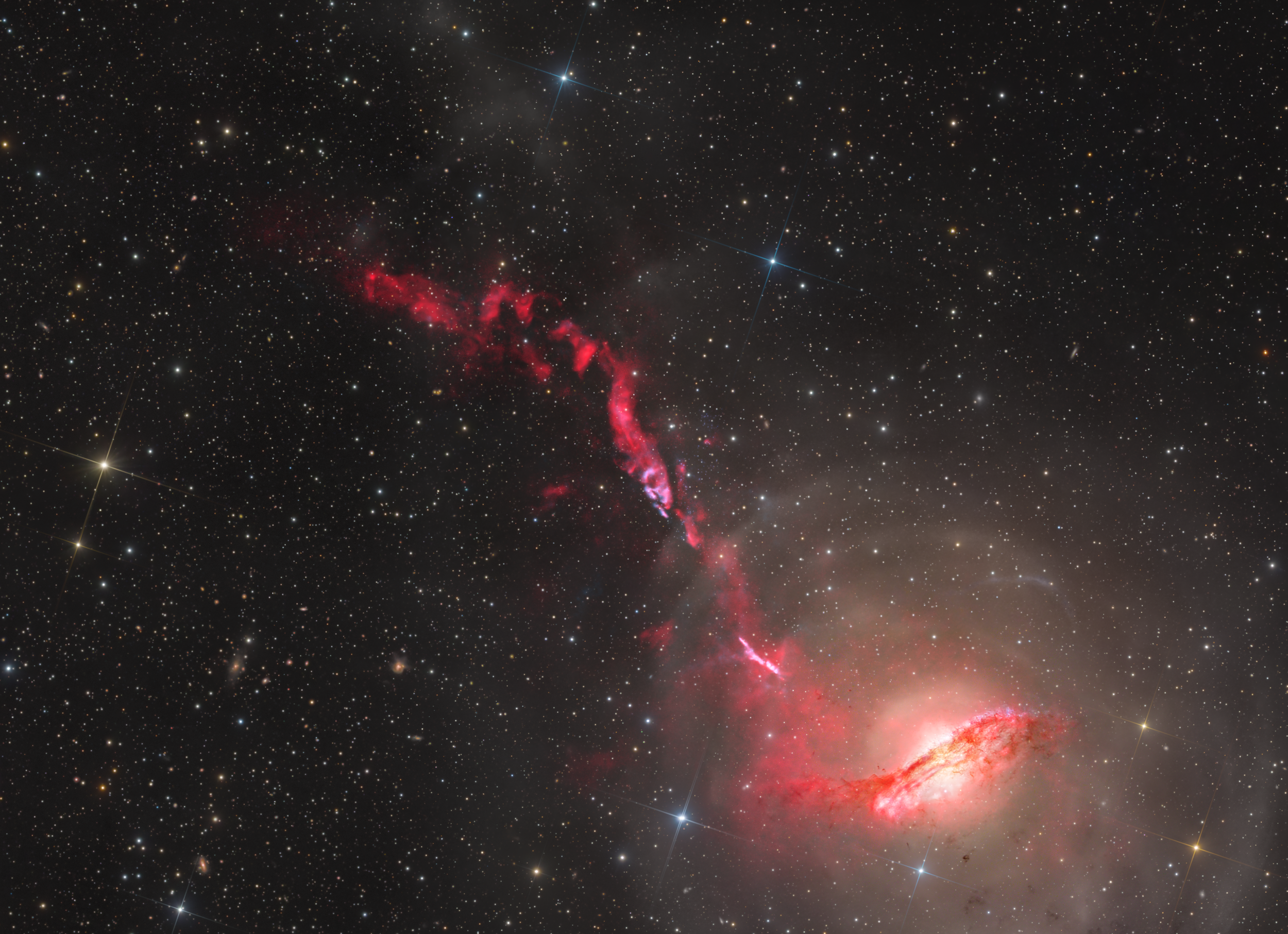
Image Title: Discovery of Extended Hα Clouds and New Filaments Near Centaurus A
Copyright: Rolf W. Olsen
Date image was taken: September 30, 2024
Location: Auckland, New Zealand
Data Acquisition Method: Personal Telescope Setup
Description and Details: Ultra-deep imaging reveals extensive Hα structures within the central 8-10 kpc region of Centaurus A, not previously described in the literature. These emission regions stretch from the central core and dust lane area and into the Northern Transition Region and generally follow the path of the well-known optical jet filaments.
The nebulosity originates near the central dust lane, extending primarily to the east and northeast. It appears as irregular, faint Hα emission regions that stretch from the dust lane through the inner optical filament, located approximately 8 kpc (25,000 light-years) from the core. The Hα emission continues northeastward, connecting with the outer optical filament at a projected distance of 15 kpc (49,000 light-years).
The area surrounding the outer filament also shows many faint Hα structures. While these features are visible in professional datasets such as from CFHT, some have not previously been captured in amateur astrophotography, including my own earlier 320-hour image from 2024.
To detect the ultra-faint Hα emission close to the core — especially within the bright stellar halo — a careful continuum subtraction was performed. This process removes broad-band flux gradients, isolating only the narrow Hα line emission.
Over the past 11 years, I have gathered hundreds of hours of data on Centaurus A from my backyard observatory in Auckland, New Zealand. This long-term effort has led to several notable results, including the first optical detection of light from the otherwise invisible southern jet and discovery of new Hα and [O III] structures associated with the northern jet’s optical filaments.
The total exposure (LRGBHaOIII) of this image is now 454 hours. As of writing, I have accumulated a total of 220 hours of Hα exposure, which I believe represents the deepest Hα image of Centaurus A ever taken, amateur or professional.
Name: Rolf Olsen
Website or Facebook Profile: http://app.astrobin.com/u/Rolf-Olsen
Share & Credit This AAPOD2 Feature
When you share this image on AstroBin, social media, forums, or your own website, please include a credit to AAPOD2 so viewers can discover where this feature came from.
Support AAPOD2 for free! Use Our AGENA ASTRO Affliate Link
AAPOD2 Title: Discovery of Extended Hα Clouds and New Filaments Near Centaurus A
AAPOD2 Page Link: https://www.aapod2.com/blog/centaurus-a-ultra-deep-ha-structures
Submit Your Photo!