
A deep look at the Milky Way Core HaRGB Mosaic
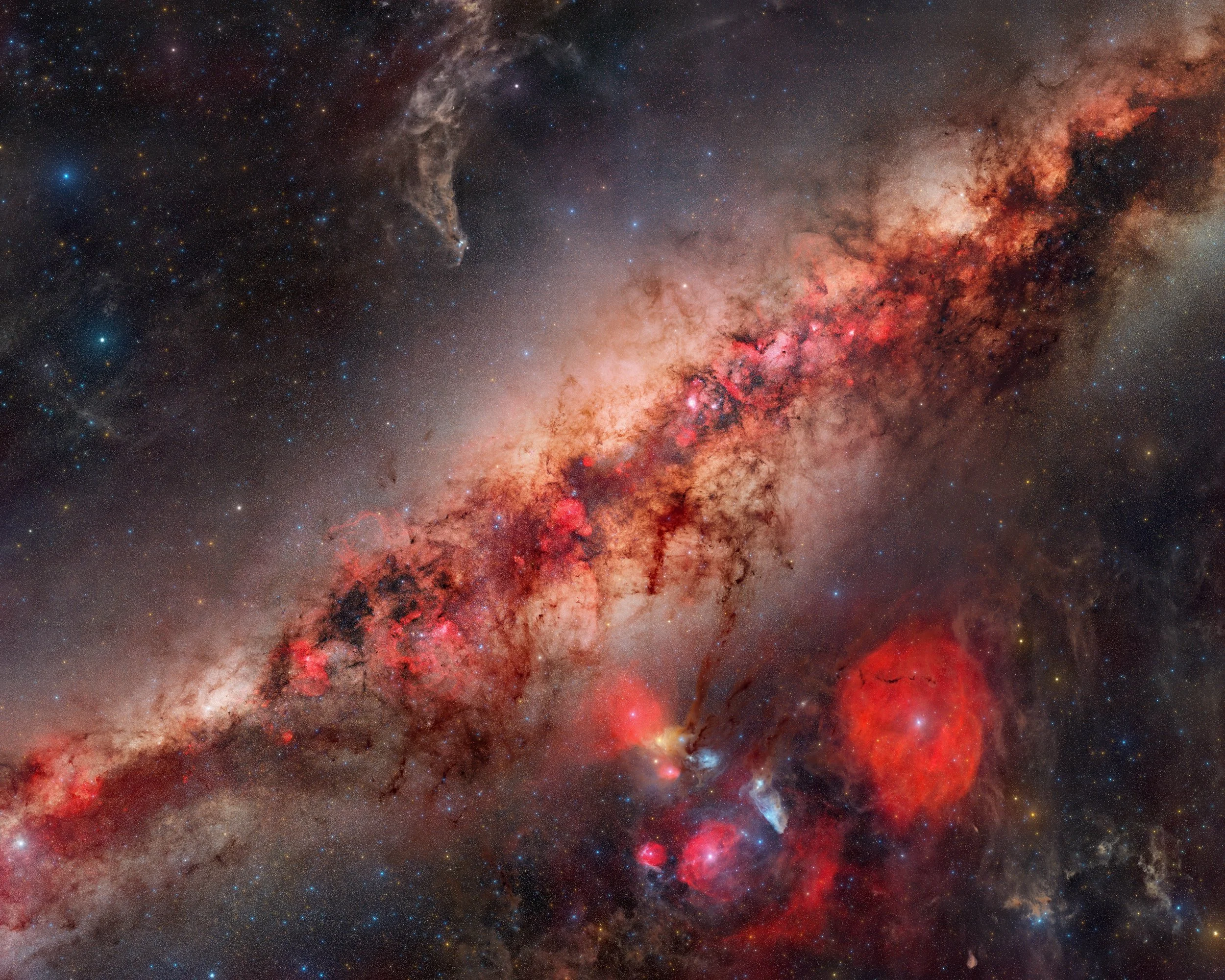
Image Title: A deep look at the Milky Way Core | 135mm HaRGB Mosaic
Copyright: Jakob Sahne
Description and Details: On my 2025 Namibia trip I finally completed a deep 135 mm mosaic of the Milky Way’s core—an idea I first tried on La Palma with much less data. I ran a dual-Samyang 135 mm f/2 rig: Sony a7 III for H-alpha and Nikon Z6 for RGB on a Sky-Watcher Star Adventurer GTi. Using N.I.N.A., I shot unguided 90–120 s frames at f/2 with accurate computer-assisted polar alignment and periodic dithers. The mosaic was planned in Telescopius and executed via a custom N.I.N.A. sequence. I captured a larger field but later trimmed panels to keep full resolution and a tighter composition.
Processing revealed severe Newton’s rings—traced to a mild LP filter—appearing mainly in the green channel. I fixed them two ways: (1) channel math using the blue channel as a reference to correct green, and (2) PixInsight’s SCNR with “Preserve lightness” off, which also adjusts luminance. Between both methods I recovered ~90% of the signal with minimal artifacts. I then assembled the mosaic in Astro Pixel Processor, ultimately working around ~750 MP for the RGB master, and later blended in clean H-alpha. I also folded in 2021 La Palma stacks to further stabilize gradients.
Under truly pristine skies the data needed little beyond careful stretching, contrast, saturation, and some finesse. After weeks of iterative tweaks, the RGB+Ha mosaic cleanly frames the Galactic Center and surrounding dust lanes and nebulae at full native detail.
The final integrationtime was 103h20min - ~65% of that was RGB
Name: Jakob Sahner
Website or Facebook Profile: https://jakobsahnerphotography.com/
Share & Credit This AAPOD2 Feature
When you share this image on AstroBin, social media, forums, or your own website, please include a credit to AAPOD2 so viewers can discover where this feature came from.
Support AAPOD2 for free! Use Our AGENA ASTRO Affliate Link
AAPOD2 Title: A deep look at the Milky Way Core HaRGB Mosaic
AAPOD2 Page Link: https://www.aapod2.com/blog/deep-look-at-the-milky-way-core
Submit Your Photo!