
M27
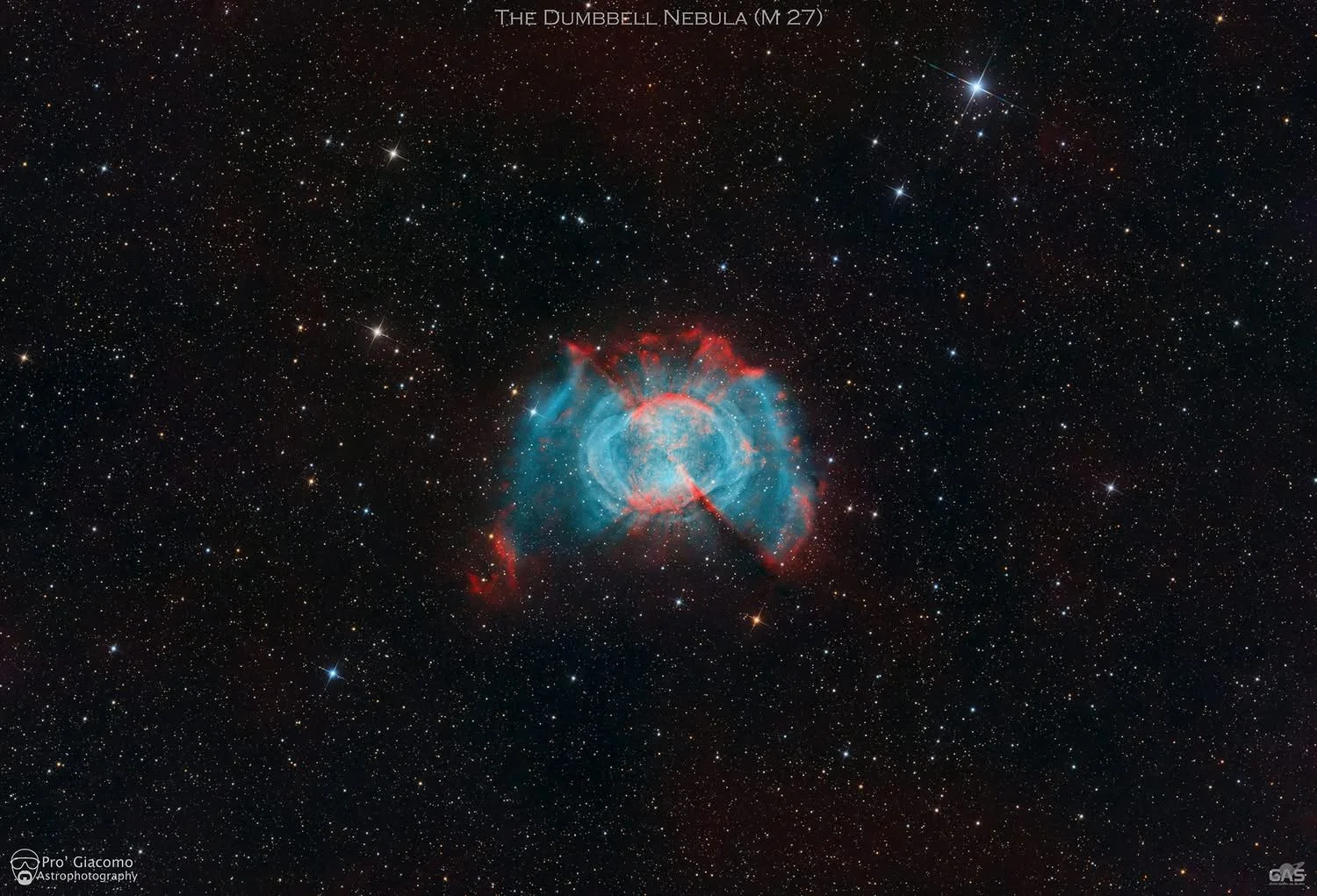
At the heart of the constellation of Volpetta, about 1,200 light-years from Earth, lies M27, the Manubrio Nebula, one of the most famous and spectacular planetary nebulae in the summer sky. Discovered by Charles Messier in 1764, it is the result of the last evolutionary phase of a star similar to our own.
Today, that star no longer exists in its original form. During the final stages of its evolution, it expelled its outer layers into space, creating the gas envelope we see today. The intense ultraviolet radiation continues to illuminate the surrounding material.
The famous shape of the nebula is due to the peculiar geometry of the expanding gas envelope. The brightest areas highlight the regions of higher density, while the outer structures, which are much weaker and more delicate, testify to the complexity of the processes that led to the loss of the star's outer layers.
Observing and photographing the Manubrio Nebula means, in a way, witnessing the conclusion of a stellar story that began billions of years ago. A delicate gas envelope, suspended in space, continues to shine as it slowly moves toward cosmic silence.
To capture the full range of brightness present in M27, from the bright central region to the very faint peripheral structures, the image was created using exposures of different times, later combined with HDR (High Dynamic Range) technology. This choice allowed preserving the details of the nucleus, preventing the brightest areas from appearing overlapped, while at the same time bringing out the delicate outer structures of the nebula.
Light: 233 x 300 seconds - Filter: Antlia ALP-T 3nm Ha&OIII
Light: 162 x 30 seconds Filter: Antlia ALP-T 3nm Ha&OIII (HDR)
Light: 135 x 60 seconds Filter: Optolong L-QEF (RGB star)
Camera: Asi 294 mc pro
Telescope: Sky-Watcher 200/1000 PDS (CUSTOM)
Mount: Skywatcher Eq 6-r Pro
Acquisition: Asiair Plus
Software: DSS - Pixinsight – Photoshop
Shots: 11-12-13-14/08/2026
Location: Torricella (TA) ITALY
Sky SQM: 19,45
Copyright: PRO’ GIACOMO.
Share & Credit This AAPOD2 Feature
When you share this image on AstroBin, social media, forums, or your own website, please include a credit to AAPOD2 so viewers can discover where this feature came from.
Support AAPOD2 for free! Use Our AGENA ASTRO Affliate Link
AAPOD2 Title: M27
AAPOD2 Page Link: https://www.aapod2.com/blog/m27
Submit Your Photo!