
Clusters in a Sea of Stars – M22 + M28
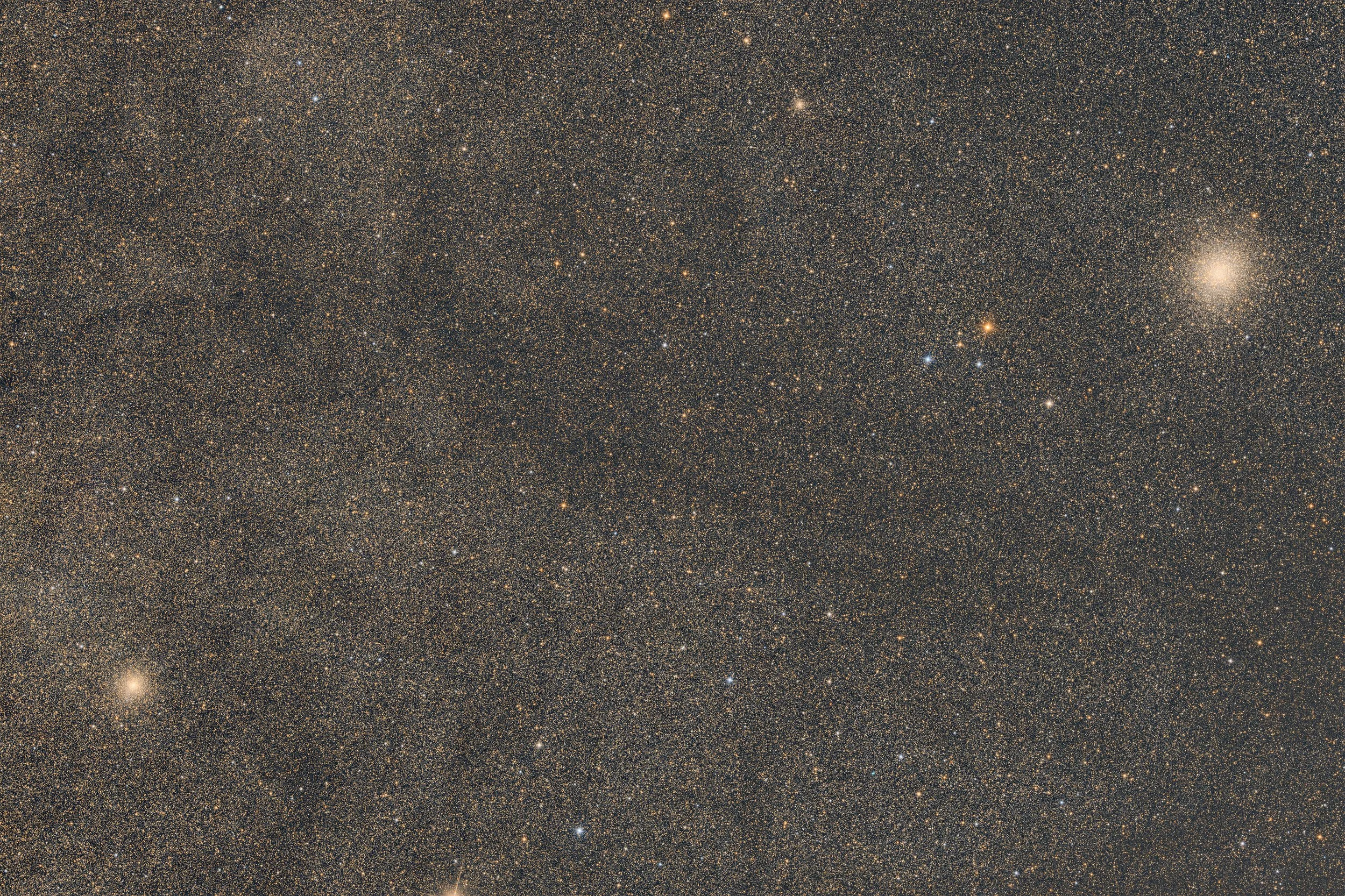
Image Title: Clusters in a Sea of Stars - M22 + M28
Copyright: Daniel Paull
Date image was taken: July 14, 2026
Location: Gidgegannup, Western Australia
Data Acquisition Method: Personal Telescope Setup
Description and Details: Globular clusters are often photographed as isolated jewels against the darkness of space. Yet in reality, they are anything but isolated. This image places two of the southern sky's finest globular clusters, Messier 22 and Messier 28, in their natural environment: the extraordinarily rich star fields of the Milky Way's central bulge. Rather than standing apart from the background, the clusters are integrated seamlessly with the surrounding star field, reminding us that they are members of our own Galaxy, sharing the same cosmic neighbourhood.
Located in the constellation Sagittarius, M22 lies approximately 10,600 light-years from Earth and is one of the closest and brightest globular clusters in the night sky. It contains several hundred thousand ancient stars, many over 12 billion years old, making it a surviving relic from the earliest epochs of the Milky Way's formation.
Nearby lies Messier 28, a more compact and distant globular cluster roughly 18,000 light-years away. While often overshadowed by its famous neighbour, M28 is itself home to hundreds of thousands of stars and has become scientifically significant through the discovery of numerous millisecond pulsars within the cluster.
This image combines approximately six hours of exposure using a Celestron RASA 11 and QHY600C, followed by 2x drizzle integration to produce a final image of approximately 240 megapixels, with an effective sampling of around 0.6 arcseconds per pixel.
At f/2.2, the Celestron RASA 11 collects light extraordinarily quickly, making it ideal for revealing faint stars across the Galactic Bulge. The trade-off is that every optical imperfection becomes visible. Tiny errors in focus, sensor tilt, collimation or tracking quickly reveal themselves when nearly every pixel contains stellar data. With such an overwhelmingly dense field, there is nowhere for acquisition or processing mistakes to hide.
The result is an image that rewards exploration at full resolution, where countless faint stars and hidden gems continue to emerge as the viewer zooms deeper into the field.
This image is best viewed at full resolution on Astrometrical: https://astrometrical.com/works/clusters-in-a-sea-of-stars-m22-m28
The field includes several notable objects:
* Globular Clusters M22, M28, and NGC 6642
* Planetary Nebula NGC 6629
* Planetary Nebula NGC 6644
* Intracluster Planetary Nebula GJJC 1 (also known as PK 009-07.1)
* Numerous variable stars
* Numerous carbon stars
* Background galaxies and other fuzzies
Highrer resolution images can be supplied on request.
Name: Daniel Paull
Website or Facebook Profile: https://www.facebook.com/astrometrical
Terms and conditions: I agree
Share & Credit This AAPOD2 Feature
When you share this image on AstroBin, social media, forums, or your own website, please include a credit to AAPOD2 so viewers can discover where this feature came from.
Support AAPOD2 for free! Use Our AGENA ASTRO Affliate Link
AAPOD2 Title: Clusters in a Sea of Stars – M22 + M28
AAPOD2 Page Link: https://www.aapod2.com/blog/messier-22-m22-and-messier-28
Submit Your Photo!