
Rima Ariadaeus – A Lunar Fault Line
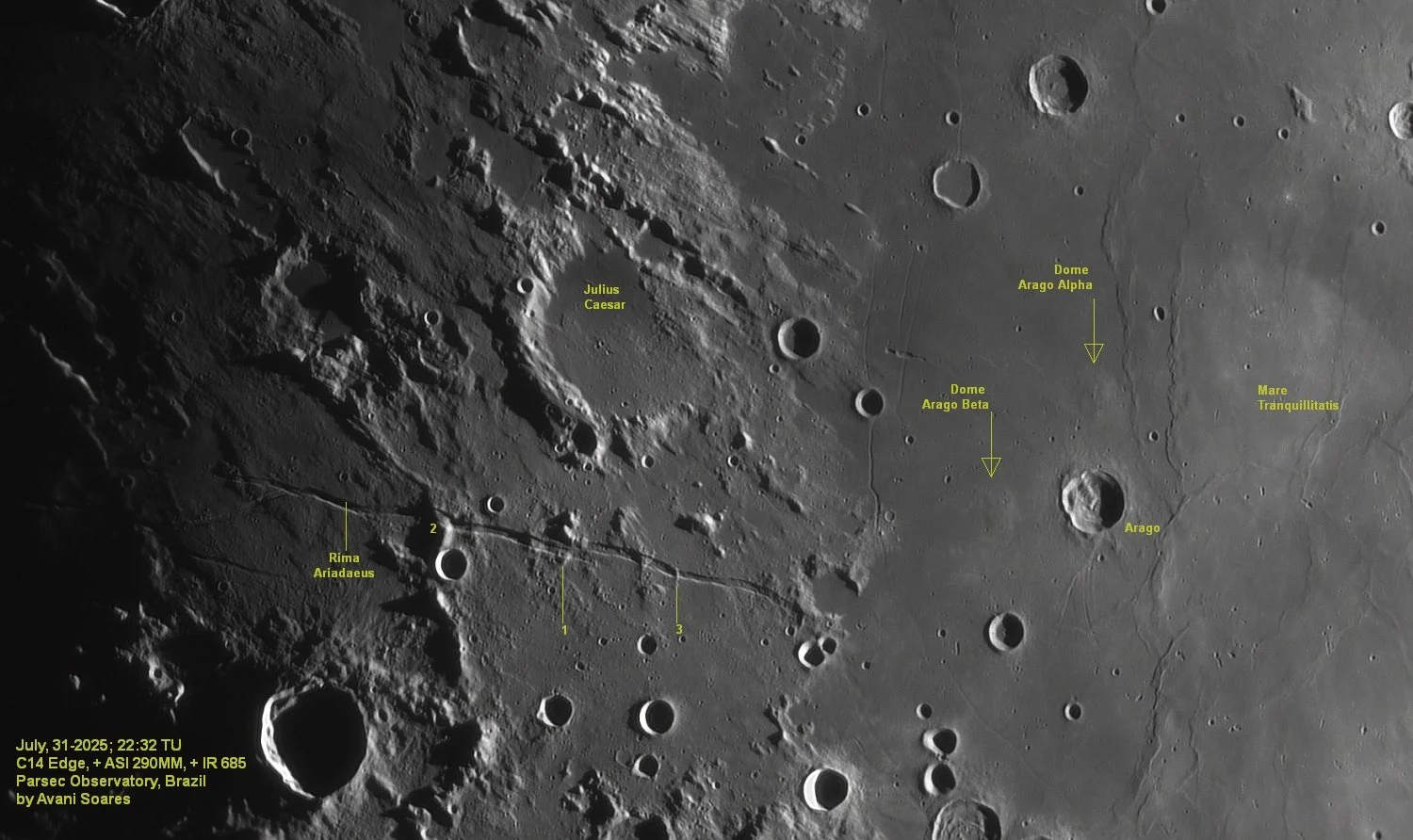
Image Title: Rima Ariadaeus
Copyright: Astroavani
Date image was taken: July 31, 2025
Location: Parsec Observatory, Brazil
Data Acquisition Method: Personal Telescope Setup
Description and Details: Rima Ariadaeus is one of several linear channel systems nestled in the highlands between Mare Vaporum and Mare Tranquillitatis. Some channels, such as Vallis Schroteri (https://www2.lpod.org/wiki/August_6,_2013), were formed by volcanic eruptions. Other channels, such as Rima Ariadaeus, are believed to be faults that formed as a result of tectonic activity. Some scientists believe that linear channels may have formed after large impact events, while others believe they were formed as a surface manifestation of deep dike systems when the Moon was still volcanically active.
Experts agree that Rima Ariadaeus, about 300 km long, is a fault system similar to those on Earth. A large portion of Rima Ariadaeus is visible in this image, and the same image shows (arrow 1) part of the channel's fault scarp. Rima Ariadaeus is 5 km wide and interrupts preexisting geological features.
The stratigraphic relationships between the rill and other surface features can help determine whether the rill is older or younger than these features in terms of relative age. For example, the groove cuts through a ridge in the middle-left of the frame (arrow 2). This relationship suggests that the rill is younger than the ridge because the rill changed the ridge's shape. However, in the image, small craters are present at the bottom of the rill, suggesting that the rill is older than these overlying craters. Likewise, the small bridge (arrow 3) appears to have formed after the rill. These types of observations are used to examine the stratigraphic relationships and relative ages of landforms in this region, allowing scientists to reconstruct the Moon's geological history.
The Domes of Arago and Julius Caesar themselves are a bonus in an already magnificent image.
Source: LROC/NASA
Adaptation and Text: Avani Soares
Name: Avani Soares
Website or Facebook Profile: https://app.astrobin.com/u/astroavani#gallery
Share & Credit This AAPOD2 Feature
When you share this image on AstroBin, social media, forums, or your own website, please include a credit to AAPOD2 so viewers can discover where this feature came from.
Support AAPOD2 for free! Use Our AGENA ASTRO Affliate Link
AAPOD2 Title: Rima Ariadaeus – A Lunar Fault Line
AAPOD2 Page Link: https://www.aapod2.com/blog/rima-ariadaeus-lunar-fault
Submit Your Photo!