

AAPOD2 Image Archives
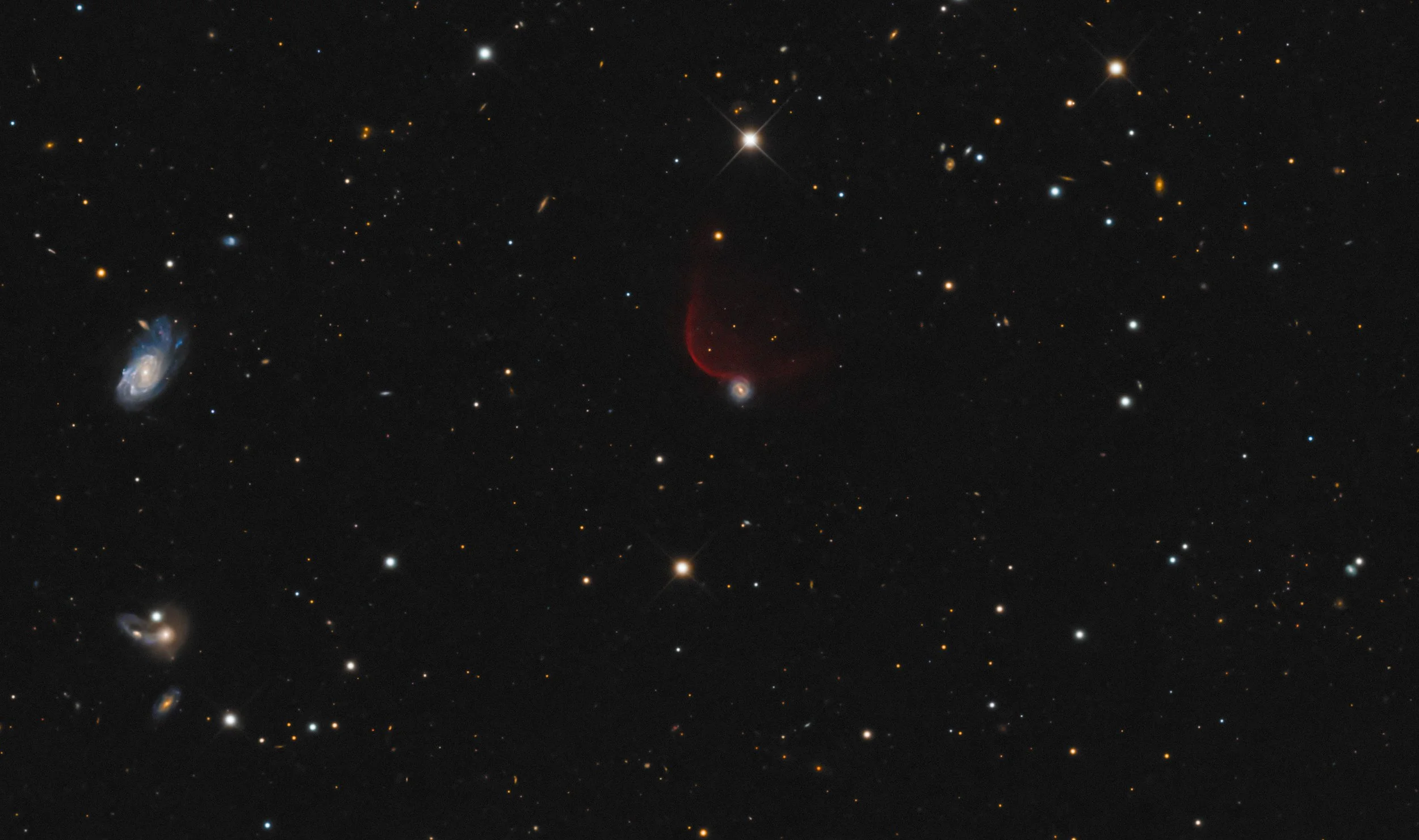
Pulsar J0437-4715 with Bow Shock
Racing through interstellar space at hundreds of kilometers per second, PSR J0437-4715 is one of the nearest known millisecond pulsars to Earth, located about 500 light-years away in the constellation Pavo. This rapidly spinning neutron star, the dense remnant of a supernova explosion, emits powerful winds of charged particles. As it plows through the thin gas between stars, those winds collide with the surrounding medium, creating the faint red arc seen here: a hydrogen bow shock formed where the pulsar’s particle outflow compresses and excites interstellar hydrogen.
Beyond the pulsar itself, this deep-field image reveals a rich background of distant galaxies scattered across the frame, emphasizing both the local and extragalactic scales captured in a single exposure. The contrast between the delicate bow shock and the myriad galaxies highlights the dynamic nature of our Milky Way’s stellar remnants against the vast, static backdrop of the universe. This image was captured from ObsTech in Chile using the RCOS 24" f/7.8 Ritchey-Chrétien telescope, showcasing how high-resolution ground-based imaging can trace the subtle interactions between extreme stellar objects and their cosmic environment.
Location: ObsTech, Chile
Credit: Adam Block, Optics RCOS 24" f/7.8 Carbon Truss Ritchey-Chrétien (Harris Telescope)Racing through interstellar space at hundreds of kilometers per second, PSR J0437-4715 is one of the nearest known millisecond pulsars to Earth, located about 500 light-years away in the constellation Pavo. This rapidly spinning neutron star, the dense remnant of a supernova explosion, emits powerful winds of charged particles. As it plows through the thin gas between stars, those winds collide with the surrounding medium, creating the faint red arc seen here: a hydrogen bow shock formed where the pulsar’s particle outflow compresses and excites interstellar hydrogen.
Beyond the pulsar itself, this deep-field image reveals a rich background of distant galaxies scattered across the frame, emphasizing both the local and extragalactic scales captured in a single exposure. The contrast between the delicate bow shock and the myriad galaxies highlights the dynamic nature of our Milky Way’s stellar remnants against the vast, static backdrop of the universe. This image was captured from ObsTech in Chile using the RCOS 24" f/7.8 Ritchey-Chrétien telescope, showcasing how high-resolution ground-based imaging can trace the subtle interactions between extreme stellar objects and their cosmic environment.
Location: ObsTech, Chile
Credit: Adam Block, and the Harris Telescope
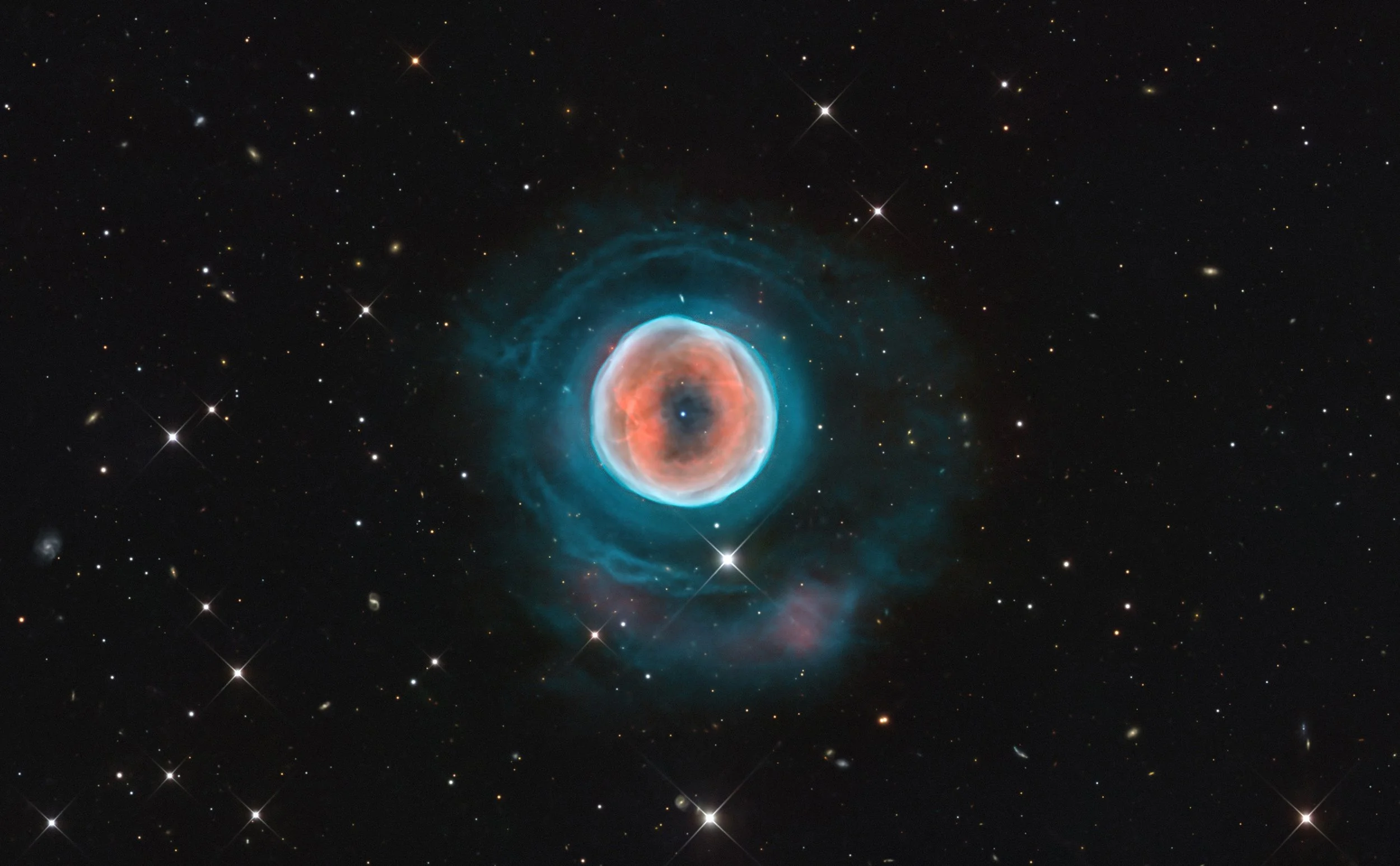
The Helix in the Peacock — Planetary Nebula IC 5148
IC 5148, often called the “Helix in the Peacock,” is a bright planetary nebula about 3,000 light-years away in the constellation Grus. It represents the final, graceful stage of a Sun-like star’s evolution as it sheds its outer layers into space. The nebula spans nearly two light-years and expands rapidly through the surrounding interstellar medium, creating a spherical shell of glowing gas illuminated by its hot central white dwarf.
Special processing that reveals only the excess H-alpha emission highlights delicate inner structures nested within the dominant OIII glow. This technique unveils the complex interplay of ionized gases shaped by stellar winds and radiation. The result is a strikingly detailed portrait of a dying star enriching its cosmic neighborhood with the elements that will seed future generations of stars and planets.