
AAPOD2 Image Archives
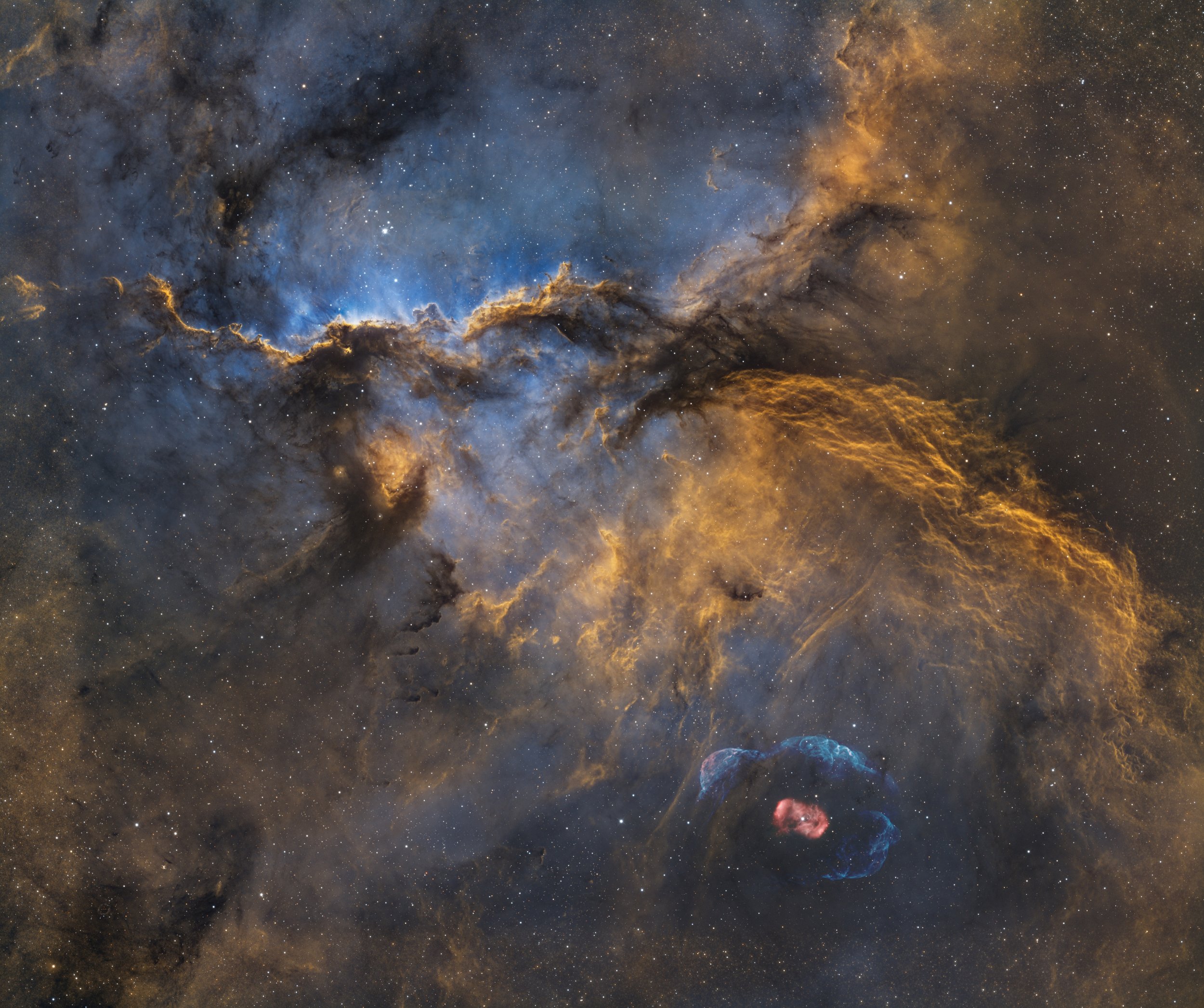
The Dragon of Ara
Stretching across 400 light-years, the vast emission nebula NGC 6188 glows in intricate filaments of hydrogen, sulfur, and oxygen. Sculpted by fierce stellar winds and radiation from the nearby young cluster NGC 6193, its form evokes a dragon soaring through the stars, a fitting image for this rich star-forming region in the constellation Ara. Within its glowing arcs, new generations of massive stars ignite, continuing to reshape the surrounding interstellar medium.
Below this sprawling cloud lies an unexpected jewel: the planetary nebula NGC 6164/6165, a symmetrical bubble of gas expelled by the massive O-type star HD 148937. Together, these neighboring objects create a striking juxtaposition, a stellar nursery giving birth to new suns above a dying star shedding its outer layers below, a vivid portrait of the cosmic cycle of stellar evolution.
This image is a two-panel mosaic, carefully captured and processed to reveal both the luminous H II structures of NGC 6188 and the delicate shell of NGC 6164/6165 in remarkable detail.
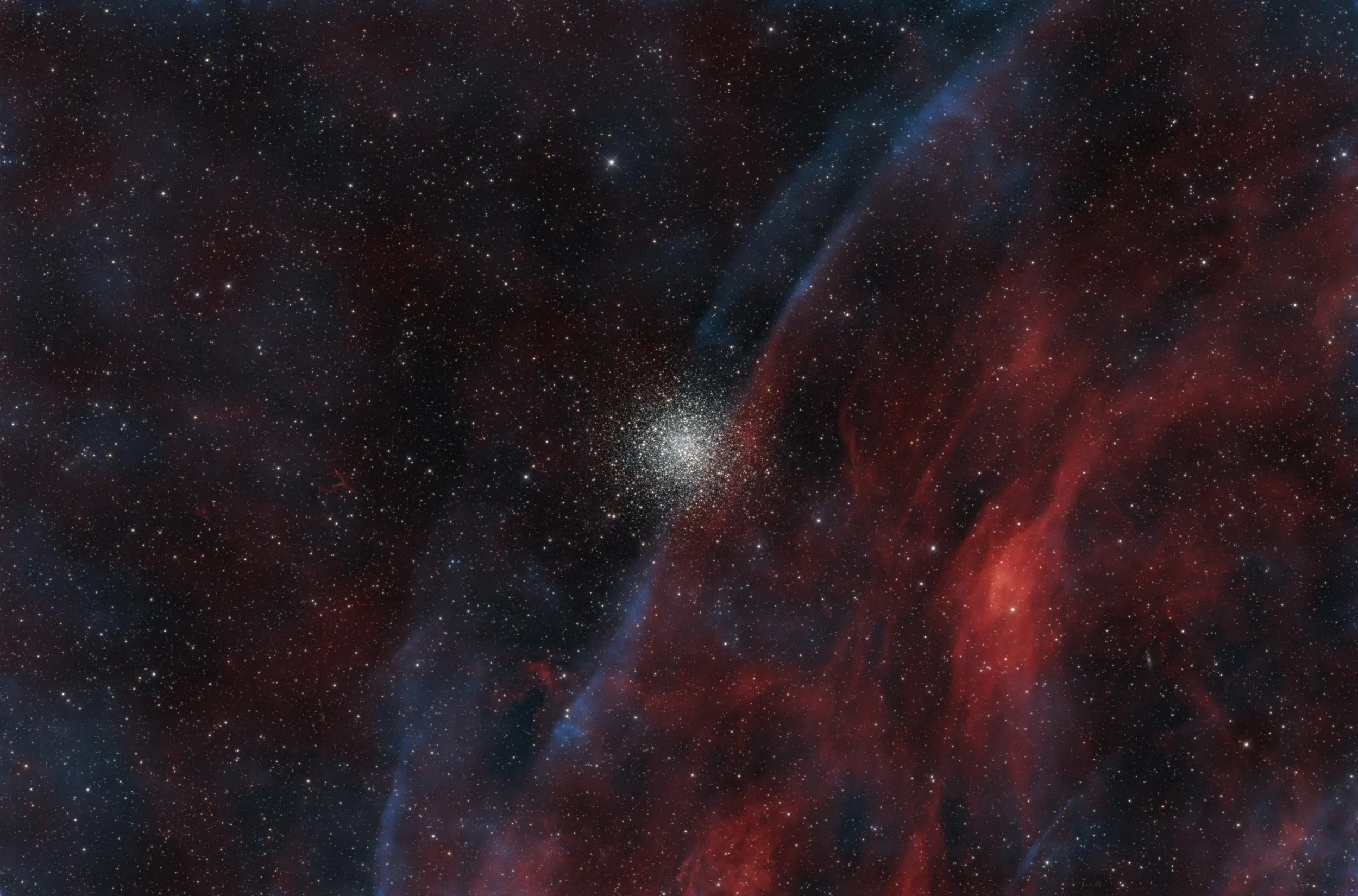
NGC 3201 and the Unexpected Glow
Located in the southern constellation Vela, NGC 3201 is a globular cluster approximately 16,300 light-years from Earth. This stellar system hosts hundreds of thousands of stars and is known for its unusually high radial velocity, suggesting a dynamic history within the Milky Way. Its relatively loose stellar concentration sets it apart from denser clusters like Omega Centauri.
Surrounding this ancient cluster is a surprising presence of faint H-alpha emission. Red hydrogen filaments thread across the field, likely unrelated to the cluster itself. Such emissions are rare in the vicinity of globular clusters, which typically contain little to no interstellar gas. The source of this emission remains unidentified but could be associated with galactic cirrus, an extended ionized structure, or even remnants of a past supernova in the line of sight.