
AAPOD2 Image Archives

Firefox Nebula
The Firefox Nebula, a lesser-known yet captivating emission nebula, resides in the constellation Orion. Its fiery appearance, characterized by glowing red and orange hues from hydrogen-alpha emissions, is accentuated by intricate filaments shaped by stellar winds and radiation. This nebula is a stellar nursery, where young, hot stars ignite the surrounding gas, creating a radiant, flame-like effect that lends the nebula its name.
Captured from Morocco, this observation benefits from the pristine skies of the Atlas Mountains. The Firefox Nebula's striking structure and vivid colors stand out against the inky backdrop, offering a glimpse into the life cycles of stars. Its radiant beauty and dynamic interplay of light and gas embody the fiery creativity of the cosmos, an ever-evolving masterpiece shaped by the forces of nature.

ATLAS - the unexpected Supernova Remnant G209.8-8.2 in Orion
Supernova Remnant G209.8-8.2, nestled within the sprawling constellation of Orion, stands as a testament to the cataclysmic events that shape the cosmos. Born from the explosive death of a massive star, this remnant carries the echoes of a stellar demise, scattering its remnants across the cosmic landscape. As the shockwave from the supernova blast continues to propagate through space, it interacts with the surrounding interstellar medium, creating intricate patterns of gas and dust that trace the remnants of the progenitor star.
Spanning across vast expanses of space, Supernova Remnant G209.8-8.2 offers astronomers a glimpse into the turbulent aftermath of a supernova explosion. Its intricate structure, shaped by the forces of stellar winds and interstellar dynamics, provides valuable insights into the life cycle of stars and the processes that govern the evolution of galaxies. Studying this remnant allows scientists to unravel the mysteries of stellar explosions, shedding light on the origins of heavy elements and the energetic phenomena that shape the universe. As it graces the night sky with its celestial presence, Supernova Remnant G209.8-8.2 stands as a reminder of the dynamic and ever-changing nature of the cosmos.
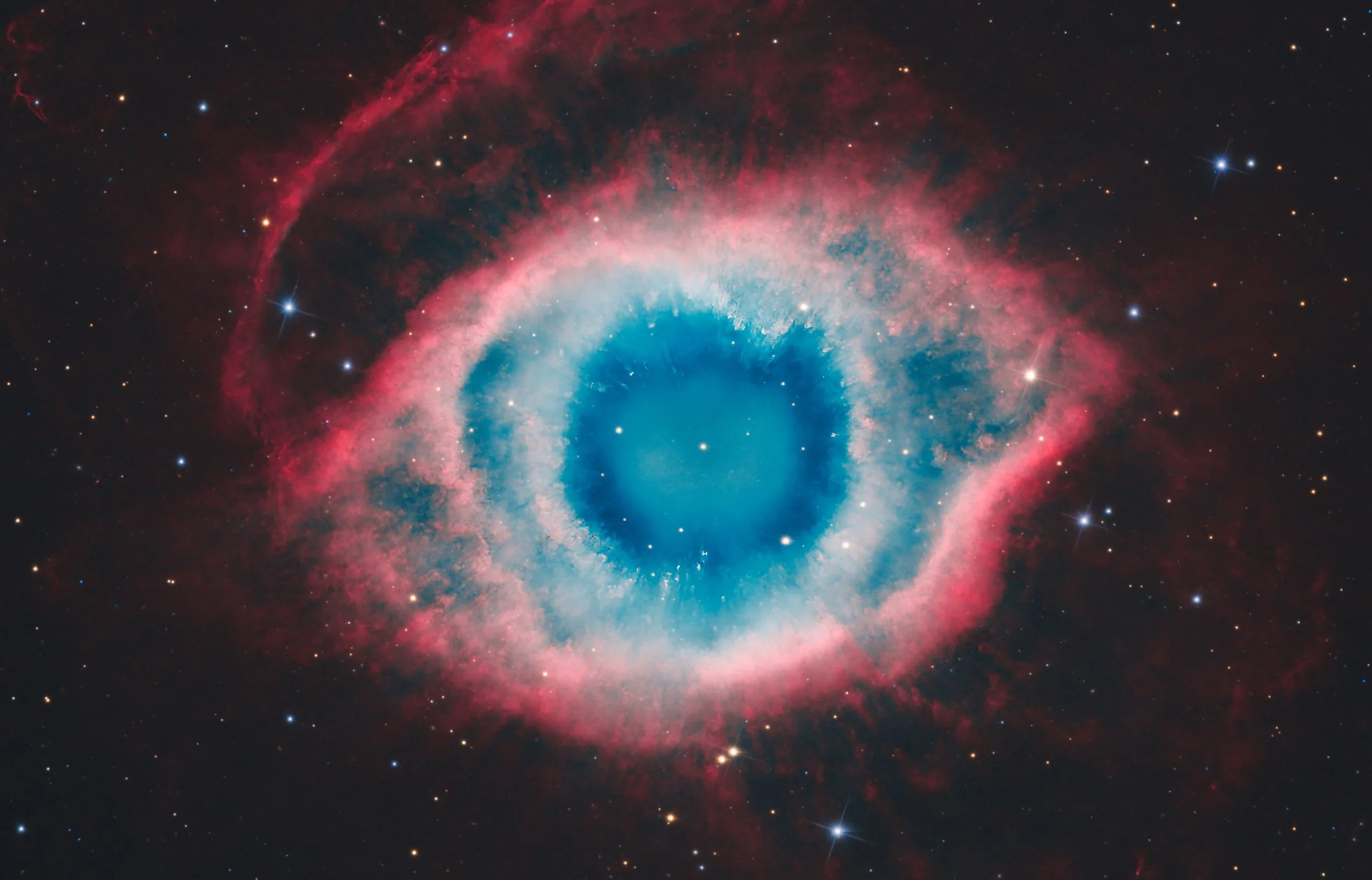
The Helix Nebula in HOORGB
The Helix Nebula, situated in the Aquarius constellation, offers a unique insight into the final stages of stellar evolution. This planetary nebula is formed as a dying sun-like star expels its outer layers, revealing a complex structure of ionized gases and intricate dust patterns spanning approximately 2.5 light-years. Through observations made with [insert telescope and camera details], the image captures the distinct chemical compositions present in the nebula. At the center of this astronomical phenomenon lies a faint, diminishing star, marking the eventual transition into a white dwarf. The Helix Nebula stands as a crucial celestial laboratory, allowing scientists to study the chemical enrichment of the interstellar medium and the mechanisms governing the transformation of stars at the end of their life cycles.
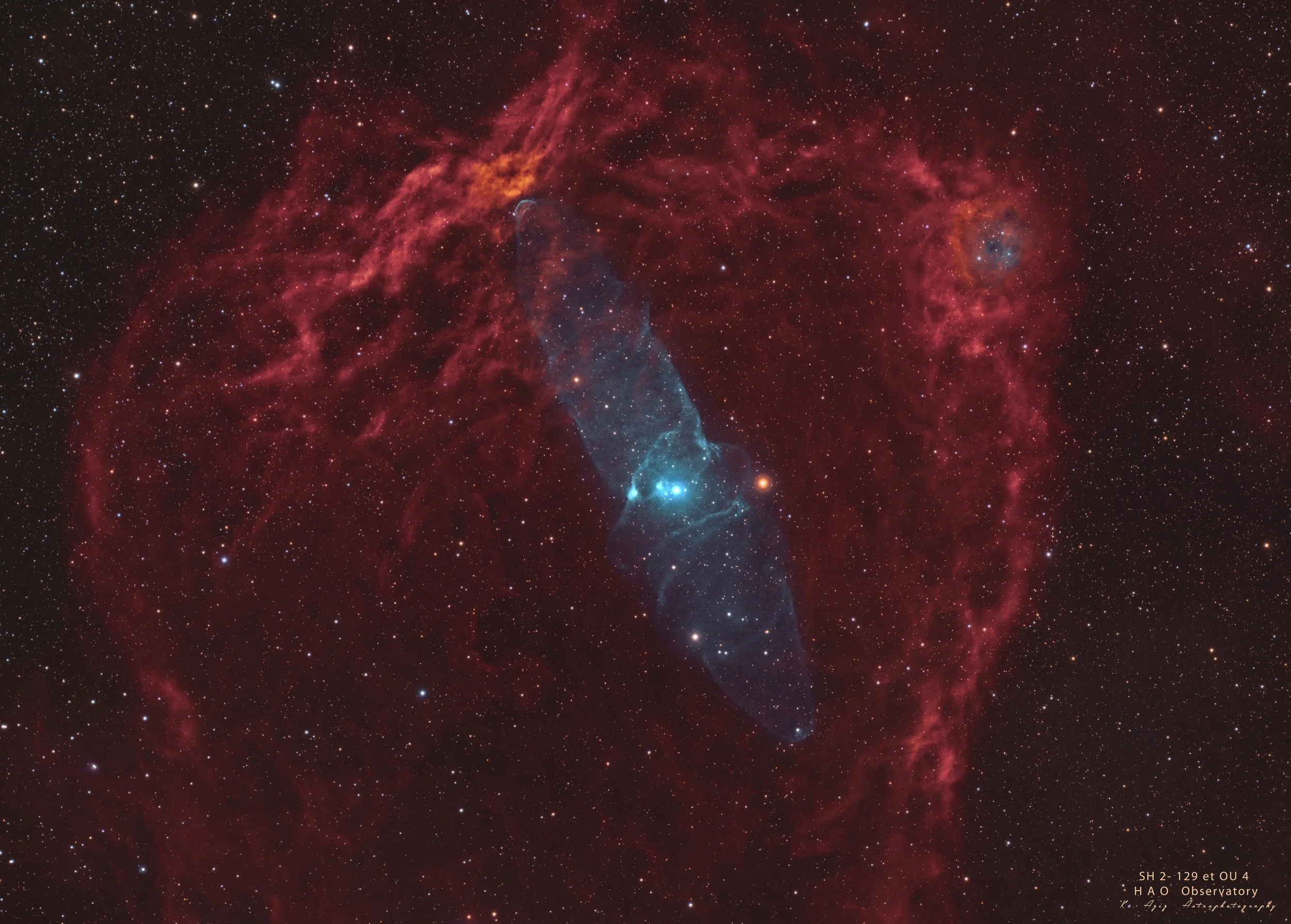
Flying Bat Nebula and Squid Nebula
Image Description and Details :
I present you my last acquisition since the setup HAO_4. these are two nebulae including one (Ou4) discovered by my friend the French astrophotographer Nicolas Outters in June 2011. This is the Giant Squid (in blue/green in the image) which is a bipolar planetary nebula located about 2000 light-years from Earth surrounded by the Flying Bat Nebula (cataloged Sh2-129 in red), both are located in the direction of the cepheus constellation.
Technical details:
- Apo Takahashi FSQ 85 to F/D 5.3
- iOptron 60 cem ec mount
- Asi 2600 mm pro
- Astronomik filters 6nm
- 205x300s HA : 17 h 05 min
- 188x600s O3 : 31 h 20 min
-181x300s S2 : 15 h 05 min
- 3 x 30 x 60s RGB : 1 h 30 min
- Full integration: 49 h 55 min
- DOF: 33/101/25
- Date: October/november 2021
- Location: HAO Observatory, Oukaimeden, Morocco.
Copyright: K. Aziz

SNR G 116.9 +00.1
mage Description and Details : I present to you an exotic object that was initially discovered as a planetary nebula but was requalified as a supernova afterglow that occurred over 7,500 years ago.
Located about 10,000 light years from home towards the Cassiopeia constellation, these are the filamentary remnants of a supernova that have a shell shape, part of which is doubly ionized oxygen (in blue) while the rest (in red) is essentially ionized hydrogen.
Technical details :
- Apo Takahashi FSQ 85 at F/D 5.3
- iOptron 60 cem ec mount
- Asi 2600 mm pro
- 6nm astronomik filters
- Acquisition sampling: 1.7 arcsec
- 92 x 600s HA i.e. 15 h 20 min
- 181 x 600s O3 i.e. 30 h 10 min
- 3 x 30 x 60s RGB i.e. 1 h 30 min
- Total integration: 47 h
- DOF: 31/149/25
- Date: August 2021
- Location: HAO4 observatory of Oukaimeden, Morocco.
Copyright: Aziz.K
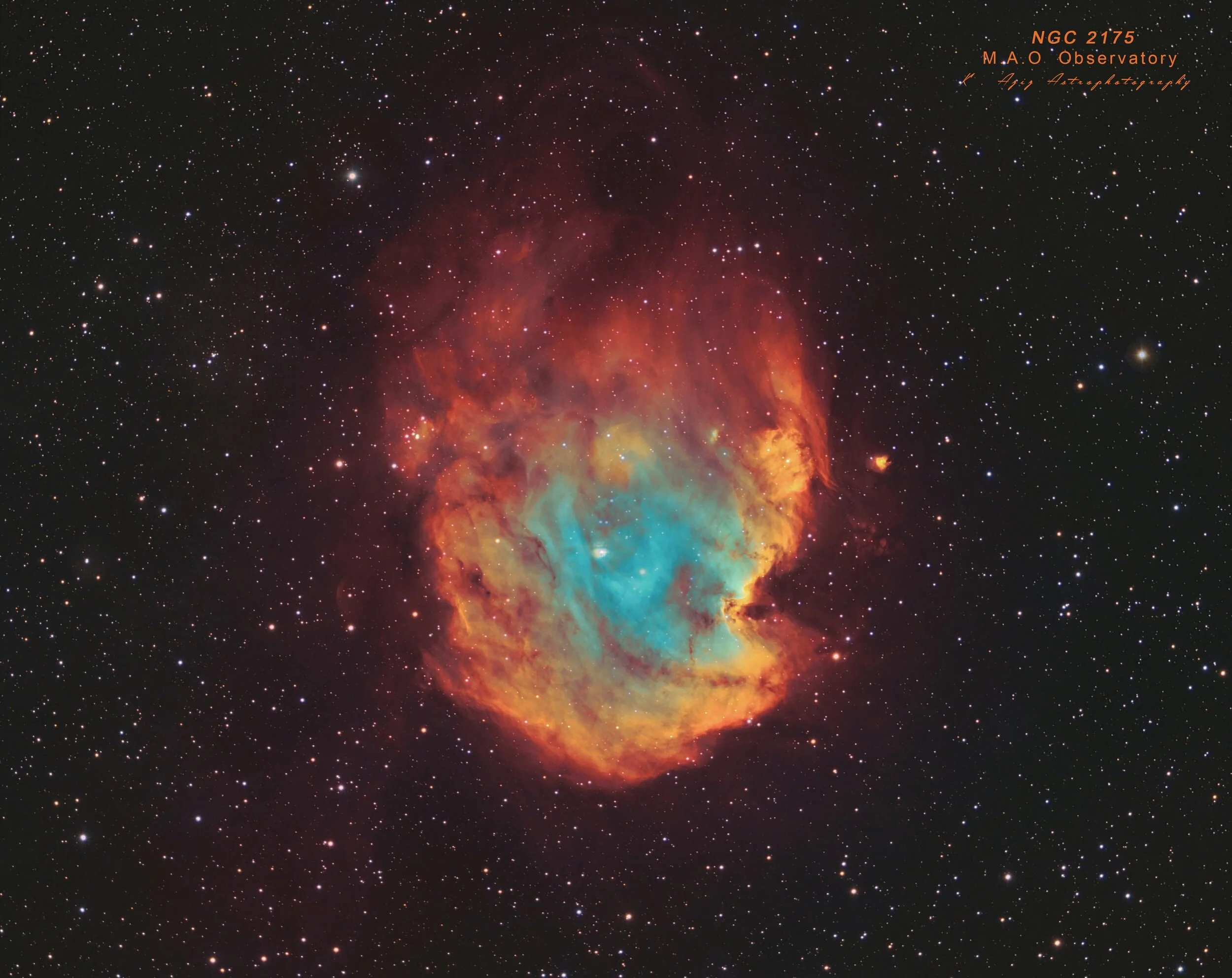
The nebula of the head of the monkey in HOO
Image Description and Details :
Located in the direction of the Orion constellation about 1600 light-years, its apparent size is slightly larger than the full moon.the monkey's head nebula or simply NGC 2175 is an emission nebula that emits in different wavelengths mainly in HA but also in Sii and Oiii.In the center is the star catalogued HD 42088 which emits a strong ultraviolet radiation that ionizes the gases in the vicinity.In addition to ultraviolet radiation, this star emits powerful stellar winds that shape the nebula's gas cluster, helping to create several pillars (visible in the image) that form a star nursery.Technical data:- Takahashi fsq 85 F/D 3.8- iOptron cem60 ec mount- Zwo asi 1600 mm cooled pro- 130x300s HA : 10h50min- 145x600s OIII : 24h10min- 30x3x60s RGB : 1h30 min- Total integration: 36 hours 30 minutes- DOF: 27x101x35- Date: January 2021- Location: Ben Slimane MAO Observatory, Morocco.
Copyright: Aziz Kaeouach
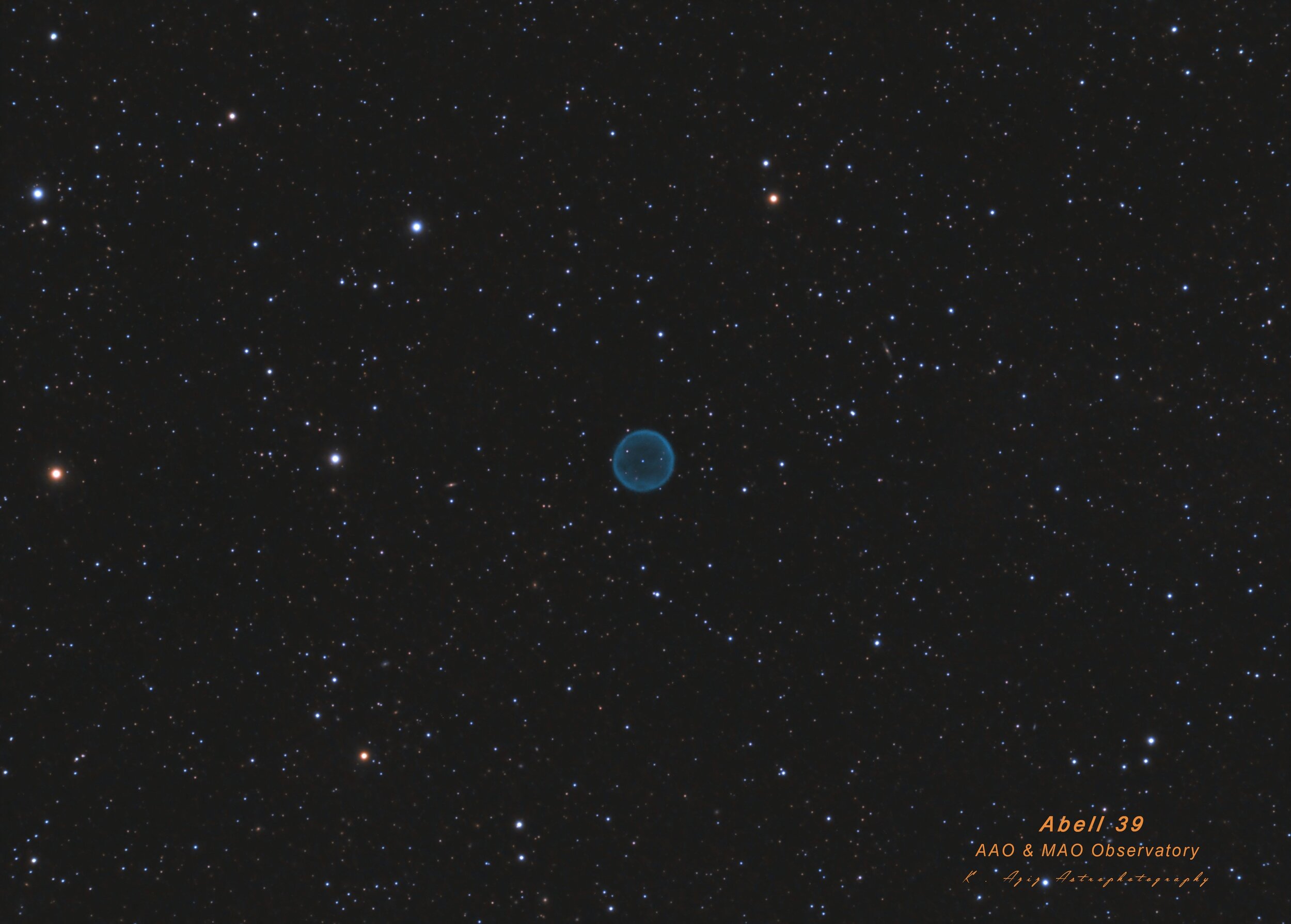
Abell 39
Image Description and Details : Here is the planetary nebula known by the sweet name Abell 39. Very dim, it is located about 6800 light-years from home in the direction of the constellation of Hercules.
Its peculiarity lies in its almost spherical shape, and despite its too small angular size, its radius is 2.5 LY making it one of the largest known planetary nebulae.
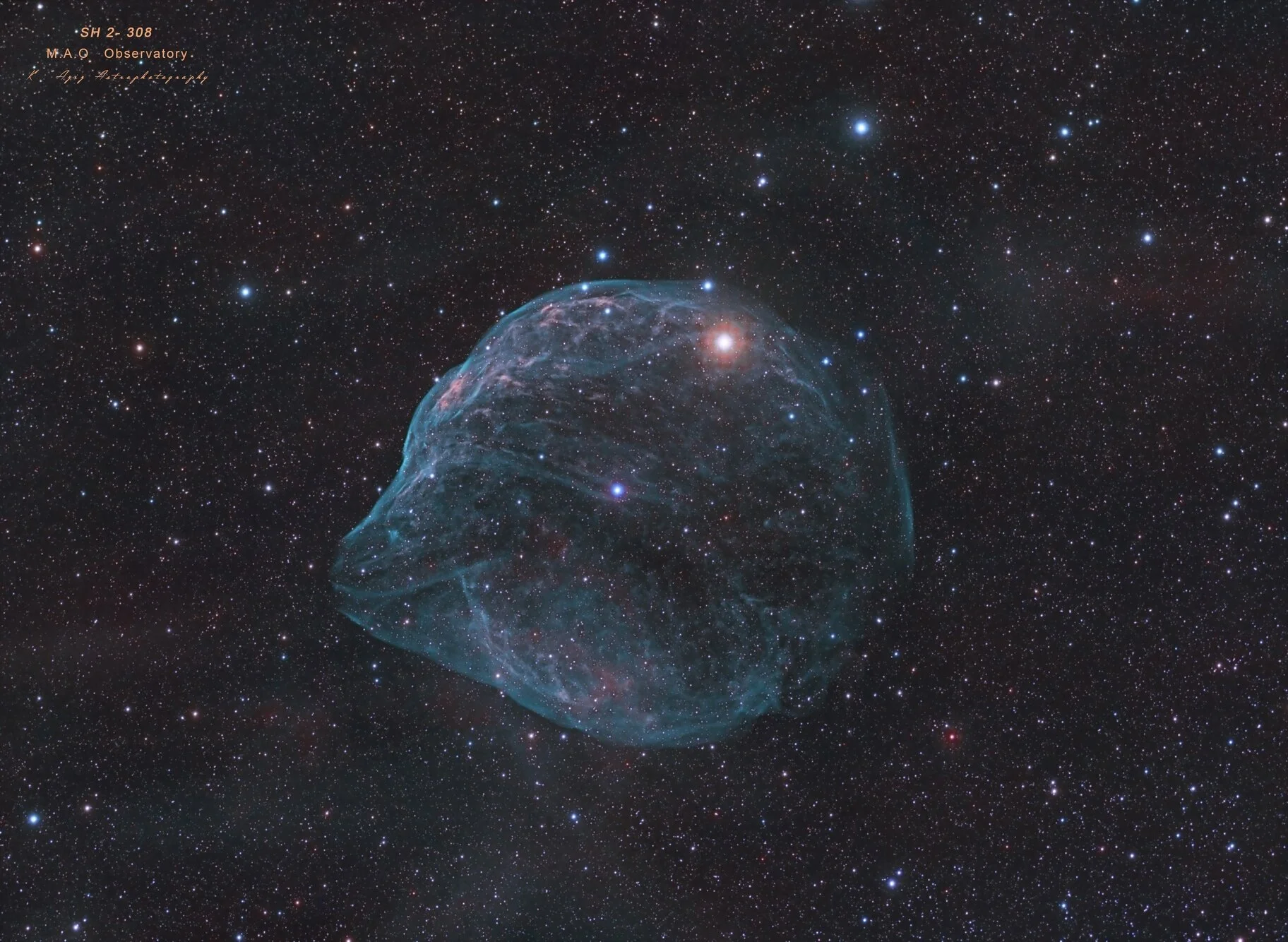
Dolphin Head Nebula -Sh2-308
Image Description and Details : Here is my first object captured in 2020.
This is the dolphin head nebula, Cataloged Sharpless SH 2-308, it is about 5,200 light-years from home towards the constellation of the Big Dog.
The massive star (Wolf-Rayet type) that created the bubble is the bright star located near the center of the nebula.
It generates a powerful radiation which drives out the gas around thus creating a giant bubble.
Technical details :
• TS 102mm F5,1 apo astrograph bezel
• Azeq6gt mount
• Zwo asi 1600 mm cooled pro
• Sampling: 1.47 arcsec / pixel.
Frames:
Astronomik 6nm OIII 36mm: 93x300" -10C
Astronomik HA 6nm 36mm: 17x300" -10C
ZWO B 36mm: 27x60" -10C
ZWO G 36mm: 27x60" -10C
ZWO R 36mm: 27x60" -10C
Integration: 10.5 hours
• DOF: 15x101x0
• Date: January 1 and 2, 2020
• Location: MAO Observatory of Ben Slimane.
Copyright: Aziz Kaeouach