

AAPOD2 Image Archives
The Cosmic Horseshoe Gravitational Lens
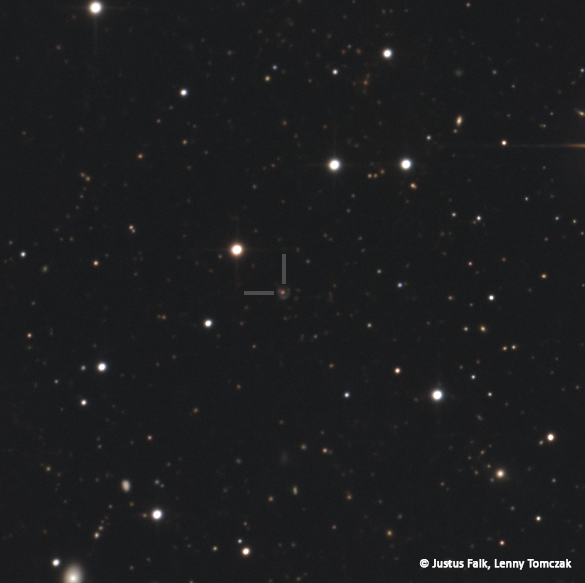
Near the heart of the Leo constellation lies an extraordinary display of cosmic physics: the Cosmic Horseshoe. Captured over 50 hours by Justus Falk and Lenny Tomczak using amateur-grade telescopes, this deepfield image reveals the faint arc of a distant galaxy whose light has been distorted into a near-perfect ring. This phenomenon—gravitational lensing—is caused by the immense mass of a foreground galaxy warping spacetime and bending the path of light from a more distant background galaxy. Though barely perceptible in the image’s dense star field, the horseshoe-like structure is a profound testament to the invisible scaffolding of gravity shaping our universe.
The gravitational lens is located about 10 billion light-years away, behind a massive elliptical galaxy at a redshift of 0.44. The system, formally designated SDSS J1148+1930, is rarely imaged by non-professionals due to its extreme faintness. Yet this achievement from a ground-based setup in Germany exemplifies what patient observation, careful planning, and collaboration can achieve. The Cosmic Horseshoe not only offers a window into the early universe—it also shows that amateur astronomers can reach deep into space with extraordinary precision.