

AAPOD2 Image Archives
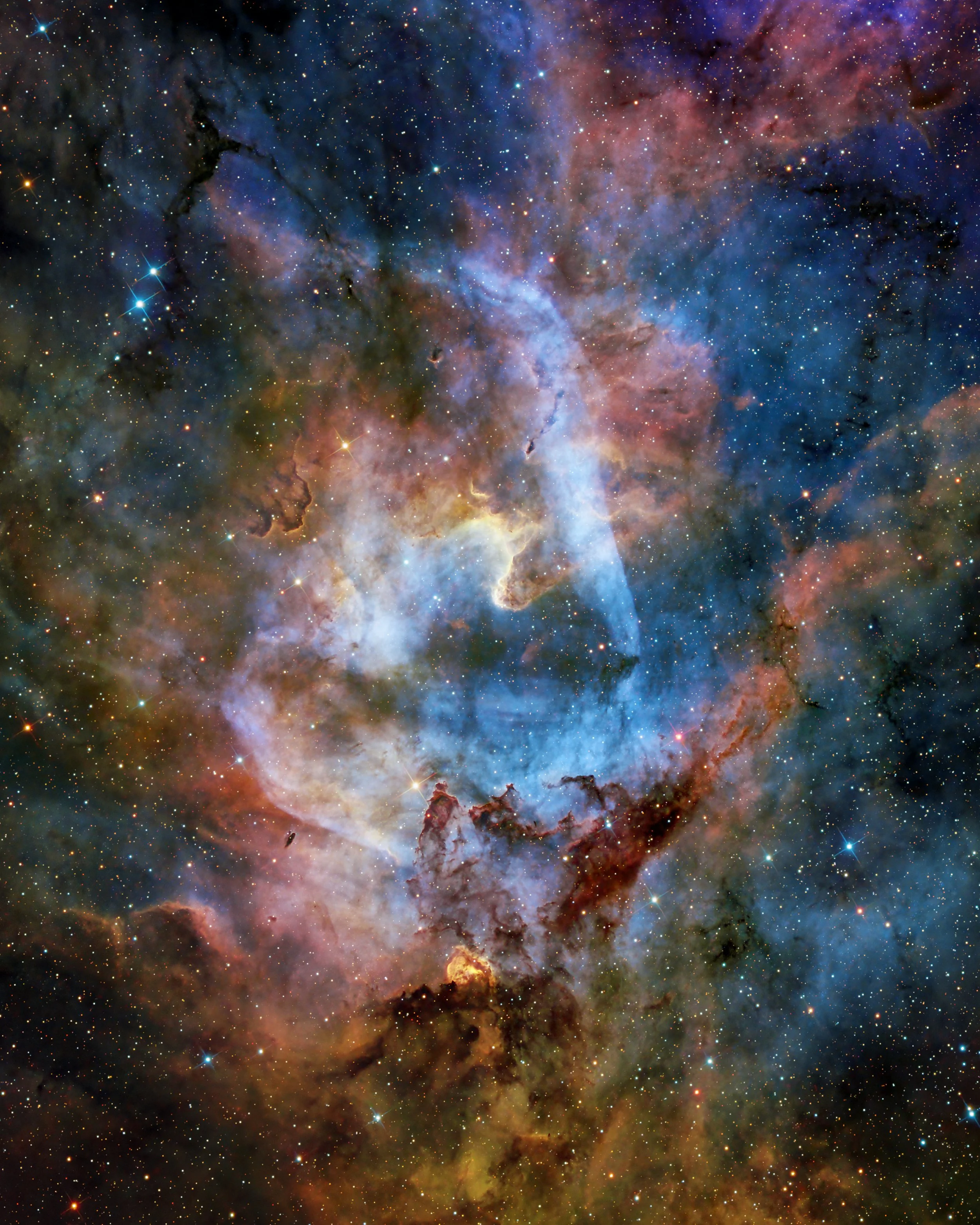
Sh2-132 – Central Region of the Lion Nebula
Sh2-132, often called the Lion Nebula, is a sprawling emission nebula located in the constellation Cepheus, roughly 10,000 light-years from Earth. The nebula’s intricate network of glowing gas and dark dust lanes forms the central “mane” and face of this cosmic lion, sculpted by stellar winds and radiation from massive stars within. In this narrowband image, ionized hydrogen (Ha), oxygen (OIII), and sulfur (SII) emissions combine to reveal the rich internal structure of this H II region, shaped by generations of stellar birth and death.
This deep integration, totaling over 65 hours of exposure, was captured from two locations in Hungary — Budapest and Tibolddaróc — using narrowband filters to isolate the glowing emissions. RGB data for stars was layered in to preserve natural color, providing a breathtaking glimpse into this active and chaotic star-forming region.
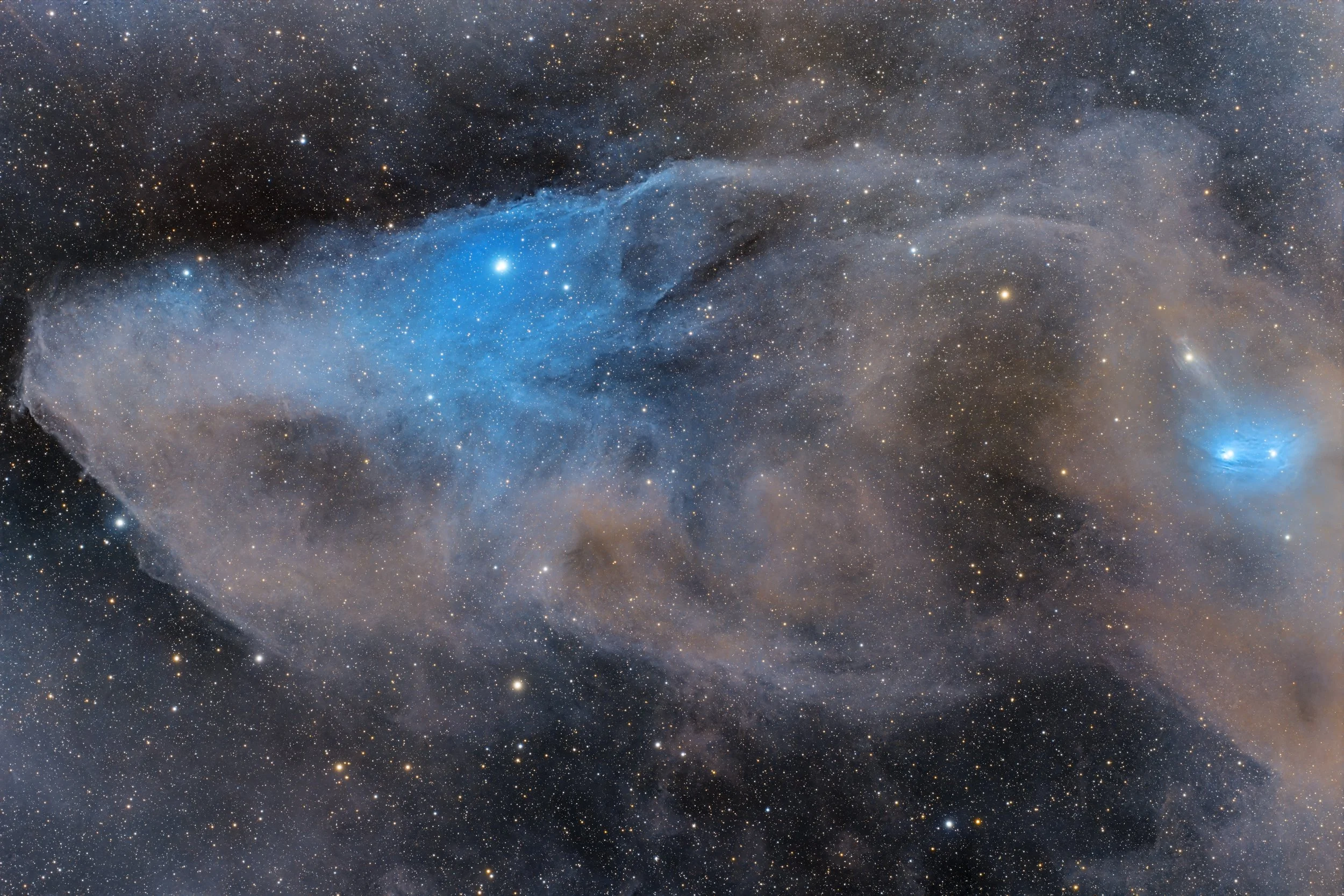
IC 4592 – The Blue Horsehead Nebula
IC 4592, known as the Blue Horsehead Nebula, is a reflection nebula in the constellation Scorpius, about 400 light-years from Earth. The deep blue glow arises from interstellar dust reflecting light from nearby hot, young stars — most prominently Nu Scorpii. This ethereal cloud’s equine shape gives the nebula its nickname and reveals the delicate structures often hidden within our galaxy’s dust lanes. Capturing it requires dark skies and long exposures to tease out its faint, expansive features.
This image was taken from Villanueva de Córdoba, Spain, a location known for its dark rural skies ideal for widefield astrophotography. The combination of excellent sky conditions and careful processing reveals not only the ghostly nebula but the broader complex of dark and reflective dust that envelops this region of the Milky Way.
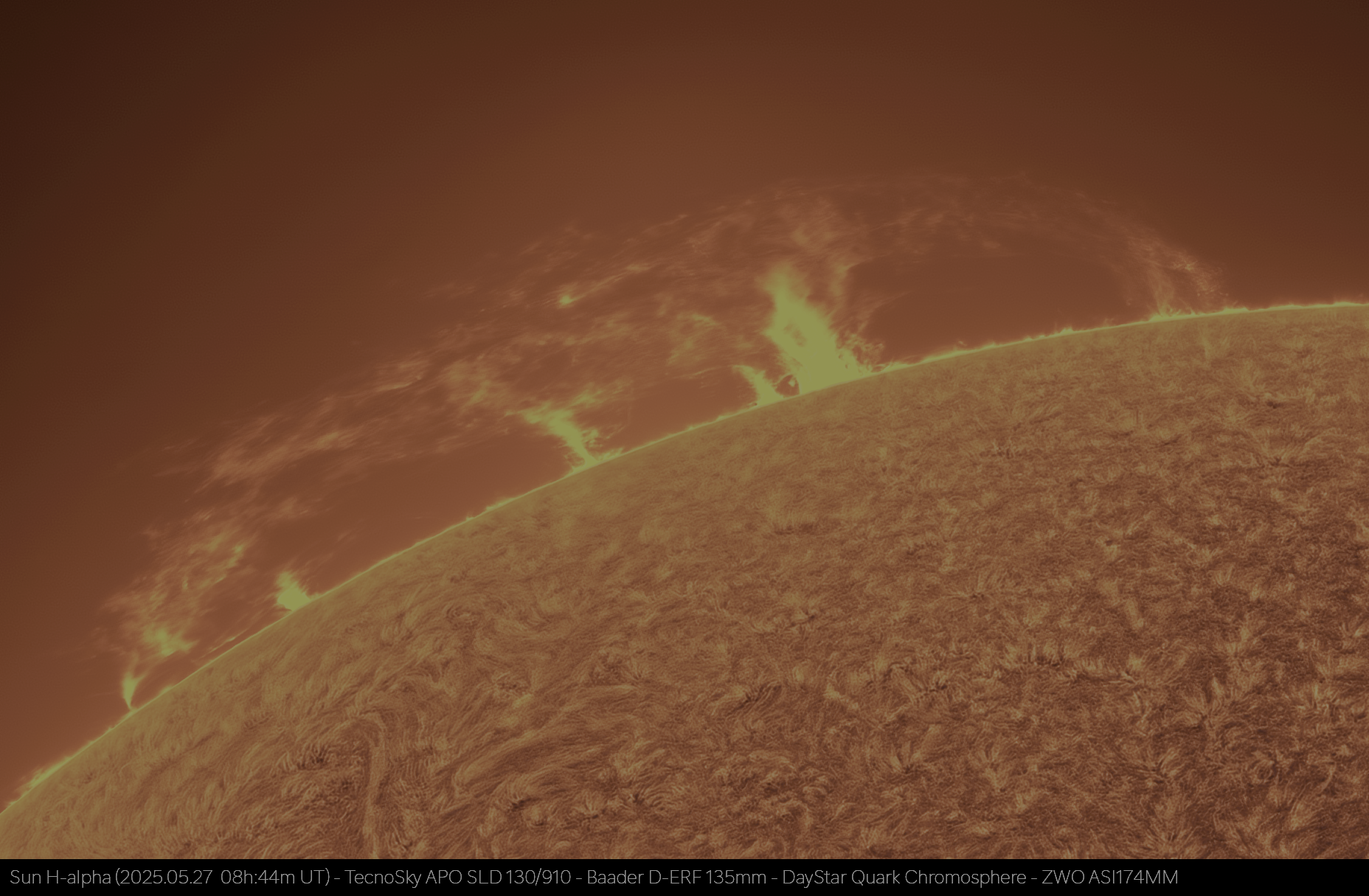
Rapidly Rising Flame – A Huge Solar Prominence
This dramatic solar prominence, captured on May 27, 2025, from Syracuse, Italy, showcases the immense power and beauty of our star. Prominences are vast arcs of plasma suspended above the Sun’s surface by magnetic fields. This one, estimated at over 150,000 kilometers in height, evolved rapidly and vanished within minutes — a fleeting but extraordinary event. Its shape and scale resemble a fireball erupting into space, a reminder of the Sun’s dynamic and volatile nature.
Captured using a high-resolution solar imaging setup — including a Tecnosky APO SLD 130/910 refractor and Daystar Quark Chromosphere filter — this image isolates the H-alpha wavelength, revealing intricate filaments of hydrogen gas rising into the solar corona. The precision of the ZWO ASI174MM camera and stability of the iOptron CEM70G mount made it possible to record this short-lived yet unforgettable moment in our solar system.
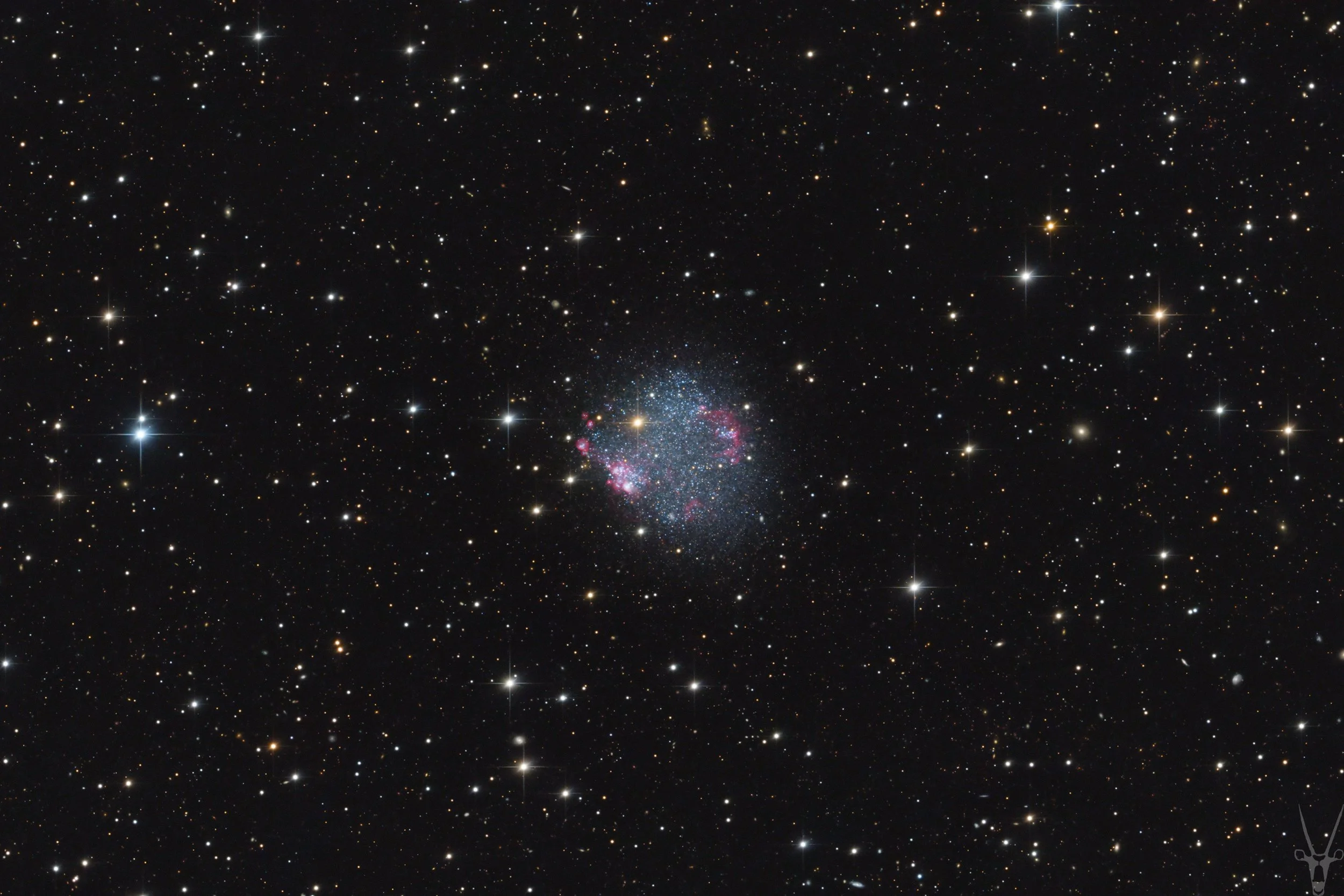
Sextans A – A Dwarf Galaxy on the Fringe
Sextans A is a faint, irregular dwarf galaxy located about 4.3 million light-years away in the constellation Sextans. As a member of the Local Group, this galaxy offers a glimpse into the early stages of galactic evolution. Its loosely bound stars and scattered clusters reflect an active star-forming history in an environment lacking the defined structure of spiral or elliptical galaxies. Sparse and dim, Sextans A is challenging to image, even under dark skies, due to its low surface brightness.
Captured from the exceptionally dark skies of Rooisand Desert Ranch, Namibia, this image brings out subtle regions of star formation and the soft glow of countless stars within the dwarf galaxy. The pristine southern location and long exposure times reveal details usually lost in light pollution, offering a rare look at this overlooked galactic neighbor on the edge of visibility.
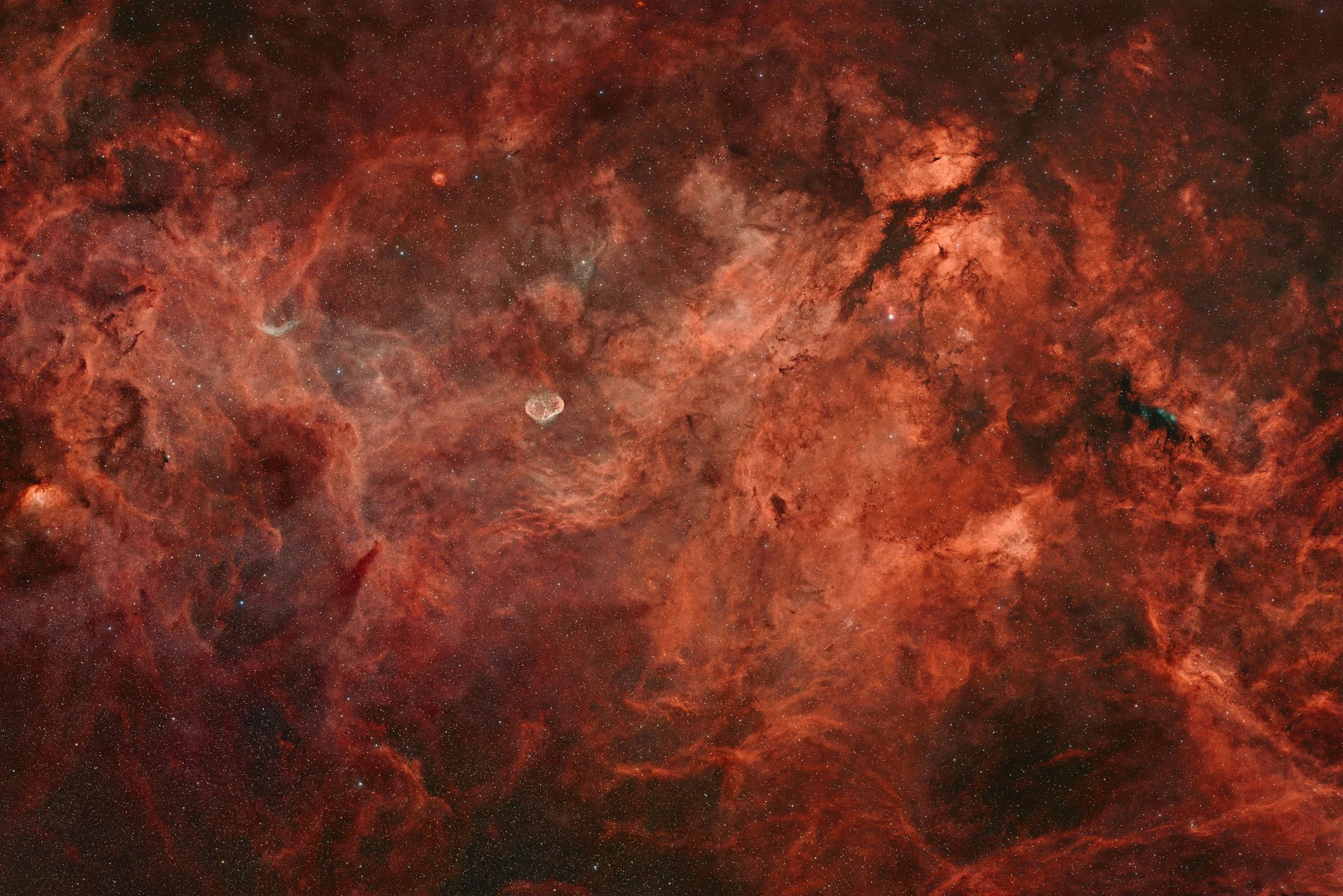
NGC 6888 and the Crescent’s Cosmic Neighborhood
NGC 6888, the Crescent Nebula, is a dramatic emission structure located about 5,000 light-years away in the constellation Cygnus. This glowing arc of ionized gas was sculpted by the powerful stellar winds of the massive Wolf-Rayet star WR 136, which is nearing the end of its life. The intricate details and shock fronts reveal the ongoing interaction between fast stellar winds and slower-moving material ejected in a previous red giant phase.
Captured from Osnabrück, Germany, this widefield image reveals not just the Crescent itself, but a richly textured region of surrounding nebulosity. Wisps of hydrogen-alpha glow intermingle with faint, complex OIII structures, painting a turbulent and dynamic portrait of this stellar nursery. This mosaic highlights both the power and fragility of massive star evolution as it unfolds against the background of the Milky Way.
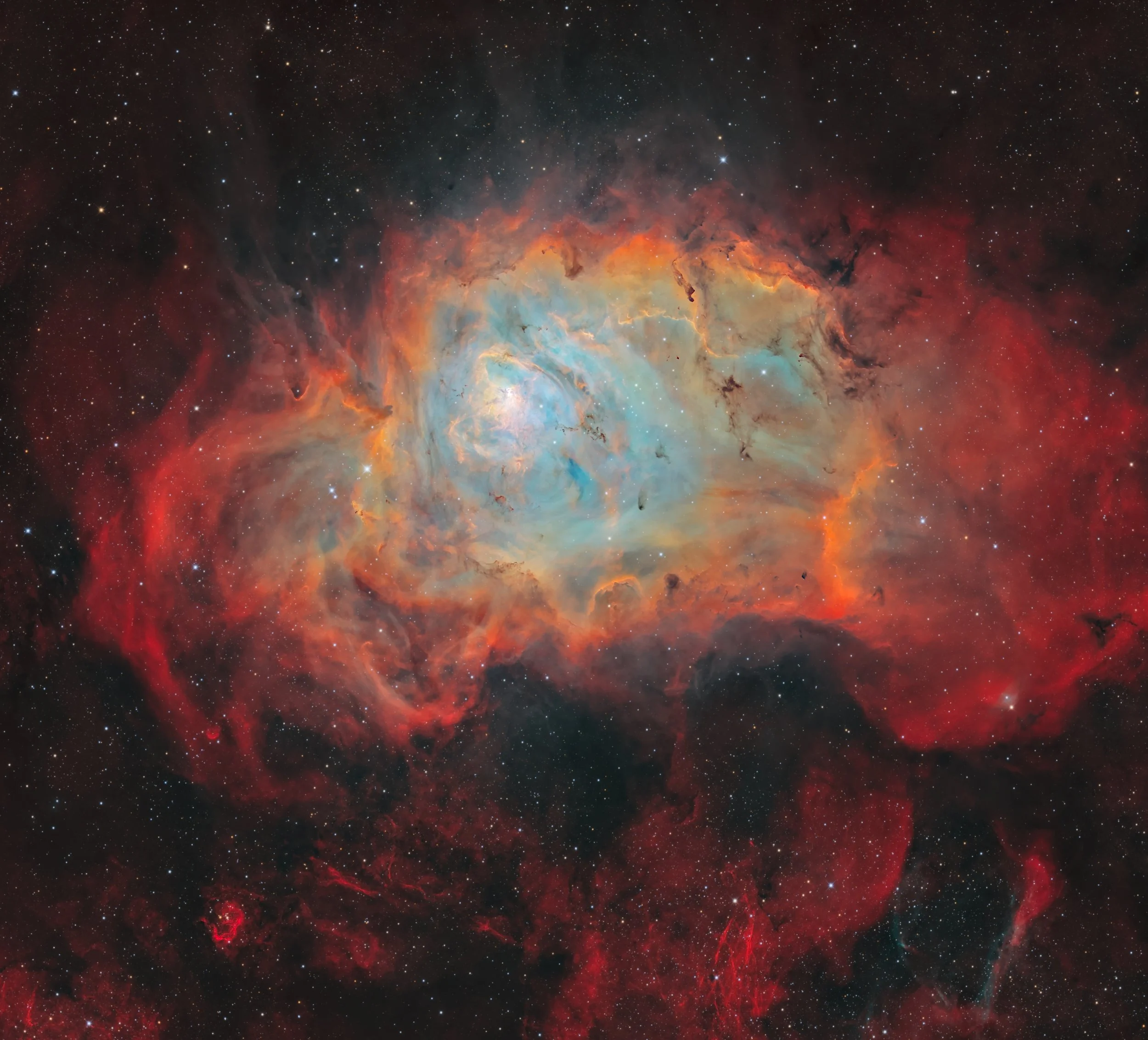
Colors of M8 in SHO: The Lagoon Reimagined
The Lagoon Nebula (Messier 8), a massive star-forming region about 4,000 light-years away in the constellation Sagittarius, comes alive in this striking narrowband SHO palette. Captured from Zapopan, Jalisco, Mexico, the image reinterprets natural colors using mapped emissions from sulfur (SII), hydrogen (Ha), and oxygen (OIII), bringing out fine structures in the gas and complex filaments that are often hidden in visible light views.
At the center, young energetic stars of open cluster NGC 6530 bathe the surrounding nebula in radiation, sculpting clouds and igniting the formation of new stars. The narrowband technique emphasizes the dynamic interplay of stellar winds and ionized gases, transforming this familiar target into a surreal cosmic landscape. The result is a celebration of both scientific precision and visual artistry.
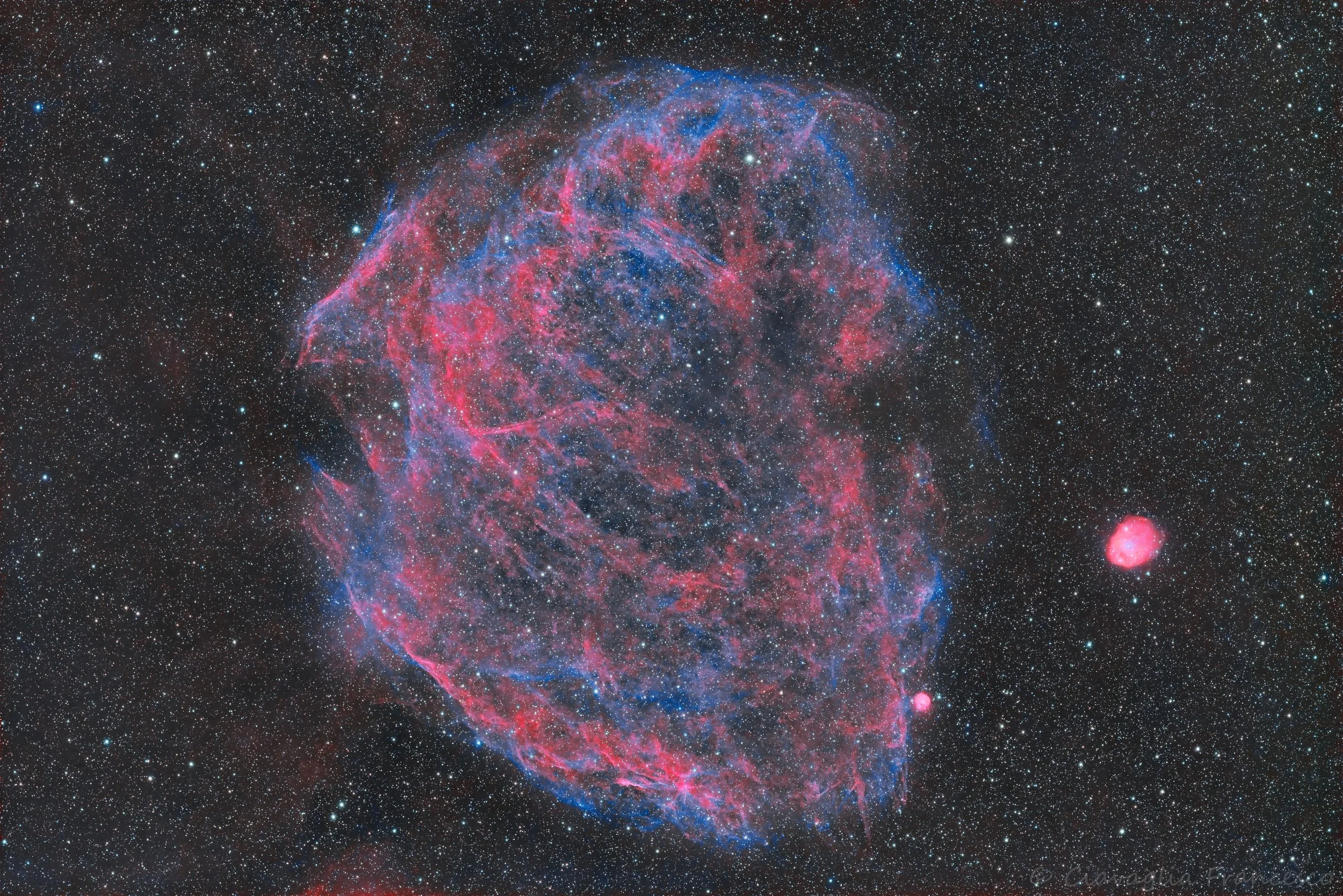
SH2-221: The Faint Supernova Remnant in Auriga
Often overlooked due to its faintness, SH2-221 is a supernova remnant nestled within the constellation Auriga, roughly 2,600 light-years away. This ethereal structure spans nearly 1.5 degrees across the sky—about three times the size of the full Moon—yet it remains challenging to observe due to its diffuse nature and low surface brightness. The glowing filaments and arcs visible in this deep image are composed primarily of ionized hydrogen gas, remnants of a star that exploded thousands of years ago.
Captured from Gualdo Tadino in Perugia, Italy, this image reveals the delicate and ghostly outlines of SH2-221 set against a richly textured star field. Long exposure and narrowband filters help isolate the nebula’s faint emission from the background, allowing the structure to emerge in dramatic detail. Observations like these continue to shed light on the dynamic processes that shape the interstellar medium long after a star’s explosive death.
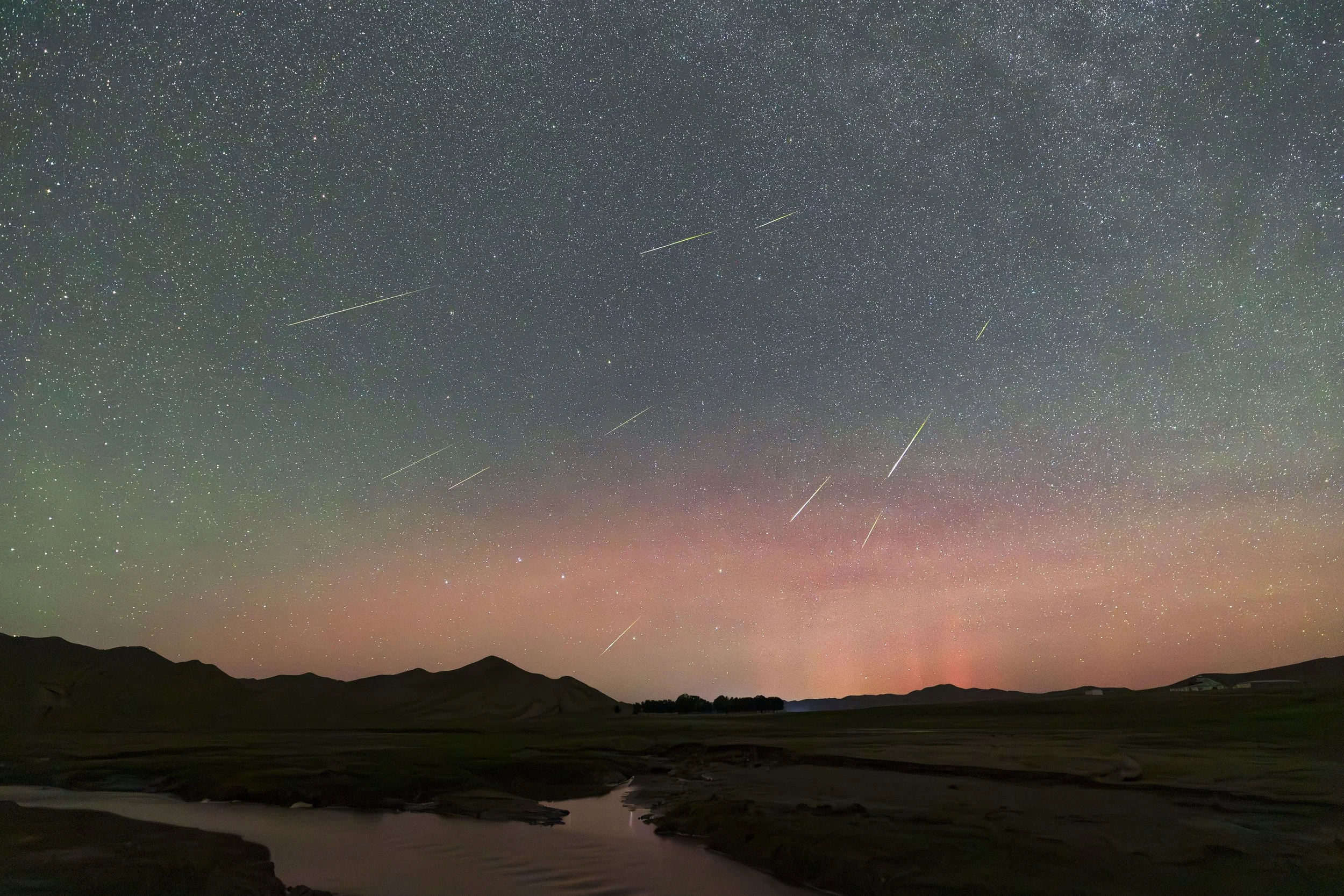
The Radiance Under the Night Sky
Langshan Reservoir in Urad Middle Banner is fed by several small streams, making it a scenic spot for night-sky photography. On a clear night, a group of friends and I drove there to capture the Perseid meteor shower. Suddenly, our aurora-forecast app alerted us that the KP index was rising. We checked NOAA’s aurora forecast and saw it could reach KP 7. We immediately scouted for a vantage point where meteors and aurora could share the same frame. We found a small creek to the north-northeast of the reservoir and began shooting. In the end, we recorded 11 meteors alongside brief, vibrant auroral pillars.
The final image showcases Perseids radiating from the right-upper corner of the frame, their trails echoing the green auroral glow below. A hint of pink aurora adds a rare, magical contrast to this combined celestial display.
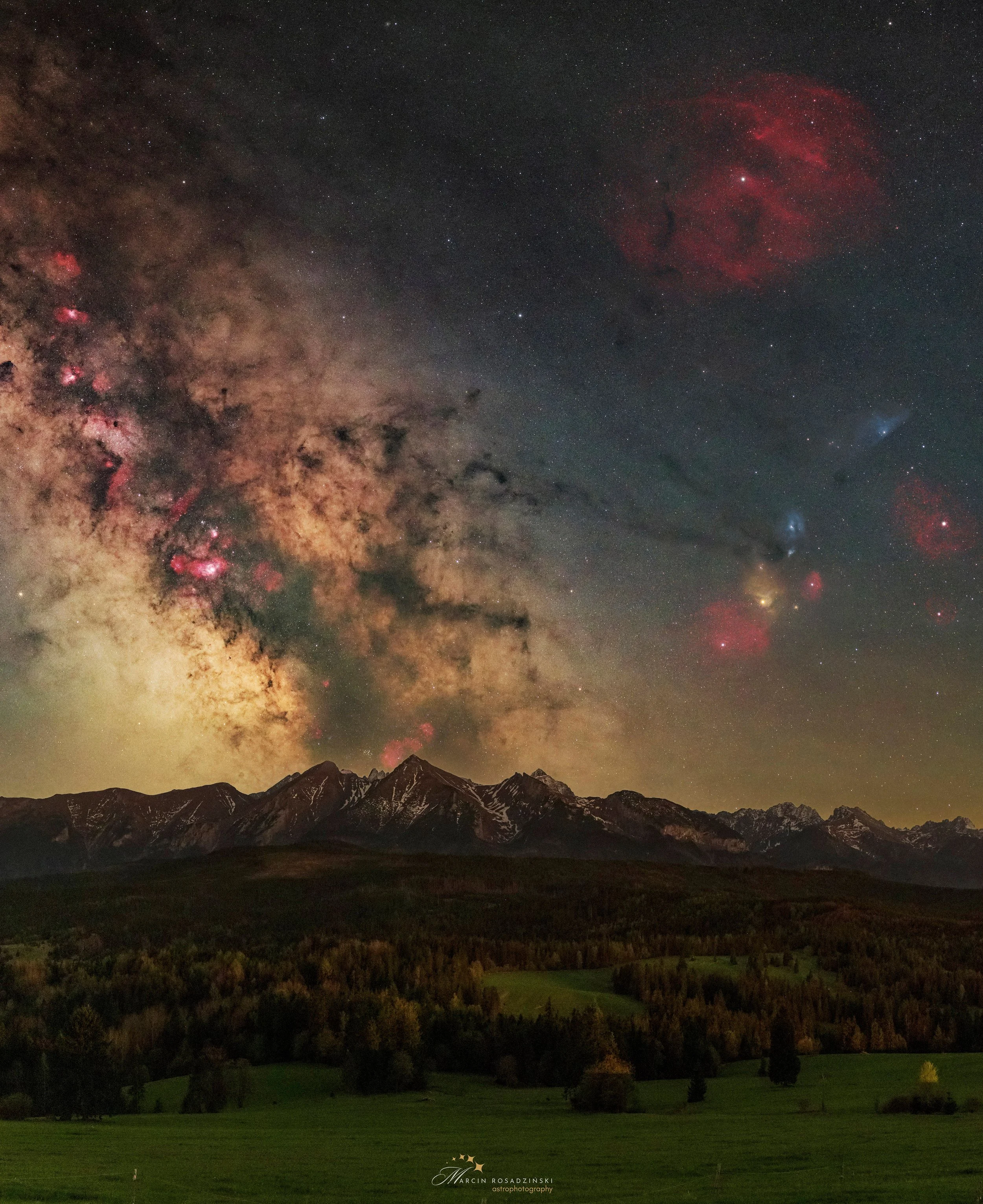
Milky Way over Tatra Mountain
Each year, astrophotographers from across Poland journey to the Łapszanka Pass in the Tatra Mountains to witness the breathtaking rise of the Milky Way’s galactic center. For many, it’s become more than a photographic destination—it’s a tradition. In this luminous image, captured from southern Poland, the summer Milky Way arches above the mountainous horizon, showcasing an intense concentration of glowing red hydrogen emission nebulae and intricate star fields.
Near the top right, the colorful Rho Ophiuchi cloud complex and the striking Zeta Ophiuchi nebula emerge vividly, enhanced by the addition of a hydrogen-alpha layer that accentuates their structure. This fragment of a larger mosaic—captured with a Canon R (astro-modified) and Sigma Art 50mm lens—combines three sky and three foreground panels for a seamless, immersive composition. Yet, despite its beauty, this cherished location faces the creeping threat of light pollution, casting doubt on the future visibility of these celestial wonders from Łapszanka.
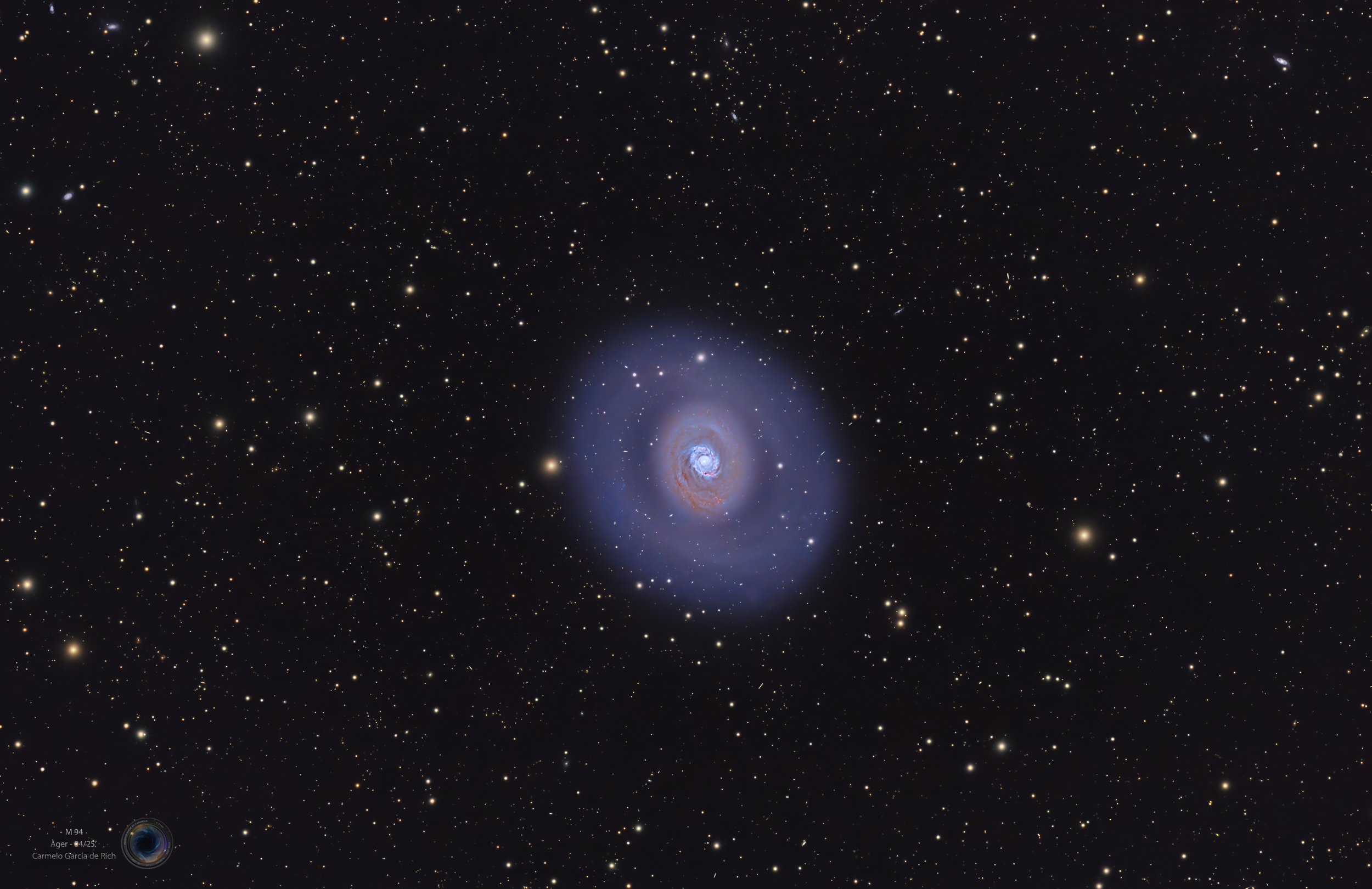
M94 - A Double Ring Galaxy
At the heart of the Canes Venatici constellation lies Messier 94, a striking spiral galaxy surrounded by faint, expansive outer rings of stars and dust. This galaxy is part of the M94 Group, an extended assembly of galaxies located roughly 13 million light-years away. Seen in remarkable clarity here, M94 reveals tightly wound spiral arms glowing with clusters of young, hot stars, while a smooth outer halo gives the galaxy its iconic eye-like appearance—earning it nicknames like the "Croc’s Eye" and "Cat’s Eye" galaxy.
Captured in Àger, Lleida, Spain this deep exposure highlights the faint, ghostly light of M94’s stellar halo, rarely visible in typical wide-field views. The subtle glow is likely the result of past galactic interactions or ongoing stellar migration in its outer regions. With sharp resolution and meticulous detail, the image provides a compelling view into both the structured inner disk and the wispy, nearly spherical envelope that gives M94 its unusual form.
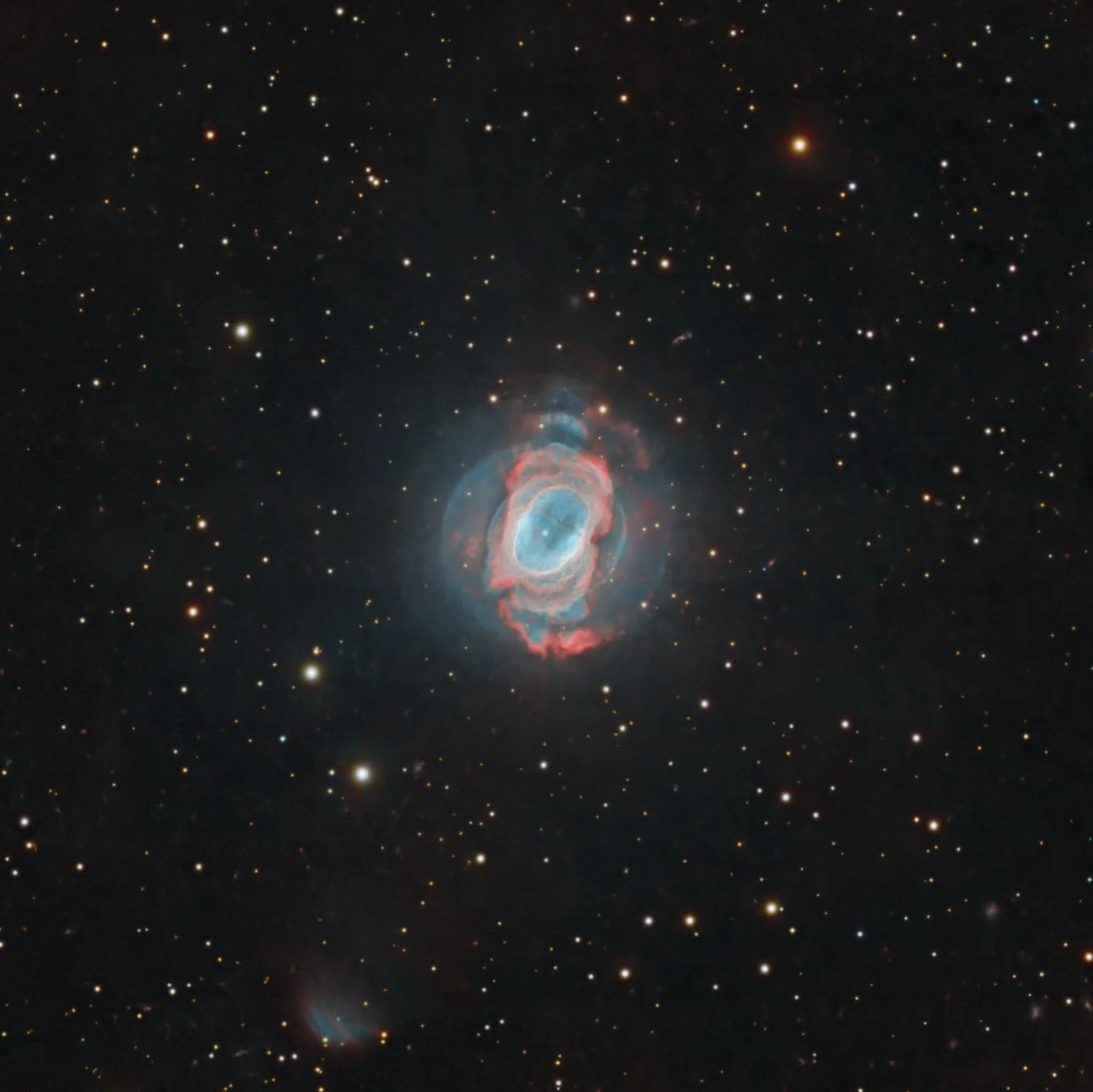
NGC 3132 Planetary Nebula with new PN discovery named Sel 1 - in HOO with RGB Stars
We would like to present this image, acquired in Obstech, Chile.
Title of the Object:
NGC 3132 Planetary Nebula with new PN discovery named Sel 1 - in HOO with RGB Stars
Description of the Object:
This image contains NGC 3132 and a newly discovered Planetary Nebula named Sel 1.
NGC 3132, also known as the Southern Ring Nebula, Eight-Burst Nebula, or Caldwell 74 is a striking planetary nebula located about 2,000 light-years away in the southern constellation Vela.
What you’re seeing is the glowing, expanding shell of gas ejected by a dying Sun-like star, now a white dwarf at its core. The nebula spans roughly 0.4 light-years across, yet appears just 1 arcminute wide in the sky — about 1/30th the width of the full Moon.
Despite its compact appearance, a considerable amount of detail can be revealed in long-exposure imaging.
In this image, the bright teal-blue core is rich in ionized oxygen (OIII), while the outer reddish arcs trace hydrogen-alpha emission (Hα). Faint dust lanes and overlapping shells show the chaotic beauty of this stellar farewell.
Recent JWST observations revealed that NGC 3132 is actually a binary star system, with a hidden second star playing a major role in shaping the nebula’s complex form over thousands of years.
Imaged in HOO RGB on Mike Selby's Planewave CDK 700 at Observatorio El Sauce, Chile.
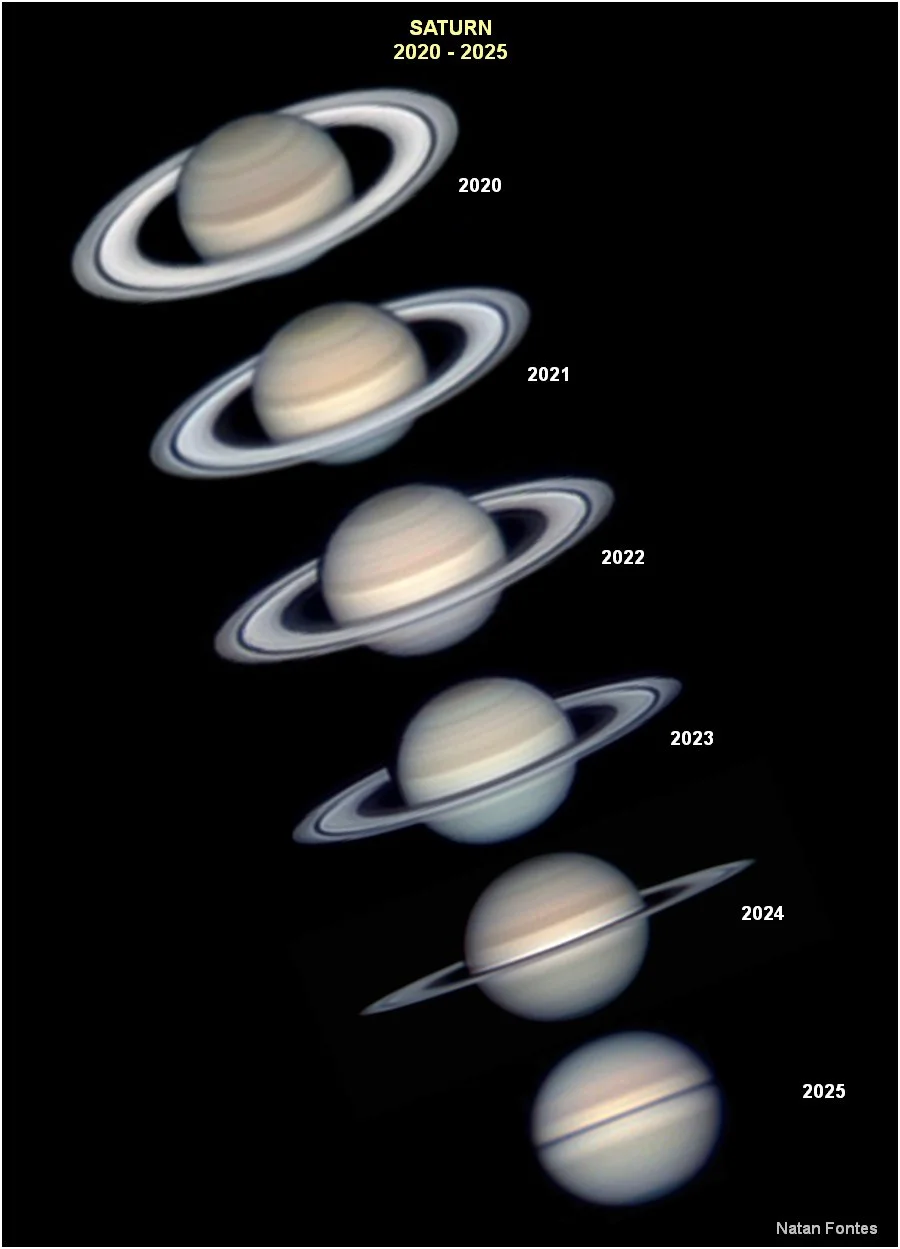
Saturn’s Ring Disappearance — A Dance of Perspective
Between 2020 and 2025, images of Saturn reveal a fascinating celestial ballet: the gradual closing of its iconic rings as seen from Earth. The majestic ring system, usually tilted at a dramatic angle, appears to narrow year by year—an illusion caused by the changing geometry of Saturn’s orbit relative to our line of sight.
By 2025, the rings seem to vanish entirely, aligned nearly edge-on from our perspective. Though still physically present, their thin, flat structure reflects very little light when seen edge-on, rendering them almost invisible through backyard telescopes. These ring plane crossings occur roughly every 15 years, offering a rare opportunity to witness the gas giant in a dramatically different guise.
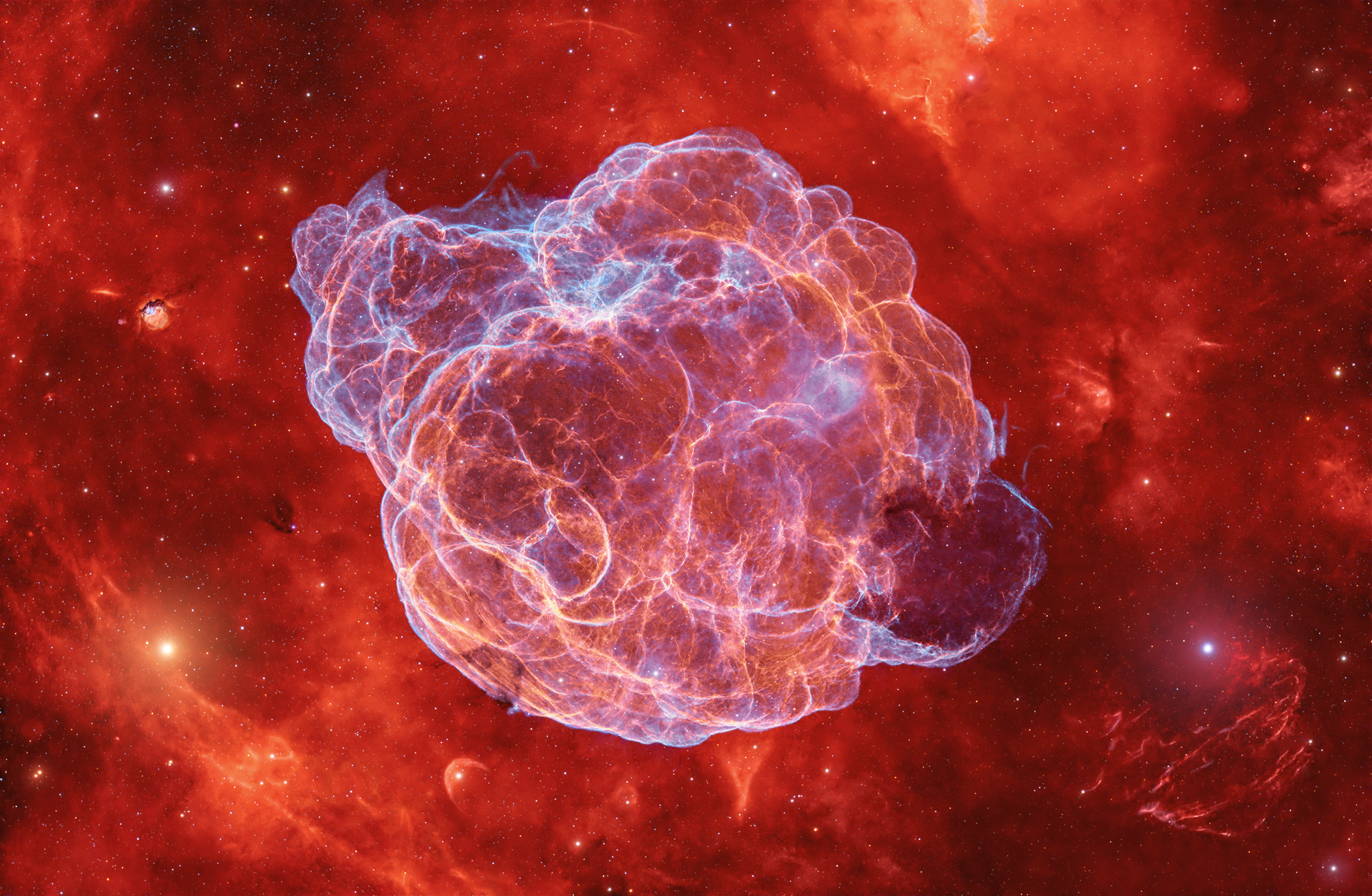
Spaghetti Nebula & Mars (569 hrs)
Captured over three winters from a backyard in Nashville, Tennessee (Bortle 8–9), this stunning deep-sky image reveals Simeis 147, also known as the Spaghetti Nebula—a vast and ancient supernova remnant approximately 3,000 light-years away in the constellation Taurus. The tangle of glowing filaments stretches across a six-degree-wide field, representing the expanding shock wave and energized interstellar material from a stellar explosion estimated to have occurred around 40,000 years ago.
What makes this composition uniquely special is the inclusion of Mars, which serendipitously entered the frame during the 2023 capture sessions. Visible near the bottom left as a golden beacon, the Red Planet offers a striking contrast to the nebula’s ethereal blues and reds. This extraordinary image required 569 hours of total integration time, spread across 147 nights—an exceptional feat made even more impressive by the challenging light pollution of the urban setting.
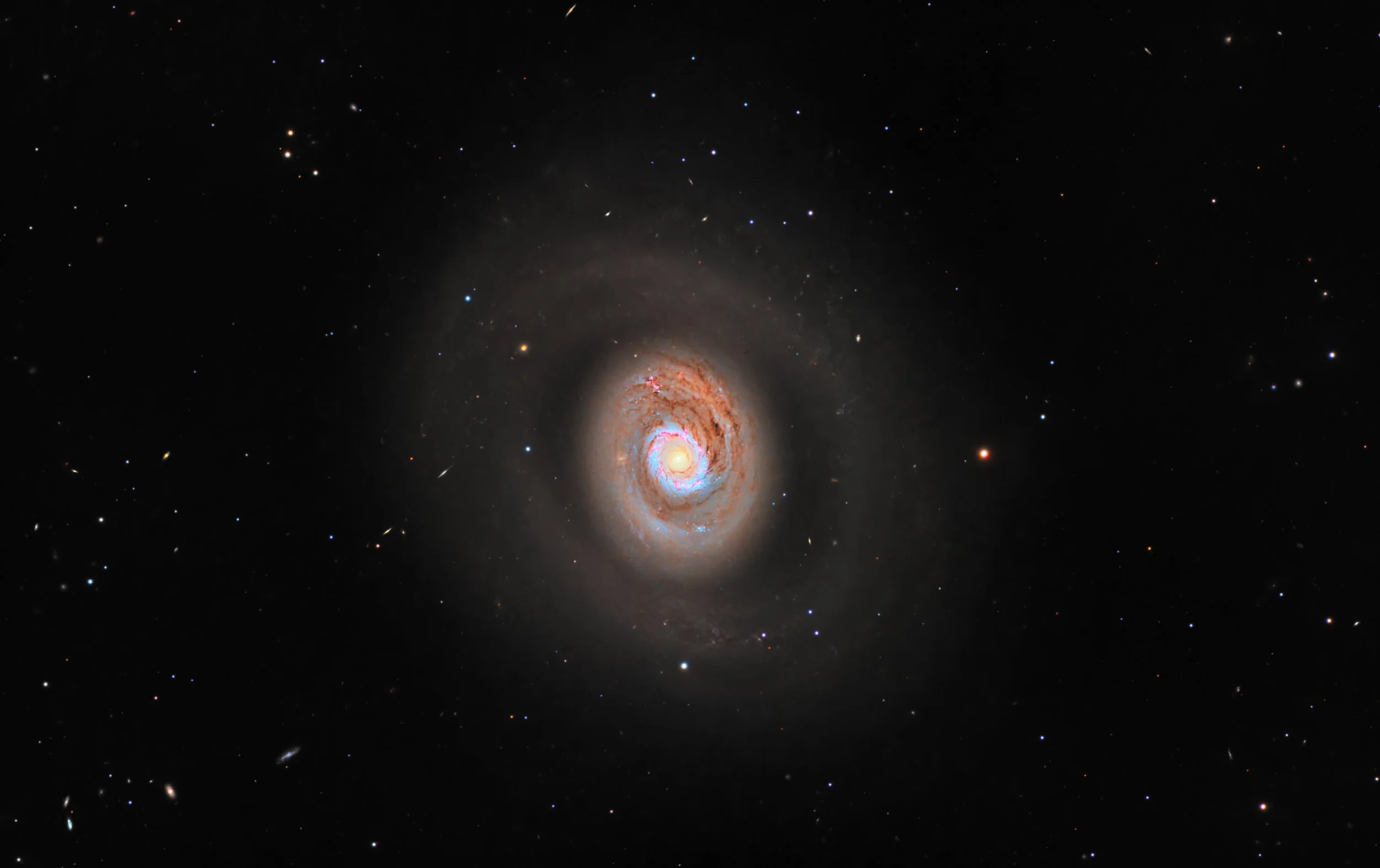
M94 LRGB Croc's Eye Galaxy
At the heart of the constellation Canes Venatici lies Messier 94, a striking spiral galaxy also known as the Croc’s Eye. Seen nearly face-on from Earth, M94’s tightly wound spiral arms and bright inner ring give it a distinctive, hypnotic appearance. This LRGB image reveals both the luminous central starburst region and the faint, extended outer disk, a structure rarely visible in casual observations. The inner core glows with pinkish star-forming regions surrounded by a bluish halo of young stars, encased in a faint oval of dust and gas.
Captured under Bortle 4 skies in Qatar, this deep exposure blends over 20 hours of luminance, red, green, and blue data to highlight both detail and faint structure. The galaxy spans about 30,000 light-years and lies roughly 16 million light-years away, making it a relatively close and photogenic target. M94’s unusual double-ringed morphology continues to intrigue astronomers, offering insights into galaxy evolution and internal dynamics shaped by bar instabilities and density waves.
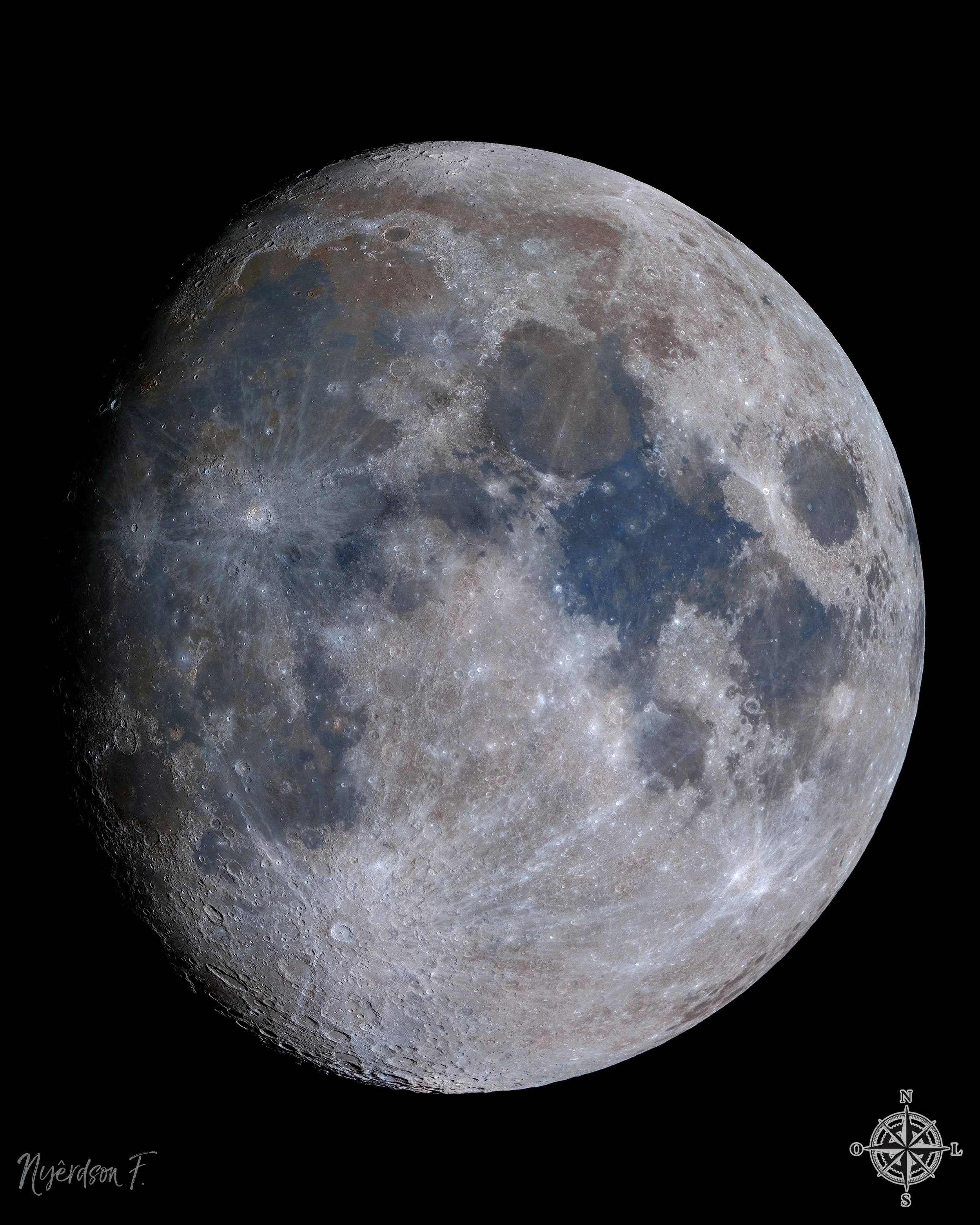
MINERAL LUNAR MOSAIC
Seen from Earth, the Moon appears mostly grey—but a closer look with enhanced color processing reveals a mosaic of subtle mineral diversity across its surface. This striking mineral Moon portrait highlights variations in lunar soil composition using color: blue tones represent titanium-rich basaltic regions, while reddish and brownish areas indicate lower titanium content and ancient highlands. Mare Imbrium and Oceanus Procellarum stretch across the upper left in cool blues, while Tycho’s bright rays explode from the lower hemisphere in radiant whites, hinting at a relatively young impact site.
This detailed mosaic was captured using stacked and sharpened frames to bring out both color and clarity, with a natural orientation indicated by the compass rose in the corner. Despite the Moon being a familiar object, its geologic history remains one of contrasts—between dark volcanic plains and light, cratered highlands; between old and young; and, as revealed here, between one mineral and another. It’s a reminder that even our nearest celestial neighbor still holds mysteries visible only to those who look a little deeper.

NGC 4236 – Barred Spiral Galaxy in the M81 Group
NGC 4236 drifts quietly along the northern edge of the M81 Group, a barred spiral galaxy seen nearly side-on from our vantage point 11.7 million light-years away in the constellation Draco. This deep and richly detailed image, captured over 54.5 hours from Jestetten, Germany, reveals the galaxy's faint outer arms, peppered with pink-hued H II regions and blue clusters of young stars. The tilted bar and dusty spiral arms span over 100,000 light-years, rivaling the size of our own Milky Way.
Despite its size, NGC 4236 is unusually dim—a low surface brightness galaxy, with active star formation spread diffusely across its disk. Against a backdrop dense with distant galaxies and foreground stars, the extended exposure time allows the faintest filaments of gas and stellar birth clouds to emerge. These subtle structures are often lost in shorter exposures, making this view both scientifically valuable and visually mesmerizing.

NGC 2403 in LRGB-HOO
A vibrant cosmic portrait, this deep exposure showcases the face-on spiral galaxy NGC 2403 glowing amid the starry backdrop of Camelopardalis. Spanning nearly 100,000 light-years, the galaxy reveals an intricate structure of dusty spiral arms and radiant pink star-forming regions traced by hydrogen-alpha emission. Lying roughly 8 million light-years away, NGC 2403 is a member of the M81 Group and bears a striking resemblance to our own Milky Way’s satellite, the Triangulum Galaxy.
Captured from Hemel Hempstead, UK, with over 33 hours of total integration time, the image reveals fine galactic details—blue clusters of young stars, reddish emission nebulae, and the mottled glow of older stellar populations in the bulge. Bright foreground stars punctuate the frame with colorful diffraction spikes, while the galaxy’s faint outer arms softly blend into the darkness of intergalactic space.

Ghostly Light in Centaurus
Drifting through the southern skies in the constellation Centaurus, NGC 5367 is a hauntingly beautiful reflection nebula embedded in a dark molecular cloud complex. The wispy blue glow near the center is caused by starlight scattering off interstellar dust, primarily from a young binary star system still forming within the nebula’s opaque folds. This LRGB image reveals the full extent of the surrounding dust structures, illuminated not only by the central stars but also by the ambient starlight of the Milky Way, producing an ethereal interplay between light and shadow.
Captured with exquisite depth and detail, this image showcases the delicate filaments and ghostlike clouds that typify this under-observed region. NGC 5367 lies roughly 2,000 light-years away and is part of the larger cometary globule CG 12. Though visually faint, these kinds of nebulae are astrophysical laboratories—harboring nascent stars, turbulent gas dynamics, and cosmic dust grains that eventually seed planetary systems. The composition’s expansive framing and faint surrounding structures make it not just a target of scientific interest, but a portrait of interstellar stillness.
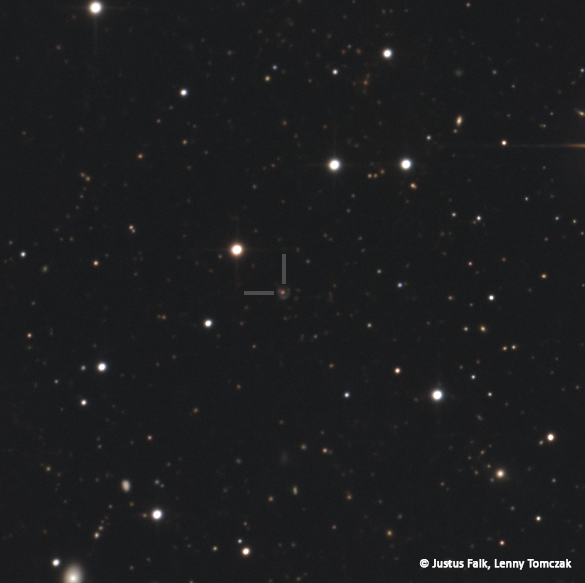
The Cosmic Horseshoe Gravitational Lens
Near the heart of the Leo constellation lies an extraordinary display of cosmic physics: the Cosmic Horseshoe. Captured over 50 hours by Justus Falk and Lenny Tomczak using amateur-grade telescopes, this deepfield image reveals the faint arc of a distant galaxy whose light has been distorted into a near-perfect ring. This phenomenon—gravitational lensing—is caused by the immense mass of a foreground galaxy warping spacetime and bending the path of light from a more distant background galaxy. Though barely perceptible in the image’s dense star field, the horseshoe-like structure is a profound testament to the invisible scaffolding of gravity shaping our universe.
The gravitational lens is located about 10 billion light-years away, behind a massive elliptical galaxy at a redshift of 0.44. The system, formally designated SDSS J1148+1930, is rarely imaged by non-professionals due to its extreme faintness. Yet this achievement from a ground-based setup in Germany exemplifies what patient observation, careful planning, and collaboration can achieve. The Cosmic Horseshoe not only offers a window into the early universe—it also shows that amateur astronomers can reach deep into space with extraordinary precision.
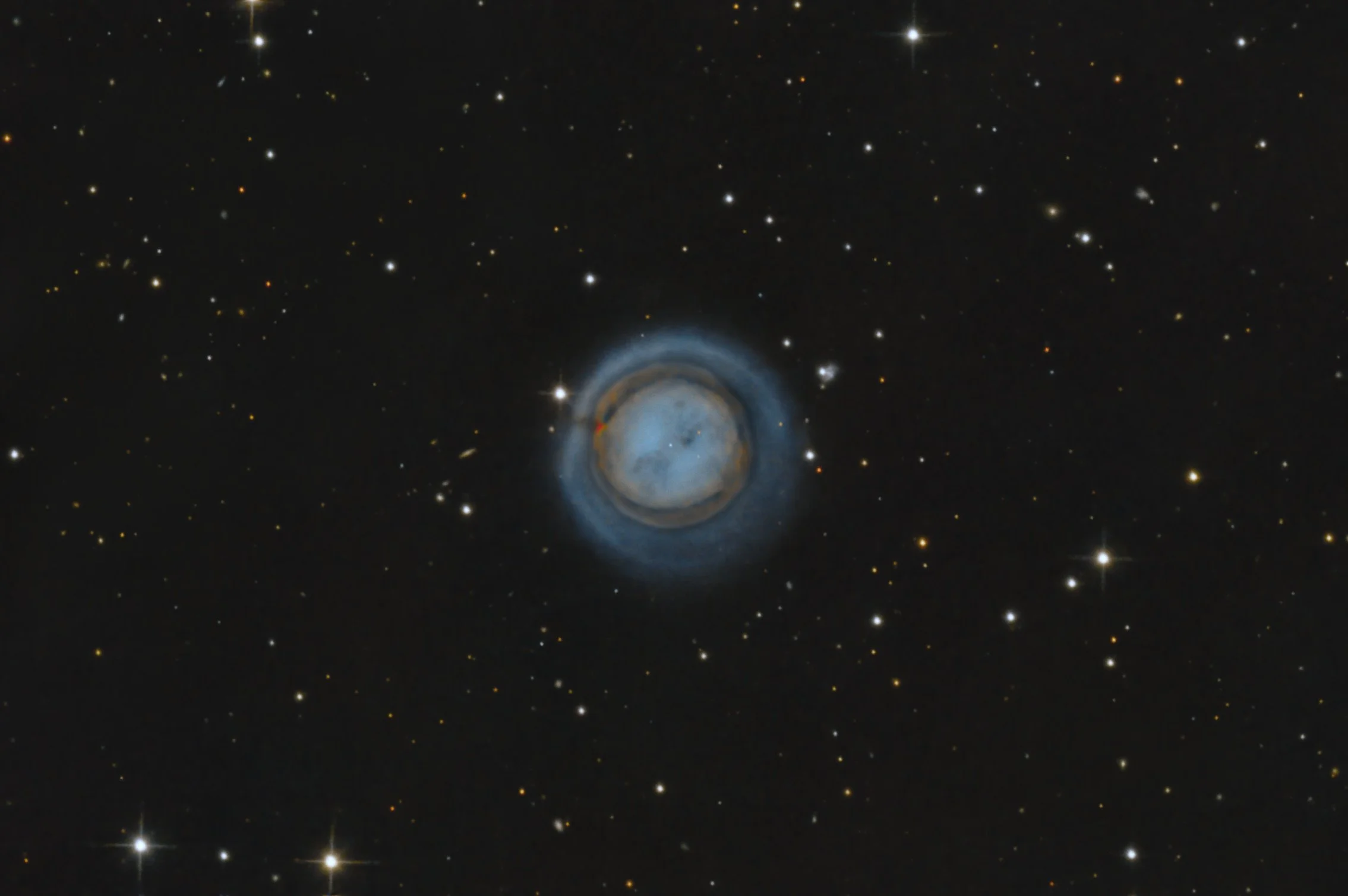
The Owl and its Outer Ring
Messier 97, also known as the Owl Nebula, is a planetary nebula located about 2,000 light-years away in the constellation Ursa Major. Its round appearance and twin dark cavities give it the look of a cosmic owl face, a structure shaped by strong stellar winds from the central white dwarf—what remains of a sun-like star near the end of its life.
Surrounding the brighter core is a faint, expansive halo of older gas, expelled in an earlier phase of stellar evolution and now slowly fading into the interstellar medium. This deep image captures both the intricate inner structure and the extended outer shell in fine detail. It was acquired from Dassendorf and Reinbek, Germany, where dark skies and stable conditions allowed for the faint outer ring to be revealed.