

AAPOD2 Image Archives
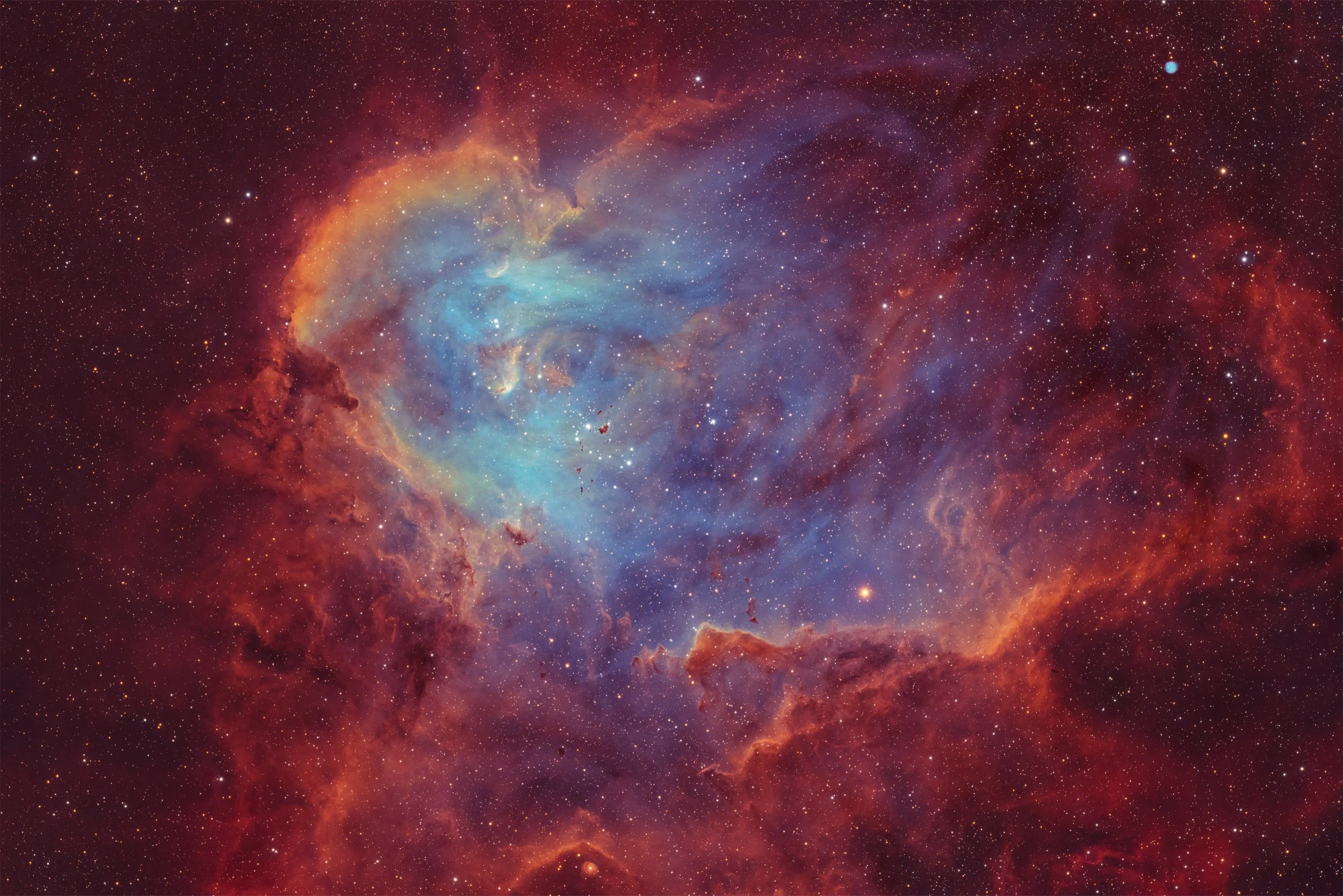
IC2944 - The Running Chicken Nebula
IC 2944 is a large emission nebula located about 6,500 light-years from Earth in the constellation Centaurus. It is sometimes called the Running Chicken Nebula because the brightest part of the gas clouds forms a shape that resembles a running chicken in photographs. The nebula glows red because young, hot stars inside it emit strong ultraviolet radiation that ionizes the surrounding hydrogen gas. When the electrons in the hydrogen recombine, they release energy as visible red light, which is why many star-forming nebulae like IC 2944 appear bright in long-exposure images.
One of the most interesting features of IC 2944 is a set of dark clouds known as Thackeray’s Globules. These small, dense pockets of gas and dust appear as black silhouettes against the bright nebula. Astronomers once thought they might be forming new stars, but studies suggest many of them may actually be evaporating under the intense radiation from nearby massive stars. IC 2944 is therefore an important region for studying how massive stars interact with and shape the gas clouds where stars are born.

SNR G206.9+2.3: A Rarely Photographed Remnant in Monoceros
SNR G206.9+2.3 is a rarely imaged supernova remnant (SNR) located in the constellation Monoceros. This celestial structure is the expanding shell of material ejected after a massive star exploded in a supernova event thousands of years ago. The remnant displays a striking filamentary structure, with delicate tendrils of ionized gases, primarily oxygen (OIII) and hydrogen (H-alpha), forming complex, glowing shells. These filaments trace the shock fronts where the expanding debris from the explosion interacts with the surrounding interstellar medium, creating intricate patterns of ionized gas that span several light-years.
The oxygen-rich regions, emitting in OIII, appear as bluish-green filaments, while the H-alpha regions, which trace ionized hydrogen, glow in shades of red. The interaction of these gases produces a complex and dynamic structure that astronomers study to understand the physics of supernova remnants and their role in enriching the galaxy with heavier elements. Despite its relative obscurity, SNR G206.9+2.3 offers a unique opportunity to explore the aftermath of stellar death and provides insight into the processes that shape the interstellar medium.