

AAPOD2 Image Archives
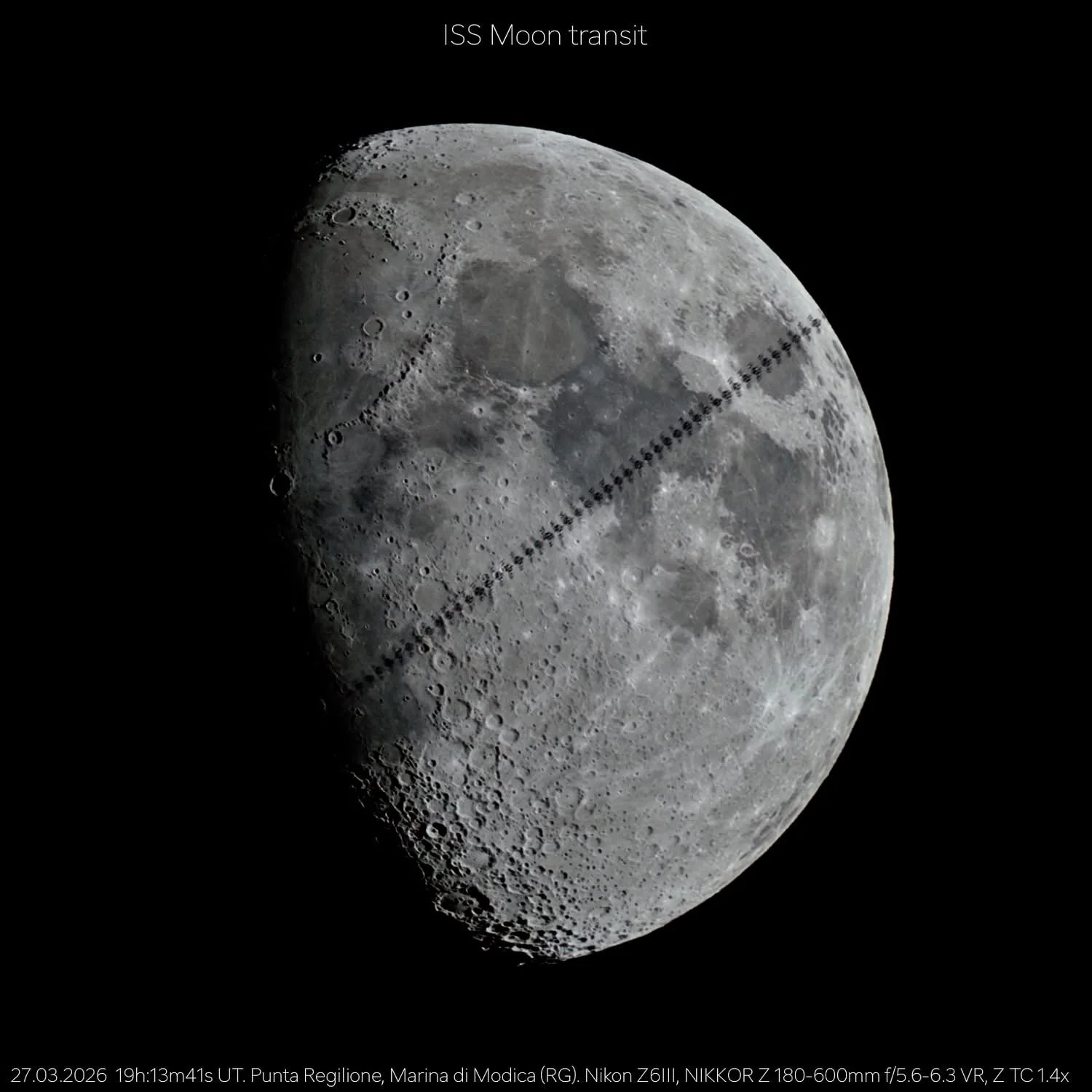
The ISS transits the Moon
Punta Regilione, Marina di Modica (RG), 27.03.2026 19h:13m:41s UT
Nikon Z6III, NIKKOR Z 180-600mm f/5.6-6.3 VR, Z TC 1.4x
Copyright: Salvo Lauricella
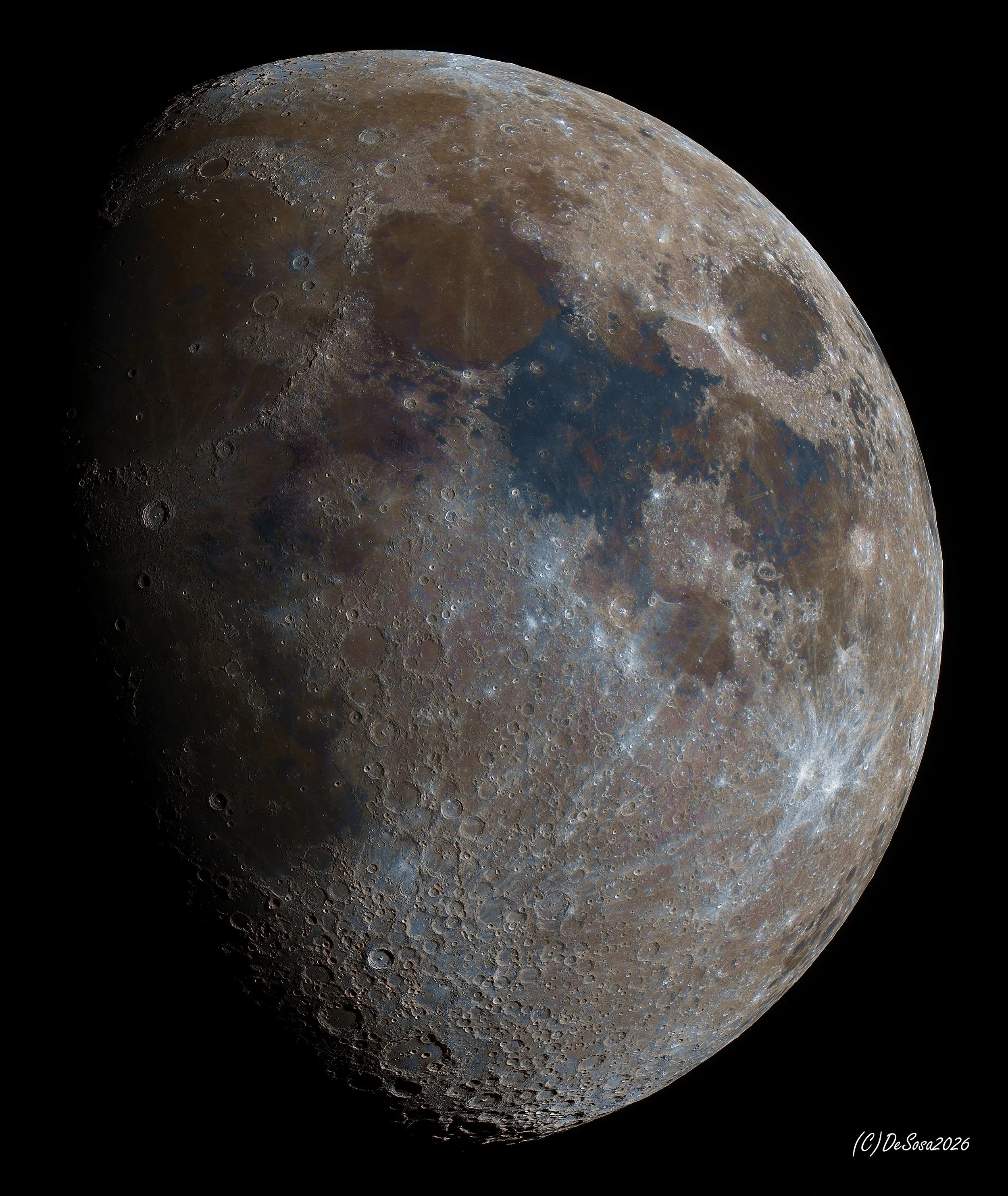
Despite appearances, the surface of the Moon has color and it is possible to capture it with a color or monochrome camera with filters. Each color is due to the large-scale presence of some type of mineral in the lunar crust, from basalts and iron oxides to titanium.
The color tones are very subtle, but real (it is not synthetic color), so during image processing the color saturation must be increased to make it visible, taking care of luminance as a source of detail and contrast.
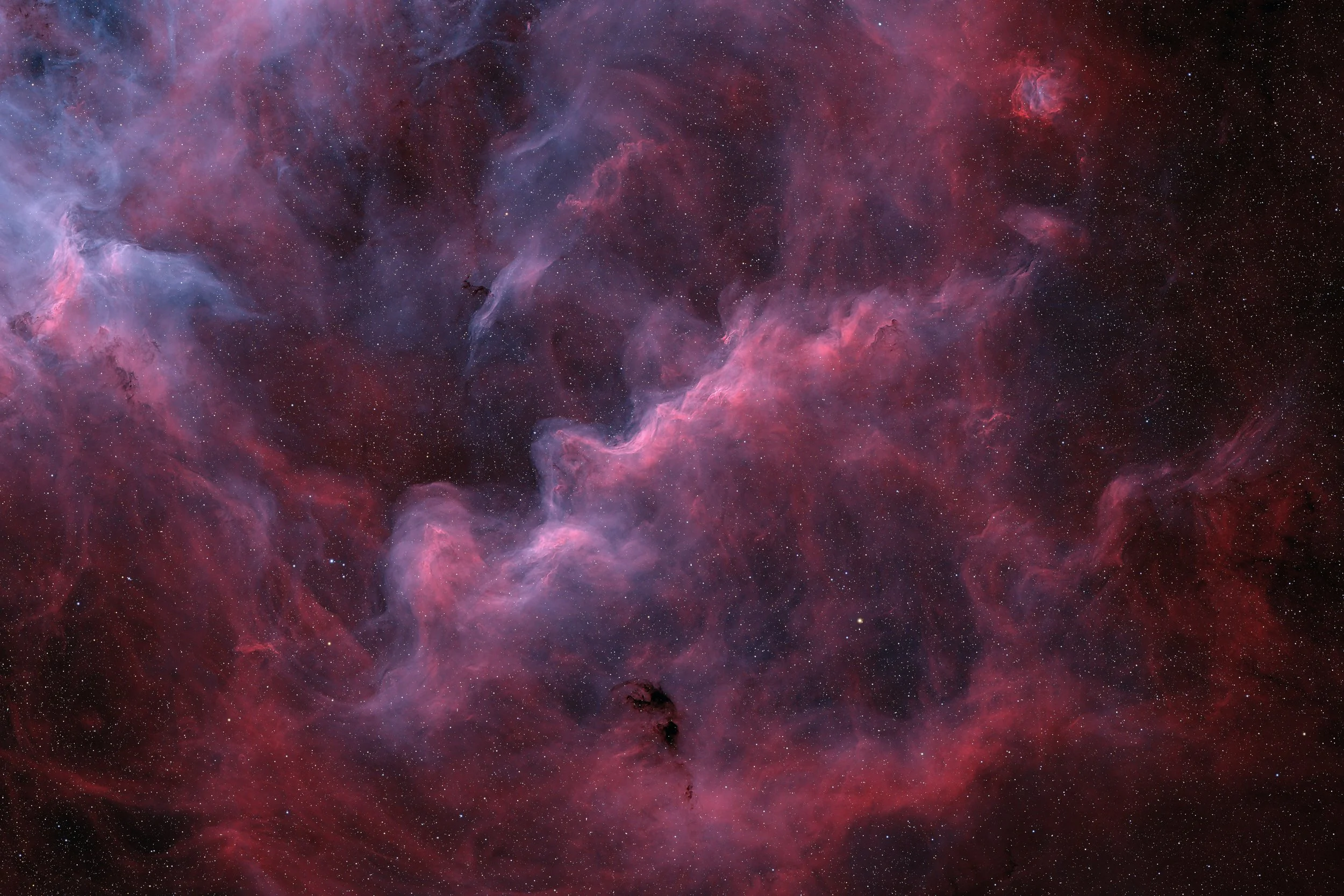
Chaotic South of Eta Carina nebula complex
The Eta Carina Nebula Complex lies within the vast Carina Nebula, one of the most active and massive star-forming regions in our galaxy. Located about 7,500 light-years away in the southern constellation Carina, this enormous nebular complex contains towering clouds of gas and dust illuminated by clusters of hot, young stars. Intense ultraviolet radiation from these stars sculpts the surrounding material into glowing ridges, pillars, and cavities, revealing the turbulent environment where new generations of stars continue to form.
At the heart of the region lies the unstable giant star Eta Carinae, one of the most massive and luminous stars known in the Milky Way. In the 1840s it underwent a violent outburst now known as the Great Eruption of Eta Carinae, briefly becoming the second-brightest star in the night sky and ejecting huge clouds of gas that formed the expanding Homunculus Nebula. Today the broader Eta Carina complex remains a dramatic cosmic laboratory, where massive stars shape their surroundings through intense radiation, stellar winds, and explosive eruptions—processes that both destroy and create the raw material for future stars and planets.
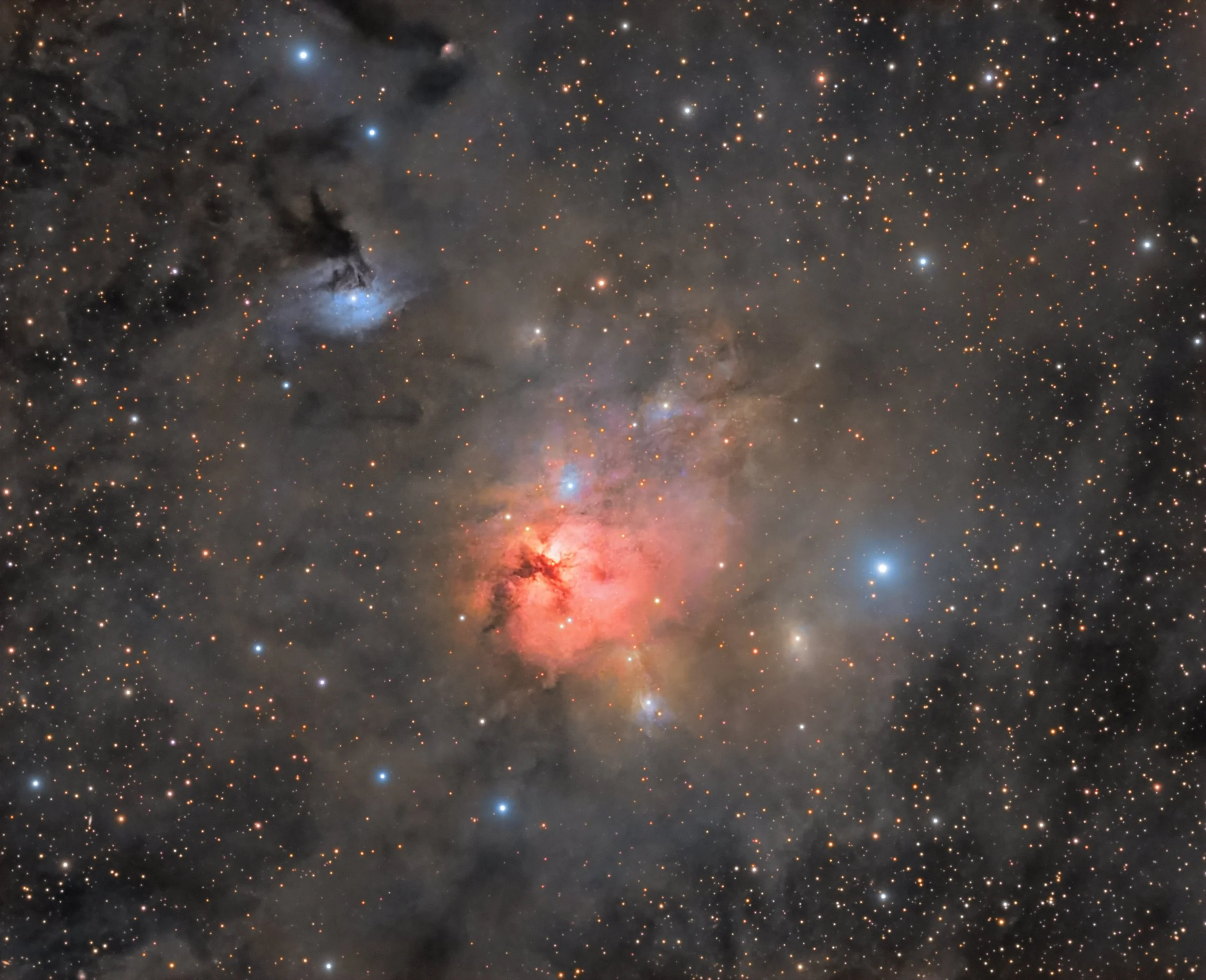
The Northern Trifid Nebula
Located in the constellation Taurus, NGC 1579 is a striking but lesser-known star-forming region sometimes called the Northern Trifid Nebula. Its nickname comes from the dark dust lanes that appear to divide the glowing cloud into several sections, reminiscent of the famous Trifid Nebula. The nebula lies embedded within a complex of interstellar gas and dust where new stars are actively forming. Bright blue reflection light from young stars mixes with faint red emission from energized hydrogen, while thick filaments of dark dust carve dramatic shapes across the glowing cloud.
At the heart of NGC 1579, energetic young stars illuminate and sculpt their dusty surroundings, creating a layered tapestry of reflection nebulae, emission regions, and opaque molecular clouds. These dark lanes are not empty space but dense concentrations of cold dust that obscure the light behind them while providing the raw material for future stellar systems. Though far less famous than its southern namesake, NGC 1579 offers a vivid glimpse into the chaotic environments where stars are born—where gravity, radiation, and turbulence slowly transform cold cosmic clouds into new suns.
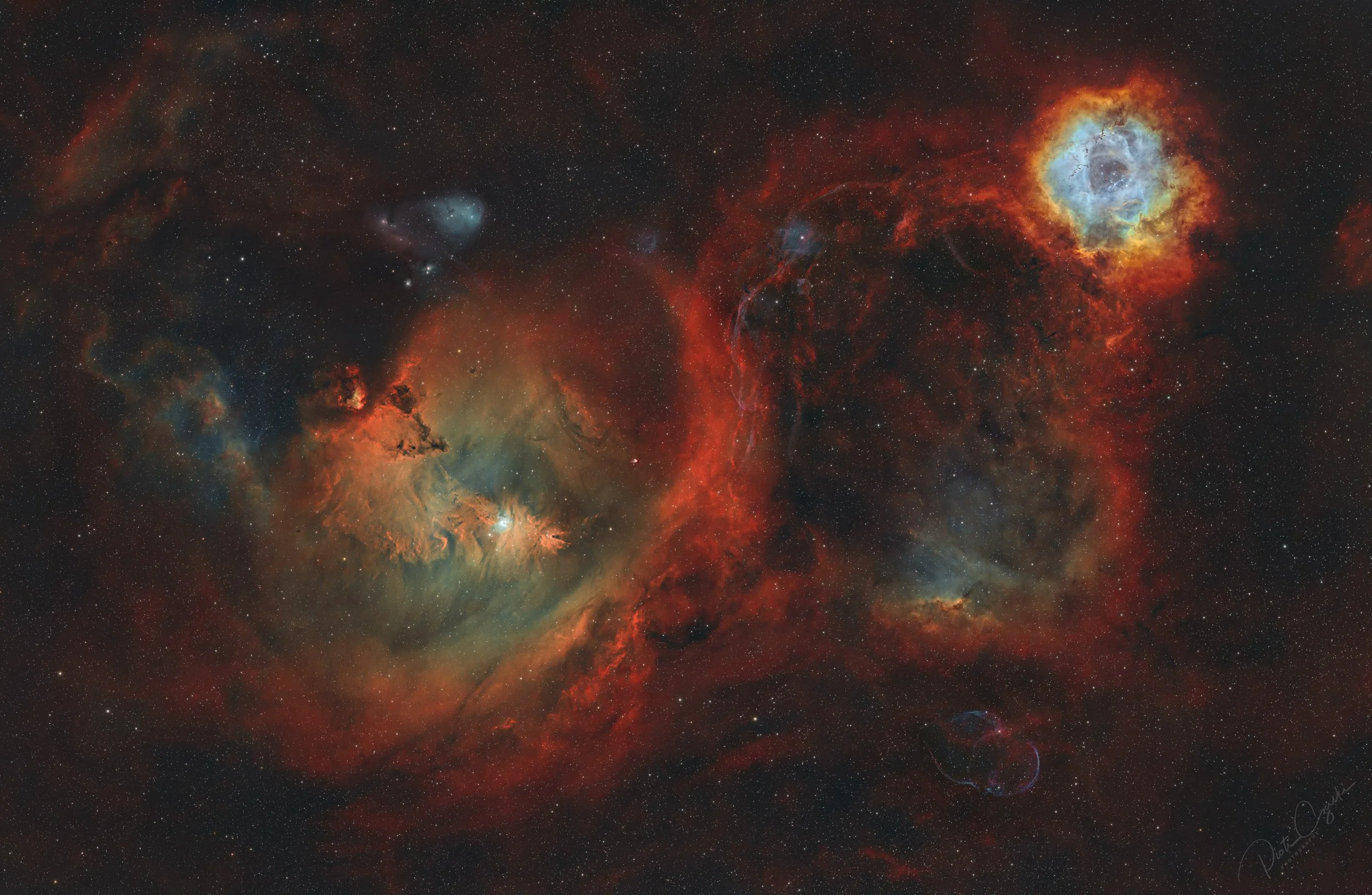
Hydrogen Symphony in Monoceros
This wide-field image captures the intricate interplay between stellar birth and stellar death in the Monoceros constellation. At upper right glows the Rosette Nebula, a stellar nursery energized by young massive stars. Left of center, the Cone Nebula and the Christmas Tree Cluster mark another active star-forming complex embedded in turbulent gas and dust. Together, these structures span hundreds of light-years, illustrating the cosmic cycle: massive stars form within molecular clouds, live briefly, and end violently — enriching and reshaping the very material from which new stars will emerge.
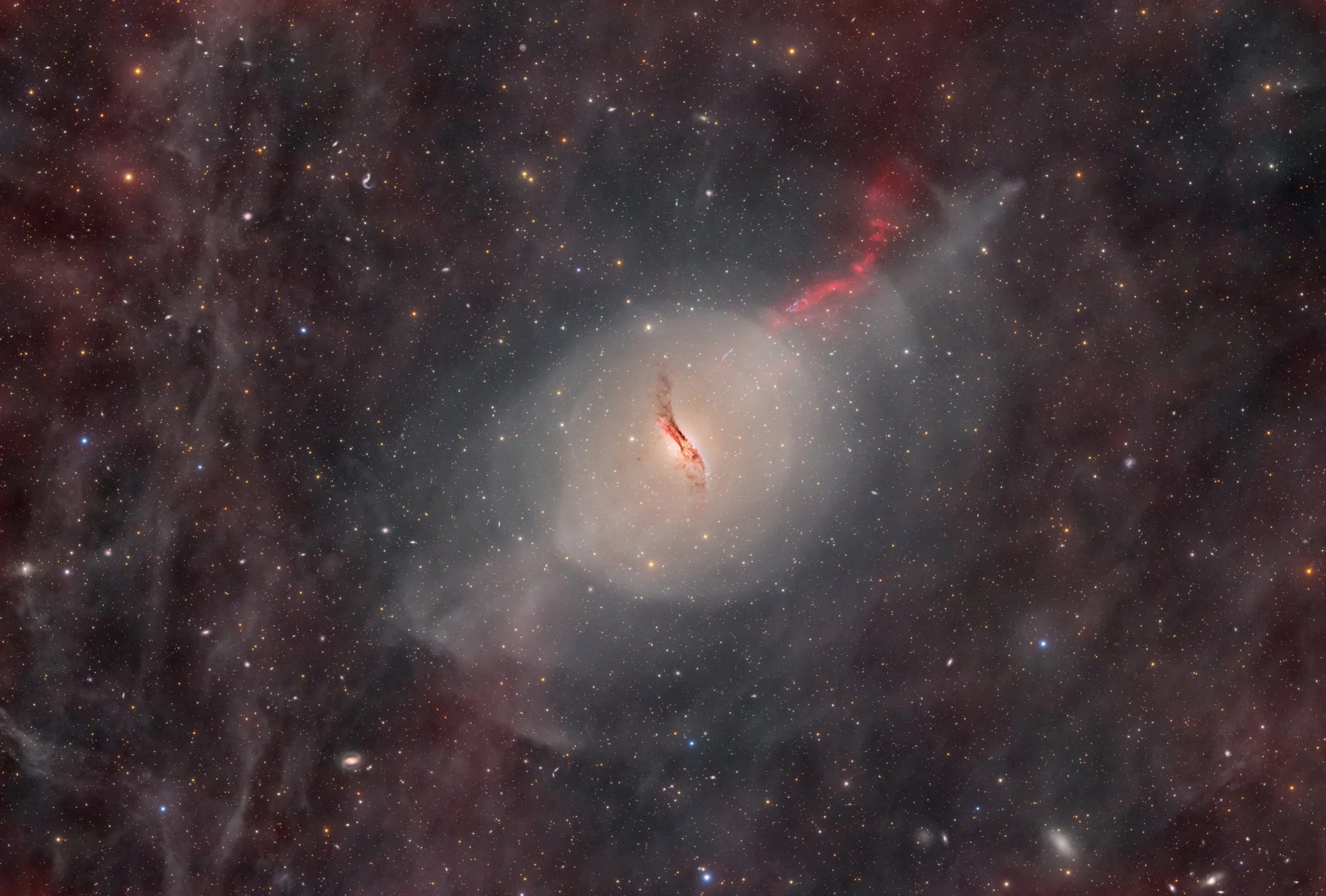
NGC 5128, Centaurus A
The galaxy NGC 5128, more commonly known as Centaurus A, is one of the closest and most striking active galaxies in the sky. Located about 12 million light-years away in the southern constellation Centaurus, it appears as a bright elliptical galaxy dramatically split by a thick, dark lane of dust. This unusual appearance is thought to be the result of a past collision and merger with a smaller spiral galaxy. The interaction stirred vast clouds of gas and dust, forming the prominent band that slices across the galaxy’s glowing core and fueling new bursts of star formation within the otherwise older elliptical system.
At the center of NGC 5128 lies a supermassive black hole millions of times the mass of the Sun, which powers the galaxy’s intense activity. As matter spirals toward the black hole, enormous jets of high-energy particles are launched outward, producing powerful radio emissions that extend far beyond the visible galaxy. Because of this, Centaurus A is classified as one of the nearest radio galaxies, making it a key target for astronomers studying black holes, galaxy mergers, and energetic cosmic jets. Its combination of bright starlight, dark dust structures, and energetic outflows makes NGC 5128 both visually dramatic and scientifically important.
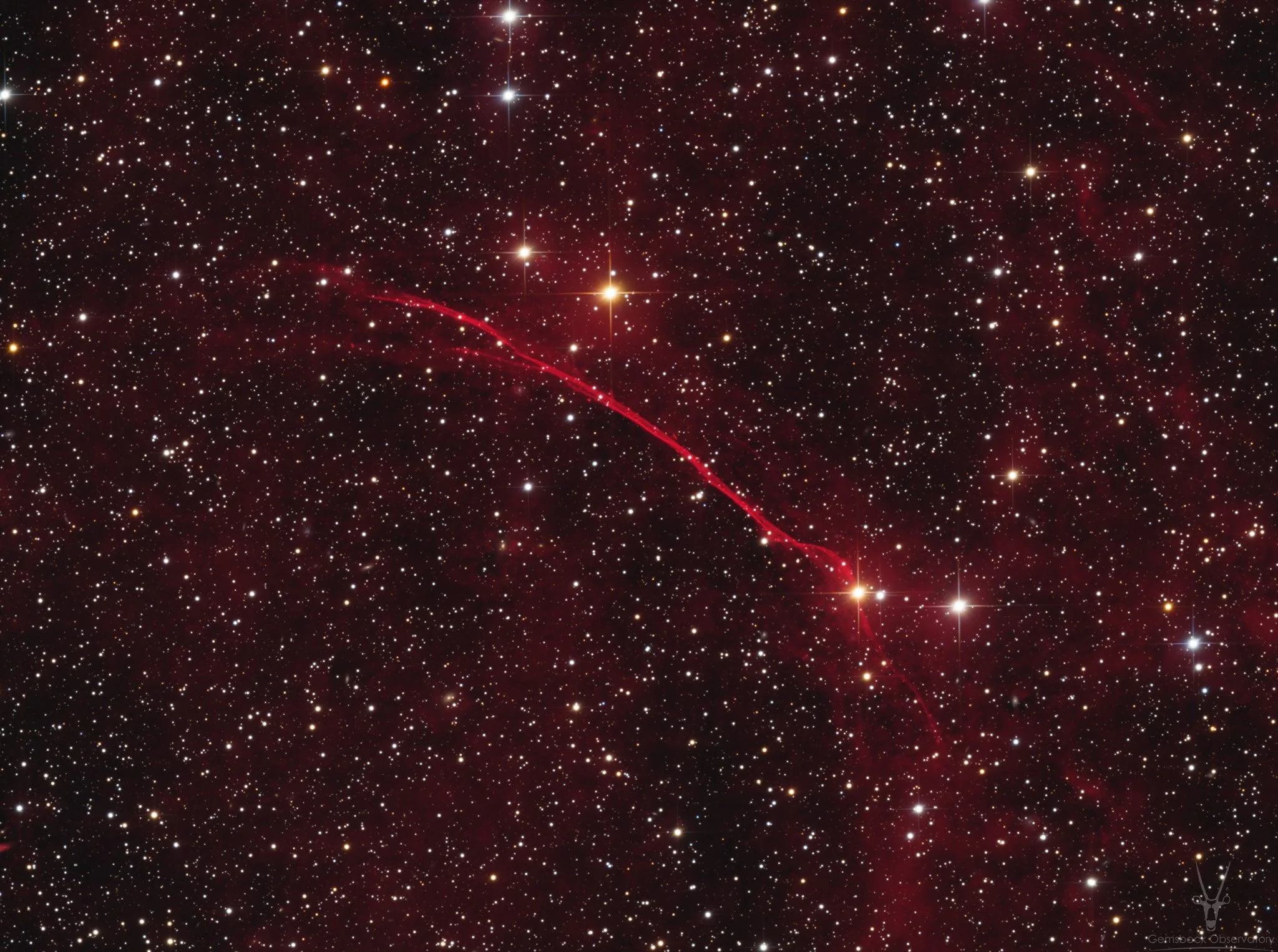
SN 1006 in Lupus
The supernova remnant of SN 1006 marks the aftermath of one of the brightest stellar explosions ever recorded in human history. First witnessed in the year 1006 by observers across Asia, the Middle East, and Europe, the star briefly outshone every object in the night sky except the Moon. Today, its expanding shell of debris lies roughly 7,000 light-years away near the southern constellation Lupus. What remains is a vast, faint ring of energized gas—known as the SN 1006 Supernova Remnant—stretching about 60 light-years across as shockwaves from the ancient explosion continue to sweep through interstellar space.
The remnant shines most strongly in X-ray and radio wavelengths, where astronomers can see the high-energy particles accelerated by the expanding shock front. These powerful shocks race outward at thousands of kilometers per second, heating surrounding gas to millions of degrees and generating delicate arcs and filaments that trace the blast’s expanding boundary. SN 1006 is believed to have been a Type Ia supernova, caused when a white dwarf star accumulated too much material and detonated in a runaway thermonuclear reaction. More than a millennium later, the faint glowing shell drifting through Lupus still carries the energy of that ancient outburst, offering astronomers a nearby laboratory for studying how supernovae shape and enrich the galaxy.
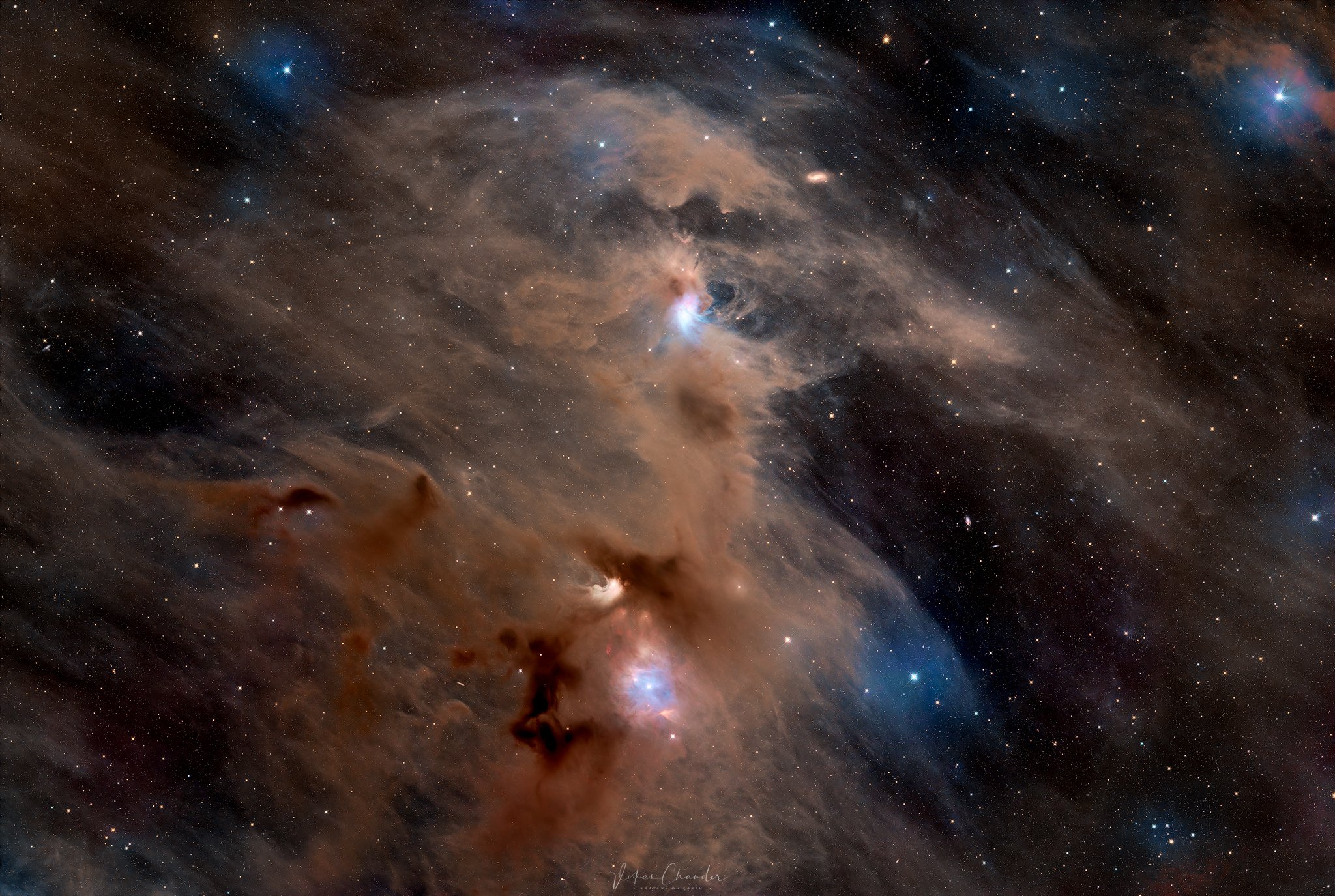
A woodpecker in Chameleon
The dark dust clouds of the Chamaeleon Molecular Cloud Complex are among the nearest stellar nurseries to Earth, lying roughly 500 light-years away in the southern constellation Chamaeleon. These clouds—especially the regions known as Chamaeleon I, Chamaeleon II, and Chamaeleon III—are composed of extremely cold gas and microscopic dust grains that block visible starlight, giving them their striking appearance as inky patches against the background of the Milky Way. Within these opaque filaments, gravity slowly gathers material into dense knots where new stars begin to form. Because the complex is relatively close to our solar system, astronomers study it carefully to better understand the earliest stages of stellar birth.
Inside these dusty clouds, young stars are often hidden from view, still wrapped in cocoons of gas and dust that absorb visible light but glow faintly in infrared wavelengths. Observations from infrared telescopes have revealed hundreds of newborn stars and protostellar disks embedded within the clouds, many only a few million years old. The dust itself plays a crucial role: it shields fragile molecules from harsh radiation, cools the gas so it can collapse under gravity, and eventually becomes part of the disks that may form planets. In this way, the dark dust clouds of the Chamaeleon region represent not emptiness, but the quiet beginnings of future stars and planetary systems.
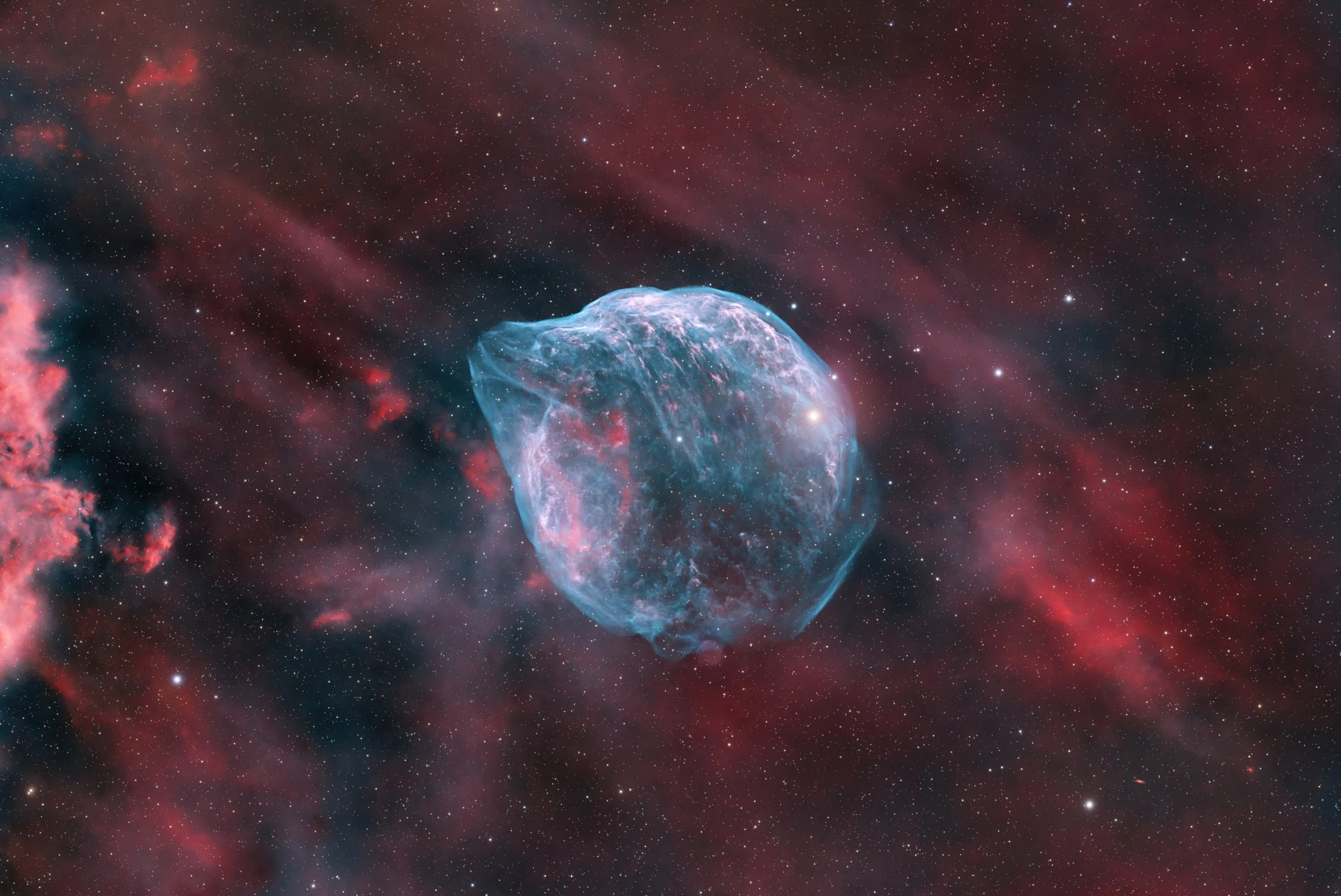
SH2-308 The Dolphin Nebula
The Dolphin Nebula (Sharpless 2-308) is a vast bubble of glowing gas located about 5,200 light-years away in the constellation Canis Major. Spanning nearly 60 light-years across, the nebula was formed by the powerful stellar winds of a massive Wolf–Rayet star, which has blown material outward to create a huge shell of ionized oxygen. When imaged through specialized filters, the nebula shines with a distinctive soft blue glow, giving it the appearance of a cosmic bubble drifting through space.
Often nicknamed the “Dolphin Nebula” because of its curved structure that can resemble a leaping dolphin in wide-field images, Sh2-308 is a challenging but rewarding target for astrophotographers. Its faint emission requires long exposures and narrowband imaging to reveal the delicate arcs of gas surrounding the central star. The nebula represents a late stage in the life of a massive star, as intense stellar winds sculpt the surrounding interstellar material before the star eventually ends its life in a supernova explosion.
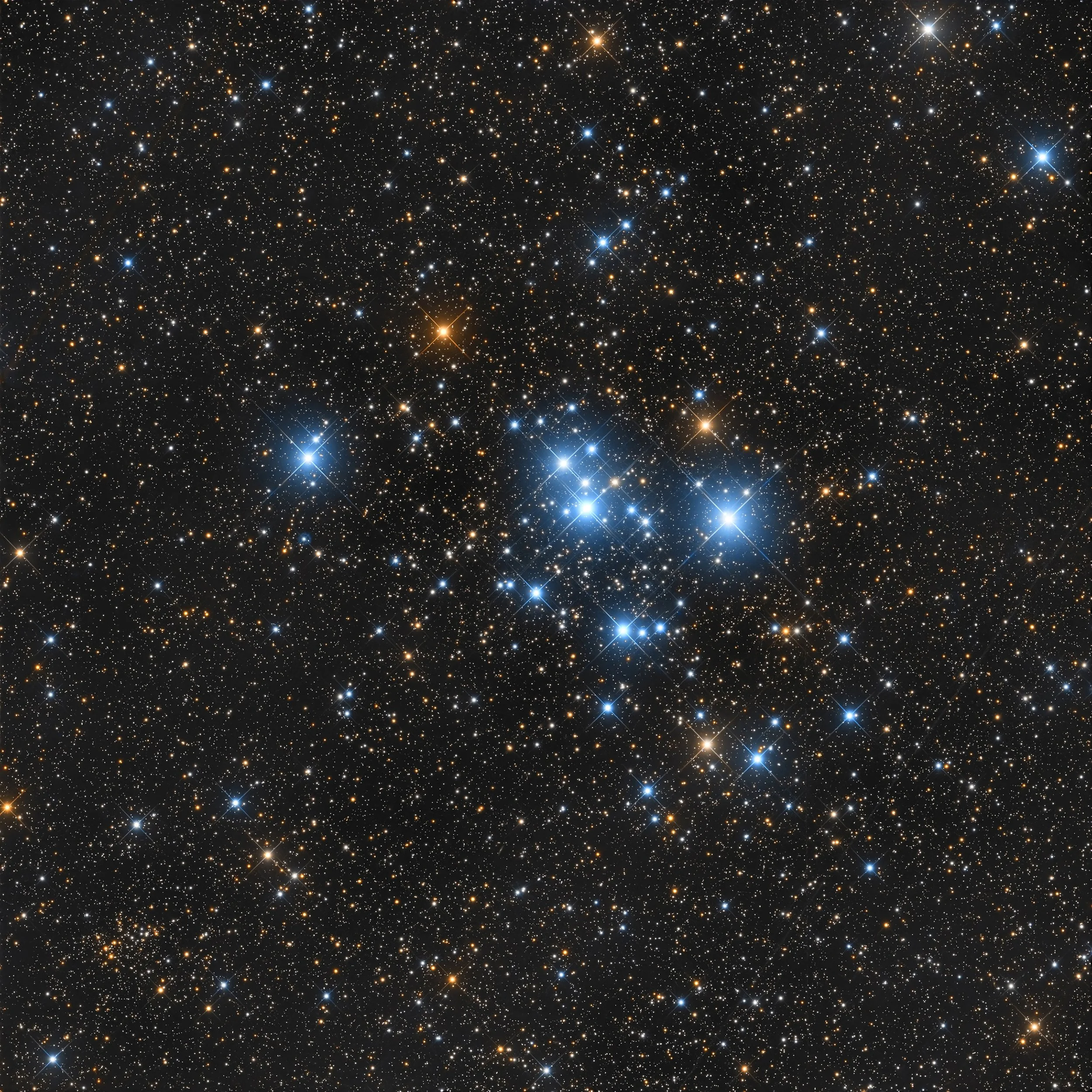
Messier 47
Messier 47 (M47) is a bright open star cluster located about 1,600 light-years away in the constellation Puppis. Containing several dozen easily visible stars and many fainter members, the cluster spans roughly 12 light-years across and shines at about magnitude 4.4, making it visible to the naked eye under dark skies. The stars of M47 are relatively young—around 78 million years old—and many of its brightest members are hot, blue stars that illuminate the surrounding star field.
Discovered by Charles Messier in 1771, M47 stands out for its loose structure and striking brightness compared to many other open clusters. Through binoculars or a small telescope, it appears as a rich scattering of sparkling stars, often contrasted with the nearby but dimmer open cluster M46, which lies just a degree away in the sky. Together they form a beautiful deep-sky pairing for observers exploring this region of the winter Milky Way.
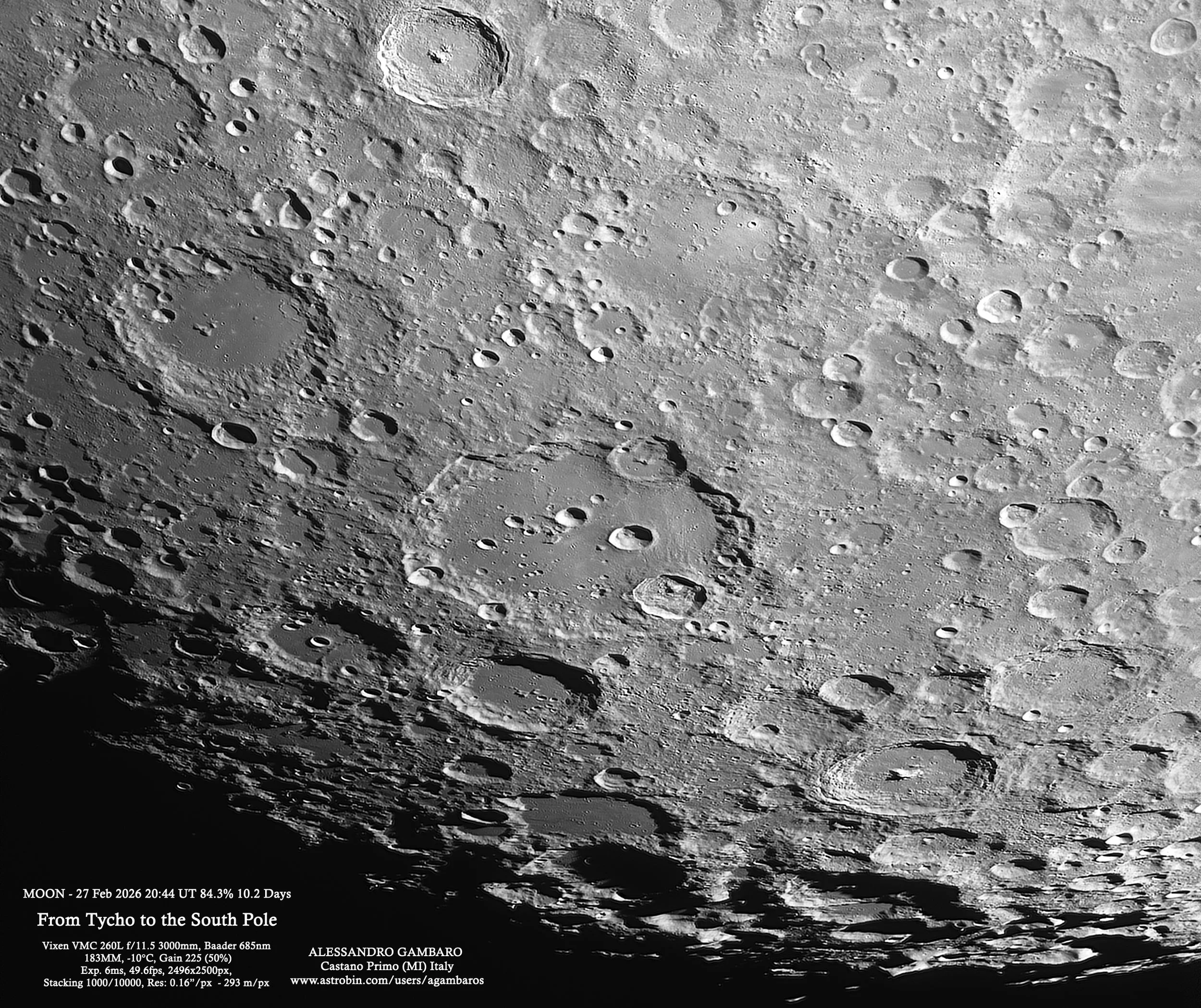
From Tycho to the South Pole
Tycho Crater is one of the most prominent impact craters on Earth’s Moon, located in the southern lunar highlands. It spans about 85 kilometers (53 miles) in diameter and was formed roughly 108 million years ago when a large asteroid struck the lunar surface. The impact created a deep crater with steep walls, terraced edges, and a dramatic central peak that rises about 2 kilometers (1.2 miles) above the crater floor.
Tycho is especially famous for its bright ray system—long streaks of ejected material that radiate outward across the Moon’s surface for over 1,500 kilometers (930 miles). These rays make Tycho easily visible from Earth with even small telescopes and are best seen during a full Moon, when the sunlight reflects strongly off the relatively young, bright material blasted out during the impact.
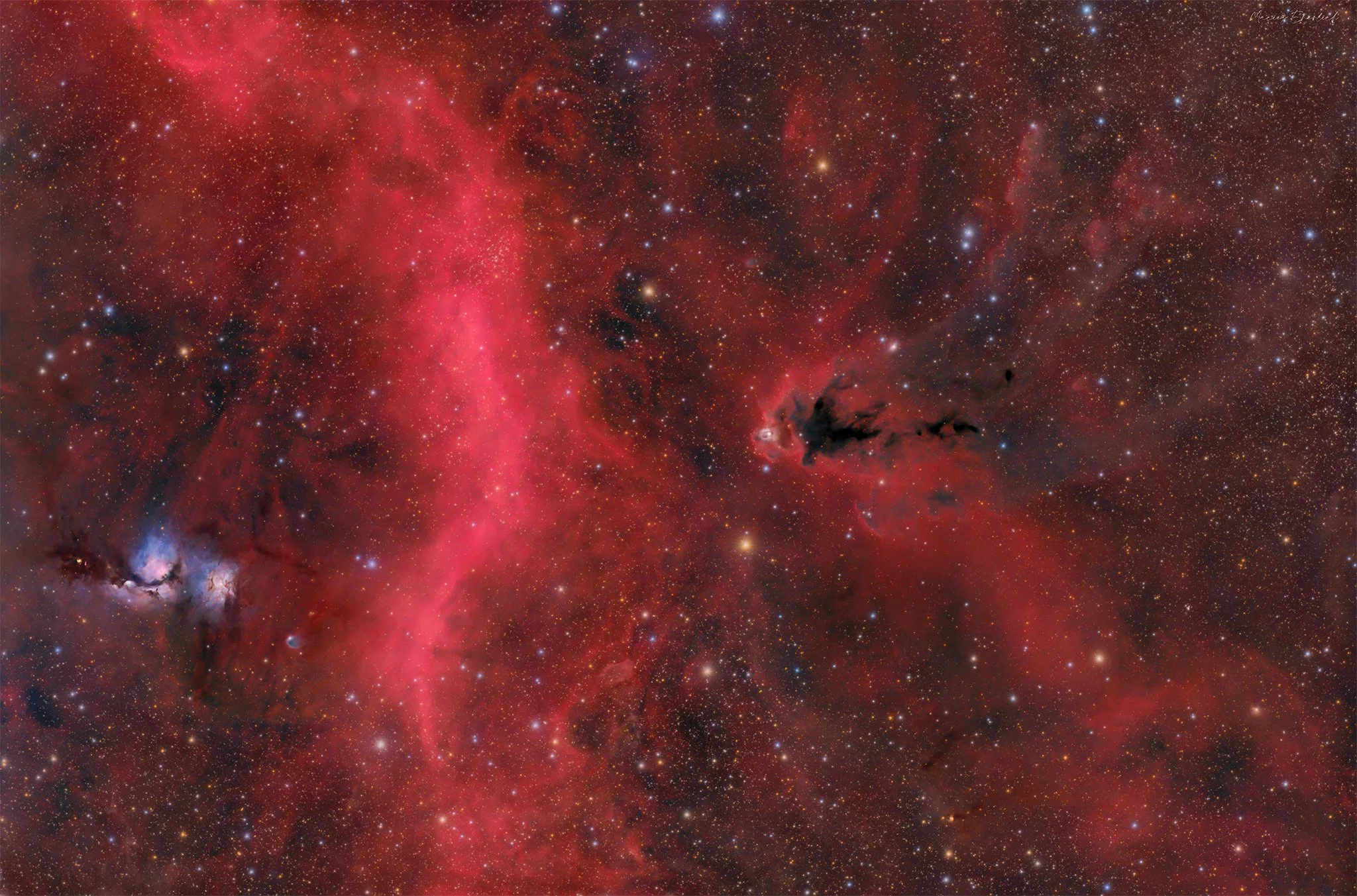
Boogyman and M78 swimming in hydrogen sea
The Boogeyman Nebula, formally known as LDN 43, is a dark nebula located roughly 1,400 light-years away in the constellation Serpens Cauda. Unlike glowing emission nebulae that shine brightly with energized gas, this object appears as an eerie silhouette against the star-filled background of the Milky Way. Thick clouds of interstellar dust block visible light from stars behind it, creating the striking illusion of a shadowy, ghost-like figure—hence its haunting nickname. The nebula’s sinuous, curved shape resembles a cloaked creature looming through space, which has made it a favorite target for astrophotographers seeking dramatic cosmic imagery.
Despite its ominous appearance, the Boogeyman Nebula is actually a stellar nursery in the early stages of star formation. Inside the dense dust clouds lies a young protostar known as RNO 91, which is actively gathering material from its surrounding environment. Powerful outflows from this newborn star carve cavities through the dark cloud, gradually dispersing the dust and shaping the nebula over time. Over millions of years, this hidden region will likely evolve into a small cluster of young stars, transforming the once-shadowy nebula into a brighter and more active region of space.
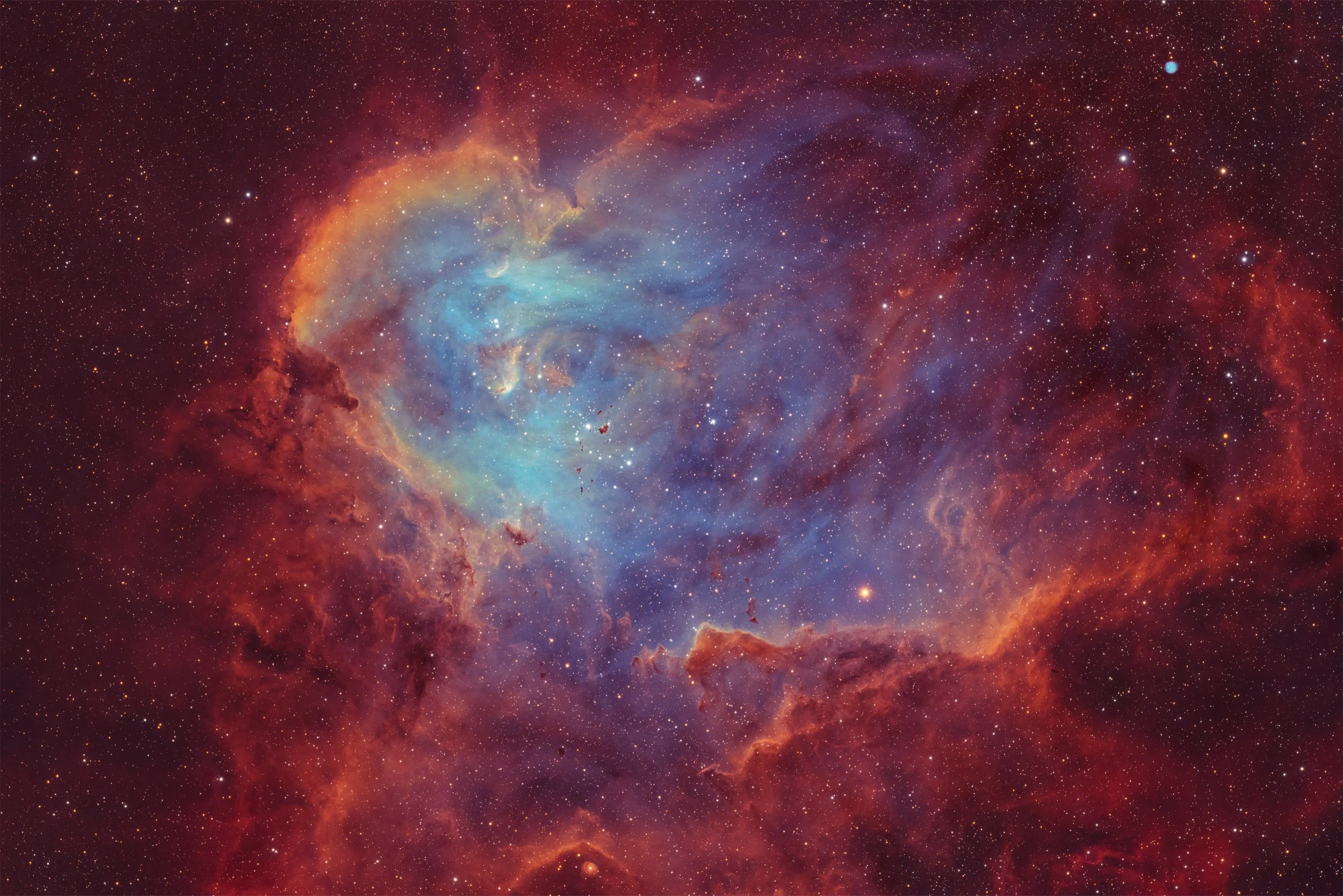
IC2944 - The Running Chicken Nebula
IC 2944 is a large emission nebula located about 6,500 light-years from Earth in the constellation Centaurus. It is sometimes called the Running Chicken Nebula because the brightest part of the gas clouds forms a shape that resembles a running chicken in photographs. The nebula glows red because young, hot stars inside it emit strong ultraviolet radiation that ionizes the surrounding hydrogen gas. When the electrons in the hydrogen recombine, they release energy as visible red light, which is why many star-forming nebulae like IC 2944 appear bright in long-exposure images.
One of the most interesting features of IC 2944 is a set of dark clouds known as Thackeray’s Globules. These small, dense pockets of gas and dust appear as black silhouettes against the bright nebula. Astronomers once thought they might be forming new stars, but studies suggest many of them may actually be evaporating under the intense radiation from nearby massive stars. IC 2944 is therefore an important region for studying how massive stars interact with and shape the gas clouds where stars are born.