
AAPOD2 Image Archives
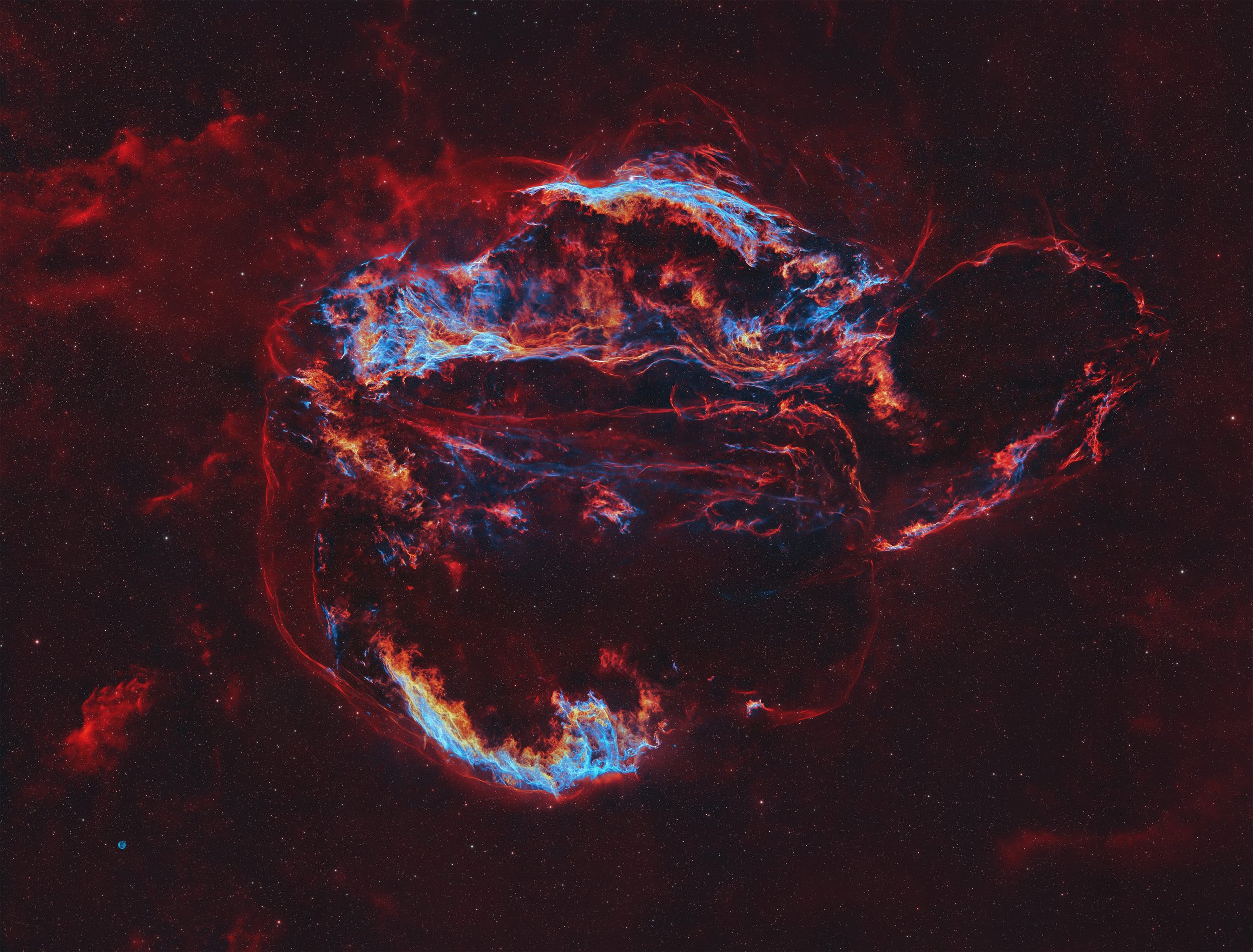
GigaVeil: 1 billion pixels, 300 hours, 35 panels, and 5 contributors on the Veil Nebula
The Veil Nebula is a massive, expanding supernova remnant—the expanding shell of ionized gas left behind when a star roughly 20 times the mass of the Sun exploded around 10,000 to 20,000 years ago—where high-velocity shockwaves collide with surrounding interstellar clouds to excite atoms of doubly ionized oxygen ($\text{OIII}$, glowing in vivid cyan) and hydrogen-alpha ($\text{H}\alpha$, glowing in deep red). Capturing this vast structure in uniform high resolution required a collaborative imaging project bringing together five astrophotographers across Delaware and Texas: Gavin Bent, Brian Nietfeld, Hunter Outten, Kaleb Jordan, and Stan Williams. Over more than 318 total hours of exposure time using a variety of focal lengths, filters, and optics, the team stitched together a 35-panel, 1-gigapixel mosaic that reveals intricate filamentary shock fronts, surrounding ambient hydrogen clouds, and faint nearby targets such as the rarely imaged planetary nebula PA28.
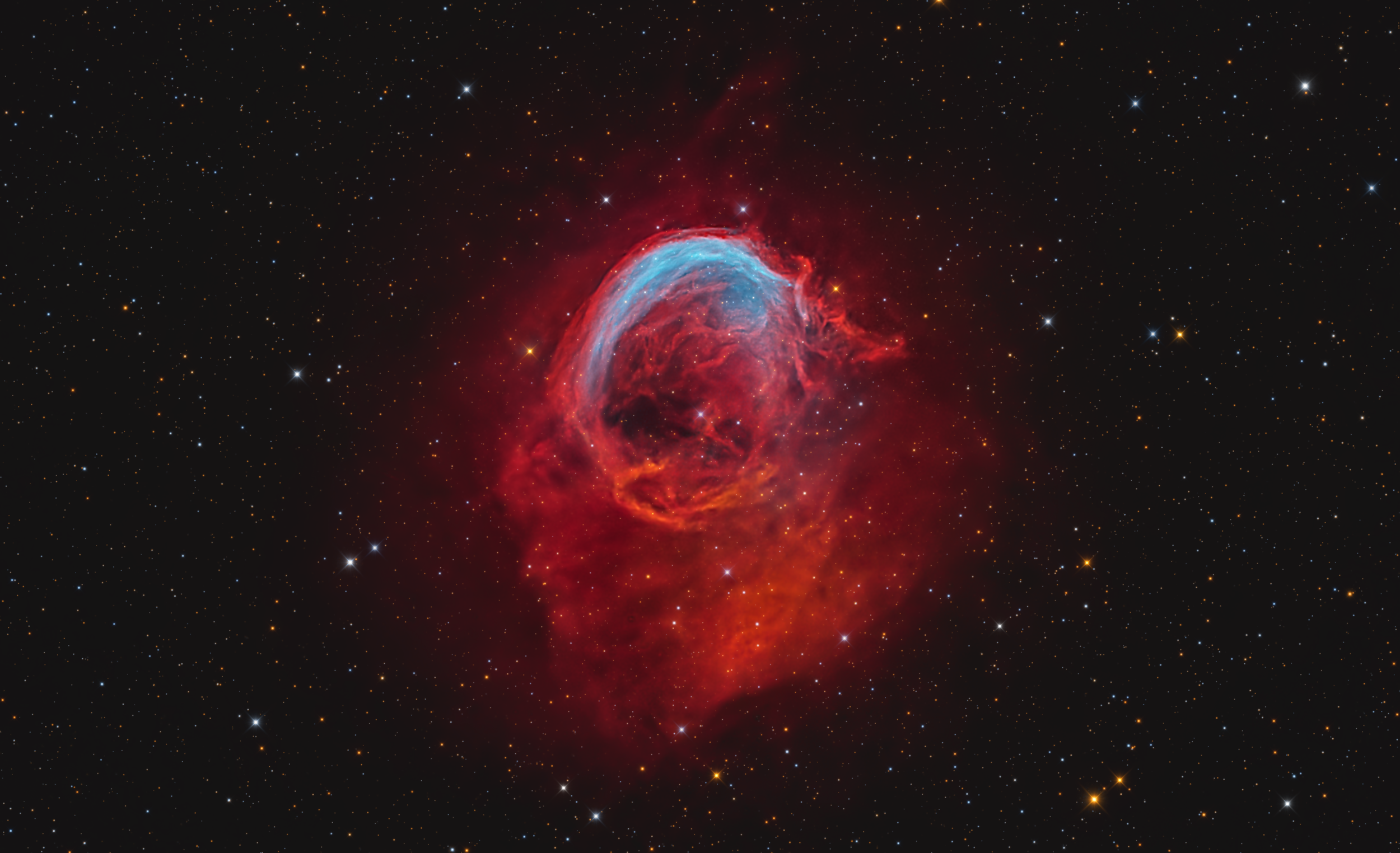
Sh2-188: The Dolphin Nebula
Sh2-188, often called the Dolphin Nebula, is a planetary nebula in Cassiopeia about 850 light-years away. Its distinct crescent shape comes from a bow shock as the nebula plows through the interstellar medium at high speed. The leading edge glows with bright hydrogen-alpha and oxygen-III emission, while fainter filaments trail behind, outlining its extended structure.
This deep image combines Ha, OIII, and SII data for over 20 hours of total exposure, revealing delicate filaments and subtle color contrasts across the nebula. The mix of short and long exposures preserves both the bright rim and the faint outer shell, capturing the nebula’s interaction with surrounding space in remarkable detail.