
AAPOD2 Image Archives
Discovery of a Bow Shock around Cataclysmic Variable Star LS Pegasi
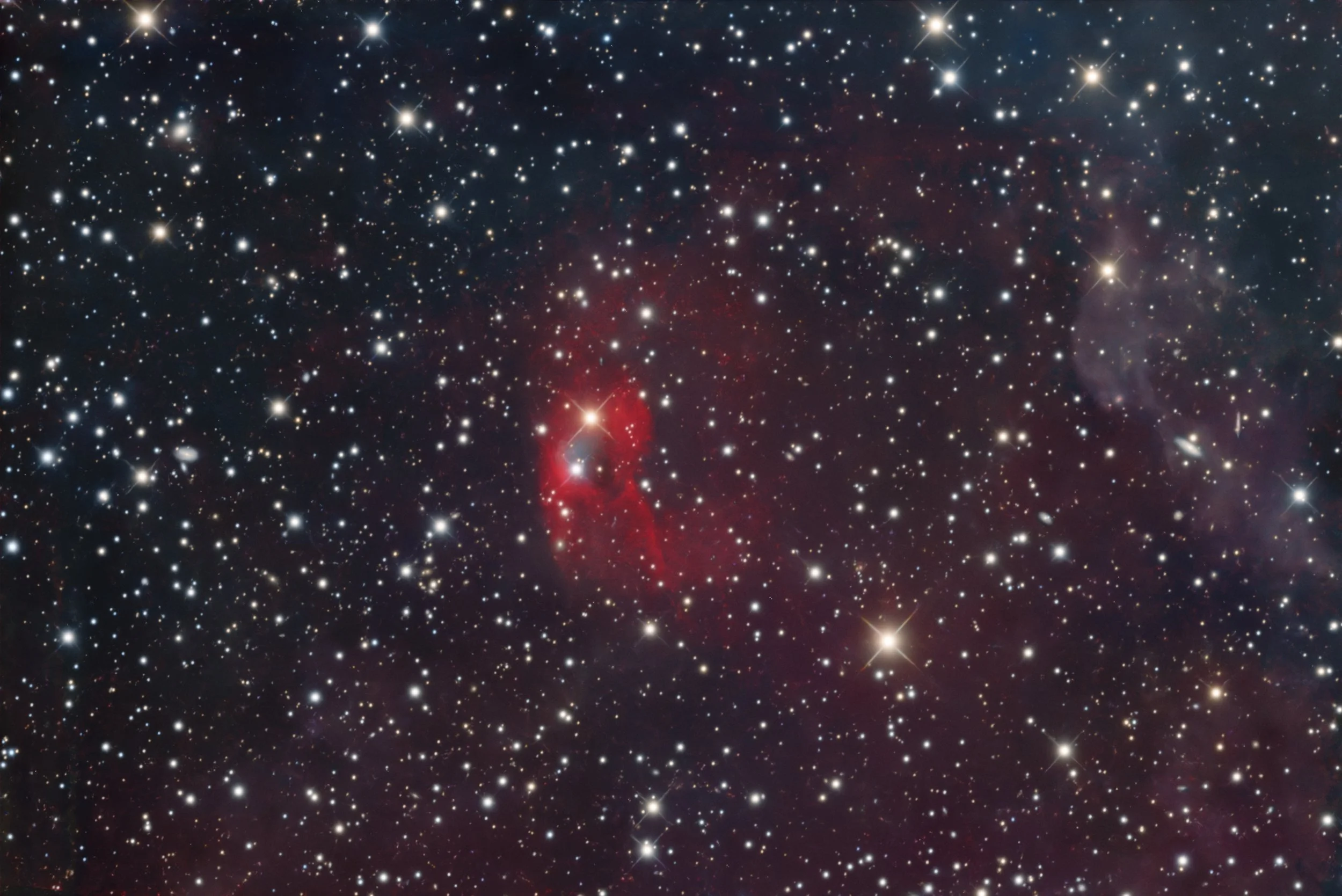
A newly revealed bow shock surrounds LS Pegasi, a well-studied cataclysmic variable (CV) star in the constellation Pegasus. This reddish arc of emission was discovered through deep imaging and analysis of archival H-alpha and OIII data, confirming early suspicions from wide-field sky surveys. The emission structure seen here is a bow shock — a shell of material shaped by the motion of the star through the interstellar medium.
LS Pegasi has been known as a variable star since 1935, but it wasn’t until 1988 that it was classified as a CV, a system where a white dwarf accretes matter from a companion. In August 2020, amateur astronomer Dana Patchick detected subtle nebulosity around LS Pegasi using VTSS and SHASSA data, leading to targeted observations and the confirmation of this shock feature. The discovery contributes to a growing list of CVs with extended emission structures, suggesting mass-loss events or wind interactions that persist on large scales.
New Discovery of Faint Nebulosity Around a Cataclysmic Variable Star
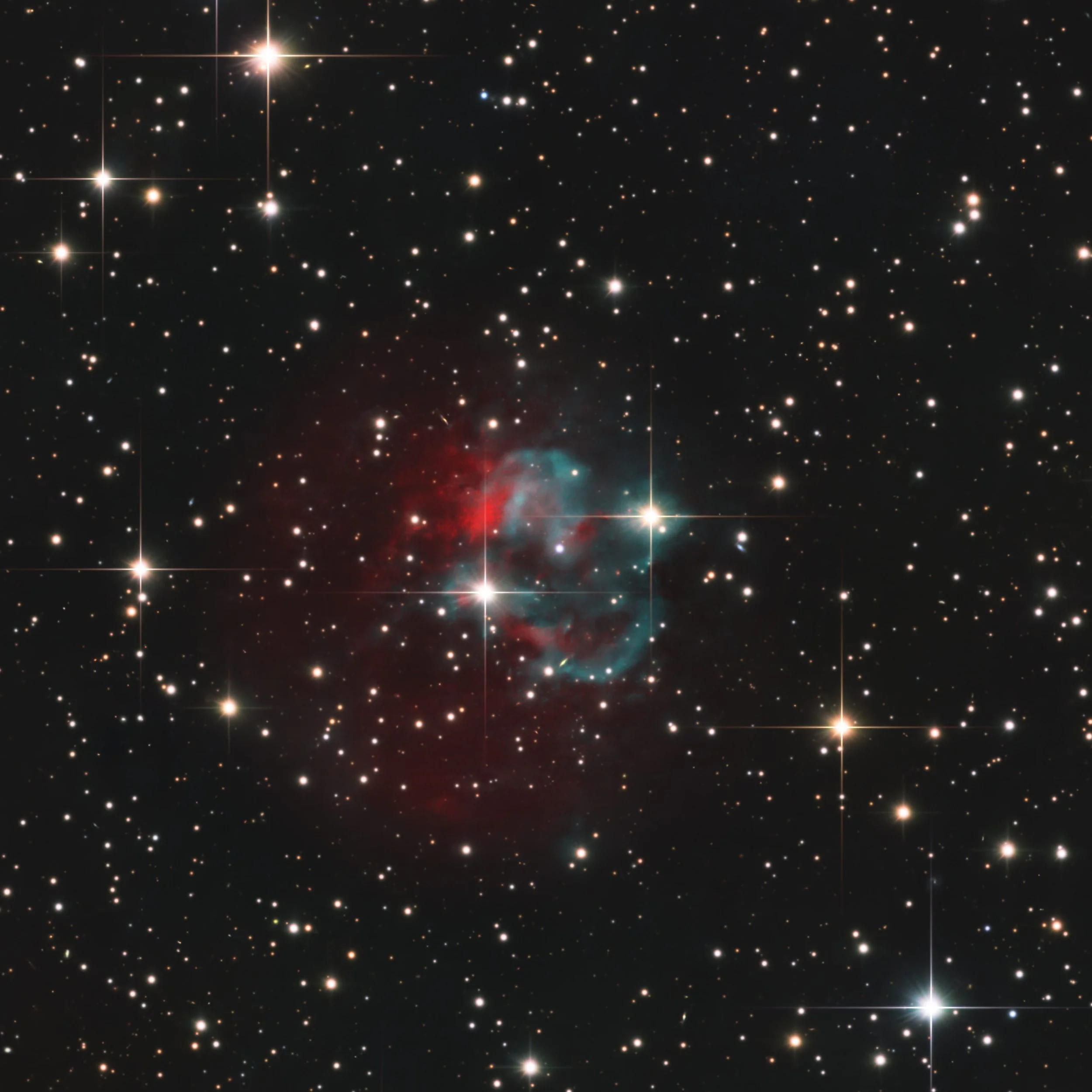
Amid a rich starfield, faint red and teal wisps of ionized gas swirl around ASASSN-19ds, a cataclysmic variable (CV) star centered between two brighter foreground stars. This rare nebulosity, revealed through over 55 hours of deep exposure, marks an extraordinary discovery. CVs seldom show extended emission, making this a significant find. The intricate structure and color separation suggest a mix of ionized hydrogen (Hα, red) and oxygen (OIII, teal), hinting at complex interactions from past outbursts or surrounding interstellar material.
The image was part of a collaboration between Daniel Stern, Jon Talbot, and Dana Patchick, and the discovery was formally analyzed in a recent academic paper by Dr. Howard Bond (arXiv:2506.11306). Taken from Chile with a CDK-24 telescope, the data reveal subtle filaments and diffuse structures often missed in shorter exposures. This observation adds a rare specimen to the catalog of nebulae associated with CVs and contributes valuable insight into the life cycles of these energetic binary systems.