

AAPOD2 Image Archives
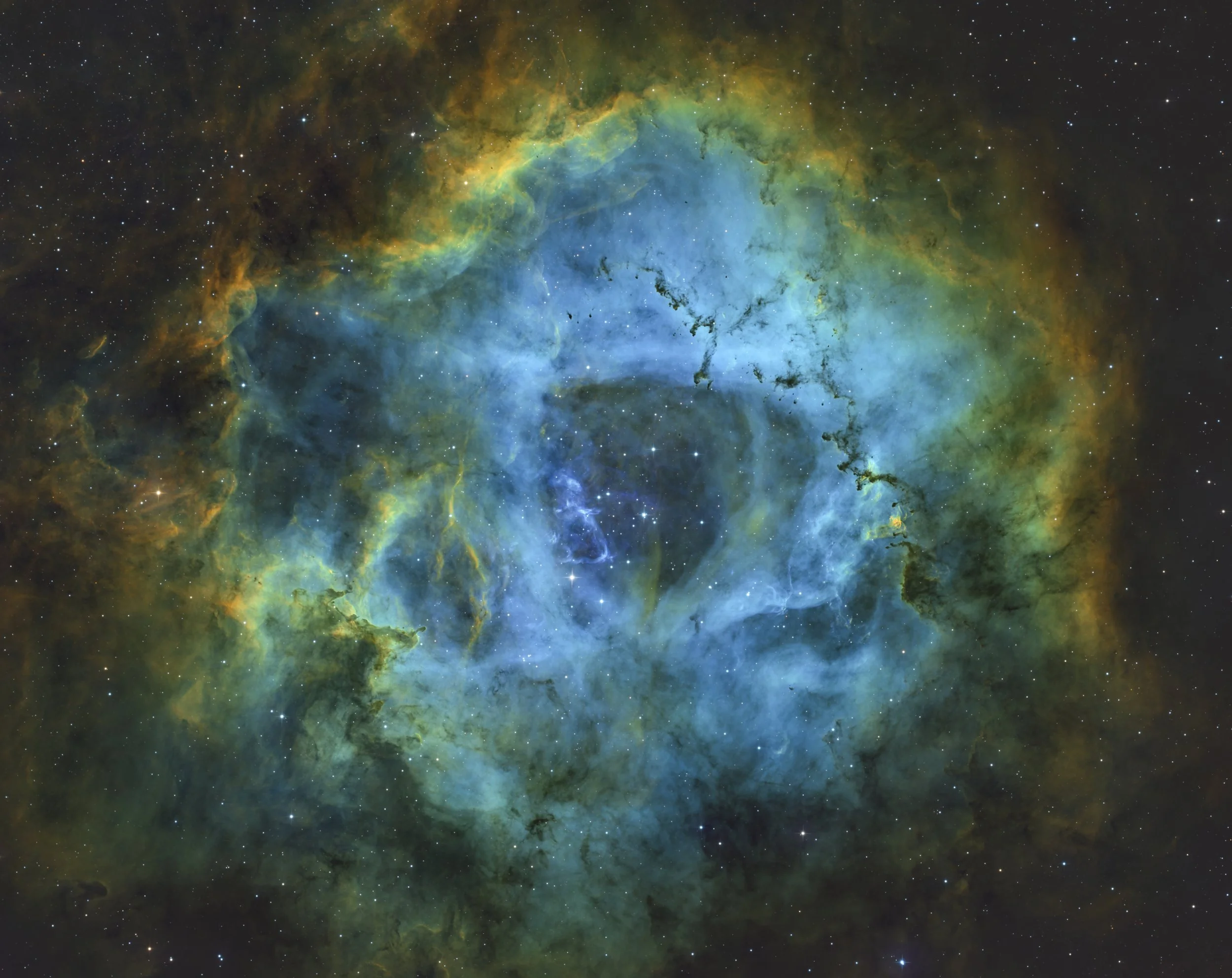
NGC 2237–2246 | The Rosette Nebula in Hubble Palette
The Rosette Nebula is a vast emission nebula located roughly 5,000 light years away in the constellation Monoceros. This image is presented in the popular Hubble SHO color palette, where sulfur, hydrogen, and oxygen emissions are mapped to red, green, and blue tones. At the center lies the young open star cluster NGC 2244, whose massive, hot stars flood the surrounding cloud with ultraviolet radiation, ionizing the gas and giving the nebula its luminous, sculpted appearance.
Powerful stellar winds from these stars have carved an enormous cavity within the nebula, compressing the surrounding gas into ridges, knots, and wispy filaments. These compressed regions are potential sites of future star formation, illustrating how stellar feedback both disrupts and triggers the birth of new stars. The false color palette enhances subtle chemical and structural differences, revealing the Rosette as a dynamic laboratory where gravity, radiation, and gas interact on interstellar scales.
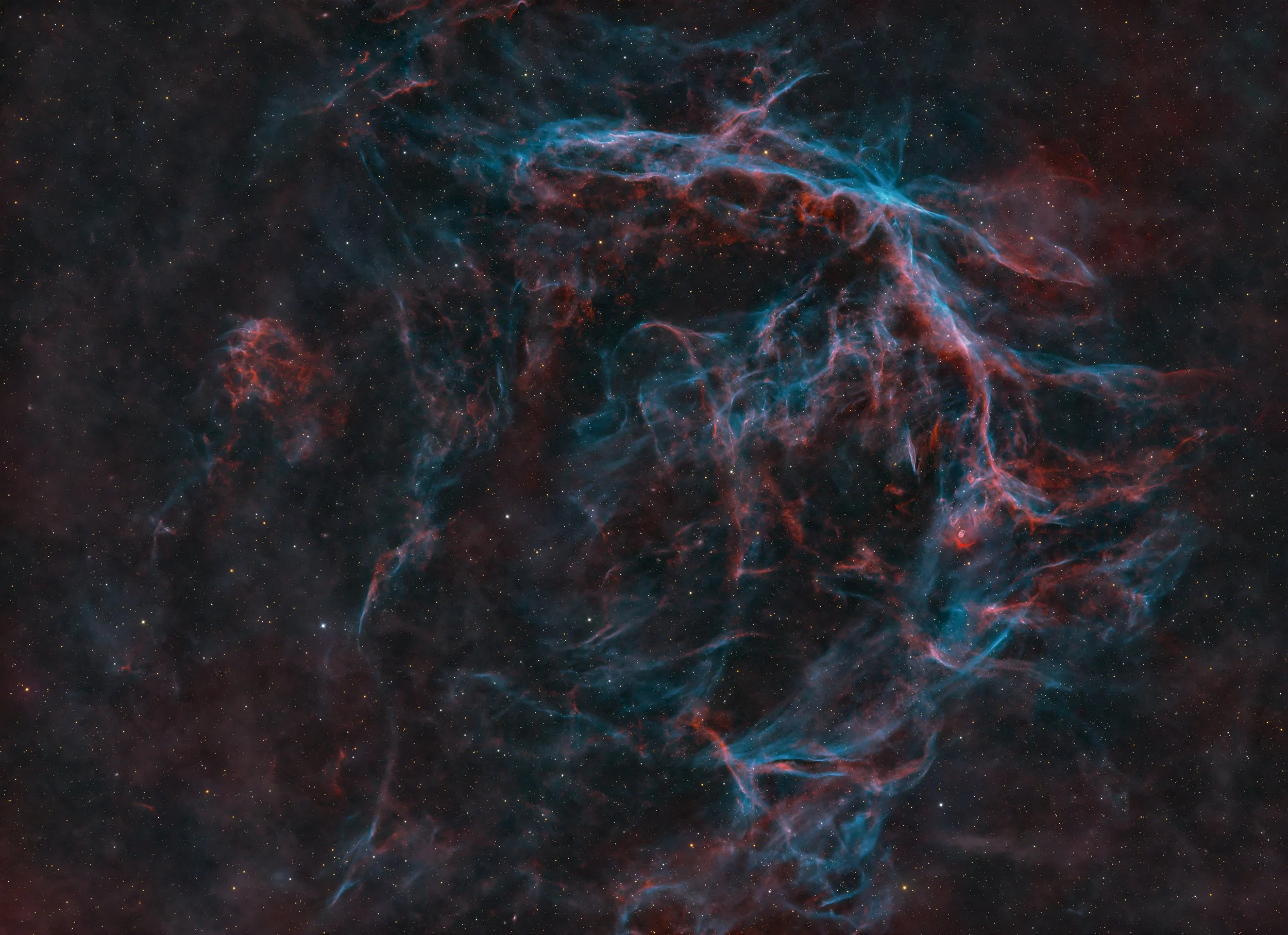
SNR G119.5+10.2 and NGC 40 in Cepheus
SNR G119.5+10.2 also known as CTA 1 is a faint and sprawling supernova remnant in Cepheus created by a massive star that exploded roughly 10 to 14 thousand years ago. Its interior hosts a weak pulsar whose energetic output continues to drive gas outward shaping the subtle filaments that arc across the field. Although the remnant was suspected to contain a pulsar when it was first identified in 1960 no signal was found until 2008 when sensitive observations finally revealed the faint emission. The surrounding structures show the diffuse glow of ancient shocked material slowly expanding into the interstellar medium.
Near the lower portion of the frame sits NGC 40 a compact planetary nebula often imaged on its own but rarely placed in context with the much larger and fainter CTA 1. In this deep 40 hour integration captured in HSO filters with an F2.2 RASA astrograph and an ASI6200MM camera from Pendleton Oregon the planetary appears as a bright knot against the sweeping remnants of the supernova. The combination highlights two very different stages of stellar evolution one from a dying low mass star and the other from the violent end of a massive one all sharing the same rich region of Cepheus.
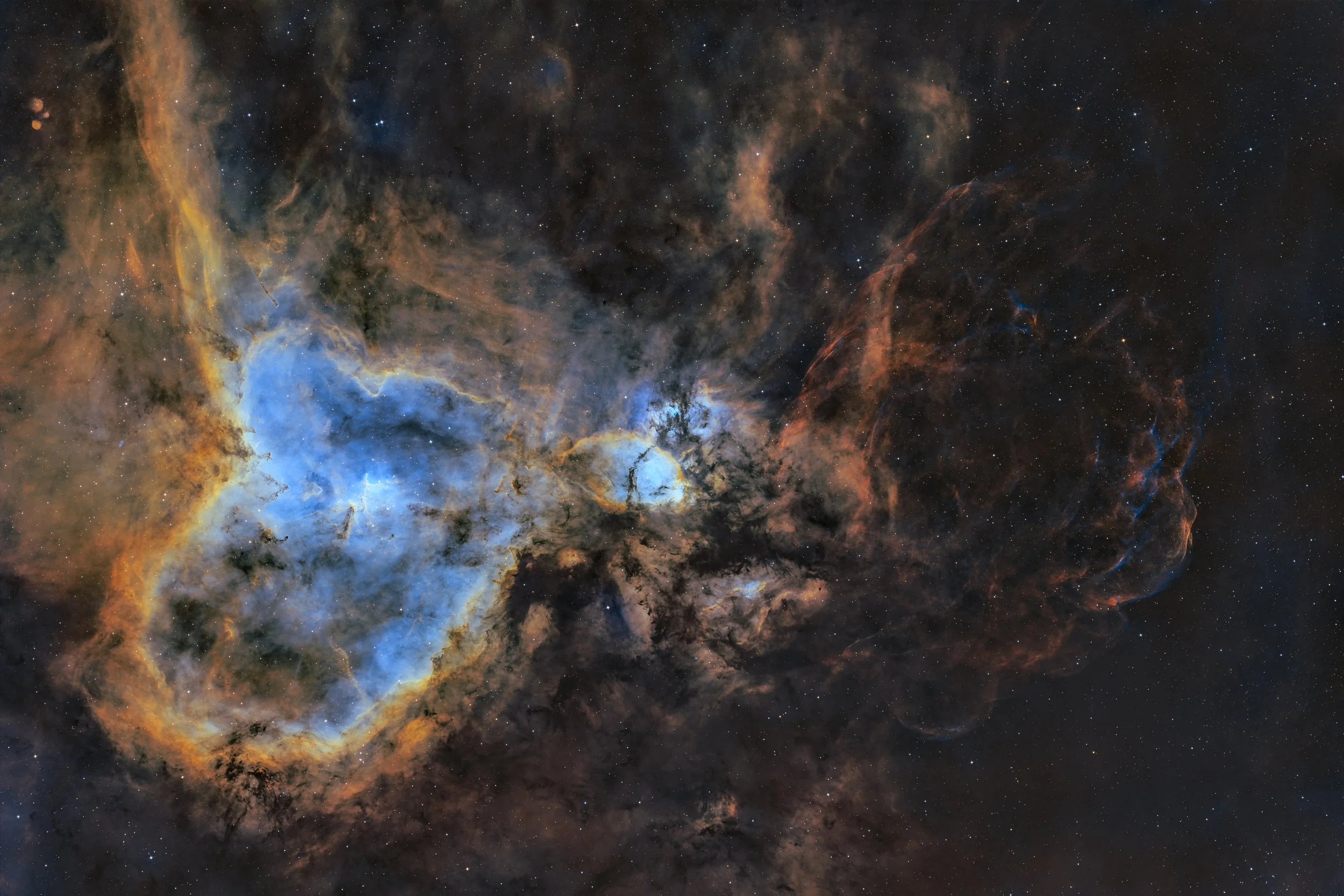
IC 1359 and the HB3 Supernova Remnant
IC 1359 appears here as a luminous knot along the western edge of the Heart Nebula, a region dominated by ionized hydrogen shaped by stellar winds from the massive stars of Melotte 15. The surrounding emission is part of the larger IC 1805 complex, where young, energetic O and B stars carve out cavities and illuminate the surrounding gas. In this frame the nebular folds, filaments, and faint dust lanes reveal the turbulent environment in which new stars continue to form.
Off to the side of IC 1359 lies SNR 132.7+1.3, also known as HB3, a huge and ancient supernova remnant spanning nearly one and a half degrees on the sky. HB3 is believed to be thousands of years old, its blast wave now stretched into faint shells and fractured arcs that blend into the surrounding hydrogen glow. This pairing places active star formation right beside the long-faded echo of a stellar death, creating a striking look at the life cycle of massive stars in a single field of view.
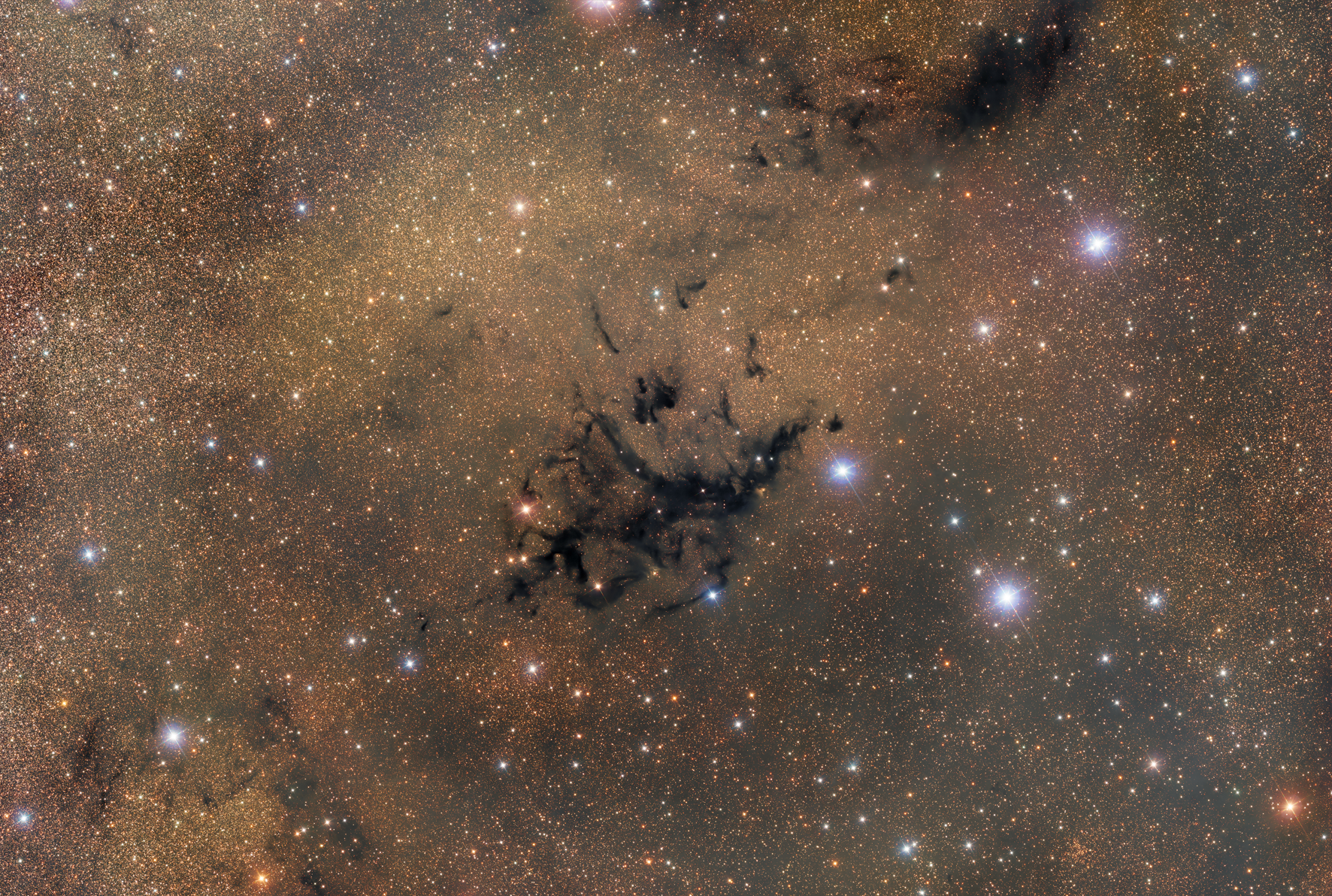
The Dark Clouds of LDN 673
Drifting among the glittering star fields of the Milky Way in Aquila, the dark nebula LDN 673 forms a striking contrast against the golden background of countless distant suns. This dense region of interstellar dust blocks visible starlight, revealing complex, filamentary shapes where gravity is slowly gathering gas into the seeds of future stars.
Captured over 20 hours of RGB integration from a backyard observatory in Eastern Oregon under Bortle 4 skies, this image highlights both the subtle color gradients of the surrounding galactic plane and the haunting opacity of the dark nebula itself. LDN 673 stands as a reminder that even the darkest regions of the night sky are places of quiet creation, silhouetted against the glow of the Milky Way.