

AAPOD2 Image Archives
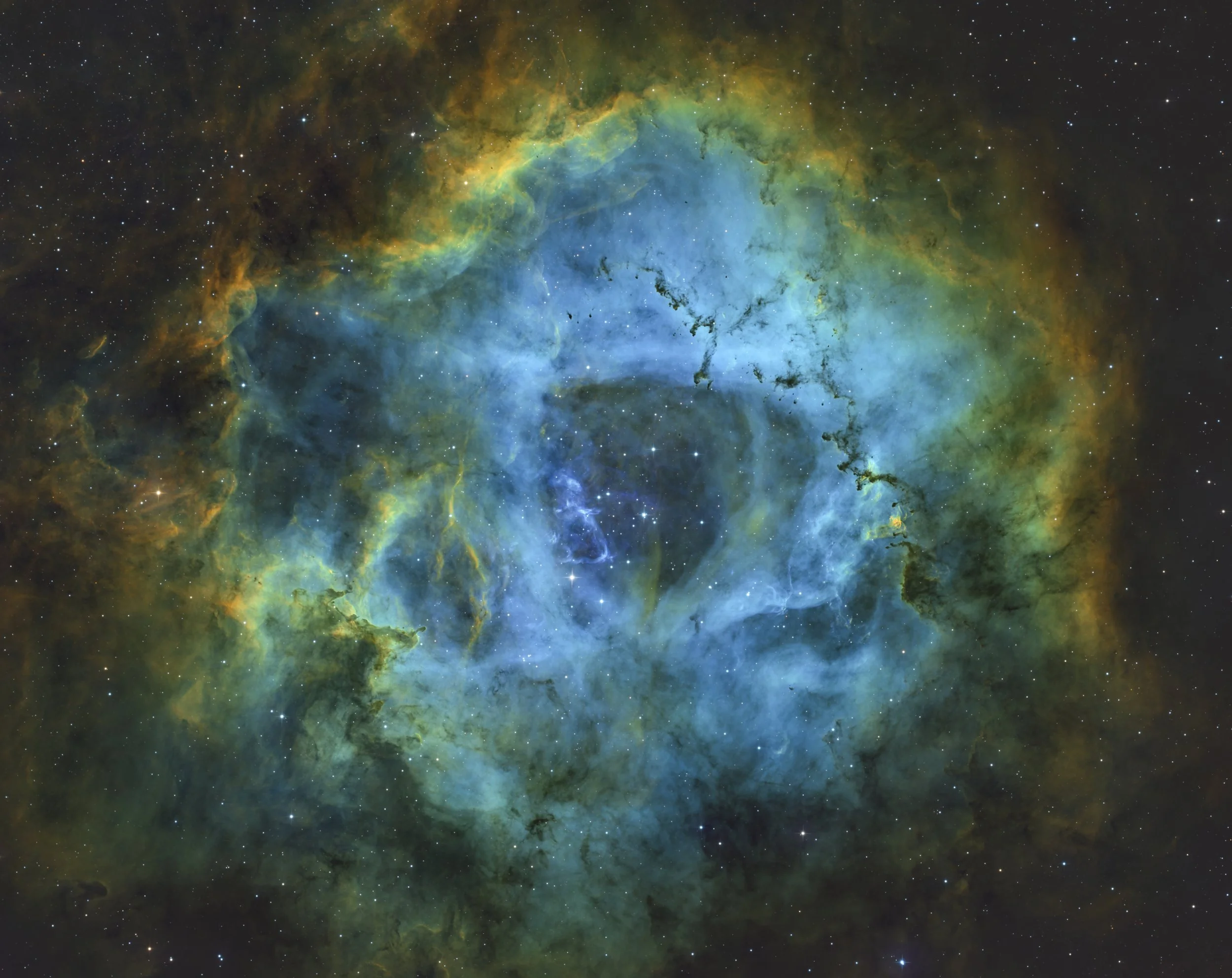
NGC 2237–2246 | The Rosette Nebula in Hubble Palette
The Rosette Nebula is a vast emission nebula located roughly 5,000 light years away in the constellation Monoceros. This image is presented in the popular Hubble SHO color palette, where sulfur, hydrogen, and oxygen emissions are mapped to red, green, and blue tones. At the center lies the young open star cluster NGC 2244, whose massive, hot stars flood the surrounding cloud with ultraviolet radiation, ionizing the gas and giving the nebula its luminous, sculpted appearance.
Powerful stellar winds from these stars have carved an enormous cavity within the nebula, compressing the surrounding gas into ridges, knots, and wispy filaments. These compressed regions are potential sites of future star formation, illustrating how stellar feedback both disrupts and triggers the birth of new stars. The false color palette enhances subtle chemical and structural differences, revealing the Rosette as a dynamic laboratory where gravity, radiation, and gas interact on interstellar scales.