

AAPOD2 Image Archives
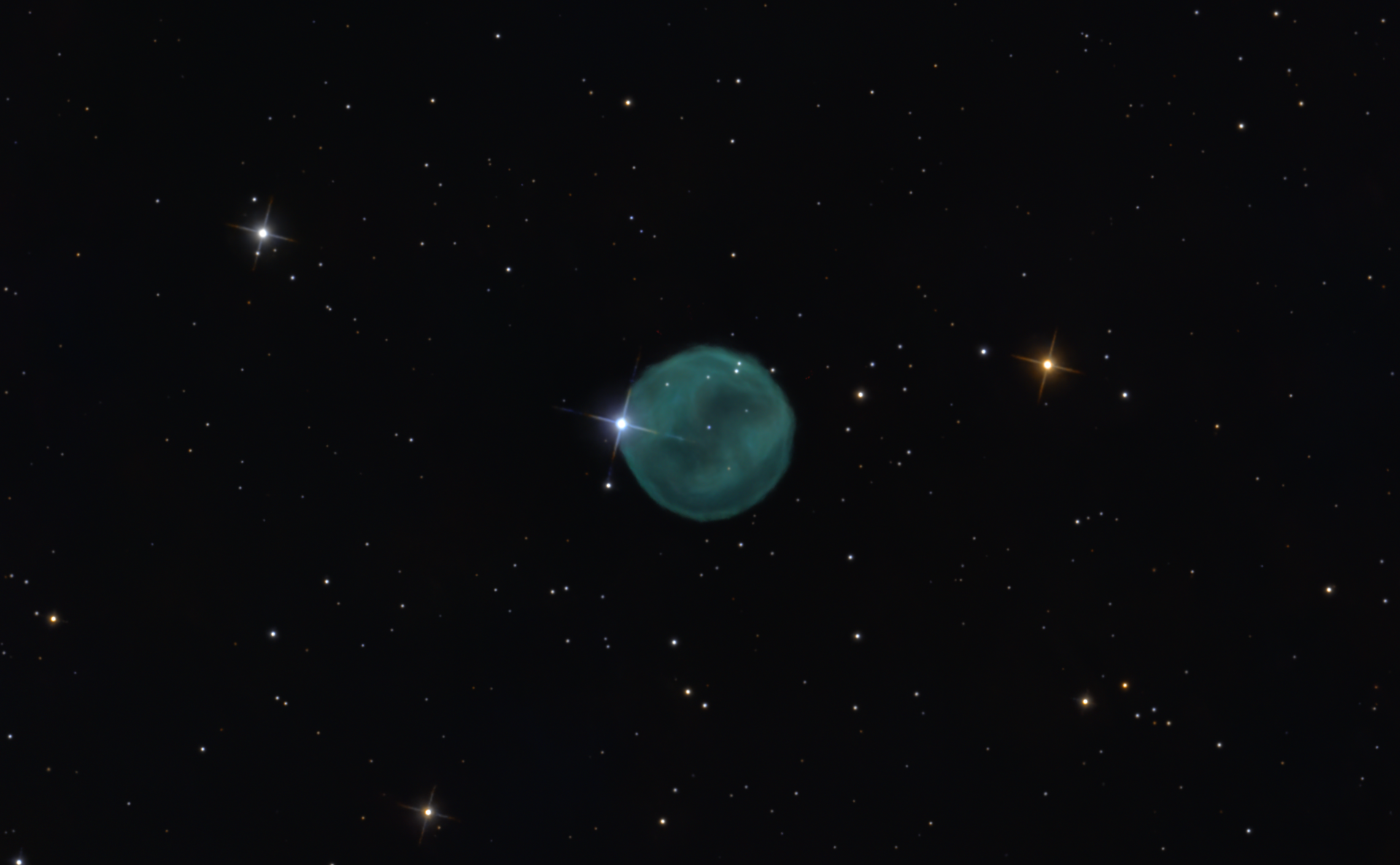
Abell 33: The Diamond Ring Nebula
In the constellation of Hydra lies the delicate planetary nebula Abell 33, a nearly perfect cosmic bubble formed when a Sun-like star shed its outer layers near the end of its life. The expanding shell of ionized oxygen glows with a soft teal hue, giving the nebula its translucent, spherical appearance. Its symmetry suggests a relatively undisturbed evolution, with the gas dispersing evenly into surrounding interstellar space over tens of thousands of years.
The striking “diamond ring” effect is created by the bright foreground star HD 83535, which happens to align almost perfectly along the nebula’s rim. Though unrelated physically, the chance alignment enhances the illusion of a celestial jewel suspended in space. Subtle internal variations within the nebular shell hint at complex stellar winds and layered mass loss from the dying central star, while distant background galaxies faintly pepper the surrounding star field, emphasizing the vast depth of the scene.
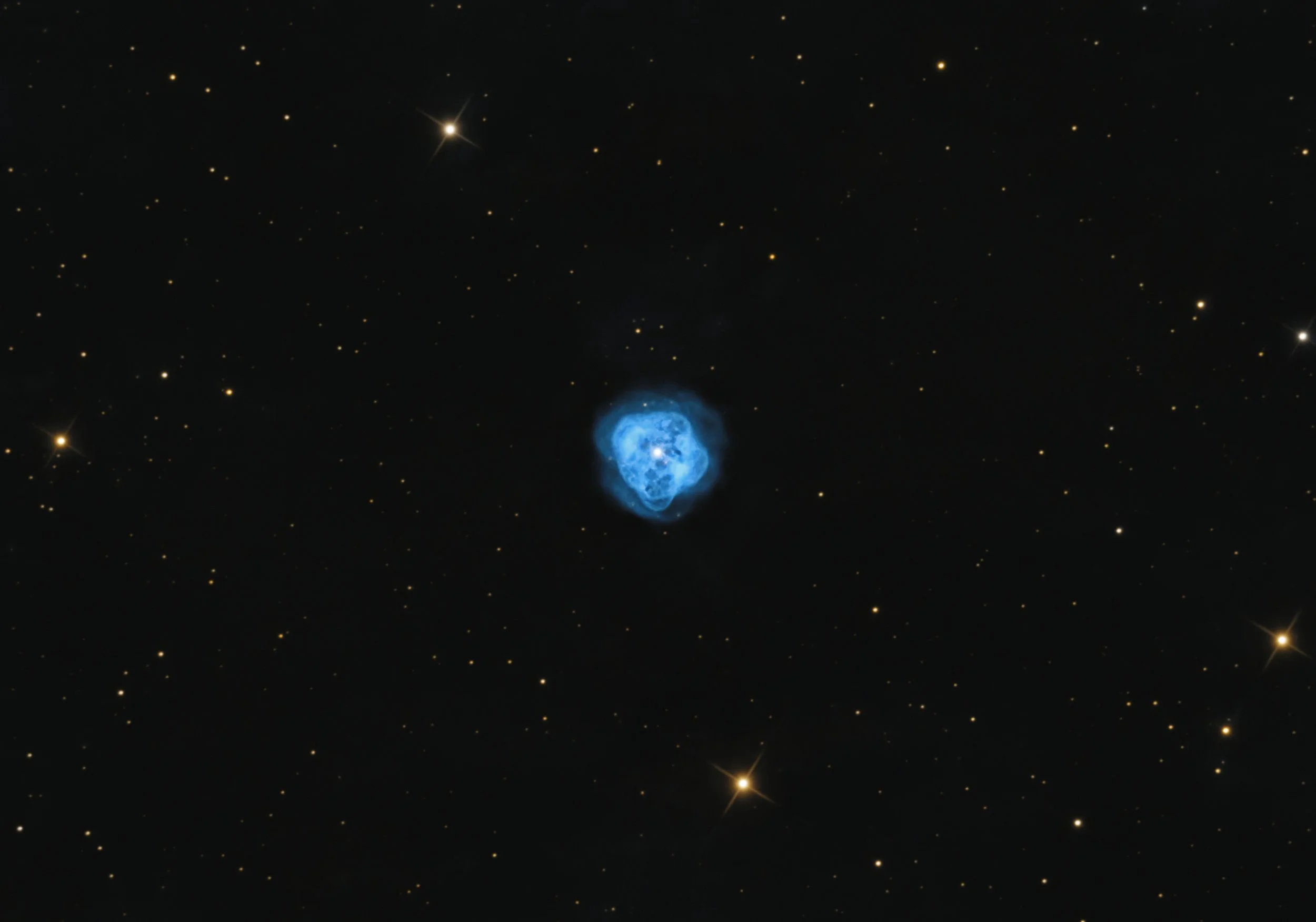
NGC 1514 - Crystal Ball Nebula
NGC 1514, often called the Crystal Ball Nebula, is a planetary nebula in the constellation Taurus, formed when a Sun-like star shed its outer layers near the end of its life. The expanding shell of ionized gas is energized by a hot central star system, causing oxygen-rich regions to glow blue while revealing a complex, layered structure that hints at multiple episodes of mass loss. The nebula lies roughly 1,500 light-years away and spans about two light-years across.
Set against a dense, star-filled background, this view emphasizes the nebula’s translucent appearance and softly contoured edges, giving it a floating, glass-like quality. Captured from New Delhi, India, the image contrasts the delicate, luminous gas with warm-colored field stars, highlighting both the fragile beauty of stellar death and the richness of the surrounding Milky Way.